Staatscourant van het Koninkrijk der Nederlanden
| Datum publicatie | Organisatie | Jaargang en nummer | Rubriek |
|---|---|---|---|
| Nederlandse Organisatie voor Wetenschappelijk Onderzoek | Staatscourant 2022, 24129 | overige overheidsinformatie |

U bent nu hier: Publicaties Officiële publicaties
Zoals vergunningen, bouwplannen en lokale regelgeving.
Adressen en contactpersonen van overheidsorganisaties.
Call Announcement, 2022 Joint Transnational Call “Management of water resources: resilience, adaptation and mitigation to hydroclimatic extreme events and management tools
Joint Transnational Call 2022
Publication Date: 1/09/2022
Pre-proposal deadline: 31/10/2022, h.15.00 CET
|
1. |
Introduction |
1 |
|
|
1.1 |
2022 Joint Transnational Call in the context of Water4All partnership |
1 |
|
|
1.2 |
Objectives of the 2022 Joint Transnational Call |
2 |
|
|
2. |
Joint Transnational Call Description |
3 |
|
|
2.1 |
Strategic aim of the Joint Transnational Call |
3 |
|
|
2.2 |
Theme of the Joint Transnational Call |
3 |
|
|
2.3 |
Expected approach from the proposals |
4 |
|
|
2.4 |
Impact of the proposals |
4 |
|
|
3. |
Call Structure |
5 |
|
|
3.1 |
Participating countries |
5 |
|
|
3.2 |
Financial Commitment |
5 |
|
|
3.3 |
Call Process |
7 |
|
|
3.4 |
Dates and deadlines |
7 |
|
|
3.5 |
Confidentiality & Conflict of interest |
7 |
|
|
3.6 |
Publishable Information |
8 |
|
|
3.7 |
Privacy Policy |
8 |
|
|
4. |
Eligibility criteria |
8 |
|
|
4.1 |
General eligibility criteria |
8 |
|
|
4.2 |
National/regional eligibility criteria |
9 |
|
|
4.3 |
Eligibility of international research institutions |
9 |
|
|
4.4 |
Recommendations for the applicants |
10 |
|
|
4.5 |
Further considerations |
11 |
|
|
4.6 |
Ethical Issues |
11 |
|
|
5. |
Application procedures |
11 |
|
|
5.1 |
Online Submission Tool |
11 |
|
|
6 |
Evaluation of Proposals |
12 |
|
|
6.1 |
Evaluation Procedures |
12 |
|
|
6.2 |
Evaluation Criteria |
14 |
|
|
6.3 |
Scoring System |
14 |
|
|
6.4 |
Funding recommendation |
15 |
|
|
6.5 |
Redress Procedure |
15 |
|
|
7 |
Project funding and reporting |
16 |
|
|
7.1 |
Negotiation of grant agreements |
16 |
|
|
7.2 |
Consortium Agreement |
16 |
|
|
7.3 |
Project Reporting |
16 |
|
|
7.4 |
Dissemination and exploitation |
17 |
|
|
7.5 |
Open Access and Open Data |
17 |
|
|
ANNEX A – GLOSSARY |
18 |
||
|
ANNEX B – USING A THEORY OF CHANGE |
18 |
||
|
ANNEX C – NATIONAL CONTACT POINTS (NCP) AND NATIONAL FUNDING REGULATIONS |
20 |
||
|
ANNEX D – EUROPEAN PARTNERSHIP WATER4ALL – WATER SECURITY FOR THE PLANET |
23 |
||
Funded by the European Union. Views and opinions expressed are however those of the author(s) only and do not necessarily reflect those of the European Union or the European Research Executive Agency. Neither the European Union nor the granting authority can be held responsible for them.
The Water4All partnership is starting in 2022 under the auspices of the European Union Horizon Europe programme for research and innovation, to concentrate research and innovation on water in Europe and beyond. Water4All’s Vision is to “boost the systemic transformations and changes across the entire research – water innovation pipeline, fostering the matchmaking between problem owners and solution providers for ensuring water security for all in the long term”.
Water security stands for the capacity of a population to safeguard sustainable access to adequate quantities of acceptable quality water for sustaining livelihoods, human well-being and socio-economic development, for ensuring protection against water-borne pollution and water-related disasters, and for preserving ecosystems in a climate of peace and political stability. Water security and ‘Just’ access to clean water for all of society are an essential aspect for Sustainable Development. This is reflected specifically in the UN Sustainable Development Goals1 (SDGs), in first instance SDG 6 “Ensure availability and sustainable management of water and sanitation for all”, which is interconnected with SDGs addressing Poverty (1), Hunger (2), Health (3), Clean Energy (7), Cities (11), Responsible Consumption and Production (12), Climate (13), Life below Water (14) and on Land (15), Peace, justice and strong institutions (16).
Reaching Water4All´s objectives require an inclusive and systemic approach, with a logical chain from problem analysis and the identification of knowledge gaps to the uptake of solutions and their concrete applications by the relevant stakeholders. The direct connection between stakeholders and problem owners with solution providers from the RD&I field is required to make decisive contributions towards the objectives of Water security: improved access to water; availability of adequate water supplies for all economic uses; ecosystems health and delivery of ecosystem services; resilience to global changes and water-related hazards. This approach will be implemented through a broad range of activities, aiming together at achieving the following outcomes:
• Deliver sound knowledge, tools and evidence basis on water for policy- & decision-making;
• Improve consideration of water impacts in all relevant policies;
• Enhance the field/market use of innovative solutions to water challenges;
• Increase citizens’ awareness and engagement for an inclusive water governance.
Among its activities to produce these outcomes, Water4All will launch a series of annual Joint Transnational Calls (JTCs) pooling national financial resources through the participation of ministries, authorities and funding organisations. These calls primary aim at strengthening the water RD&I collaboration and producing and sharing top class water-related knowledge and data. The topics for the calls will be drawn from the water challenges identified in the Water4All Strategic Research and Innovation Agenda (SRIA, publication foreseen February 2022; see figure 1).
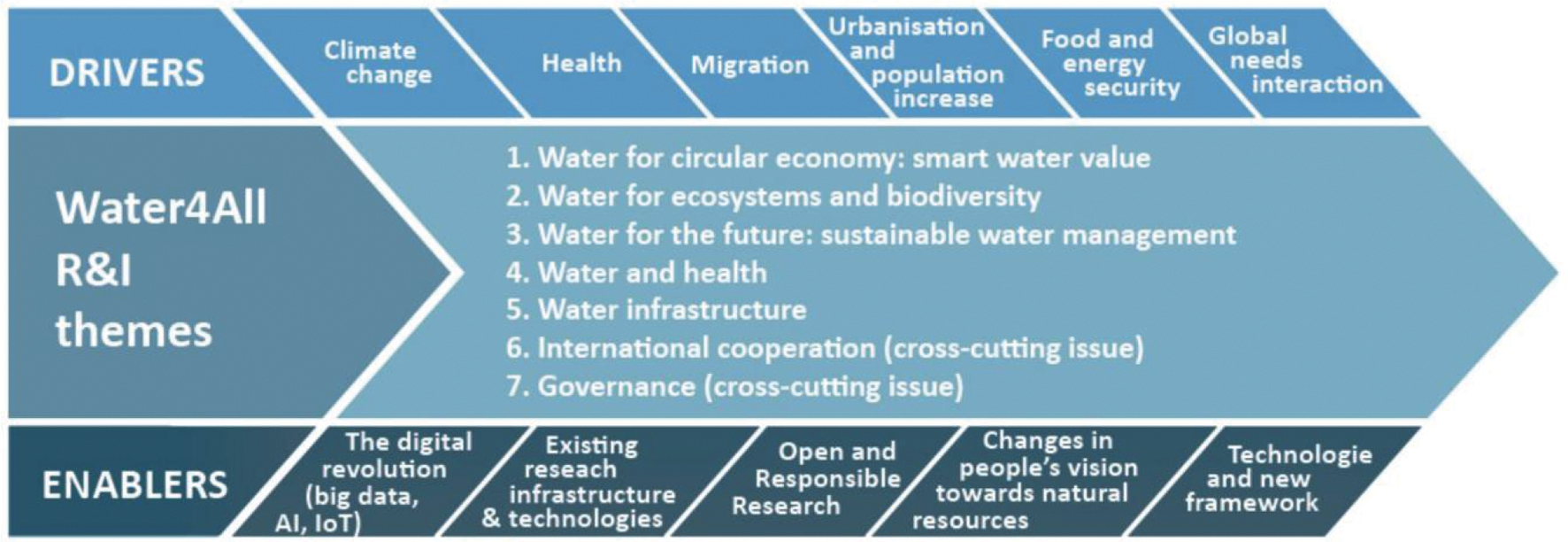
Figure 1 – Water4All RD&I’s themes, drivers and enablers
The 2022 Joint Transnational Call is the first of these calls. It is implemented by 34 research and innovation funding organizations from 29 countries responsible for funding research and innovation actions in the field of water, with the financial support from the European Commission.
The increase in the number of hydrological extreme events in the last few decades2 has motivated the research community to investigate their spatial variability and underlying processes. Evidence suggests that for properly supporting water management and tackling future and emerging challenges, it is necessary to make progress in understanding the spatiotemporal complex systems that drive hydrological events. Approaches for the characterisation of relationships between such complex systems and economic, organisational, policy, social and regulatory conditions need to be developed to bring systemic change.
Water4All’s 2022 Joint Transnational Call will therefore seek to deliver knowledge, models, approaches, tools and methodologies to better understand hydrological processes at different scales and to respond more efficiently to emerging water issues related to extreme events. The results will support the implementation of EU water policies (Green Deal, Water Framework Directive (WFD) and its daughter Directives, etc.) and EU plans and strategies related to water management (e.g., zero pollution action plan, and strategies, EU Biodiversity Strategy for 2030) for resource efficiency and protection, water use and adaptation and resilience to hydroclimatic extreme events.
Governance plays a key role in each of the water challenges, as good governance is a key element in the identification and implementation of the best available measures for people, water and other systems. Therefore, the 2022 Joint Transnational Call will seek for innovative governance models, and enhanced participation of stakeholders, communities and society at large in water management issues related to extreme events. Addressing governance will require participation and engagement of stakeholders in the problem analysis and the identification of relevant knowledge gaps. The co-design of solutions, and the co-management of decisions related to water will require activities in the field of communication, public awareness and education. Direct involvement of stakeholders and citizens in research, e.g., through citizen science, is encouraged.
Attention will be paid in the 2022 Joint Transnational Call to barriers, to the adoption of proposed solutions and to the application of key lessons from other disciplines in the implementation of results. The proposals will be required to describe how results from the research can be applied and which stakeholders should be involved to achieve the desired impact. The broad topic of Management of water resources has received ample attention in previous Horizon 20203, Water JPI4 and PRIMA5 calls, among others, and research and development of tools for supporting related policy in EU-funded projects has been extensive. Proposals must not duplicate past efforts and results. Approaches built on the results of previous projects must demonstrate that they include improved and/or new ideas and approaches. Collaboration with active projects on the topic will be welcomed in order to achieve synergies and avoid duplications. The proposed approaches should focus on regional and river basin level solutions. To demonstrate the feasibility of (scalable) approaches local level cases may be used.
The 2022 Joint Transnational Call “Management of water resources: resilience, adaptation and mitigation to hydroclimatic extreme events and management tools” within the Water4All Partnership is aimed at research and innovation to improve water security in the long term. In line with the strategic objectives of Water4All, the results should contribute to the implementation of evidence-based, global, EU and national water management policies and strategies, within the frameworks of the Green Deal, WFD, Just Transition and the Sustainable Development Goals.
The call will focus on solutions for hydroclimatic extreme events, as described in the Water4All Strategic Research and Innovation Agenda (version 08/02/2021)6 Theme III “Water for the future: sustainable water management”, as well as address the cross-cutting Theme VII “Governance” and Theme V “Water Infrastructures”. Research & innovation proposals submitted under the Water4All 2022 Joint Transnational Call are required to address at least one of the following topics:
Topic 1. Resilience, adaptation and mitigation to hydroclimatic extreme events
1.1 Addressing knowledge gaps in our understanding of the causes of water scarcity, drought events, seasonal variability in climate impacts to develop adaptation and mitigation measures, taking climate change into account.
1.2 Developing and demonstrating innovative (or improved) societally acceptable adaptation and mitigation strategies to cope with hydro-climatic extreme events and their increase in length and duration. This includes floods and droughts, although is not limited to them, adopting a regional or a basin scale wide approach.
1.3 Improving resilience and adaptation capacity of water infrastructure (e.g., industrial water facilities, urban networks, wastewater treatment facilities, stormwater management systems and rural systems) to hydroclimatic extreme events.
Topic 2. Tools for water management – in the context of hydroclimatic extreme events
2.1 Developing tools (e.g., multi-risk approach, decision support tools, monetary/non-monetary costs valuation) to support the design and implementation of strategies for adaptation and mitigation to hydro-climatic extreme events, especially floods (including “flash-floods”), heat waves and droughts in a catchment to sea perspective.
2.2 Generating new methodologies, tools and models for water resources assessment/modelling for water bodies in scarcely monitored /data scarce areas. A combination of physical and digital solutions is expected, and opportunities provided by citizen science should be seized.
2.3 “Smartening the water system” and use of innovative digitalization, including improved/new sensors, models, communications and computing technologies.
Topic 3. Improved water governance in the context hydroclimatic extreme events and international contexts
3.1 Undertaking an analysis and developing robust Governance models for the management of water resources in the context of extreme events, is critical increasing the decision-making capacity of institutions and involvement of citizens. This should include ways of improving coordination between water managers to increase our capacity to reduce vulnerability to extreme events, as well as effectively respond to them.
3.2 Addressing and encouraging international cooperation in the field of water, including management of transboundary water resources and contribution to Water Diplomacy.
It should be noted that within the area of water governance there is an extensive framework already set by the OECD Principles on Water Governance. This framework could be used as a starting point for preparing project proposals.
Please note:
• The effects of hydroclimatic extreme events can relate to both water quality and/or quantity.
• It is not compulsory to address all subtopics within a topic in the proposals.
• It is possible to submit comprehensive proposals addressing more than one topic and subtopic.
• ANNEX C – NATIONAL CONTACT POINTS (NCP) AND NATIONAL FUNDING REGULATIONS of this document provide a matrix of the topics funded by each participating country/region and the national regulations.
The proposals can focus on the development of new knowledge through basic research and/or the implementation of solutions and tools. In all cases, knowledge transfer and impact of the deliverables must be clearly demonstrated. Delivered new knowledge should have the potential to be used in new and improved options and tools for governance, management and evidence-based policy making. Problems related to hydroclimatic extreme events to be tackled can be both related to water quality and quantity. Both surface and groundwater can be included.
Applicants are invited to look at systemic processes of planning, control and management of water resources within the river basin in the face of climate change and extreme events. The proposals are also expected to contribute to the acceleration of the adoption of measures and to connect actors in management to improve coordination, thus increasing capacity to reduce vulnerability to extreme events and effectively respond to them. This should include an evaluation of effectiveness of current mitigation and adaptation measures and/or to what extent improvements are being offset by increased extreme events.
The proposals should help to develop a better understanding of the socio-economic aspects, governance and behavioural changes associated with the impact of extreme events on water resources and people. Thus, strengthening socio-economic approaches to protect and restore water resources, covering governance issues, such as public participation and tools to transfer the scientific knowledge into decision-making and facilitating / supporting "just transition for all" should be included. This may include developing new participatory approaches and tools for water management and systemic change, e.g., co-creation and co-production, integration of different kinds of knowledge (indigenous, local and technology), increased participation from underrepresented groups, novel ICT tools, etc.
In line with the European Commission’s (EC) aims for Horizon Europe to create significant societal and environmental impact proposals will be required to describe what impact their research is expected to achieve in the long run and how they contribute to the overall impacts defined for this call:
• Improved water availability and optimisation of water quality and quantity for all uses in Europe, while maintaining ecosystems needs.
• Improved resilience of European populations to water-related hazards, extreme events and climate change.
• Supporting the implementation of the UN SDGs and ensuring a Just Transition for all.
Credible societal impact will require input from stakeholders when formulating the knowledge gaps to be addressed in the proposal (co-design) and actively working together on the project with those stakeholders while exchanging knowledge (co-creation). Diversity of stakeholders, spanning the entire research and innovation chain, is important to accurately describe the problem and to best implement the results, e.g., representatives from water agencies, the business and financial sectors, water authorities, NGOs, ministries, academia, citizens etc. Consortia should also crosscut scientific disciplinary boundaries (multi- or interdisciplinarity), combining exact sciences with social sciences and humanities.
Applicants are highly encouraged to use a “Theory of Change” to help define their project, both for analysis of the problem to be addressed and to indicate via what route the expected results of the project could eventually lead to societal impact. In ANNEX B – USING A THEORY OF CHANGE” more information on using a Theory of Change can be found, including a link to an online workshop applicants can use.
A total of 34 Funding Partner Organisations (FPOs) from 29 countries have agreed to launch a Joint Transnational Call for RD&I proposals on the topic “Management of water resources: resilience, adaptation and mitigation to hydroclimatic extreme events and management tools”.
The research teams applying for funding shall comply with national regulation of the related FPO in the Water4All consortium listed in ANNEX C – NATIONAL CONTACT POINTS (NCP) AND NATIONAL FUNDING REGULATIONS. The participation of applicants from other countries is allowed, if they have their own separate source of funding or if funds by another source are guaranteed (i.e., by a national or international funding organisation). In this case, the commitment of these partners must be provided upon submitting the full proposal.
For more information on eligibility of international research institutions please see chapter 4.3 Eligibility of international research institutions.
Applicants should note that, in some countries, several funding organisations participate in the call with different organisational rules and priorities. Applicants must pay attention to the national regulations and if questions arise, it is highly recommended to contact the NCPs before submitting a pre-proposal and full proposal.
A total of approx. 34 million has been provisionally allocated for this Joint Transnational Call by the participating FPOs with the support of the EU (Table 1). These funds will be used for RD&I activities carried out by researchers, institutions and companies according to the funding rules and legal frameworks of their respective FPOs.
Partners applying in a consortium cannot request more than their relevant FPO stated in the national/regional regulations annexes to this Call Announcement.
|
Country |
Funding Partner Organisation |
National budget (tentative) |
||
|---|---|---|---|---|
|
1 |
Austria |
Fonds zur Förderung der wissenschaftlichen Forschung |
FWF |
700.000,00 |
|
2 |
Belgium |
Agentschap Innoveren & Ondernemen |
VLAIO |
800.000,00 |
|
3 |
Belgium |
Fonds Voor Wetenschappelijk Onderzoek-Vlaanderen |
FWO |
700.000,00 |
|
4 |
Belgium |
Fonds de la Recherche Scientifique |
F.R.S.-FNRS |
300.000,00 |
|
5 |
Brazil |
Brazilian National Council of State Funding Agencies |
CONFAP |
863.400,00 |
|
6 |
Brazil |
Brazilian National Council for Scientific and Technological Development |
CNPq |
100.000,00 |
|
7 |
Czechia |
Technology Agency of the Czech Republic |
TA CR |
700.000,00 |
|
8 |
Denmark |
Innovation Fund Denmark |
IFD |
1.000.000,00 |
|
9 |
Estonia |
Sihtasutus Eesti Teadusagentuur |
ETAg |
150.000,00 |
|
10 |
France |
Agence Nationale de la Recherche |
ANR |
1.700.000,00 |
|
11 |
Germany |
Federal Ministry of Education and Research |
BMBF |
1.000.000,00 |
|
12 |
Hungary |
Nemzeti Kutatási, Fejlesztési és Innovációs Hivatal |
NKFIH |
330.000,00 |
|
13 |
Ireland |
Environmental Protection Agency of Ireland |
EPA |
500.000,00 |
|
14 |
Italy |
Ministero dell’Università e della Ricerca |
MUR |
2.700.000,00 |
|
15 |
Italy |
Ministero dello Sviluppo Economico |
MISE |
3.000.000,00 |
|
16 |
Israel |
Ministry of Energy |
MoE |
400.000,00 |
|
17 |
Latvia |
Latvijas Zinatnes padome |
LZP |
500.000,00 |
|
18 |
Lithuania |
Lietuvos mokslo taryba |
LMT |
150.000,00 |
|
19 |
Luxembourg |
Luxembourg National Research Fund |
FNR |
350.000,00 |
|
20 |
Malta |
Ministry for Environment, Energy and Enterprise |
MEEE |
300.000,00 |
|
21 |
Moldova |
National Agency for Research and Development |
NARD |
100.000,00 |
|
22 |
Netherlands |
Dutch Research Council |
NWO |
1.128.000,00 |
|
23 |
Norway |
Research Council of Norway |
RCN |
1.000.000,00 |
|
24 |
Poland |
Narodowe Centrum Badań i Rozwoju |
NCBR |
1.000.000,00 |
|
25 |
Portugal |
Fundação para a Ciência e a Tecnologia |
FCT |
500.000,00 |
|
26 |
Romania |
The Executive Agency for Higher Education, Research, Development and Innovation Funding |
UEFISCDI |
1.000.000,00 |
|
27 |
Slovak Republic |
Slovak Academy of Sciences |
SAS |
240.000,00 |
|
28 |
South Africa |
Water Research Commission |
WRC and DSI |
90.000,00 |
|
29 |
Spain |
Agencia Estatal de Investigación |
AEI |
1.500.000,00 |
|
30 |
Spain |
Centre for the Development of Industrial Technology |
CDTI |
1.200.000,00 |
|
31 |
Sweden |
The Swedish Research Council for Environment, Agricultural Sciences and Spatial Planning |
FORMAS |
2.000.000,00 |
|
32 |
Switzerland |
Swiss National Science Foundation |
SNSF |
900.000,00 |
|
33 |
Turkey |
Turkiye Bilimsel Ve Teknolojik Arastirma Kurumu |
TUBITAK |
500.000,00 |
|
34 |
United Kingdom |
Engineering and Physical Sciences Research Council |
EPSRC UKRI |
299.546 |
|
Estimated EU funding |
6.476.023,20 |
|||
|
Total in Euro |
||||
|
34.176.969,20 |
||||
|
EU member states and Associated countries |
Third countries and other countries |
The Joint Transnational Call will be advertised online from the following web pages: Online Submission Tool: https://water4all2022-submission.mur.gov.it
Web sites: www.water4all-partnership.eu
As well as on the FPOs web pages and on the EC Funding & Tenders portal. The application process consists of two consecutive steps:
STEP 1
The Consortium Coordinator must submit a pre-proposal on behalf of the consortium, providing key data on the proposed project. The deadline for the submission of the pre-proposal is 31/10/2022, 15.00 CET (Rome time).
STEP 2
The Consortium Coordinator must submit a full proposal on behalf of the consortium. The deadline for full proposal submission is 20/03/2023, 15.00 CET (Rome time). Deadline to be confirmed after Step 1.
ANNEX of this document provide the contact information of the NCPs in each participating country/region. It is required that each partner in a consortium checks their national/regional eligibility regulations. He/she should contact their NCP(s) to be informed about the rules in his/her country/region prior to submission of a pre-proposal and a full proposal.
|
Time Schedule of the Call 2022 |
|
|---|---|
|
First Step: Submission of pre-proposals |
|
|
30 June 2022 |
Pre-announcement |
|
1 Sept. 2022 |
Call Publication 1st Step |
|
31 Oct. 2022 |
Deadline for submission of the pre-proposals |
|
2 – 30 Nov. 2022 |
General and National eligibility checks by the CS and FPOs |
|
5 Dec. 2022 |
2nd CSC Meeting-Eligibility Check Validation |
|
6 Dec. 2022 – 18 Jan. 2023 |
Scientific evaluation by remote evaluators |
|
19 Jan. 2023 |
4th meeting CSC – Selection pre-proposals for the second step |
|
20 Jan. 2023 |
Notification to the applicants of the 1st step outcomes |
|
20 Jan. – 2 Feb. 2023 |
Period for appeal |
|
3 Feb. – 16 Feb. 2023 |
Evaluation of the appeals received and communication of decisions to the applicants |
|
Second Step: Submission of full proposals |
|
|
20 Jan. 2023 |
2nd step opening |
|
20 Mar. 2023 |
Deadline submission of the full proposals |
|
21 – 27 Mar. 2023 |
Eligibility check of full proposals by Call Secretariat |
|
28 Mar. – 12 May 2023 |
Individual evaluation of full proposals |
|
15 May – 29 May 2023 |
Draft Evaluation Summary Reports by rapporteurs |
|
31 May – 1 Jun. 2023 |
Evaluation Panel Meeting – Ranking list |
|
5 Jun. 2023 |
Meeting CSC for selection of proposals recommended for funding |
|
6 Jun. 2023 |
Notification to the applicants of the 2nd step outcomes |
|
6 – 20 Jun 2023 |
Period for appeal |
|
20 Jun. 2023 – 4 Jul. 2023 |
Evaluation of the appeals received and communication of decisions to the applicants |
|
5/6 Jul. 2023 |
Final approval of the proposals recommended for funding |
|
Last quarter 2023 / 1st quarter 2024 |
Start of the RD&I projects |
|
Last quarter 2026 / 1st quarter 2027 |
End of the RD&I projects |
|
Reporting of the RD&I projects |
|
Research plans (pre-proposals and full-proposals), abstracts, and evaluation statements are confidential documents. Proposal documents are therefore handled and stored with due care and confidentiality.
Water4All consortium and its Call Secretariat ensure complete confidentiality to applicants during the evaluation process, i.e., the proposals will only be available to the national/regional funding organisations and the mandated experts responsible for the evaluation of the proposal. Experts appointed for the evaluation will sign a confidentiality agreement and will be asked to declare any conflict of interest. The proposals will be handled by the Water4all Call Secretariat. Each of the funding organizations will subsequently handle projects approved for funding. Accordingly, national law will govern. Projects approved for funding will be governed by the confidentiality rules in the national law of the participating funding organisations.
The publishable information of the projects selected for funding, as listed in below section 3.6 will be published at the end of the call process.
A list of the funded projects will be published at the end of the call process (once the projects have been selected). Therefore, applicants should be aware that the following information from the proposals may be published by Water4All and FPOs for promotional purposes: (1) Project Title and Project Acronym, (2) Publishable abstract, (3) Duration of the project, (4) Total costs and total funding of the research project, (5) Organisation name and country of each partner, (5) Name of the Project Coordinator.
Each of the funding organizations will subsequently handle projects approved for funding. Accordingly, national law will govern. Projects approved for funding will be governed by the confidentiality rules in the national law of the funding organisations.
By submitting the application, the Consortium Coordinator and partners agree to the use, to the share (for specific purposes: e.g., evaluation, for future nomination of experts, Water4all specific communication) and to the storage of projects related information according to the Privacy Policy and the General Data Protection Regulation (GDPR). Further information on Privacy Policy 7 is presented on the Online Submission Tool
Partners should note that the general eligibility criteria (§ 4.1) and the national regulations (§ 4.2) are decisive for the evaluation of project proposal at first and second steps.
Proposals, which do not meet all 2022 Joint Transnational Call general eligibility criteria, will be declined without further review.
Non-eligibility of a partner applying for funding may cause the rejection of the entire proposal without further review. Therefore, before submitting an application, the Consortium Coordinator should verify that all partners of the consortium have read their corresponding national/regional regulations. Coordinators and project partners must be aware that some national funding agencies require the submission of national documents in addition to the international pre-proposal.
Proposals passing the general and national eligibility checks will be forwarded to the evaluators for assessment. The Call Secretariat (CS), on behalf of the Call Steering Committee (CSC), will communicate the results of the eligibility check and the decisions taken to the coordinator of each consortium.
Eligibility of Water4All Partnership beneficiaries
Research teams from some beneficiaries of Water4All Partnership may exceptionally participate to this co-funded call; the list of the beneficiaries of Water4All Partnership and those allowed to participate in the projects’ consortia are indicated in ANNEX D – EUROPEAN PARTNERSHIP WATER4ALL – WATER SECURITY FOR THE PLANET. For those beneficiaries, measures have been foreseen to mitigate the risk of, perception of, or de facto conflict of interest or unequal treatment of applicants. All other beneficiaries of Water4All partnership may not apply for funding under the co-funded call for proposals.
The general eligibility criteria are summarized in Table 2. In case of not fulfilling these requirements, the proposal will not be considered for funding.
Table 2: General Eligibility Criteria
|
Scope |
• Proposals must address at least one main topic, even though it is not compulsory to address all subtopics within a topic in the proposals. |
|
Consortium composition |
General Consortium composition: • Each consortium must be composed of at least a minimum of three eligible partners that request funding from participating Funding Partner Organisations from three different countries. • In addition to the abovementioned condition, the projects must involve at least two independent legal entities from two different EU Member States or Horizon Europe associated countries as recipients of the financial support. • The upper limit of eligible project partners per consortium is 7 (including 1 self-funded partner). |
|
• The maximum number of partners from the same country within the consortium must comply with national/regional regulations. • For proposals involving up to 5 partners, maximum two entities that are also involved in the Water4all partnership (listed in ANNEX D) may participate in the same proposal. Larger proposals may involve up to three entities that are also involved in the Water4all partnership (listed in ANNEX D). |
|
|
Consortium Coordinator: • In each proposal, one of the entities must act as the Consortium Coordinator which has the responsibility for submitting the proposal. • The Consortium Coordinator must be eligible for funding by a Funding Partner Organisation (FPO) of this call. • The P.I. of the entity acting as Consortium Coordinator can only participate in one proposal (i.e. if the principal investigator is the Consortium Coordinator of a proposal, he/she cannot participate in any other proposal, neither as a Consortium Coordinator nor as Principal Investigator of a partner). |
|
|
Workload: • The workload distribution within a consortium must be balanced, and no partner (including a self-funded partner) should have more than 50% of person months. • Partners from the same country shall not have, altogether, more than 50% of person months |
|
|
Partners not requiring funding: • No more than one self-funded project partner per consortium is allowed. • The applicants have to prove their willingness to self-fund their own activities or the willingness of other partners to fund their activities by sending a letter of intent/commitment together with the full proposal. • They have to follow the rules given in this Call Announcement and have to be part of the project consortium agreement. • A self-funded partner cannot coordinate a project. • They are not considered in the minimum requirement of eligible partners and countries in the Water4All eligibility criteria • They are counted for the requirement of the maximum number of partners in a project. |
|
|
Duration |
• The international RD&I projects duration should be 36 months. • Start date and end date of the researcher groups within the consortium must be aligned as far as possible. |
|
Submission |
• Pre-proposals and Full Proposals must be received before the deadlines. • The pre-proposal and the full proposal must be submitted correctly and completely via the Online Submission Tool (https://water4all2022-submission.mur.gov.it) according to chapter 5. Application procedures and the Guidelines for Proposal Submission (published on the Submission Tool website). • Proposals must be written in English. |
In addition to the general eligibility criteria, each project partner must ensure that his/her contribution to the overall project conforms to:
• Where applicable, relevance of the proposal to the topic(s)/subtopic(s) funded by national/regional FPOs
• Compliance with national/regional funding criteria and regulations as reported in the document “National/Regional Regulations” available in the 2022 Joint Transnational Call website and/or on the FPOs’ website;
• Compliance with limits to budget requests.
• Where requested by the national funding organization, submission of additional national documents in accordance with national rules.
The table in ANNEX C – NATIONAL CONTACT POINTS (NCP) AND NATIONAL FUNDING REGULATIONS describes important restrictions related to each national/regional regulation.
The following eligibility rules count for international research institutions:
• The Joint Research Centre (JRC) can participate in a proposal as a partner. Coordinating the proposal is not possible, since they do not “belong” to any FPO country. They will have to participate at their own expenses. They will not count in the "three different eligible entities" rule from three different FPO countries for eligibility purposes. The formal signed letter of availability of funds should be included in the full proposal as an Annex.
• Partners from countries not participating in the Call may join consortia only as partners (not as coordinator). Participation will be at the institutions' own expense. Moreover, such partners will have to demonstrate that they will achieve the related tasks in the proposal. The formal signed letter of availability of funds should be included in the full proposal as an Annex.
• International institutions, e.g. UN institutions, need to investigate their respective national eligibility guidelines for national and/or global funding and make sure they would be able to fulfil the duties of funded projects (i.e. signature of consortium agreement).
All partners within a consortium should take into consideration the following recommendations for setting up their project proposals:
Scope
• Proposals should go beyond the state of the art by providing high quality RD&I and, when appropriate, make use of innovative technologies, approaches and concepts to do so;
• Proposals should consider on-going research activities funded by other instruments, programmes or projects. Cooperation with these activities is of high importance;
• Proposals should consider and incorporate appropriate cross-cutting issues, such as socio-economic and/or capacity development.
Consortium composition
• All proposals are encouraged to consider geographical balance and implementation in appropriate geographic settings and according to the objectives of the proposal, including in low- and middle-income countries/regions, and less performing countries
• Participants with the role of project partners can participate in more than one proposal.
• Participation of legal entities from countries (and/or regions) not participating in the call, at the entities’ own expense, is welcome
• Project partners that are not eligible for funding may participate at their own expense or if they have their own separate source of funding. They have to comply with requirements sets out in Table 1 for partners not requiring funds.
• It is encouraged but not compulsory to involve stakeholders (i.e., small and medium enterprises (SMEs), industries, authorities, public administrations, associations, as well as civil society organisations) as partners or self-funded partners. The modalities of participation of stakeholders are defined in the national regulations.
• All proposals should integrate the gender dimension 8 of RD&I activities.
• Every partner in a proposal, including a self-funded partner, needs a Participant Identification Code (PIC) from the EC to be included in the submission. The applicants have to check their PIC or ask for the creation of a PIC well in advance of the submission9.
Budget
• There is no specific limit of total budget for proposals
• The requested total budget of proposals is only limited by the number of eligible partners and by the budget of each partner. Please consider the national regulations of each FPO with regard to the specific budget limitations.
Duration
Duration of the RD&I projects should be 36 months. Funded consortia will be asked to agree on a common starting date, to be set in the last quarter of 2023/first quarter of 2024.
Applicants should also take into consideration the following advice:
• All Partners and the Consortium Coordinator must comply with the applicable national and EU rules and legal provisions, for instance about competition and EU State aid rules, environment, utilisation of genetic resources, equal opportunity and gender, and public contracting whenever applicable.
• Plan and complete the application process as soon as possible to avoid an overload of the system near the deadline and ensure the support by the CS or the NCPs in case of need.
• The financial plan and allocation of resources (table available in the electronic submission system and filled in by the Consortium Coordinator following the instructions given by all Partners) should be coherent with the work plan proposed. Funding requests which are not adequately justified may affect the evaluation score given to the proposal.
Ethical issues are taken into account in the scientific evaluation of proposals and when making the funding recommendation. Applicants should always describe any relevant ethical aspects in their research plans. If a research permit or a statement by an ethics committee is required for the implementation of the project, applicants should provide information on the permits or permit proposals.
Any proposal which seems to contravene fundamental ethical principles will not be selected and may be excluded from the evaluation and selection procedure. Judgment of the significance of ethical issues will be made by using the criteria published by the Commission in its guidelines on How to Complete your Ethics Self-Assessment10.
A two-step application procedure will be used in this Joint Transnational Call. Pre-proposals and full proposals must be submitted electronically via a specifically designed web platform, the Online Submission Tool, using the templates provided.
Applicants should note that the online system may experience high traffic volumes in the last hours before the submission deadline and it is therefore highly recommended to submit the final version of the pre / full-proposal well in advance of the deadline to avoid any last-minute technical problems. Requests for extensions of the deadline due to last minute technical problems will not be considered.
The Online Submission Tool is available at the following address: https://water4all2022-submission.mur.gov.it
Step 1 (Pre-proposal stage)
1. The Consortium Coordinator creates an account on the JTC2022 Online Submission Tool.
2. The coordinator can enter, edit and save the electronic forms, add partners to the consortium, upload the project description and submit the proposal. Partners can enter and edit their own data only.
3. It is possible to update and submit as many times as necessary the pre-proposal until the submission deadline (31/10/2022, 15:00 CET).
4. Applicants should note that core data are fixed at this stage. In particular, the funding requested by each partner cannot be increased in the second stage.
The submission of a pre-proposal is mandatory. It is not possible to enter the application procedure at a later stage. The information given in the pre-proposal will be used to check for eligibility and to evaluate the pre-proposal.
For any technical questions regarding the submission, please contact the Wate4All Call Secretariat (water4all2022_callsecretariat@mur.gov.it).
Please note, that some of the partners will also need to submit an application directly to their respective national/regional FPOs. For further details about these procedures and schedule, please consult the national/regional regulations and/or your NCP.
Step 2 (Full proposal stage)
The second step of the application consists of the submission of a more extensive full proposal. Only research consortia which successfully passed the first step will be invited to submit a full proposal.
All rules mentioned in the pre-proposal stage apply for this stage as well.
Below the steps are described that need to be considered by the Consortium Coordinator and the project partners for the submission of the full proposal:
1. The Online Submission Tool will be open for invited consortia.
2. The information provided in the pre-proposal will be automatically imported into the full proposal.
3. The coordinator can enter, edit and save all new information according to the guidelines of the full proposal in the submission tool.
4. It is possible to update and submit as many times as necessary the full proposal until the submission deadline (20/03/2023, 15:00 CET).
Applicants should note that information on the core data (e.g., funding requested or institutions) cannot be changed in full proposals, unless explicitly requested by evaluators, by a funding organisation or by the CSC.
Please note that the information given in the pre-proposals is binding. No major changes regarding the proposals’ content will be allowed by the Call Steering Committee (CSC) between the pre-proposals and full proposals.
Regarding the administrative details, a limited number of changes may be allowed, provided they are in line with the general rules of the call and the rules of the Funding Partner Organisations (FPO). Participant shall contact the call secretariat via e-mail and their FPO via the contacts reported in ANNEX C – NATIONAL CONTACT POINTS (NCP) AND NATIONAL FUNDING REGULATIONS in order to inform them about their willingness to modify the project proposal. Requests for changes shall be assessed and allowed by all the FPOs involved in the proposal.
Minor change of budget must be allowed by the relevant FPO.
Changes in the consortium composition:
No changes of coordinator (i.e., Principal Investigator) will be allowed, except in case of force majeure. A request of change of coordinator must be submitted to the Call Secretariat, at least one week before the deadline for submitting full proposals and it will be discussed on a case-by-case basis by the CSC.
Changes in the consortium composition are allowed (maximum 2 changes of Project Partners in proposals with more than 5 partners; maximum 1 change of project partner in proposals with 5 or less partners), provided approval by the concerned Funding Organisations. Please note that the following actions are considered as changes: addition, removal or replacement of a Partner (incl. subcontracted and self-financed partners). Please note that the maximum number of changes applies to “Partner”, i.e., the independent legal entity participating in the Transnational RD&I project
When applying, keep in mind that the submission system will close at 15:00 CET of the deadline date established for both Step 1 and Step 2. However, the CS can only ensure responses to email support requests up to 13:00 CET. The respective email contacts by the CS and NCPs are listed in this document (ANNEX C – NATIONAL CONTACT POINTS (NCP) AND NATIONAL FUNDING REGULATIONS).
Step 1 (Pre-proposal stage)
Pre-proposals that are submitted correctly and within the deadline will be checked for eligibility by the Call Secretariat against criteria defined in chapter Online Submission Tool 4. Eligibility criteria and by the FPOs according to their national/regional criteria (see national regulations).
All eligible pre-proposals will be subject to a scientific evaluation by at least three remote evaluators based on two criteria – ‘Excellence’ and ‘Impact’ (see Table 3). The CS will check that no Conflict of Interest exists concerning the proposals evaluated. A ranking list of pre-proposals will be produced, including only pre-proposals that meet the minimum threshold, i.e., 3 out of 5 in each criterion. The final score will be calculated firstly by reckoning the average of the scores given by the Remote Evaluators for each criterion, rounded to the closest integer value, and, afterwards, summing up the average scores of the two criteria.
The objective of this first step is to identify the best proposals to proceed to Step 2 and to ensure balance between requested and available funds at the national level. The eligible pre-proposals will be divided in 3 groups, according to their scores: Group A (highest evaluation scores), Group B (medium evaluation scores) and Group C (low evaluation scores). All pre-proposals in Group A, if funds available, will be invited to STEP-2.
Among the pre-proposals in Group B, proposals will be selected to Step 2, taking into account the ranking list, the representativeness of all FPOs and the funding ratio limits. Pre-proposals in Group C will be dismissed for their low classification and unavailability of funding.
Consortium Coordinators will be informed of the outcomes by the Water4All Call Secretariat and, if appropriate, invited to submit a full proposal.
Step 2 (Full proposal stage)
After the submission deadline for full proposals, the submitted full proposals will be checked to ensure that they meet the formal call criteria and have not changed substantially from the respective pre-proposals. Full proposals not meeting the formal conditions will be rejected without further review.
All full proposals will be subject to a remote scientific evaluation by at least three remote evaluators based on three criteria – ‘Excellence’, ‘Impact’ and ‘Quality and Efficiency of Implementation’.
The CS will produce a preliminary ranking list of the full proposals based on scores calculated with the same methodology used for pre-proposals in STEP 1 (first averaging the scores per criterion rounded to the closest integer value and, afterwards, summing up the averages).
Each proposal will then be reviewed by the Evaluation Panel (EP), taking into account the results of the remote evaluation. The Evaluation Panel will be composed by an adequate number of experts independent of any funding organisation involved in this call and the CSC will check that no Conflict of Interest exists concerning the proposals evaluated.
The EP will be headed by a Chair. The Panel Chair will be a regular member of the panel with the added duties of moderating the panel meeting and conveying the results of the discussions to the CSC.
For each proposal, one of the EP members will be nominated as a rapporteur and another two as evaluators. They have to assess the proposal and the remote evaluations in advance of the meeting and prepare a draft common Evaluation Summary Report (ESR). During the Panel Meeting the evaluation results for each full proposal will be presented by the rapporteur and can be discussed by the Panel members.
The EP meeting will complete the evaluation procedure, agreeing the final individual score for each criterion, which shall be an integer value, and the overall score for each proposal. Due to the large number of proposals to be evaluated, the EP could decide to focus on those proposals that report divergent scores from the remote evaluators. Any proposal where there is a consensus between the remote evaluators on any of the three criteria being below the threshold, may not be discussed and ranked by the EP (regardless if there is divergence or not in other scores).
The decisions of the EP should be taken collectively, preferably by consensus or by simple majority of the panel members, in case consensus cannot be reached. The EP will produce a final score and a final Evaluation Summary Report for each proposal, that will be transmitted to the applicants.
The threshold on the final score is 10/15: no project with a lower score will be funded. A ranked list of proposals will be produced based on the final scores.
The final ranking list will be forwarded to the CSC which will meet to decide on the projects to be recommended for funding by FPOs. For this decision, the CSC will take into account the order of the ranking list from the EP and the funding availability.
The projects with the same final scores will be prioritised by the CSC taking into consideration the following principles. The CSC can decide how to use these principles providing that they are used uniformly for all proposals.
• Maximizing the total number of projects funded and thus optimizing the amount of EC financial support to the Water4All call;
• Maximizing the number of countries/regions involved into the projects funded;
• Assuring a good balance between different topics of the call;
• Promoting the allocation of the EC financial support pro rata, based on the actual contributions of the Funding Organisations involved in the proposals.
The applicants will be informed about the final outcome of the call.
An independent expert will be invited as external observer to the Panel meeting to assess the conformity of the general procedure.
If a pre-proposal or a full proposal passes the general and national eligibility checks, it will be evaluated following the procedures reported in the previous paragraph 6.1. The following evaluation criteria will be applied by remote evaluators and by the EP in order to assess each proposal:
|
Excellence |
Impact |
Implementation |
|---|---|---|
|
Threshold: 3/5 |
Threshold: 3/5 |
Threshold: 3/5 |
|
1.1 Clarity and pertinence of the project’s objectives to the Water4All JTC2022 topics and extent to which the proposed work is ambitious, and goes beyond the state of the art. – Is the proposal contributing to and/or increasing the advancement of the Science &Technology knowledge? – Does the proposal take scientific and/or technological risk? (Please comment ...) – Does the proposal have a potential breakthrough despite this risk-taking? 1.2 Addressing the knowledge gaps: – Are the methodology and research design clear, feasible and suitable to answer the identified knowledge gaps and/or achieve the proposed objectives? – Are risks properly identified and managed? 1.3 Soundness of the proposed methodology, including the underlying concepts, models, assumptions, inter-disciplinary approaches, appropriate consideration of the gender dimension in research and innovation content, and the quality of open science practices, including sharing and management of research outputs and engagement of citizens, civil society and end users where appropriate. |
2.1 Credibility of the pathways to achieve the expected outcomes and impacts specified in the call text, and the likely scale and significance of the contributions from to the project. – Is the plan for impact clear and does it follow logically from the expected results of the project? – Is it suitably ambitious with regards to solving the problem addressed? – Is there strategic impact on reinforcing competitiveness and/or on solving societal or environmental problems at European and international level? 2.2 Suitability and quality of the measures to maximise expected outcomes and impacts, as set out in the dissemination and exploitation plan, including communication activities. – Are there feasible exploitation and dissemination plans of the scientific project results (including management and IPR) – Are the expected results or the knowledge acquired of importance for economic/ societal sectors and the economic development? – Is there a clear communication plan? 2.3 Added value of European transnational co-operation and networking – Does the proposal identify the right actors to make successful use of the results possible? – Is there are clear plan for interactions with /exchange and transfer of results within the consortium, to stakeholders or society? |
3.1 Quality and effectiveness of the work plan, assessment of risks, and appropriateness of the effort assigned to work packages, and the resources overall. – Is the proposed organization and management of the scientific project effective and efficient? – Are the management structures and procedures, including risk and innovation management, appropriate? – Are the resources assigned to the work packages in line with their objectives and deliverables? 3.2 Capacity and role of each participant, and the extent to which the consortium as a whole brings together the necessary expertise. – Are participants in the proposal well-suited to the tasks assigned to them (necessary expertise)? – Is their role well-defined and do they complement each other well? – Are tasks well balanced among partners? 3.3 Appropriateness of the partners and justification of the resources to be committed (budget, staff, equipment ...) – Is the estimated effort/allocation of resources appropriate? – Is it ensured that all participants have a valid role and adequate resources in the project to fulfil that role? – Do the work and financial plans plus the time schedule show prospects for success? – Is there a balance of scientific and financial contributions from respective countries' partners? |
|
Overall score Threshold: 10/15 |
||
Remote evaluators and Panel Members will address all sub criteria described in Table 3, but individual scores will be attributed only to the three main criteria. Each criterion will be scored out of 5 (no half marks allowed) based on the following scoring system. The threshold for each criterion being 3 out of 5: no project with a lower score for one of the criteria, or an overall score lower than ten (10) at Step 2 will be funded.
TABLE 4 – SCORING SYSTEM
0 – LIMITED – The proposal fails to address the criterion or cannot be assessed due to missing or incomplete information.
1 – POOR – The criterion is inadequately addressed, or there are serious inherent weaknesses.
2 – FAIR – The proposal broadly addresses the criterion, but there are significant weaknesses.
3 – GOOD – The proposal addresses the criterion well, but a number of shortcomings are present.
4 – VERY GOOD – The proposal addresses the criterion very well, but a small number of shortcomings are present.
5 – EXCELLENT – The proposal successfully addresses all relevant aspects of the criterion. Any shortcomings are minor.
Evaluators will identify strengths and weaknesses (if any) and provide context for their comments based on the application, i.e., evaluators will be asked to score proposals as they were submitted, rather than on their potential if certain changes were to be made. When an evaluator identifies substantial shortcomings, he/she must reflect this by awarding a lower score for the criterion concerned. There should be consistency between the numerical scores and written comments.
Projects will be recommended for funding by the CSC, based on the ranking lists of the full proposals described above and in accordance with budgetary considerations.
Final funding decisions are made by the participating funding organisations.
Applicants can appeal against the evaluation outcome if they suspect a breach in the application of the evaluation and selection procedures. This redress procedure only covers the procedural aspects of the evaluation and/or eligibility checks, including the national eligibility checks. The redress will not call into question the scientific or technical judgement of appropriately qualified experts.
In this case they shall submit their appeal to the Partnership Coordination Team of Water4All (redress_water4all@agencerecherche.fr) and the call secretariat (water4all2022_callsecretariat@mur.gov.it) via email, up to 14 calendar days after the date of dispatch of the evaluation outcome email by the call secretariat at the end of each stage (first or second step). The proposal outcome email containing the results of the evaluation will give information on the appeals procedure, which is described below.
Admissibility of appeals
For an appeal to be admissible the following conditions must be met:
− The appeal must be submitted by the Coordinator of the proposal to which the appeal relates
− Only one appeal per proposal will be considered
− The appeal must be addressed to the Water4All viceChair
− The appeal must be submitted via email within the 14 calendar days deadline. The appeal must contain the following minimum information:
• The name of the call for proposals;
• The proposal number;
• The title of the proposal;
• A description of the alleged shortcomings of the evaluation procedure.
The appeal must demonstrate a procedural irregularity, factual error, manifest error of assessment, misuse of powers, or a conflict of interests. Appeals that do not meet the above conditions, or do not deal with the evaluation of a specific proposal or express mere disagreement with the result or the reasoning of the evaluation might be judged as not suitable for redress.
Procedure
Upon receipt of an appeal, an acknowledgement of receipt will be sent by the call secretariat within 7 calendar days. The acknowledgement shall report the redress process and the anticipated date by which a decision on the appeal will be communicated to the appellant.
All appeals received by the 14 calendar days deadline will be processed together and the decision will be communicated to the appellant within 14 calendar days from the deadline for submitting the appeals.
The Water4ll viceChair will establish an internal appeals committee chaired by the Water4All viceChair and comprised of the Independent Observer, one representative from the Ethics & deontology board of Water4All and one representative of the consortium (Pillar B leader / CEO or other representative of the coordinator / funding agency not involved in the call). The role of the appeals committee is to evaluate the appeals according to the procedure, ensuring fair and equal treatment of applicants, with support of the call secretariat (or the Chair of the Call Steering Committee) and one representative per funding agency concerned by the appealing proposals, if needed. The Committee will provide its opinion on the implementation of the evaluation procedure, on the basis of the available information related to the proposal and its evaluation, and will make a recommendation to the Water4All viceChair, who is in charge of deciding, except for national eligibility.
A negative national eligibility check of a funding organization cannot be overruled by the Water4All vice Chair. Appeals on national eligibility decisions will be assessed by the FPO responsible for the national eligibility check, that will provide justification about its decision to the Vice Chair, in order to prove that national funding rules listed in the call text have been applied correctly.
For Step 1: Pre-proposals which were originally considered ineligible or not admissible to submit a full proposal, but which the Water4All viceChair found to be eligible will be allowed to participate in STEP 2. This will not lead to a change of the deadline for the full proposal submission.
For Step 2: The redress procedure may lead to a re-evaluation of all or part of the proposal by independent experts not involved in the previous evaluation or to the confirmation of the initial evaluation.
A re-evaluation will only be carried out if the appeal shows that the selection procedure was flawed by a breach which affects the evaluation outcome and the final decision on whether to fund a proposal. This means, for example, that a problem relating to one evaluation criterion will not lead to a re-evaluation if the proposal has failed anyway on another criterion or if even by adding the maximum points for this criterion, the final score still remains below the funding threshold.
The score following any re-evaluation will be regarded as definitive. It may be lower than the original score. All appeals will be treated in confidence and will not prejudice future applications.
After a positive funding recommendation, the outcome of this process will be communicated by the CS to the Consortium Coordinators, who will then have to inform the Principal Investigator of the project partners. The project partners must directly contact their NCP in order to start the contract negotiation and accomplish the remaining steps until the research project can start.
The Consortium Coordinator is responsible for synchronising the project start with the whole consortium. Each funding organisation will fund its own national/regional partner(s) within the project (funding of project partners is provided by the participating funding programmes according to applicable national/regional funding rules).
Applicants are therefore strongly advised to consider the national/regional regulations published in ANNEX C – NATIONAL CONTACT POINTS (NCP) AND NATIONAL FUNDING REGULATIONSof this document.
Successful consortia have to negotiate a Consortium Agreement before commencement of the project. This should address matters such as the regulation of intellectual property rights, decision making and actions to be taken in the event of unsatisfactory performance by one or more partners. In some countries/regions, such an agreement might be required for release of the funds. Applicants must comply with national/regional regulations (national regulations) regarding this issue. Support for the preparation of a Consortium Agreement can be found on the DESCA webpage http://www.desca-2020.eu/.
Upon request, this consortium agreement must be made available to the participating funding organisations.
In addition to the reporting required by the national/regional rules, Consortium Coordinators will be required to submit a Mid-term Progress Report and a Final Report (and deliverables needed to monitor the progress) to the CSC according to common templates which will be provided to them. All partners will have to deliver input for these reports. The monitoring will be conducted during the life span of the project.
Funding recipients must ensure that all outcomes (publications, etc.) of 2022 Joint Transnational Call projects include a proper acknowledgement of Water4All Partnership, the EC, and the respective FPOs.
In addition, each project partner must comply with the reporting requirements of its respective national FPOs.
More information on the monitoring and reporting procedures will be provided to the coordinators of the projects recommended for funding.
Water4All will organise a minimum of three events for the projects funded in the frame of the present call (see Table 4). Relevant stakeholders will be invited to these events. Funded projects should dedicate appropriate resources for dissemination activities including for participation in activities organised by Water4All.
|
Events |
Participants |
When |
|---|---|---|
|
Water4All Kick-off meeting of the selected projects |
Coordinators and partners of funded projects, stakeholders, CSC |
Autumn 2023 |
|
Water4All Mid-term Meeting |
Coordinators and partners of funded projects, stakeholders, CSC |
Spring 2025 |
|
Water4All Final Meeting |
Coordinators and partners of funded projects, stakeholders, CSC |
Autumn 2026 |
Dissemination of project results is essential and the dissemination plan should propose communication routes, such as scientific papers, posters, courses or training material, web-based tools, workshops or direct intervention towards end users.
Dissemination to national end-users is necessary in all partner countries. A dissemination plan will be requested for the full proposal and should specify how the planned activities will contribute to the impact of the project.
The optimisation of the impact of publicly-funded scientific research is of fundamental importance to improve conditions to i) minimise the time spent searching for information and accessing it, ii) be able to speed up scientific progress, and iii) make it easier to cooperate across and beyond the EU.
Open Access requirements for all scientific publications and long form publications produced by the projects funded by the Joint Transnational Call 2022 will support Green Open Access (immediate or delayed open access provided through self-archiving), or Gold Open Access (immediate open access provided by a publisher for the most important outputs). In the case of Green Open Access, partners will (as soon as possible and at the latest on publication) deposit a machine-readable electronic copy of the published version or final peer-reviewed manuscript accepted for publication in a repository for scientific publications. In addition, partners will ensure open access to the deposited publication and bibliographic metadata. Information should be provided about all the other scholarly objects, tools and instruments that are needed to validate the conclusions of the publication.
In case of any Intellectual Property Rights (IPR) issue for some project data and products the consortium may decide to go for Opt Out Option and cover this within the project consortium agreement.
In case of any IPR issue, projects can go for Opt Out Option before or after the signature of the consortium agreement (thereby freeing themselves from the associated obligations) on the following grounds:
• Incompatibility with the need for confidentiality in connection with security issues;
• Incompatibility with rules on protecting personal data;
• If there are other legitimate reasons not to provide open access to research data.
Depending on the funding rules of the FPOs, the costs related to the implementation of these provisions are eligible for reimbursement during the duration of the grant.
The funded projects are requested to develop a Data Management Plan, according to the provisions of the HE MGA art. 17, page 110 – 11211. All funded projects will be requested to submit metadata on all the data resources directly generated by the project. A dedicated contact / procedure will be indicated at the launch of the project.
• Associated Countries: Associated Countries are countries who signed an association agreement with the European Union and its Members. In Horizon Europe, legal entities from Associated Countries can participate under the same conditions as legal entities from the Member States. The list of Associated Countries is available here: https://ec.europa.eu/info/funding-tenders/opportunities/docs/2021–2027/common/guidance/list-3rd-country-participation_horizon-euratom_en.pdf
• Call Secretariat (CS): The Call Secretariat, hosted by the Ministry of Universities and Research, Italy, will be in charge to prepare, coordinate and follow-up the joint call processes, both electronically and physically. It will work in cooperation and consultation with the Call Steering Committee and provide the CSC with all documents needed for decisions. It is the central contact point for applicants regarding all technical and general issues of the submission.
• Call Steering Committee (CSC): The Call Steering Committee (CSC) will be composed of one representative per FPO and will be the decision-making body in the framework of this call.
• Consortium Coordinator (CC): Coordinator of the transnational collaborative RD&I proposal. Coordinates the submission of the proposal prepared by the partners to the Joint Transnational Call 2022 online submission system, represents the Consortium before the CSC and the CS and, if funded, is responsible for the internal project management.
• Consortium/Consortia: Transnational group(s) of partners, submitting a collaborative Research, Development and Innovation (RD&I) proposal.
• EP Chairperson: Leads the EP meeting, by: ensuring active, all-inclusive and rich participation of all members; managing the collective decision-making by the EP; launching voting procedures if necessary; approving the EP meeting agenda and the minutes, proposed by the CS.
• EP viceChairperson: Takes the duties of the Chairperson if the Chairperson is absent, for example, due to a conflict of interest.
• Evaluation Panel (EP): Panel of internationally recognised scientific or industry experts which will evaluate and rank the Transnational Project full proposals submitted in the Joint Transnational Call 2022 in order of merit. EP members will not submit or participate in proposals within this Joint Transnational Call 2022 and must sign declarations on confidentiality, conflict of interest and code of conduct.
• Evaluators: Independent experts appointed for their independent evaluation of the submitted pre and/or full proposals to the Joint Transnational Call 2022. Evaluators will not submit or participate in proposals within this Joint Transnational Call 2022 and must sign declarations on confidentiality, conflict of interest and code of conduct.
• Funding Partner Organisation (FPO): Parties that have committed national/regional funds to participate in the Joint Transnational Call 2022.
• Independent Observer: external expert invited as observer to the EP meeting to assess the conformity of the evaluation procedure.
• National Contact Point (NCP): Each participating FPO in this Joint Transnational Call 2022 has nominated NCP(s) to provide information on national/regional funding rules and procedures.
• Principal Investigator (PI): Researcher/Leader of the research team of a Partner in a funded Joint Transnational Project 2022.
• Project funding: The total sum of the funding, which will be granted by the FPO to the project partners. The amount of funding that each project partner can receive depending from the national funding rules.
• Project partner: independent legal entity participating in the Transnational RD&I project.
• Transnational Project costs: The total sum of the project costs which is necessary for the implementation of the foreseen activities.
• Transnational Project: A project funded in the frame of the Joint Transnational Call 2022.
With Horizon Europe the EC aims to create significant societal and environmental impact. The research conducted in this call for proposals should therefore have relevance and potential for impact beyond the academic world, such as in societal, technical, economical or cultural realms. This is why consortia should consider how relevant stakeholders can be involved in, and/or benefit from, the design and realisation of the proposed research project.
To further enhance the potential for impact of the proposed research, the application should state how approaches for achieving impact are integrated in the research design and conducted by the consortium in engagement with end users, such as practitioners, policymakers, and industry. To this end, applicants are asked to include a plan that sets out the potential for impact of the proposed research.
One way to make such a plan is to use a Theory of Change. This is a logical framework that can be used as a tool to write a good research proposal that is aimed at societal impact. Below you can find a summary, for more information you can visit a workshop the Dutch Research Council (NWO) has developed for their applicants, but can be freely used by anyone: https://impact.nwo.nl/en/working-with-an-impact-plan
A Theory of Change (see box 1 for a schematic overview) describes how the research process can contribute to societal/economic/environmental change, taking into account the context, actors involved and describing the sequence of logically-linked consequential relations.
There are two parts:
The Problem Analysis where a joint effort with research partners as well as stakeholders allows for making explicit which (and whose) problem is being tackled and how the desired change is perceived to happen through research efforts. You start by clearly defining the societal problem and the desired impact. Next the causes are discussed and the knowledge gaps identified. This part should form a logical chain to the project, hypotheses, methodology and workplan.
The Impact Pathway is the visualisation of the change process following from research execution as described in the Theory of Change. It makes explicit how the research activities will lead to results (output) and how exchange of knowledge and the uptake of research output will contribute to desired changes in behaviour, relationships, actions and activities of partners and stakeholders (outcome) that are considered essential to achieving the desired impact.
Any projections on expected change will of course be based on a myriad of assumptions, which can differ from person to person, between organizations or groups and even over time. Making assumptions explicit helps to create a shared vision and documenting these assumptions allows for reflection on whether and how expected pathways to impact remain adequate or need adjustment.
A Theory of Change is not fixed, but rather reflected on and, if needed, updated continuously throughout the research process and beyond. For this reason, it is also used as part of the monitoring, evaluation and learning trajectory
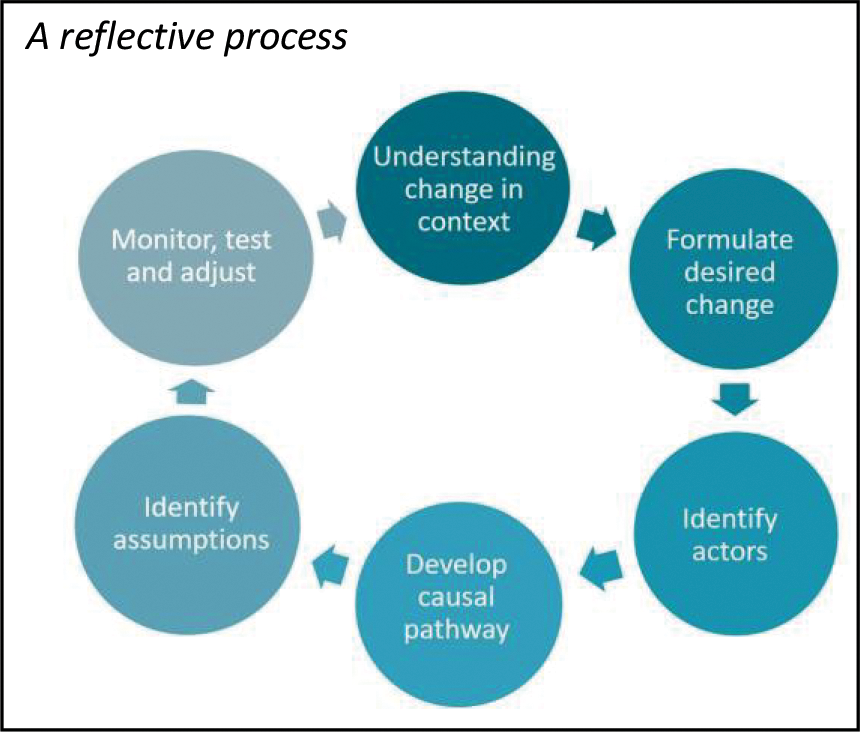
An important element are productive interactions: Exchanges between researchers and stakeholders in which knowledge is produced and valued that is both scientifically robust and socially relevant. No change can be made without exchanging information AND people acting on that information. Interactions can be direct/personal, indirect or financial. The quantity as well as quality of the productive interactions forms an indicator for the potential for societal impact. Examples of productive interactions are:
− Co-design: formulation of research questions and approaches jointly with potential end-users;
− Co-creation: joint execution of research projects with stakeholders and interactive dialogue on research results.
A Strategic Activity Planning spells out how the proposed productive interactions contribute to achieving outcomes. Outputs do not automatically lead to outcomes, thus strategies are needed of the research consortium to plan and monitor how their efforts will enhance the potential for outcomes. This planning should include specific activities for:
Stakeholder engagement: Who are the relevant stakeholders to engage with according to context analysis, how are the productive interactions organised and when?;
Communication strategy: How are engagement dialogues organised and results exchanged and translated, and whose responsibility is it?;
Monitoring, Evaluation and Learning: How are results of activities monitored and evaluated, such that assumptions can be tested and activities adjusted accordingly and whose responsibility is it?;
Capacity strengthening: How are required capacities (of consortium partners and stakeholders) strengthened in order to achieve the outcomes, how is this organised and whose responsibility is it?
A Risk assessment entails a description of potential risks for the successful execution of your project and options for handling or mitigating these risks.
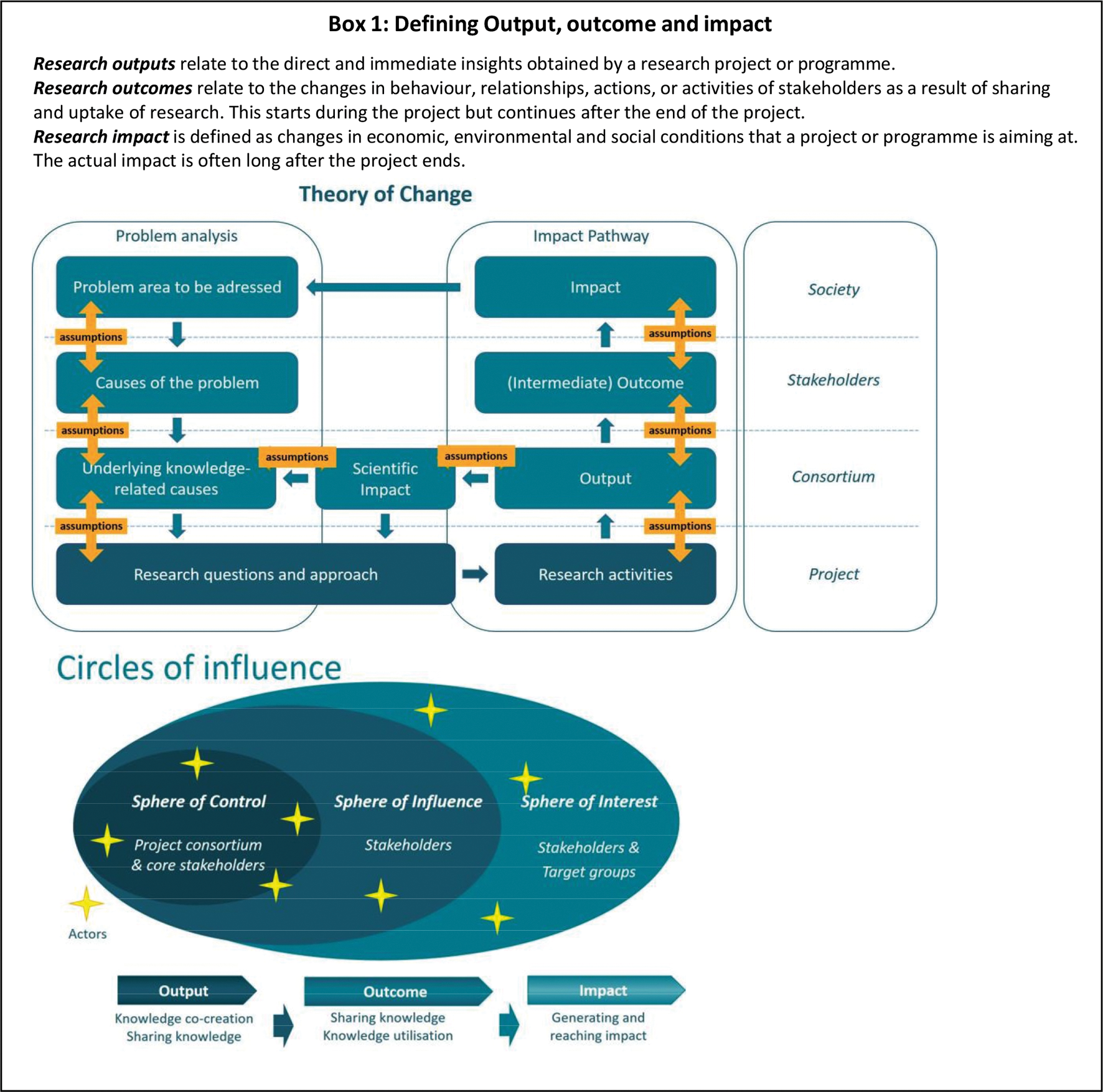
An empty cell means that no specific rules apply to that criterion. ATTENTION!:  means that you need to check the corresponding national/regional regulations available
in the 2022 Joint Transnational Call website and/or on the FPOs’ website.
means that you need to check the corresponding national/regional regulations available
in the 2022 Joint Transnational Call website and/or on the FPOs’ website.
|
Country |
Funding Partner Organisation (FPO) |
National/Regional Contact Point (NCP) |
NOT Funding All Themes and Sub-Topics |
Limits on Requested Budget per proposal |
NOT all types of partners are eligible for funding |
Different rules apply for different types of institutions |
Partners need to submit documentati on to their FPO |
|---|---|---|---|---|---|---|---|
|
Austria |
FWF Fonds zur Förderung der wissenschaftlichen Forschung |
Kati Huttunen Kati.Huttunen@fwf.ac.at +43 1 505 67 40 8408 |
|
|
|||
|
Belgium |
VLAIO Agentschap Innoveren & Ondernemen |
Kathleen Goris kathleen.goris@vlaio.be |
|
|
|
|
|
|
Belgium |
FWO Fonds Voor Wetenschappelijk Onderzoek-Vlaanderen |
Toon Monbaliu Europe@fwo.be +32 (0)2 550 15 70 |
|
|
|
|
|
|
Belgium |
F.R.S.-FNRS Fonds de la Recherche Scientifique |
Joël Groeneveld, international@frs-fnrs.be, +32 2504 9270 |
|
|
|
||
|
Brazil |
CONFAP Brazilian National Council of State Funding Agencies |
Elisa Natola Advisor for International Cooperation elisa.confap@gmail.com |
|
|
|
|
|
|
Brazil |
CNPq Brazilian National Council for Scientific and Technological Development |
Dileine Cunha Science & Technology Analyst dileine.cunha@cnpq.br |
|
|
|
|
|
|
Czechia |
TA CR Technology Agency of the Czech Republic |
Aneta Lízancová aneta.lizancova@tacr.cz +420 778 976 953 |
|
|
|
|
|
|
Denmark |
IFD Innovation Fund Denmark |
Martin Kyvsgaard International Investment Officer Martin.kyvsgaard@innofond.dk +45 61905081 Bo Frølund Investment Officer Bo.froelund@innofond.dk +45 61905043 International Collaborations internationale@innofond.dk |
|
|
|
||
|
Estonia |
ETAg Sihtasutus Eesti Teadusagentuur |
Katrin Saar Katrin.saar@etag.ee(+372) 731 7386 |
|
|
|
||
|
France |
ANR Agence Nationale de la Recherche |
Armelle Montrose & Claire Treignier Water4All- CallsFR@agencerecherche.fr |
|
|
|
||
|
Germany |
BMBF Federal Ministry of Education and Research |
Anne Petzold anne.petzold@kit.edu |
|
|
|
||
|
Hungary |
NKFIH Nemzeti Kutatási, Fejlesztési és Innovációs Hivatal |
Krisztina Hollósi krisztina.hollosi@nkfih.gov.hu |
|
|
|
|
|
|
Ireland |
EPA Environmental Protection Agency of Ireland |
Alice Wemaere a.wemaere@epa.ie |
|
|
|||
|
Italy |
MUR Ministero dell’Università e della Ricerca |
Maria Bianco maria.bianco@mur.gov.it Aldo Covello aldo.covello@mur.gov.it |
|
|
|
|
|
|
Italy |
MISE Ministero dello Sviluppo Economico |
Rosario Gargiulo Rosario.gargiulo@mise.gov.it Valentina Milazzo Valentina.milazzo@mise.gov.it |
|
|
|
|
|
|
Israel |
MoE-IL Ministry of Energy |
Olga Zlatkin olgaz@energy.gov.il |
|
|
|
|
|
|
Latvia |
LZP Latvijas Zinatnes padome |
Ineta Plikša ineta.pliksa@lzp.gov.lvDace Tirzīte dace.tirzite@lzp.gov.lv |
|
|
|
||
|
Lithuania |
LMT Lietuvos mokslo taryba |
Viktoras Mongirdas viktoras.mongirdas@lmt.lt +370 676 19613 |
|
|
|||
|
Luxembourg |
FNR Luxembourg National Research Fund |
Helena Burg helena.burg@fnr.lu +352 691362812 |
|
|
|
||
|
Malta |
MEEE Ministry for Environment, Energy and Enterprise |
Brian Borgbrian.a.borg@gov.mt |
|
|
|
|
|
|
Moldova |
NARD National Agency for Research and Development |
Vadim Iatchevici vadim.iatchevici@ancd.gov.md(+373) 022 27 04 45 |
|
|
|
||
|
Netherlands |
NWO Dutch Research Council |
Ron Winkler r.winkler@nwo.nl |
|
|
|
|
|
|
Norway |
RCN Research Council of Norway |
Linda Jarrett lja@rcn.noMaryam Shapouri msh@rcn.no |
|
|
|
|
|
|
Poland |
NCBR Narodowe Centrum Badań i Rozwoju |
Kinga Szymańska-Rzeźnik International Cooperation Department – Programme Section Kinga.Szymanska@ncbr.gov.pl |
|
|
|
|
|
|
Portugal |
FCT Fundação para a Ciência e a Tecnologia |
Marco Mota marco.mota@fct.pt Germana Santos germana.santos@fct.pt |
|
|
|
|
|
|
Romania |
UEFISCDI The Executive Agency for Higher Education, Research, Development and Innovation Funding |
Nicoleta Dumitrache Nicoleta.dumitrache@uefiscdi.ro Mihaela Manole Mihaela.manole@uefiscdi.ro |
|
|
|
|
|
|
Slovak Republic |
SAS Slovak Academy of Sciences |
Martin Novak mnovak@up.upsav.sk |
|
|
|||
|
South Africa |
WRC Water Research Commission |
Mr Tiyani Chauke tiyanic@wrc.org.za Mamohloding Tlhagale mamohlodingt@wrc.org.za |
|
|
|
|
|
|
Spain |
AEI Agencia Estatal de Investigación |
Maja Kolar and Silvia Lorrio water4all.aei@aei.gob.es |
|
|
|||
|
Spain |
CDTI Centre for the Development of Industrial Technology |
Héctor González partenariadoshe@cdti.es |
|
|
|
||
|
Sweden |
FORMAS The Swedish Research Council for Environment, Agricultural Sciences and Spatial Planning |
Kristina Laurell Kristina.laurell@formas.se +46 704404059 |
|
|
|
||
|
Switzerland |
SNSF Swiss National Science Foundation |
Martina Kern water4all@snf.ch |
|
|
|||
|
Turkey |
TUBITAK Turkiye Bilimsel Ve Teknolojik Arastirma Kurumu |
Azmi Serhat Yildirim azmiserhat.yildirim@tubitak.gov.tr +90 312 298 1765 |
|
|
|
|
|
|
United Kingdom |
EPSRC-UKRI Engineering and Physical Sciences Research Council |
Maria Calderon Munoz EngineeringPeerReview@epsrc.ukri.org |
|
|
|
N° |
Participant |
Country |
Beneficiary may apply to the call JTC |
|---|---|---|---|
|
1 (Coord.) |
ANR |
France |
|
|
2 |
APE |
EU |
X |
|
3 |
INBO |
EU |
|
|
4 |
WE |
EU |
X |
|
5 |
BMBWF |
Austria |
|
|
6 |
FWF |
Austria |
|
|
7 |
F.R.S.-FNRS |
Belgium |
|
|
8 |
FWO |
Belgium |
|
|
9 |
VITO |
Belgium |
X |
|
10 |
Fonds Innoveren |
Belgium |
|
|
10.1 |
VLAIO |
Belgium |
|
|
11 |
VMM |
Belgium |
|
|
12 |
MENDELU Brno |
Czech Republic |
X |
|
13 |
MZP |
Czech Republic |
|
|
14 |
TA CR |
Czech Republic |
|
|
15 |
DNNK |
Denmark |
|
|
16 |
IFD |
Denmark |
|
|
17 |
GEUS |
Denmark |
X |
|
18 |
MST |
Denmark |
|
|
19 |
DMP |
Denmark |
|
|
20 |
ETAg |
Estonia |
|
|
21 |
AKA |
Finland |
|
|
22 |
MMM |
Finland |
|
|
23 |
SYKE |
Finland |
X |
|
24 |
YM |
Finland |
|
|
25 |
BRGM |
France |
X |
|
26 |
CNRS |
France |
X |
|
27 |
FWT |
France |
X |
|
28 |
DVGW |
Germany |
X |
|
29 |
KIT-PtKA |
Germany |
X |
|
30 |
GSRI |
Greece |
|
|
31 |
NKFIH |
Hungary |
|
|
32 |
EPA |
Ireland |
|
|
33 |
MoE-IL |
Israel |
|
|
34 |
CMM |
Italy |
|
|
35 |
CNR |
Italy |
X |
|
36 |
ISPRA |
Italy |
X |
|
37 |
MUR |
Italy |
|
|
38 |
LZP |
Latvia |
|
|
39 |
MoES |
Latvia |
|
|
40 |
RTU |
Latvia |
X |
|
41 |
LMT |
Lithuania |
|
|
42 |
EWA |
Malta |
X |
|
43 |
MEEE |
Malta |
|
|
44 |
NARD |
Moldova |
|
|
45 |
CEW |
Netherlands |
X |
|
46 |
CIV Water |
Netherlands |
|
|
47 |
Fryslan |
Netherlands |
|
|
47.1 |
Leeuwarden |
Netherlands |
|
|
48 |
IenW |
Netherlands |
|
|
49 |
NWO |
Netherlands |
|
|
50 |
Water Alliance |
Netherlands |
X |
|
51 |
WETSUS |
Netherlands |
X |
|
52 |
NIVA |
Norway |
X |
|
53 |
RCN |
Norway |
|
|
54 |
NCBR |
Poland |
|
|
55 |
FCT |
Portugal |
|
|
56 |
LIS-Water |
Portugal |
X |
|
57 |
LNEC |
Portugal |
X |
|
58 |
UEvora |
Portugal |
X |
|
59 |
UEFISCDI |
Romania |
|
|
60 |
EUBA |
Slovakia |
X |
|
61 |
SAV |
Slovakia |
|
|
62 |
WRC |
South Africa |
|
|
63 |
AEI |
Spain |
|
|
63.1 |
FECYT |
Spain |
|
|
64 |
CDTI |
Spain |
|
|
65 |
IMDEA Water |
Spain |
X |
|
66 |
PTEA |
Spain |
|
|
67 |
ZINNAE |
Spain |
X |
|
68 |
FORMAS |
Sweden |
|
|
69 |
SUEN |
Turkey |
X |
|
70 |
TUBITAK |
Turkey |
X |
|
71 |
Mechelen |
Belgium |
X |
|
72 |
CREA |
Czech Republic |
X |
|
73 |
DSI |
South Africa |
|
|
74 |
MISE |
Italy |
|
|
75 |
FNR |
Luxemburg |
|
|
76 |
SNSF |
Switzerland |
|
|
77 |
UKRI |
United Kingdom |
|
|
78 |
CONFAP |
Brazil |
|
|
79 |
CNP-Q |
Brazil |
Research Performing Organisations are represented in Italic.
Aldo Covello, Maria Bianco
MUR – Ministry of Universities and Research
DG for Internationalization and Communication
Largo Antonio Ruberti 1
00153 Rome (RM) – Italy
E-mail: water4all2022_callsecretariat@mur.gov.it
2022 Joint Transnational Call
“Management of water resources: resilience, adaptation and mitigation to hydroclimatic extreme events and management tools”
Joint Transnational Call 2022
Publication Date: 1/09/2022
Pre-proposal deadline: 31/10/2022, 15.00 CET
NETHERLANDS
|
|
Funding Organisation: |
NOW
|
|
National Contact Point (NCP) |
Name: |
Email and Phone: |
|
Ron Winkler |
r.winkler@nwo.nl |
|
|
Eligible Institutions |
See eligible applicants |
|
|
Eligible Applicants |
For scientists based in the Kingdom of the Netherlands, the NWO eligibility criteria apply. Full, associate and assistant professors, lectors, senior researchers and other researchers with a comparable position* may submit an application (i.e. participate in a consortium and request NWO funding) if they have a tenured position (and therefore a paid position for an indefinite period) or a tenure track agreement at one of the following organisations: • universities located in the Kingdom of the Netherlands; • university medical centres; • Institutes affiliated to the Royal Netherlands Academy of Arts and Sciences (KNAW) or NWO; • Universities of applied sciences as referred to in Article 1.8 of the Higher Education and Scientific Research Act (WHW); • the Netherlands Cancer Institute; • the Max Planck Institute for Psycholinguistics in Nijmegen; • the DUBBLE Beamline at the ESRF in Grenoble; • Naturalis Biodiversity Center; • Advanced Research Centre for NanoLithography (ARCNL); • Princess Máxima Center. • TO2 institutes: Deltares, Marin, NLR, TNO and Wageningen research (former DLO) *A comparable position refers to a researcher that has a demonstrable and comparable number of years of experience in carrying out scientific research and supervising other researchers as a full, associate or assistant professor. Persons with a zero-hour employment agreement or with a contract for a limited period of time (other than a tenure track appointment) may not submit a proposal. It could be the case that the applicant’s tenure track agreement ends before the intended completion date of the project for which funding is applied for, or that before that date, the applicant’s tenured contract ends due to the applicant reaching retirement age. In that case, the applicant needs to include a statement from their employer in which the organisation concerned guarantees that the project and all project members for whom funding has been requested will receive adequate supervision for the full duration of the project. Applicants with a part-time contract should guarantee adequate supervision of the project and all project members for whom funding is requested. |
|
|
Eligible Costs |
The NWO budget modules (including the maximum amount) available for this Call for proposals are listed in the table below. Apply only for funding that is vital to realise the project. Proposals are required to have at least one personnel position of 12 full-timemonths Available budget modules Postdoc – at least 6 full months and at most 36 full-time months, according to VSNU or NFU rates Research leave – max. 5 months, 1 fte, according to VSNU or NFU rates Personnel universities of applied sciences and TO2 institutes – rates based on Handleiding Overheidstarieven 2021 (HOT) (Manual for Dutch Government Fees 2021, table 2 from section 2.2, hourly cost-covering rate) Material costs – max. 15 000 € per year per full-time scientific position (postdoc) Knowledge utilisation – max. € 25.000 Internationalisation – max. € 25.000 For the budget module “Postdoc”, a one-off individual bench fee of € 5,000 is added on top of the salary costs to encourage the scientific career of the project employee funded by NWO. Note that PhD positions cannot be applied for in this call, due to the maximum project duration of 3 years. The budget items “overhead”, “equipment” and “subcontracting costs” in the Water4All format are not eligible for NWO funding. Please refer to the detailed explanation of NWO budget modules to see which costs are eligible for NWO funding. It is recommended to use the financial details form (obligatory in full proposal phase) in the pre-proposal stage to confirm eligibility of budget items. A more detailed explanation of the budget modules and the financial details form can be found at the following web address: https://www.nwo.nl/calls/partnership-water4all-management-water-resources-face-hydroclimatic-extreme-events At the full proposal phase, it is required to submit a financial details form separately to NWO. This form is available on: https://www.nwo.nl/calls/partnership-water4all-management-water-resources-face-hydroclimatic-extreme-events The deadline to submit financial details to NWO is similar to the official deadline of the call of the European Water4Alll Partnership at step 2 (25 August 2022, 15:00 CEST). Do not hesitate to contact the national contact person in case of questions. |
|
|
Funding Commitment |
Total Amount for the Call |
Maximum Amount Per Proposal |
|
1.128.000 EUR |
270.000 EUR |
|
|
Other Funding Criteria |
– An application for NWO funding (i.e. the Dutch part of a European consortium) has a single main applicant (i.e. Dutch Partner or Coordinator in the European consortium), responsible for scientific and financial management. – An applicant may only request NWO funding for one project (part of a European consortium) in this call of the European Water4All Partnership. – Applicants may not apply for a post-doc position for themselves. – Impact of the research is at the heart of this call of the European Water4All Partnership. Please refer to the detailed description of requirements and evaluation criteria, including impact, in the full call announcement of the Water4All Partnership. – Stakeholder engagement is essential to maximize the chances of reaching impact and NWO considers engagement of stakeholders an important asset, starting with the design of your project, as well as the definition of active roles for each of them during the course of the project. Valorisation of stakeholder engagement in the project (as self financed industrial and/or societal partner) in the form of in kind or in cash contributions from stakeholders is therefore strongly recommended by NWO – Submission of financial and scientific reports at national level is required in accordance with the rules of NWO. – NWO may award more than € 270.000 to compensate for new personnel VSNU/NFU tariffs |
|
|
Relevant documents |
Full details for project funding in this call is available on the NWO website: https://www.nwo.nl/calls/partnership-water4all-management-water-resources-face- hydroclimatic-extreme-events For full details of the general NWO funding process, please refer to https://www.nwo.nl/en/apply-funding-how-does-it-work |
|
|
Additional Info |
The budget for The Netherlands in this call is brought together by the Dutch Ministry of Infrastructure and Water Management (IenW) and the Dutch Ministry of Agriculture, Nature and Food Quality (LNV). |
|
|
Useful Links |
The NWO Grant Rules 2017 and the Agreement on the Payment of Costs for Scientific Research are applicable to the part of the project’s budget covered by the grant from NWO. Under the Dutch General Administrative Law Act, any interested party has the right to lodge an objection to the decision taken by NWO within six weeks of the date of the decision letter. Further information about the objections procedure can be found on the NWO website. |
|
9-digit number serving as a unique identifier for organisations (legal entities) participating in EU funding programmes / procurements. If needed, one can apply for a temporary PIC on: https://ec.europa.eu/info/funding-tenders/opportunities/portal/screen/how-to-participate/participant-register. A search tool for organisations and their PICs is available on https://ec.europa.eu/info/funding-tenders/opportunities/portal/screen/how-to-participate/participant-register-search. We suggest validating the PICs via the public available Partner Search – Organisation Profile service. This allows use to fill out some requested data inputs automatically, which is less error-prone and provides much better user experience. https://ec.europa.eu/info/funding-tenders/opportunities/portal/screen/support/apis
Kopieer de link naar uw clipboard
https://zoek.officielebekendmakingen.nl/stcrt-2022-24129.html
De hier aangeboden pdf-bestanden van het Staatsblad, Staatscourant, Tractatenblad, provinciaal blad, gemeenteblad, waterschapsblad en blad gemeenschappelijke regeling vormen de formele bekendmakingen in de zin van de Bekendmakingswet en de Rijkswet goedkeuring en bekendmaking verdragen voor zover ze na 1 juli 2009 zijn uitgegeven. Voor pdf-publicaties van vóór deze datum geldt dat alleen de in papieren vorm uitgegeven bladen formele status hebben; de hier aangeboden elektronische versies daarvan worden bij wijze van service aangeboden.
 Authentieke versie (PDF)
 Informatie
 Printen
 Delen
Delen