Kamerstuk
| Datum publicatie | Organisatie | Vergaderjaar | Dossier- en ondernummer |
|---|---|---|---|
| Eerste Kamer der Staten-Generaal | 2020-2021 | 35295 nr. N |

U bent nu hier: Publicaties Officiële publicaties
Zoals vergunningen, bouwplannen en lokale regelgeving.
Adressen en contactpersonen van overheidsorganisaties.

Aan de Voorzitter van de Eerste Kamer der Staten-Generaal
Den Haag, 19 maart 2021
Graag doe ik u, mede namens de Minister van Justitie en Veiligheid, de Minister voor Rechtsbescherming, de Minister van Binnenlandse Zaken en Koninkrijksrelaties en de Minister voor Basis- en Voortgezet Onderwijs en Media, de Nederlandse inzending toekomen op de op 29 januari jl. door de Europese Commissie gedeelde vragenlijst in het kader van de toetsingscyclus voor de rechtsstaat 2021.
De toetsingscyclus voor de rechtsstaat is in 2020 van start gegaan.2 Het jaarlijkse rapport over de rechtsstaat in de Unie en de lidstaten van de Commissie verscheen vervolgens op 30 september 2020 voor het eerst3 en is in de kern een preventief instrument. Het stelt zich ten doel om rechtsstatelijkheid in de lidstaten te bevorderen en te voorkomen dat problemen ontstaan of verergeren door alle lidstaten op gelijke voet langs de rechtsstatelijke meetlat te leggen. Dit doet de Commissie op basis van vier pijlers: het rechtsbestel, het anti-corruptiekader, mediapluriformiteit en overige institutionele zaken met betrekking tot checks and balances. Dit jaar zijn hiertoe 46 indicatoren opgesteld. In vergelijking met vorig jaar is een aantal indicatoren nader uitgewerkt of toegevoegd, onder meer ten aanzien van de genomen maatregelen in het kader van de bestrijding van de COVID-19-pandemie. De volgende indicatoren zijn toegevoegd ten opzichte van vorig jaar: 13, 14, 16, 24, 31, 37 en 41. In de beantwoording is rekening gehouden met wat Nederland vorig jaar reeds indiende.
Het virtuele landenbezoek van de Commissie aan Nederland is voorzien voor 25 en 26 maart a.s., waarbij zij zal spreken met zowel de meest betrokken vakdepartementen als ook met relevante (beroeps)organisaties die actief zijn op het terrein van de rechtsstaat.
De Commissie is voornemens om op basis van onder meer de verkregen input en de landenbezoeken het Rechtsstaatrapport 2021 in de maand juli te publiceren. Het rapport zal vervolgens onderwerp zijn van bespreking tijdens de jaarlijkse rechtsstatelijkheidsdialoog in de Raad Algemene Zaken. Daarnaast is de verwachting, in lijn met de Nederlandse inzet, dat net als vorig jaar tevens bespreking zal plaatsvinden in het kader van de JBZ-Raad.
De Minister van Buitenlandse Zaken, S.A. Blok
No substantial changes have been made since the publication of the Rule of Law Report 2020 within the framework of appointing and selection of judges and prosecutors.
With regards to the newly added element of appointment and selection of court presidents the following information is relevant. A court president is appointed by Royal Decree (koninklijk besluit) for a period a six years. An extension for three years is possible. The Council for the Judiciary recommends the appointee for appointment as court president to the Minister for Legal Protection. The Minister sends a request for a Royal Decree to appoint a court president to the King as a formal requirement. The Council for the Judiciary is obliged in the selection procedure for a court president to involve the Board of the Court and the Works Council (Ondernemingsraad). Also, the Courts Council (gerechtsvergadering, Article 22 and 28 Law on the Judicial Organization) has the right to be heard. All judicial officers (judges) of the Court are part of the Court’s Council.
In last year’s report, it was mentioned that a Commission of State on the reform of the parliamentary system (Commissie-Remkes) has advised on the manner of selection and appointment of the members of the Supreme Court. The Commission proposes a different selection and appointment procedure. The government concurred with the advice of the Commission and has drawn up a proposal to change the relevant provision in the Constitution. The proposal envisages the replacement of the nomination of a candidate by the majority of the House of Representatives by a nomination committee. The proposal is currently pending before the Council of State (Advisory Division) for advice.
Other than specified below, no substantial changes have occurred since the publication of the Rule of Law Report 2020.
The age for retirement for judges is 70 years. Due to the Covid-19 pandemic, the judiciary experienced an increase in backlogs. Therefore a temporary arrangement has been made to appoint retired judges until their 73th as substitute judges. This is regulated in the Second Temporary Law on Covid-19 (8 July 2020).
The creation of substitute judges happens upon recommendation from the board of the court to the Council of the Judiciary. The Council of the Judiciary, as formal requirement, recommends the Minister for Legal Protection to send a Royal Decree to the Head of State, the King, to appoint the recommended person.
No substantial changes have been made since the publication of the Rule of Law Report 2020 with regards to the promotion of judges and prosecutors.
The board of the courts in all district courts publishes the method of allocation of cases for the different legal areas. As a rule, the allocation is organized at random. In the administrative regulations published by the boards of the district courts, the cases that will not be allocated at random are specified in case of specific necessary expertise. After allocation, the name of the judge is announced to the parties. A transfer of a case to a different judge is only possible under the conditions as published in the specific allocation method. The notification of the transfer to the parties in the case includes the specific reasons for the transfer.
As mentioned last year, the Council for the Judiciary and the Presidents of the courts published a new code for the allocation of cases in January 2020. The main objective of the code is to update standards to better meet the international requirements, including case law of the European Court of Human Rights. Allocation of cases will be assigned as objectively as possible. Cases that cannot be allocated at random are limited to specific criteria such as a specific necessary expertise. The criteria for the allocation of cases must be objective, transparent and verifiable. Because of the new code for the allocation of cases, the methods concerning the allocation of cases have been revised. They will be published and enter into force by 1 April 2021.
Other than specified below, no substantial changes have occurred since the publication of the Rule of Law Report 2020.
Appointment of board members
Since last year, the Council for the Judiciary has modified the internal procedure for the appointment of members of the board of a court. To improve transparency and the information position of employees, all relevant internal documents on the procedure will be accessible to all employees of the court on the internal website. Currently, the court provides a profile of the requirements of the candidate board member on the internal website. These profiles are made in consultation with the Council for the Judiciary, the board of the court, the court meeting and the Works Council. In the selection procedure the board of the court, the court meeting and the court council are involved.
The Advisory Division of the Council of State has issued further guidance (23 September 2020) on the process of appointment of members of board members in the judiciary. It concludes there is no need to alter the current legal system. The system is in accordance with the principles of the rule of law and the international standards. It was recommended, yet not required, by the Advisory Division of the Council of State to enlarge the role of local judges in the appointment process at their specific court and it was recommended to increase transparency of the appointment procedures for local employees.
No substantial changes have occurred since the publication of the Rule of Law Report 2020.
No substantial changes have occurred since the publication of the Rule of Law Report 2020.
In the country chapter of the Rule of Law Report 2020 on the Netherlands, the power of the Minister of Justice and Security to issue specific instructions to the prosecution service was raised. The Netherlands would like to reiterate that this power is accompanied by safeguards to protect judicial independence and has not been used in practice. Some developments that we want to share in regard to this issue can be found below.
In 2019, following a ruling by the Court of Justice of the EU5, the Law on Surrender (Overleveringswet 6) was amended. As a result of this ruling, public prosecutors were no longer allowed to issue European Arrest Warrants in connection with the existing possibility to issue instructions or receive directions from the executive power. In response to this ruling an emergency act was implemented.7 This emergency act transfers the power to issue an arrest warrant to the investigating magistrate (rechter-commissaris). The case law on the competent judicial authority does continue to evolve. In November 20208, the Court of Justice of the EU ruled that the public prosecutor does not meet the requirements, because of the possibility to receive instructions from the executive power, to consent, as «executing judicial authority», to the prosecution or sentencing for an offence committed prior to the surrender. Again, the Law on Surrender will be – among other things – changed in this respect. Several tasks of the public prosecutor will be transferred to the court. For this reason, research will be conducted in 2021 into the role and position of the Dutch Public Prosecution Service as the competent judicial authority on the basis of EU instruments in the field of cross-border criminal law cooperation (and where relevant other international instruments).
No substantial changes have occurred since the publication of the Rule of Law Report 2020.
Every year, the Central Bureau of Statistics publishes its research on the trust in the judiciary, government and media.9 In 2018, 72,6% of the general public trusted the judiciary and in 2019 this increased to 73,6%. This means that the general public in Netherlands remains positive to very positive about the trustworthiness of the judiciary. Other information on the perception of the general public can be found in figures 44, 45, 46, 47 and 48 of the European Justice Scoreboard 2020.
Concerning the parliamentary report «Unprecedented Injustice»
Under chapter IV-D a general explanation and reaction to the report is included; under this indicator the focus will be on the judiciary. Not only relating to the independence of the judiciary, but mostly for the trust in the government in general, the child care subsidies enforcement regime possibly could have influenced the perception of the general public of the judiciary.
In December 2020, a report10 from a parliamentary committee of inquiry (Commissie-Van Dam) on childcare subsidies was published. The committee concludes in the report that in the execution of the childcare subsidies the fundamental principles of the rule of law have been infringed. The criticism is not only directed towards the execution on the part of the civil service – specifically tax authority/subsidies – but also towards the legislature and the judiciary. Without naming specific individual judgements of the judiciary, the commission finds that for years the administrative division of the judiciary has contributed to the high level of enforcement that did not directly follow from imperative law. Hence, in the conclusion of the committee of inquiry the administrative division of the judiciary has disregarded its duty to provide legal protection to individual citizens.
In response to the report, the Administrative Jurisdiction Division of the Council of State created an independent commission11 to advice the Council of State on the substance of the legal reflection on the childcare subsidies rulings, the methods and the persons or groups that should be included.
Last January, following the conclusions of the report on childcare subsidies, a motion12 by the House of Representatives was adopted. The House of Representatives concludes in the motion that the rule of law has been infringed and that external advice from independent experts should be sought. The Venice Commission has been requested by the House of Representatives in the motion to advice on the following topics: the legal protection of citizens in the Netherlands particularly administrative law, the checks and balances in theory and in practice including both chambers of Parliament and the judiciary.
Court fees
With regard to the court fees, the Minister for Legal Protection has submitted a draft law on court fees in civil matters with a more differentiated system of court fees in cases with a lower value (between EUR 500 and EUR 5 000). This will result in lower court fees for the cases with the lowest value. The House of Representatives has approved the bill, which is now pending before the Senate. After approval, its entry into force is foreseen for the last quarter of 2021.
Legal aid
As announced last year, the Ministry of Justice and Security is currently preparing a revision of the system of legal aid. One of the key elements is to better tailor (legal) aid to the demand of people needing help. The aim is to strongly improve the online landscape of information, advice and help around legal problems. The goal is to create one clear site/platform where people can easily find reliable, understandable information which can help those who are able to solve their own problems. The information will be organised around life events, easily recognisable developments that everyone can encounter in their life and which can have great impact. Plans for an online platform are currently being made. For people who are not adequately digitally skilled or who need more personal help, there will be a telephone number and easily accessible locations where people can go for face-to-face help. The revision will be completed in 2025.
Previous legislative processes to revise the legal aid system did not receive the approval of Parliament. It has therefore been decided to start this revision with pilot projects to collect best practices and to translate those practices into legislation. To support and stimulate service providers during this transition the government has provided a temporary allowance. All stakeholders now participate in the revision programme. The benefits that the revision will yield, will be re-invested in the system of legal aid and will be used to offer service providers better fees.
The plans were communicated to Parliament in the following letters:
– Outline of plans 9 November 201814
– Progress Report 12 July 201915
– Progress Report 19 December 201916
– Midterm Review and Progress Report 26 June 202017
– Progress Report 11 January 202118
Language
With regards to the newly added element of language, within the Netherlands the spoken and written language in the judiciary is Dutch. Non-Dutch speakers in criminal proceedings have the right to a translator and interpreter based on Article 275 and 276 of the Code of Criminal Procedure (Wetboek van Strafvordering)19. All translators and interpreters used by the courts and public prosecution office are centrally registered20.
For sign language, the above-mentioned situation is also applicable. However, on 22 September 2020 the Senate approved a bill that strengthens the position of the sign language and recognises Dutch sign language as an official language in the Netherlands21.
From the 1 January 2014, it is possible to use the Frisian language at courts in the provinces Friesland, Groningen and Drenthe. In other courts, the use of Frisian language is allowed when a person insufficiently masters the Dutch language. In these cases the court will use a Frisian translator.
In civil and administrative proceedings, parties are responsible for arranging interpreters or translators. In the Netherlands Commercial Court22, a special chamber of the Court in Amsterdam, the proceedings and the judgements are in English. The proceedings are tailored to create an efficient solution for mostly complex cases.
No substantial changes have occurred since the publication of the Rule of Law Report 2020. In the Netherlands, the new category included by the Commission in the questionnaire «material» is included in the lump sum the Council for the Judiciary gets every year.
With regards to the newly added element of training of justice professionals, in the Netherlands, the Training and Study Centre for the Judiciary (SSR) is responsible to adequately train employees from the judiciary, including court staff such as court clerks, and the Public Prosecution Service. In partnership with the Dutch courts of law and public prosecutor’s offices, SSR trains law graduates to become judges and public prosecutors. These initial training programs have undergone major changes and SSR has redesigned the judge program. The Public Prosecution Service has taken the initiative to modify the public prosecutor program itself, with SSR acting as a consultant. The SSR is operating independently from the Ministry of Justice and Security. The Council for the Judiciary (Raad voor de Rechtspraak) is responsible for financing training courses. Although, in the Netherlands the SSR is responsible for the content of the training programs.
The Netherlands Bar Association (Nederlandse Orde van Advocaten, NOvA) is the professional organisation of the legal profession. All lawyers in the Netherlands jointly form the NOvA. The NOvA is completely independent of the government. All costs incurred by the NOvA are being paid for by the lawyers through an annual financial contribution to the NOvA. In the past years, the NOvA has developed a new vocational training for lawyers. The new training starts in March 2021. The curriculum will focus more on ethics, practical skills and the application of legal knowledge. Lawyers are required to undergo continuous training on a yearly basis.
With regards to this newly added element, the Ministry of Justice and Security strongly supports the implementation of digital technology in the justice system. In the justice system as a whole (the legal infrastructure, which includes the judiciary and the legal professions) case management systems are being introduced and digital working environments are optimised. New commercial online services providers emerge in the justice sector as a whole; examples are online complaint procedures with regard to property valuation or traffic offenses. The Dutch Bailiffs organization (KBvG) is also exploring opportunities for digitalization especially with the upcoming European legislation in the area. The Dutch national notarial association (KNB) is already anticipating the digital notarial document for the founding of private companies. Also, innovation and access to justice in the digital age in general are encouraged by the Ministry of Justice and Security, for example by organising a legal tech challenge for students, and by establishing, in close cooperation with Leiden University, a training programme with regard to legal tech for legal professionals.
Judiciary
In the criminal justice system, the public prosecution office and the judiciary are working together on a digitalisation plan with the other parties in the sector. The government has made a budget of EUR 200 million available for digitalisation in the period 2018–2022. Updates on the digitalisation process can be followed online.23 In 2018, digital litigation in criminal cases became possible at the Supreme Court and at the courts of first instance. At present, most of the criminal cases in first instance are tried via digital litigation. In 2019, the IT governance for the civil and administrative sector in judiciary was re-established, regular portfolio consultations with the Ministry are set in place and a new plan was built. The new plan has been carefully reviewed by the national IT review committee.24
The main aim of the new programme is to create digital access to justice for citizens and the legal professions.25 From 2021 onwards, the digitalisation process of the judiciary for civil and administrative cases will first focus on two sectors: national tax cases and seizure requests. After successful digitalisation of these two sectors, the following legal procedures are digitalised: regular immigration cases; national social insurance contribution cases and joint requests for divorce. The new strategy for digitalisation follows a step-by-step approach with regard to digitalising legal sectors. A pilot will start at one court and after successful completion of the digitalisation process the other courts will follow. To guarantee access to justice for all citizens it remains possible to submit a case on paper to the court. This is different for the legal professions where digital litigation has been made mandatory in some legal sectors.
With the new approach to the process of digitalisation, the judiciary responds to wishes of society to litigate digitally, as is already possible in criminal cases and a partly possible in asylum cases. Currently for asylum cases, digital litigation for the legal professions has been made mandatory. In January 2021, a new legislative resolution on electronic litigation was published.26 The resolution has not yet come in to full force but currently opens the opportunity for the judiciary to use a secure emailing system regarding legal procedures. Based on this electronic litigation resolution the legal procedures can become paperless in the future.
Covid-19 measures
In the beginning of April 2020 due to Covid-19, the Council of Judiciary introduced new measures to ensure digital case handling.27 Much more cases than usual were held using video conferencing. Additionally, documents could be sent by using a new secure email system28.
The Dutch procedure for Bailiffs needed additional measures to continue during the Covid-19 pandemic as well. A new covenant between the Ministry of Justiceand the bailiffs outlines the details of new temporarily effective measures.29 The procedure normally requires a bailiff to deliver to persons directly. Temporarily, bailiffs are allowed to deliver to the letterbox of the person without the documents losing their legal status. For the long term, the sector is working with the Ministry of Justice and Security on a plan for digitalisation of summons.
Since the pandemic, at the notaries, it became possible to appear digitally for notarial services and documents. Currently the Dutch Notarial Organization is implementing EU legislation and in the near future, the process of notarial deeds will become digitalised.
No substantial changes have occurred since the publication of the Rule of Law Report 2020, besides the following rectification. Instead of every 4 years, a customer satisfaction survey (court user survey) takes place every 3 years.
With regard to the newly added element of geographical distribution, the Netherlands has 11 courts in the Netherlands, five courts of appeal and one High Court.
The 11 courts have jurisdiction in criminal, civil and administrative cases. Internally there is a division for civil cases up to EUR 25.000 (kanton) and some special law branches including employment cases, consumer cases and lease cases. By law one court can be mandated to handle specialised cases. For example, this is currently the case for military (military chamber in Arnhem) and sea law (the so-called «wet» chamber in Rotterdam).
The five courts of appeal have jurisdiction in criminal cases and civil cases. In these cases, it is possible to ask the High Court for cassation in third instance. In administrative cases the Administrative Jurisdiction Division of the Council of State is the appeal (and last) instance.
There are a few specialised administrative instances such as the Central Council of Appeal (jurisdiction is regulated in the Beroepswet) and the Administrative Court for Trade and Industry. The judiciary has some pilot projects with easily accessible courts. These projects will be continued in 2021. A new pilot, «the proximity judge» (nabijheidsrechter) will start in summer 2021. The Temporary Experiment Law (Tijdelijke experimenteerwet rechtpleging) gives the legal basis for this pilot project. According to this law, parties are obliged to take part in these projects.
Information about the length of proceedings is part of the European Justice Scoreboard.30 For the 2020 report, this is mentioned in figures 5- 12. The information in the EJS is based on data from CEPEJ and the questionnaire members expert group EJS.
Effect of Covid-19 pandemic on the judiciary (criminal, civil and administrative law)
Due to the Covid-19 pandemic, there is an increase in the backlog of cases in 2020 and 2021. The Council for the Judiciary and the boards of the courts have taken action to decrease the backlog. For example, if the circumstances of the cases allowed it, cases were handled by a chamber of a single judge instead of a chamber of three judges. Inter alia, it is now possible to appoint judges who are retired as substitute-judge until they reach the age of 73. See also indicator 2.
Effect of Covid-19 pandemic on the Criminal Justice system
As a result of the Covid-19 pandemic, drastic measures have been taken that have restricted the administration of justice. Many hearings could not take place or had to take place online. As a result, the number of criminal cases awaiting a hearing has increased significantly. In recent months, a lot of work has been done in the administration of justice to allow the work to continue despite the restrictive measures. For example, measures have been taken by all organizations, individually and in collaboration with the government, such as screens, walking routes, renting extra rooms and better tele-hearing facilities. The government has made resources available for these measures. To eliminate the backlogs that have arisen in the criminal justice system as a result of the measures related to Covid-19, an approach has been agreed upon across the system with the aim of reducing the backlogs by the end of 2021 back to the level at the start of the Covid-19 crisis. The innovative practices, mentioned before, that were developed to overcome the backlog, will be evaluated with a view to the possibility of their permanent implementation.
An (independently conducted) review of the criminal justice system31 in 2020 has yielded recommendations to improve the functioning of the criminal justice system and the cooperation within this system. In response to these results, the organizations in the criminal justice system and the Ministry of Justice and Security have jointly drawn up an action plan32 to give an extra impulse, both in the short term and in the longer term, to the functioning of the criminal justice system and the cooperation within this system. This action plan focuses on measures relating to the acceleration of the length of proceedings in the criminal justice system. This primarily focuses on minimizing the length of proceedings of cases involving common crimes as well as high impact crime. These types of offenses were selected as a result of their major impact on society and the large share these offenses have in the total influx of criminal cases.
Not applicable.
International evaluations
Recalling our previous submission, the Netherlands has undergone several international evaluations in the context of the anti-corruption framework. The report of the round 4 evaluation of the Netherlands in the OECD Working Group on Bribery (WGB) was adopted in October 2020, and became public the next month.33 The Netherlands» first compliance report in the context of the R5 Council of Europe GRECO evaluation is being finalised and the Netherlands expects this report to be adopted in the March 2021 GRECO meeting. At this time no reference can be made to the draft report, but after adoption it will be made public and may provide additional information for this Rule of Law report. The UNCAC evaluation is on-going; the virtual on-site visit took place in November 2020 and the Netherlands hopes the report will become public in the course of 2021.
After publication of the OECD and UNCAC evaluations, the Netherlands expects to publish a policy response on behalf of all involved government agencies on how the Netherlands will deal with the recommendations. Additionally in 2021 the Ministry of Justice and Security commissioned research by the WODC34 regarding corruption risks in the Netherlands. The preparation for this research is still in its initial stages, so no further information is available at this time of writing.
As the past year was mostly geared towards the international evaluations, no large policy changes were introduced. The recommendations of the international evaluations and independent research is expected to guide our anti-corruption framework for the coming years.
No substantial changes have been made since the publication of the Rule of Law Report 2020 within the institutional framework in the fight against corruption.
In 2020 the Netherlands launched an extensive programme focusing on combating subversive organised crime and created a Directorate General within the Ministry of Justice and Security to coordinate the programme (DG Ondermijning). This has led to additional funding in this field and the creation of the multidisciplinary intervention team (MIT). The National Police Internal Investigations Department (NPIID) is an important partner of the MIT and will receive a structural annual investment of EUR 3.3 million to strengthen the NPIID and Dutch public prosecution office’s investigatory capacity.35
As of September 2020 two NPIID investigators are now stationed in the Special Caribbean municipalities of the Netherlands (Bonaire, Sint Eustatius and Saba) creating more permanent investigative capacity in the Caribbean part of the Netherlands. This pilot project will last three years. Before the pilot investigators travelled to the region on an ad-hoc basis.
Last year’s report mentioned that the rules on integrity for civil servants are contained in the National Government Integrity Code of Conduct. The correct translation of this Code must be «Code of Conduct for Integrity in the Central Public Administration». This clarifies that this Code only applies to civil servants who work for the Central Public Administration.
Also, last year’s report mentioned that the Interdepartmental Platform of Integrity Management focuses on cross-government integrity policy. However, this platform does not focus on cross-government but on cross-departmental integrity policy.
In the information provided for last year’s report, we mentioned that the House of Representatives was in the process of adopting a code of conduct and introducing a supervisory system as regards declaration requirements. The Code of Conduct for the House of Representatives36 has 5 articles concerning independence, gifts, registrations, use of confidential information and the rules of procedure. The regulation of supervision and enforcement37 provides regulation for compliance (Voorstel van het presidium voor een regeling toezicht en handhaving gedragscode leden van de Tweede Kamer der Staten-Generaal). The regulation, establishing an independent College to investigate complaints regarding Members» adherence to the Code of Conduct and to advise the House on possible sanctions, was adopted by the House on 22 September 2020 and will enter into force on 1 April 2021.38 The House is currently in the process of selecting a chair and two members for the new College.39
GRECO compliance report in the 5th round (persons entrusted with top executive functions and law enforcement agencies) is scheduled for discussion and adoption in the GRECO-plenary in May 2021. After the adoption the compliance report will be published.
This year, the introduced legislation concerning the strengthening of the integrity of elected and appointed officials on the local and provincial level will be debated in Parliament. The government’s aim is that this legislation will come into effect before the municipal elections of March 2022 (provincial elections are in March 2023). The proposed bill, which among others prescribes a Code of Conduct as a mandatory requirement for appointed officials on the local and provincial level, will be extended with some elements that were originally foreseen in a second proposal. This includes a mandatory risk analysis on integrity for appointed local and provincial officials. The aim of such a risk analysis is to provide information on possible risks and vulnerabilities on a candidate’s integrity, so the candidate can take preventive measures on possible future conflict of interest, or withdraw himself from the nomination process. The local council (or the provincial council) has the final say, it can decide on the outcome of the risk analysis not to appoint the candidate as alderman (or member of the provincial executive). By incorporating this element in the bill that has already been proposed to the House of Representatives, the government is trying to ensure that a robust piece of legislation will enter into force after the municipal elections of March 2022. Furthermore, preparations will be made for a second proposal on strengthening the integrity at the municipal and provincial level as was originally intended, but without the necessary deadline of elections.
No substantial changes have occurred since the publication of the Rule of Law Report 2020 with regards to the rules on lobbying and asset disclosure concerning Ministers, state secretaries and civil servants. Also, no substantial changes have occurred in these fields with regard to the provincial and local levels of government.
In the proposed amendment to the Political Finance Act (Wet financiering politieke partijen, Wfpp) which is currently under consideration by Parliament, financing of or financial support for political parties by institutions or organizations (public or private) from outside the European Union or the European Economic Area is prohibited. The aim is to protect the functioning and organization of political parties against foreign interference. A limitation of EUR 4 500 per year for gifts or donations from abroad will be abolished in order to make all foreign gifts or donations transparent. Dutch citizens living abroad will be excluded from these measures. Moreover, the proposed amendment to the Political Finance Act contains a proposal to increase the transparency on gifts of legal entities. Political parties will be obliged to report the names of the natural persons who are the «ultimate beneficial owners» of the legal entity.
No substantial changes have occurred since the publication of the Rule of Law Report 2020 with regards to the rules on preventing conflict of interests in the public sector as far as Ministers, state secretaries and civil servants are concerned.
The legislation that has been introduced to the House of Representatives last year, will be debated this year. This includes clarifying and strengthening of the rules on withholding from taking part in the decision-making process for elected and appointed officials on the local and provincial level.
The Integrity Guidelines for Holders of Political Offices has been recently updated, including model codes of conduct for elected and appointed officials. This as part of the effort of the Ministry of the Interior and Kingdom Relations to support municipalities and provinces in their responsibilities to promote political integrity.
Whistleblower protection
The evaluation of the Whistleblowers Authority Act took place in 2020. The researchers found that there were too few facts and figures available to make statements about the effectiveness of the Act. According to the researchers, the contribution to the legal protection of the whistleblower and the resolution of social wrongs can be further increased in several respects. The response to the evaluation was sent to Parliament in December 2020. This indicates that further steps can certainly be taken on the basis of the research report. The law will be amended as a result of the evaluation, with a start on the bill in 2021. It has also been indicated that further support for whistleblowers is desirable. To gain insight into the best possible interpretation of that support, a pilot will first be started.
With the current bill to implement the EU Whistleblower Directive, the reversal of the burden of proof will in any case be realized, which further improves the protection of the whistleblower. The aim is to have the bill implementing the EU Whistleblower Directive to enter into force in December 2021. Employers will be informed by means of a website in 2021 about the consequences of the directive and how they can prepare for this.
Encouraging reporting of corruption
Awareness raising activities largely follow the sectoral approach. For 2020 this was greatly hindered due to national Covid-19-regulations, restricting meetings over a certain number of people.
The awareness-raising activities in 2020 of the Anti-Corruption Centre of the Fiscal Information and Investigation Service (FIOD-ACC) were mostly postponed due to the pandemic. Meetings that were scheduled with general counsels of multinationals and lawyers in the Netherlands to discuss, among other topics, corruption risks and self-reporting, were cancelled in 2020, but are rescheduled for 2021.
Please see last year’s information regarding the decentralized approach. The specific sectors are responsible to develop measures to prevent corruption and conflicts of interest. No substantial changes have been made since the publication of the Rule of Law Report 2020 within this framework.
A parliamentary «motion» by Parliamentarians Van Toorenburg – Yesilgöz-Zegerius40, was adopted late 2020. This requested the government to develop a multi-sectoral plan strengthening the security of mainports in the Netherlands. These infrastructures can be seen as a risk regarding integrity violations and corruption, as organized crime groups require (use of or access to) this infrastructure to support their activities. Both public and private organizations working in these areas may be at risk. Aspects of the plan on mainports may address these risks and introduce mitigating measures. The new DG Ondermijning has initiated discussions with stakeholders to facilitate the development of the plan.
Measures addressing corruption risks in economic support programmes; The Reimbursement Fixed Costs
The Dutch government has introduced an extensive economic stimulus package for several sectors in reaction to the pandemic. One of the elements is a financial package where companies can receive a reimbursement of fixed costs. The Netherlands Enterprise Agency, which operates under the auspices of the Ministry of Economic Affairs and Climate Policy, has set up an extensive risk management system to prevent risks in the implementation of the Reimbursement Fixed Costs (Tegemoetkoming vaste lasten, TVL) as much as possible. SMEs and enterprises other than SMEs can receive a reimbursement to help cover part of their fixed costs. The risk management system is continuously adjusted on the basis of internal and external signals. Some of these measures are aimed at the application phase and some at the determination phase of the grant. TVL Applications with an increased risk of corruption checked manually prior to the payment of the advance by The Netherlands Enterprise Agency. If necessary, additional information and supporting documents are also requested from the applicant. Furthermore, it is the policy of the Netherland to always report corruption to the Public Prosecution Service.
Law enforcement during the pandemic
Especially in the beginning of the Covid-19 pandemic there was a large impact on criminal investigations which lead to delays. For several months specific activities such as dawn-raids, hearing suspects and witnesses or observations were either not possible or had to be adapted. Law enforcement was also influenced by limited hearings within the courts. Additionally FIOD also investigated several cases of fraud related to the Covid-19 pandemic. This has led to several criminal investigations and prosecutions related to fraud (protective equipment, fraudulent health certificates and misuse of governmental subsidies following from the pandemic).41
No substantial changes have occurred since the publication of the Rule of Law Report 2020 with regards to any other relevant measures to prevent corruption in the public and private sector of top executive functions.
Efforts continue to implement GRECO recommendations. The compliance report in this context will be discussed in March in the next GRECO meeting, and will be made public after translation. The most important measures that can be referred to in the context of law enforcement agencies:
– The police adopted and published theme pages of its Professional Code. These are documents on their intranet dealing with a range of integrity issues and including both case law on the matter, practical examples and internal regulations and guidance. This follows the rules of conduct (gedragsregels) that the KMar (Royal Netherlands Marechaussee) adopted in 2019 following GRECO recommendations.
– Both the national police and KMar have developed additional training programmes relating to integrity. The KMar have recently developed two short practical training courses within the Open Defence Academy (ODA) around the topics of Leadership & Ethics (6 modules) and Integrity & Vulnerability (4 modules). For more in-depth knowledge, an online Master Class on Ethics and Information Security is also available online. In addition, a new application for mobile devices became available in April 2020 (My Defence) that provides support for internal communication and information, integrity and security for the entire Defence organization. The police education curriculum is currently being adjusted to ensure that integrity issues are included. A new education block on integrity is being developed, with an emphasis on dilemmas and using the thematic pages of the Professional Code. The development of this program is in an advanced stage. It exists of two-day «in person» training and additional E-learning modules. Due to Covid-19, the in-person training has not yet been launched, but is now planned for Q2 2021. Work is also ongoing to develop a professional e-learning programme through a mobile phone application (KNOWINGO).
– Both the national police and KMar have introduced various new tools and applications in the context of access and screening of the use of law enforcement data. These are mostly technical control measures.
– The national police are completing a Financial Interests Policy Rule, detailing which officials have a duty to report financial interests, what is meant by financial interests and how these interests must be reported. A Financial Compliance Officer who is to supervise the reporting thereof and the adequate implementation of this policy rule, was approved by senior management late December 2020. The KMar has, in addition to legislation on the duty to report financial interests already in place in the General Military Civil Servants Statute (Algemeen militair ambtenarenreglement) 42, developed a draft memorandum on registering financial interests. This memorandum has not yet formally entered into force.
– As was mentioned last year, legislation on screening of police personnel on integrity was being developed. As of October 2020 this legislation is adopted by both houses of Parliament; implementation of the legislation and supporting regulations are expected by the end of 2021.43
– The WODC research on the risks of conflicts of interests of police and KMar after leaving employment is ongoing and expected to be published by summer 2021.
– In 2020 research was conducted on the system of integrity investigations by the national police department conducting the investigations (Veiligheid, Integriteit en Klachten, VIK). The research and new approach developed following from this research were made public in a letter to Parliament.44
The legislation which will be introduced to prevent a dual role of Members of Parliament and judge is expected to enter the consultation phase by summer 2021.
The OECD report was published in November 2020.45 The Netherlands is currently working on its plans in order to further implement the recommendations of the WGB. Also, the public-private partnership between the banking sector and FIOD led to the publication of a knowledge document in the autumn of 2020 and promotional video. This is also referred to in the OECD report paragraph 39. Several recommendations were made in the context of the WGB evaluation. The Netherlands is currently reviewing the recommendations, and is expecting to share a policy document on how the recommendations will be implemented by summer 2021.
Two different types of research have been requested to the WODC:
– Corruption risks in the Netherlands – mentioned in our introduction;
– Framework for self-reporting and self-investigations – the WODC was requested to conduct research on the possible framework for the use of self-investigations and self-reporting. The first topic follows from a parliamentary «motion»46 and the second topic from the OEDC WGB evaluation.
The NPIID takes part in the project Resilient Public Governance (Weerbaar Openbaar Bestuur) focusing on increasing resilience within public governance against subversive crime. The aim is to increase connections between public governance and the NPIID, contribute to prevention and increase signals of corruption coming from this field. In phase 1 of the project the needs of stakeholders were identified. As of 1 February 2021, phase 2 has started in which a route map for implementation of possible measures and activities will be developed. The execution phase is expected to start before summer 2021.
No changes have been made since the publication of the Rule of Law Report 2020 in terms of criminalisation of corruption offences.
Two DPPO directives have been adopted, which have an impact on the investigation and prosecution of (especially) foreign prosecution.
– On 1 October 2020 a new Directive on investigation and prosecution of foreign corruption came into effect.47One change which relates to criminalization is the deletion of language of the old Directive on small facilitation payments, to prevent any lack of clarity regarding the alignment of legislation with the OECD convention.
– On 4 September 2020 a new Directive on Large Settlements came into effect.48 This Directive introduces an independent commission for legal oversight for specific settlements. The role of the Minister of Justice, in terms of approving settlements, ended upon the introduction of this commission. This temporary commission has been set up for the interim- period before new legislation is introduced, which will introduce legal oversight on these categories of settlements. The new legislation is expected to be brought into consultation this spring.
The Public Prosecution Service has provided an overview of data over the last 4 years on application of sanctions for corruption offences.
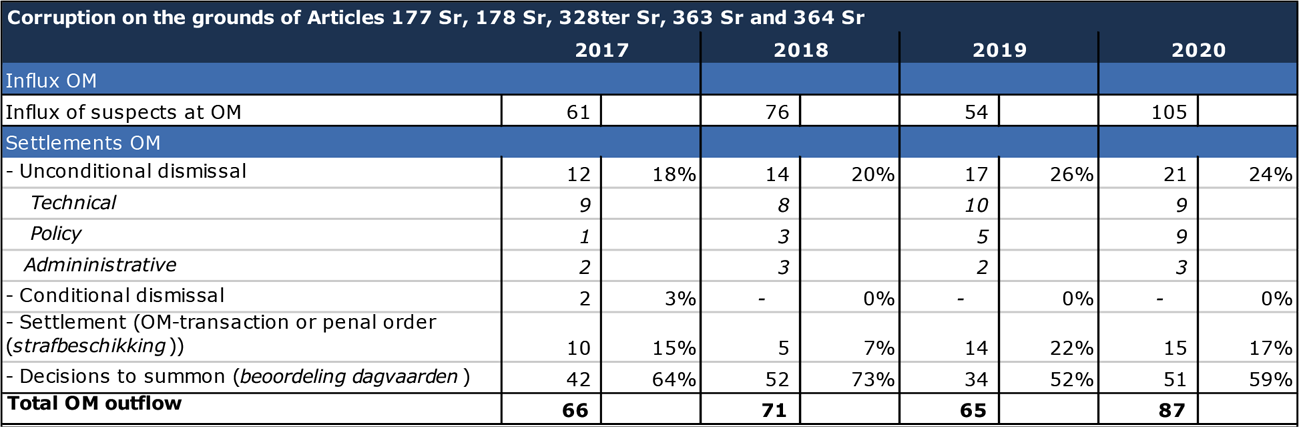
The OECD evaluation report gives an overview of the most recent enforcement data in the context of foreign bribery. Please see the report paragraph 1349 and further.
General data from DPPO (and NPIID specifically) can be found in the annual report.50
Transparency of data
Data regarding the OECD WGB evaluation (foreign bribery) is made public in the context of the evaluation report. The Netherlands published the report in a letter to Parliament in November 2020.
The annual DPPO report contains statistics, including on NPIID investigations. This is published each year.
Anonymised judgements of criminal cases are also published online on www.rechtspraak.nl.
Additionally DPPO publishes press releases following a so-called «large transaction». This includes a statement of facts for the large transactions, the sanction and the legal person involved. This policy is included in the relevant before mentioned directive on large settlements, and is further highlighted in the final paragraph of the press release on the new settlement regime.51
As mentioned in last year’s report, there is a special procedure pursuant to Article 119 of the Constitution with regard to violations of the law committed by Ministers, Members of Parliament and state secretaries while in office. This procedure is currently being reviewed by a dedicated committee. The committee is expected to deliver its report by the summer of 2021.
In addition to last year’s submission, we can mention that the international character of foreign bribery investigations may be further limited due to Covid-19 measures. The execution of MLA requests is one of the processes that can be hindered in many countries.
Also, legal privileges in relation to large data sets also remain a potential obstacle in the context of timely prosecution. This is also addressed in the OECD report. The Netherlands is considering whether lead times could be reduced in the future by using digital technology to filter out privileged material from large electronic databases kept by law firms. On this subject a judgment of the Supreme Court is relevant. In its judgement of 16 June 2020 (ECLI:NL:HR:2020:1048) the Supreme Court ruled that it is not in violation of legal professional privilege if the investigative judge – in cases where big sets of data have to be searched – gives an order to a specially designated investigative officer to use search terms to filter out information that falls within the scope of legal professional privilege, if certain conditions are met (person that invokes the privilege is involved when the search terms are determined; not just words, but also images can be searched). This means that the investigative judges do not (no longer) have to assess each individual document, which could save (a lot of) time when dealing with big sets of data. Moreover, it is clear from this judgment that blanket claims on legal professional privilege which are not substantiated, cannot block the use of the information that is filtered. This case law, in other words, helps preventing blanket claims on legal professional privilege from blocking the investigation.
Research by the Research and Documentation Centre (WODC) took place last year to explore possible bottlenecks for meeting the time limits regarding legal privilege and to explore furthers ways for streamlining the procedures. The outcome of this report is now being reviewed.
Regarding in-house lawyers and legal privilege an important judgement was recently published.52
Other – please specify
The information below is relevant in the context of the Dutch approach regarding foreign bribery. In October 2020 the Dutch Minister for Foreign Trade and Development Cooperation presented a policy note on international responsible business conduct (RBC policy).53 This policy aims to strengthen responsible business conduct and to spur companies into taking responsibility for ceasing, preventing or mitigating any adverse effects resulting from their activities, products or services. This includes tackling corruption. The RBC policy is part of a wider government approach to make international value chains sustainable and achieve the UN Sustainable Development Goals (SDGs). Evaluations and studies have found that although current Dutch RBC policy contains valuable elements to advance RBC, it has failed to achieve its goal (that Dutch companies engage in responsible business conduct in line with international standards). Voluntary measures alone are inadequate. A smart mix of measures is necessary to achieve the RBC policy goal, comprising information, facilitation, incentives, conditions and obligations. A policy mix at EU level is preferred and would align with the current EU ambitions. The government is proposing a smart policy mix with general due diligence legislation, preferably at EU level, at its heart. The building blocks for EU measures can also be used nationally if an effective and practicable EU proposal fails to get off the ground. The policy mix will be supplemented with measures to promote compliance with legislation and the exercise of due diligence. Specifically, these measures are RBC criteria in public procurement and private sector instruments, a new RBC support office, financial incentives and sector-wide cooperation. The government has developed a theory of change to gain insight into progress in and achievement of the RBC policy goals. The measures in the smart mix must promote RBC awareness, knowledge and commitment and anchor RBC principles in Dutch companies. A monitoring and evaluation framework will be drawn up for each measure. In February, the House of Representatives was informed on the state of play54, further steps are expected around the summer but may be influenced by the outcome of the upcoming national elections.
No substantial changes have occurred since the publication of the Rule of Law Report 2020.
As announced in the previous report, the procedure for the appointment and dismissal of the head and members of the collegiate body of the Media Authority has been adapted. The Minister of Education, Culture and Science appoints the head and members of the collegiate body on the basis of unanimous advice from an independent appointment committee set up by the Media Authority. The Minister can only deviate from this advice if the rules of procedure were not respected or if an appointment would be contrary to the law. Suspension and dismissal will only take place due to unsuitability or incompetence for the position fulfilled or due to other compelling reasons related to the person concerned. Dismissal will also take place at own request.
Further to the previous report, in the Netherlands there are ombudsmen for the media: the ombudsman for public broadcasters and several ombudsmen for national and regional newspapers.
As for the public broadcasters, the ombudsman monitors and investigates the journalistic statements of the public broadcasters. In addition, the ombudsman investigates and handles complaints from the public on this topic. The ombudsman does not deal with all programs of the public broadcasters, but only with journalistic programs on radio, TV or the Internet, which fall within the genres of news, current affairs, sports, information and education.
The ombudsmen for the newspapers investigate, evaluate and assess the reporting in newspapers, as well as handle complaints from their readers.
Journalists and programme makers are free to write, publish and broadcast what they wish. Central and local government does not interfere with content. The government is never allowed to check content in advance. This is laid down in both Article 7 of the Constitution and the Media Act (Mediawet 2008).
No substantial changes have occurred since the publication of the Rule of Law Report 2020.
In accordance with the PersVeilig Protocol, the police recently established an internal action framework in which the police's actions are described in the event that a journalist asks for advice prior to a report, demonstration or event so as to be able to work safely on site.
In 2020 the media sector was affected by the steep decline of advertising revenues that occurred due to the Covid-19 crisis. As a direct result from lockdown measures, entrepreneurs, organizations, etc. cut back on their advertising budgets, which affected mainly the local public broadcasters, door-to-door-newspapers, digital hyperlocals and locally paid newspapers, given their large/sole reliance on these revenues as a source of income. The government installed the Temporary Support Fund for locally provided information (Tijdelijk Steunfonds voor Lokale Informatievoorziening). The aim of this support fund, with a budget of EUR 35 million is to support the local media sector and to make sure that even and especially during the Covid-19 pandemic the public have access to locally relevant information.
There have been a number of instances in 2020 whereby the press was put under pressure. For example, when the National Public Broadcaster (NOS) decided to remove the logo’s from their camera vans due to threats or when journalists where harassed during anti-Covid-19 demonstrations. This has led to questions from the public and political parties to the Minister of Justice and Security and the Minister for Primary and Secondary Education and Media. They in turn have indicated that the police, the Public Prosecution Service, the Dutch Society of Editors-in-Chief and the Dutch Association of Journalists are working in close collaboration in the project PersVeilig56, that there would be a review of all the measures that are currently in place to ensure journalists» safety and that if necessary, additional measures would be taken. This review will be sent to Parliament shortly.\\bz.ad.minbuza.local\Data\Users\kruining.emma\My Documents\Mijn documenten\Input OCW RoL rapportage 2021.docx In short, the law enforcement capacity is in place, all parties are working closely together and PersVeilig is still a good example of an effective collaboration between relevant stakeholders. At the same time there is also room for some improvement, which was to be expected given that PersVeilig was only created in the course of 2019. These improvements have been identified and will be taken up in due course.
One issue that arose in 2020 was the protection of freelance journalists who face harassment and do not have an employer to back them up. An inventory was made of the safety measures these freelance journalists need and the way in which they can be supported in realizing those measures, taking into account the lack of an employer who is responsible for providing a safe working environment. Following this inventory, the government has decided to financially contribute to facilities for freelance journalists in the event of a threat or risk so that they can safely practice their profession. The conditions for this contribution are currently discussed in consultation with PersVeilig.
Access to information for the public is based on the Freedom of Information Act (Wet openbaarheid van bestuur, Wob). A new bill, the Open Government Act (Wet open overheid, Woo) proposed by Members of Parliament to replace the Wob, has been pending for some time now. At the start of 2019, a new bill to amend the Woo was submitted to the House of Representatives. In January 2021 it was debated in the House, which resulted in the adoption of the bill, including some further amendments by the MP’s who initiated the bill as well as others. One of the changes made to the bill is the establishment of a permanent independent advisory committee on open government and information management. This Advisory committee also has the task to receive complaints from journalists about the access to information and to mediate in cases with governmental bodies when asked to do so.
Together with the original proposal for the Open Government Act, the new bill is pending in the Senate during 2021. This bill is intended to increase the transparency of the government. The bill will enhance the focus on the proactive disclosure of public information in order to serve the rule of law, democracy, citizens and public governance better. The cornerstone of the bill is Section 1.1: «Everyone is entitled to public information without having to assert interest in that regard, subject to the restrictions imposed by this Act.» As such, maintaining the provisions for requests of information from the Wob, the Woo adds a list of documents to be disclosed compulsorily. Following its introduction, expected in 2022, the Woo will replace the Wob.
The Dutch police, the Public Prosecution Service, the Dutch Society of Editors-in-Chief and the Dutch Association of Journalists are working in close collaboration in the project PersVeilig. Within the framework of PersVeilig, the Dutch Association of Journalists has planned to investigate the safety of journalists in the Netherlands. To gain a better insight into the extent to which abuse of lawsuits against journalists occur, they will take into account legal threats. Currently, there is no indication that such a threat is structurally present. The conclusions of the investigation and the newly gained insight in this matter will therefore be closely studied.
Other – please specify
Not applicable.
There is one new development that has occurred since the publication of the Rule of Law report 2020 concerning internet consultation. The aim of internet consultation is to provide as many citizens as possible with an opportunity to express their thoughts on proposed legislation through www.internetconsultatie.nl. To achieve this, the government is currently running a pilot project (Innovatie in internetconsultatie) aimed towards making the website and the proposals more accessible and easier to read (B1 level).
There is also one aspect in need of clarification regarding last year’s information. It was mentioned that a summary of the answers to the seven questions of the Dutch comprehensive impact assessment system IAK (see www.naarhetiak.nl) was published for consultation together with the legislative proposal and the explanatory note. The seven questions of the IAK serve as principles and demands for officials when drafting a legislative proposal on the order of a Minister or State Secretary. The answers to the seven questions are checked by several supervising authorities before the proposal is sent to the Council of Ministers.
No substantial changes have occurred since the publication of the Rule of Law Report 2020 with regards to the rules and use of fast-track procedures and emergency procedures since the publication of the Rule of Law report 2020, except one. In last year’s report we mentioned that a new law to combat the Covid-19 emergency was being prepared (Tijdelijke wet Covid-19 Justitie en Veiligheid). This law has come into force and functions as a legal basis for dealing with the current crisis. This law is a temporary law which can be extended for three months per extension. See indicator 41 for further information on Covid-19 measures.
Given that the legislative process in the Netherlands doesn’t have a specific fast track procedure, it is not possible to say what percentage of decisions is adopted through emergency/urgent procedure compared to the total number of adopted decisions. As we’ve mentioned in last year’s report, some steps of the legislative process can be omitted or done with urgency, but it differs per legislative proposal whether this is done and which steps are omitted or done with urgency.
No substantial changes have occurred since the publication of the Rule of Law Report 2020 with regards to the regime for the constitutional review of laws.
– judicial review (including constitutional review) of emergency regimes and measures in the context of Covid-19 pandemic
– oversight by Parliament of emergency regimes and measures in the context of Covid-19- 19 pandemic
– measures taken to ensure the continued activity of Parliament (including possible best practices)
Judicial and constitutional review
Emergency regimes and measures in the context of the Covid-19 pandemic bring different challenges for the protection of fundamental rights. To ensure the protection of fundamental rights the government has established a temporary law on Covid-19 measures that has entered into force on 1 December 2020 (Tijdelijke wet maatregelen Covid-19).57 This temporary law provides a specific legal basis to restrict fundamental rights, which is necessary according to the European Convention on Human Rights and the Dutch constitutional provisions on human rights. The measures based on the temporary law are reviewed regularly. Every three months the Council of State reviews applicable measures and advises on the prolongation of the temporary law. This has led to the prolongation for another three months, starting 1 March 2021.
In the light of treaty law and constitutional requirements, the temporary law always requires careful assessment on how far limitations of fundamental rights may extend. A crucial element in this are the requirements of necessity, proportionality and subsidiarity. For this reason, requirements mentioned in the temporary law have been made explicit in a separate provision as general requirements that have to be taken into account when taking measures. In the light of these principles, the law also provides for the possibility of differentiation, so that measures can be put in place for specific areas or activities, for example, where this is really necessary to combat the epidemic. It also provides for the possibility to make exceptions or to grant exemptions, to enable customization of the measures where justified. In practice, this means that a relaxation or activation of measures is always determined on the basis of the current situation and a balance between the various interests, whereby the importance of the protection of fundamental rights weighs heavily. In addition, it is continuously examined whether measures are (still) necessary.
During the period in which measures were taken, courts have ruled several times on the justification of certain measures. These disputes were mainly about whether the legal basis on which a measure is based is also a solid legal basis for the intended purpose. See, for example, the judgment of the preliminary relief judge of the Court of The Hague of 8 January 2021 (C / 09/605233 / KG ZA 21–2), which ruled that the mandatory PCR test for travellers from abroad could be upheld. The most high-profile of these cases was the ruling of the preliminary relief judge of the Court of The Hague of 16 February 2021 that the curfew imposed by the government was not based on a solid legal basis and was thus unlawful with immediate effect (ECLI:NL:RBDHA:2021:1100). The Dutch government appealed this verdict and also appealed its immediate effect. The Court of Appeal in The Hague ruled on the same day that the curfew would remain in place until the court had reached a final verdict on the appeal. On Friday 26 February 2021 the Court of Appeal ruled that the curfew was in fact based on a solid legal basis, thereby overturning the ruling of the preliminary relief judge (ECLI:NL:GHDHA:2021:285).
Oversight by Parliament of emergency regimes and measures in the context of Covid-19- 19 pandemic
On 1 December 2020, the temporary law on Covid-19 measures has entered into force. From this moment on, all Covid-19 measures are based on this temporary law instead of regional emergency ordinances. Regional emergency ordinances are proclaimed without involvement of Parliament. Given the duration of the pandemic, the regional emergency ordinances had to be replaced by an instrument that guarantees parliamentary involvement. The temporary law on Covid-19 measures offers this alternative instrument. The Covid-19 measures are now detailed in a temporal ministerial decree which is based on the temporary law on Covid-19. If necessary, this ministerial decree is adapted to the circumstances at that time. The ministerial decree and every adaptation is submitted to Parliament after being signed by the relevant Ministers. The House of Representatives then has the opportunity to reject the ministerial decree within one week. In this way, Parliament can exercise control over the measures taken in context of the Covid-19 pandemic.
As mentioned under the previous heading (judicial and constitutional review), the preliminary relief judge of the court of The Hague ruled on 16 February 2021 that the curfew the government had put in place, was not based on a solid legal basis. Although the government disagreed with this ruling and eventually won on appeal, it decided in the meantime to establish a new solid legal basis for the curfew regardless of the final verdict of the Court of Appeal. The new legislation was approved by Parliament and entered into force on 22 February 2021. Although the new legal basis was established in a short time, all requirements for a good legislative process have been met. The curfew is now included in the temporary law on Covid-19 measures.
Measures taken to ensure the continued activity of Parliament
In the temporary law on Covid-19 measures exceptions have been made to ensure the continued activity of Parliament. In addition to this legal measure, hygiene measures have been taken by Parliament to make sure the members of Parliament can debate in a safe way. Examples of these hygiene measures are: the requirement to keep a safe distance, the advice to wear a facemask when moving through the room and building and the practice to clean the platform after each speaker.
To ensure that also the democratic processes within decentralised authorities could continue, the laws on these authorities have been complemented with a temporary law on digital deliberation and decision-making58 to give these authorities the opportunity to publicly deliberate and decide through digital applications.
At the central level the Netherlands Institute for Human Rights (College voor de rechten van de mens) is the main actor as the national human rights institution. Last year’s report contains detailed information of the independence, capacity and powers of this body. There are no new developments concerning those matters.
No substantial changes have occurred since the publication of the Rule of Law Report 2020 with regards to the Court of Audit, except for the fact that its budget increased from EUR 31 million for 2018 to EUR 33 million for 2020.
Concerning the National Ombudsman, last year’s report mentioned that this institution can start an investigation after receiving a complaint by a citizen. What deserves further clarification is that the National Ombudsman can also start an investigation on his own initiative (without receiving a formal complaint). There are no new developments concerning the National Ombudsman, except for the fact that the number of specialists that work for the National Ombudsman increased to 180 people. Also, its budget increased from more than EUR 18 million for 2018 to EUR 19.8 million for 2020.
In the Dutch system of administrative law, administrative sanctions form a subcategory of administrative decisions. Rules that apply to administrative decisions therefore also apply to administrative sanctions and are mostly laid down in the General Administrative Law Act. Given the more punitive nature of administrative sanctions, additional rules and safeguards apply to these types of administrative decisions in comparison to non-punitive administrative decisions. For example, when a person is being heard on account of a perceived violation of an administrative rule and are threatened with an administrative sanction, they are not obliged to make a statement on the perceived violation. Also, administrative bodies are only allowed to impose an administrative sanction if they have a legal basis to do so. These rules are laid down in chapter 5 of the General Administrative Law Act.
The collection of data related to administrative decisions and sanctions has to be in line with general rules on the collection of data by government agencies and privacy rules and regulations. Given the decentralised nature of the administrative law system in the Netherlands, there is no general overview of the amount of administrative decisions and sanctions taken by all government bodies on the local, provincial and national level. Often, government bodies do keep track of this themselves, but there is no legal obligation to do so. Results are often published by these bodies in their annual reports.
In the information provided for last year’s report, we mentioned that the Digital Publications Act (Wet elektronische publicaties) had been put forward in Parliament. The Digital Publications Act aims to increase accessibility of (proposed) administrative decisions not addressed to one or more persons concerned, by dictating that those decisions are to be published in the digital official journals of the administrative bodies. This bill has passed Parliament and will go into effect on 1 July 2021.
Concerning the judicial review of administrative decisions, there is one additional piece of information we can provide. An appeal against an administrative decision, either at the respective administrative body that originally took the decision or at a subsequent court, does not automatically result in the suspension of the administrative decision. However, suspension of the decision can be requested at a court via a preliminary injunction.
No substantial changes have occurred since the publication of the Rule of Law Report 2020 with regards to the implementation by the public administration and State institutions of final court decisions.
In the information provided for last year’s report we mentioned that a legislative proposal had been submitted which aims to provide more clarity for board members of associations and foundations as to what their tasks and responsibilities are (Wet bestuur en toezicht rechtspersonen). This proposal was passed by Parliament and the law is scheduled to go into effect on 1 July 2021. We also mentioned that in order to provide more transparency a proposal had been drafted for associations, foundations and churches to publicly disclose substantive donations they receive from outside the EU/EEA and in addition, for foundations to disclose their annual accounts (Wetsvoorstel transparantie geldstromen naar maatschappelijke organizaties). This proposal is currently pending before the House of Representatives.
Civil society organizations can apply for a wide range of subsidies at the national, regional and local level of government. The terms and conditions for those subsidies can vary, but there is a general legal framework laid down in the General Administrative Law Act. This framework contains rules on the rights and obligations that rest on both the administrative body providing the subsidy and the organization receiving it.
There is a strong and vibrant culture of civil society organizations who actively campaign on issues concerning the rule of law. As far as measures capable of affecting the public perception of these civil society organizations go, the Dutch government has no specific policy in place.
No other substantial changes have occurred since the publication of the Rule of Law Report 2020 with regards to the enabling framework for civil society.
As mentioned under the previous topic, there are civil society organizations such as ProDemos60 that foster a rule of law culture. The national government itself does not have a specific programme designed for this purpose. Last year the government did launch the National Human Rights Action Plan 2020 which describes how the government wants to protect and promote human rights in the Netherlands.61 Also, the Academy for Legislation provides training for civil servants on topics such as constitutional law and the rule of law in general.62 These courses are mandatory for civil servants of the national government that enter specific trainee programmes.
On 27 January 2021, the European Affairs Committee of the House of Representatives held a committee debate with the Minister of Foreign Affairs on the developments concerning the rule of law in the EU.
Although the national government cannot itself mandate a specific curriculum in secondary education, it can and does set certain general assignments for boards of education and core goals for students. Among these are assignments and core goals that place emphasis on the meaning of the rule of law and its importance to Dutch society. In November 2020, the House of Representatives overwhelmingly voted in favour of new legislation that makes fostering of respect for and knowledge of the rule of law in both national and international context a core assignment of education boards and the curricula that they establish. The proposed new legislation is at the moment being debated by the Senate.63
Other – please specify
Concerning the parliamentary report «Unprecedented Injustice»
In December 2020, Members of Parliament presented the report «Unprecedented Injustice»,64 after a parliamentary inquiry into problems concerning child care benefit. See chapter I-A under 10 for a specific explanation of the aspects of the report concerning the judiciary.
The conclusion of the report was that the basic principles of the rule of law were violated by the law-making bodies, the judiciary and the executive. By putting too much emphasis on fighting fraud, the principle of proportionality wasn’t adhered to in fraud investigations or in the imposed sanctions. In some cases, unintended administrative errors could lead to investigations and allegations of fraud, resulting in the full recovery of benefits. Depending on the receiver’s income and the amount of years involved, this could lead to tens of thousands of euros of debt. Also, the Tax Authority processed data on dual and non-Dutch nationality in a manner that was unlawful and discriminatory. The Tax Authority processed this data for reviewing benefits applications, for the purpose of risk analysis and for detecting fraud. The Dutch Data Protection Agency has announced to impose a sanction.
In response to the report the government resigned on 15 January 2021. It also apologised to the families concerned, condemned the discrimination by the Tax Authority and has promised a compensation of EUR 30 000 for each family. Furthermore, various different measures have been announced. Among others, various laws will be reviewed in terms of proportionality and will be amended, if needed. The House of Representatives has called on the government to improve the principle of fair balance in legislation. Data on dual nationality will no longer be used for risk profiling when an objective justification is lacking and will be removed in that case from all systems within the Tax Authority and employees will be trained to recognize prejudice. Parents can put their case before the Netherlands Institute for Human Rights if they feel they have been discriminated against by the Tax Authority. Also, the government will increase transparency by actively publishing internal documents that lead to formal government decisions and by giving more information on the considerations and internal discussions on government policy. Furthermore, plans are made to change the benefit system and reduce its complexity in order to lower the risk of parents having to repay their benefits afterwards.
During the parliamentary debate on the report and government’s response in January this year, the House of Representatives voted for a parliamentary motion that requests the President and Vice-Presidents of the House to draft a proposal for a more in-depth parliamentary inquiry. The aim of this inquiry would be to research elements of the problem that weren’t part of the first inquiry, including the selection on the basis of dual and non-Dutch nationality and the role of the legislature.
Vorig jaar hebben beide Kamers de Nederlandse inbreng ten behoeve van de toetsingscyclus ontvangen bij brief van 20 mei 2020: https://www.rijksoverheid.nl/documenten/kamerstukken/2020/05/20/kamerbrief-inzake-nederlandse-inzending-eu-toetsingscyclus-voor-de-rechtsstaat
Zie voor de kabinetsreactie die op 30 oktober 2020 met beide Kamers is gedeeld: https://www.rijksoverheid.nl/documenten/kamerstukken/2020/10/30/kamerbrief-oordeel-kabinet-over-rechtsstaatrapport-2020-van-de-europese-commissie
The reference to «judges» concerns judges at all level and types of courts as well as judges at constitutional courts.
ECJ Judgement of 27 may 2019, joined cases C-508/18 OG and C-82/19 PPU PI, ECLI:EU:C:2019:456.
The emergency act from 10 July 2019, entry into force 13 July 2019 (Wet van 10 juli 2019 tot wijziging van de Overleveringswet in verband met het arrest van het Hof van Justitie van de Europese Unie in de gevoegde zaken C-508/18 OG en C-82/19 PPU PI, Staatsblad 2019, 259).
https://www.raadvanstate.nl/kinderopvangtoeslag/programma-reflectie/#highlight=kinderopvangtoeslag
Under this topic, Member States are not required to give statistical information but should provide input on the type of information outlined under section 2.
See more information: https://www.rijksoverheid.nl/documenten/kamerstukken/2020/10/29/tk-bit-toets-project-digitale-toegankelijkheid-rechtspraak
https://www.tweedekamer.nl/kamerstukken/brieven_regering/detail?id=2020Z12401&did=2020D26520
https://www.tweedekamer.nl/kamerstukken/brieven_regering/detail?id=2020Z21836&did=2020D46521
Research and Documentation Centre is the knowledge centre of the Dutch Ministry of Justice and Security. The WODC carries out or commissions independent scientific research for policy and implementation purposes.
See: Jaarbericht FIOD 2020, Opsporend Nederland samen sterk in de fraudebestrijding – FIOD
Jarenlange celstraffen voor witwassen mondkapjesfraudegeld | Nieuws | Rechtspraak,
Drie aanhoudingen voor fraude met COVID-steunmaatregelen – FIOD
Tijdelijke wet digtale beraadslaging en besluitvorming provincies, gemeenten, waterschappen en openbare lichamen Bonaire, Sint Eustatius en Saba.
Cf. the website of the European Court of Auditors: https://www.eca.europa.eu/en/Pages/SupremeAuditInstitutions.aspx#
The Academy | Academie voor Wetgeving / Academie voor Overheidsjuristen (rechtenoverheid.nl)
Kopieer de link naar uw clipboard
https://zoek.officielebekendmakingen.nl/kst-35295-N.html
De hier aangeboden pdf-bestanden van het Staatsblad, Staatscourant, Tractatenblad, provinciaal blad, gemeenteblad, waterschapsblad en blad gemeenschappelijke regeling vormen de formele bekendmakingen in de zin van de Bekendmakingswet en de Rijkswet goedkeuring en bekendmaking verdragen voor zover ze na 1 juli 2009 zijn uitgegeven. Voor pdf-publicaties van vóór deze datum geldt dat alleen de in papieren vorm uitgegeven bladen formele status hebben; de hier aangeboden elektronische versies daarvan worden bij wijze van service aangeboden.
 Authentieke versie (PDF)
 Informatie
 Gerelateerd
 Printen
 Delen
Delen