Tractatenblad van het Koninkrijk der Nederlanden
| Datum publicatie | Organisatie | Jaargang en nummer | Rubriek | Datum totstandkoming |
|---|---|---|---|---|
| Ministerie van Buitenlandse Zaken | Tractatenblad 2026, 48 | Verdrag |

U bent nu hier: Publicaties Officiële publicaties
Zoals vergunningen, bouwplannen en lokale regelgeving.
Adressen en contactpersonen van overheidsorganisaties.
51 (1992) Nr. 11
Verdrag inzake de bescherming van het mariene milieu in het noordoostelijk deel van de Atlantische Oceaan (met Bijlagen en Aanhangsels);
Parijs, 22 september 1992
Voor een overzicht van de verdragsgegevens, zie verdragsnummer 005089 in de Verdragenbank.
Op 26 juni 2025 zijn in overeenstemming met artikel 13, eerste lid, van het Verdrag, Besluit 2025/01 en Besluit 2025/02 aangenomen. De Engelse tekst van de Besluiten luidt als volgt:
Recalling the general obligations in Article 2 of the Convention for the Protection of the Marine Environment of the North-East Atlantic;
Recalling Annex V to the OSPAR Convention on the protection and conservation of the ecosystems and biological diversity of the maritime area, and in particular its Article 3 1.a, which makes it a duty of the OSPAR Commission to draw up programmes and measures for the control of the human activities identified by the application of the criteria in Appendix 3;
Recalling Article 4.2 of Annex V of the OSPAR Convention which requires Contracting Parties who are members of the International Maritime Organisation (IMO) to endeavour to cooperate within that Organisation in order to achieve an appropriate response, including in relevant cases that Organisation’s agreement to regional or local action, taking account of any guidelines developed by that Organisation on the designation of special areas, the identification of particularly sensitive areas or other matters;
Recalling Strategic Objective 2 of the North-East Atlantic Environment Strategy 2030 (NEAES 2030) to prevent pollution by hazardous substances, by eliminating their emissions, discharges and losses, to achieve levels that do not give rise to adverse effects on human health or the marine environment with the ultimate aim of achieving and maintaining concentrations in the marine environment at near background values for naturally occurring hazardous substances and close to zero for human made hazardous substances;
Recalling Strategic Objective 5 of the NEAES 2030 to protect and conserve marine biodiversity, ecosystems and their services to achieve good status of species and habitats, and thereby maintain and strengthen ecosystem resilience;
Recalling Strategic Objective 7 of the NEAES 2030 to ensure that uses of the marine environment are sustainable, through the integrated management of current and emerging human activities, including addressing their cumulative impacts;
Recalling the results of the OSPAR Quality Status Report 2023 that concentrations of hazardous substances and ocean acidification remain a cause for high concern in most of the OSPAR Maritime Area, where relevant environmental objectives are not achieved;
Recognising obligations by OSPAR Contracting Parties that are also EU Member States under the Marine Strategy Framework and Water Framework Directives;
Emphasising the critical role of maritime transport in supporting the economy of Europe and beyond, and the necessity to ensure an environmentally safe, climate neutral, and sustainable shipping, taking fully into account all the environmental and socio-economic externalities, while preserving the level playing field for the shipping industry;
Recognising the entry into force of the IMO global sulphur cap in 2020 and the implementation of existing and upcoming Emission Control Areas for sulphur oxides within the OSPAR Maritime Area;
Noting that under MARPOL Annex VI, exhaust gas cleaning systems (EGCS) can be used as an alternative compliance mechanism for removing sulphur oxides from a ship’s emissions;
Noting the significant increase in the number of ships equipped with EGCS since the entry into force of the IMO global sulphur cap in 2020 and following the implementation of existing and upcoming Emission Control Ares for sulphur oxides;
Recognising that both open-loop and closed-loop EGCS operation modes lead to discharges into the marine environment that are considered of high concern by the OSPAR Contracting Parties;
Recognising that environmental impacts from hazardous substances and therefore also by EGCS discharge water affect ecosystem services by also impacting negatively on economic sectors such as recreation, tourism, fisheries and aquaculture and inflicting economic losses on individuals, enterprises and communities;
Noting the IMO 2022 Guidelines for Risk and Impact Assessment of the discharge water from EGCS (MEPC.1/Circ.899), which state that the adoption of restrictions or a ban on discharge water from EGCS should be considered if the criteria in paragraph 7.4 in MEPC.1/Circ.899 are met;
Recognising the work done by IMO on part 3 “regulatory matters” of output 1.23 “Evaluation and harmonization of rules and guidance on the discharge of water from equivalent compliant methods, including Exhaust Gas Cleaning Systems (EGCS), into the aquatic environment, including conditions and areas” established in MEPC 77-WP.8 – Report of the Working Group on Air Pollution and Energy Efficiency in 2019 and planned for conclusion by 2026, and that IMO has still not agreed relevant global regulations;
Noting the many documents submitted by the EU Contracting Parties and the Commission on the toxicity of the EGCS discharge waters, including MEPC 76/9/2 and MEPC 80/5/5 encouraging urgent national and regional actions, submission by Sweden on the economic cost of EGCS (PPR 11/INF.20), by Finland on the EU-funded project “EMERGE” (PPR 11/INF.11), and by the Kingdom of the Netherlands on experience with Inspections of ships equipped with EGCS (MEPC 79/INF.4);
Recognising the urgent need for regulation by the competent authorities of the Contracting Parties to effectively control the discharges of hazardous substances into the marine environment, in order to achieve mandatory national or EU thresholds in OSPAR Maritime Areas where these are not met or where EGCS discharge water risk deteriorating the environment and the resilience of marine ecosystems;
Recognising the need to exploit synergies and exchange of best practices, including with other regional sea conventions (HELCOM and Barcelona Convention), given experience and common interests in shared or near sea areas, the international nature of shipping, as well as in view of possible coordination and enhanced collaboration at the IMO;
Noting that globally, more than 40 countries, including OSPAR Contracting Parties, have adopted various local restrictions on EGCS discharge waters and that this measure can reach harmonisation and provide certainty to the stakeholders at a regional scale, and;
Acknowledging that while some Contracting Parties have already adopted national prohibitions, other Contracting Parties may require more time to assess relevant risks and impacts and may not be ready to support the timeline of this Decision, but are encouraged to do so before NEAES 2030 expires, to maximise the environmental effect of this Decision and ensure legal clarity and uniformity in the OSPAR Maritime Area for the benefit of the shipping industry.
The Contracting Parties to the Convention for the Protection of the Marine Environment of the North East Atlantic DECIDE:
1.1. For the purpose of this Decision, terminology is in line with IMO resolution MEPC.340(77) – 2021 EGCS Guidelines and MEPC.1/Circ.899 - 2022 Guidelines for Risk and Impact Assessment:
|
“EGC unit” |
means the device within which exhaust gas and cleaning medium are mixed. An EGC unit may have a single or multiple fuel oil combustion unit(s) connected to it. |
|
“EGCS” |
means the Exhaust Gas Cleaning System that includes one or more EGC units and which is based on technology that uses a wet cleaning medium for the reduction of SOX from an exhaust gas stream from installed fuel oil combustion unit(s), operating in either open-loop or closed-loop mode. A hybrid EGCS can operate in both open-loop mode and closed-loop mode. Several EGC units may utilize a common uptake system with a single exhaust gas monitoring system. Several EGC units may utilise a common washwater, water supply, treatment and/or overboard system and discharge water monitoring equipment. |
|
“Open-loop mode” |
means the EGCS operating mode in which the washwater, typically seawater, is passed through the EGC unit only once before it is being discharged overboard as discharge water. |
|
“Closed-loop mode” |
means the EGCS operating mode in which the washwater is passed several times through the EGC unit. To ensure that the washwater keeps its required operating properties and efficiency, its pH usually has to be adjusted, e.g. by adding chemicals such as NaOH. In addition, a small amount of washwater is bled, periodically or continuously, from the system. This bleed-off water, unless meeting discharge water criteria in the Guidelines under regulation 10, needs to be treated to meet discharge water criteria, or is regarded as EGCS residue. to be disposed of at port reception facilities (resolution MEPC.1/Circ.900). This EGCS operating mode typically includes holding tanks, where the discharge water can be collected and held until delivery ashore. |
|
“Discharge water” |
means any water to be discharged overboard from the operation of an EGCS. |
|
“Port area” |
means the area where ships are securely moored or anchored in a port while they are loading, unloading or hotelling, including the time spent when not engaged in cargo operations. |
2.1. The purpose of the Decision is to significantly reduce the release of EGCS discharge water with its associated loads of hazardous substances, especially metals and polycyclic aromatic hydrocarbons, and acidification to the marine environment in the OSPAR Maritime Area.
2.2. This Decision applies to ships in internal waters and port areas of the OSPAR Maritime Area.
2.3. This Decision does not apply to warships and other government ships operated for non-commercial purposes, under the jurisdiction of the Contracting Parties.
3.1. Each Contracting Party shall adopt measures for the purpose of implementing a national prohibition of release of discharge waters from EGCS operating in open-loop mode by 1 July 2027 and any mode by 1 July 2029, within its internal waters and port areas of the OSPAR Maritime Area.
3.2. A Contracting Party may postpone its implementation of the prohibition specified in Article 3.1 by a maximum of 3 years, by notifying the OSPAR Secretariat and explaining the reasons.
3.3. Contracting Parties shall coordinate, to the extent possible, the timing and extent of any staged approach to national implementation of a prohibition on the discharge from EGCS operations and exchange information on their respective progress at OSPAR and IMO meetings, as appropriate.
3.4. By 2027, the OSPAR Commission will examine the case for extending the geographical scope of this Decision to territorial waters in accordance with the EGCS Roadmap in OSPAR Agreement 2025-17.
4.1. This Decision enters into force in accordance with Article 13.2 of the Convention.
4.2. The dates for implementation of the national measures are set in section 3.1.
5.1. Contracting Parties shall report on the implementation of this Decision to the appropriate OSPAR subsidiary body every year until full implementation. Reporting shall be based on the format of Appendix 1.1.
Implementation Report on Compliance
|
Country |
|
|---|---|
|
Reservation applies |
Yes/No1) |
|
Is the measure applicable in your country? |
Yes/No1) |
If not applicable, then state why not (e.g. no relevant installation)
....................
....................
....................
....................
|
Means of Implementation: |
by legislation |
by administrative action |
by negotiated agreement |
|---|---|---|---|
|
Yes/No1) |
Yes/No1) |
Yes/No1) |
Please provide information on:
a. specific measures taken to give effect to this measure;
b. any special difficulties encountered, such as practical or legal problems, in the implementation of this measure;
c. the reasons for not having fully implemented this measure should be spelt out clearly and plans for full implementation should be reported;
d. in accordance with article 3.3, progress towards the national adoption [or transposition] and implementation of the regional prohibition;
e. how is compliance monitoring implemented.
....................
....................
....................
....................
Recalling Article 2 of the Convention for the Protection of the Marine Environment of the North-East Atlantic (“the OSPAR Convention”) which requires the Contracting Parties, in accordance with the provisions of the Convention, to take all possible steps to prevent and eliminate pollution and to take the necessary measures to protect the maritime area against the adverse effects of human activities so as to safeguard human health and to conserve marine ecosystems and, when practicable, restore marine areas which have been adversely affected. To this end Contracting Parties shall, individually and jointly, adopt programmes and measures and shall harmonise their policies and strategies;
Recalling Article 3 and Annex I of the OSPAR Convention on the prevention and elimination of pollution from land-based sources, and in particular Paragraph 2 of Article 1 with reference to Appendix 2;
Recalling Annex V to the OSPAR Convention on the protection and conservation of the ecosystems and biological diversity of the maritime area, and in particular its Article 3 1.a, which makes it a duty of the OSPAR Commission to draw up programmes and measures for the control of the human activities identified by the application of the criteria in Appendix 3;
Recalling Strategic Objective 4 of the North-East Atlantic Environment Strategy 2030 (NEAES 2030), and the commitment of the OSPAR Commission to prevent inputs of and significantly reduce marine litter, including microplastics, in the marine environment to reach levels that do not cause adverse impacts to the marine and coastal environment with the ultimate aim of eliminating inputs of litter;
Recalling NEAES 2030 Strategic Objective 4 operational objective 3 (S4.O3), and its commitment to reduce by at least 50%1) the prevalence of the most commonly found single-use plastic items and of maritime-related plastic items on beaches in order to contribute to the achievement of relevant regional and EU threshold values building upon requirements for EU Member States in the EU Single Use Plastics Directive (Directive 2019/904), and by at least 75%2) by 20303);
Recalling ALSO NEAES 2030 Strategic Objective 4 operational objective 4 (S4.O4) that led to the OSPAR target to, by 2030, reduce by at least 70% the prevalence of all marine litter on beaches, as assessed at the OSPAR area level;
Recognising the Second OSPAR Regional Action Plan on Marine Litter (RAP ML 2, 2022 – 2030) agreed in June 2022 and Action A.4.24) of the RAP ML 2 (as set out in OSPAR Agreement 2022-05);
Recognising the prevalence of foamed plastics in the North-East Atlantic, as evidenced by: (i) the results of the latest OSPAR assessments on Beach Litter – Abundance, Composition and Trends (2019), where Plastic/polystyrene pieces < 50 cm [301] are the most commonly found item (average 135.9 items per 100 m of coast) on OSPAR beaches; and (ii) the results of an assessment conducted over 2018-2020 during the OceanWise project, in OSPAR countries monitoring foamed polystyrenes (Denmark, the Netherlands, Germany, France, Ireland and Portugal), showing EPS/XPS pollution represents 15% of total plastics and 13% of total litter found on beaches, with a median of 4 items/100m (Cedre, 2022) and (iii) OSPAR Beach litter monitoring data on foamed polystyrene acquired since 2021 in accordance with OSPAR Beach Litter CEMP Guidelines (2020) and stored in the OSPAR Beach Litter Database;
Recognising that foamed plastics are found in fulmar stomachs, as evidenced by the results of the latest OSPAR assessments on Plastic Particles in Fulmar Stomachs in the North Sea (2019);
Recognising the results of OSPAR’s 2023 Quality Status Report that show that overall, the amounts of marine litter in the OSPAR Maritime Area remain high, despite signs of improvement;
Recognising the Background Document for the development of programmes and measures to reduce EPS and XPS pollution in the North-East Atlantic Ocean (OSPAR publication 2024/1056);
Recognising that marine pollution by the degradation of non-coated EPS, XPS, and other forms of foamed plastic, in pontoons and buoys should be avoided and prevented to the greatest possible extent;
Recognising that there is a need for additional evidence to understand the release of EPS, XPS and other foamed plastic from the underside of partially coated pontoons;
Noting Directive (EU) 2019/904 of the European Parliament and of the Council of 5 June 2019 on the reduction of the impact of certain plastic products on the environment, and the Directive 2008/56/EC of the European Parliament and of the Council of 17 June 2008 establishing a framework for community action in the field of marine environmental policy (Marine Strategy Framework Directive), and corresponding legislation in other Contracting Parties;
Noting the Regulation (EC) No 1907/2006 of the European Parliament and of the Council of 18 December 2006 concerning the Registration, Evaluation, Authorisation and Restriction of Chemicals (REACH) and corresponding legislation of other Contracting Parties.
The Contracting Parties to the Convention for the Protection of the Marine Environment of the North-East Atlantic decide:
1.1. For the purpose of this Decision:
means a lightweight plastic material made of polystyrene foam and consisting of small hollow spherical balls that are expanded through a moulding process;
means a plastic material manufactured using extrusion of polystyrene: a continuous process which results in a closed-cell structure with a smooth skin on the top and bottom of the board;
means a hard, stiff, transparent synthetic resin produced by the polymerization of styrene. It can be used to produce hard plastic materials but also foam plastic materials by its expansion or extrusion;
means a synthetic resin converted into a spongelike mass with a closed-cell or open-cell structure, either of which may be flexible or rigid that shares the same fracturing or fragmenting properties as EPS/XPS;
;
means a float serving as a navigation mark, suspension device, to show hazards and / or the location of fishing gear, or for mooring purposes;
means that the EPS, XPS, or other foamed plastic buoy or pontoon is encapsulated with a protective layer or covering (regardless of material) that is resistant to abrasion and UV damage, in order to prevent flaking and mechanical degradation of the EPS, XPS, or other foamed plastic contained within said coating;
means a coating is applied to the top and sides of the EPS, XPS, or other foamed plastic pontoon whereas only the underside of the pontoon is exposed;
means an EPS, XPS, or other foamed plastic buoy or pontoon that is not coated (as defined in paragraph 1(g.) or paragraph 1 (h.) of this Decision. Partially coated buoys are considered as non-coated products.
Purpose
2.1. The purpose of this Decision is to prevent and eliminate plastic pollution from entering the OSPAR Maritime Area through the release of expanded polystyrene (EPS), extruded polystyrene (XPS), and other foamed plastic, from pontoons and buoys made of these materials.
Scope
2.2. The provisions included in this Decision shall apply to: (i) non-coated pontoons and buoys; (ii) partially coated pontoons; and (iii) coated pontoons and buoys in order to prevent the release of EPS, XPS or other foamed plastics into the OSPAR Maritime Area.
3.1. Use of non-coated EPS, XPS and other forms of foamed plastic in pontoons and buoys
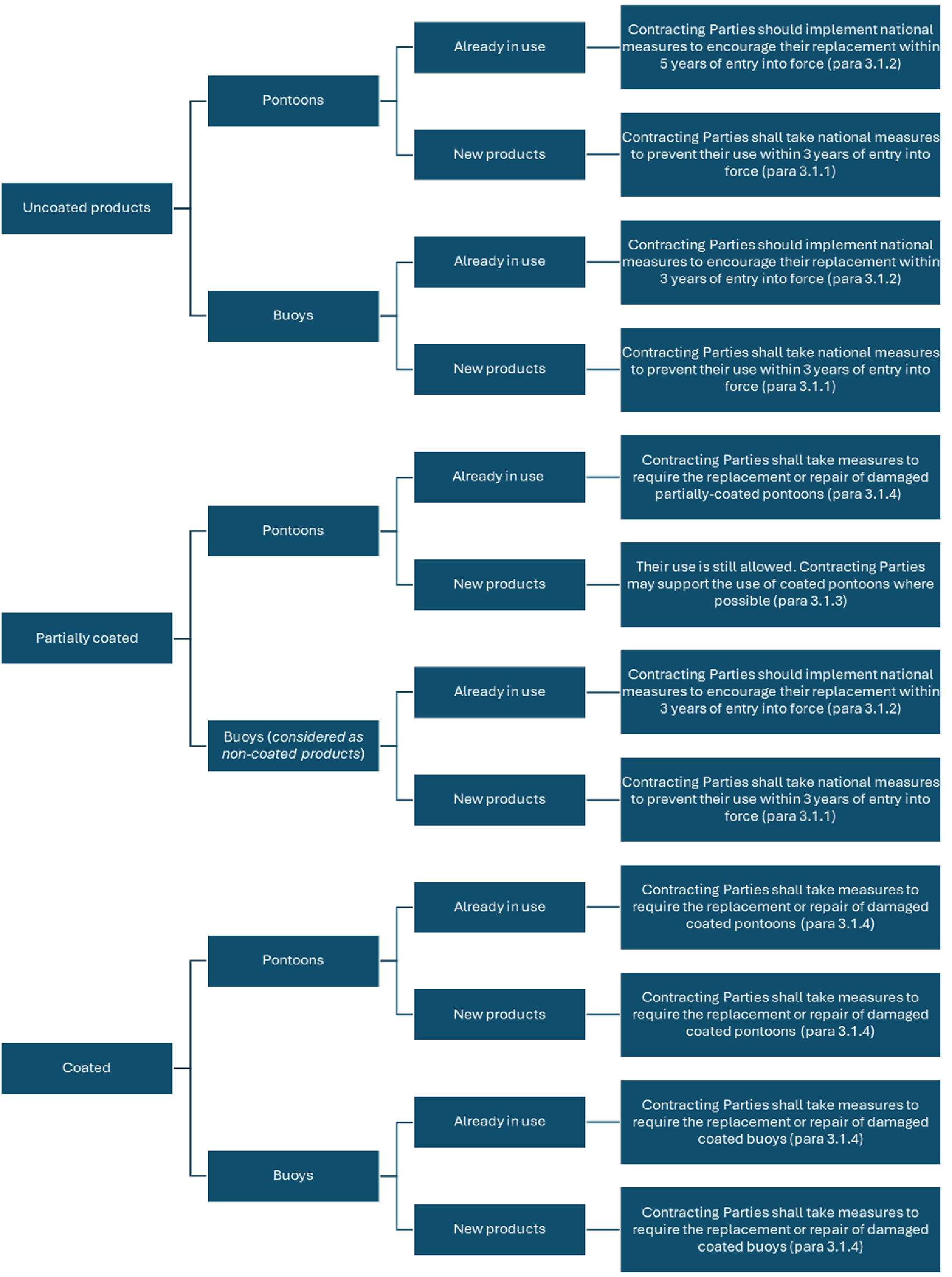
3.1.1. Contracting Parties shall take national measures, within three years of entry into force of this Decision, to prevent the use of new non-coated pontoons and buoys. National measures may include, inter alia:
a. A ban on placing on the market; or
b. licencing controls; or
c. action by other appropriate means to achieve the purpose and scope of the Decision.
3.1.2. Contracting Parties should implement national measures to encourage the timely replacement of existing non-coated pontoons and buoys, with the aim of ensuring that there are no such pontoons and buoys in the OSPAR Maritime Area as soon as possible but at least within five years for pontoons and three years for buoys, following entry into force of this Decision.
3.1.3. Nothing in this Decision shall prevent the continued use of coated pontoons and buoys and partially coated pontoons. However, Contracting Parties may support the use of coated pontoons where possible, in line with the precautionary principle.
3.1.4. Contracting Parties shall take measures to require the replacement or repair of coated pontoons and buoys, and partially coated pontoons, where the coating has been breached or there are signs of degradation, and the EPS, XPS, or other forms of foamed plastic is exposed.
3.1.5. Existing standards for ecotoxicology in aquatic environments should be considered when selecting alternative materials for floating devices (for example, hard plastic materials (e.g. blow-moulded HDPE – high-density polyethylene, filled with air), devices made with hard plastic materials and filled with EPS (e.g. pontoons used for heavy duty applications made of polyethylene float casing), and devices made from ecologically neutral materials, such as cork.
3.1.6. Contracting Parties shall require such monitoring and inspection as is necessary to ensure compliance with the Decision. This could be done through environmental inspections, or notifying and licensing processes for relevant activities, as appropriate.
3.1.7. Appendix 2 of this Decision provides a visual representation of how the provisions listed in Section 3 apply to (i) non-coated pontoons and buoys; (ii) partially coated pontoons; and (iii) coated pontoons and buoys. In case of conflict between the written provisions and the visual representation, the written provisions prevail.
4.1. This Decision will enter into force in accordance with Article 13.2 of the Convention.
5.1. Reports on the implementation of this Decision shall be submitted to the appropriate OSPAR subsidiary body in the intersessional period 2029/2030 in accordance with OSPAR’s Standard Implementation Reporting and Assessment Procedure.
5.2. When reporting on implementation, the format as set out in Appendix 1 shall apply.
The format below for the implementation report on compliance with OSPAR Decision 2025/02 to prevent the release of expanded polystyrene (EPS), extruded polystyrene (XPS), and other foamed plastic from pontoons and buoys
Country:
Reservation applies: Yes / No
Is measure applicable in your country: Yes / No
1. If not applicable, then state why not (e.g. no relevant installation or activity):
....................
....................
....................
....................
....................
Means of implementations:
|
By legislation |
By administrative action |
By negotiated agreement |
|---|---|---|
|
Yes / No |
Yes / No |
Yes / No |
2. Please provide information on:
a. specific measures taken to give effect to this measure by using the attached template;
b. any special difficulties encountered, such as practical or legal problems, in the implementation of this Decision;
c. the reasons for not having fully implemented this measure should be spelt out clearly and plans for full implementation should be reported;
d. if appropriate, progress towards being able to lift the reservation.
....................
....................
....................
....................
De Besluiten 2025/01 en 2025/02 zijn ingevolge artikel 13, tweede lid, van het Verdrag in werking getreden op 13 januari 2026.
Wat betreft het Koninkrijk der Nederlanden, gelden de Besluiten, evenals het Verdrag, voor Nederland (het Europese deel).
In overeenstemming met artikel 19, tweede lid, van de Rijkswet goedkeuring en bekendmaking verdragen heeft de Minister van Buitenlandse Zaken bepaald dat de Besluiten, zullen zijn bekendgemaakt in Nederland (het Europese deel) op de dag na de datum van uitgifte van dit Tractatenblad.
Uitgegeven de eerste mei 2026.
De Minister van Buitenlandse Zaken, T.B.W. BERENDSEN
The percentage targets in this operational objective are regional targets and relate to the OSPAR Maritime area.
“Reduce the impact of expanded polystyrene (EPS) and extruded polystyrene (XPS) in the marine environment” including the development of OSPAR products.
Kopieer de link naar uw clipboard
https://zoek.officielebekendmakingen.nl/trb-2026-48.html
De hier aangeboden pdf-bestanden van het Staatsblad, Staatscourant, Tractatenblad, provinciaal blad, gemeenteblad, waterschapsblad en blad gemeenschappelijke regeling vormen de formele bekendmakingen in de zin van de Bekendmakingswet en de Rijkswet goedkeuring en bekendmaking verdragen voor zover ze na 1 juli 2009 zijn uitgegeven. Voor pdf-publicaties van vóór deze datum geldt dat alleen de in papieren vorm uitgegeven bladen formele status hebben; de hier aangeboden elektronische versies daarvan worden bij wijze van service aangeboden.
 Authentieke versie (PDF)
 Informatie
 Gerelateerd
 Printen
 Delen
Delen