Staatscourant van het Koninkrijk der Nederlanden
| Datum publicatie | Organisatie | Jaargang en nummer | Rubriek |
|---|---|---|---|
| Nederlandse Organisatie voor Wetenschappelijk Onderzoek | Staatscourant 2026, 31537 | overige overheidsinformatie |

U bent nu hier: Publicaties Officiële publicaties
Zoals vergunningen, bouwplannen en lokale regelgeving.
Zoals belastingen, uitkeringen en subsidies.
Officiële publicaties van de overheid.
Adressen en contactpersonen van overheidsorganisaties.

EUROPEAN PARTNERSHIP
DRIVING URBAN TRANSITIONS
DUT Call 2026
Co-funded by the European Commission (Grant N° 101069506)
CALL TEXT
|
IMPORTANT DATES Opening of the call for pre-proposals: 1 September 2026 Submission deadline pre-proposals: 17 November 2026 at 13:00:00 (CET) Submission deadline full proposals: 15 April 2027 at 13:00:00 (CEST) |
Revisions of the Call text
If the Call text has been updated, the changes are tracked in the table below.
|
Date |
Update in Call text |
|---|---|
|
July 3 |
Updated NA for CCDRC, added NAs for FFG, CVTISR and SIA |
|
July 27 |
Updated NAs for BF, DLR, FFG, SNSF, VLAIO, added NAs for AEI, CDTI, ETAg, LMT, NWO, SWEA |
|
August 3 |
Updated NA for CCDRC, added NAs for ANR, LCS, TA CR and TUBITAK |
|
September 1 |
Updated Nas for BF, RCN, added NAs for BSNF, PH, FRS-FNRS, FWO, FZJPtJ, GSRI, KAIA, MHESR, Vinnova |
|
1 |
Introduction |
||
|
1.1 |
Structure of the Call text |
||
|
1.2 |
Background to urban challenges addressed through the DUT Partnership |
||
|
1.3 |
Available budget and funding scheme |
||
|
2 |
Scope and topics of the Call for proposals |
||
|
2.1 |
Aims, approaches and recommendations for proposals |
||
|
2.2 |
Types of research and innovation (R&I) activities to be supported10 |
||
|
2.3 |
Call topics |
||
|
2.3.1 |
Cross-cutting Topic #1: Adaptive reuse of existing urban structures and spaces |
||
|
2.3.2 |
15-minute City Transition Pathway (15mC TP) |
||
|
2.3.3 |
Circular Urban Economies Transition Pathway (CUE TP) |
||
|
2.3.4. |
Positive Energy Districts Transition Pathway (PED TP) |
||
|
3 |
Eligibility criteria and guidelines for applicants27 |
||
|
3.1 |
Consortium: who can participate and apply |
||
|
3.2 |
What can be applied for? |
||
|
3.3 |
Preparing and submitting an application |
||
|
3.4 |
Summary of the transnational eligibility criteria |
||
|
3.5 |
National/regional specific eligibility rules |
||
|
3.6 |
Eligibility check |
||
|
3.7 |
Fallback Procedure |
||
|
4 |
Assessment and selection procedure |
||
|
4.1 |
Pre-proposal stage (stage 1) |
||
|
4.2 |
Full proposal stage (stage 2) |
||
|
4.3 |
Right to object a decision, redress procedure |
||
|
4.4 |
Time schedule |
||
|
4.5 |
Evaluation criteria |
||
|
4.6 |
Conflicts of interest (Expert Panel) |
||
|
5 |
Project implementation |
||
|
5.1 |
Consortium agreement |
||
|
5.2 |
Project monitoring and reporting |
||
|
5.2.0 |
Programme activities |
||
|
5.2.1 |
Mandatory project events |
||
|
5.2.2 |
Reports and summaries for the general public |
||
|
5.2.3 |
Support for the DUT Knowledge Hub(s) |
||
|
5.2.4 |
Support for Mission Innovation “Urban Transitions Mission” participation |
||
|
5.3 |
Publications and dissemination |
||
|
5.3.0 |
Communication Strategy |
||
|
5.3.1 |
Acknowledgements |
||
|
5.3.2 |
Open science practices, data management and data sharing |
||
|
5.4 |
Personal data protection |
||
|
5.5 |
“Do No Significant Harm” (DNSH) principle |
||
|
6 |
Contact details and other information |
||
|
Annex A: Specific Funding Agencies’ Budgets and Rules of Eligibility |
|||
|
Annex B: Data Management |
|||
|
Annex C: Definitions of strategic and applied research and innovation |
|||
|
Annex D: Urban Living Labs |
|||
|
Annex E: Glossary |
|||
The aim of this Call for proposals is to support transnational research and/or innovation projects that help cities tackle urban challenges and transition towards a climate neutral and resilient future for all. Projects should contribute to one or more of the three Transition Pathways: the 15-minute City (15mC), Circular Urban Economies (CUE), and Positive Energy Districts (PED). These pathways provide a holistic and systemic approach to tackling urban challenges, fostering innovation and enabling cities to implement sustainable solutions.
It is the fifth Call of the DUT Partnership co-funded by the European Commission (EC) under the Horizon Europe framework programme.
The projects selected within this Call will be funded directly by national/regional Funding Agencies from the following countries: Austria, Belgium, Bulgaria, Croatia, Czech Republic, Denmark, Estonia, Finland, France, Germany, Greece, Hungary, Kingdom of the Netherlands, Latvia, Lithuania, Norway, Philippines, Poland, Portugal, Republic of Korea, Romania, Slovakia, Slovenia, Spain, Sweden, Switzerland, Tunisia, and Türkiye
Each proposal must involve, at least, three partners from three countries on this list that are eligible for funding by their respective national/regional Funding Agency. At least two of those partners must be from countries eligible for EC Co-Fund (see transnational eligibility rules in section 3.4 for details).
The added value of transnational collaboration should be clearly stated.
Out of the countries listed above, only Funding Agencies from the following countries are eligible for EU Co-Fund (EU Member States and Associated Countries to Horizon Europe): Austria, Belgium, Bulgaria, Croatia, Czech Republic, Denmark, Estonia, France, Germany, Greece, Hungary, Kingdom of the Netherlands, Latvia, Lithuania, Norway, Poland, Portugal, Republic of Korea, Romania, Slovakia, Slovenia, Spain, Sweden, Switzerland, Tunisia and Türkiye
The Call welcomes cross-sector collaborations and projects are expected to adopt co-creative approaches involving stakeholders such as local communities, civil society organisations and the private sector, particularly SMEs, from the early stage of the project design. The participation of a municipality or local authority in the project consortium is mandatory (see section 3.4 for transnational eligibility rules).
Applicants are invited to consider users' needs in the identification of the project goals.
This call puts an extra emphasis on innovation-oriented projects targeted at demonstrating, scaling, and uptake of innovative solutions in cities, districts and neighbourhoods, and in terms of interdisciplinary approaches, it is open to a wide range of scientific disciplines.
This document describes the objectives, scope, and topics of the Call, rules for participation and procedures for proposal development and project implementation.
Further information on this Call (mandatory templates to use when applying, link to the submission platform, etc.) can be found on the DUT Website.
This Call text is structured as follows:
• Section 2 describes the aims and topics of the Call.
• Section 3 presents the eligibility criteria for an application, as well as the instructions for submission.
• Section 4 covers the assessment and selection procedure and presents the evaluation criteria.
• Finally, section 5 describes the implementation of the project regarding the consortium agreement, project monitoring and programme activities.
Cities and urban areas are the nexus for the transformations required if the European Union (EU) is to achieve the targets of the European Green Deal (EGD) and to fulfil commitments related to the United Nations (UN)’ Agenda 2030 Sustainable Development Goals (SDGs), UN-Habitat’s New Urban Agenda, the EU Agenda for Cities, the Urban Agenda for the European Union, and the Paris Agreement (COP21).
Additionally, they play a crucial role in the implementation of the Horizon Europe Mission on Climate-Neutral and Smart Cities (EU Cities Mission) and the New European Bauhaus (NEB) initiative.
The DUT Partnership aims to address these challenges with an integrated approach to offer decision makers in public authorities including municipalities, companies including SMEs and, more generally, society, solutions to enact and enable necessary urban transformations. Furthermore, the DUT Partnership, through research and innovation (R&I) projects, aims to develop skills and tools (including technology) that facilitate urban change, boost urgently needed urban transformations, and bring existing and new knowledge and evidence into action.
The DUT Partnership accelerates urban transitions through three thematic areas – known as Transition Pathways (TPs), which focus on key dimensions of urban transitions: urban mobility (the 15-minute City Transition Pathway (15mC TP)), urban energy (the Positive Energy Districts Transition Pathway (PED TP)), and urban resources and greening (the Circular Urban Economies Transition Pathway (CUE TP)).
While each TP has its distinct thematic focus, they function as interconnected sub-programmes, ensuring that urban transitions are approached in a comprehensive and integrated manner.
• The 15-minute City Transition Pathway (15mC TP) addresses challenges of urban mobility, logistics, public space and proximity-based policies to promote implementation of climate neutral, resilient neighbourhoods for all. It draws on research and innovation projects to showcase a diverse mosaic of approaches that drive mobility transitions. The 15mC TP aims to enable analysis, development and testing of ideas, tools and innovations for 15-minute cities within co-creative and transdisciplinary settings.
• The Circular Urban Economies Transition Pathway (CUE TP) aims to foster urban places, communities and neighbourhoods that are sustained by circular resource flows and enhance the wellbeing of their inhabitants and ecosystems. It encourages urban planning and design characterised by regenerative urbanism, favouring the combination of circular principles, urban greening, and equal access to urban spaces and resources.
• The Positive Energy Districts Transition Pathway (PED TP) aims to develop innovative solutions for planning, large-scale implementation, and replication of PEDs across Europe’s urban and peri-urban areas. By combining energy efficiency, renewable energy production, and energy flexibility at the local level, PEDs offer and contribute to affordable energy systems, affordable quality housing, and competitive, resilient and inclusive local economies for cities through energy communities, contributing to European goals such as the SET Plan and the EU Mission on Climate-neutral and Smart Cities.
For the DUT Partnership to maximise impact of European and global policies, these three TPs are to be considered in an integrated manner. Evidence will be created with and for city administrations, municipalities, businesses and society, with an aim to bring forward the innovations and capacity building needed to transform our neighbourhoods and urban areas into climate neutral, liveable, healthy, socially and economically attractive and well-being places.
The DUT Partnership offers a framework for innovation, demonstration and preparation of larger scale translation of innovative and people-centred solutions and approaches into local urban settings.
Therefore, these insights and solutions generated by the DUT Partnership might also support the Cities Mission implementation, empowering local authorities and stakeholders with the knowledge and tools needed to achieve the ambitious goal of delivering 100 climate-neutral and smart cities by 2030.
The total available budget for this Call is approximately EUR 49 M of budget committed by the participating Funding Agencies. Additionally, the EC will support this Call through Horizon Europe (co-funded action DUT – Grant Agreement number 101069506) with a co-fund of up to 30% of the eligible Funding Agency budget for the 2026, 2027 and 2028 DUT Partnership Calls.
The national/regional Funding Agencies (outlined in Annex A), which are partners of the EC grant under the DUT Partnership project, are ineligible for funding under this Call.
Each national/regional Funding Agency will provide funds directly to their eligible beneficiaries in accordance with the agencies’ rules and regulations.
Tables 1 and 2, provided in Annex A, give an essential overview of the national and regional budgets dedicated to this Call by each Funding Agency and of their positioning on which topics (including the cross-cutting topic), research categories, organisation types, etc. that they can fund.
Table 3, provided in Annex A, presents the funding rules and guidelines for each national/regional Funding Agency.
Focus on urban areas, in the context of achieving climate neutral and resilient cities
Projects are expected to be focused on urban areas (including peri-urban areas) and their issues and challenges. Where appropriate, they may also consider the effects and impact on other territories like rural areas or consider urban-rural relationships, so long as the urban focus remains.
Cross-sector collaboration, broad involvement of stakeholders
The complex societal challenges addressed in the DUT Partnership also ask for knowledge on and insight in transition, innovation and implementation processes, acceptance of new systems and services, and insight in mid- and long-term behaviour of stakeholders.
Therefore, collaboration and co-production of knowledge with practitioners and professionals in companies and governments, advocacy groups, citizen and inhabitant groups or NGOs (grouped under the generic name of “stakeholders” below), is highly relevant.
All projects must clearly engage stakeholders and demonstrate user needs relevant to the project goals (see the evaluation criteria in section 4.5).
Stakeholders might, for example, be involved in the choice of the topic of the proposal, in the design and advising on the project and/or in carrying out parts of the work programme. Therefore, consortia submitting proposals to this Call are asked to describe how stakeholders are involved in the project (such as, throughout the various stages of project design, implementation, analysis and dissemination). The extent of involvement may vary according to the context of the project proposed and national/regional regulations of participating Funding Agencies.
Stakeholders may be associated with the project as full partners or as cooperation partners that do not directly receive funding but can contribute to the project in various forms (in steering committees, as advisors, as providers of data, etc.). See Annex A for individual funder rules.
Projects are expected to take a transdisciplinary, cross-sectoral and preferably co-creative approach from the early project formulation stages.
A systemic approach to urban transitions
Recognising that transformative impact stems from system innovations, DUT emphasises the systemic nature of urban transitions. Cities function as interconnected, complex systems composed of social, environmental, economic and technological dynamics, and identifying leverage points for scalable solutions is crucial to altering the structural conditions that shape urban development. To translate this systemic approach into practice and provide a foundation for systemic urban change and leverage points, DUT defines urban impact through four interdependent impact dimensions. Projects are encouraged to address all or as many of these dimensions as possible:
– Culture and values
– Governance and policy
– Technologies and infrastructure
– Business models and tools
A place-based approach
Transformative change must be locally grounded to be effective. Therefore, a place-based approach is key to DUT’s modus operandi, to ensure that the urban transition is rooted in local identities, social needs and ecological benefits. Understood and implemented as a bottom-up strategy place-making empowers local actors and communities to shape both their environments and broader systemic structures. Applicants are encouraged to acknowledge their project’s local contexts, actively engaging diverse stakeholders to co-create on the project.
Inclusion of diversity (including gender dimension) or specific population considerations
Applicants must integrate diversity considerations in submitted proposals, as well as consider underrepresented populations in the planned research (see also the Evaluation Criteria in section 4.5). This includes not only diversity distribution and gender balance in the consortium composition, but also the inclusion of diversity perspectives and analysis in the R&I activities where this is relevant1.
Transnational benefit
Projects should support collaboration that goes beyond individual national efforts and demonstrates sharing, operationalising and transferring of existing knowledge, resources, and research facilities to mutual, transnational benefit. Clear added value of the transnational consortium should be demonstrated and, if relevant, the added value for national investments.
Connection to earlier transnational European, national, regional, local research and innovation actions
The projects funded in this Call are expected to build on existing knowledge and experience as achieved in earlier relevant transnational European, national, regional and local R&I programmes, pilots, test implementations and field labs2. In the proposal, it is necessary to indicate how projects are positioned with respect to the state-of-the-art.
In particular, projects are expected to articulate how they go beyond the current state-of-the-art and leverage results from previous or ongoing transnational European, national, regional and local R&I initiatives, such as relevant projects in the Horizon 2020 and Horizon Europe programme (including Cities Mission calls among others), JPI Urban EuropeCalls, NetZeroCities Pilot Cities Programme, LIFE programme, Climate Adaptation Missioncalls, New European Bauhaus, Clean Energy Transition Partnershipcalls, etc.
Outputs and outcomes of the projects, broader impacts of the proposed activity
The Call Secretariat recommends that establishment of potential long-term partnerships, leveraging of existing knowledge networks and project co-design between project participants and their stakeholders be essential components of the proposed projects.
Additionally, it is recommended that outputs be targeted towards decision-making (including public and private spheres, as well as communities) and innovations as broadly understood in DUT (technological, organisational, institutional, social etc.).
The proposals are expected to present:
• how stakeholders will be engaged and contribute to the project and will be involved in the dissemination and uptake of the results;
• their plan for broadly communicating and disseminating outputs and outcomes, to enhance knowledge transfer of results to end users; and describe their strategy for longer-term uptake and scaling of project outcomes;
• how project measures might support the effective implementation of related urban strategies and action plans, e.g. Climate City Contracts for projects with an EU Mission Label.
The projects are also asked to contribute to, and through their results, feed into the dissemination and valorisation activities of the DUT Partnership (see section 5.3 – Programme activities).
This Call is open for proposals referring but not limited to strategic urban research, applied urban research, urban innovation (see definitions in the table below). Different Funding Agencies have the possibility to fund different parts of the R&I landscape. Table 1 in Annex A indicates the research types that will be funded by each Funding Agency.
The call is open to a very wide range of scientific disciplines and the combination of different research types within one project (with potential differentiation at work package level) is possible. Please consult Annex A to find out which disciplines and research types are funded by your Funding Agency.
While some project aspects (purpose, intended impact, roles and level of stakeholder involvement) depend heavily on a project's positioning with respect to R&I activities, it is worth noting that all TPs (and all subtopics except for the crosscutting topic which is for innovation projects only) are open to both the research oriented and the innovation oriented approach. Therefore, the assessment framework accounts for differences between the approaches by applying specific sub-criteria (see section 4.5).
At the program level, DUT aims to establish a balanced portfolio of funded projects covering the R&I landscape. While DUT encourages proposals adopting an innovation-oriented approach (IOA) to maximize real-world impact and solution uptake, applicants are asked to identify and indicate which of the following approaches is the best fit for their project, depending on the main purpose of their proposal:
• a more “research-oriented approach” (ROA) to support projects aimed at producing knowledge, analysing data, better understanding and modelling phenomena, and developing expertise and tools that will be useful to stakeholders, practitioners and policymakers. This R&I orientation (called ROA moving forwards) welcomes proposals mainly focused on strategic and/or applied research;
• a more “innovation-oriented approach” (IOA) to support projects aimed at developing or improving practical, operational solutions for companies, local communities and urban public authorities, as well as piloting, testing, demonstration, scaling and commercialization of such solutions. This R&I orientation (called IOA moving forwards) welcomes proposals mainly focused on applied research and innovation3.
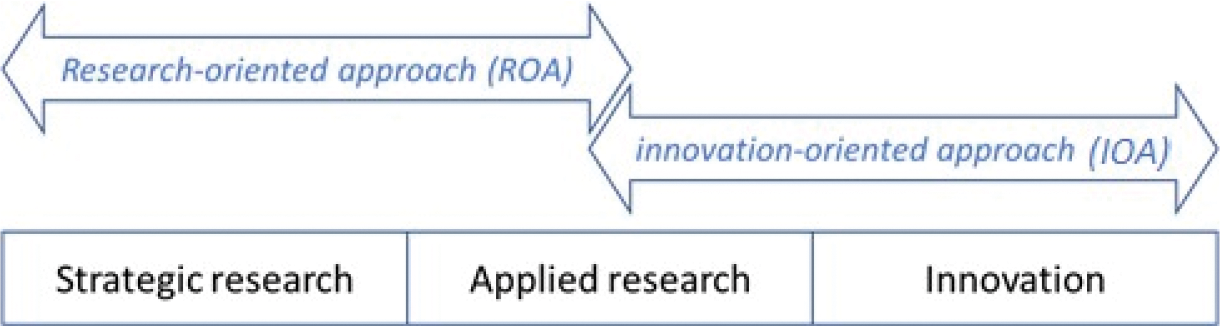
Figure 1: positioning of the ROA and IOA with respect to research and innovation
Note: This figure only applies to the definitions used by the Call Secretariat (which are used to position applications on the Expert Panels, etc.). Specific Funding Agencies may have different definitions/criteria – therefore, Applicants must familiarise themselves with the National Annexes (see Annex A) of the Funding Agencies involved in their proposal.
For proposals combining both research and innovation aspects, the project coordinator must choose the approach that is the most relevant considering the main objective and major novelty brought about by their project. Alignment is expected between the type of activities (ROA/IOA) and the type of partner contribution indicated.
|
Definitions of strategic research, applied research and innovation (research types) The key characteristics of the three stages of R&I activities are defined as follows: • “Strategic urban research” is defined as research activities driven by the desire to know, understand, and explain how cities function and interact across domains and sectors. Strategic urban research by this definition encompasses qualitative, as well as quantitative approaches, and examples can be found in any academic discipline. The subject of this type of research can be a specific aspect of a city or a city in its entirety, or even a network of related cities. Strategic urban research can be theoretical, comparative or case specific. For this research approach, the primary goal is to expand on common knowledge about how cities function. In line with this, it places a high value on traditional scientific methods and publication in peer reviewed journals. In many cases, this type of research should still have value to end users so they should be engaged where appropriate. • Understanding of how cities function (within the scope of the Call Topics) is essential to be able to achieve effective (policy) intervention. Achieving this through knowledge creation is often referred to as “applied urban research” (corresponding to industrial research in the GBER1). Applied urban research in this context is about how city officials, citizens and inhabitants, practitioners and others can influence and interact with a city, with the purpose of improving or adapting it, in some respect. In applied urban research, there is good opportunity to involve citizens and inhabitants, and representatives from non-academic institutions (NGOs, advocacy groups, citizen and inhabitant organisations, companies, public authorities...) in projects, to bring a practitioners’ perspective to co-produce knowledge relevant for user stakeholders. Applied urban research is designed to be tangible and applicable to such a degree that the results are likely to have an impact on actual decisions and policy. Apart from publication in peer reviewed journals, knowledge exchange activities such as policy briefings, policy seminars and other events targeted at stakeholders are important, as well as dissemination in popular media. • While strategic and applied urban research are both focused on producing knowledge, “urban innovation” (corresponding to experimental development in the GBER) takes things one step further and promotes the actual creation or advancement towards new policies, practices, services, products or processes – such as integrated systems, tools, services and data – in such a manner that the first impact already takes place during the project phase. Initiatives should therefore have a focus on experimentation, testing, demonstration, evaluating and disseminating results, and are always carried out in close collaboration with stakeholders. Policies, practices, processes, services or products being developed could be of commercial value, but equally welcome is innovation directed at public governance, management and operation (societal value). Urban innovation should be carried out in close collaboration with stakeholders. |
For more details, see Annex C.
The following table provides some key characteristics of the two R&I approaches.
|
Characteristics |
Research-oriented approach (ROA) |
Innovation-oriented approach (IOA) |
|---|---|---|
|
Desired impact |
Advance towards answering the questions: • “How do cities really function?” in a way that can be generalised and add to the universal body of knowledge about cities and serve as a foundation for future research. • “What works, when attempting to improve cities?” in a way that can be generalised enough to serve as useful knowledge for decision makers and practitioners. |
Advance towards the development, implementation, demonstration, testing, evaluation and uptake of approaches for new products, services, policies, practices and processes, with potential for improving economic, social or environmental sustainability in cities. |
|
Importance of generating results fit for publication in reputable academic journals |
Very important |
Encouraged |
|
Methodological approach |
Rigorous scientific method including methodological advancement |
Systematic, proven approach |
|
Foundation of work on evaluation and analysis of empirical observations |
Encouraged |
Required |
|
Involvement of stakeholders |
Involved at least as advisors |
Directly involved in the workload |
|
Role for applying Urban Living Labs (see Annex D) |
Welcomed |
Encouraged |
|
Role for policy research |
Fits well |
May fit |
|
Valorisation of project results delivering factual impact (facts and figures) |
Provision of insights to an important societal issue, production of useful, impactful knowledge in terms of facts and figures for stakeholders/decision makers/practitioners |
Market potential and quantitative impact of the project or capacity to respond to a demand or need (including societal needs) |
|
Interdisciplinary approach |
Encouraged |
Encouraged |
|
Academic disciplines expected in project |
All welcome (especially from social sciences, arts and humanities) |
|
|
Preference for qualitative and quantitative methods |
Both welcomed |
Both welcomed |
|
Background of evaluators for project assessment |
Knowledgeable researchers from universities and Research and Technology Organisations (RTOs) with topic relevant disciplinary background and expertise, researchers with strong experience on utilisation of research results, representatives of companies, cities and other relevant stakeholders. |
|
The Call topic descriptions are organized under the three Transition Pathways (TPs): CUE, 15mC, and PED. For each TP, two topics have been identified as focus areas for this year’s Call.
As urban transition challenges are inherently interconnected, proposals may address multiple topics across one or more TPs. Therefore, DUT encourages cross-cutting projects that combine aspects from different TPs. However, each proposal must select one primary TP topic, which is most closely aligned with the proposal’s core focus and against which it will be evaluated. Additionally, proposals may indicate any additional TP topics addressed, to make sure that cross-cutting aspects will be considered during the assessment.
To further strengthen real-world impact, scaling and accelerate the uptake of solutions, this Call introduces a dedicated cross-cutting topic open to Innovation Oriented Approaches (IOA) only. This topic explicitly spans all three TPs and responds to the need for projects that move beyond conceptual development towards pilots, demonstrations, transformation and implementation in real urban contexts. By focusing this topic exclusively on IOA projects, the Call aims to support initiatives with a high degree of maturity, strong cross-sector collaboration, and clear pathways to deployment, replication, and scaling.
Applicants are therefore invited to carefully select the approach, Research Oriented Approach (ROA) or Innovation Oriented Approach (IOA), that best aligns with their project objectives, and to note that the cross-cutting topic is open for IOA proposals only, with the explicit ambition to maximize impact and solution uptake across European cities.
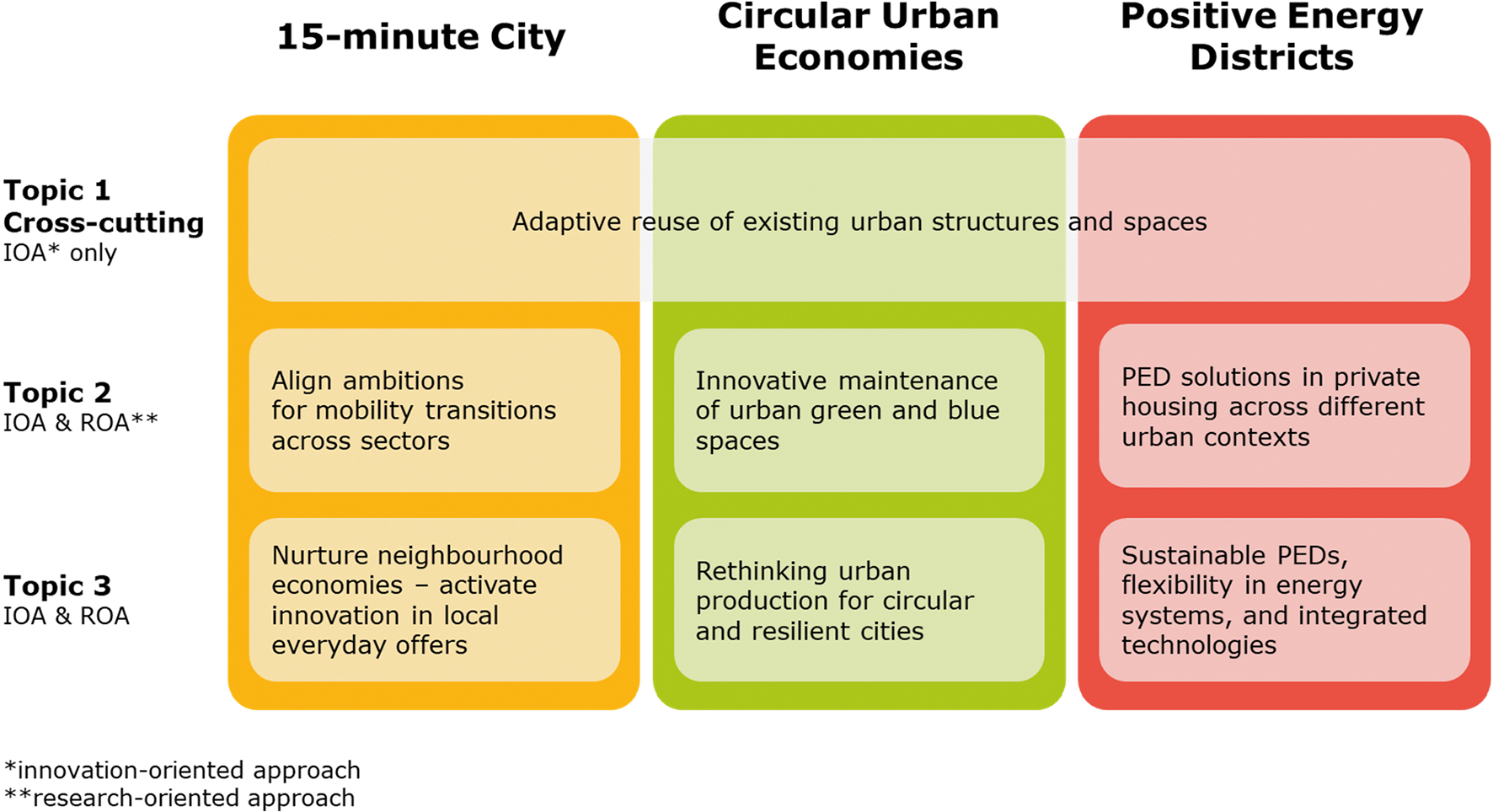
Transformative projects in urban contexts require holistic approaches, and the integration of thematic and organisational layers. The connected level of complexity asks for systemic approaches, balancing conflicting objectives, and engagement of a diversity of stakeholder groups. For this cross-cutting innovation-oriented topic, we encourage potential applicants to compile inter- and transdisciplinary consortia that go beyond single-sector perspectives and explore combinations of aspects from all DUT Transition Pathways.
Please note that:
• This topic is only open for applications making use of the Innovation Oriented Approach (IOA).
• Beyond the general DUT criteria to include an urban public authority in the consortium, this topic has a specific transnational eligibility criteria to include at least one private sector organisation (see section 3.1).
• For administrative reasons, proposals need to select one main thematic focus / one Transition Pathway (15mC / CUE / PED) in the submission system. However, an integrated approach is expected, combining specific aspects (see below) of at least two of the three Transition Pathways.
• Please consult Table 1 and 2 in Annex A for an overview of which of the Funding Agencies that fund this as well as the TP-specific topics.
CHALLENGE DESCRIPTION
Across Europe, cities are made of extensive stocks of buildings, infrastructures, streets, industrial sites, green and blue areas; some of them underused, vacant or obsolete. These assets embody large amounts of material, energy, economic, and cultural value, but also spatial potential. At the same time, urban areas face accelerating pressures from risks caused by climate change, energy dependency and energy poverty, social inequality, shortage of affordable housing, mobility challenges, and resource constraints. Continuing to prioritise new construction on green fields over the transformation of existing urban structures risks locking cities into carbon-intensive pathways, increasing land take, and missing opportunities for faster, more inclusive, and cost-effective urban transitions.
Adaptive reuse refers to repurposing an existing building, infrastructure or urban space for new functions while preserving much of its original material. Instead of demolishing buildings or sites, adaptive reuse offers a powerful lever to reimagine and repurpose existing structures and spaces to meet present and future needs. When strategically implemented, adaptive reuse can reduce material and energy demand, activate underused urban space, support compact and people-centred urban living, and enable the integration of renewable energy systems and flexible infrastructures.
At the same time, adaptive reuse can generate latent effects and unexpected outcomes for inhabitants. These may include shifts in social dynamics, changes in affordability and accessibility, and the potential for both community revitalisation and displacement (e.g., through gentrification). Altered spatial layouts and building characteristics can also influence everyday practices, comfort, and perceptions of place. While adaptive reuse can strengthen local identity and cultural continuity, it may also introduce tensions between preservation and new uses. Understanding these unintended or indirect impacts is therefore critical to ensuring that adaptive reuse contributes not only to environmental and economic goals, but also to socially equitable and inclusive urban development.
Despite its potential, the real-world implementation of adaptive reuse remains fragmented. Regulatory barriers, fragmented ownership, misaligned incentives and sectoral silos are some of the aspects that hinder large-scale application. There is a strong need for innovative projects that move beyond individual buildings or isolated interventions and demonstrate adaptive reuse as a systemic, cross-sectoral urban transformation strategy. This is at the core of this topic, which invites proposals to tackle the above-mentioned challenges through integrated, place-based, and systemic approaches.
SCOPE
Project proposals submitted under this topic should address one or several of the following questions:
• How can adaptive reuse and redevelopment of existing buildings, retail spaces, infrastructures, (semi-)public space, brownfields, or industrial areas and green and blue spaces be implemented as an integrated strategy that simultaneously supports circular resource use, low-carbon energy systems, and a city of short distances?
• How can underused or mono-functional urban spaces (e.g. parking areas, motorized traffic-dominated streets, vacant buildings, industrial estates) be transformed through real-world pilots into multifunctional, high-density spaces that support sustainable mobility, local production, social services, local energy sharing and community life?
• Which cross-sector collaboration models (e.g. between municipalities, housing providers, energy actors, mobility providers, SMEs, business sector and civil society) enable adaptive reuse projects to move from concept to implementation and long-term operation?
• Which participatory methods can be used to enable community involvement and local ownership, but also guarantee high sustainability ambitions? How can (small) businesses, local initiatives and associations/NGOs be integrated and actively engaged in local developments and solutions, together with public entities, real estate developers and larger enterprises?
• Which policy, planning, and governance approaches, including incentives, regulatory tools, and community engagement mechanisms, most effectively enable implementation of inclusive and socially responsive adaptive reuse projects that enhance individual and systemic resilience?
• How can proposed interventions address underlying structures, including governance arrangements, investment logics, regulatory frameworks, behaviours, and cultural norms.
• How can adaptive reuse overcome regulatory and financial barriers, as well as obstacles related to fragmented ownership, and what innovative governance, financing, or procurement models can enable replication and scaling?
• How can adaptive reuse projects integrate high-quality design, aesthetics, and cultural heritage – in line with the principles of the New European Bauhaus – ensuring that interventions are not only sustainable and functional but also beautiful, inclusive, and reflective of local identity and sense of place?
• How can adaptive reuse interventions deliver measurable impacts in terms of emissions reduction, energy performance, resource efficiency, accessibility, social inclusion, and resilience, and how can these impacts be monitored to support uptake?
Specific 15mC aspects
• How can mobility infrastructure and public spaces be made future-proof and resilient – capable of absorbing external shocks, remaining flexible under changing conditions and enabling rapid recovery from disruptions? How can changes to existing mobility infrastructure be implemented while maximising material reuse, responding to shifting mobility needs and demographic changes, avoiding overreliance on a single dominant transport mode?
• How can integrated planning instruments that coordinate construction and maintenance of streets and squares across municipal departments and stakeholders best contribute to resilience, effective adaptation and efficient resource use? Which tools, conditions and processes are required to make integrated planning the standard practice in urban development?
• What is needed and how can experimental and temporary mobility arrangements (e.g. during construction phases) be applied across contexts to test iterative interventions, diversify monofunctional traffic spaces and enable new uses?
• How can adaptive reuse of outdoor infrastructure (e.g. vacant lots, parking garages, rooftop spaces, and semi-public areas) be promoted and effectively supported to create healthy, green and socially inclusive spaces?
Specific CUE aspects
• How can adaptive reuse reduce environmental impacts and support circular urban economies by extending the lifecycle of buildings, minimizing demolition waste, and prioritizing the reuse of existing resources?
• How can adaptive reuse balance cultural heritage preservation with contemporary urban needs, enabling cities to maintain architectural identity while accommodating new functions and uses?
• How can the transformation of underutilised buildings and sites through adaptive reuse address pressing social and spatial needs, such as affordable housing, cultural infrastructure, and accessible green public spaces?
Specific PED aspects
• How can adaptive reuse projects embed Positive Energy District principles, such as energy efficiency, local renewable energy production, energy flexibility, shared energy systems, or energy communities, within existing urban fabrics and mixed-use neighbourhoods?
• How can mixed-use functions combining industrial, commercial, and community functions be promoted, and how can synergies between these different uses be best used in terms of energy production, sharing and flexibility (e.g., coordinated use of waste heat)?
• How can brownfield areas/former industrial areas be transformed into multi-functional, local/regional energy hubs with a potentially positive energy balance? How can they be integrated into the overall energy system?
EXPECTED OUTPUTS AND OUTCOMES
Rather than focusing on isolated technical solutions, projects are expected to address this topic in a systemic way. Project outputs should be both impact- and process-oriented, ensuring they are as concrete and user-centered as possible, and are expected to:
• Demonstrate real-world pilot projects showcasing adaptive reuse of existing urban structures and spaces, integrating solutions for energy, mobility, circularity, and spatial transformation.
• Show how proposed interventions address underlying systemic conditions, including governance arrangements, investment logics, regulatory frameworks, behaviours, and cultural norms.
• Deliver validated implementation models for adaptive reuse that combine spatial redesign, energy system integration, circular resource strategies, and cross-sectoral governance arrangements.
• Provide evidence-based insights on the performance, costs, benefits, and trade-offs of adaptive reuse interventions, supporting informed decision-making and de-risking future investments.
• Develop replicable frameworks and toolkits enabling cities and urban stakeholders to plan, finance, and implement adaptive reuse projects at neighborhood or district scale.
• Generate policy and regulatory recommendations informed by pilots and experiments, addressing barriers related to planning, energy regulation, mobility, ownership structures, and procurement.
• Establish participatory approaches and frameworks that enable meaningful community involvement and local ownership, while ensuring significant impact across energy, mobility, space use, and circular resource flows.
• Outline strategies for uptake, replication, and scaling, demonstrating how adaptive reuse can be mainstreamed across diverse urban contexts and contribute to long-term urban transition pathways.
CHALLENGE
Extensive commuting to work – predominantly by private car – is a daily reality for millions of Europeans, with significant implications for both individuals and society as a whole. While some companies (e.g. office and shopping centres as well as industrial sites) and large institutions, such as hospitals or universities, are taking steps to support employees and customers in choosing active mobility, public transport and e-mobility as their first and default option, such efforts remain relatively rare, fragmented and uncoordinated. More coordinated and ambitious action is needed, specifically in times of energy crisis.
This topic therefore aims to align ambitions for shifting towards and building infrastructure for sustainable mobility modes between public authorities and (especially large) private and public organisations.
Building on goals and requirements set out in city strategies such as Sustainable Urban Mobility Plans (SUMPs) and Climate City Contracts on the one hand, and the Corporate Sustainability Reporting Directive (CSRD)4 and EU Taxonomy on the other, both sides are obliged to take shared action and increase ambition, effort and output, when it comes to sustainable travel of employees and customers. The challenge is to stimulate effective and scalable forms for collaboration that jointly shape an urban future with sustainable mobility at its core.
SCOPE
In this topic, proposals are encouraged to develop and test innovative and scalable approaches to corporate mobility management that support sustainable commuting, work-related and consumer mobility. The focus is on holistic concepts that reduce traffic, costs and emissions while improving employee health, well-being and satisfaction, thereby strengthening companies’ social and local responsibility.
At the core are pathways towards sustainable corporate mobility that prioritise shared, active and / or non-motorised transport modes (such as public transport, ride sharing, cycling and walking), emission-free vehicle fleets, as well as organisational and digital solutions that reduce resource use. Proposals should build on existing policy instruments and market options, while developing attractive incentives (pull measures), as well as exploring appropriate regulatory or organisational conditions (push measures) to mobilise both companies and employees. The assessment of impacts on employers, employees and the surrounding districts, including co-benefits for climate, health, equity and quality of life, may form an integral part of the analysis and implementation.
Projects should enable private and public organisations to jointly identify and address mobility challenges together with public authorities and mobility providers and further deepen existing efforts. Emphasis should be placed on building long-term, trust-based partnerships between sectors, including clear governance, data sharing, capacity building and flexible collaboration models, beneficial for both sides and adapted to different organisational contexts. Such partnerships should be perceived as active contribution to local mobility strategies delivered by organisations, with a clear articulation of their roles and resources, as well as social and territorial responsibilities.
Furthermore, projects are invited to explore the shared and multiple use of public, private and semi-public spaces and infrastructure, including parking, (bi-directional) charging, logistics facilities and vehicle fleets, supported by viable business and organisational models. The aim is to stimulate mutual learning on resource and infrastructure sharing and to develop implementation cases that enable such practices, in line with rhythms throughout the day (e.g. coordination and slot management for parking and charging infrastructure, opening private vehicle fleets for general use), to be deployed at scale.
Finally, proposals are invited to examine how changes in work organisation and location (e.g. hybrid work, satellite offices, co-working spaces) can reduce frequency of commuting, trip length and peak-hour travel spikes, thus supporting the implementation of 15-minute City concepts and creating opportunities in peripheral or disadvantaged areas. Focus on this topic should include analyses of commuting patterns, governance and cost structures, incentive mechanisms and the impacts of changing work arrangements on cities and urban mobility systems.
Project proposals submitted under this topic may address one or several of the following questions:
• How can corporate mobility management be leveraged as a systemic driver for sustainable mobility transitions at urban and regional scale?
• How can corporate mobility strategies be effectively aligned with public mobility policies and long-term urban objectives, including clear governance, responsibilities and accountability?
• What conditions, frameworks and business models are required to scale and mainstream innovative corporate mobility solutions beyond pilots and across diverse organisational and territorial contexts?
• How can durable, trust-based collaboration between companies, public authorities and mobility providers be institutionalised, including data sharing, capacity building and coordinated decision-making?
• How can shared and multi-use of corporate and public mobility-related spaces and infrastructure be strategically enabled and implemented to increase resource efficiency, resilience and inclusiveness in urban mobility systems?
• How can changes in work organisation and location be strategically harnessed to reduce mobility demand and peak-hour travel spikes, support polycentric and 15-minute City development and create opportunities in peripheral or disadvantaged areas?
EXPECTED OUTPUTS AND OUTCOMES
Rather than focusing on isolated technical solutions, projects are expected to address this topic in a systemic way. Project outputs should be impact-oriented and process-oriented, and therefore as concrete and user-centred as possible. Expected outputs include, but are not limited to:
• Evidence-based frameworks, methodologies and toolkits that enable companies and public authorities to design and implement corporate mobility management as a lever for systemic urban mobility transformation.
• Pilots and testbeds for creative, innovative and scalable approaches for corporate mobility management that is based on deep understanding of needs and opportunities and builds on testing and assessment of options.
• Practical models for cross-sector collaboration, including data-sharing frameworks, capacity-building approaches and partnership structures that enable sustained cooperation between companies, public authorities, and mobility providers.
• Scalable approaches for shared resource and infrastructure use, supported by viable organisational and governance arrangements.
• Analyses, decision-support tools and pilot approaches that demonstrate how changes in work organisation and location (e.g. hybrid work, satellite offices) can reduce commuting demand, flatten peak-hour travel spikes and reshape mobility patterns.
CHALLENGE
A functioning mix of commerce, services and production plays a central role in everyday urban life. It enables residents to meet daily needs locally, provides employment opportunities, fosters social interaction and contributes to vitality and resilience in neighbourhoods. Across cities of different sizes and contexts, rising e-commerce and competition from out-of-town shopping centres have weakened traditional district structures. This resulted in high vacancies and increasingly fragile and unbalanced local offers, which in turn drive greater everyday mobility and reduce access to nearby services. Yet being able to satisfy daily needs locally is a key determinant of quality of life and building local resilience, and a cornerstone for 15-minute City concepts.
This topic focuses on neighbourhood economies, understood as systems of diverse local commerce and social exchange, embedded in community relationships. Such systems generate shared wealth by circulating value locally, reducing travel distances and strengthening trust, identity and resilience – while acknowledging its embeddedness in bigger city-regional systems. Accordingly, the topic invites research and innovation on how to rethink and revitalise neighbourhood economies as multifunctional, pedestrian-friendly centres that integrate commerce, services, workplaces and small-scale production, while also considering key dimensions of urban mobility transitions. All proposals should foresee active engagement of critical local stakeholders needed to fulfil selected themes and laid out objectives.
SCOPE
This topic encourages projects to explore different pathways that strengthen, stabilise and / or rebuild neighbourhood economies by enhancing local opportunities, essential services and community wealth. Proposals should address challenges such as gaps in local provision (e.g. food or service “deserts”) and analyse how neighbourhood economies evolve over time in response to societal, economic, and demographic change. A systemic, multi-level perspective is expected, examining neighbourhood economies from the local to the metropolitan (and where relevant, national) scale.
Proposals should conceptualise neighbourhood economies as interconnected systems shaped by business models, legal and regulatory frameworks, financial (dis)incentives, governance arrangements, (public) procurement practices, as well as alliances among public, private and community stakeholders. Understanding how these factors influence the availability, diversity and resilience of local goods and services across different urban and geographical contexts is central to developing effective responses.
Building further on these aspects, proposals should identify key levers for intervention in situations of undersupply or unbalanced local offers and co-create locally embedded solutions. Potential pathways include the role of anchor institutions in bundling local needs – such as commerce, services and spaces for social interaction – and in supporting collective and community-based initiatives that strengthen social ties. This may also involve initiatives to (re)introduce small-scale production and manufacturing into neighbourhoods, as well as to (re)connect work and everyday life through hybrid models, such as co-working spaces, workshops, repair cafés or makerspaces.
Proposed approaches should build on existing local assets and resources, including people, skills, services, alliances and built environment, and explore how these can be mobilised to generate durable local opportunities. Key implementation challenges include mediating between property owners and local users, establishing public-private-community partnerships to close gaps in local supply, scaling effective collaborations and fostering community wealth building. Disadvantaged neighbourhoods but also suburban areas may serve as living laboratories for testing and refining such models beyond inner-city districts. Proposals are encouraged to build on deep understanding of good practices across different urban contexts to develop actionable strategies and ensure endurance beyond short-term experimentation.
This topic further invites engagement with concepts such as foundational economy, community prosperity and neighbourhood economies, particularly in relation to care, everyday services and local infrastructures that support reproduction of society and enhance a balanced mix of urban functions within built environments.
Finally, proposals are encouraged to investigate how spatial and mobility-related policies, such as land-use planning, ground-floor management, pedestrianisation, short-distance mobility and new work arrangements, interact with local economic dynamics.
Project proposals submitted under this topic should address one or several of the following questions:
• Which structural, regulatory, financial and governance factors most strongly influence the availability, diversity and resilience of local offers of goods and services, and how do they differ across contexts?
• Which levers for intervention are most effective in addressing gaps, undersupply and imbalances in neighbourhood offers and infrastructures, particularly in disadvantaged or vulnerable areas?
• Which collaborative models between public, private, and community-based stakeholders may enable and stabilise effective initiatives to increase local offers and infrastructures?
• How can anchor institutions, community-based initiatives and hybrid business models strengthen local supply, social ties and community wealth? What is needed to synthesise, translate and scale related existing practices to other contexts?
• Under what conditions can small-scale production, manufacturing and hybrid business models (e.g. co-working spaces, repair cafés, makerspaces) be successfully (re)embedded in neighbourhood economies?
• How do spatial planning and mobility policies interact with neighbourhood economies, and to what extent can they be applied to avoid daily trips or shift to sustainable mobility options, while enhancing local economic vitality?
• How can digital services (such as apps, chat groups, formal and informal neighbourhood platforms) be applied to strengthen neighbourhood economies and local social resilience?
EXPECTED OUTPUTS AND OUTCOMES
Rather than focusing on isolated technical solutions, projects are expected to address this topic in a systemic way. Project outputs should be impact-oriented and process-oriented, and therefore as concrete and user-centred as possible. Expected outputs include, but are not limited to:
• Evidence and analytical frameworks to understanding dynamics in neighbourhood economies from a systemic perspective.
• Insights on intervention pathways and co-created, locally embedded solutions, building on effective levers to address gaps and imbalances in local provision.
• “Policy packaging” to strengthen neighbourhood economies that guide interventions in cities of different size and context.
• Governance and collaboration models between public, private and community-based stakeholders that support local supply and community wealth building.
• Strategies for scaling and perspectives to increase durability beyond pilots, building on synergies with existing local initiatives.
• Evidence-based recommendations on interactions of planning and mobility policies and results on neighbourhood economies, reduced travel demand and sustainable mobility.
• Greater readiness for replication and policy uptake of neighbourhood economy approaches.
CHALLENGE DESCRIPTION: Urban green, blue, and blue-green spaces, such as parks, gardens, street trees, rivers, ponds, and wetlands, are vital components of city ecosystems. They provide critical services including biodiversity habitat, stormwater management, urban cooling, and recreational and social value. However, the long-term maintenance of these spaces is often undervalued or under-resourced, leading to degraded ecological health and diminished benefits. Conventional maintenance regimes that prioritize neatness or minimal cost can inadvertently harm biodiversity (e.g. over-mowing or removing natural debris) and limit the climate resilience potential of urban nature elements. With climate change intensifying and biodiversity in decline, cities urgently need to reimagine maintenance as a proactive strategy for adaptation and ecological health. European policy developments underscore this urgency: the new EU Nature Restoration Law aims to halt net loss of urban green spaces by 2030 and increase urban nature area in following decades, and it mandates restoring urban ecosystems and ensuring access to quality green space for all residents. This calls for innovative, systemic approaches to maintenance, not just technical fixes, but new governance, financing, and collaborative models, to enhance the biodiversity, climate adaptation capacity, and social value of urban green and blue assets.
SCOPE: Project proposals submitted under this topic should address one or several of the following questions:
• How can routine maintenance practices (such as mowing, pruning, and waterway management) be transformed to boost urban biodiversity and ecological health while preserving functionality and safety in green and blue spaces?
• How can maintenance strategies for urban nature contribute to climate adaptation, for example, by managing vegetation and water in ways that reduce heat, drought and flood risks, and what innovations are needed to adapt upkeep regimes under changing climate conditions?
• What governance models and cross-sector collaborations (e.g. across municipal departments, community groups, and private stakeholders) can ensure the sustainable long-term stewardship of urban green and blue spaces, overcoming silos and engaging new actors in maintenance?
• What innovative financing mechanisms or business models can be developed to fund the ongoing care of parks, waterways and other urban natural areas (for instance, dedicated green maintenance funds, public-private partnerships, or payments for ecosystem services)?
• How can maintenance practices maximize the social value of urban nature, ensuring that green/blue spaces are accessible, safe, and inclusive for all communities, while also enhancing ecological outcomes?
• What are citizens’ needs in terms of urban nature? And how can citizens by actively involved in the maintenance of Urban Green and Blue Spaces?
EXPECTED OUTPUTS AND OUTCOMES: Rather than focusing on isolated technical solutions, projects are expected to address this topic in a systemic way. Project outputs should be impact-oriented and process-oriented, and therefore as concrete and user-centred as possible. Expected outputs include, but are not limited to:
• Guidelines or toolkits for biodiversity-friendly and climate-resilient maintenance regimes in various types of urban green, blue and blue-green spaces.
• Governance frameworks or partnership models (e.g. community stewardship agreements, inter-departmental coordination mechanisms) for co-managing and maintaining urban natural spaces over time.
• Innovative financing strategies (such as dedicated urban nature funds, new municipal budget tools or revenue schemes from circular reuse of green waste) to support the long-term upkeep of urban green infrastructure.
• Decision-support tools or methods for planning maintenance activities that optimize ecological and climate adaptation outcomes (for example, dynamic maintenance scheduling informed by weather and biodiversity data).
• Policy recommendations for integrating maintenance considerations into urban development and nature restoration plans – ensuring that creation of new green/blue spaces is paired with sustainable maintenance strategies aligned with EU biodiversity and climate goals.
CHALLENGE DESCRIPTION: In the transition to circular urban economies, cities can reinvent themselves not only as consumers of goods but also as sustainable producers. Urban production activities, ranging from local food cultivation and repair workshops to small-scale manufacturing, makerspaces and creative industries, can significantly shorten value chains and keep resources circulating locally. By localising production, cities can reduce the environmental footprint of goods (through lower transport emissions and less waste) and strengthen community resilience with local jobs, skills and enterprises. Such approaches can also foster economic inclusion by creating opportunities for diverse groups within the urban population. However, most cities today are not structured to support production: industrial activities have often been zoned to the periphery or entirely outside city boundaries, and urban plans and infrastructure typically prioritise housing and services over manufacturing or agriculture. There is an urgent need for novel strategies and governance to embed production back into urban systems in a sustainable, low-impact way. This means allocating space and facilities for production (from rooftops and brownfields for urban farming to shared workshops for repair and fabrication), enabling the use of urban waste streams as raw materials for new products, and updating policies that currently hinder circular local enterprise (for example, regulations on reuse or permitting of craft industries). Recent global supply chain disruptions and EU policy initiatives (such as the Circular Economy Action Plan and emerging “right to repair” regulations) highlight the importance of rebuilding localised, circular production capabilities. By rethinking urban production, cities can increase their self-sufficiency, reduce environmental impacts, and improve social cohesion and innovation. This topic calls for creative, systemic approaches to integrate production into the urban fabric as a key driver of circularity and resilience.
SCOPE: Project proposals submitted under this topic should address one or several of the following questions:
• How can different forms of local urban production (e.g. urban farming, repair cafés and makerspaces, small-scale manufacturing, or creative upcycling industries) be successfully integrated into city environments to strengthen circular resource flows and shorten supply chains?
• What strategies and infrastructure are needed for cities to accommodate production activities in a sustainable, low-emission way, for instance, through innovative urban design, multi-use zones, or new technologies, while maintaining a high quality of life for residents?
• How can urban waste and resource streams (such as recyclables, organic waste, waste heat or water) be harnessed as inputs for local production, and what circular business models can turn one sector’s waste into another sector’s raw material?
• In what ways can expanding urban production contribute to community resilience and social inclusion, and what governance or support mechanisms (municipal programs, cooperative models, skill-building initiatives, etc.) are needed to maximize these social benefits?
• What policy and regulatory innovations at the city level could enable and encourage sustainable urban production (for example, updates to zoning/permitting, incentives for circular businesses, public procurement supporting local products, or public-private collaboration frameworks)?
EXPECTED OUTPUTS AND OUTCOMES: Rather than focusing on isolated technical solutions, projects are expected to address this topic in a systemic way. Project outputs should be impact-oriented and process-oriented, and therefore as concrete and user-centred as possible. Expected outputs include, but are not limited to:
• Frameworks or models for creating circular production hubs or networks in cities, linking local producers with consumers and recycling/waste management to enable circular resource loops.
• New spatial planning guidelines or tools that help city planners designate and integrate spaces for production (workshops, urban farms, repair centers) within dense urban areas in a livable and sustainable manner.
• Platforms, tools or pilot demonstrations that facilitate resource sharing and collaboration among urban producers – for example, digital marketplaces for exchanging secondary materials, or shared physical facilities for fabrication and repair.
• Policy recommendations and governance innovations (such as model municipal policies, incentive programs or partnership templates) for city authorities to support circular local production and “make & repair” economies.
• Evidence-based assessments (case studies, metrics, impact evaluations) of how urban production initiatives affect environmental outcomes (e.g. waste reduction, emissions savings) and socio-economic outcomes (e.g. job creation, community wellbeing), providing knowledge to guide future urban strategies.
CHALLENGE DESCRIPTION
85% of buildings in the EU were built before 2000, and 75% have poor energy performance. A large share of these buildings is privately owned residential buildings. Considering these numbers, improving the energy performance of existing buildings is key to saving energy, reducing bills for citizens and enterprises, and achieving a zero-emission and fully decarbonised building stock by 2050.5
Across Europe, housing providers face declining new construction due to rising costs and limited financing, while renovation activities progress slowly. Residential construction is projected to reach a ten-year low by 2025, underscoring the urgent need for innovative and scalable refurbishment solutions.6
At the same time, cities with 45.000 or more inhabitants are obliged to develop local heating and cooling plans with the aim to decarbonise heating and cooling. The heating and cooling sector represents 80% of all energy consumed by buildings, with 72% of that energy coming from fossil fuels. Decarbonising the heating and cooling sector is therefore essential to achieving the wider objective of a climate-neutral building stock, while also supporting the EU’s objectives of competitiveness, strategic autonomy, power grid limitations and reducing (energy) poverty.7
The PED concept offers a transformative framework to upgrade existing urban areas by improving energy performance, reducing carbon emissions, and promoting integrated, sustainable approaches. However, deep renovation remains constrained by outdated building stock, structural challenges, cultural, heritage and architectural limitations, and the high costs of both renovation, renewable energy integration and administrative constraints.
SCOPE
Proposals under this topic should accelerate the integration of PED principles into private housing and mixed-ownership urban areas, with a strong emphasis on deep renovation, sustainable heating and cooling (storage) solutions, electrification, power/electricity grid capacities and potential infrastructural limitations. Approaches should enable scalable, cost-effective, and socially just refurbishment strategies and ensure affordability, social inclusion, and protect residents from rising housing and energy costs.
In this context, proposals should explore how PED-driven refurbishment preserves and enhances asset value, reduces regulatory risks, and supports long-term viability for private owners, housing providers, and investors. Solutions must be adapted to the realities of existing residential areas (e.g. post-war housing estates, privately owned apartment blocks, historical settings, and mixed-use neighbourhoods).
To address challenges related to fragmented ownership structures, multi-owner buildings, and mixed public-private property regimes, proposals should consider integrated governance, regulatory and financing approaches. These should enable decision-making, investment, and operation of shared energy systems, clarify stakeholder roles, and overcome administrative barriers. Proposals should also identify effective models of public-private cooperation, support mechanisms, and investment practices involving key stakeholders (e.g. real estate developers, and property, asset, and facility managers), supported by evidence-based approaches and city-level science-policy collaboration. This may include testing financing mechanisms that combine public and private funding, reduce upfront investment barriers, lower energy bills, mitigate energy poverty and ensure long-term benefits for residents.
Furthermore, proposals should consider spatial constraints and requirements within existing (dense) residential contexts, as well as the visual and architectural impacts of renewable energy technologies, ensuring compatibility with building design, heritage considerations, and residents’ acceptance.
Architectural choices should account for property value and market attractiveness. Proposals are encouraged to align and integrate New European Bauhaus (NEB) principles.8
Main questions/ objective
• How can PED solutions be integrated and streamlined in private housing in a diverse and complex stakeholder environment, while ensuring affordability and social inclusion alongside decarbonisation?
• How can processes be applied to different urban contexts (refurbishment/new developments, historical/heritage settings, privatised post-war environments, etc.)?
EXPECTED OUTPUTS AND OUTCOMES
Rather than focusing on isolated technical solutions, projects are expected to address this topic through systems thinking, place-based approaches, and integrated neighbourhood strategies. Project outcomes should be impact-oriented and process-driven, with a strong focus on real-world applicability, affordability, and social inclusion. Projects should clearly define their expected qualitative and/or quantitative outputs (including facts and figures) in relation to the selected challenge questions.
Expected outputs include, but are not limited to:
• Identify solutions and technical requirements for integrating renewable energy technologies in existing urban areas, including assessment of spatial, architectural and market-related constraints that influence feasibility and acceptance.
• Policy and regulatory recommendations addressing fragmented ownership, multi-owner decision-making (including exploring organisational models such as the potential for implementing Energy Communities), and administrative barriers, alongside innovative and affordable financing mechanisms supporting PED adoption in private housing.
• Practical frameworks and guidance for private owners, housing associations, and mixed public-private housing providers to plan, finance, implement, operate, and monitor PED solutions, including strategies for resident communication and engagement.
• Demonstration of PED solutions delivering measurable improvements in energy efficiency, local renewable energy generation, energy flexibility, and resilience, with documented evidence of reduced energy costs for residents and mitigation of energy poverty risks.
• Development of integrated solutions for collective heating and cooling solutions, electrification strategies, and the integration of digital tools, and smart energy technologies at neighbourhood scale.
CHALLENGE DESCRIPTION
Flexibility in energy systems and the integration of energy technologies are core pillars of PEDs, enabling districts to balance demand with variable renewable generation, manage local surplus, and ensure secure and resilient energy supply. However, despite extensive modelling and design efforts, real-world implementation and long-term validation of integrated, flexible energy systems remain limited. Natural fluctuations, combined with user behaviour and infrastructural capacities in renewable energy supply pose significant challenges for grid stability and efficient system operation. The diversity of energy carriers, technologies and stakeholders, combined with fragmented data standards, proprietary protocols and misaligned regulatory frameworks, hinders interoperability and coordinated operation. As a result, there is insufficient evidence on technical performance, economic viability and social acceptance, including user engagement. Addressing these challenges through real-world urban demonstrations is essential to understand behavioural drivers, validate system integration, and support the scalable deployment of flexible, integrated energy solutions.
SCOPE
Proposals under this topic must develop context-sensitive and scalable approaches for integrating energy system flexibility and integrated technologies into PEDs. The objective is to enable PEDs to operate as reliable, resilient, and energy-positive systems by coordinating electricity, heating, cooling, and mobility through multi-carrier flexibility solutions that support local and regional energy systems. Projects should embed, demonstrate and validate integrated technological and digital flexibility solutions, including electrical and thermal storage, demand response, controllable loads, sector coupling (power-to-heat, power-to-X), e-mobility, V2G, and decentralised renewable generation at district scale. Proposals need to explore coordinated operation into the planning, design, implementation, and operation of PEDs, supported by adapted regulatory, market, and data governance frameworks, and demonstrate how energy demand and supply can be aligned with variable renewable generation through smart energy system design, temporal balancing, and coordinated control. This includes smart energy system design, temporal balancing, forecasting, and control strategies that considers for natural supply fluctuations, user behaviour/ consumption patterns and infrastructural constraints. Proposals are expected to explore regulatory, market, data governance, and interoperability adaptations, as well as innovative and blended financing and business models that enable flexible services, de-risk investments, and support scale-up.
PED flexibility solutions must be connected to wider urban and regional energy systems, overall grid services and grid ownership structures, providing solutions for grid congestion and enabling demand response, energy sharing, storage, sector coupling, and participation in flexibility and energy markets, thereby enhancing system efficiency, resilience, grid stability, and climate neutrality. Thus, the specifics of a balancing role of PEDs and local energy solutions in general need further exploration, elaborating on the (positive) impact of not least the overall resilience of European energy systems.
In this context, proposals need to explore the roles of municipalities, utilities, aggregators, grid operators, technology providers, building owners, mobility operators, as well as energy communities and citizens in planning, implementing, operating, and monitoring flexibility-enabled PEDs. Proposals should develop governance, coordination, and market models and demonstrate scalable approaches applicable across diverse urban contexts, PED typologies, and regulatory environments, ensuring fair distribution of costs and benefits. Proposals should consider approaches for strengthening social acceptance and user participation, addressing behavioural drivers, trust and incentives through engagement of residents, energy communities, SMEs, and local stakeholders. Solutions should demonstrate shared local benefits, including improved energy affordability, enhanced system reliability, increased renewable integration, and opportunities for local value creation through flexibility services. Applicants are encouraged to review the projects funded in 2022 under PED Topic 2, to build upon their results, and to incorporate subsequent advancements in the field.
Questions:
• How can integrated context-sensitive flexibility solutions across energy carriers, sectors, and actors be effectively designed, governed, and validated in real-world PEDs to enable resilient, scalable, and socially accepted sustainable energy systems?
• What governance frameworks, market arrangements, digital interoperability models, and financing mechanisms can enable diverse actors and citizens to co-create, operate, and scale flexibility in PEDs?
EXPECTED OUTPUTS AND OUTCOMES
Rather than focusing on individual technologies, projects are expected to adopt systems thinking and place-based approaches that integrate technical, digital, economic, and social innovation. Outcomes should be impact-oriented, evidence-based, and user-centred, supporting the large-scale deployment of flexibility-enabled PEDs.
Projects should clearly define their expected qualitative and/or quantitative outcomes, supported by measurable indicators, facts, and figures. Expected impacts include, but are not limited to:
• Coordinated operation of electricity, heating, cooling, and mobility systems at the district scale, demonstrating improved energy efficiency, renewable energy integration, and system reliability.
• Demonstration on how local flexibility solutions can contribute to mitigate grid congestion challenges and support local and regional grid operation
• Demonstration of multi-carrier flexibility technologies, including electrical and thermal storage, demand response, controllable loads, sector coupling, district heating and cooling, and e-mobility/V2G etc., operating as a coherent system.
• Proven digital and ICT architectures such as digital twins, agent-based or AI-supported control, interoperable data models, and secure data exchange across urban infrastructures.
• Evidence-based assessment of planned versus realised flexibility potential, supported by long-term monitoring of technical, environmental, and economic performance and contributions to grid stability and resilience.
• Scalable approaches for overcoming interoperability barriers, including open interfaces, shared communication protocols, and reference architectures applicable across technologies and vendors.
• Validated local market and governance models, such as local flexibility markets, peer-to-peer trading, virtual power plants, and energy community frameworks, enabling clear distribution of benefits.
• Improved understanding of social acceptance and behavioural aspects of energy flexibility, including user participation, incentives, and trust.
• Policy, regulatory, and standardisation recommendations, alongside replicable PED flexibility concepts and implementation guidelines, supporting scaling across European cities and regions.
This Call includes both a set of transnational requirements common for all Applicants (i.e. transnational eligibility criteria), as well as national/regional requirements for Applicants participating in a consortium (namely specific Funding Agency rules which apply to Applicants that claim funds from a specific Funding Agency, see Annex A for guidance and agency web links with further information).
All funded partners in this Call will be funded by their national/regional Funding Agencies, in accordance with their respective national/regional eligibility criteria. Please note that a specific national/regional Agency may not be able to fund all types of organisations and/or TPs and/or research activities.
Applicants must pay careful attention to the relevant national/regional funding rules indicated in Annex A and contact the relevant national/regional contact person with any queries to avoid any issues related to national/regional eligibility.
The term “proposal” is used both for the pre-proposal (first stage of the selection procedure) and the full proposal (second stage of the selection procedure).
Definitions: applicants, main applicant, co-applicant, principal investigator
• Applicants are defined as organisations/institutions/companies (i.e. legal entities) that apply for funding. Applicants can be but are not limited to:
○ companies and commercial organisations, including SMEs,
○ urban government authorities (such as local and regional government institutions, municipalities and municipal organisations, city authorities, urban public administrations, infrastructure and service providers),
○ consumers and civil society representatives (e.g. local and community organisations, non-governmental organisations, not-for-profit organisations, advocacy and activist groups, citizens’ representatives, neighbourhood initiatives, social innovators, social entrepreneurs, etc.).
○ research organisations (higher education institutions including universities, university colleges; research institutes or other entities with research undertakings),
○ Actors from the culture and creative sectors (e.g. architects, artists and designers).
• The Main Applicant is the entity responsible for coordinating and managing the project (i.e. project coordinator). It will be the contact point with the DUT Call Secretariat on behalf of the whole consortium and is responsible for the administrative management of the complete project. The Main Applicant is responsible for overseeing the project activities and ensuring that the work programme is on track.
• Co-applicants are Applicants other than the Main Applicant, eligible for funding from a Funding Agency. There may be more than one Co-applicant from any participating country. In some cases where there is more than one Co-applicant from one country, the responsible Funding Agency may require one of them to be identified as the National Contact Point (NCP); this is done by the Main Applicant, by nominating a partner as such.
• Cooperation Partners are partners that are ineligible for funding from Funding Agencies directly (e.g. partners from countries not participating in this Call or ineligible for funding by any of the Funding Agencies, or are eligible but want to participate without receiving funding), but may be included in a project as Cooperation Partners if a) they finance their activity from other sources and (b) the consortium in general fulfils the requirements on the number of eligible applicants from participating countries. A clear description/indication of the role and form of engagement of these Cooperation Partners should be included in the proposal. A written commitment (Letter of Intent) from Cooperation Partners, participating with their own funding or with an in-kind contribution should be submitted with the full proposal. It should be noted that Cooperation Partners do not count toward the minimum of three eligible applicants from at least three participating countries outlined in the transnational eligibility rule 1 below.
• Partners generically refers to Main and Co-applicants and Cooperation Partners.
• The Principal Contact Point (PCP) is defined as the person who is the lead investigator for an Applicant.
Eligibility rules for the consortia and Applicants
Transnational eligibility rule 1: Each proposal must be submitted by a consortium consisting of at least three eligible Applicants from at least three different participating countries (see Annex A). Only Applicants eligible for funding by the participating Funding Agencies9 from the following countries are eligible to apply as Main Applicant or Co-applicant: Austria, Belgium, Bulgaria, Croatia, Czech Republic, Denmark, Estonia, Finland, France, Germany, Greece, Hungary, Kingdom of the Netherlands, Latvia, Lithuania, Norway, Philippines, Poland, Portugal, Republic of Korea, Romania, Slovakia, Slovenia, Spain, Sweden, Switzerland, Tunisia and Türkiye. In addition, at least two of the eligible Applicants must be from at least two different countries eligible for EC co-funding in this Call. The following EU Member States (MS) or Associated Countries (AC) to the Horizon Europe are eligible for EC co-funding in this Call: Austria, Belgium, Bulgaria, Croatia, Czech Republic, Denmark, Estonia, France, Germany, Greece, Hungary, Kingdom of the Netherlands, Latvia, Lithuania, Norway, Poland, Portugal, Republic of Korea, Romania, Slovakia, Slovenia, Spain, Sweden, Switzerland, Tunisia, Türkiye
Note: Countries not eligible for EC co-funding are marked as AP in the National Annex.
All legal entities must be independent from each other to be considered as different applicants10. Please pay careful attention to the specific Funding Agencies’ rules regarding eligibility of applicants in Annex A since not all Funding Agencies can support all types of Applicants.
Ineligible Applicants (e.g. from other countries or ineligible to receive funding from a participating Funding Agency) may participate as a Cooperation Partner.
Transnational eligibility rule 2: Consortia must include at least one urban public authority11 (city, municipality or entity providing key urban services12, so long as this entity is owned by a local government (confirmation of this by the local government may be requested by the Call Secretariat)) either as a Main Applicant, Co-applicant, or Cooperation Partner depending on the national/regional eligibility criteria.
Transnational eligibility rule 3: The Main Applicant (project coordinator) must be eligible to be funded and request funding by its national/regional participating Funding Agency.
Transnational eligibility rule 4: A Principal Contact Point (PCP) must only participate in a maximum of two proposals13, and only once as the PCP of a Main Applicant. If the DUT Call Secretariat, in charge of checking transnational eligibility, identifies the same person as PCP in more than two pre-proposals, or as PCP of the Main Applicant of more than one pre-proposal, all pre-proposals/full proposals in which they are a PCP, will be declared ineligible.
Transnational eligibility rule 5: Consortia submitting a proposal in the cross-cutting topic must include at least one private sector organization (industry, company, business, SME, branch/sector organization) as a funded partner (Main or Co-Applicant).
Recommendations for the consortia composition
Consortia are strongly encouraged to include at least one representative from civil society, either as a Main Applicant, Co-applicant, or Cooperation Partner, depending on the national/regional eligibility criteria. For the cross-cutting topic, involvement of at least one such representative who receives funding is strongly recommended.
Moreover, consortia may include partners active across several positions within the research and development system (i.e., innovation, applied research, strategic/fundamental research) and across disciplines (natural sciences, social sciences, arts and humanities, engineering, etc.).
Typically, small to medium sized consortia (involving funding requests to 3–5 Funding Agencies on average per proposal), are expected. However, there is no upper limit, and consortia may involve as many partners as necessary for a convincing proposal, ensuring that all participants have a justified role. Each partner within the consortium should clearly add value to the objectives of the proposed project.
Depending on the nature of the project, each partner in the consortium must demonstrate how they will exploit the expected results.
Consortia are expected to be balanced between countries, both in terms of number of partners and distribution of budget and no individual Applicant or Cooperation Partner may represent more than 50% of the workload calculated in terms of person-months.
Consortia must integrate gender balance and other diversity aspects in the dedicated section of the proposal (see the Evaluation Criteria in section 4.5).
It is also possible to include “widening” countries, if they are participating in the Call (see Annex A for a list of participating Funding Agencies). Please note that all consortium partners should serve a purpose that enhances the proposal; therefore, it is only recommended to add a widening partner (or any partner, for that matter) if their tasks provide a clear benefit to the success of the project.
Also, Applicants should consider the budgets and expected number of projects of all involved Funding Agencies (listed in Annex A of this document) when building the project consortium. A Funding Agency that receives too many applications will likely encounter budget issues, which may lead to most of those Applicants being eliminated due to financial constraints.
This section presents the eligibility rule and the recommendations concerning the duration and funding request of a project.
– Transnational eligibility rule 6: Project duration: Projects may be funded for a maximum of 36 months.
Funding recommendations
Transnationally, there are no fixed minimum or maximum limits for a project size. Please see Annex A for limits set by specific Funding Agencies.
In the proposal, a justification of the requested budget is required. The estimated budget must be given in euros only and be tabulated according to the proposal template provided. All costs must be eligible according to the Funding Agencies’ rules (see Annex A). In case of doubt, Applicants should consult their respective Funding Agencies.
This section presents the eligibility rules and the recommendations for preparing and submitting a pre-proposal/full proposal. It also presents what is not allowed and what may be exceptionally allowed in terms of modifications between the pre-proposal and the full proposal stage.
– Transnational eligibility rule 7: Language and mandatory forms.
Pre-proposals/full proposals must be prepared in English using the designated mandatory proposal form. Proposals written in other languages will be ineligible.
The proposal form should be filled in completely.
Pre-proposals and full proposals must respect the total number of pages using a standard font size and normal page margins as indicated on the proposal form.
– Transnational eligibility rule 8: Submission.
Pre-proposals and full proposals must be submitted on the UEFISCDI electronic submission system, UDiManager14 (www.uefiscdi-direct.ro), before each associated deadline:
• the Call for pre-proposals is open until 17 November 2026, 13:00 (CET).
• In March 2027, applicants will be invited to enter the second stage of the procedure: the Call for full proposals will close on 15 April 2027, 13:00 (CEST).
An online help document with guidelines for submission will be provided, detailing the procedures and duties of the Main Applicant and of other consortium partners.
It is not possible to resubmit or revise the pre-proposal/full proposal after the submission deadline, unless it pertains to corrections to technical administrative details and is requested by the Call Secretariat.
– Transnational eligibility rule 9: Only pre-proposals invited to submit a full proposal will be eligible in the second stage of the selection procedure. If a Main Applicant decides to submit a full proposal rejected at the end of the first stage, this full proposal will be declared ineligible.
– Transnational eligibility rule 10: No fundamental changes initiated by the applicants alone between the pre-proposal and the full proposal will be accepted. Namely:
○ the project objectives stated in the pre-proposal cannot be changed,
○ the Main Applicant (and its PCP) must stay the same, except in case of force majeure,
○ the consortium (co-applicants) should stay the same (except for the Inclusion possibilities allowed explicitly by the Call Secretariat, see below in section 4.1),
○ only minor changes on the funding demand per Funding Agency can be allowed (except in the case adding Inclusion Procedure partners).15
○ changes in the consortium structure requested as part of the Fallback Procedure (see section 3.7) are considered modifications requested by the Call Secretariat and are therefore exempt from this rule.
The Call Secretariat may allow such modifications in exceptional cases, if duly justified.
Modifications requested by a Funding Agency do not count as changes between the pre-proposal and the full proposal stages.
By submitting a pre-proposal/full proposal, applicants agree that it will be forwarded to all Funding Agencies, which are receiving a request to provide funding for that proposal.
Some Funding Agencies require submission of information on a national/regional level as well (see Annex A).
When considering the use of generative artificial intelligence (AI) tools, it is imperative to exercise caution and careful consideration. The AI-generated content should be thoroughly reviewed and validated by the Project Consortium to ensure its appropriateness and accuracy, as well as its compliance with intellectual property regulations.
When preparing a Proposal, Project Consortia are fully responsible for its content, including any parts generated with the support of AI tools and must be transparent in disclosing which AI tools were used and how they were utilized in the designated space in the pre- and full proposal templates.
Specifically, Project Consortia are required to:
• Verify the accuracy, validity, and appropriateness of the content and any citations generated by the AI tool and correct any errors or inconsistencies.
• Provide a list of sources used to generate content and citations, including those generated by the AI tool in the designated space in the pre- and full proposal templates. Double-check citations to ensure they are accurate and properly referenced.
• Be conscious of the potential for plagiarism where the AI tool may have reproduced substantial text from other sources. Check the original sources to be sure you are not plagiarising someone else’s work.
• Acknowledge the limitations of the AI tool in the Proposal preparation, including the potential for bias, errors, and gaps in knowledge.
• Follow the European Commission's guidelines on the responsible use of generative AI16 in research
• Ensure that any use of AI (including but not limited to proposal preparation, work within the project, project outcomes, ...) observes relevant EC regulations.
• Only transnational projects will be funded; consortia must include at least three independent legal entities applying for funding from three different countries that have Funding Agencies participating in the Call. In addition, at least two eligible Applicants within a consortium must be from different EU MS or AC eligible for EC co-funding in this Call (see Annex A for a summary). Please note: Proposals which no longer fulfil this rule due to a consortium change requested by the Call Secretariat as part of the Fallback Procedure (see section 3.7) must add a new partner through the Inclusion Procedure (see section 4.1) before the full proposal submission deadline.
• Each consortium must include at least one urban government authority partner, either as a Main Applicant, Co-applicant or Cooperation Partner, depending on the national/regional eligibility criteria.
• Each consortium submitting an application to the cross-cutting topic must include at least one private sector organization (industry, company, business, SME, branch/sector organization) either as a Main Applicant or Co-applicant
• The project coordinator (Main Applicant) must be eligible to be funded by its national/regional participating Funding Agency and request funding.
• One person must only participate in a maximum of two proposals as a PCP, and only once as the PCP of a Main Applicant17.
• The duration of a project must not exceed 36 months.
• Pre-proposals/full proposals must be written in English and respect the template form (in terms of overall size, limit of pages and characters). The template form must be filled in completely.
• Pre-proposals/full proposals must be submitted on the UEFISCDI electronic submission system (UDiManager) before the corresponding deadlines indicated in this document.
• Only pre-proposals invited to submit a full proposal are eligible in the second stage.
• No fundamental changes between the pre-proposal and full proposal, initiated by the applicants alone, will be accepted.
In addition to the transnational rules and procedures laid out in the previous section, there may be specific Funding Agencies’ rules (e.g. Funding Agencies’ eligibility criteria for certain organisations, co-funding requirements, national/regional evaluation rules, submission of additional documents or information on a national/regional platform, etc.). Please note that there are also limitations regarding the types of research or innovation activities that different Funding Agencies are able to support.
It is strongly recommended to check these national/regional rules with the contact person at the respective Funding Agency (see Annex A) before submitting a proposal.
The DUT Call Secretariat will verify the eligibility of the pre-proposals/full proposals according to the transnational eligibility criteria described in the previous section.
The participating Funding Agencies will perform an eligibility check for compliance according to their funding rules.
Both transnational and Funding Agencies’ eligibility criteria must be met for a proposal to be declared eligible at either stage.
In the case a Co-applicant(s) is (are) ineligible, the proposal may still be eligible if and when the eligibility criteria are met by the proposal without this (these) partner(s).
If a proposal is “eligible”, this does not mean that it will be awarded funding, only that the proposal will be admitted to the evaluation procedure.
This Procedure is meant to provide an additional means to avoid losing projects due to high oversubscription rates of individual Funding Agencies. It does not replace the already established Inclusion Procedure (section 4.1), but rather works hand in hand with it. The Procedure consists of the following process:
During the Stage 1 Selection meeting, the Call Steering Committee (CSC) will select all pre-proposals that can be invited to the second stage without reaching an oversubscription greater than 4 (or 3, for Funding Agencies not eligible for EC Co-Funding, see section 1 or Annex A for a summary) in any Funding Agency, following the recommendation of the Expert Panels. Additionally, as part of the Fallback Procedure, the CSC checks the different ranking lists to select all pre-proposals which have not already been selected for invitation, and which fulfil the following criteria:
• The pre-proposal must be fundable according to the Expert Panels (see section 4.5);
• The pre-proposal must include applicants from only one Funding Agency with an oversubscription rate higher than 4 (or 3, for Funding Agencies not eligible for Co-Funding, see section 1 or Annex A for a summary);
• All applicants from this oversubscribed Funding Agency will be removed from the consortium. The consortium is asked to redistribute the tasks among other consortium partners and/or add consortium partners from a different eligible country;
• These applicants must not include the Main Applicant;
• The cumulated person months contributed by these applicants must not exceed 25% of the overall project person months;
• If the removal of these applicants results in a project with funded applicants from less than three countries or less than two EU MS or Horizon Europe AC countries, meaning if the proposal is no longer transnationally eligible according to the Transnational Eligibility Rule 1, the removed applicants must be replaced with one or more funded applicants from a different eligible country via the Inclusion Procedure;
• If the pre-proposal proceeds without the removed applicants, the oversubscription rates for all other involved Funding Agencies must not be higher than 4 (or 3 for Funding Agencies not eligible for Co-Funding, see section 1 or Annex A for a summary) as well;
All Main Applicants will be informed at the same time, therefore removing (and replacing) the applicants in question will be part of the writing process of the full proposal.
The Fallback Procedure is not mandatory – should a consortium choose that they do not wish to proceed without the applicants in question, they can choose to not submit their revised full proposal. Additionally, depending on any contracts/agreements already signed within the consortium in question, the applicants in question may also refuse to be removed/replaced (which would also lead to the pre-proposal remaining unchanged and being removed from the Call).
After Stage 2 of the Call has closed, the Call Secretariat will examine the affected full proposals as part of the transnational eligibility checks and declare those which have not removed the applicants in question ineligible. Full proposals which no longer fulfil Transnational Eligibility Rule 1 will also be declared ineligible.
For this Call for proposals, a two-stage procedure will be adopted.
In the first stage, consortia are invited to submit pre-proposals, highlighting the project’s core concept,
partnership, and merit.
A pre-proposal includes a description of the partners, concise project description not exceeding the page limits indicated in the template (exceeding this limit will render the pre-proposal ineligible for funding), and budget indications with limited details fulfilling national/regional requirements.
Transnational evaluation
The pre-proposals declared to be eligible according to the transnational and national/regional criteria will be assessed by an Expert Panel. The Panel will consist of recognised international experts in relevant fields, including academics and practitioners who can assess both the scientific excellence and the innovative and practical value of the pre-proposals. The Panel will be appointed by the Funding Agencies. No external referees or reviewers will be part of the assessment at this stage.
The Expert Panel will assess the pre-proposals using the evaluation criteria described in section 4.5. Each pre-proposal will be assessed by at least three Expert Panel members. The Expert Panel will meet to discuss all pre-proposals, produce an assessment report for each pre-proposal and ranking lists to advise the Funding Agencies responsible for the selection of pre-proposals.
The outcome of the Expert Panel’s work will consist of six ranking lists, corresponding either to one specific TP and one specific R&I approach (ROA or IOA). Applicants should select the approach (ROA or IOA) that best aligns with their project’s objectives. The Call encourages proposals adopting the IOA when appropriate to maximize real-world impact and solution uptake. Please note that the cross-cutting topic is open for IOA only (and will therefore be part of the corresponding IOA ranking list).
|
TP |
Research-oriented approach (ROA) |
Innovation-oriented approach (IOA) |
|---|---|---|
|
PED TP |
Ranking list PED + ROA |
Ranking list PED + IOA |
|
15minC TP |
Ranking list 15mC + ROA |
Ranking list 15mC + IOA |
|
CUE TP |
Ranking list CUE + ROA |
Ranking list CUE + IOA |
Selection of the pre-proposals invited to the second stage
The decision for the invitation to submit a full proposal in the second stage will be conjointly taken by the participating Funding Agencies (acting as a CSC) and will be based on these six ranking lists and the following other criteria that will be used to arbitrate between the ranking lists.
These criteria will aim to ensure that:
1. the invited pre-proposals represent national/regional funding requests that do not exceed 4 times (3 times for Funding Agencies not eligible for Co-Fund, see section 1 or Annex A for a summary) the available national/regional budget of each Funding Agency;
2. a maximum of countries participating in the Call are represented in the proposals accepted in the second stage;
3. a good representation (in terms of the number of proposals) of the three TPs and of both types of R&I approaches will be included in the second stage.
Invited consortia will then elaborate their ideas to full proposals (second stage).
An overall assessment of the quality of their pre-proposals will be provided to all consortia that were declared formally eligible in Stage 1. The report can be accessed on the UDiManager (note: only the Main Applicant of each consortium receives a notification when the report is available).
Inclusion procedure
It is possible that invited consortia will be explicitly allowed by the DUT Call Secretariat to integrate, in their full proposal, additional partners requesting funds from specific Funding Agencies, if these Funding Agencies are underrepresented in the proposals invited to the second stage.
Any such addition of applicants must comply with all the national eligibility conditions indicated in the Call Text and the regulations of the respective Funding Agencies (see Annex A).
This inclusion option between the pre-proposal stage and the full-proposal stage shall be conducted in close cooperation with the respective Funding Agencies with the aim of allowing as many countries as possible to be involved in the funding of the transnational projects.
The additional Co-applicants may not effect a significant change to the proposal’s original aims, impact and main tasks, but should enhance the original focus.
This possibility does not invalidate the consistency requirements between pre-proposal and full proposal stage outlined at the end of section 3.3.
Transnational evaluation
Full proposals deemed eligible (as described in sections 3.4, 3.5 and 3.6) according to the transnational and national/regional criteria (this includes the page limits mentioned within the proposal template – exceeding these will render the proposal ineligible) will be assessed by an international Expert Panel, as in the first stage.
Each full proposal will be evaluated by at least four independent experts.
The Expert Panel will meet to discuss all proposals, to produce an assessment report for each full proposal and ranking lists of full proposals to be considered for funding by the Funding Agencies.
The outcome of the Expert Panel will again be six ranking lists, as in stage 1, each ranking list corresponding to a specific TP and a specific R&I approach (ROA or IOA).
Decision for funding
Based on the ranking lists made by the Expert Panel and considering the available budgets of the Funding Agencies, the Funding Agencies meeting in a CSC will jointly decide which projects to recommend for funding. The final formal funding decision will be taken by each Funding Agency afterward, following its national/regional procedure.
Taking into account the available budgets of the Funding Agencies, this CSC recommendation will be based on the identification of the optimal choice of projects to be funded, arbitrating between projects from different ranking lists, and also between any projects equally ranked within the same ranking list18,
according to the following objectives:
1. optimising both the total number of projects funded and the total number of participating countries/regions involved in these projects;
2. ensuring both a good representation (in terms of the number of projects) and balanced success rates between the three TPs and between the two R&I approaches;
3. ensuring that the EC co-funding will be used as efficiently as possible but also distributed as fairly as possible among the participating countries eligible for EC co-funding.
A written statement on the evaluation of each full proposal will be sent by the Call Secretariat to the Main Applicants. The Call Secretariat will inform the Main Applicants of projects that have been recommended for funding on the subsequent contracting procedure.
The Main Applicant of a Project Consortium, who considers that the outcome was based on an error in the eligibility checks or selection procedure, can submit a written complaint. This redress procedure covers only the procedural aspects of the evaluation and/or eligibility checks, including the national eligibility checks. The redress will not call into question the scientific or technical judgment of appropriately qualified experts.
An eligible complaint must be submitted as a single PDF document, including all relevant documents and written in English, to the Call Secretariat (call@dutpartnership.eu) within 14 days of receiving the outcome (either the eligibility outcome or the selection outcome). Once this deadline has passed, a complaint is no longer possible.
To be eligible, the complaint must:
• be submitted by the Main Applicant to the Call Secretariat as mentioned above;
• indicate which proposal the complaint applies to by stating the proposal code as well as the proposal acronym;
• include a description of the alleged shortcomings of the eligibility or evaluation procedure;
• focus on aspects concerning the outcome on the proposal (e.g. admissibility or eligibility checks, evaluation procedure, etc.), not its merits;
• raise procedural irregularities, factual errors, misuse of powers or a conflict of interests;
• contain proof that the responsible Agency acknowledges that this complaint is valid if the complaint is related to the outcome of the national eligibility checks
Only one request for review per proposal will be considered in Stage 1 and 2 respectively. If several appeals are received, the last one will be considered. Appeals that do not meet the above conditions or are mere repetitions of the content of the proposal or disagreements with the result or reasoning of the technical evaluation will not be considered.
The request cannot refer to the outcome of proposals submitted by other Project Consortia or under different or previous calls.
An eligible and complete request for review will be referred to a committee convened by the Call Secretariat and comprised of staff who were not involved in the process for transnational eligibility checks or evaluation of the proposal. All requests for review will be treated as confidential but shared with the relevant Funding Agencies.
|
Date |
Description |
|---|---|
|
17 November 2026 (13:00 CET) |
Deadline submission of pre-proposals |
|
December 2026 |
Eligibility check |
|
February 2027 |
Meeting of Expert Panel to assess pre-proposals |
|
March 2027 |
Invite applicants to submit full proposals |
|
15 April 2027 (13:00 CEST) |
Deadline submission of full proposals |
|
May 2027 |
Eligibility check |
|
June 2027 |
Meeting of Expert Panel to assess full proposals |
|
July 2027 |
Funding recommendation by the CSC |
|
July 2027 |
National funding decisions and announcement of results to Main Applicants |
|
September 2027 – January 2028 |
Start of the projects |
|
2028 |
Kick-off meeting |
Pre-proposals and full proposals will be assessed according to specific evaluation criteria by using a common evaluation form. Some sub-criteria are specific to the R&I approach (ROA or IOA). Each consortium is responsible for choosing the approach that best fits the objectives and positioning of their proposal.
The criteria will be used for both evaluating the pre-proposals and the full proposals. Criteria with asterisk* are used only for the evaluation of full proposals.
|
Excellence – Relevance and Merit |
5 points |
|
|
1. Clarity and pertinence of the objectives 2. Credibility of the proposed approach and soundness of the concept 3. Added value of transnational cooperation 4. Clarity and feasibility of the project design and of the proposed methodology* 5. Identification of risks and mitigation plan* |
||
|
Sub-criteria adapted to ROA: • Originality, contribution to new strategic knowledge, progress beyond the state of the art |
Sub-criteria adapted to IOA: • Innovativeness of the approach compared to existing solutions and/or business-as-usual |
|
|
Impact and User Engagement (societal and broader impacts of project results) |
5 points |
|
|
1. Relevance to the Call topic(s) (see expected outcomes in each topic description) 2. Integration of diversity and gender perspectives in the project plan and goals when applicable; alternatively, please instead include an explanation as to why it is not applicable to your proposal 3. Engagement of stakeholders (e.g. communities, cities, policymakers, regulators, NGOs, or industry) 4. Effectiveness of the proposed measures for the dissemination and/or exploitation of project results (*) both at the transnational and the regional levels |
||
|
Sub-criteria adapted to ROA: • Potential of the project to provide insights to an important societal issue and produce useful knowledge for stakeholders* |
Sub-criteria adapted to IOA: • Market potential of the project and/or capacity to respond to a demand or a need* |
|
|
Quality and Efficiency of Project Implementation |
5 points |
|
|
1. Composition, quality and suitability of experience and expertise of the consortium to address the project goals (including interdisciplinarity, cross-sectorial collaboration, and co-creation aspects where relevant) 2. Complementarity and balance of substantial contributions of partners of the consortium 3. Feasibility and appropriateness of timescale 4. Global value for money (costs are realistic and reasonable with respect to the ambition of the project and the expected results and impact) 5. Appropriateness of costs allocation and justification of requested resources (staff, equipment, etc.)* 6. Appropriateness of the allocation of tasks and workloads, ensuring that all participants have a valid role and adequate resources in the project to fulfil that role * 7. Appropriateness of the management structures and procedures, including risk, quality and innovation management as well as data concerns, for example GDPR risks, risks associated with access to data, etc.* 8. Consideration of regulatory and ethics issues, when necessary* 9. Consideration of data management issues (if applicable to the proposal), such as access to data, data processing, data quality, etc., for example by providing a Data Management Plan* |
||
Evaluation scores will be awarded for each of the three main criteria and not for the individual sub-criteria. Sub-criteria are aspects that the experts will consider in the assessment of that criterion.
A scoring system from 0 to 5 will be used to evaluate each proposal with respect to each evaluation criterion, using the following definitions for the scores:
|
Points |
Explanation |
|---|---|
|
5 |
Excellent. The proposal successfully addresses all aspects of the criterion. |
|
4 |
Very good. The proposal addresses the criterion very well, but small improvements are possible. |
|
3 |
Good. The proposal addresses the criterion in question well, but certain improvements are necessary. |
|
2 |
Fair. The proposal generally addresses the criterion, but there are significant weaknesses that need corrections. |
|
1 |
Poor. The proposal shows serious weaknesses in relation to the criterion. |
|
0 |
Failure. The proposal fails to address the criterion in question or cannot be assessed because of missing or incomplete information. |
The Expert Panel will have the ability to use half marks in their evaluation.
The thresholds for a project to be considered for funding will be 3 for individual criteria and 10 for the overall score.
All necessary measures will be taken by the Call Secretariat to ensure the absence of conflict of interests (CoIs) of Expert Panel members with respect to the proposals they will have to assess.
The Expert Panel members (reviewers) will be asked to formally declare that no CoIs exist at any time of their evaluation duty and will sign a non-disclosure agreement concerning all documents and the entire process. In case of breaching the rule of no CoI, the member will be discharged from participation in the Expert Panel.
The Call Secretariat will perform a first check of potential CoIs before sending the proposals to the reviewers. Reviewers are bound to indicate after receiving the proposals whether there is a CoI with any of the consortium partners of the proposals they have been asked to assess. Reviewers will sign a formal declaration that they do not participate in the Call nor have any conflicting interests regarding the consortium partners of the projects that they reviewed.
This Call is part of the DUT Partnership that includes various joint programme activities (e.g. knowledge sharing, networking) described in this section.
Projects funded via this Call will become part of the DUT Partnership R&I portfolio. Participants of projects funded via this Call are expected to actively participate in the programme activities and to consider this in the planning of their project proposal by including budget to participate in the programme activities.
Each funded project is required to have a signed consortium agreement (CA) between all partners within six months following the start of the project19.
For projects involving enterprises, the signature of the CA is needed prior to the start of the project: see Article 27 of the EC Framework for State aid for research and development and innovation.
The CA must address, as a minimum, the following topics:
1. Internal organisation and management of the consortium
2. Sharing of risks and results
3. Dissemination and exploitation of results
4. Intellectual property arrangements
5. Settlement of internal disputes.
Additional national/regional Funding Agencies’ regulations concerning the requirement for a CA, including the date of the signature, may also apply.
The DESCA model may be a helpful starting point in designing the CA. Please note that the DESCA model CA was written for Horizon Europe projects with the EC acting as the sole Funding Agency. Thus, several of the paragraphs need to be adapted as DUT Joint Call projects have different Funding Agencies for the respective project parts carried out in the different countries.
Project monitoring and reporting will be in accordance with the respective Funding Agency’s rules.
In addition to the Funding Agency’s requirements, the consortia are expected to deliver progress reports to the Call Secretariat, in English, on an annual basis, including a description of their transnational cooperation and a publishable summary of the project status. A reporting template will be provided on the programme website.
A detailed survey must be completed by the Main Applicant together with the annual joint reports. This survey includes key performance indicators for project progress and their contribution to the overall aim of the Call.
The Call Secretariat will publish detailed guidelines to assist projects with their transnational reporting duties.
To foster exchange between the projects, dissemination and communication to stakeholders, decision makers and the public, and to refine and identify challenges and objectives for future Calls, the DUT Partnership has established a multi-layered scheme of mandatory activities, opportunities and support for projects.
Time and budget (including travel expenses) of a maximum of EUR 30 000 should be reserved by the consortium for these programme activities.
Three project events are foreseen to foster exchange between all projects of this Call. A project kick-off will be organised in 2027, a mid-term event in 2028 and a final event in 2029/2030. Two of these meetings will be hybrid and we expect 2–3 partners per project to attend on site, while at least one event will be online only. Active participation of the funded projects is mandatory, e.g. by preparing short project presentations and/or posters.
In addition, funded projects should plan to contribute to at least one DUT event per year. Examples of such events includes cross-project meetings to deepen reflections on project results; participation in stakeholder dialogues; workshops to reflect research results; and conference sessions to promote and discuss science policy issues regarding sustainable urbanisation.
Municipalities who are partners in funded projects should plan to take part in the DUT City Panel. The DUT City Panel is a collaborative platform facilitating co-creation, consultation, exchange, cooperation and engagement with cities relating to the strategic priorities of the DUT Partnership. More specifically, the DUT City Panel supports cities in their transition challenges, strengthening existing skills and tools to boost urban change and transformation towards climate neutral, and resilient cities. Involving the experience, needs and requirements of municipalities in DUT through the City Panel is essential to develop challenge driven and innovative solutions. Further information on the DUT City Panel can be found here: DUT City Panel - DUT Partnership.
All consortia of funded projects are expected to prepare regular popular science summaries (on an annual basis) of the project contents and updates for programme activities and publications by the EC and the DUT Partnership (e.g. for brochures, (digital) newsletters, websites).
At the end of each project, projects are expected to submit an additional publishable report, meant for the general public. A template for this report will be provided by the Call Secretariat.
Information on the projects and its partners, including summaries, abstracts, contact information, publishable reports and general information on the project may be published by the DUT Partnership, its partners, the EC or any entity contracted by them. All partners of a consortium grant rights of use to the aforementioned entities.
The Call Secretariat will publish detailed guidelines and templates to assist projects with these duties.
In order to capitalise on the project results and facilitate their translation and transfer to practitioners, it is required that approved projects participate in the activities of the DUT Knowledge Hub(s). The main objectives of the Knowledge Hubs are to support the projects, to gather a community around a specific theme and to strengthen the links between the different actors (cities, stakeholders, research, innovation).
Each project must be represented by an expert who will spend at least 5 person-months on Knowledge Hub activities.
The experts, together with the management team of the Knowledge Hub(s) and the specific TP programme management, will work on one or more of the following themes and challenges:
– Contributing to the strategic development of the TP;
– Synthesis results, collaboration with other projects;
– Science policy briefs, participation in specific events;
– Communication to the scientific community and stakeholders.
A mandatory work package summarises these standard activities. It remains the responsibility of each project to nominate the expert who will best represent their project, deliver the project outputs and participate in the writing of supporting materials (policy recommendations, white papers, etc.) This expert must be nominated with their name and contact details, and resources (budget and staff) for this role should be indicated.
Description of expected work:
1. Meet and discuss across projects, to find synergies, overlaps, new insights, and inspiration. Achieved by an ongoing exchange between Project Experts and DUT Partner Experts through meetings and online written exchange.
2. Extract results and synthesise insights from projects for its translation into support materials and project-specific innovation portfolio cases. The projects’ results, learnings and insights will be translated into support materials such as policy briefs, webinars, toolkits, white papers, or similar formats that synthesise learnings, tools, and insights from DUT projects on a specific topic.
3. Transfer insights, learnings and produced materials for internal and external dissemination. The insights, learnings and materials produced will be disseminated to stimulate transfer from science to policy and practice. Each project plays a key role in transferring materials to relevant target groups.
Deliverables and month of delivery:
• 1. Inputs for innovation portfolio (description of innovative solution(s), with relevance for achieving sustainability and liveability in cities, enabled by DUT, and with potential for scaling). (M18)
• 2. Summary of learnings and results from year 1 (one pager) (M12)
• 3. Summary of learnings and results from year 2 (one pager) (M24)
• 4. Summary of learnings and results from year 3 (one pager) (M36)
The DUT Partnership, helping co-lead the Mission Innovation “Urban Transitions Mission” (MI UTM), aims to support the internationalisation and integration of DUT-funded projects in the international city knowledge and learning hub. MI UTM delivers urban pathways to net-zero enabled by clean energy and systemic innovation across all sectors and in urban governance.
MI UTM facilitates the dissemination and communication of project results at international level, while providing a platform for cities to exchange and have interactive learning together. The main aims of this opportunity are to support the projects on global collaboration and capacity building, gather a community around a specific topic and enhance the links between the different actors (cities, stakeholders, research, innovation).
Within this Call, projects are invited to participate in the activities and formats of the MI UTM, by nominating at least one city representative to act as the project representative for MI UTM.
The projects are invited to allocate project budget to the participation in MI UTM activities. We estimate that two person-months should be sufficient for this role.
The city representatives acting as project representative in MI UTM could work on one or more of the following topics and formats:
• Engaging in knowledge-transfer and capacity building opportunities with UTM cities to accelerate their journey to net-zero, resilient and inclusive futures through dedicated tailor-made trainings and knowledge sharing offers in seven main research clusters (Transport, Energy, Water, NBS, Governance, Finance, Data & Scenarios).
• Access and engage in an online global platform for knowledge exchange (the UTM Centre), that provides cities with direct access to good practices, expert advice, integrated solutions, peer-learning opportunities and guidance for each step of their city climate journey.
• Co-creating and co-hosting of thematic sessions in the framework of international events; contributing and participating in an annual UTM Global Innovation Summit.
By joining the UTM cohort cities can also access:
• A globally designed framework helping cities to strengthen their own climate plans and strategies, prioritise actions, and reap the benefits of systemic approaches to reach their net-zero target.
• Direct support to identify needs-based solutions in partnerships with the UTM Global Innovation Alliance of partners, including national policymakers, private sector, financial institutions and international organizations.
• Pilot opportunities to apply innovation, test and scale up solutions in partnership with the UTM's Global Innovation Alliance.
• Curated access to technical assistance, signposting of funding and investment, and blended finance, through a dedicated helpdesk.
To ensure efficient communication and dissemination of results and outcomes, it is encouraged that all proposals include communication activities in connection to final results and deliverables from each of the project work packages (WPs).
A communication plan is a mandatory deliverable in year 1. Thus, each project shall have dedicated budget and personnel for communication, with at least one person assigned as the ambassador for communication activities (such as a WP leader). Communication activities may include, but are not restricted to, promotion of the project activities (events, webinars, seminars, publications), speaking at external events, writing key messages targeting the project's audience, and sharing results with the wider DUT community. Templates and guidelines for the communication plan will be provided by the Call Secretariat/DUT communication team at the kick-off event.
It is up to the consortium to implement these activities in a way that best fits their proposal. Please note that not all Funding Agencies may fund communication costs (meaning it might be reasonable to exclude certain project partners from this work) – please check Annex A for national/regional rules.
Projects must ensure that all outcomes (e.g. publications) of transnational projects include a proper acknowledgement of DUT Partnership, the EC DG Research &Innovation, and the respective Funding Agencies.
Guidelines and information on requirements can be found here: dutpartnership.eu/information-projects
The DUT Partnership strongly promotes open science and communicating the open science principles to the research community, as well as to other stakeholder communities (FAIR principles).
DUT encourages funded projects to openly share research data and digital outputs to stimulate new approaches to the collection, reuse, analysis, validation and management of data and information, thus, increasing the transparency of the research and innovation process and robustness of the results.
However, the DUT Partnership also recognises that not all data can be shared openly, and that there will be legitimate reasons to constrain access. For detailed information on the requirements regarding data management within this Call, please see Annex B.
Wherever possible, funded projects are expected and obliged to provide open access to research outputs (e.g., publications, data, software, models, algorithms, and workflows) through deposition in trusted repositories.
Projects are expected and obliged to share either a link to a trusted repository or the files themselves of their research outputs with the Call Secretariat.
Costs of open access publications are eligible costs for many Funding Agencies involved in this Call and therefore sufficient budget should be reserved for open access publications where eligible. Details on whether these costs are eligible can be found in the respective Funding Agencies’ National Annex (see Annex A).
The provisions of the General Data Protection Regulation (GDPR) shall be complied with by the Call Secretariat and the Funding Agencies participating in the organisation of this Call with respect to the processing of personal data. Depending on the country and the participating Funding Agency, different national laws might apply, and different electronic systems will be used regarding the processing of personal data.
By submitting an application, the Applicants consent to the use, processing and retention of their personal data20, in accordance with article 6.1 (e) & (c) of the GDPR (2016/679) and for the purposes of:
1. processing and evaluating the application where processing shall be lawful only if and to the extent that processing is necessary for the performance of a task carried out in the public interest or in the exercise of official authority vested in the controller;
2. administering any subsequent funding award;
3. managing the relationship between the Applicants and the Funding Agencies;
4. analysing and evaluating the Call;
5. providing aggregate data to national and European surveys and analyses on the funded projects;
6. and complying with audits that may be initiated by the Funding Agencies and the EC (or its agencies).
In addition, by submitting an application, the Applicants agree to share their personal data with funders based outside the European Economic Area (EEA) and with reviewers (some of which may be based outside the EEA) in relation to the above activities.
Funders and reviewers may link the data that Applicants provide in the application with national, bibliographic or external research funding data which is available through public subscription-based databases (e.g. Scopus, Web of Science, etc.) or other national/open datasets.
The R&I activities and projects funded within the DUT Partnership are obliged not to support or carry out activities that make a significant harm to any of the six environmental objectives as defined in Article 17 on the establishment of a framework to facilitate sustainable investment (EU Taxonomy Regulation).
General information on the Call
Updated information on this Call and all relevant documents/templates are published on the DUT Partnership Website.
If you have questions on the general Call process and proposal submission, please contact the Call Secretariat.
DUT Call Secretariat
Elena Simion (UEFISCDI – Executive Agency for Higher Education, Research, Development and Innovation Funding), Amina Ghorbel and Pascal Bain (ANR – Agence Nationale de la Recherche), Maria Rachele Nocera (MUR – Ministero dell'Università e della Ricerca)
Email address of the Call Secretariat: Call@dutpartnership.eu
Contact points of participating Funding Agencies
For questions regarding specific Funding Agencies’ rules and additional forms please check Annex A: Specific Funding Agencies’ Budgets and Rules of Eligibility first. Additional information can be obtained by contacting the indicated national contact persons at the participating Funding Agencies.
The following tables are presented to give some guidance to the applicants when considering the consortium building process and to make it easier to read the specific Funding Agencies’ rules.
Please consult Table 3 for the detailed eligibility criteria for each Funding Agency.
|
Country / Region |
Funding agency |
total budget [M EUR] |
15minC |
CUE |
PED |
Types of RDI activities eligible for funding |
Maximum funding per project/project applicant/main applicant [K EUR] |
Indicative mean or range of funding demand per project expected [K EUR] |
Duration ofcontracting phase (months) |
Anticipatednumber of projects |
Universities and research organisations |
Municipalities |
Business organisations and companies |
NGOs and similar |
|---|---|---|---|---|---|---|---|---|---|---|---|---|---|---|
|
Austria |
FFG |
3.7 |
1,7 |
1 |
1 |
– Applied research – Innovation |
400k for Applied Research 500k for Innovation |
400–500k |
3 |
15–18 |
Yes |
Yes |
Yes |
Yes |
|
Belgium / Flanders |
FIO / VLAIO |
0.8M€ |
YES |
YES |
YES |
– Applied research – Innovation |
550k€ |
Indicative maximum: 499k€, prior contact with VLAIO is necessary if higher is needed |
2–3 months after decision at DUT- level |
– |
NO |
YES only if in collabo ration with at least 1 Flemish business organisation |
YES |
YES if econo mic activit ies |
|
Belgium / Flanders |
FIO / VLAIO |
0.6M€ |
YES |
YES |
YES |
– Practice oriented research |
440k€ |
300k€ |
2–3 months after decision at DUT- level |
2 |
YES for specific university college and integrated university educations |
NO |
NO |
NO |
|
Belgium / Flanders |
FWO |
0.75M |
YES |
YES |
YES |
– Basic research / Strategic research |
250K EUR |
/ |
1 |
3–4 |
YES |
NO |
NO |
NO |
|
Belgium / Wallonia-Brussels Federation |
F.R.S.-FNRS |
0.3 |
YES |
YES |
NO |
– Fundamental research |
300 K EUR/ project |
300 K EUR |
1 |
1 |
YES |
NO |
NO |
NO |
|
Bulgaria |
BNSF |
0.9 M € |
YES |
YES |
YES |
– Basic research |
300 K EUR |
300 K EUR |
36 |
3 |
YES |
NO |
NO |
NO |
|
Croatia |
HRZZ |
0.4M |
YES |
YES |
YES |
– Strategic research – Applied research – Innovation |
200K |
200K |
12 |
2 |
YES |
NO |
NO |
NO |
|
Czech Republic |
TA CR |
0.6M |
YES |
NO |
YES |
– Applied research – Innovation |
150K |
130–150K |
4 |
3–4 |
YES |
YES |
YES |
YES |
|
Denmark |
IFD |
2,26M (pending final approval) |
YES |
YES |
YES |
– Strategic research – Applied research – Innovation |
300 per partner 500 per project |
200–500 |
3–4 |
8–10 |
YES |
YES |
YES |
YES |
|
Estonia |
ETAG |
0.3 |
NO |
YES |
NO |
– Strategic research – Applied research |
150 per project or 300 per project if Estonian partner is Main Applicant |
N/A |
2 |
1 |
YES |
YES |
YES |
YES |
|
Finland |
BusinessFinland (AP) |
3 M€ |
YES |
YES |
YES |
– Applied research – Innovation |
N/A |
200–500K€ |
N/A |
4–6 |
YES |
NO |
YES |
NO |
|
France |
ANR |
3.00 |
YES |
YES |
YES |
– Strategic research – Applied research |
500 |
200–350 |
3 (indicat ive) |
8- 10 |
YES |
YES |
YES |
YES |
|
Germany |
DLR |
3.2 |
Yes |
No |
No |
– Strategic research – Applied Research – Innovation |
500/350/400 |
100–500 |
4 |
6–9 |
Yes |
Yes |
Yes |
Yes |
|
Germany |
FZJ-PtJ |
0.67M |
NO |
NO |
YES |
– Applied research – Innovation |
330/330/330 |
100–330 |
3 |
1–2 |
YES |
YES |
YES |
YES |
|
Greece |
GSRI |
1M |
YES – except for Topic #3: Nurture neighbourhood economies – activate innovation in local everyday offers |
YES |
YES |
– Strategic research – Applied research – Innovation |
– up to 180K EUR per project – up to 220K EUR per project if Greek partner assumes the project coordination |
N/A |
Up to 24 months |
4–5 |
YES |
YES - only under specific conditions, please see (a) Nation al/Regional information and eligibility criteria |
YES |
YES |
|
Hungary |
NKFIH |
1 M EUR |
X |
X |
X |
– Strategic research – Applied (industrial) research – Innovation/Experimental development – Feasibility Study |
300 000 EUR/project 150 000 EUR/partner 200 000 EUR/partner if the Hungarian partner is the main applicant |
0–300 |
3–4 months from the submis sion cut-off date of the national call |
3–6 |
YES |
yes, as partner of a main applicant |
YES |
YES |
|
Korea, Republic of |
KAIA |
0.6M |
YES |
YES |
YES |
– Strategic research – Applied research – Innovation |
200K |
150K–200K |
3 |
3 |
YES |
YES(no n fundable) |
YES |
NO |
|
Latvia |
LCS |
0,6 M |
No splitting Cross-cuttingtheme not funded |
– Research and innovation only |
100.000 EUR per year per Latvian partner |
300.000 EUR per project partner (if 36 month), 200.000 EUR for a 2-year project. Max 2 partners per project |
3 |
2 |
Yes |
No |
Yes |
No |
||
|
Lithuania |
LMT |
0.3M |
YES |
YES |
YES |
– Strategic research – Applied research |
250 |
150–250 |
1–2 |
1–2 |
YES |
yes, as partner s of main applica nt |
yes, as partners of main applicant |
yes, as partn ers of main applicant |
|
Netherlands, Kingdom of the |
NWO |
4 |
YES |
YES |
YES |
– Strategic research – Applied research |
400 |
50–400 |
– |
10 |
YES |
NO |
NO |
NO |
|
Netherlands, Kingdom of the |
SIA |
1.2 |
YES |
YES |
YES |
– Applied research – Innovation |
300 per project or 325 per project if Dutch UAS is the Main Applicant (coordinator of the transnational consortium) |
200–325 |
3 |
4–6 |
YES, Univer sities of Applied Sciences |
YES, but only as partner of applicant (UAS) |
YES, but only as partner of applicant (UAS) |
YES, but only as partn er of applic ant (UAS) |
|
Norway |
RCN |
2,26 M€ |
NO |
YES |
NO |
– Strategic research – Applied research – Innovation |
450 K EUR |
400–450 K EUR |
36–38 |
5–6 |
YES |
YES |
YES |
YES |
|
Philippines/Asia |
PH (AP) |
1.06M Euro (Php75M) |
Yes |
Yes |
No |
– Applied research – Innovation |
350K EUR |
280K – 350K EUR Php 20M – 25M |
2–3 mons |
3 |
Yes |
No |
No |
Yes |
|
Poland |
NCBR |
2.65M |
0.88M |
0.88M |
0.88 M |
– Strategic research – Applied research – Innovation |
– up to 250 K EUR per project if a single applicant from Poland (research organisation or enterprise) applies for funding – up to 450 K EUR per project if a group of entities from Poland applies for funding |
n/a |
3–6 |
approx. 5 to10 |
YES |
YES (only as a part of group of entities) |
YES |
YES (only as a part of group of entities) |
|
Portugal – Centro region |
CCDR Centro |
0.5M |
NO |
Only Topic 3 (ROA) |
Topic 2 and Topic 3 (ROA) |
Project type of partner contribution: – Strategic research – Applied research |
200 000,00€ (if the regional entity is the main applicant of the international project); 100 000,00€ (if the regional entity is a project applicant in the context of the internationalproject) |
100.000 € – 200.000 € |
12 |
3–5 |
YES |
YES (only if in cooperation with an ENESII ) |
NO |
NO |
|
Romania |
UEFISCDI |
1 |
tbd |
tbd |
tbd |
– tbd |
tbd |
tbd |
tbd |
tbd |
tbd |
tbd |
tbd |
tbd |
|
Slovakia |
CVTI SR |
0.1M |
YES |
YES |
YES |
– Strategic research – Applied research – Innovation |
The funding amount per Slovak partner in internationalprojects is 100k |
100K |
18 |
1 |
YES |
YES |
YES |
YES |
|
Slovenia |
ARIS |
0.45 |
YES |
YES |
YES |
– Strategic research |
165 |
165 |
3 |
2–3 |
YES |
NO |
NO |
NO |
|
Spain |
AEI |
1,012 |
NO |
YES |
NO |
– Strategic research – Applied research – Innovation |
175–362,5 (see national annex) |
(see national annex) |
Final trimester of 2027 |
7–8 |
YES |
NO (see national annex) |
NO (see national annex) |
NO (see national annex) |
|
Spain |
CDTI |
0.6 |
YES |
YES |
YES |
– Industrial Research – Experimental development |
– minimum 150k |
225k |
4–6 months |
3–4 |
NO |
NO |
YES |
NO |
|
Sweden |
The Swedish Research Council for Environment, Agricultural Sciences and Spatial Planning (FORMAS) |
3,25 M Euro (35 M SEK) |
NO |
YES |
NO |
– Strategic research – Applied research – Innovation |
300k Euro per project (400k Euro per project if the Main Applicant is Swedish). |
300k Euro per project (400k Euro per project if the Main Applicant is Swedish). |
4 |
7–9 |
YES |
YES |
YES |
YES |
|
Sweden |
SWEA |
1.5 |
YES |
– Applied research – Innovation |
N/A |
N/A |
– |
5–6 |
YES |
YES |
YES |
YES |
||
|
Sweden |
Vinnova |
1.175 |
YES |
NO |
NO |
– Applied research – Innovation |
300K |
Approx. 250–300 K |
3 |
4–6 |
YES |
YES |
YES |
YES |
|
Switzerland |
SNSF |
1.8 Mio CHF |
YES |
YES |
YES |
– Strategic research – Applied research |
400 kCHF |
300 kCHF |
3 |
4–6 |
YES |
NO |
NO |
NO |
|
Tunisia |
MHESR |
0.7 |
YES |
YES |
YES |
– Strategic research – Applied research – Innovation |
100 |
100 |
3 |
1–7 |
YES |
NO |
NO |
NO |
|
Türkiye |
TUBITAK |
1 |
YES |
YES |
YES |
– Strategic research – Applied research – Innovation |
– 230 per project (excluding PIP&OC), – Per partner – Higher education institutions, training and research hospitals and public institutions and organisations (including city, metropolitan and district municipalities) (excluding PIP&OC) 100 – Private entities: 230 * PIP&OC: Project Incentive Payment and Overhead costs |
230 |
4–6 |
5–6 |
YES |
YES |
YES |
NO |
|
Country / Region |
Funding Agency |
15mC |
CUE |
PED |
15mC |
CUE |
PED |
|||
|---|---|---|---|---|---|---|---|---|---|---|
|
Crosscutting Topic(Topics 1) |
Topic 2 |
Topic 3 |
Topic 2 |
Topic 3 |
Topic 2 |
Topic 3 |
||||
|
Austria |
FFG |
X |
X |
X |
X |
X |
X |
X |
X |
|
|
Belgium / Flanders |
FIO / VLAIO |
X |
X |
X |
X |
X |
X |
X |
X |
X |
|
Belgium / Flanders |
FWO |
X |
X |
X |
X |
X |
X |
|||
|
Belgium / Wallonia-Brussels Federation |
F.R.S.-FNRS |
X |
X |
X |
X |
|||||
|
Bulgaria |
BNSF |
X |
X |
X |
X |
X |
X |
|||
|
Croatia |
HRZZ |
X |
X |
X |
X |
X |
X |
X |
X |
X |
|
Czech Republic |
TA CR |
X |
X |
X |
X |
|||||
|
Denmark |
IFD |
X |
X |
X |
X |
X |
X |
X |
X |
X |
|
Estonia |
ETAG |
X |
X |
|||||||
|
Finland |
Business Finland (AP) |
X |
X |
X |
X |
X |
X |
X |
X |
X |
|
France |
ANR |
X |
X |
X |
X |
X |
X |
|||
|
Germany |
DLR |
X |
||||||||
|
Germany |
FZJ-PtJ |
X |
||||||||
|
Greece |
GSRI |
X |
X |
X |
X |
NO |
X |
X |
X |
X |
|
Hungary |
NKFIH |
X |
X |
X |
X |
X |
X |
X |
X |
X |
|
Korea, Republic of |
KAIA |
X |
X |
X |
X |
X |
X |
X |
X |
X |
|
Latvia |
LCS |
NOT FUNDED |
X |
X |
X |
X |
X |
X |
||
|
Lithuania |
LMT |
X |
X |
X |
X |
X |
X |
|||
|
Netherlands, Kingdom of the |
NWO |
X |
X |
X |
X |
X |
X |
|||
|
Netherlands, Kingdom of the |
SIA |
X |
X |
X |
X |
X |
X |
X |
X |
X |
|
Norway |
RCN |
X |
X |
X |
||||||
|
Philippines/ Asia |
PH (AP) |
X |
X |
|||||||
|
Poland |
NCBR |
X |
X |
X |
X |
X |
X |
X |
X |
X |
|
Portugal – Centro region |
CCDR Centro |
X |
X |
X |
||||||
|
Romania |
UEFISCDI |
TBD |
TBD |
TBD |
TBD |
TBD |
TBD |
TBD |
TBD |
TBD |
|
Slovakia |
CVTI SR |
X |
X |
X |
X |
X |
X |
X |
X |
X |
|
Slovenia |
ARIS |
X |
X |
X |
X |
X |
X |
|||
|
Spain |
AEI |
X |
X |
X |
||||||
|
Spain |
CDTI |
X |
X |
X |
X |
X |
X |
X |
X |
X |
|
Sweden |
FORMAS |
X |
X |
X |
||||||
|
Sweden |
SWEA |
X |
X |
X |
||||||
|
Sweden |
Vinnova |
X |
||||||||
|
Switzerland |
SNSF |
X |
X |
X |
X |
X |
X |
|||
|
Tunisia |
MHESR |
X |
X |
X |
X |
X |
X |
X |
X |
X |
|
Türkiye |
TUBITAK |
X |
X |
X |
X |
X |
X |
X |
X |
X |
Please note: The cross-cutting Topic 1 is reserved for IOA proposals only.
|
Country |
Funding Agency |
|---|---|
|
Austria |
Austrian Research Promotion Agency (FFG) |
|
Belgium / Flanders |
VLAIO |
|
Belgium / Flanders |
FWO |
|
Belgium / Wallonia-Brussels Federation |
F.R.S.-FNRS |
|
Bulgaria |
BNSF |
|
Croatia |
HRZZ |
|
Czech Republic |
Technology Agency of the Czech Republic (TA CR) |
|
Denmark |
IFD |
|
Estonia |
Estonian Research Council (ETAG) |
|
Finland |
BF (AP) |
|
France |
Agence Nationale de la Recherche (ANR) |
|
Germany |
DLR |
|
Germany |
Forschungszentrum Jülich GmbH – Projektträger Jülich |
|
Greece |
GSRI |
|
Hungary |
National Research, Development and Innovation Office (NKFIH) |
|
Korea, Republic of |
Korea Agency for Infrastructure Technology Advancement (KAIA) |
|
Latvia |
LCS |
|
Lithuania |
LMT |
|
Netherlands, Kingdom of the |
Dutch Research Council (NWO) |
|
Netherlands, Kingdom of the |
SIA |
|
Norway |
RCN |
|
Philippines/ Asia |
PH (AP) |
|
Poland |
The National Centre for Research and Development (Narodowe Centrum Badań i Rozwoju) NCBR |
|
Portugal, Centro region |
CCDR Centro, I.P. |
|
Romania |
UEFISCDI |
|
Slovakia |
CVTI SR |
|
Slovenia |
ARIS |
|
Spain |
AEI |
|
Spain |
CDTI |
|
Sweden |
The Swedish Research Council for Environment, Agricultural Sciences and Spatial Planning (FORMAS) |
|
Sweden |
Swedish Energy Agency – Energimyndigheten (SWEA) |
|
Sweden |
Vinnova |
|
Switzerland |
Swiss National Science Foundation (SNSF) |
|
Tunisia |
MHESR |
|
Türkiye |
The Scientific and Technological Research Council of Türkiye (TÜBİTAK) |
(a) National/Regional information and eligibility criteria:
|
Information type |
Details |
|---|---|
|
Contact Point |
Siebert Wielstra, programme officer, (+31) 70 349 46 67 Silke Heijma, programme officer, (+31) 70 344 06 56 dutp@nwo.nl |
|
Funding commitment |
€ 4,000,000 The budget for this Call for proposals is made available by the Dutch Research Council (NWO) and the Ministry of the Interior and Kingdom Relations. |
|
Start and duration of contracting phase |
Granted consortia receive their grant award letter from NWO circa September/October 2027. |
|
Approximate earliest possible starting date (nationally) |
Granted consortia can formally start their project as soon as all conditions in the NWO grant award letter are met. |
|
Anticipated number of projects to be funded by the funding partner |
10 |
|
Maximum funding per awarded project |
€ 400,000 |
|
Eligibility of a partner as a beneficiary institution |
NB For national main applicants from Universities of Applied Sciences (UAS), please refer to annex A of Taskforce for Applied Research SIA. An application for funding from NWO may consider the following roles: • National main applicant (mandatory): the national applicant who leads the application to NWO and is the foreseen national project leader, in case a project is granted. • National co-applicant (optional): national applicants in addition to the national main applicant with an active role and responsibility in realising the project and requesting funding from NWO. A researcher may only request NWO funding for one project (part of a European consortium) in this Call for proposals, either as a national main applicant or a national co-applicant within an application for NWO funding. National main applicant To be eligible to submit a proposal, researchers must be employed for an indefinite period (with the associated employment contract) or have a tenure track agreement at any of the following research organisations: • universities as referred to in paragraphs a, b, h and j, of the Annex to the Higher Education and Scientific Research Act (WHW; Wet op het hoger onderwijs en wetenschappelijk onderzoek) and universities listed in the Policy Rules for Universitieslocated in the Kingdom of the Netherlands; • university medical centres, as described in Article 1.13, paragraph 1 of the WHW; • KNAW institutesand NWO institutes; • TO2 institutions1; • Netherlands Cancer Institute; • Max Planck Institute for Psycholinguistics in Nijmegen; • Naturalis Biodiversity Center; • Advanced Research Centre for NanoLithography (ARCNL); • Princess Máxima Center. Researchers employed at a TO2 institute may also submit as a national main applicant if they have at least a salaried position for a limited period of time. Individuals with a zero-hour or fixed-term employment contract (other than a tenure track appointment) cannot submit a proposal. Applicants with a part-time appointment must ensure adequate supervision of the project and all project members for whom funding is requested. It may be that the national applicant’s tenure track employment contract ends before the intended completion date of the project for which grant funding is being requested, or that the national applicant’s tenure agreement ends before this date due to their reaching retirement age. In such cases, the proposal must include a statement from the employer. In this statement, the research organisation in question guarantees that the project and all project members for whom funding is being requested will receive adequate supervision for the full duration of the project. National co-applicant All requirements regarding the employment contract described under ‘National main applicant’, also apply to national co-applicants. National co-applicants must be affiliated with: 1) a research organisation eligible as a national main applicant (see above) or; 2) a university of applied sciences, as referred to in Article 1.8, paragraph 1, of the WHW or; 3) other research organisations as described in Article 1.1, paragraph 4 of the NWO Grant Rules 2024 that comply with the following cumulative conditions. The organisation must: • be established in the Netherlands; • be a foundation, organisation or legal entity established and governed by public law (in Dutch: publiekrechtelijke rechtspersoon) (all other legal forms, including private and public limited companies, are excluded); • have as its primary goal the independent conduct of its own fundamental research, industrial research or experimental development or widely disseminating the results of those activities through teaching, publications or knowledge transfer; • be able to state that the organisation keeps separate accounts regarding economic/non-economic activities and that undertakings with decisive influence on the organisation do not enjoy preferential access to the organisation's results. Note: Prior to submission of a pre-proposal or, if possible at that stage according to the Call for proposals, full proposal, NWO will assess whether an organisation complies with Article 1.1, paragraph 4 of the NWO Grant Rules 2024 and is thus eligible to participate as national co-applicant based on the above conditions. This assessment also helps to ensure NWO’s compliance with regulations prohibiting state aid. To enable the assessment to be carried out, the intended national co-applicant’s organisation must submit the following documents by email to dutp@nwo.nlno later than 20 working days before the submission deadline of the pre-proposal(i.e. by 20 October 2026, 14:00:00 CEST): • a recent extract from the Chamber of Commerce; • a deed of establishment and/or current articles of association; • the most recently available annual accounts, including an audit report2; • a completed Research Organisation Statement, which is available on the funding page of this Call for proposals. Other relevant documents may also be included. NWO may also request additional information if the above documents do not allow for adequate determination of the organisation’s eligibility to act as national co-applicant. If in a full proposal national co-applicants are added to the consortium who are not affiliated with any of the research organisations listed above, these new national co-applicants must be assessed based on the same conditions. Again, the intended national co-applicant’s organisation must submit at least the above-mentioned documents by email no later than 20 working days before the submission deadline of the full proposal (i.e. by 17 March 2027, 14:00:00 CET) If the intended national co-applicant’s organisation has already been assessed and found to comply with these conditions as part of a different NWO programme, please contact NWO at the above email address well before the applicable deadline to determine whether further assessment is necessary. If the intended national co-applicant’s organisation fails to submit the documents required for assessment on time, NWO will not accept the organisation as national co-applicant. If a research organisation was already assessed and approved as a national co-applicant for this Call for proposals prior to submitting the pre-proposal, there is no need to have it assessed again for the submission of the full proposal. |
|
Eligible topics |
CUE 2 – Innovative Maintenance of Urban Green and Blue Spaces CUE 3 – Production in the City 15mC 2 – On-board organisations to the urban mobility transition 15mC 3 – Nurture neighbourhood economies – activate innovation in local everyday offers PED 2 – PED solutions in private housing across diverse urban contexts PED 3 – Sustainable PEDs, flexibility in energy systems, and integrated technologies |
|
Eligible type of research and TRL |
Strategic research, applied research. |
|
Submission of the (pre)proposal at the national level |
This is not necessary. |
|
Additional eligibility criteria for the funding agency |
– An application for NWO funding has one national main applicant, responsible for research and financial management. National co-applicants within an application for NWO funding are allowed. – Researchers employed at a university in the Kingdom of the Netherlands, umc or a research organisation, as referred to in Article 1.1, first paragraph, subparagraphs c toh, of the NWO Grant Rules 2024 may not apply for a scientific or post-doc position for themselves. – PhD positions cannot be applied for in this call, due to the maximum project duration of 3 years. – Overhead costs are not eligible for NWO funding. |
|
Eligible costs |
The available budget modules are: 1. Personnel: Salary costs can be claimed for the following positions: 1.1 Postdoc: at least 1 position, for at least 12 months, for at least 0.5 fte, according to UNL or UMCNL rates, a benchfee is available; 1.2 Non-scientific personnel (NWP): according to UNL or UMCNL rates; 1.3 Research leave: max. 10% of the grant amount, according to UNL or UMCNL rates; 1.4 Personnel at universities of applied sciences, TO2 institutes and other organisations: using the Government Tariff Manual (HOT), Table 2, under 2.2 ‘average total salary cost per salary scale’, column 'Hourly rate productive hours, excluding VAT'. 2. Materials: For project-specific material costs, up to 25% of the grant amount. Subsequently, up to 50% of the material budget can be used for work by third parties. Engagement of students may be included here according to the usual internship fee or HOT rates3. 3. Knowledge utilisation: For activities that promote the use of knowledge from the research, mandatory and at most 20% of the grant amount. 4. Project management: Up to 5% of the grant amount. It is recommended to use the NWO budget template in the pre-proposal stage to confirm eligibility of budget items and correct use of tariffs. For full proposals, it is mandatory to submit the NWO budget form for the funding requested at NWO at the time of the transnational deadline to dutp@nwo.nl. A detailed “Explanation of budget modules and indexing” can be found on the NWO funding page of this Call for proposals. Do not hesitate to contact the national contact point in case of questions, for example for a preliminary review of a draft budget form or the eligibility of national main and/or co-applicants prior to the application deadline. Please do so well in advance. |
|
Website with additional information |
|
|
Additional information |
The NWO Grant Rules 2024 and the Approval of Funding for Scientific Research are applicable to all applications for NWO funding. Any arrangements made regarding the grant from NWO must comply with all applicable rules and legislation, including but not limited to the conditions set out in the grant award letter, the NWO Grant Rules 2024, and the European legislation on state aid. As stipulated in the NWO Grant Rules, Article 3.2, paragraph 2, the project cannot start until the conditions set out in the grant award letter regarding the start of the project are met. Please note, these conditions will include a signed Consortium agreement by all partners in the transnational project. Once proposals are recommended for funding on a transnational level, the consortia will be notified by the DUT Call Secretariat and subsequently, the national granting process will be initiated by NWO. Under the Dutch General Administrative Law Act, any interested party has the right to lodge an objection to the decision taken by NWO within six weeks of the date of the decision letter. Further information about the objection’s procedure can be found on the NWO website: www.nwo.nl/en/lodging-an-objection. NWO will, if necessary, apply a one-off indexation of personnel costs when awarding a grant. The current UNL/UMCNL/HOT rate on the national decision date applies. Please refer to the “Explanation of budget modules and indexing” on the NWO funding page, for more information on indexing. Submission of financial and scientific reports at national level is required in accordance with the rules of NWO. Granted consortia will be informed. |
No audit report is necessary for organisations not legally required to have their annual accounts audited. However, such organisations must be able to provide proof of exemption from this legal requirement.
All activities included in this budget module must fit the European Commission definition of ‘knowledge transfer activities’ inthe State aid framework for research and development and innovation (OJ 2022, C 414).
(b) Funding rates:
|
Organisation type |
Basic research |
Industrial / Applied Research |
Experimental development / Innovation |
|---|---|---|---|
|
Large Enterprises |
n/a |
n/a |
n/a |
|
Medium Enterprises |
n/a |
n/a |
n/a |
|
Small Enterprises |
n/a |
n/a |
n/a |
|
University colleges, and integrated university educations |
n/a |
n/a |
n/a |
|
Universities, public research organisations |
100% |
100% Note: NWO only funds applied research |
n/a |
|
Public authorities |
n/a |
n/a |
n/a |
|
Associations (and NGOs) without economic activities |
n/a |
n/a |
n/a |
(a) National/Regional information and eligibility criteria:
|
Information type |
Details |
|---|---|
|
Contact Point |
Hanneke Jansen, +31 6 51 01 63 89 Marcus van Leeuwen, +31 6 12 25 32 27 dutp@regieorgaan-sia.nl |
|
Funding commitment |
€ 1.200.000 |
|
Start and duration of contracting phase |
Start: September 2027 Duration: 2–3 months, no longer than 6 months |
|
Approximate earliest possible starting date (nationally) |
November 2027 |
|
Anticipated number of projects to be funded by the funding partner |
4–6 |
|
Maximum funding per awarded project |
€ 300.000 if Dutch university of applied sciences is co-applicant in the transnational project € 325.000 if Dutch university of applied sciences is main applicant, coordinator of the transnational project. |
|
Eligibility of a partner as a beneficiary institution |
National main applicant: OnlyUniversities of applied sciences as referred to in Article 1.8 and paragraph g, of the annex to the Dutch Higher Education and Research Act (Wet op het hoger onderwijs en wetenschappelijk onderzoek, WHW), can act as national main applicant. The national main applicant is the applicant who leads the application to SIA and is the foreseen national project leader, in case a project is granted. Consortium partner receiving funding: other partners (than UAS), like SMEs, public authorities and/or NGO’s based in The Netherlands may be funded within the project, but only as consortium partner of the Dutch University of applied sciences. Large enterprises may not receive funding as a consortium partner. NB: For Dutch research organisations other than UAS, please refer to Annex A for the national eligibility requirements of NWO. |
|
Eligible topics |
All |
|
Eligible type of research and TRL |
Applied research, practice-oriented research and innovation. |
|
Submission of the (pre)proposal at the national level |
This is not necessary, however please note applicants are required to submit a mandatory SIA budget form in the Full Proposal stage, as well as a de minimis form for each funded consortium partner, unless they classify as a research organisation as defined in article 1.1, paragraphs 1 and 4, of the NWO Grant Rules 2024. This budget form and the de minimis form will be made available on the callpage of Regieorgaan SIA before the full proposal phase. The forms must be submitted by e-mail to dutp@regieorgaan-sia.nl by the submission deadline for Full Proposals. |
|
Additional eligibility criteria for the funding agency |
The board of the UAS has to be informed about the submission of this proposal and needs to agree with its content. Participation of a cooperation partner based in The Netherlands in the transnational consortium is mandatory. A minimum of 20% in-kind contribution of the requested subsidy, by the UAS or its partners based in the Netherlands, is required. As a researcher, you may only be involved as Principal Investigator (PI) for your University of Applied Sciences once in this Call for proposals. All funded consortium partners, meaning consortium partners that are to receive subsidy from SIA through the main applicant are subject to the de minimis regulation (Regulation (EU) no. 1407/2013 of the European Commission of 18 December 2013), unless they classify as a research organisation as defined in article 1.1, paragraphs 1 and 4, of the NWO Grant Rules 2024. Based on the de minimis regulation, consortium partners may receive a maximum of € 300,000 in government support over a period of three years. By completing the de minimis statement, consortium partners declare that in the event of the award of a grant by SIA, they will not exceed the de minimis threshold. If a consortium partner finds that the de minimis threshold will be exceeded with the grant from SIA (and other possible de minimis aid), this consortium partner cannot receive funding from SIA through the main applicant. The main applicant must take this into account when drawing up the application budget, and must therefore check for each funded consortium partner whether the subsidy amount applied for does not exceed the de minimis threshold. The de minimis statement, completed separately by each consortium partner, forms part of the full proposal. |
|
Eligible costs |
Personnel costs Funding for Universities of Applied Sciences: no limit on number of positions, rates based on the most recent version of Handleiding Overheidstarieven (HOT), Table 2 under 2.2 “Gemiddelde totale kosten per salarisschaal CAO Rijk”, column “Uurtarief productieve uren, ex btw”, costs for the participation of students and material costs. The most recent HOT tariffs must be applied for the entire duration of the project. Higher tariffs than HOT are not allowed. Other partners Other partners (than UAS), like SMEs, public authorities and/or NGO’s based in The Netherlands may be funded within the project. Large Enterprises cannot be funded. For other educational institutions, TO2 institutions, governments and other government-funded institutions, the same rates apply as for universities of applied sciences. For organisations that do not use a comparable collective agreement (cao), the following salary scales from HOT table 2 under 2.2, columns productive hours apply. Project assistant scale 6. Junior scale 10. Medior scale 12. Senior scale 13. Director scale 16. In total the maximum allowed funding for other consortium partners, excluding the universities of applied sciences, is 25% of the funding by SIA. Participation of students It is allowed for students, connected to the university of applied sciences, to work within the project. If the students contribute as part of their curriculum, the rate according to the usual internship fee of the college or university applies. For students employed as student assistants, the rate according to Handbook of Government Rates (HOT), Table 2 under 2.2 “Gemiddelde totale kosten per salarisschaal CAO Rijk”, column “Uurtarief productieve uren, ex btw”, scale 1, applies. Material Costs Material costs include consumables, test setups, open access publications, hiring third parties, citizen science, (inter)national travel and accommodation costs (economy class), access to major (inter)national facilities and costs for permits, software licenses, conferences, fieldwork, guest researchers and data management. Not eligible are costs that fall under organizational infrastructure and overhead, such as a fully functioning workstation, office automation, depreciation other than those mentioned above, housing, insurance, administration and provisions for archiving. Investments It is possible to claim costs for investments in equipment, infrastructure and other research resources that retain economic value or can be reused after the project has ended. Labour costs for staff who prepare the equipment, infrastructure and other research resources for use are not considered part of the investment. Only the depreciation costs of investments are eligible for funding. Depreciation rates are calculated based on the purchase price excluding financing costs, a straight-line depreciation method and an actual useful life. Depreciation costs relating to investments made abroad cannot be claimed. A maximum of 20% of the subsidy amount can be budgeted for investment costs. In-kind contribution A minimum in-kind contribution of 20% is required. The in-kind contribution may be delivered by the UAS or its Dutch partners. The in-kind contribution may exist of either personnel or material costs. Do not hesitate to contact the national contact person in case of questions. |
|
Website with additional information |
More information about this call for Universities of Applied Sciences can be found at the website of Regieorgaan SIA. |
|
Additional information |
The NWO Grant Rules 2.024 are applicable to the part of the project’s budget covered by Regieorgaan SIA. Under the Dutch General Administrative Law Act, any interested party has the right to lodge an objection to the decision taken by Regieorgaan SIA, within six weeks of the date of the decision letter. Further information about the objections procedure can be found on the SIA website. Regieorgaan SIA will, if necessary, apply a one-off indexation of personnel costs when awarding the grant. The HOT rate at the time of the decision date applies and the date on which the rates take effect is used for this purpose. |
(b) Funding rates:
|
Organisation type |
Basic research |
Industrial / Applied Research |
Experimental development / Innovation |
|---|---|---|---|
|
Large Enterprises |
n/a |
n/a |
n/a |
|
Medium Enterprises |
n/a |
100% |
100% |
|
Small Enterprises |
n/a |
100% |
100% |
|
University colleges, and integrated university educations |
n/a |
100% |
100% |
|
Universities, public research organisations |
n/a |
100% |
100% |
|
Public authorities |
n/a |
100% |
100% |
|
Associations (and NGOs) without economic activities |
n/a |
100% |
100% |
Why the DUT Partnership requires Data Management Plans (DMPs):
The DUT Partnership wishes to promote open, transparent and robust urban and global change research and innovation/implementation by encouraging more open sharing of research data, leading to wider data analysis, more data reuse, and the combination of datasets from multiple sources. The DUT Partnership believes that an increased emphasis on the open sharing of research data has the potential to stimulate new approaches to the collection, analysis, validation and management of data, and to the transparency of the research process. However, DUT also recognises that not all data can be shared openly, and that there will be legitimate reasons to constrain access, for example the risks to the privacy of individuals must always be considered where data arise from, or are derived from, personally identifiable data.
The DUT Partnership considers that the production and implementation of a project specific data management plan (DMP) is an essential requirement to enable the sharing of research data. Research data includes:
• digital information created directly from research activities, such as experiments, analysis, surveys, measurements, instrumentation and observations;
• data resulting from automated or manual data reduction and analysis including the inputs and outputs of simulations and models.
Project specific DMPs should be in accordance with relevant standards and community best practice, which may vary by subject and disciplinary area. Research data should normally be open by default, unless there are legitimate reasons to constrain access, and the data must be made available with minimum time delay, including being discoverable through catalogues and search engines. Data with acknowledged long-term value should be preserved, protected from loss and remain accessible and usable for future research in sustainable and trustworthy repositories.
To enable research data to be discoverable and effectively reused by others, including those outside the discipline of origin, sufficient metadata should be recorded and made openly available to enable other researchers to understand the research and reuse potential of the data. Published results should always include information on how to access the supporting data and other research materials. Researchers should ensure that metadata created to support research datasets retained for the long-term is sufficient to allow other researchers a reasonable understanding of those datasets and thereby minimise unintentional misuse, misinterpretation or confusion.
Data Management Plan Requirements
A DMP describes the data management life cycle for the data to be collected, processed and/or generated by a research project funded within this Call. As part of making research data findable, accessible, interoperable and reusable (FAIR), a DMP should include information on:
• the handling of research data during and after the end of the project;
• the types of data, samples, physical collections, software, curriculum materials, and other materials to be collected, processed and/or generated during the project;
• the standards to be used for data and metadata format and content (where existing standards are absent or deemed inadequate, this should be documented along with proposed solutions or remedies);
• policies for broad access and sharing including provisions for appropriate protection of privacy, confidentiality, security, intellectual property, or other rights or requirements;
• policies and provisions for reuse, redistribution, and the production of derivatives;
• plans for archiving data, samples, and other research products, and for preservation of access to them via an institutionally supported repository.
Eligible Topics for Strategic Research: Topics 2 and 3 for all Transition Pathways.
Eligible Topics for Applied Research: All topics.
Eligible Topics for Innovation: All topics.
|
Characteristics |
Strategic research |
Applied research |
Innovation |
|---|---|---|---|
|
Desired impact |
Advance towards answering the question “How do cities really function?”, in a way that can be generalised and add to the universal body of knowledge about cities and serve as a foundation for future research. |
Advance towards answering the questions: • “How do cities really function?” in a way that can be generalised and add to the universal body of knowledge about cities and serve as a foundation for future research. • “What works, when attempting to improve cities?” in a way that can be generalised enough to serve as useful knowledge for decision makers and practitioners. |
Advance towards the development, implementation, demonstration, testing, evaluation, and uptake of approaches for new products, services, policies, practices, and processes, with potential for improving sustainability in cities. |
|
Importance of generating results fitting for publication in reputable academic journals |
Highest importance |
Very important |
Encouraged |
|
Methodological approach |
Rigorous scientific and experimental method including methodological advancement |
Rigorous scientific and experimental methods including methodological advancement |
Systematic, proven approach |
|
Foundation of work on evaluation and analysis of empirical observations |
Encouraged |
Encouraged |
Required |
|
Involvement of stakeholders |
Involved at least as knowledge co-creators/co-designers |
Involved at least as knowledge co-creators/co-designers |
Directly involved in the workload |
|
Role for applying Urban Living Labs (see Annex D) |
Encouraged |
Encouraged |
Encouraged |
|
Role for policy research |
Encouraged |
Fits well |
May fit |
|
Valorisation of project results |
Provision of insights to an important societal issue, production of useful knowledge for stakeholders |
Provision of insights to an important societal issue, production of useful knowledge for stakeholders |
Market potential of the project or capacity to respond to a demand or need |
|
Background of Expert Panel for project assessment |
Knowledgeable researchers from universities and RTOs with topic relevant disciplinary background and expertise, representatives from commercial actors in industry and business, government authorities, civil society organisations and innovators, and other relevant stakeholders |
||
Projects may employ the approach to R&I called Urban Living Labs (ULL).
The DUT Partnership uses this notion to describe methods, approaches and projects that involve a high level of stakeholder participation, co-creation, co-production, learning-loops, and experimental approaches to improve urban life. It is hence an umbrella notion for methodological tools when the challenge at hand is understood to benefit from or even require experimental approaches and substantial co-creation between stakeholders and urban actors. Participants in ULLs shoulder the role of co-creators to explore, examine, experiment, test and evaluate ideas, scenarios, processes, systems, concepts and creative solutions in complex everyday life settings. When more societal functions are involved in a project, it is aimed to ensure a robust knowledge creation. If successfully implemented, an ULL helps promote capacity building through close collaboration between researchers, politicians, business and civil society in response to challenges in urban settings. As a multi-stakeholder and innovative approach, it offers different actors the opportunity to influence and change current urban settings through research and explorative activities that involves interaction and learning processes. In this way, sustainable urban development can be concretised, tested and translated into everyday life situations, and includes how to best achieve sustainability objectives. The typical outcome of ULLs tend to be processes, services, systems or products employing working methods that integrate inhabitants and other actors into the entire development process.
Over the recent decade, ULLs have become common to tackle urban challenges in Europe, offering the opportunity to research and innovate on a wide variety of issues in everyday settings as well as to test hypotheses and elements to pathways towards urban sustainability and liveability transformations.
An ULL will typically run for the length of a project (usually three years) – although there are also examples of longer-term lab settings to which a DUT-project might be connected. After this period data is collected, knowledge is shaped, results are drawn together, and learning occur whereby, in some situations, changes in the wider urban context happen. Systematic integration of the outcomes in urban governance might be key to assure long-term impact and contribution of the ULL to sustainable and liveable urban transformations in cities and urban areas.
In general, the ULL concept is applied to urban areas to institutionally densify the urban innovation ecosystems that deal with the multidimensional challenges in urban areas. All DUT Calls also encouraged the implementation of ULLs. Here are some of their characteristics:
STAKEHOLDER ENGAGEMENT
From the point of view of academic research, an ULL is transdisciplinary and profoundly integrates expertise not just from several academic disciplines but more widely from stakeholders in their everyday urban settings. Stakeholders here are those who are or would be affected in an everyday life situation, with all their experience and expectations available and made useful in the project. Note that this goes far beyond what might be achieved by adding a reference group or panel of so-called users to a traditional research project. In an ULL, stakeholders are deeply and actively involved from the early stages of the project, and the research is by its design open for surprises and learning that originates from the stakeholders involved. ULLs go beyond occasional and periodic consultation and workshops: the research process is designed not only to add the results from the various disciplines, but also to connect them together to form cycles of learning and feedback. This enables more learning for all parties involved, including non-academic partners, than the simple serial connection of a process from one discipline being followed by a process from another discipline. An ULL hence involves partners representing more than one sector of society other than academia, e.g. a municipal government, private companies and non-governmental organisations. It is a forum for research and discovery, that by the DUT Call Text design is open for learning and exploration in any direction, between any combination of participants who consider participation mutually beneficial and where the terminology adopted is inclusive and understandable. The learning outcomes should aim to contribute to capacity building on tackling urban challenges. This is one of the ways in which ULLs aim for long-term value creation and sustainability after project funding ends.
PURPOSE
The purpose of ULLs is not necessarily to produce new and original knowledge, but to respond to challenges, create value and explore ways to shape synergies out of urban challenges and achieve sustainability goals. This may include the recycling or adaptation (i.e. implementation) of already existing knowledge and innovations and collaboration with its change makers and initiators: scaling across and capacity building rather than scaling up by streamlining with successfully realised or ongoing projects.
METHOD FOR INNOVATION
While embracing the flexibility, the openness to serendipity, and the iterative nature of working across disciplines, organisations and sectors, an ULL maintains the rigour and orderliness characteristic for scientific method. Constituted by the appropriate methods, knowledge and expertise, the methods applied facilitate the creation of knowledge which is translatable to new contexts. An ULL may contain activities representing all areas of an urban innovation ecosystem. The ULL method is in this sense response attentive, and challenge driven; processes and initial targets may change depending on participant feedback or external circumstances.
LOCATION
An ULL is located right where the process and challenge being addressed take place, in everyday urban life, typically but not exclusively on a neighbourhood scale. In this way, the outcomes can demonstrate a clear practical outcome. There are ethical considerations as to when to apply it and how. If the ULL involves digital tools, the reasons for this needs to be carefully evaluated and thought of in relation to context.
|
Term |
Description |
|---|---|
|
Co-creation |
An approach where heterogeneous actors collaborate to produce knowledge, instruments, technology, artefacts, policy, know-how, etc. |
|
Innovation |
A process in which new ideas (technologies, designs, procedures, etc.), and combinations of them, bring about changes in (sub)systems like supply chains, markets, urban regions, etc. This process can be incremental, radical or even disruptive. |
|
Interdisciplinarity |
A collaboration spanning multiple disciplines (e.g. natural sciences, social sciences, arts and humanities, engineering sciences, technological sciences, medical sciences) and involving the application of complementary methodologies to more innovatively and comprehensively tackle a common problem than would otherwise be possible. |
|
Open data |
Data that can be freely used, reused and distributed by anyone. |
|
Smart City |
Refers to cities in which ICT is increasingly pervasive and ubiquitous. Cities whose knowledge economy and governance are being progressively driven by innovation, creativity and entrepreneurship; and in which digital technologies can be used to efficiently and effectively run cities and the services provided by them. |
|
Sustainability |
A multifaceted property that describes the extent to which social, economic and environmental objectives are in balance; that economic activity is not declining, that non-renewable resource throughputs are minimised and that society has high capital and is cohesive, equitable and inclusive. |
|
Transdisciplinarity |
A collaboration spanning multiple partners, both academic and non-academic, to solve a common problem. Non-academic partners may include city officials, (non-) governmental agencies and offices, charitable organisations, companies, civil society, grassroots movements etc. |
|
Urban innovation ecosystems |
Relational assemblages of stakeholders, researchers and initiatives which together make up an integrated effort for implementation and validation of approaches and solutions. |
|
Urban area |
From a morphological perspective: an area encompassing one or more cities plus its built-up environs, irrespective of local body administrative boundaries, often subject to a minimum built up density threshold and a minimum population size (e.g. clusters of contiguous grid cells of at least 300 inhabitants per km2 and a minimum population of 5 000). From a functional perspective: a continuous area including one or several urban centre(s) and all population settlements in which a significant proportion of the employed population works in the urban centre(s) or in localities connected to the urban centre(s). |
|
Urban Living Lab |
A forum for innovation, applied to the development of new products, systems, services, and processes in an urban area; employing working methods to integrate people into the entire development process as users and co-creators to explore, examine, experiment, test and evaluate new ideas, scenarios, processes, systems, concepts and creative solutions in complex and everyday contexts. |
A project is considered diversity (or gender) relevant when it concerns individuals or specific groups of people and/or when its findings may affect individuals or specific groups.
This does not necessarily mean earlier projects by one of the applicants, but refers to projects and knowledge in general.
If this Call was focused on technological research and development (which is not the case), we would have been talking of TRLs between 1 and 4 for ROA and above 4 for IOA.
As defined in scope 3 emissions on employee commuting in CSRD Directive (EU) 2022/2464 and ESRS Delegated Act (EU 2023/2772).
www.housingeurope.eu/the-private-rental-sector-and-housing-unaffordability-in-european-cities.
For instance, a company located in three participating countries and eligible for funding by the respective Funding Agencies will not be considered as three independent applicants and will count for only one applicant.
Key urban services include sanitation, energy, water, transport infrastructure and transportation, education, health services, emergency services and (public) housing. See also: employment-social-affairs.ec.europa.eu/policies-andactivities/social-protection-social-inclusion/addressing-poverty-and-supporting-social-inclusion/access-essential-services_en.
Some Funding Agencies may impose stricter participation rules, such as no participation in more than one pre-proposal. The potential applicants are invited to read the National Annexes and check this kind of eligibility rule with the Funding Agency’s contact person.
A PIC (Participant Identification Code) number for each Partner is necessary to submit a (pre-)proposal.
No gap will be left in each ranking list. When going down the ranking list, if a project cannot be funded with the available budget, no project ranked below will be funded.
Some Funding Agencies may have stricter rules; please check your national/regional agency’s National Annex.
Last name, first name of the persons involved, date of birth, professional contact information, degree(s), position (current and previous), fields of activity, place of work, organisation, address(es), curriculum vitae, ORCID number, name and reference of projects, pre-proposals, full project proposals (scientific document, administrative and financial appendix).
Kopieer de link naar uw clipboard
https://zoek.officielebekendmakingen.nl/stcrt-2026-31537.html
De hier aangeboden pdf-bestanden van het Staatsblad, Staatscourant, Tractatenblad, provinciaal blad, gemeenteblad, waterschapsblad en blad gemeenschappelijke regeling vormen de formele bekendmakingen in de zin van de Bekendmakingswet en de Rijkswet goedkeuring en bekendmaking verdragen voor zover ze na 1 juli 2009 zijn uitgegeven. Voor pdf-publicaties van vóór deze datum geldt dat alleen de in papieren vorm uitgegeven bladen formele status hebben; de hier aangeboden elektronische versies daarvan worden bij wijze van service aangeboden.
 Authentieke versie (PDF)
 Informatie
 Printen
 Delen