Staatscourant van het Koninkrijk der Nederlanden
| Datum publicatie | Organisatie | Jaargang en nummer | Rubriek |
|---|---|---|---|
| Airport Coordination Netherlands | Staatscourant 2026, 26569 | beleidsregel |

U bent nu hier: Publicaties Officiële publicaties
Zoals vergunningen, bouwplannen en lokale regelgeving.
Adressen en contactpersonen van overheidsorganisaties.

De directeur van Airport Coordination Netherlands (ACNL),
Gelet op:
Verordening (EEG) nr. 95/93 van de Raad van 18 januari 1993 inzake gemeenschappelijke regels voor de toewijzing van slots op communautaire luchthavens (Slotverordening);
De Worldwide Airport Slot Guidelines (WASG);
De Wet luchtvaart;
De noodzaak tot transparantie en verduidelijking betreffende de definitie van reeksen slots en vaststelling van historische aanspraken;
Overwegende dat:
Het noodzakelijk is om de criteria vast te leggen betreffende de definitie van reeksen slots en vaststelling van historische aanspraken;
De Beleidsregel definitie van reeksen slots en vaststelling van historische aanspraken deze criteria beschrijft en toepasbaar is op Amsterdam Airport Schiphol (AMS), Eindhoven Airport (EIN) en Rotterdam The Hague Airport (RTM);
Besluit:
De Beleidsregel definitie van reeksen slots en vaststelling van historische aanspraken versie 2.0 wordt vastgesteld.
Dit besluit en de daarbij behorende bijlagen worden gepubliceerd op de website van Airport Coordination Netherlands (www.slotcoordination.nl) en in de Staatscourant.
|
Auteur: |
Airport Coordination Netherlands (ACNL) |
|
Datum: |
14 juli 2026 |
|
Versie: |
2.0 |
|
Ingaande: |
IATA-noordelijk winterseizoen 2026 (W26) |
Airport Coordination Netherlands (ACNL) is een onafhankelijk bestuursorgaan naar publiekrecht. In de Nederlandse Wet luchtvaart is ACNL aangewezen als de onafhankelijke coördinator voor slot gecoördineerde luchthavens in Nederland. ACNL is verantwoordelijk voor de toewijzing en monitoring van slots op Amsterdam Airport Schiphol (AMS), Rotterdam The Hague Airport (RTM) en Eindhoven Airport (EIN). Om de luchthavencapaciteit optimaal te benutten, is het onze missie om op een onpartijdige, niet-discriminerende en transparante manier slotcoördinatie- en monitoringdiensten te leveren.
ACNL publiceert de volgende beleidsregel overeenkomstig artikel 1:3, lid 4, juncto artikel 4:81 van de Nederlandse Algemene wet bestuursrecht (Awb).
1. De initiële slotaanvraag is de belangrijkste mijlpaal voor de toewijzing van (reeksen) slots voor een nieuw IATA-seizoen. De historische referentiedatum (HBD) is de mijlpaal voor het vaststellen van de referentielijn die wordt gebruikt om de naleving van de ‘use-it-or-lose-it’-regels te beoordelen. Het is daarom van cruciaal belang dat aan beide zijden van de door de luchtvaartmaatschappijen geëxploiteerde routes de reeksen die aan het einde van het seizoen in aanmerking komen voor historische aanspraak, op dezelfde basis worden vastgesteld. Echter, de Europese slotverordening en de WASG laten ruimte voor interpretatie. In de afgelopen decennia is er een praktijk ontstaan waarbij verschillen bestaan tussen gecoördineerde luchthavens. Dit kan leiden tot concurrentieverstoring tussen luchthavens of luchtvaartmaatschappijen.
2. Derhalve hebben verschillende Europese coördinatoren een richtlijn opgesteld met als doel te bevorderen dat de vaststelling van historische aanspraken op een geharmoniseerde manier plaatsvindt, waarbij het hoofddoel van de coördinatie van luchthavenslots als leidraad dient: het waarborgen van de meest efficiënte aanmelding, toewijzing en benutting van de beschikbare luchthavencapaciteit. Dit zal de voordelen voor de consument optimaliseren, rekening houdend met de belangen van luchthavens en luchtvaartmaatschappijen.
Deze richtlijn harmoniseert de processen zoveel als nodig is en biedt speelruimte waar dit de primaire doelstelling van de coördinatie van luchthavenslots dient.
3. Historische aanspraak kan alleen worden toegewezen aan een reeks slots (niet aan een individueel slot). Het is daarom van cruciaal belang om eerst een reeks slots te definiëren en vervolgens de berekeningsmethode voor de historische aanspraak vast te stellen, op basis waarvan de SHL kan worden opgesteld. De structuur van deze richtlijn bestaat uit deze twee delen. Beide delen zijn onlosmakelijk met elkaar verbonden.
4. ACNL implementeert de bovengenoemde richtlijn ‘Definition of Series and Determination of Historic Rights’- Datum: 25 september 2024 – Status: Versie 1.4 door middel van deze beleidsregel.
5. Definities van de WASG en de Europese slotverordening.
WASG
Een reeks slots bestaat uit ten minste 5 slots die zijn toegewezen voor hetzelfde of ongeveer hetzelfde tijdstip op dezelfde weekdag, regelmatig verspreid over dezelfde dienstregelingsperiode.
Europese slotverordening
Art. 2, onder a): ‘slot’: door een coördinator overeenkomstig deze verordening gegeven toestemming om op een welbepaalde datum en tijd de gehele voor de uitvoering van een luchtdienst noodzakelijke luchthaveninfrastructuur op een gecoördineerde luchthaven te gebruiken om te landen of op te stijgen, zoals toegewezen door een coördinator overeenkomstig deze verordening.
Art. 2, onder k): onder ‘reeks slots’ wordt verstaan ten minste vijf slots die voor een dienstregelingsperiode op dezelfde tijd en regelmatig op dezelfde dag van de week zijn aangevraagd en aldus zijn toegewezen, of, wanneer dat niet mogelijk is, op ongeveer dezelfde tijd zijn toegewezen.
De definities van slots en reeksen zijn belangrijk op HBD en voor reeksen die na HBD zijn gecreëerd of verlengd, omdat deze mijlpaal het referentiepunt vormt voor de beoordeling van de naleving van het gebruik van slots voor de vaststelling van historische aanspraak en het opstellen van de historische lijsten (SHL) voor de volgende overeenkomstige dienstregelingsperiode.
6. Interpretatie (gebaseerd op de primaire doelstelling van slotcoördinatie: efficiënt gebruik van capaciteit):
• ‘5 slots’ betekent minimaal 5 opeenvolgende weken of perioden van twee weken. Andere patronen kunnen door coördinatoren worden aanvaard wanneer kan worden aangetoond dat ze regelmatig zijn.
• Een geldige reeks slots kan bestaan uit meerdere perioden van elk minimaal 5 opeenvolgende weken op hetzelfde tijdstip op dezelfde dag van de week, mits de reeks slots betrekking heeft op dezelfde dienst.
• Dezelfde tijd moet worden gezien in de context van de coördinatieparameter voor de luchthaven. De coördinator dient de coördinatieparameter die als referentie wordt gebruikt voor de definitie van „dezelfde tijd’ op de website van de coördinator te publiceren. Voor AMS, EIN en RTM is „dezelfde tijd’ vastgesteld op een bandbreedte van 59 minuten voor alle slots in de reeks; als dit niet mogelijk is, moet de aanvraag op de wachtlijst blijven staan.
• De definitie van een slot voor het bepalen van een reeks op HBD betekent „het exploiteren van een luchtdienst (...) op een specifieke datum en tijdstip (...)’. Een reeks slots op HBD wordt herkend aan dezelfde richting (vertrek /aankomst), herkomst/bestemming, dag van de week en hetzelfde tijdstip zoals gedefinieerd. Coördinatiesoftware identificeert reeksen aan de hand van het vluchtnummer; luchtvaartmaatschappijen zijn verplicht om voor elke reeks op HBD unieke vluchtnummers te gebruiken. Wijzigingen in vluchtnummers of andere kenmerken (binnen de in dit document beschreven coördinatieparameters en toleranties) die na HBD worden aangebracht, hebben geen invloed op de historische geschiktheid van de slotreeks.
• Wijzigingen na HBD zijn toegestaan binnen de in dit document beschreven toleranties.
• Voor de berekening van de naleving van de ‘use-it-or-lose-it’-regels worden reeksen die mogelijk in aanmerking komen voor historische aanspraak, geïdentificeerd en bevestigd op HBD.
• De historische aanspraak van de reeks (UIOLI-regels) wordt beoordeeld op basis van de som van de slots in de reeks over alle perioden van minimaal 5+ weken die worden erkend als onderdeel van die reeks/luchtdienst.
7. Voorbeelden:
Onderstaande voorbeelden dienen als richtlijn voor het vaststellen van historische aanspraken en de samenstelling van de Slot Historic List (SHL).









8. Luchtvaartmaatschappijen moeten 80% van de slots exploiteren die zijn toegewezen aan een reeks slots die zij bij HBD in bezit hebben, om historische aanspraak op de reeks te verkrijgen zoals toegewezen bij HBD voor de volgende overeenkomstige dienstregelingsperiode. Om diverse redenen kan de luchtvaartmaatschappij echter besluiten haar programma aan te passen aan veranderende omstandigheden en aan de veranderende vraag van de consument.
1) ‘use-it-or-lose-it’ (UIOLI)-berekening: voorbeelden.




2) Nieuwe reeksen toegewezen na HBD:
Ad-hoc-slots die na de historische basisdatum (HBD) worden toegewezen, worden toegewezen op niet-historische basis. Slots die echter als reeks zijn aangevraagd maar aanvankelijk op ad-hoc basis zijn toegewezen, en die tegen het einde van de dienstregelingsperiode een reeks vormen, kunnen in aanmerking komen voor historische voorrang. Voor een reeks slots die na de historische basisdatum nieuw is toegewezen, vormt het aantal slots in de reeks op de datum van de eerste toewijzing de basis voor de ‘use-it-or-lose-it’-berekening.
3) Structurele wijzigingen (5 of meer opeenvolgende slots):
Wijzigingen van slots voor vijf of meer opeenvolgende weken. Wijzigingen zoals tijdstip, aantal stoelen, vliegtuigtype, herkomst/ bestemming, diensttype of vluchtnummer hebben geen invloed op de historische geschiktheid van de slotserie, maar kunnen wel van invloed zijn op de kenmerken van historische vluchten zoals deze bij SHL zijn verdeeld.
a) Berekening van de naleving van het ‘use-it-or-lose-it’-principe:
De wijziging heeft geen invloed op de berekening van ‘use-it-or-lose-it’. De berekening wordt gemaakt op basis van het aantal slots van de oorspronkelijke reeks zoals vastgelegd bij HBD.
Voorbeelden:
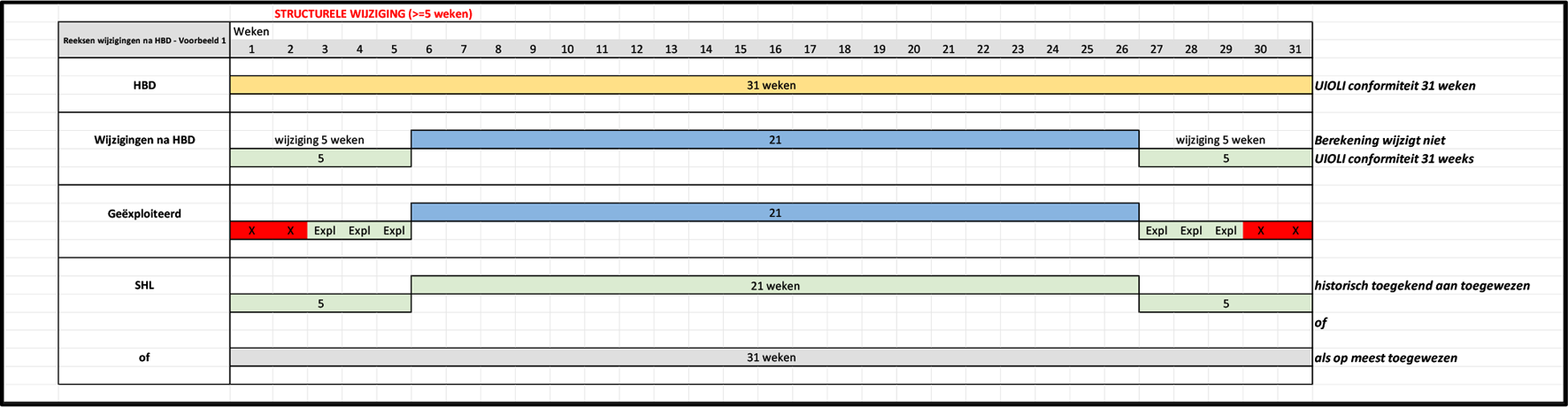

b) Vaststelling van historische rechten in SHL: de beslissing wordt beïnvloed door de beschikbaarheid van de slots in de ‘historische basislijn’.
• Uiterlijk op SHL deelt de coördinator de luchtvaartmaatschappij mee of de op SHL gerapporteerde tijd de oorspronkelijk op HBD toegewezen tijd is of de laatst goedgekeurde tijd. Hetzelfde geldt voor andere capaciteitsrelevante parameters, zoals vliegtuigtype, terminalcapaciteit en binnenlandse/internationale herkomst/bestemming.
• Tussen SHL en Agreed SHL kan de luchtvaartmaatschappij met de coördinator de mogelijkheden bespreken om consumenten te voorzien van handige dienstregelingen die aan de vraag voldoen en consistent zijn van het ene seizoen naar het andere.
4) Ad-hoc wijzigingen:
Tolerantievenster:
Voor AMS, EIN en RTM geldt dat ad-hoc wijzigingen van maximaal 239 minuten ten opzichte van de HBD-tijd meetellen voor de ‘use-it-or-lose-it’-regel.
Wijzigingen buiten dit venster worden, net als annuleringen, voor de ‘use-it-or-lose-it’-regel beschouwd als ‘niet uitgevoerd’.
Opmerking: In dit document geldt de tolerantiemarge alleen voor de planning van de dienstregeling. Afwijkingen in de daadwerkelijke dienstregeling (stiptheid) vallen onder slothandhaving.
Voorbeelden:





Opmerking:
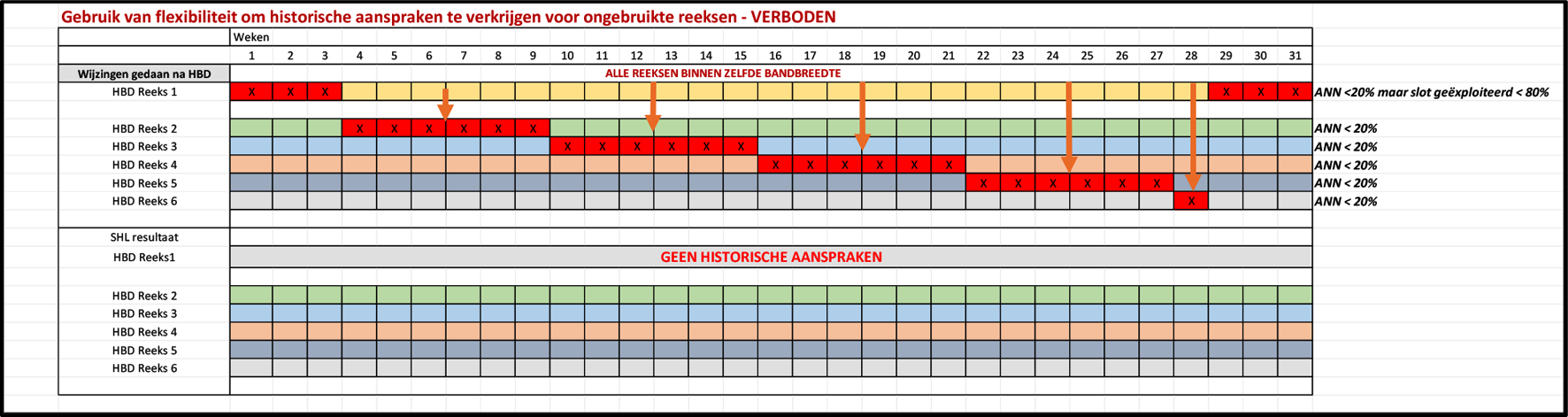
Luchtvaartmaatschappijen kunnen de tolerantiemarge niet gebruiken om historische aanspraak te verkrijgen voor diensten die niet voor 80% zijn uitgevoerd zoals toegewezen op HBD.
Voorbeeld:
5) Slots die na de HBD op ad-hoc basis zijn toegewezen:
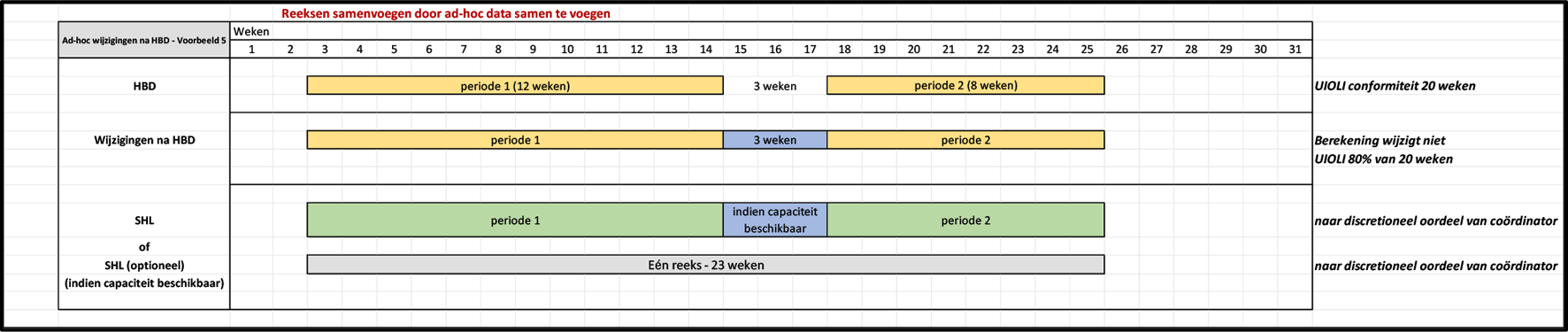
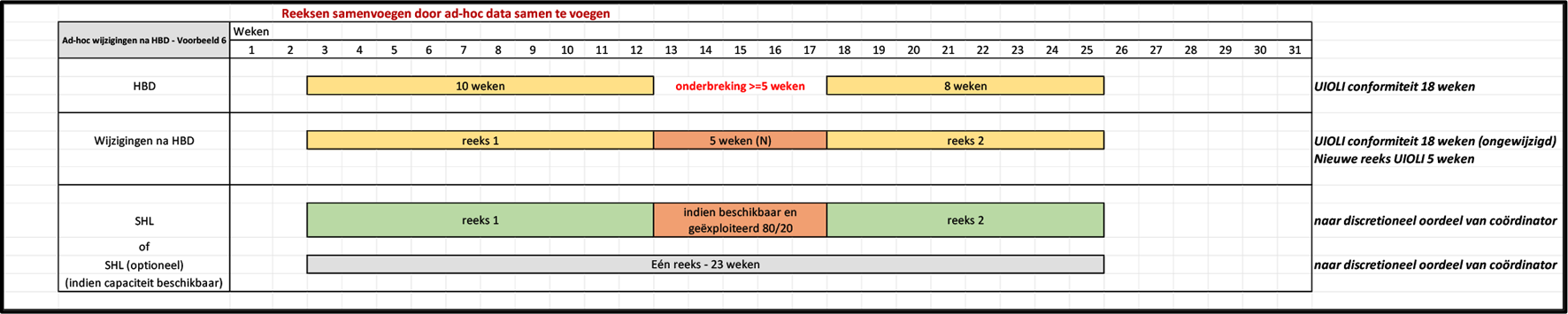
Coördinatoren beschouwen de uitbreiding van bestaande reeksen als een ad-hoc toewijzing. Slots die op ad-hoc basis zijn toegewezen, komen niet in aanmerking voor historische voorrang. Slots die echter als reeks zijn aangevraagd maar aanvankelijk op ad-hoc basis zijn toegewezen, en die een reeks vormen en aan het einde van het seizoen als reeks zijn uitgevoerd, kunnen wel in aanmerking komen voor historische voorrang.
Voorbeelden:
6) Overdrachten van slots na HBD:
Overdracht van slots binnen een luchtvaartmaatschappij
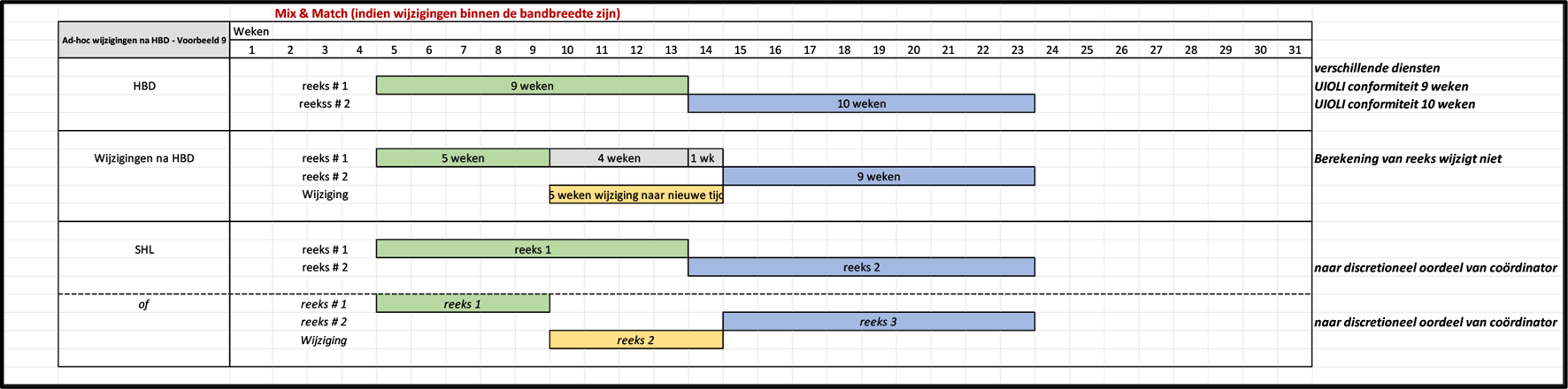
Slots die worden gewijzigd om een andere reeks te voltooien, hebben geen invloed op de nalevingsdoelstelling van de reeks zoals vastgelegd op HBD en verbreken de reeks niet.
Het is niet toegestaan om de benuttingsgraad op peil te houden met behulp van een andere reeks.
Als een luchtvaartmaatschappij tegelijkertijd meer dan één reeks slots aanhoudt met identieke of overlappende exploitatieperioden, wordt het gebruik van elke reeks afzonderlijk berekend.
Overdracht van slots van de ene naar de andere luchtvaartmaatschappij
In geval van overdracht van een slot van de ene luchtvaartmaatschappij naar de andere, keert de reeks bij SHL terug naar de luchtvaartmaatschappij die de reeks exploiteerde, tenzij anders overeengekomen tussen de partijen (de twee luchtvaartmaatschappijen en de coördinator).


7) Opstellen van SHL-lijsten (flexibiliteit):
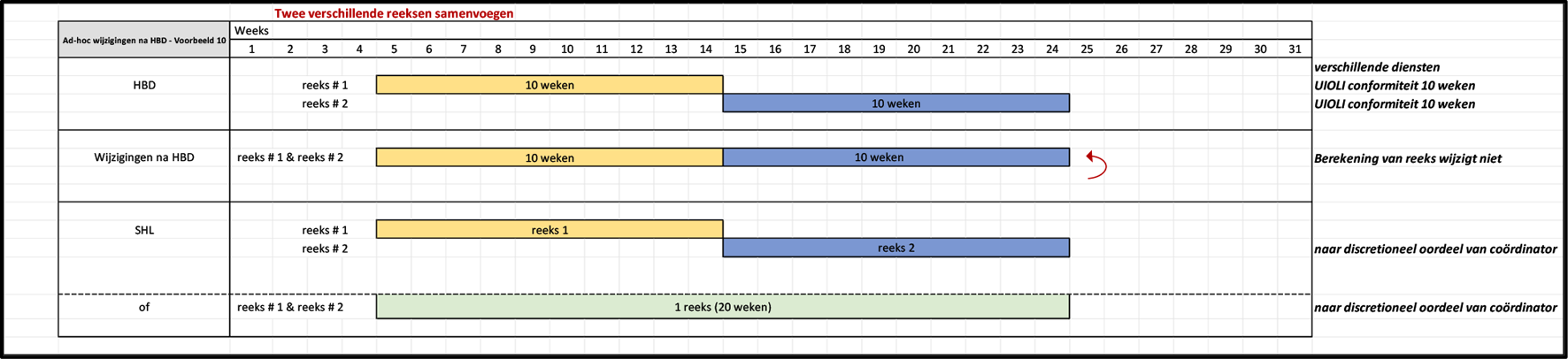
Bij het opstellen van de SHL kunnen coördinatoren slots die de benuttingsdrempel hebben overschreden, samenvoegen door dezelfde reeksen te combineren.
• Bij het samenvoegen van gefragmenteerde perioden van dezelfde dienst tot een langere reeks, wordt onder „dezelfde dienst’ verstaan een reeks slots die worden geëxploiteerd voor hetzelfde vluchtnummer, dezelfde richting (vertrek/aankomst), dezelfde weekdag, dezelfde herkomst/bestemming en hetzelfde tijdstip.
• Op voorwaarde dat de in deze reeksen samengevoegde slotperioden beschikbaar zijn binnen de capaciteit die is vastgesteld voor historische aanspraak.
• Wanneer het samenvoegen van reeksen niet leidt tot het verlies van historische aanspraken voor de betrokken luchtvaartmaatschappij.
8) Aanvullende opmerkingen:
• Mogelijk misbruik.
○ Het aanvragen van nieuwe slots of het reserveren van slots die de luchtvaartmaatschappij of andere vliegtuigexploitant niet van plan is te exploiteren, kan als misbruik worden beschouwd.
○ Coördinatoren en dienstregelingsfacilitators zullen luchtvaartmaatschappijen identificeren die slots aanvragen op een manier waardoor zij zouden profiteren van een hogere prioriteit bij de initiële slottoewijzing. Coördinatoren of dienstregelingsfacilitators kunnen besluiten om een lagere prioriteit toe te kennen aan de initiële aanvraag van deze luchtvaartmaatschappij op die luchthaven of voor die reeks slots in het volgende seizoen. De coördinator of dienstregelingsfacilitator kan een lijst van de gevallen naar het coördinatiecomité sturen.
9. Deze beleidsregel kan worden gewijzigd als gevolg van wijzigingen in wet- en regelgeving en/of aanpassingen in de onderliggende richtlijn.
10. Deze beleidsregel treedt in werking met ingang van het IATA-noordelijke winterseizoen 2026 (W26). Er zijn inhoudelijk geen wijzigingen ten opzichte van versie 1.0 gepubliceerd op 3 oktober 2024; die versie bevatte slechts een verwijzing naar de onderliggende richtlijn, terwijl deze versie de tekst van de richtlijn overneemt.
The Director of Airport Coordination Netherlands (ACNL),
Having regard to:
Council Regulation (EEC) No. 95/93 of 18 January 1993 on common rules for the allocation of slots at Community airports;
The Worldwide Airport Slot Guidelines (WASG);
The Dutch Aviation Act (in Dutch: Wet luchtvaart);
The need for transparency and clarification regarding the definition of series and determination of historic entitlements;
Considering that:
It is necessary to establish the criteria regarding the definition of series and determination of historic entitlements;
The Policy Rule Definition of Series and Determination of Historic Entitlements sets out these criteria and applies to Amsterdam Airport Schiphol (AMS), Eindhoven Airport (EIN), and Rotterdam The Hague Airport (RTM);
Decides as follows:
The Policy Rule Definition of Series and Determination of Historic Entitlements version 2.0 is hereby adopted.
This decision shall enter into force as of 25 October 2026.
This decision and its annexes shall be published on the website of Airport Coordination Netherlands (www.slotcoordination.nl) and in the Dutch Official Gazette (In Dutch: Staatscourant).
Schiphol, 14 July 2026
H. Thomassen, Director of Airport Coordination Netherlands (ACNL)
|
Author: |
Airport Coordination Netherlands (ACNL) |
|
Date: |
14 July 2026 |
|
Version: |
2.0 |
|
Effective: |
IATA Northern Winter season 2026 (W26) |
Airport Coordination Netherlands (ACNL) is an independent governing body by public law. In the Dutch ‘Wet Luchtvaart’ (Law on Aviation) designated as the independent coordinator for slot coordinated airports in the Netherlands. ACNL is responsible for slot allocation and slot monitoring at Amsterdam Airport Schiphol (AMS), Rotterdam The Hague Airport (RTM) and Eindhoven Airport (EIN). In order to make optimal use of the airport capacity our mission is to deliver slot coordination and monitoring services in a neutral, non-discriminatory and transparent way.
ACNL is publishing following policy rule according to article 1:3 (4) in conjunction with article 4:81 of the Dutch ‘Algemene wet bestuursrecht’ (General Administrative Law Act). The abbreviation in Dutch is ‘Awb’.
1. The initial slot request is the key milestone for the allocation of (series of) slots for a new IATA season. The Historic Baseline Date (HBD) is the milestone to create the baseline that is used to evaluate the compliance to use-it-or-lose-it rules. It is therefore crucial that on both sides of the routes operated by the airlines, the series that will be eligible to obtain historic entitlement at the end of the season are determined on the same basis. But the European Slot Regulation and the WASG leave room for interpretation. In the past decades a practice has arisen with differences between coordinated airports. This may create distortion of competition between airports or airlines.
2. Therefore, several European coordinators have developed a guidance with the objective to promote that the determination of historic entitlements is done in a harmonised manner, guided by the prime objective of airport slot coordination to ensure the most efficient declaration, allocation, and use of available airport capacity. It will optimise benefits to consumers, considering the interests of airports and airlines.
That guidance harmonises processes as much as necessary and provides leeway where this serves the primary objective of airport slot coordination.
3. Historic entitlement can only be assigned to a series of slots (not to an individual slot). It’s therefore crucial to first define a series of slots and second determine the calculation method of the historic entitlement, based on which the SHL can be drawn up. The structure of that guidance consists of these 2 parts. Both parts are inextricably linked.
4. ACNL implements the above-mentioned guidance ‘Definition of Series and Determination of Historic Rights’ – Date: 25 September 2024 – Status: Version 1.4 by means of this Policy Rule.
5. Definitions of the WASG and the European Slot Regulation.
WASG
A series of slots is at least 5 slots allocated for the same or approximately
same time on the same day-of-the-week, distributed regularly in the same season.
European Slot Regulation
Art.2.(a) ‘slot’ shall mean the permission given by a coordinator in accordance with this Regulation to use the full range of airport infrastructure necessary to operate an air service at a coordinated airport on a specific date and time for the purpose of landing or take-off as allocated by a coordinator in accordance with this Regulation.
Art.2.(k): ‘series of slots’ shall mean at least five slots having been requested for the same time on the same day of the week regularly in the same scheduling period and allocated in that way or, if that is not possible, allocated at approximately the same time.
The definitions of slots and series are important at HBD and for series created or extended after HBD, because this milestone is the reference point for the evaluation of the compliance of the usage of slots for the determination of historic entitlement and the creation of the historic lists (SHL) for the next equivalent season.
6. Interpretation (based on primary objective of slot coordination: efficient use of capacity):
• ‘5 slots’ means minimum 5 consecutive weeks or fortnight weeks. Other patterns may be accepted by coordinators when can be demonstrated as being regular.
• A valid series of slots can be composed of several periods each of minimum 5 consecutive weeks at the same time on the same day-of-week provided the series of slots are for the same service.
• The same time must be seen within the context of the coordination parameter for the airport. Coordinator should publish the coordination parameter used as the reference for its definition of ‘same time’ on the coordinator’s website. For AMS, EIN and RTM the same time is set to a bandwidth of 59 minutes for all slots in the series; if not possible, the request should remain on the waitlist.
• The definition of a slot for the purposes of determining a series held at HBD means ‘operating an air service (...) on a specific date and time (...)’. A series of slots at HBD is recognized by being the same direction (Dep/Arr), origin/destination, day-of-week, and same time as defined. Coordination software identifies series by flight number, airlines are required to use unique flight numbers for each series at HBD. Changes in flight numbers or other attributes (within the coordination parameters and tolerances described in this document) made after HBD do not affect historic eligibility of the slot series.
• Post HBD changes are permitted with the tolerances described in this document.
• For the calculation of compliance with use-it-or-lose-it rules, series that are potentially eligible for historic entitlement are identified and confirmed at HBD.
• Historic entitlement of the series (UIOLI rules) are evaluated on the sum of the slots contained in the series across all periods of minimum 5+ weeks recognised as being part of that series/air service.
7. Examples:
Below examples are provided as guidance for the determination of historic entitlements and the composition of the Slot Historic List (SHL).









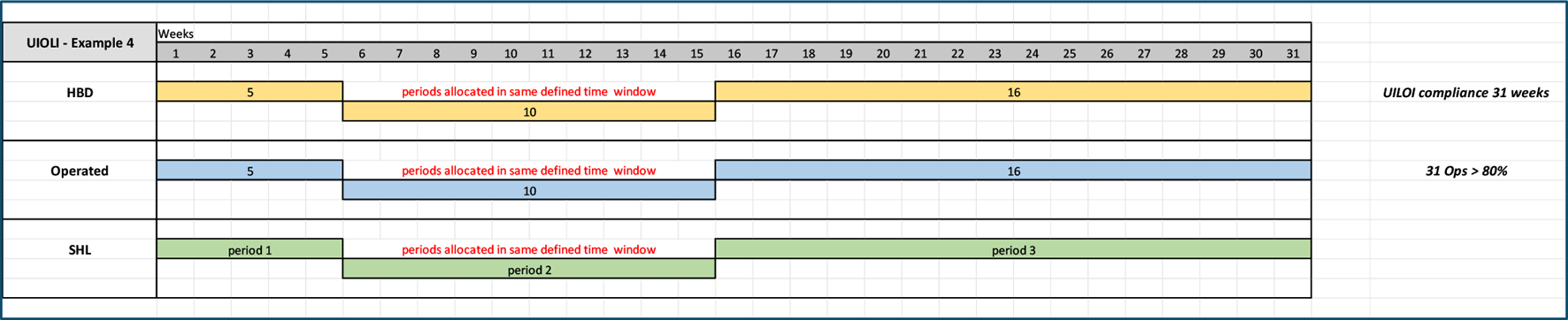
8. Air carriers must operate 80% of the slots allocated to a series of slots it holds at HBD to be granted historic entitlement of the series as allocated at HBD for the next equivalent season. But, for various reasons, the carrier may decide to adjust its program to changing conditions, as well as changing consumer demand.
1) use-it-or-lose-it (UIOLI) calculation: examples.


2) New series allocated after HBD:
Ad-hoc slots allocated after HBD are allocated on a non-historic basis. However, slots requested as a series but initially allocated on an ad hoc basis, which form a series by the end of the season, may be eligible for historic precedence. For a series of slots newly allocated after the Historic Baseline Date, the number of slots in the series on the date of first allocation forms the basis of the use-it-or-lose-it calculation.
3) Structural changes (5 or more consecutive slots):
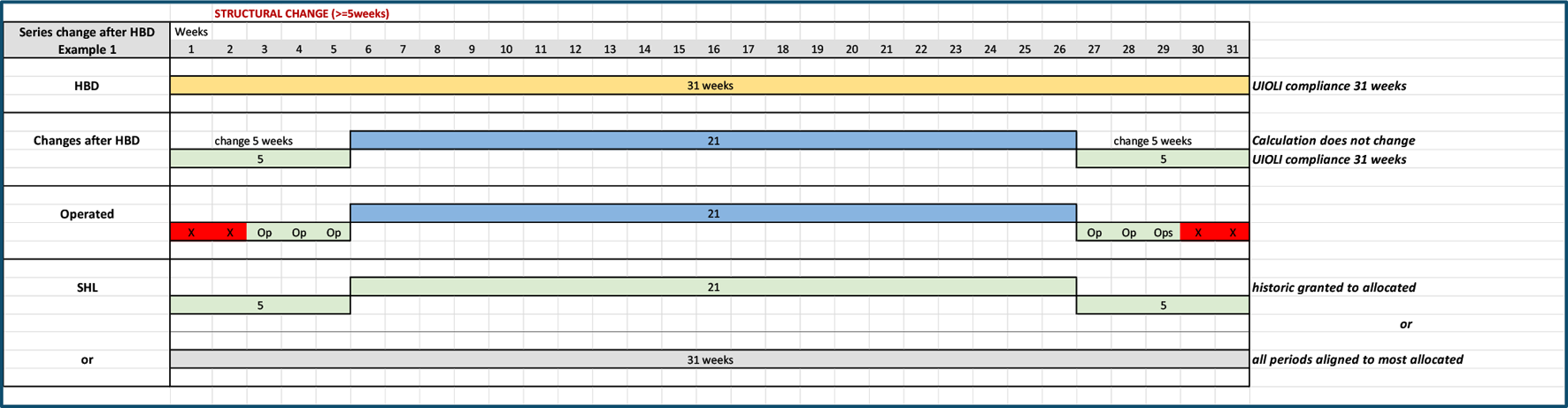
Changes of slots for five or more consecutive weeks. Changes like time, number of seats, aircraft type, origin/destination, service type, flight number will not affect historic eligibility of the slot series but may impact the attributes of historic flights as distributed at SHL.
a) Calculation of compliance to use-it-or-lose-it:
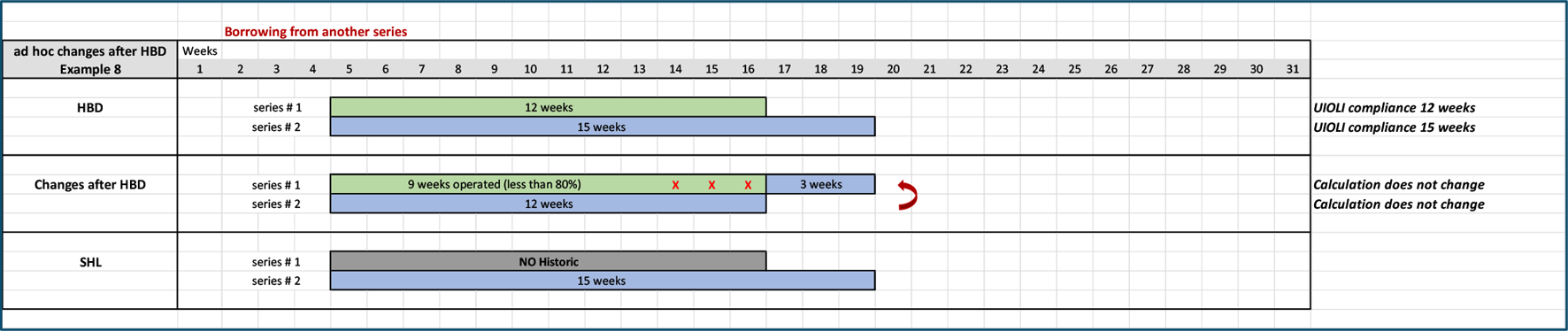
The change does not affect the calculation of use-it-or-lose-it. The calculation is made on the number of slots of the original series as held at HBD.
Examples:

b) Determination of historic entitlement in SHL: the decision is influenced by the availability of the slots in the ‘historic baseline’.
• At the latest at SHL, the coordinator informs the carrier if the time reported on the SHL is the original time allocated at HBD or the latest approved time. The same applies for other capacity relevant parameters such as aircraft type, terminal capacity, domestic/international origin/destination.
• Between SHL and Agreed SHL the airline can discuss the possibilities with the coordinator to provide consumers with convenient schedules that meet demand and are consistent from one season to the next.
4) Ad hoc changes:
Tolerance window:
For AMS, EIN and RTM applies that ad hoc time changes of up to 239 minutes off the HBD time are counted towards the use-it-or-lose-it rule.
Changes outside of this window are counted like cancellations as ‘not operated’ for the use-it-or-lose-it rule.
Remark: In this document, the tolerance window applies only for the planning of operations. Deviations in actual operations (punctuality) are part of the slot enforcement.
Examples:





Remark:
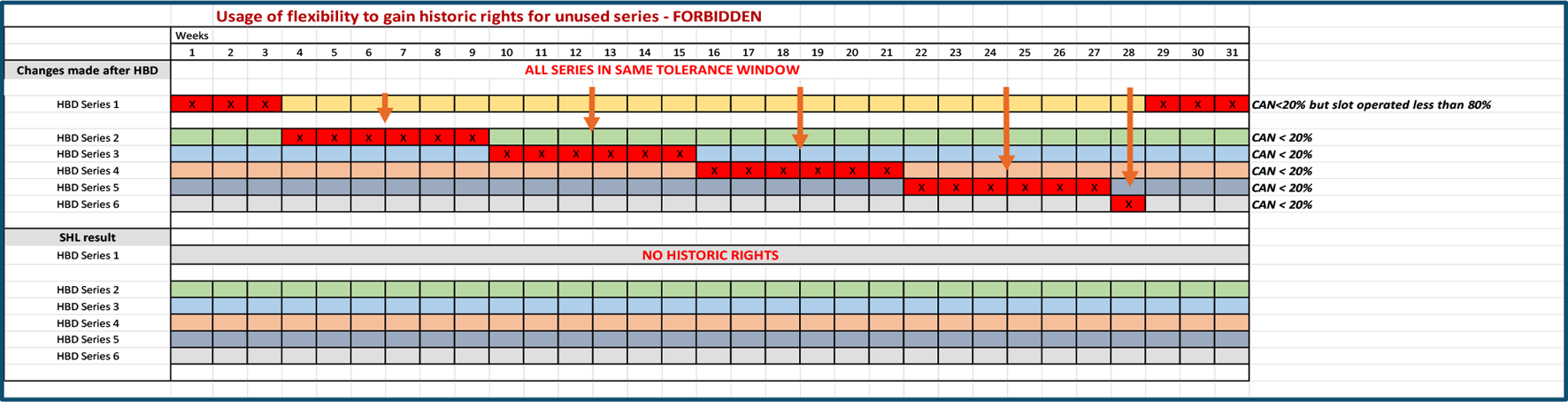
Airlines cannot use the tolerance window to gain historic entitlement for series or services that were not operated 80% as allocated at HBD.
Example:
5) Slots allocated on ad hoc basis after HBD:
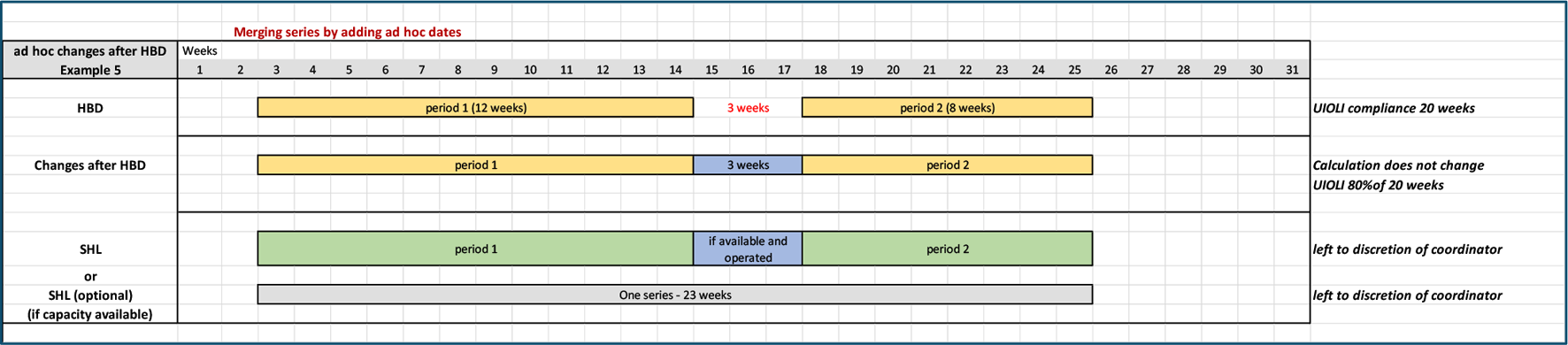
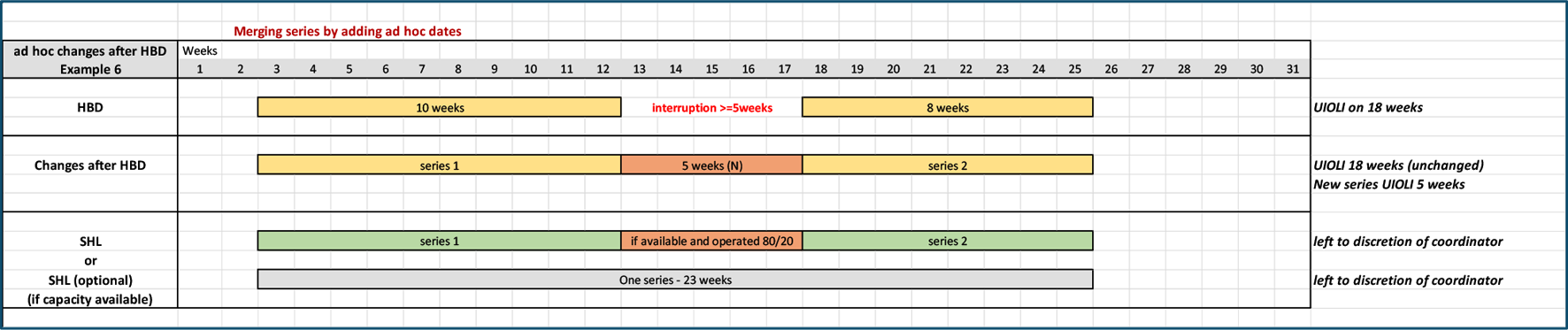
Coordinators will consider the extension of existing series as ad hoc new allocation. Slots allocated on an ad hoc basis are not eligible for historic precedence. However, slots requested as a series but initially allocated on an ad hoc basis, which form a series and have been operated as a series by the end of the season, may be eligible for historic precedence.
Examples:
6) Slots transfers after HBD:
Slots transfers within airline
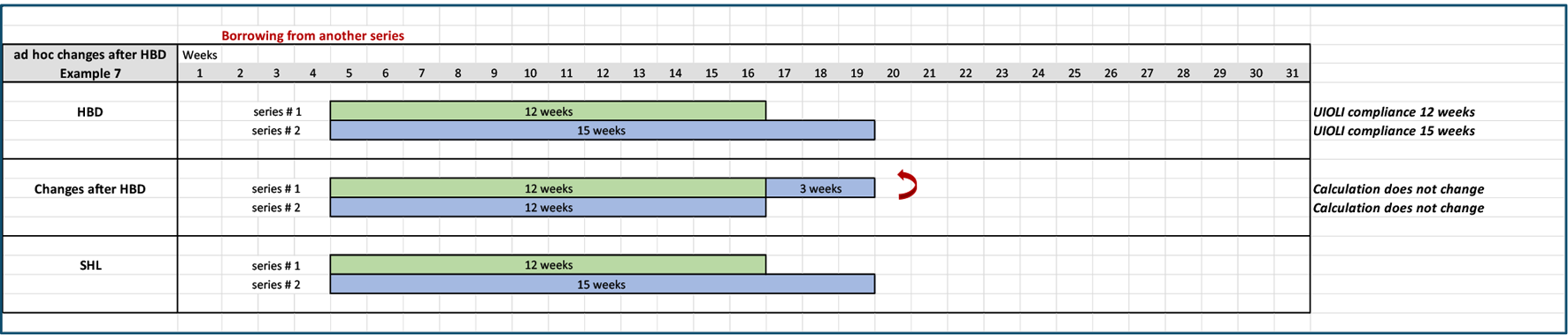
Slots changed to complete another series do not change the compliance target of the series as hold at HBD and do not break the series.
It is not allowed to hold up the utilisation rate using another series.
If an airline holds more than one series of slots at the same time with identical or overlapping periods of operation, then the usage of each series is calculated separately.
Slots transfer from one to another airline
In case of transfer of slot from one airline to another, at SHL the series returns to the airline who was operating the series, unless otherwise agreed between the parties (the two airlines and the coordinator).
7) Creation of SHL lists (flexibility):
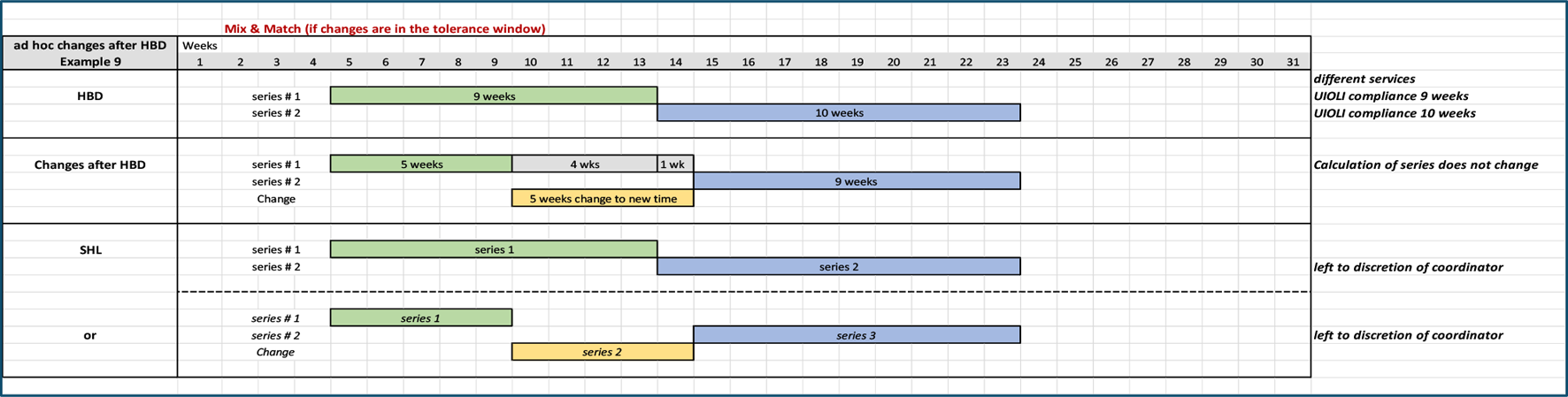
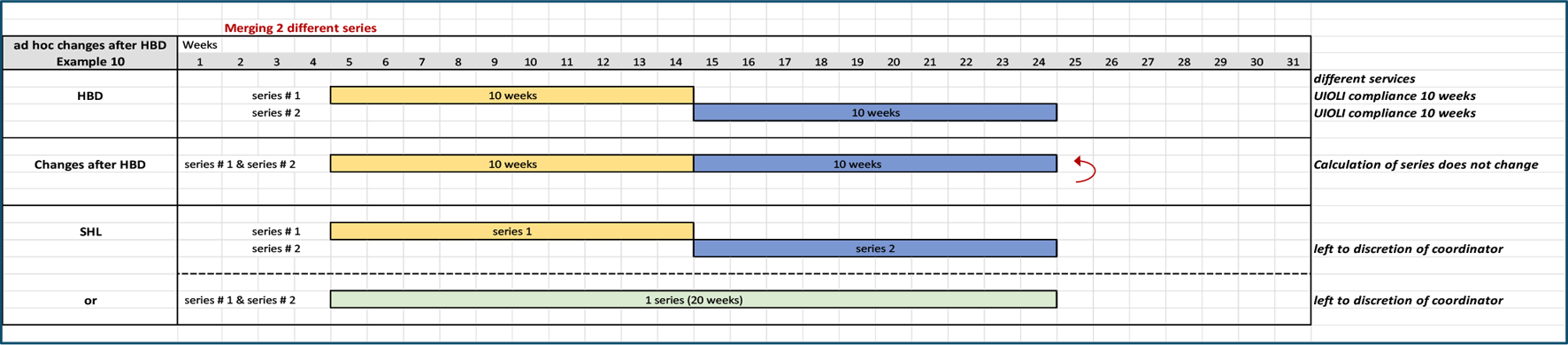
When creating the SHL, Coordinators may consolidate slots that have passed the utilisation threshold by combining the same series.
• When consolidating fragmented periods of the same service into a longer series, the ‘same service’ means a series of slots operated for the same flight number, direction (Dep/Arr), weekday, origin/destination, and time.
• Provided that the slots periods consolidated in these series are available in the capacity defined for historic entitlement.
• Where the consolidation of series does not result in a loss of historic entitlement for the airline concerned.
8) Additional remarks:
• Potential misuse:
○ Request new slots or hold slots that the airline or other aircraft operator does not intend to operate may be considered as a misuse.
○ Coordinators and schedules facilitators will identify air carriers who are requesting slots in a way that they would benefit from a higher priority in the initial slot allocation. Coordinators or schedule facilitators may decide to give a lower priority level to the initial demand made by this carrier at that airport or for that series of slots in the next season. The coordinator or schedules facilitator will send a list of the cases to the Coordination Committee.
9. This Policy Rule is subject to changes pursuant to change of regulation(s) and/or changes in the underlying guidance.
10. This Policy Rule will be effective as of IATA Northern Winter season 2026 (W26). There are no substantive changes compared with version 1.0, published on 3 October 2024; that version merely included a reference to the underlying guidance, whereas this version reproduces the underlying guidance in full.
Kopieer de link naar uw clipboard
https://zoek.officielebekendmakingen.nl/stcrt-2026-26569.html
De hier aangeboden pdf-bestanden van het Staatsblad, Staatscourant, Tractatenblad, provinciaal blad, gemeenteblad, waterschapsblad en blad gemeenschappelijke regeling vormen de formele bekendmakingen in de zin van de Bekendmakingswet en de Rijkswet goedkeuring en bekendmaking verdragen voor zover ze na 1 juli 2009 zijn uitgegeven. Voor pdf-publicaties van vóór deze datum geldt dat alleen de in papieren vorm uitgegeven bladen formele status hebben; de hier aangeboden elektronische versies daarvan worden bij wijze van service aangeboden.
 Authentieke versie (PDF)
 Informatie
 Printen
 Delen
Delen