Staatscourant van het Koninkrijk der Nederlanden
| Datum publicatie | Organisatie | Jaargang en nummer | Rubriek |
|---|---|---|---|
| Nederlandse Organisatie voor Wetenschappelijk Onderzoek | Staatscourant 2026, 26222 | overige overheidsinformatie |

U bent nu hier: Publicaties Officiële publicaties
Zoals vergunningen, bouwplannen en lokale regelgeving.
Zoals belastingen, uitkeringen en subsidies.
Officiële publicaties van de overheid.
Adressen en contactpersonen van overheidsorganisaties.

The Joint Transnational Call (JTC) 2026 is the first call of the European Partnership on Raw Materials for the Green and Digital Transition (RAMP) under the Horizon Europe framework programme.
This call aims to fund research and/or innovation projects across the raw material1 value chain. The projects should focus on enhancing access to raw materials while promoting circular economy practices, achieving sustainability, and minimising social and environmental costs. They should add value, innovate and contribute to industrial development. The thematic scope of the JTC draws on RAMP’s Strategic Research and Innovation Agenda (SRIA) and includes primary and secondary supply, design and production, and the use and reuse of products and components. RAMP welcomes actors from academia, industry (small, medium and large), public bodies and civil society2.
The call is open to proposals under the following six topics:
• Topic 1 – Ensuring a resilient supply of raw materials from primary sources
• Topic 2 – Targeting secondary sources to enhance access to raw materials
• Topic 3 – Efficient and effective use of raw materials in design and production
• Topic 4 – Overcoming technological barriers to circularity
• Topic 5 – Putting circular economy ambitions into action
• Topic 6 – Innovative approaches for analysing raw materials value chains
37 funders from 25 countries are participating in this call, committing more than 39 M€.
Each project partner is funded directly by their respective national/regional funder.
Each multilateral proposal must involve at least three partners from three countries, which request (and are eligible for) funding by one of the funders participating in the JTC 2026. Funders from at least two of these countries must be eligible for receiving the European Commission (EC) co-fund.
Proposals are encouraged to connect the different steps of the supply chain, bridge multiple disciplines, engage with stakeholders and situate themselves in the relevant policy context.
Centralised submission and evaluation of submitted proposals will be implemented in 2 steps, and the funded projects are expected to start between June and September 2027.

Further information on this Call (mandatory templates, link to the submission platform, partner finder tool, etc.) can be found on RAMP’s website.
Contact: CallSecretariat.RAMP@anr.fr
Joint Transnational Call 2026
Version 1.2 – published on 23/06/2026
|
Version: Date |
Update in the Call Text |
|---|---|
|
V1.1: 15/06/2026 |
5.1 Funding Scheme: Number of funders and total committed budget updated. |
|
5.2 Participating funders: • BE – FWO included. • BR – CONFAP / Fundação Araucária, FAPEG and FAPES included. • MD – NARD included. |
|
|
Annex 1 – Funder-specific rules: • BE – FWO included. • BR – CONFAP / Fundação Araucária, FAPEG and FAPES included. • FR – ANR – “maximum funding demand” and “further guidance” updated. • MD – NARD included. |
|
|
V1.2: 18/06/2026 |
Annex 1 – Funder-specific rules: • ES – CDTI – “eligible costs” and “other eligibility criteria” updated. • RO – Funder rectified to “ANC, through UEFISCDI” |
|
V1.3: 22/06/2026 |
5.2 Participating funders: update of participations subject to confirmation. |
|
5.2 Participating funders: • Update of participations subject to confirmation. • BR – CONFAP / FAPEMIG included. |
|
|
Annex 1 – Funder-specific rules: • BE – NWO external links updated. • BR – CONFAP / FAPEMIG included. |
CEP – Call Evaluation Panel
CSC – Call Steering Committee
CRM – Critical Raw Materials
CRMA – The European Critical Raw Materials Act
EC – European Commission
EAB – Ethics Advisory Board
EOL – End of Life
ERA-MIN – European Research Area Network on Raw Materials
ESES – Electronic Submission and Evaluation System
IoT – Internet of things
JCS – Joint Call Secretariat
JTC – Joint Transnational Call
LCA – Life cycle assessment
PI – Principal investigator
RAMP – Raw Materials Partnership
R&I – Research and Innovation
RM – Raw Materials
SDGs / UN SDGs – United Nations Sustainable Development Goals
SEG – Scoping Expert Group
SRIA – Strategic Research and Innovation Agenda (refers to the RAMP SRIA unless stated otherwise)
TRL – Technology Readiness Level
In the context of this document, the following definitions apply:
• Partners – All legal entities within the consortium of a given proposal (including the Coordinator).
○ Beneficiary partners: All legal entities applying for funding within the consortium of a given proposal (including the Coordinator).
▪ Coordinator: The legal entity applying for funding in the Call and responsible for coordinating and managing the proposal at the transnational level. The Coordinator cannot be changed between the deadline for pre-proposal submission (Stage 1) and the selection of full proposals to be funded (Stage 2) in the Call process.
▪ Non-coordinating partner: Legal entities within the consortium of a given proposal, other than the coordinator, who are also applying for funding in the Call.
○ Self-funded partners: Legal entities participating in the project but securing their own funds, and therefore without applying for funding in the Call. Each Self-funded partner must submit a Letter of Commitment in Stage 2 as an annex to the full proposal.
○ Principal Investigator (PI): the person who will lead the activities of a given partner.
○ Team members: persons (other than the PI) involved in the activities undertaken by a given partner.
• Proposal: refers to both stages of the call
○ Pre-proposal: refers to stage 1 of the call
○ Full proposal: refers to stage 2 of the call
Contents
|
1 |
Acronyms/Abbreviations |
|
2 |
Definitions |
|
3 |
Introduction |
|
4 |
RAMP – the Raw Materials Partnership |
|
4.1 |
The consortium |
|
4.2 |
RAMP’s activities and role in the RM landscape |
|
5 |
Joint Transnational Call – JTC 2026 |
|
5.1 |
Funding scheme |
|
5.2 |
Participating funders |
|
5.3 |
Call design |
|
6 |
JTC2026 – Thematic scope |
|
6.1 |
Overarching considerations |
|
6.1.1 |
Project consortia |
|
6.1.2 |
Crosscutting aspects |
|
Topic 1 – Ensuring a resilient supply of raw materials from primary sources |
|
|
Topic 2 – Targeting secondary sources to enhance access to raw materials |
|
|
Topic 3 – Efficient and effective use of raw materials in design and production |
|
|
Topic 4 – Overcoming technological barriers to circularity |
|
|
Topic 5 – Putting Circular Economy Ambitions into Action |
|
|
Topic 6 – Innovative approaches for analysing raw materials value chains |
|
|
7 |
Call procedures |
|
7.1 |
Eligibility |
|
7.1.1 |
Transnational eligibility |
|
7.1.2 |
National/regional eligibility |
|
7.1.3 |
Ethics requirements |
|
7.2 |
The role of the project coordinator |
|
7.3 |
Submission procedures |
|
7.4 |
Evaluation process |
|
7.5 |
Evaluation criteria |
|
7.6 |
Evaluation scale |
|
7.7 |
Selection and funding |
|
7.8 |
Redress procedure |
|
7.9 |
Changes in the proposal between stages 1 and 2 |
|
7.9.1 |
Changes initiated by the applicants |
|
7.9.2 |
Changes requested by a funder or by the JCS |
|
7.9.3 |
Changes in the consortium |
|
8 |
General Data Protection Regulation |
|
9 |
Conflicts of interest |
|
9.1 |
Definitions of Conflict of Interest |
|
9.2 |
Conflicts of interest within the evaluation process |
|
9.3 |
Conflicts of interest within the preparation of calls |
|
10 |
Project implementation |
|
10.1 |
Consortium agreement |
|
10.2 |
Project lifetime: changes and reporting |
|
11 |
Horizon Europe Requirements and Obligations of funded projects |
|
11.1 |
Ethics and Research Integrity |
|
11.2 |
Open Science and Research Data Management |
|
11.3 |
Dissemination and Communication |
|
11.4 |
Exploitation of Results |
|
11.5 |
Intellectual Property Rights and Access to Results |
|
11.6 |
Gender Equality, Diversity and Inclusiveness |
|
11.7 |
Security and Confidentiality |
|
11.8 |
Strategic Interests and International Cooperation |
|
11.9 |
Further Information |
|
12 |
Other RAMP activities |
|
Annex 1 – Funder-specific rules |
|
|
Annex 2 – FAQ – Frequently Asked Questions |
|
|
Call Scope and general procedures |
|
|
Consortium requirements |
|
|
Preparing and submitting a proposal |
|
|
Evaluation and selection process |
|
|
Changes between stages 1 and 2 |
|
|
Project implementation |
|
Figures
Figure 1 – Map of countries and regions participating in the RAMP consortium
Figure 2 – RAMP’s themes and their positioning with respect to the circular economy
Figure 3 – Workflow of the JTC 2026
Figure 4 – distribution of the eligible TRL ranges of the funders participating in the JTC 2026
Figure 5 – Positioning of JTC 2026 Topics with respect to the circular economy
Figure 6 – Evaluation process
Tables
Table 1 – Funders participating in the JTC 2026, respective budgets and eligible Topics
Table 2 – Call 2026 timeline
Table 3 – Scores and thresholds per evaluation criterion (stages 1 and 2)
Table 4 – Pre-proposal evaluation criteria
Table 5 – Full proposal evaluation criteria
Table 6 – Evaluation scale
The aim of this call for proposals is to support transnational research and innovation (R&I) projects that contribute to a sustainable supply and efficient use of raw materials (RM) to support the green and digital transition. The scope of the call covers all stages of the RM value chain including crosscutting aspects, upscaling and industrial implementation.
This document contains information on: the Raw Materials Partnership (RAMP), its role in the RM landscape and its goals; the aims and topics of this call; eligibility criteria; submission, evaluation and selection procedures and criteria; and project implementation.
Reliable access to RM will underpin the transition to a greener and more digitalised world. Indeed, by the year 2050, significant increases in the demand for a range of metals and minerals are projected.3 At the same time, many parts of the world are striving to achieve a circular economy that maximises efficiency while minimising adverse socio-ecological consequences. RAMP has been set up against this backdrop.
RAMP encompasses the biggest RM-focused constellation of funders to date, bringing together 56 organisations from 34 countries and regions across Europe and beyond, aligning efforts, strategies, and resources to support the green and digital transition in Europe and globally. The RAMP consortium includes partners from across Europe as well as associated and third countries, ensuring broad geographic representation to address global R&I needs (see Figure 1 – Map of countries and regions participating in the RAMP consortium.).
RAMP partners are:
• National and Regional R&I Programme Owners and Research Funding Organisations (RFOs), which are the majority of the consortium, leading joint R&I programmes and provide funding for calls and additional activities.
• International Associations and Thematic Organisations, which provide expertise, help inform policy, and assess impact.
• SMEs, which bring expertise in R&I policy and management.
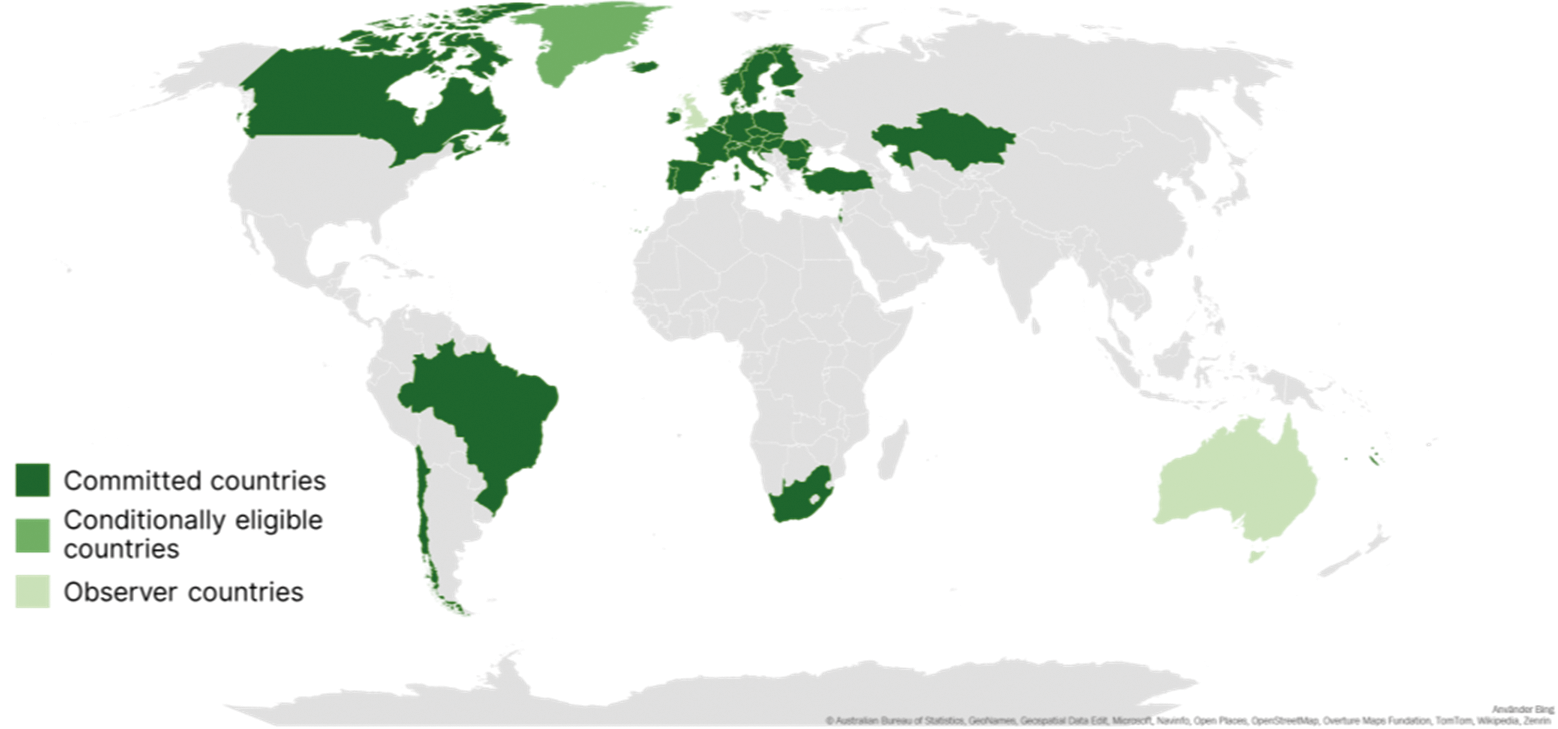
Figure 1 – Map of countries and regions participating in the RAMP consortium.
Over the 11-year duration of RAMP, the consortium will undertake a variety of activities to achieve its expected impacts, which include strengthened domestic production and enhanced resilience of global supply chains, improved resource efficiency and sustainability, and advanced circular economy practices.
A prominent pillar of RAMP’s activities are the annual JTCs, which will not only help build an effective R&I programme but also underpin impactful dissemination, policy support and sustainability.
Building on its predecessor network ERA-MIN, but with a significantly expanded scope, RAMP’s activities are steered towards three overarching objectives:
• Building an international multistakeholder R&I ecosystem on RM.
• Implementing an ambitious R&I programme that addresses the entire RM value chain.
• Contributing to circular and sustainable approaches as well as the development and implementation of RM-related policies.
RAMP’s JTCs contribute to the second objective by supporting transnational multistakeholder R&I projects that are expected to create scientific, societal and economic impacts consistent with the Critical Raw Materials (CRM) Act and the UN SDGs.
RAMP’s activities are organised around six core and crosscutting themes (originally outlined as transversal themes in its SRIA) that are aligned with the relevant policy documents and address key RM-related challenges or needs. These themes are the starting point for the definition of the JTC’s scope and topics in collaboration with the R&I community.
Core theme 1: Resilient primary and secondary RM supply – focuses on innovation in exploration, mining, mineral processing and recycling for improving access while maintaining environmental and social sustainability.
Core theme 2: Efficient use of RM in design and production – promotes improvements in product design, processes and tools to substitute CRM or minimise the use of RM in key sectors.
Core theme 3: Sustainable use and reuse of products – complements the RM value chain by reducing losses and enabling circular economy in actions that prolong product lifespan, integrate end-of-life products as secondary RM supply, promote sustainable practices and tackle technical, social and legal barriers to RM reuse.
Crosscutting theme 1: Effective policy development and governance, focuses on open-access and consolidated data, tools, platforms and best practices within the RM sector to enable data-driven policy and transparent governance.
Crosscutting theme 2: Maximising societal benefits, focuses on promoting social innovation, workplace equity and respect for human rights, minimising local environmental damage and fostering open communication.
Crosscutting theme 3: World-class innovation capacity, targets strategic partnerships with resource rich, likeminded countries, promotion of technology transfer, alignment and coordination of projects and funding as well as capacity building actions to build a skilled, diverse and dynamic workforce.
To ensure continued relevance and to help steer RAMP towards its long-term objectives, the JTCs are defined and updated in collaboration with the community:
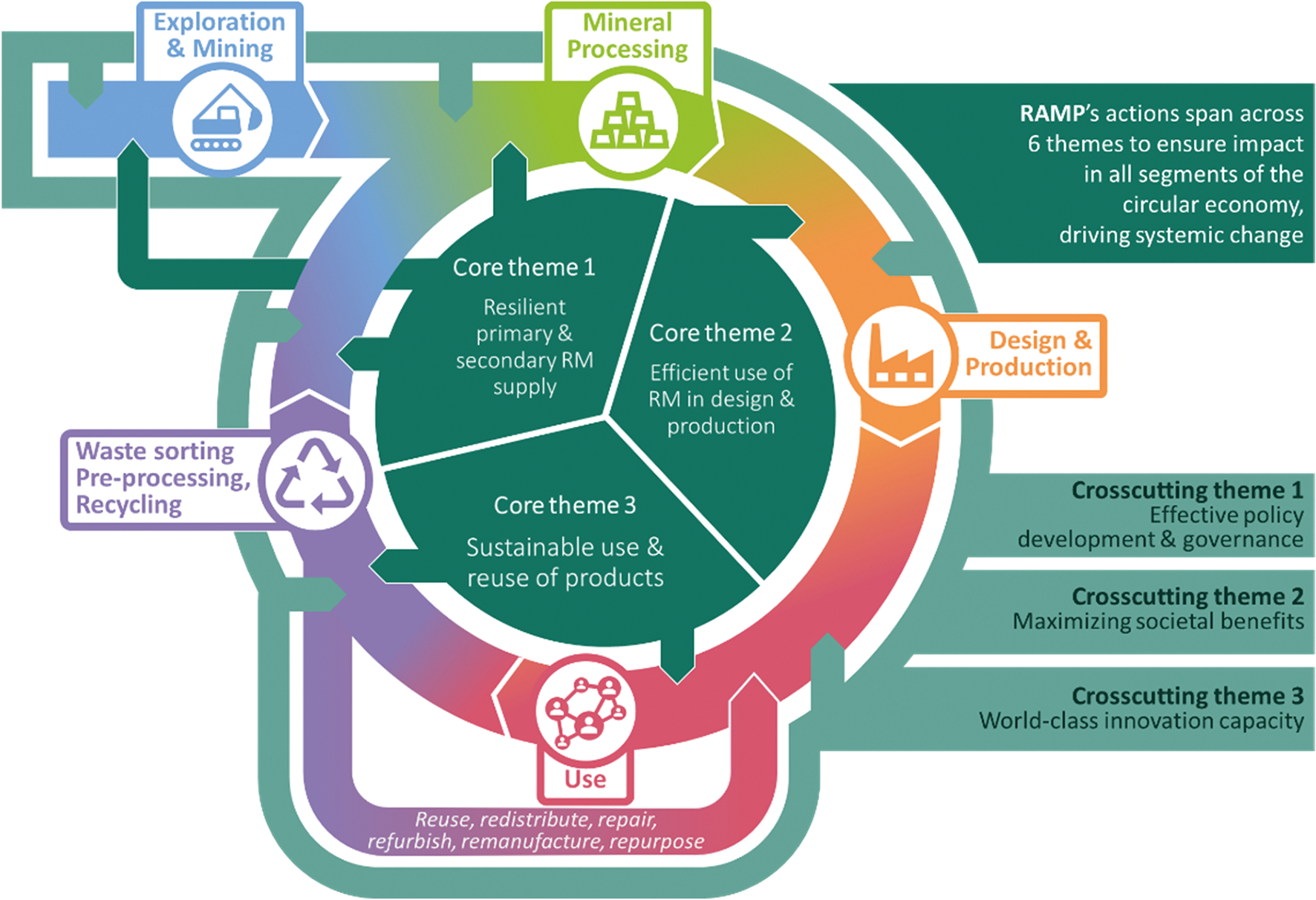
Figure 2 – RAMP’s themes and their positioning with respect to the circular economy.
• Call scope will be updated from one edition to the next to reflect the evolving RM landscape via open consultations and close interaction with the R&I community (via different liaison groups and a Scoping Expert Group, for instance) supplemented by horizon scanning at the RAMP level.
• Experts can register via open calls to participate in the Call Evaluation Panels (CEP) (please note: participants of submitted proposals cannot be evaluators for the same call).
• New funders are welcome to the consortium: if the funding organisation of your country/region is not participating in the current call, they can reach out to the RAMP coordinator to negotiate participation in future calls or other activities.
The impact of RAMP funded R&I will be enhanced by additional, targeted activities that will be developed over the course of the Partnership, addressing all the core and crosscutting themes while adapting to the evolving RM landscape.
It is envisioned that the projects and activities supported by RAMP will complement or feed into those of funding schemes such as EIT Raw Materials and Horizon Europe, for example via upscaling, valorisation and standardisation.
Submission and evaluation procedures are centralised at the RAMP level (some funders might require additional procedures; applicants are required to verify their compliance with the rules of their respective funder). Funding procedures are managed directly between the funders and their beneficiaries through their pre-established funding systems and rules.
37 funders from 25 countries are participating in the JTC 2026, committing a total of more than 39 M€.
In addition to the national/regional budgets committed by the participating funders, the EC will support RAMP’s JTCs through Horizon Europe (Grant Agreement number 101286492) with a co-fund proportional to the committed call budget. Part of this co-fund will be used as a top-up to complement national/regional budgets and enable more projects to be funded. This additional budget will be redistributed through the funders to their respective beneficiaries (i.e. no funding arrangements will be made between the EC and the funded projects).
Since each national/regional funder will provide funds directly to their eligible beneficiaries in accordance with their own rules and regulations, each applicant must ensure they comply with all eligibility requirements and procedures of their respective funder (see Annex 1).
Prospective applicants who are not eligible to request funding from one of the funders in the table below can only join project consortia as self-funded partners, Please note that applicants not requesting funding from one of the funders participating in the call do not count towards the minimum number of countries in the consortium requirements.
It may also be possible for those prospective applicants not eligible to request funding to act as external collaborators or as service providers (if subcontracting is allowed by the concerned funder).
All funders participating in the JTC 2.026 are listed in the table below.4
|
Eligible topics |
|||||||||
|---|---|---|---|---|---|---|---|---|---|
|
Country |
Geographical coverage |
Funder |
1 |
2 |
3 |
4 |
5 |
6 |
Funder’s indicative Call budget |
|
AT – Austria |
National |
FFG |
N |
Y |
Y |
Y |
N |
Y |
1 200 000 € |
|
BE – Belgium |
Regional / Wallonia-Brussels Federation (French speaking community of Belgium) |
F.R.S.-FNRS |
Y |
Y |
Y |
Y |
Y |
Y |
300 000 € |
|
Regional / Flanders region, Belgium |
FWO |
Y |
Y |
Y |
Y |
Y |
Y |
700 000 € |
|
|
Regional |
SPW |
Y |
Y |
Y |
Y |
Y |
Y |
1 000 000 € |
|
|
Regional / Flanders |
VLAIO |
Y |
Y |
Y |
Y |
Y |
Y |
1 000 000 € |
|
|
BG – Bulgaria |
National / Researchers of other countries may participate in the Bulgarian team of the Call under specific rules |
BNSF |
Y |
N |
Y |
Y |
Y |
Y |
450 000 € |
|
BR – Brazil |
National / Candidates should be considered eligible from the following State Funding Agencies (FAPs): Fundação Araucária (State of Paraná), FAPEAM (State of Amazonas), FAPEG (State of Goiás), FAPEMIG (State of Minas Gerais), FAPERGS (State of Rio Grande do Sul), FAPES (Espírito Santo), FAPESB (State of Bahia), FAPESP (State of São Paulo), FAPESPA (State of Pará), and FAPERO (State of Rondônia). |
CONFAP |
Y |
Y |
Y |
Y |
Y |
Y |
1 650 000 € |
|
National |
EMBRAPII |
Y |
Y |
Y |
Y |
N |
Y |
3 000 000 € |
|
|
National |
FINEP* |
N |
Y |
Y |
N |
N |
N |
3 000 000 € |
|
|
CA – Canada |
Regional / Québec |
PRIMA Québec |
Y |
Y |
Y |
Y |
N |
N |
625 000 € |
|
CH – Switzerland |
National |
FOEN |
N |
Y |
Y |
Y |
Y |
Y |
180 000 € |
|
National |
SNSF |
Y |
Y |
Y |
Y |
Y |
Y |
660 000 € |
|
|
CZ – Czechia |
National |
TA CR |
Y |
Y |
Y |
Y |
Y |
Y |
1 000 000 € |
|
DE – Germany |
National |
BMFTR |
Y |
Y |
N |
N |
N |
N |
2 000 000 € |
|
Regional / Saxony |
SMWK |
Y |
Y |
Y |
Y |
Y |
Y |
1 000 000 € |
|
|
DK – Denmark |
National |
IFD |
Y |
Y |
Y |
Y |
Y |
Y |
1 000 000 € |
|
EE – Estonia |
National |
ETAG |
Y |
Y |
Y |
Y |
Y |
N |
300 000 € |
|
ES – Spain |
National |
AEI |
Y |
Y |
Y |
Y |
Y |
Y |
1 000 000 € |
|
National |
CDTI |
Y |
Y |
Y |
Y |
N |
Y |
500 000 € |
|
|
FI – Finland |
National |
BF |
Y |
Y |
Y |
Y |
Y |
Y |
2 000 000 € |
|
National |
RCF |
Y |
Y |
Y |
Y |
Y |
Y |
1 500 000 € |
|
|
FR – France |
National |
ANR |
Y |
Y |
Y |
Y |
Y |
Y |
1 500 000 € |
|
Regional / New Caledonia |
CNRTEC |
Y |
N |
N |
N |
N |
Y |
150 000 € |
|
|
HR – Croatia |
National |
MZOM |
Y |
Y |
Y |
Y |
Y |
Y |
500 000 € |
|
HU – Hungary |
National |
NKFIH |
Y |
Y |
Y |
Y |
Y |
Y |
500 000 € |
|
IL – Israel |
National |
IIA |
Y |
Y |
Y |
Y |
Y |
Y |
500 000 € |
|
MD – Moldova |
National |
NARD |
N |
N |
Y |
Y |
Y |
N |
100 000 € |
|
NL – Netherlands |
National |
NWO |
N |
N |
N |
Y |
Y |
Y |
2 000 000 € |
|
NO – Norway |
National |
RCN |
Y |
Y |
Y |
Y |
Y |
Y |
850 000 € |
|
PL – Poland |
National |
NCBR |
Y |
Y |
Y |
Y |
Y |
Y |
1 500 000 € |
|
RO – Romania |
National |
ANC, through UEFISCDI |
Y |
Y |
Y |
Y |
Y |
Y |
1 000 000 € |
|
SE – Sweden |
National |
Vinnova / SWEA |
Y |
Y |
Y |
Y |
Y |
Y |
3 420 000 € |
|
National |
VR |
Y |
Y |
Y |
Y |
Y |
Y |
1 500 000 € |
|
|
SI – Slovenia |
National |
MVZI |
Y |
Y |
Y |
Y |
Y |
Y |
1 200 000 € |
|
SK – Slovakia |
National |
CVTI SR |
Y |
Y |
Y |
Y |
Y |
Y |
100 000 € |
|
National |
SAS |
Y |
Y |
Y |
Y |
Y |
Y |
240 000 € |
|
|
TR – Türkiye |
National |
TÜBİTAK |
Y |
Y |
Y |
Y |
Y |
Y |
750 000 € |
RAMP will strive to fund high-quality R&I activities that contribute to the production of new knowledge, innovations, technology, products, services and policies in RM topics of strategic relevance.
The Call is organised as a two-step application process (involving pre- and full proposals), and only pre-proposals that are invited to stage 2 will be allowed to submit a full proposal. Proposals that are not submitted in the Electronic Submission and Evaluation System (ESES) before the submission deadline will not be considered for evaluation and will be rejected.
The main steps in the call procedures are:
• The eligibility of individual applicants applying for funding will be checked by their respective national/regional funders according to their specific rules. The eligibility of the consortia and the proposals as a whole will be checked by the RAMP Joint Call Secretariat (JCS) according to the transnational eligibility rules.
• The centralised evaluation of eligible pre-proposals and full proposals will be carried out by thematic panels of independent international evaluators for each stage.
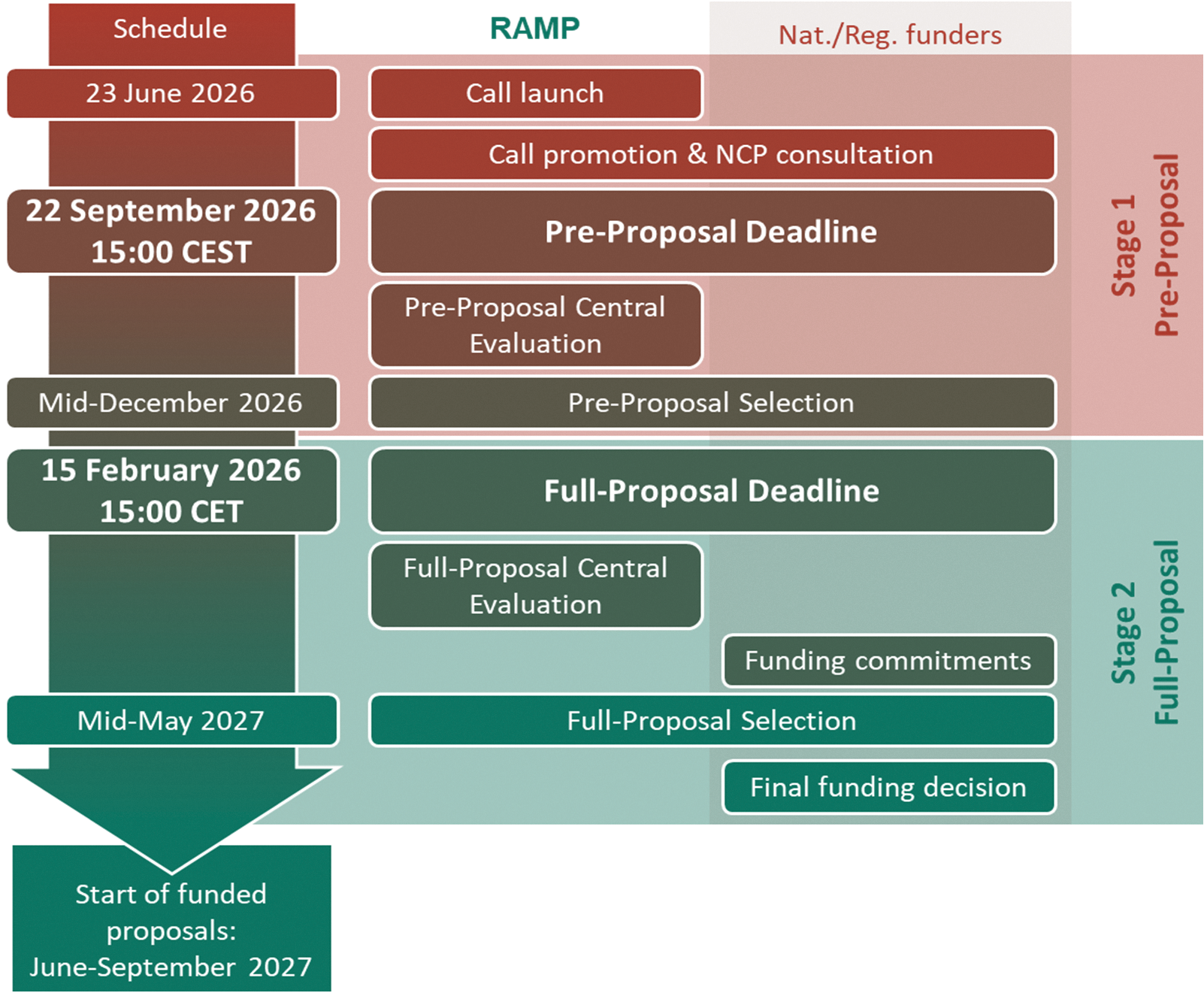
Figure 3 – Workflow of the JTC 2026
• In stage 1, the Call Steering Committee (CSC) will agree on a list of pre-proposals invited to submit a full proposal. The decision will be based on the outcomes of the centralised evaluation and on the available national/regional budgets.
• Consortia invited to stage 2 may add or replace partners prior to full proposal submission under specific conditions, provided all the requirements are fulfilled (see Changes in the proposal between stages 1 and 2).
• In stage 2, the CSC will agree on a joint selection list based on the full proposals ranking lists and available national/regional budgets.
• The final funding decisions will be made by the national/regional funders according to their respective processes, and grant preparation and financial arrangements will be managed at national/regional level for each of the funded partners.
Once they are informed of a decision (eligibility, invitation to stage 2, recommendation for funding), applicants have 10 days to submit a redress request regarding the specific decision.
|
Stage 1 |
23/06/2026 |
Call Launch |
|
02/07/2026 |
Information webinar |
|
|
22/09/2026 15:00 CEST |
Pre-proposal submission deadline |
|
|
Early October 2026 |
Eligibility results |
|
|
10-day redress window |
||
|
Mid-December 2026 |
Stage 1 results (evaluation and selection) |
|
|
10-day redress window |
||
|
Late December 2026 |
Invitation to stage 2 |
|
|
Stage 2 |
31/01/2027 |
Requests (and approval) of changes between stages 1 and 2 |
|
15/02/2027 15:00 CET |
Full proposal submission deadline |
|
|
Early March 2027 |
Eligibility results |
|
|
10-day redress window |
||
|
Mid-May |
Stage 2 results (evaluation and selection) |
|
|
10-day redress window |
||
|
Late May/ Early June |
Communication of Funding decisions |
|
|
June–September |
National/regional contract negotiations / start of projects (expected) |
While proposals may employ different architectures and strategies tailored to the target challenges and objectives of their specific topics, there are expectations and considerations that permeate the entirety of the call scope.
RAMP encourages transdisciplinary and diverse consortia spanning the R&I system (i.e. innovation, applied research, strategic/fundamental research, industrial research and experimental development) and disciplines (natural sciences, social sciences, arts and humanities, engineering, etc.). The call is open to both academic partners (such as universities, public or private research institutes, foundations) and commercial companies, whether SMEs or larger (the eligibility of the various types of applicants depends on the respective funder).
Engagement of stakeholders (such as companies, practitioners, NGOs and policy and/or societal actors) in the proposals is possible either as beneficiaries or as self-funded partners cooperating in committees, as advisors or data providers, etc. This involvement can take place during the project inception, implementation, analysis or dissemination of results.
Proposals must constitute a single and coherent joint project that clearly justifies the participation of all partners, demonstrating strong integration and interdependence among them rather than a mere aggregation of individual national activities. Consortia are expected to be balanced between countries regarding the number of partners, staff efforts in person-months (PM) and budget distribution while accounting for the intrinsic economic differences between regions. The collaboration within the consortium should go beyond individual national efforts, striving for sharing, operationalising and transferring existing knowledge, technology, resources, and research facilities for mutual benefit. Clear added value of the transnational consortium and, if relevant, the added value for national investments should be demonstrated.
Applicants are recommended to consider the available budgets, expected scale of funding demands and expected number of fundable projects for all involved funders when building their consortia. The funding demand for proposals will vary according to their duration, scale and ambition; as well as the size of the consortium and the specific rules of the funders involved. It is foreseen that the average proposal requests between 1 and 2 million euros in funding.
If a funder receives demands that far exceed its available funds, this may lead to most of their applicants being eliminated due to financial constraints.
Projects funded under RAMP are expected to address important knowledge-, innovation- or policy-related gaps in the RM ecosystem, subsequently feeding into larger initiatives (e.g. Horizon Europe) by upscaling, knowledge and technology sharing, and capacity building at various levels.
Proposals must be clearly positioned with respect to the state-of-the-art and are expected to build on the knowledge and experience achieved through previous transnational/European as well as national, regional and local R&I programmes. To avoid or overcome bottlenecks in adoption or commercialisation, proposals are strongly encouraged to devise, from an early stage, strategies and pathways for the future utilisation of the research results or for increasing their impact. Such strategies may include but need not be limited to the participation of industrial partners, collaborators or users.
Since the scope of this call covers the entirety of the RM value chain, RAMP welcomes all TRLs (including activities for which the concept of TRL is not applicable). However, according to the TRL eligibility range of the participating funders (Figure 4), it is expected that the majority of the proposals are positioned at lower to medium TRL.
Proposals should adopt Safe and Sustainable by Design principles and/or consider approaches to understanding and/or mitigating potential social and environmental impacts of their activities as relevant.
Proposals must explicitly address social acceptance including Indigenous rights, local democratic processes and long-term impacts on local communities where relevant.
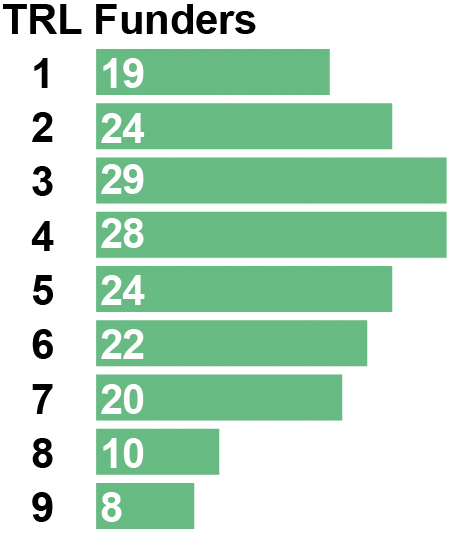
Figure 4 – distribution of the eligible TRL ranges of the funders participating in the JTC 2026.
Finally, gender balance and other diversity considerations are expected to be integrated in the project from its inception, both at the consortium level and within the planned research as relevant.
Whereas RAMP encourages and expects its projects to adopt inter- and transdisciplinary approaches, all proposals submitted to JTC 2026 must be positioned within one of the six topics described below, according to the main challenges they address.
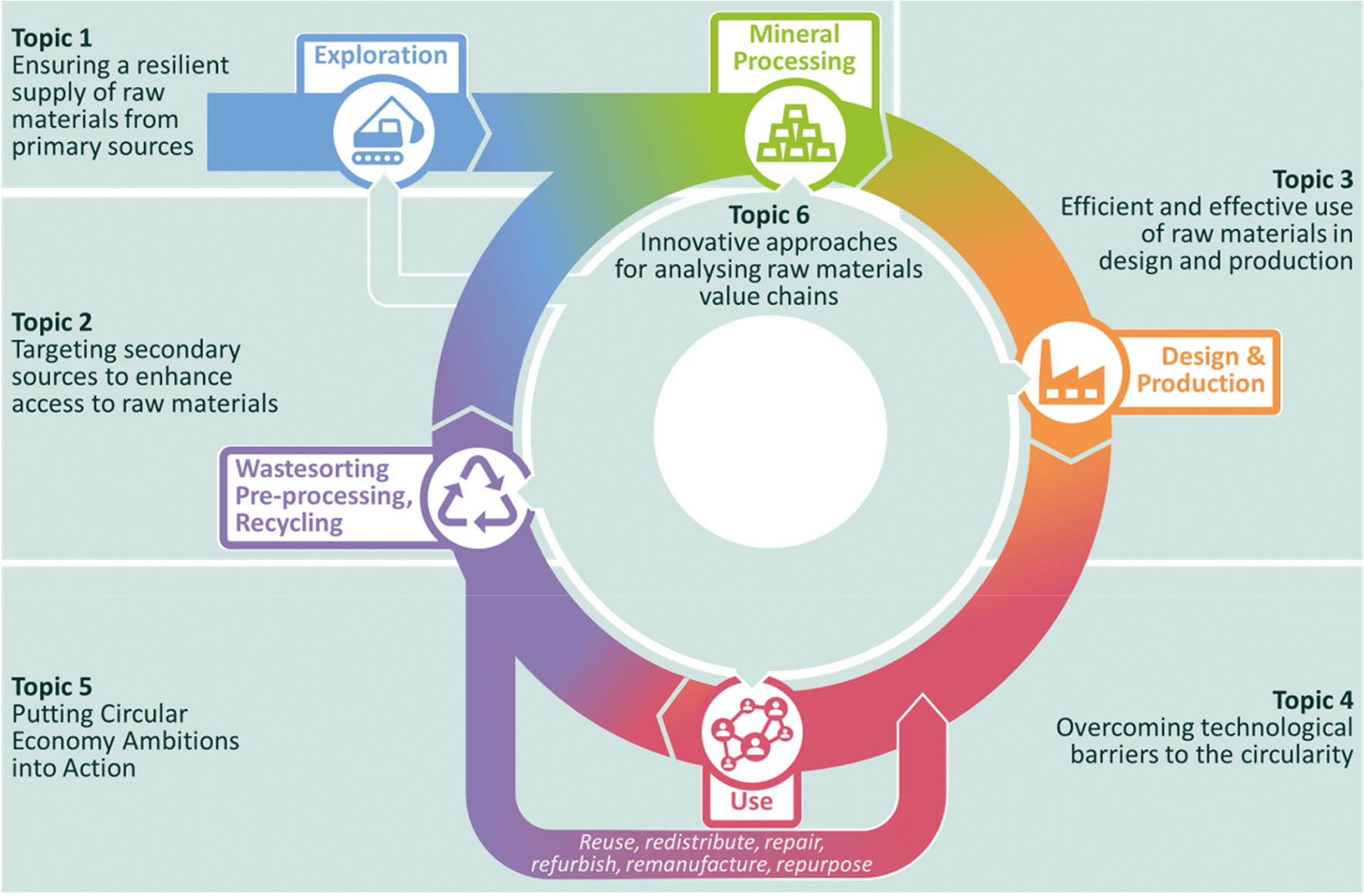
Figure 5 – Positioning of JTC 2026 Topics with respect to the circular economy.
This topic is aligned with Core Theme 1 of the SRIA. Projects under this topic are expected to tackle challenges within the primary supply chain including the sustainable exploration, extraction, refining and processing of RM.
Context and rationale
Given the high projected demand for raw materials, primary sources in the form of mines and quarries will remain indispensable. Existing sources might need to be reappraised or tapped more effectively, whereas new sources will need to be identified and made quickly operational. The EU CRM Act has set benchmarks of at least 10% domestic extraction and 40% domestic processing by 2030. Ensuring a resilient and sustainable supply from primary sources to meet such ambitious targets will require overcoming a series of technical and regulatory challenges, while considering social and ecological justice.
Scope
This topic is aligned closely with Core Theme 1 of the SRIA: resilient primary and secondary raw materials supply. RAMP welcomes proposals for projects that tackle the primary supply chain including the exploration, extraction, refining and processing of raw materials. The projects are encouraged to connect the different steps of the supply chain (for example, exploration insights informing extraction strategies) and bridge multiple disciplines (for example, mining engineering, economics and environmental science). Projects under Topic 1 may address one or more of the following aspects:
Exploration and resource assessment, for example innovative low impact, non-intrusive or minimally invasive exploration techniques for identifying deep and unconventional deposits; mineral system models and digital geological databases; ore characterisation and assessment to optimise extraction strategies; as well as tools and methods for assessing supply chain vulnerabilities and resource criticality.
Sustainable mining and extraction, for example automated and digitalised mining operations (such as mining machinery); new solutions in data management and integration; environmentally friendly and energy efficient extraction technologies; minimising mining waste; and assessing and mitigating the social and environmental impacts of mining.
Metallurgical processing and refining of primary ores, for example advanced metallurgical processes (bio-, hydro-, pyrometallurgical or combinations); aiming at zero waste mining while reducing environmental impact; energy efficient and emission reducing refining technologies; and digital tools, process control and automation in metallurgical operations.
Proposals are also encouraged to consider, as relevant, aspects such as policies and governance models; data-driven approaches to improve permitting; financing and economic sustainability of operations; community engagement and acceptance including land-use conflicts and Indigenous rights; capacity building; and standardisation of data and processes.
Keywords
Artificial intelligence; automation; bioleaching; community engagement; data integration; digital geological databases; digitalisation; energy efficiency; ecological footprint; environmental impact assessment; primary raw materials supply; exploration; extraction technologies; geosciences; hydrometallurgy; metallurgical metallurgy; mineral system modelling; social and environmental impacts; mining; mining machinery; modelling; ore processing; permitting efficiency; pyrometallurgy; refining; resource assessment; resource-efficient technologies; social acceptance; sustainable mining; waste minimisation.
This topic is aligned with Core Theme 1 of the SRIA. Projects under this topic are expected to focus on recovering and reintegrating into supply chains raw materials from secondary sources including end-of-life products; industrial, urban and mining waste; and other anthropogenic sources.
Context and rationale
Decommissioned or obsolete modern machinery and infrastructure as well as consumer devices that have reached end-of-life are a veritable repository of raw materials, especially the critical or strategic ones. In this context, the EU CRM Act has set a target of recycling contributing towards at least 25% of its annual strategic materials needs by 2030. Currently, however, secondary resources contribute only a small fraction of the total material demand owing to challenges associated with recovery, processing and reintegration into production value chains. This calls for advanced recovery technologies, innovative, competitive business models and system level solutions across this part of the value chain.
Scope
This topic is aligned closely with Core Theme 1 of the SRIA: Resilient primary and secondary raw materials supply. RAMP welcomes proposals for projects that focus on recovering raw materials from secondary sources including end-of-life products, industrial, urban and mining waste, and other anthropogenic sources, and reintegrating them into supply chains. The projects are encouraged to connect the different steps of the supply chain (for example, recycling capabilities guiding business model development) and bridge multiple disciplines (for example, engineering and behavioural science). Projects under Topic 2 may address one or more of the following research areas:
Recovery and recycling technologies, for example those applicable to end-of-life products (such as batteries or photovoltaic panels); urban mining approaches to extract raw materials from the built environment and landfills; remining closed mine sites; valorisation of mining and other secondary sources in the technosphere, including digital solutions (e.g. AI and IoT) for identifying and tracking valuable materials in such streams and metallurgical processing and refining of secondary sources.
Integration and value chain optimisation, for example integration of secondary feedstocks into primary production facilities; business models enabling efficient processing and reintegration of secondary materials; quality assessment and certification methods for facilitating market acceptance; tools for the management of secondary sources (e.g. monitoring and tracking technologies using AI, enabling mapping of accessible raw materials); and Life Cycle Assessment (LCA) and material flow analysis facilitating optimisation.
Proposals are also encouraged to consider, as relevant, aspects such as policies and governance models; financing and economic sustainability of operations; community engagement and acceptance; and digital tools and platforms enabling material exchange, collaboration, and industrial symbiosis.
Keywords
Artificial intelligence; digital monitoring; economic feasibility; secondary raw materials supply; feedstock integration; IoT applications; LCA; market acceptance; material flow analysis; material tracking; metallurgical processing; metallurgy; monitoring and mapping of secondary sources; quality certification; recovery; recycling; reintegration of secondary materials; re-mining; resource-efficient technologies; secondary raw materials; sensor-based sorting; urban mining; waste valorisation.
This topic is aligned with Core Theme 2 of the SRIA. Projects under this topic are expected to focus on design and production approaches that make more efficient use of RM and other inputs such as energy and water; minimise social and environmental impacts; enable reuse, repair and recycling; and allow substitution where relevant.
Context and rationale
Both primary and secondary raw materials find their way into finished products through manufacturing. Although industry has made great technological advances in the recent decades, there is considerable scope for increasing the efficiency of production processes (e.g. lower RM, water and energy use), minimizing potential environmental impacts and facilitating the substitution of CRM. At the same time, design and production processes need to adapt to feedstocks with a wider range of properties to ensure greater use of secondary raw materials and enable the reuse, repair and recycling.
Scope
This topic is closely aligned with Core Theme 2 of the SRIA: Efficient Use of Raw Materials in Design and Production. RAMP welcomes proposals for projects that focus on improving product design and the efficient use of RM in production processes and consider, for example, the Safe and Sustainable by Design principles. The projects are encouraged to connect the different steps of the supply chain (for example, the potential for reuse/recycling guiding design innovation) and bridge multiple disciplines (for example, process engineering and environmental science or toxicology). Projects under Topic 3 may address one or more of the following research areas:
Efficient production processes and technologies, for example ones that minimise RM use and losses; substitute CRM with more commonly accessible materials; use waste from one process as input for another process; enable more efficient use of water, energy and other inputs; and reduce adverse social and environmental impacts. The processes or technologies should exploit, as relevant, the full potential of AI, machine learning and other digital tools, e.g. for monitoring material cycles, tracking and tracing, etc.
Innovative product design, for example to facilitate the substitution of critical raw materials; increase the use of secondary raw materials; and modular product architecture as well as the use of easily separable material composites to enable reuse, repair, and recycling. Innovations in design should exploit the full potential of digital tools such as AI and machine learning, as well as other relevant tools, e.g. for assessing the social and environmental impacts over product lifecycles.
Proposals are strongly encouraged to involve industrial partners, including energy- and material-intensive process industries, especially in projects including higher-TRL (≥4) activities relevant for European strategic value chains.
Keywords
AI-driven process control; assessing and minimizing social and environmental impacts; assessment of new approaches in product design and production; circular design; circular product design; CRM substitution; digital tools to aid production and design; digital twins; durable product design; eco-design; industrial collaboration; lifecycle impact assessment; material tracing; minimizing raw materials use in products; modular architecture; modular product architecture; process optimisation; product design for repair; production digitalisation; resource-efficient manufacturing; resource-efficient production; Safe and Sustainable by Design; substitution of CRM; water and energy efficiency.
This topic is aligned with Core Theme 3 of the SRIA. Projects under this topic are expected to provide technological advances aimed at increasing the service life of products or components through reuse, repair, refurbishing, remanufacturing and repurposing, thereby achieving circularity across the raw materials value chain.
Context and rationale
During the last few years, the notion of a circular economy – increasing the service life of products or components and closing the loop – has become firmly established in all spheres. Implementing such an economy has the potential for optimising raw material use and enhancing social and ecological wellbeing. Doing so, however, requires surmounting substantial technological barriers that hinder the circular use of products.
Scope
This topic is closely aligned with Core Theme 3 of the SRIA: Sustainable Use and Reuse of Products. RAMP welcomes proposals for projects that will provide knowledge, tools and technological advances aimed at increasing the service life of products or components. Projects under Topic 4 may address one or more of the following research areas:
Development of technologies and prototypes to facilitate reuse, repair (e.g. via modular product architecture), refurbishment, remanufacturing and repurposing of products, thereby extending their service life.
Development of methods for measuring and safeguarding product and component reliability.
Development of easy-to-use real-time decision support tools and digital product monitoring tools to optimise decisions, e.g. for repair or remanufacturing, and predictive maintenance.
Keywords
Component reliability; decision-support systems; decision-support tools; digital product passports; digital twin; disassembly and sorting; end-of-life products; mass flow analysis; predictive maintenance; product monitoring tools; recycling interface optimisation; refurbishing; refurbishment; remanufacturing; repair; repair solutions; repurposing; reuse; reuse technologies; reverse logistics; sensor-based condition monitoring; service life extension; technologies increasing the service life of products.
This topic is aligned with Core Theme 3 of the SRIA. Projects under this topic are expected to provide knowledge and tools for enhancing the adoption of circular-economy principles, for example by improving or developing standards and norms; analysing the policy/regulatory, social, behavioural, economic and spatial aspects of use and reuse; and critically analysing and improving circular business models.
Context and rationale
When it comes to achieving a circular economy in the raw materials context, technological innovation is necessary but not sufficient to ensure that products are used and reused for as long as possible. Social, behavioural and regulatory barriers must also be overcome, and the right type of data must be made available. Ultimately, various actors must embrace new norms, standards and practices, and the policy context needs to be conducive to such an endeavour. Both industry (via business and service models) and consumers (via preferences and acceptance) will play an especially important role in the success of efforts aimed at increasing the service life of products.
Scope
This topic is closely aligned with Core Theme 3 of the SRIA: Sustainable Use and Reuse of Products. RAMP welcomes proposals for projects that will provide knowledge as well as practical solutions for helping overcome non-technological barriers to the adoption of circular-economy practices. Projects under Topic 5 may address one or more of the following research areas:
Developing innovative business models (for example Product as a Service) and financial instruments that prioritise sustainability and circularity in product design and consumption patterns.
Identifying and providing solutions for overcoming legal, regulatory and consumer behaviour related obstacles to the circular use of products. This includes, as relevant, strategies to actively enhance consumer engagement in and social acceptance of circular economy practices, and the engagement of local authorities, associations and companies.
Projects are encouraged to explore, when relevant, regulatory frameworks, permitting efficiency, coordination mechanisms, and CRMA implementation, including best practices for transparent and predictable processes at regional and local levels.
Keywords
Capacity building; circular business models; consumer engagement; CRMA compliance; financial instruments for circularity; governance innovation; legal, regulatory and other barriers to circular economy; local and regional implementation; new standards; norms and practices; permitting processes; policy and regulatory frameworks; product-as-a-service; social and behavioural change; transparency and predictability.
This topic is relevant to all core themes of the SRIA. Projects under this topic are expected to develop new ways of characterising raw materials value chains, for example through enhanced data management and standardisation; dynamic value chain modelling; LCA; and financial models and strategies.
Context and rationale
Data availability and quality as well as analytical capabilities have a critical role in enhancing our understanding of all components of raw materials value chains. Despite increased monitoring and advances in such approaches as LCA, key gaps need to be filled to ensure that value chain analysis can directly support resource efficiency by optimising material flows and evidence-based policymaking for sustainability. There is also considerable scope for incorporating, in a more sophisticated manner, geopolitical, economic and other aspects within analyses.
Scope
RAMP welcomes proposals for projects that will address crosscutting challenges in the raw materials sector through technical approaches that enhance data management, modelling, standardisation and financial strategies. The scope includes the development of dynamic models for value chains, standardisation of data and processes, EOL analysis, mass flow analysis, and financial models to mitigate pricing fluctuations. Projects under Topic 6 may address one or more of the following research areas:
Developing dynamic models of value chains, including stress testing of supply chains, physical models (for example, energy consumption), and links with mass flow analysis and LCA.
Standardisation of data and processes to address fragmentation and ensure interoperability; blockchain and other tools for enhancing traceability and transparency.
Undertake various types of analyses, for example EOL analysis to improve material circularity and sustainability; mass flow analysis to optimise resource use and minimise waste; and financial modelling to mitigate pricing fluctuations.
Keywords
Blockchain traceability; data standardisation and harmonisation; dynamic system analysis; EOL analysis; financial models; financial resilience; geopolitical and market analysis; identification of barriers (e.g. policy, regulatory) for a competitive raw materials industry; interoperability; LCA; mass flow analysis; pricing fluctuation modelling; risk assessment; scenario modelling; traceability and transparency of raw materials supply; transparency tools; value chain modelling.
Prior to the centralised evaluation, proposals undergo two levels of eligibility checks, one relative to the entire proposal and the other relative to specific partners. The ineligibility of one or more partners may lead to the ineligibility of the entire proposal, as detailed below. Ineligible proposals are not sent to central evaluation and are therefore rejected.
As each partner in a project is to be funded directly by their respective funder in accordance with their respective national/regional eligibility criteria, applicants are required to ensure that they comply with these criteria. It is recommended that applicants contact their respective national/regional contact person to avoid eligibility-related issues emerging later in the process.
By submitting a pre- or full proposal, all applicants agree that it will be accessible to all funders from which funding is requested, as well as the JCS and RAMP’s Ethics Advisory Board (EAB).
• Proposals must fit within the scope of the call and be submitted to only one of the call topics.
• The maximum duration of projects is 36 months.
• The project workplan must include the provision of dedicated resources (PM and budget) to ensure the participation of at least one project representative in at least one dissemination, exploitation or communication event or activity organised by RAMP within the project lifetime (such as final seminars or networking events, for instance).
• Proposals must be complete, written in English and comply with the mandatory templates and formatting. They must be submitted by the coordinator to the RAMP ESES before the submission deadlines.
○ Restructuring or modification of the templates, disregard to the page limit or late submission will result in the rejection of the proposal.
○ No resubmission or revision is allowed after the submission deadline, for both pre- and full proposals, unless the JCS requests corrections to technical administrative details.
○ The prior submission of a pre-proposal (and the invitation to stage 2) are requirements for the submission of a full proposal. The information given in the pre-proposals is binding. No change to the objectives outlined in a pre-proposal is allowed. A limited number of changes may be allowed upon approval by the JCS and by all involved funders (see Changes in the proposal between stages 1 and 2).
• Applicants must complete an ethics self-assessment as part of the application
• Proposals that include activities related to deep sea mining are not eligible for funding by RAMP.
• Proposals that include activities related to any application other than civil are not eligible for funding by RAMP.
• If the proposals note the intended use of satellite-based earth observation, positioning, navigation and/or related timing data and services, then the projects must make use of Copernicus and/or Galileo/EGNOS (other data and services may additionally be used).
• The types of partners that can apply for funding (provided that they are eligible according to their respective national/regional funder) are:
○ Public research organisations
○ Private research organisations
○ Universities
○ Small and medium companies
○ Large companies
○ Consultancies
○ Others (e.g. municipalities, regional/national administrative bodies or non-profit legal entities such as NGOs, stakeholder associations, societies and foundations)
Prospective applicants must consult the relevant national annex to verify their eligibility to be funded.
• The consortium must be comprised of a minimum of three partners from at least three different countries (with at least two of them being EU member states or associated countries). They should be requesting funding from an RFO participating in the current call and be eligible according to their respective national/regional rules.
○ Additional partners, including self-funded partners, are allowed.
▪ There is no maximum limit of partners in a consortium, but their participation must be relevant to the project’s objectives and ambitions, and the consortium should remain manageable.
○ The project coordinator must be eligible for funding and request funding from a participating RFO (and be eligible according to its rules).
• The efforts measured in person months (PM) for all the personnel participating in the project for a given partner) must be balanced and coherent within the consortium:
○ The total efforts of a single applicant cannot exceed 50% of the total project efforts (in PM) in the proposal.
○ The total effort of applicants from a single country cannot exceed 60% of the total project efforts (in PM) in the proposal.
○ In case one or more partners withdraw or are removed from the consortium (eligibility, financial reasons, force majeure, etc.), the total efforts of the missing partner(s) must be less than 25% (in PM) of the total project efforts.
▪ The viability of a project with missing partner(s) will be assessed on a case-by-case basis.
Self-funded partners can join a consortium with their own resources and/or can bring their own funding (e.g. if ineligible to receive funding from one of the funders in the call or due to other reasons).
Self-funded partners will not be subject to national/regional eligibility assessments. A letter of commitment will be required at stage 2 submission. If the letter of commitment is not provided, the self-funded partner will be rejected and will not be considered in the evaluation.
Self-funded partners cannot be coordinators of projects; their role must be clearly described, and they are not counted towards the minimum number of eligible partners and countries.
Applicants need to respect that entities subject to EU restrictive measures5 under Article 29 of the Treaty on the European Union (TEU) and Article 215 of the Treaty on the Functioning of the EU (TFEU) as well as Article 75 TFEU are not eligible to participate in any capacity. In addition, restrictions apply to legal entities established in Russia, Belarus or in non-government-controlled territories of Ukraine. This list may evolve if new sanctions are decided by the EU.
Each applicant is responsible for enquiring about their eligibility and checking their compliance with the applicable rules and procedures of the funder from which they request funding. This must be done before the submission of the proposal, since no resubmission or revision is allowed after the submission deadline, for both stages, unless the funding organisation requests corrections to technical administrative details.
Examples of national/regional requirements are:
• Mandatory contact/registration prior to project submission
• Presence of additional forms/documents
• Additional national/regional-level submission procedures
• Type, financial status and/or number of participants
• Thresholds and/or range for requested funding, eligible costs and funding rates
• Thematic relevance or priorities, including TRL and expected impacts
The Annex 1 – Funder-specific rules contains the information relative to each participating RFO for the current call.
If the ineligibility of one or more applicants results in a consortium that no longer fulfils the transnational eligibility conditions, the entirety of the proposal will be deemed ineligible.
The evaluation criteria of this call include compliance with relevant ethical principles. Applicants must describe the potential ethical implications of their proposed R&I in their workplans. Projects involving field experiments, pilot projects or any activity that might modify the existing socio-ecological status at any location should include environmental- and social-impact assessments covering biodiversity, land use, tailings and waste management, and nature-restoration strategies as appropriate. Any work involving the use of humans (for example surveys or interviews, as well as reliance on local assistance) should be carried out with the appropriate authorisation, considering EU and national ethics requirements.
To identify any potential ethical issues, applicants are required to complete an ethics self-assessment and provide supporting documentation referred to in the ethics issues checklist.
Please consult the available Horizon Europe programme guidance: How to complete your ethics self-assessment.
If any ethical issues are foreseen to arise during the proposed project, these must be addressed in the full proposal. The Horizon Europe guidelines address ethical issues in relation to the following: human embryos & foetuses, human beings, human cells or tissues, personal data, animals, non-EU countries, environment, health & safety, dual use, and exclusive focus on civil applications.
This self-assessment, as well as any additional ethical issues that are raised by the CEP and the RAMP’s EAB, will be shared with national/regional funders who may stipulate specific ethics requirements, which in turn must be met by successful applicants as part of the national/regional funding contract (and will be included in the project reporting).
Any proposal deemed to violate fundamental ethical principles, after review by RAMP’s EAB, will not be accepted. Assessment of the significance of ethical issues will be made by applying the criteria published by the EC in its guidelines for the Horizon Europe Framework Programme. Where activities undertaken in non-EU and non-associated countries raise ethical issues, the applicants must ensure that the research conducted outside the EU is legal in at least one EU Member State or Associated Country.
Each consortium needs to appoint a Coordinator, who will fulfil the following roles and responsibilities:
• Ensure the correct submission of pre- and full proposals via the ESES and lead the consortium throughout the submission process.
• Be responsible for the overall project coordination and act as the central contact point for the consortium during the full lifespan of the research project.
• Inform RAMP about any situation or event that might affect the implementation of the project.
• Ensure that all work is carried out to a high standard and meets contractually agreed deliverables and milestones presented in the proposal and approved by the funders.
• Be responsible for sharing all information with consortium partners.
• Be responsible for reporting data and the timely delivery of project reports.
• Be responsible for setting up a consortium agreement between the project partners.
The Coordinator will not be responsible for the financial management of project funding, which shall be handled directly between the consortium members and their corresponding funders.
It is mandatory at both stages that the complete documents for the pre- and full proposals are submitted by the Coordinator in the ESES before the corresponding deadline. A tutorial will be provided on the call webpage.
It is strongly recommended that the partners familiarise themselves with the platform in advance and that they complete the submission procedure ahead of time, as RAMP will not allow for deadline extensions for any reason that is not under its direct responsibility.
No resubmission or revision are allowed after the submission deadline, for both pre- and full proposals, unless the JCS requests corrections to technical or administrative details.
For both stages, the centralised transnational evaluation will be carried out by a panel of independent international experts (CEP). CEP members will be researchers, practitioners and other stakeholders who have a high standing in their fields, with recognised expertise in the research areas represented by the call topics. Potential CEP members can be nominated by members of the RAMP consortium or apply to the open call for experts. The composition of the CEP (proposed by the JCS and endorsed by the CSC) will be determined according to the required technical expertise. The JCS will take all measures to avoid conflicts of interest and will target a balanced CEP composition with respect to gender, geographical distribution, expertise areas, and industrial and academic representation.
The CEP will be subdivided into six thematic subpanels, corresponding to the topics of the current call.
During the evaluation process (Figure 6), each proposal will be evaluated by at least three CEP members who will prepare an individual qualitative pre-assessment (1). All proposals within a thematic subpanel will be subsequently discussed in a plenary session, during which experts will agree on a final assessment and score for each proposal, resulting in a ranking list for the thematic subpanel (2).
The centralised evaluation will lead to:
• Six thematic ranking lists of proposals above the threshold.
• Evaluation reports for each evaluated proposal.
Based on the ranking lists and the available budgets, the CSC will elaborate the selection list (3) (see selection procedures).
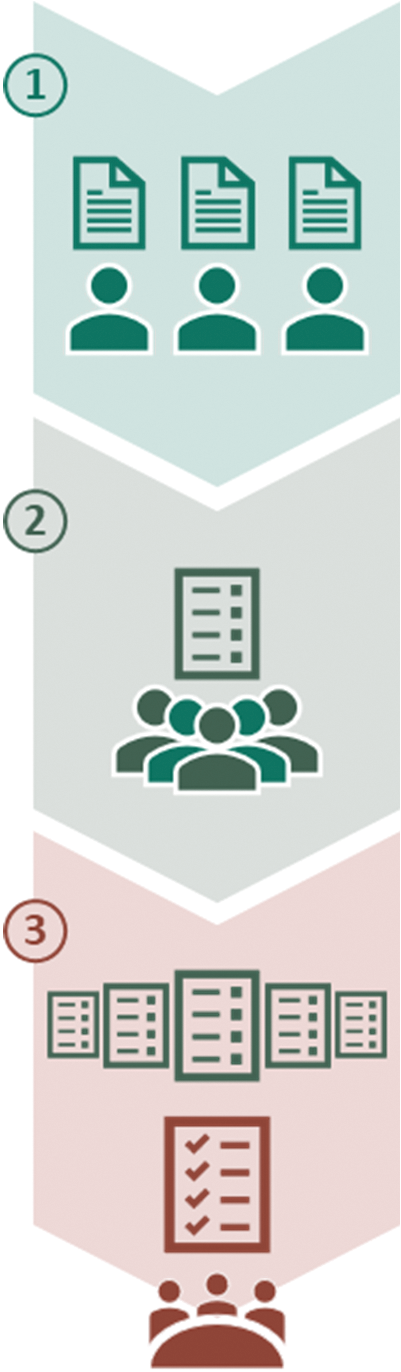
Figure 6 – Evaluation process.
RAMP will implement measures to manage potential Conflicts of Interest within the entirety of its evaluation process. An external observer will verify that the call procedures meet the applicable requirements and regulations.
Proposals will be assessed comparatively in terms of their Excellence, Impact and, in stage 2, Implementation efficiency.
Information about project implementation is nevertheless mandatory at stage 1, and it will undergo a qualitative assessment and eligibility checks, but it will not receive a score.
Proposals will be considered below the threshold (and not included in the ranking lists) if they do not reach a score of:
• At least 3 out of a maximum of 5 per criterion (of a total of two criteria in stage 1 and three criteria in stage 2), and
• A total score of 6 out of a maximum of 10 in stage 1, and 10 out of a maximum of 15 in stage 2.
|
Stage 1 |
Stage 2 |
|
|---|---|---|
|
Number of criteria |
2 |
3 |
|
Maximum score per criterion |
5 |
5 |
|
Minimum threshold per criterion |
3 |
3 |
|
Total minimum threshold |
6 |
10 |
|
Total maximum score |
10 |
15 |
These main criteria, equally weighted, contain different elements, which will be assessed according to the particularities and expectations for each topic and for the different call stages.
|
Stage 1 – Pre-proposal evaluation criteria |
||
|---|---|---|
|
Excellence |
Positioning of the proposed work relative to the state of the art/ extent of project’s ambition, innovation/economic potential, and ground-breaking objectives. |
5 |
|
Added value of transnational cooperation. Complementarity and balance of experience and expertise of the consortium to address the project objectives. |
||
|
Clarity and pertinence of the proposal objectives relative to RAMP and the call topic |
||
|
Coherence and credibility of the proposed technical/scientific hypotheses and feasibility within the proposed timescale |
||
|
Impact |
Relevance for the call topic: ability of the proposal to deliver the expected outcomes; alignment with the European or international impacts expected for the overall call. Appropriateness of the type of the expected results. |
5 |
|
Integration of gender and diversity perspectives in the project plan and objectives when applicable (or justification if not applicable). |
||
|
Engagement of stakeholders (e.g. communities, municipalities, policymakers, regulators, NGOs) if applicable (or justification if not applicable). |
||
|
Engagement of the proposed research with environmental as well as ethical, political, social and/or cultural dimensions, if applicable. |
||
|
Implementation |
Adequacy of global costs with respect to the ambition of the project and its expected results and impact No score in stage 1 (mandatory information for eligibility and qualitative assessment) |
|
|
Stage 2 – Full proposal evaluation criteria |
||
|---|---|---|
|
Excellence |
Positioning of the proposed work relative to the state of the art/ extent of project’s ambition, innovation/economic potential, and ground-breaking objectives. |
5 |
|
Added value of transnational cooperation. Complementarity and balance of experience and expertise of the consortium to address the project objectives. |
||
|
Defined and well-quantified objectives with the potential to contribute significantly to the topic objectives. |
||
|
Identification of risks and inclusion of a mitigation plan. |
||
|
Technical soundness of the proposed concept and appropriateness of the proposed approach. Includes effective incorporation of responsible practices within the project, the credibility of the TRL evolution, and potential for industrial adoption (if applicable). |
||
|
Impact |
Relevance for the call topic: ability of the proposal to deliver the expected outcomes; alignment with the European or international impacts expected for the overall call. Appropriateness of the type of the expected results. |
5 |
|
Integration of gender and diversity perspectives in the project plan and objectives when applicable (or justification if not applicable). |
||
|
Engagement of stakeholders (e.g. communities, municipalities, policymakers, regulators, NGOs and/or industry) if applicable (or justification if not applicable). |
||
|
Engagement of the proposed research with environmental as well as ethical, political, social and/or cultural dimensions, if applicable. |
||
|
Effectiveness of the proposed measures for the dissemination and/or exploitation of project results both at transnational and regional levels. |
||
|
Implementation |
Coherence, relevance, and balance of the roles of the partners. Appropriateness of the allocation of the distribution of tasks and workloads. |
5 |
|
Feasibility and appropriateness of the workplan for the proposed objectives and timescale. |
||
|
Appropriateness of cost allocation and justification of requested resources (staff, equipment, etc.) |
||
|
Appropriateness of the management structures and procedures, including risk, quality, and innovation management as well as data concerns, for example GDPR risks, risks associated with access to data, etc. |
||
|
Consideration of regulatory and ethics issues, when necessary. |
||
|
Consideration of data management issues, such as access to data, data processing, data quality, etc., for example by providing a Data Management Plan. |
||
|
Score |
Definition |
|---|---|
|
5 |
Excellent. The proposal successfully addresses all aspects of the criterion. |
|
4 |
Very good. The proposal addresses the criterion very well, but small improvements are possible. |
|
3 |
Good. The proposal addresses the criterion in question well, but improvements are necessary. |
|
2 |
Fair. The proposal generally addresses the criterion, but there are significant weaknesses that need corrections. |
|
1 |
Poor. The proposal shows serious weaknesses in relation to the criterion. |
|
0 |
Not addressed. The proposal fails to address the criterion in question or cannot be assessed because of missing or incomplete information. |
The selection of proposals (for either stage 2 or for funding) will be made by the CSC based on the ranking lists and the available budgets. Proposals below threshold are not included in the ranking lists and, therefore, cannot be included in the selection list that will emerge from the selection process. Proposals not selected due to budgetary constraints will also not be included in the selection list.
When necessary to arbitrate between proposals with equal scores or in different ranking lists, the CSC will aim to ensure that:
In stage 1:
• The total requested funding of the selected pre-proposals for each funder does not exceed 4 times their committed budget in stage 1 (3 times for funders ineligible for co-funding, see Annex 1 – Funder specific rules).
• As many countries participating in the call as possible are represented in the consortia of proposals invited to second stage.
• There is a good representation (in terms of the number of proposals) of all six topics.
In stage 2:
• Both the total number of projects funded and the total number of participating countries/regions involved in these projects are optimised.
• There is good representation (in terms of the number of projects) and balanced success rates between the six topics.
• The EC co-funding is used as efficiently as possible but also distributed as fairly as possible among the participating countries eligible for EC co-funding.
The CSC may need to arbitrate between these objectives to ensure the best possible outcome for RAMP, given the evaluation results of the call in question.
During the selection of full proposals for funding, no gaps will be left in each of the ranking lists (if a project cannot be funded due to budgetary constraints of one or more funders, no project ranked below it will be included in the selection list).
Once the selection list is complete, and if additional lower ranked proposal(s) can be funded by using exclusively the remaining national/regional funds (i.e. without using the EU top-up), the concerned funders may opt for inviting the additional proposal(s) for funding, in an independent additional list. This is an optional procedure, applicable upon mutual agreement and if compatible with the rules of the concerned funders.
RAMP will inform the applicants of the outcome of the selection procedure as soon as feasible via feedback emails, and the final evaluation reports will be accessible to the coordinators of proposals. The evaluation scores are confidential and will be accessible to only the CSC.
Funding arrangements (contracts, grant or consortium agreements, etc.) will be carried out at national/regional level between each funded partner and their respective funder.
In case a mistake in procedural aspects of the call is perceived, applicants must contact the Joint Call Secretariat within 10 days of receiving the relevant official communication (eligibility, invitation to stage 2, recommendation for funding).
RAMP will not accept appeals:
• motivated by technical issues which are not under its direct responsibility;
• on the merits of the scientific evaluation;
• on the decisions of the EAB; or
• on the decisions of the CSC.
An ad-hoc committee will be composed by the JCS, including the funders involved in/affected by the redress request(s), volunteer members of the CSC (provided they do not have a Conflict of Interest (CoI)) and the independent observer.
Only pre-proposals invited to stage 2 will be allowed to submit a full proposal, which must remain coherent with the pre-proposal as it was evaluated. Therefore, only limited changes are allowed between stages 1 and 2 and subject to the approval of the JCS and the relevant funders.
No fundamental changes initiated by the applicants alone will be accepted. Specifically:
• the project objectives stated in the pre-proposal cannot be changed.
• significant budget changes are not allowed unless requested by the JSC or the funders.
○ If requested by a funder, then they will decide whether a justification is needed according to their own rules
• the Coordinator (and its PI) cannot be changed, except in case of force majeure.
• the consortium should stay the same unless requested explicitly by the JSC or by the funders.
• Changes in the consortium should be avoided.
○ Changes in the consortium structure and funding demand within the fallback or widening procedures (below) are considered modifications requested by the JSC and are therefore exempt from this rule.
Any changes to the proposal must be duly justified and submitted for the approval of all concerned funding organisations at least 15 days before the full proposal deadline. It is the responsibility of the Coordinator to ensure that all funders have been duly informed and have approved the changes.
Applicants must consult their respective funders to verify whether additional limitations apply regarding changes between stages 1 and 2.
All changes in the proposal and their consequences to the workplan must be detailed in the full proposal, which must not have deviated significantly compared to the pre-proposal evaluated by the CEP.
In some cases, applicants may be requested by their funders or by the RAMP’s JSC to implement changes to the full proposal (such as minor corrections to comply with national procedures, changing between two funders of the same country, replacement of partners, etc.).
The concerned applicants will be informed about the requested changes and applicable procedures, and whether the changes are mandatory or not. If an applicant fails to implement a mandatory modification, they will be deemed ineligible (which may entail the ineligibility of the entire consortium according to the Transnational eligibility criteria).
Pre-proposals invited to stage 2 may be allowed to modify their consortia prior to the full proposal submission if duly justified within the widening and fallback procedure mechanisms described below, which are offered as tools to maximise the participation of different countries and regions, and to avoid losing projects due to high oversubscription of an individual funder.
All coordinators will be informed at the same time about: the outcomes of the stage 1 selection; on whether they can take part in the widening procedure; and the list of funders participating in the widening procedure.
The widening and fallback procedures are not mandatory, and adding, removing, or replacing partners and revising the full proposal are accordingly part of the writing process of the full proposal. Submission deadlines will not be extended for the consortia taking part in these procedures.
New partners introduced between stages 1 and 2 must comply with the eligibility criteria of their respective RFOs as well as the transnational ones.
Between stages 1 and 2, the JCS may invite project consortia to integrate, in their full proposal, additional partners requesting funds from specific funding organisations which are underrepresented in the pre-proposals invited to stage 2.
This addition must be accompanied by relevant and well-dimensioned tasks which are coherent with the overall workplan and cannot cause a significant deviation from the proposal’s original objectives, expected impacts and main tasks, but should enhance its original focus. This possibility does not invalidate the consistency requirements between the pre-proposal and full proposal.
New partners can only request funding from one of the funders participating in the widening procedure for the current call. The list of participating funders will be published along with the results of the stage 1 selection.
This inclusion option between the pre-proposal stage and the full proposal stage, which allows as many countries as possible to be involved in the funding of the transnational projects, must be conducted in close cooperation with the respective funders.
After the CSC agrees on the pre-proposal selection list (following the ranking lists until the oversubscription limits of the respective funders), it is possible that proposals scored above threshold cannot be invited due to a high oversubscription of one single funder.
In case this concerns non-coordinating beneficiary partner(s) that in total contribute to 25% or less of the project efforts (PM), the consortium may opt for removing all partners from the concerned funding organisation (or converting them into self-funded partners).
• If this would result in the transnational ineligibility of the proposal, the exiting partner(s) must be replaced via the widening procedure.
• If the proposal remains eligible without the beneficiary partner(s) in question, the replacement of the exiting partner(s) is optional.
All personal data provided to RAMP in the execution of the call (e.g., project applications, evaluator assessments, mailing lists, tracking websites, registration for events) will be collected, stored and processed in accordance with the General Data Protection Regulation (GDPR) (Regulation EU 679/2016). For more information, please consult the privacy policy on the ESES.
RAMP is committed to avoiding any CoI and safeguarding good scientific practice. A code of Conduct related to CoI, confidentiality, and non-disclosure is defined and applies to the CSC, Independent Observer, Ethics Board, and CEP.
An important aspect of this code is the avoidance of any conflicts between personal interests and the interests of the applicants. The CSC and respective representatives, the independent observer and the CEP will perform their work impartially and take all measures to prevent any situation in which the impartial and objective implementation of the work is compromised for reasons involving economic interest, political or national affinity, family or emotional ties or any other shared interest (CoIs).
The situations in the following non-exhaustive list are automatically considered a CoI:
• Being involved in (the preparation of) any pre- and/or full proposal.
• Having submitted a proposal as a principal investigator or a team member under the current call.
• Being a director, trustee or partner or in any way involved in the management of an applicant.
• Being employed or contracted by one of the applicants.
• Having close professional proximity, e.g., being a member of the same scientific institution with a hierarchical or department relation or impending change of the CEP member to the institution of the applicant in a position with a hierarchical or department relation or vice versa.
• Having close family ties (spouse, domestic or non-domestic partner, child, sibling, parent, etc.) or other close personal relationships with the applicants of the proposal.
• Having (or having had during the last five years) a close scientific collaboration with an applicant of the proposal.
• Having (or having had) a relationship of scientific rivalry or professional hostility with an applicant of the proposal.
• Having (or having had), a mentor/mentee relationship with a principal investigator of the proposal.
• Having a current or prior (past five years) activity in advisory bodies of the applicant’s institution, e.g., scientific advisory boards.
• Having direct or indirect benefit/disadvantage if any proposal submitted is accepted or rejected.
• Having personal economic interests in the funding decision.
Other situations preventing the CEP members or reviewers from participating in the evaluation impartially could be considered a CoI and should be reported as such by the CEP members.
Applicants included in a proposal submitted to this call (including all team members, external collaborators and service providers) cannot serve as CEP members.
All necessary measures will be taken by the JSC to ensure that CEP members (evaluators) have no CoI with respect to the proposals they will assess.
The JSC Secretariat will perform a first screening of potential CoI before assigning the proposals to specific CEP members and sending them limited information on the assigned proposals. Prior to gaining access to any sensitive information, the evaluators will sign a non-disclosure agreement concerning all call documents and processes, and a formal declaration that they will not participate in the Call and that no CoIs regarding the consortium partners of their assigned proposals exist at any time of their evaluation duty.
If a CoI is identified, the member will be discharged from reviewing specific proposals or from participation in the CEP, depending on the nature of the CoI.
The beneficiaries of RAMP that might apply to the co-funded calls are excluded from the work of call preparation, selection, and project follow-up and monitoring. All call-related information is inaccessible to these beneficiaries. In this way, the possibility of research units belonging to these organisations participating in RAMP’s calls for proposals is safeguarded.
Each funded project is required to have a signed consortium agreement (CA) between all partners, typically within six months from the start of the project (stricter rules from specific funders may apply, please verify the applicable rules).
For projects involving companies, the signature of the CA is needed prior to the start of the project: see Article 27 of the EC Framework for State aid for research and development and innovation.
The CA must address, as a minimum, the following topics:
• Internal organisation and management of the consortium
• Sharing of risks and results
• Dissemination and exploitation of results
• Intellectual property arrangements
• Settlement of internal disputes
Additional national/regional funders’ regulations concerning the requirement for a CA, including the date of the signature, may also apply.
The DESCA model may be a helpful starting point in designing the CA. Please note that the DESCA model CA needs to be adapted to funding instruments such as RAMP (which involve different funders for each respective project part carried out in a different country).
During the project lifetime, progress surveys with key performance indicators and simplified reporting must be completed. At the RAMP level, coordinators are required to deliver a mid-term and a final report. Templates, detailed procedures and further guidance will be provided in due time to the funded projects.
Additionally, RAMP will organise annual conferences with dedicated project sessions as well as Other RAMP activities in future years. All RAMP-funded projects are required to ensure the participation of at least one representative in at least one of these events over the project lifetime (see the transnational Project requirements).
Changes during the lifetime of the project (extension of project duration, modification of partners or team members, restructuring of the workplan) should be avoided, but in case they are necessary, the appropriate change request must be submitted to the involved funders and to RAMP according to the guidelines provided to funded projects.
Modifications that would result in significantly changing the original scope or eligibility of the project are to be accepted only under exceptional circumstances and with proper justification.
At the national/regional level, the funder-specific monitoring and reporting modalities will apply to their respective partners.
Projects funded under the RAMP Partnership are expected to comply with the relevant principles, obligations and requirements applicable under Horizon Europe and the RAMP Grant Agreement.
Applicants must take these requirements into account when preparing their proposals and planning project implementation.
Projects must comply with the highest standards of ethics and research integrity and, where applicable, obtain all relevant authorisations, approvals and permits required under national and international legislation.
Research activities must be carried out in accordance with recognised principles of research integrity and responsible R&I.
Projects are expected to adhere to the implementation of Open Science principles and are strongly encouraged to communicate their outcomes to as wide an audience as possible.
Costs of open-access publications are considered to be eligible costs by many of the funders involved in this JTC, and sufficient budget should hence be reserved for this purpose where eligible (see Annex 1 – Funder-specific rules).
Beneficiaries should ensure (where appropriate and taking into account legitimate interests, protection of intellectual property, confidentiality and security considerations) that:
• scientific publications resulting from the project are made openly accessible;
• research data are managed in accordance with the FAIR principles (Findable, Accessible, Interoperable and Reusable);
• a Data Management Plan is established and maintained where relevant;
• research outputs are disseminated as openly as possible and as closed as necessary.
Projects are expected to actively disseminate and communicate their activities and results to relevant scientific, industrial, policy and societal stakeholders.
Dissemination activities should consider the protection of intellectual property rights, confidentiality obligations and any security considerations.
Projects must ensure that all their outcomes (such as scientific publications) and communication and dissemination activities acknowledge the support received through the RAMP Partnership, Horizon Europe and the involved national/regional funders. Funded projects will receive detailed acknowledgement guidelines.
Applicants should demonstrate a credible approach for the uptake, use, valorisation and exploitation of project results.
Projects are expected to take appropriate measures to maximise the scientific, technological, economic, environmental and societal impact of the results generated.
Beneficiaries are expected to establish appropriate arrangements regarding ownership, protection, management and use of results generated by the project.
Consortium agreements should address intellectual property rights, access rights, dissemination procedures and exploitation arrangements among project partners.
Projects should promote gender equality, diversity and inclusiveness, taking these considerations into account where relevant in project design, implementation, governance and dissemination activities.
Projects involving sensitive information, strategic technologies or security-relevant aspects must comply with applicable security, confidentiality and information-protection requirements.
Where relevant, additional measures may be required during project implementation to safeguard legitimate interests, intellectual property, commercially sensitive information and security-related considerations.
Given the strategic importance of raw materials value chains, beneficiaries may be required to consider the protection of strategic assets, technologies, knowledge and results in accordance with applicable Horizon Europe and national requirements.
To further the impact of the Partnership, RAMP will implement a variety of additional activities over its lifetime, according to the outcomes of its biennial strategic plans. Some of these activities, such as networking events, targeted calls or actions, or the formation of thematic networks, may include the participation of RAMP-funded projects.
If such actions take place within the lifetime of the project, they may be counted as the mandatory participation in at least one dissemination, exploitation or communication event or activity organised by RAMP, as detailed in the transnational eligibility requirements.
If no relevant activities are implemented over the course of the project’s lifetime, the consortium must participate in at least one of RAMP’s project seminars.
Participants of previously funded RAMP projects will continue to be welcome to contribute to additional activities that will be implemented after the end of their project. However, please note that costs incurred after the end of a project are not eligible, and this participation would be in-kind or need to be funded by another mechanism.
Applicants are required to verify that they comply with the specific rules of their respective funders; and strongly advised to contact their national funding organisation before proposal submission.
For guidance regarding funder-specific rules, documents and procedures, please directly contact the contact persons listed in the funder’s annex.6
Self-funded partners must comply with the transnational (at RAMP level) rules and requirements.
The Horizon Europe Requirements and Obligations of funded projects described in the section 11 of the call text apply to all funded partners irrespective of whether these are explicitly stated by their national/regional funder in Annex 1.
Please read carefully the funder-specific information below and the frequently asked questions.
|
NL – Netherlands |
|||||||||
|
NWO |
Nederlandse Organisatie voor Wetenschappelijk Onderzoek |
||||||||
|
Dutch Research Council |
|||||||||
|
Geographical coverage |
National |
||||||||
|
Total Funder’s commitment for the call |
2 000 000 € |
Eligible for EC cofund |
yes |
||||||
|
Call webpage |
|||||||||
|
Contact persons |
Nadine Prust, Policy Officer, +31 (0)70 349 47 31 Anna De Graaf-van Dinther, Policy Officer, +31 (0)30 600 12 93 Do not hesitate to contact the national contact points in case of questions on NWO funding via ep-rawmaterials@nwo.nl |
||||||||
|
Expected number of funded projects, indicative range of funding demand, other relevant information |
5 |
||||||||
|
Funding demand thresholds per partner or project |
□ |
Min. |
✓ |
Max. |
□ |
No mandatory limits |
|||
|
– |
400 000 € |
– |
|||||||
|
Eligible topics |
Topic 1 |
Topic 2 |
Topic 3 |
Topic 4 |
Topic 5 |
Topic 6 |
Particular conditions |
||
|
No |
No |
No |
Yes |
Yes |
Yes |
– |
|||
|
Eligible TRL |
TRL 1 |
TRL 2 |
TRL 3 |
TRL 4 |
TRL 5 |
TRL 6 |
TRL 7 |
TRL 8 |
TRL 9 |
|
Yes |
Yes |
Yes |
Yes |
Yes |
Yes |
No |
No |
No |
|
|
Eligible types of partner and applicable funding rates |
|||||||||
|
Higher education organisations |
Yes |
||||||||
|
Public research centres |
Yes |
||||||||
|
Other public bodies (e.g., municipalities, regional/national administrative bodies) |
No |
||||||||
|
SMEs, large companies |
No |
||||||||
|
Non-profit private entities (NGOs, stakeholder associations, societies, foundations) |
No |
||||||||
|
Others |
No |
||||||||
|
Mandatory participation of a partner type |
An application for funding from NWO may consider the following roles: – National main applicant (mandatory): the national applicant who leads the application to NWO and is the foreseen national project leader, in case a project is granted. – National co-applicant (optional): national applicants in addition to the national main applicant with an active role and responsibility in realising the project and requesting funding from NWO. A researcher may only request NWO funding for one project (part of a European consortium) in this Call for proposals, either as national main applicant or national co-applicant within an application for NWO funding. National main applicant To be eligible to submit a proposal, researchers must be employed for an indefinite period (with the associated employment contract) or have a tenure track agreement at any of the following research organisations: • universities and universities of applied sciences, as described in Section 1.8, subsection 1 of the Dutch Higher Education and Research Act, or universities referred to in the Policy Rules for Universities in the Kingdom of the Netherlands (https://www.nwo.nl/en/nwo-grant-rules); • university medical centres, as described in Article 1.13, paragraph 1 of the Higher Education and Scientific Research Act; • KNAW institutes (https://www.knaw.nl/en/institutes) and NWO institutes (https://www.nwo-i.nl/en/nwo-institutes-organisation/nwo-institutes/); • TO2 institutions1; • Netherlands Cancer Institute; • Max Planck Institute for Psycholinguistics in Nijmegen; • Naturalis Biodiversity Center; • Advanced Research Centre for NanoLithography (ARCNL); • Princess Máxima Center. Researchers employed at a university of applied sciences and researchers employed at a TO2 institute may also submit as a national main applicant if they have at least a salaried position for a limited period of time. Individuals with a zero-hour or fixed-term employment contract (other than a tenure track appointment) cannot submit a proposal. Applicants with a part-time appointment must ensure adequate supervision of the project and all project members for whom funding is requested. It may be that the national applicant’s tenure track employment contract ends before the intended completion date of the project for which grant funding is being requested, or that the national applicant’s tenure agreement ends before this date due to their reaching retirement age. In such cases, the proposal must include a statement from the employer. In this statement, the research organisation in question guarantees that the project and all project members for whom funding is being requested will receive adequate supervision for the full duration of the project. This applies to a national main applicant as well as national co-applicant (see below). National co-applicant National co-applicants must be affiliated with a research organisation either 1) eligible as a national main applicant (see above), or 2) with other research organisations as described in Article 1.1, paragraph 4 of the NWO Grant Rules 2024 that comply with the following cumulative conditions. The organisation must: • be established in the Netherlands; • be a foundation, organisation or legal entity established and governed by public law (in Dutch: publiekrechtelijke rechtspersoon) (all other legal forms, including private and public limited companies, are excluded); • have as its primary goal the independent conduct of its own fundamental research, industrial research or experimental development or with widely disseminating the results of those activities through teaching, publications or knowledge transfer; • be able to state that the organisation keeps separate accounts regarding economic/non-economic activities and that undertakings with decisive influence on the organisation do not enjoy preferential access to the organisation’s results. Note: Prior to submission of a pre-proposal or, if possible at that stage according to the Call for proposals, full proposal, NWO will assess whether an organisation complies with Article 1.1, paragraph 4 of the NWO Grant Rules 2024 and is thus eligible to participate as national co-applicant based on the above conditions. This assessment also helps to ensure NWO’s compliance with regulations prohibiting state aid. To enable the assessment to be carried out, the intended national co-applicant’s organisation must submit the following documents by email to ep-rawmaterials@nwo.nlno later than 20 working days before the submission deadline (i.e. by 22 September 2026, 14:00:00 CEST): • a recent extract from the Chamber of Commerce; • a deed of establishment and/or current articles of association; • the most recently available annual accounts, including an audit report2; • a completed Research Organisation Statement, which is available on the funding page of this Call for proposals. Other relevant documents may also be included. NWO may also request additional information if the above documents do not allow for adequate determination of the organisation’s eligibility to act as national co-applicant. If in a full proposal national co-applicants are added to the consortium who are not affiliated with any of the research organisations listed above, these new national co-applicants must be assessed based on the same conditions. Again, the intended national co-applicant’s organisation must submit at least the above-mentioned documents by email no later than 20 working days before the submission deadline (i.e. by 22 September 2026, 14:00:00 CEST) If the intended national co-applicant’s organisation has already been assessed and found to comply with these conditions as part of a different NWO programme, please contact NWO at the above email address well before the applicable deadline to determine whether further assessment is necessary. If the intended national co-applicant’s organisation fails to submit the documents required for assessment on time, NWO will not accept the organisation as national co-applicant. If a research organisation was already assessed and approved as a national co-applicant before submitting the pre-proposal, there is no need to have it assessed again for the submission of the proposal. |
||||||||
|
Eligible costs |
1. Salary costs can be claimed for the following positions: 1.1 Postdoc: at least 1 position, for at least 12 months, for at least 0.5 fte, according to UNL or UMCNL rates, a benchfee is available; 1.2 Non-scientific personnel (NWP): according to UNL or UMCNL rates; 1.3 Research leave: max. 10% of the grant amount, according to UNL or UMCNL rates. 1.4 Personnel at universities of applied sciences, TO2 institutes and other (research) organisations: using the Government Tariff Manual (HOT), Table 2, under 2.2 ‘average total salary cost per salary scale’, column ‘Hourly rate productive hours, excluding VAT’. 2. Materials: For project-specific material costs, up to 25% of the grant amount. Subsequently, up to 50% of the material budget can be used for work by third parties. Engagement of students may be included here according to the usual internship fee or HOT rates3. 3. Knowledge utilisation: For activities that promote the use of knowledge from the research, mandatory and at most 20% of the grant amount. 4. Project management: Up to 5% of the grant amount. It is recommended to use the NWO budget template in the pre-proposal stage to confirm eligibility of budget items and correct use of tariffs. For full proposals, it is mandatory to submit the NWO budget form for the funding requested at NWO at the time of the transnational deadline. A detailed “Explanation of budget modules and indexing” can be found on the NWO funding page of this call. Do not hesitate to contact the national contact point in case of questions. |
||||||||
|
Other eligibility criteria / specific rules |
Please note the following: • An application for NWO funding has one national main applicant, responsible for research and financial management. National co-applicants within an application for NWO funding are allowed. • Researchers employed at a university in the Kingdom of the Netherlands, umc or a research organisation, as referred to in Article 1.1, first paragraph, subparagraphs c to h of the NWO Grant Rules 2024 may not apply for a scientific or post-doc position for themselves. • PhD positions cannot be applied for in this call, due to the maximum project duration of 3 years. • Overhead costs are not eligible for NWO funding. |
||||||||
|
Additional submission procedures required at national/regional level |
|||||||||
|
□ |
Stage 1 |
||||||||
|
✓ |
Stage 2 |
NWO Budget Form |
|||||||
|
□ |
Other |
||||||||
|
□ |
No additional procedures |
||||||||
|
Further guidance |
The NWO Grant Rules 2024 (https://www.nwo.nl/en/nwo-grant-rules) and the Approval of Funding for Scientific Research https://www.nwo.nl/en/approval-funding-scientific-research-2008) are applicable to all applications for NWO funding. Any arrangements made regarding the grant from NWO, for instance in a Consortium Agreement, must comply with the NWO Grant Rules 2024 and the European legislation on state aid. Once proposals are recommended for funding on a transnational level, the consortia will be notified by the Joint Call Secretariat and subsequently, the national granting process will be initiated by NWO. Under the Dutch General Administrative Law Act, any interested party has the right to lodge an objection to the decision taken by NWO within six weeks of the date of the decision letter. Further information about the objection’s procedure can be found on the NWO website: https://www.nwo.nl/en/lodging-an-objection. NWO will, if necessary, apply a one-off indexation of personnel costs when awarding a grant. The current UNL/UMCNL/HOT rate on the national decision date applies. Please refer to the “Explanation of budget modules and indexing” on the NWO funding page, for more information on indexing. As stipulated in the NWO Grant Rules, Article 3.2, paragraph 2, the project cannot start until the conditions set out in the grant award decision regarding the start of the project are met. Please note, these conditions will include a signed Consortium agreement by all partners in the transnational project. Submission of financial and scientific reports at national level is required in accordance with the rules of NWO. Granted consortia will be informed. |
||||||||
No audit report is necessary for organisations not legally required to have their annual accounts audited. However, such organisations must be able to provide proof of exemption from this legal requirement.
All activities included in this budget module must fit the European Commission’s definition of ‘knowledge transfer activities’ in the State aid framework for research and development and innovation (OJ 2022, C 414).
What type of projects are expected in this call?
RAMP expects to fund proposals that deliver impact across the entire RM chain. This includes relevant scientific, technical and social aspects across all TRLs (if compatible with the applicable national/regional rules).
Is it possible to select more than one topic for my proposal?
No. Inter-/transdisciplinary proposals are encouraged, and this aspect can be further highlighted in the abstract and the choice of keywords to describe the proposal. But the applicants must choose the topic which describes best the core aspects of the proposal.
What are the consequences of the choice of a topic?
The choice of the appropriate call topic is the responsibility of the applicants and is important to ensure that the proposals are assessed in a fair and efficient way. Proposals within a same topic are evaluated by the same thematic subpanel and discussed in a plenary session. Each topic has specific objectives and expected impacts, and the projects are evaluated according to their capacity of addressing them.
Who is funding this call?
Each beneficiary partner of a funded project is funded directly by their national/regional funder. In addition to that, the EC participates with co-funding proportional to the national/regional budget allocated to selected proposals, and part of this funding is used as top-up to increase the number of selected proposals. From the point of view of the funded consortia, the co-funding mechanism has no practical repercussion, as the top-up is redistributed through the funders to their own participants.
I see that my country is part of the RAMP consortium, but my funding agency does not participate in this call. What does that mean?
RAMP spans a duration of 11 years and encapsulates not only the JTCs but also a range of other activities. Some of RAMP’s partners are not national/regional funders and participate in other activities. Additionally, each funder can decide whether to participate in an individual call or not, according to national/regional budgets/priorities.
Is there a dedicated budget per topic? Is it possible that no projects are funded under a certain topic?
RAMP does not have fixed budgets per topic. The consortium will strive for reaching the most beneficial selection outcomes for the call according to the results of the topic-specific evaluation panels, the relative success rates of the topics, the budgetary situation of the participating funders and the long-term objectives of the Partnership.
How do I know if I can apply for funding in this call?
The eligibility of applicants depends on the respective national/regional funders. SMEs, large companies, academic research groups, universities or other organisations can apply as long as they are eligible to request funding according to their regional/national regulations. National/regional rules and contact points are available in the Annex 1 – Funder-specific rules.
How do I build a consortium when different funders have different eligible topics and TRLs?
The eligibility of topics and TRLs are decided at national/regional level according to the strategy of each funder. A proposal can only be submitted to one topic. Therefore, it is only possible to build consortia for which the topic is eligible for all the funders from which the applicants will request funding. The TRL ranges within a consortium may differ between partners depending on the architecture of the workplan. In that case, the TRL of the activities of each partner must correspond to the eligible TRLs of the respective funder.
I have two partners that request funding from different regional agencies within a country different from mine. Is our consortium eligible?
No. This consortium only involves two countries.
Can I participate in more than one proposal?
Yes, provided that this is allowed by your national/regional funder.
Can my organisation participate in more than one proposal?
Yes, if allowed by the respective funder.
I do not see my national/regional funding organisation in the list of participating funders. Can I request funding in this call?
No. In RAMP JTCs, each project partner is funded directly by their respective national/regional funder; there is no centralised or cross-border funding. Therefore, only partners eligible to the national/regional funder participating in the current call can request funding.
You can still participate in a proposal as a self-funded partner (self-funded partners are also to be included in the Consortium Agreement), as an external collaborator, or as a service provider (if compatible with national/regional rules), depending on the extent of the work to be carried out.
I believe my national/regional funding organisation should participate in this call. Can they join?
RAMP is open to new participants, however, the national/regional decision to join a given call is made several months prior to the call launch. Funders interested in participating in future calls can contact RAMP’s coordination office (ramp@vinnova.se) for further information.
How many partners does a consortium need?
An eligible consortium needs at least 3 beneficiary partners from 3 different countries (2 of which EU member states or associated countries). There is no upper limit as long as all partners have a justified role and add clear value to the objectives of the proposal. Larger consortia should also keep in mind adequate management and exploitation strategies, and realistic ambitions within the maximum project duration of 36 months.
I Have prepared a pre-proposal but am still missing one partner. Can I submit it as is and complete my consortium later?
No. The pre-proposal must be complete at stage 1 of the submission. Consortia that do not comply with the central eligibility criteria will be considered ineligible and the pre-proposal will not be evaluated. A partner search tool is available in RAMP’s website.
Can I submit a full proposal (stage 2) without submitting a pre-proposal (stage 1)?
No.
Can I modify the proposed template or add hyperlinks to extra supporting information?
No. The proposed templates and page limits are in place to ensure the fairness of the evaluation procedure.
Can I submit a proposal to RAMP in my national language?
No. In both stages, proposals must be submitted to RAMP by the Coordinator in English. The language of national/regional funding applications depends on the rules of the respective funders. Applicants must contact their respective funders for specific details and procedures.
Can I make use of Artificial Intelligence (AI) to write my proposal?
Generally, AI can be used for proposal writing provided it adheres to the guidelines of the EC/European Research Area on the responsible use of generative AI in research, which can be found here. Critical points are that i) researchers remain ultimately responsible for scientific output and ii) the use of generative AI must be made transparent.
What is the maximum amount of funding I can request?
Each partner must comply with the funding rules of their respective funder. National/regional budgets and funding limits (if applicable) are available in the Annex 1 – Funder-specific rules.
Do I need to provide budget information in stage 1?
Yes. Budget information is mandatory in both stages. In stage 1, this information will undergo eligibility checks by the concerned funders, and a qualitative assessment by the CEP. In stage 2, it undergoes eligibility checks and a full assessment (with the corresponding score).
Do all partners need to request a similar amount of funding?
No. Budgets must be built in a reasonable way, according to the planned tasks, pre-existing infrastructure/equipment, the eligible costs and the overall economic context of each partner. It is recommended to explain apparent disparities between partners (if for example currency differences or cost eligibility make one partner remarkably more/less “expensive” than the others).
Do self-funded partners need to provide their costs in the proposal?
Yes. If they are a partner supporting the project through R&D activities (as opposed to an external collaborator or service provider), they need to provide their efforts (PM) and other costs. Only their requested funding will be zero.
What is the difference between costs and requested funding?
The costs reflect the entirety of the resources (including human effort) that are going to be mobilised in the framework of the project, even if these resources are funded through other means. The requested funding corresponds to the part of the project costs that are eligible for funding within this call, which the applicants request from their respective funders.
Can I modify my budget in stage 2?
It is highly recommended that budget calculations are made as accurately as possible in stage 1 since most funders do not allow budget increases between the two stages, and the ratio between funding demand and available budget are an important factor in the selection process. The main exception to this is the case of changes to the consortium within the Widening procedure and the Fallback procedure.
How do I calculate a partner’s efforts in person-months?
A person-month (PM) is the metric for the time (human effort) that the key personnel of an organisation devote to the project, regardless of the source of funding. “Key personnel” includes the entire project team and not only the permanent staff, even if these efforts are funded through another source, and not by the funding requested in this call.
To calculate PM, please follow the EC definition: https://ec.europa.eu/newsroom/just/items/643967
Does every applicant have to submit a proposal to RAMP?
No. In both stages, only the Coordinator must submit the proposal and respective mandatory forms in the RAMP ESES. Once the Coordinator creates the proposal in the ESES, each partner will be required to log in the system and input their specific information. It is strongly recommended that all partners familiarise themselves with the platform in advance to ensure a smooth submission process.
Since each applicant applies for funding to their respective funder, additional procedures may apply. Please note that it may be necessary to submit additional information to the national/regional funder.
What is a Participant Identification Code (PIC)?
The PIC is a 9-digit number serving as a unique identifier for organisations (legal entities) participating in EU funding programmes / procurements. Please refer to the website: Registration and validation of your organisation – Online Manual – Funding Tenders Opportunities
Is the PIC mandatory? How do I know if my organisation has one?
Yes, the PIC is mandatory, and a proposal cannot be submitted if a partner does not have one. It is possible, however, to submit a proposal with a temporary PIC if your organisation does not still have a validated one. In the following website you can check if your organisation has a PIC, and find information on how to apply for one if necessary: Participant register | EU Funding & Tenders Portal
Please note that if your organisation’s name was registered without accents/special characters, the tool will not be able to find it if you type it with accents/special characters.
I lost internet access or had another technical issue; can I ask for an extension of the submission deadline?
No. Out of fairness to all applicants and to ensure the evaluation schedule is respected, RAMP will not accept any submission or modification of proposals after the deadline. Applicants must ensure they are familiar with the submission platform and that they prepare their proposals in due time to avoid last minute issues. Please contact your national/regional funder to confirm national/regional deadlines if applicable.
Will my proposal be evaluated by all the involved funders?
No. For both stages the evaluation is centralised and managed by RAMP’s JCS. However, each funder will verify the eligibility of their own applicants.
What happens if one or more of my partners are considered ineligible or not selected (for stage 2 or for funding)?
If the proposal would become ineligible without the partner(s) in question (see transnational eligibility) and if the partner(s) cannot be replaced (see widening procedure and fallback procedure), the entire proposal becomes ineligible. If the proposal would remain eligible without said partner(s) and they are not replaced, the remaining funders will decide on whether they would still support the proposal in its current state, on a case-by-case basis and according to the scope of the works and the role of the leaving partner(s).
My proposal was scored above threshold but was not selected (for stage 2 or for funding) due to financial constraints. What does that mean and can I appeal?
A score above threshold does not mean that the proposal will be selected or funded, it means that it has reached the minimum possible score that allows it to be included in their topic’s ranking list. If a proposal was not selected (for stage 2 or for funding) due to financial constraints, it means that at least one of the funders involved in the proposal has already selected enough proposals to reach their oversubscription or their budget limit. Therefore, appeals on selection decisions based only on a proposal’s score will not be accepted.
12.1.1.1 Can I add partners to my consortium between stages 1 and 2?
This can be done in specific circumstances, provided that the addition of the partners is accompanied by relevant and well-dimensioned activities, and as long as it doesn’t cause significant deviation of the main objectives of the proposal. All changes in the consortium must be approved by the concerned funders.
In case the potential new partners are to request funding from a funder not originally present in the pre-proposal, they must be eligible for funding from one of the funders participating in the Widening procedure. This list is published along with the results of the stage 1 of a call.
In case the partner is to request funding from a funder already present in the pre-proposal, this must be compatible with their specific rules, and not cause significant change in the overall funding requested for the funder in question (this would typically mean replacing partners or redistributing tasks and the corresponding budget).
See Changes in the proposal between stages 1 and 2 for more details.
Can each partner have different start and end dates?
Since projects are expected to carry out effective collaboration, and not to be assimilated to national projects running in parallel, it is highly recommended that all parties have similar start and end dates. If necessary, and in exceptional cases, different start and end dates must be agreed upon by all involved funders.
Can a project duration be extended?
Only in exceptional cases, under the condition that all involved project partners, funders and RAMP agree with and confirm the extension.
What happens if a partner leaves the consortium after the project start?
This issue should be covered by the Consortium Agreement. In addition, all significant changes to the project must be brought to the attention of RAMP (via the change request form that will be made available to the funded partners in due time) and of all involved funders. The changes are to undergo approval of all involved parties, and to be managed according to the relevant national/regional rules.
Do I need to submit a report to RAMP?
Yes. It is mandatory to submit a mid-term and final report at central level (submitted by the Coordinator and describing the activities of the entire consortium), as well as short monitoring questionnaires over the project lifetime (modalities will be provided in due time to funded consortia). Additionally, the national/regional reporting procedures between applicants and their funders apply.
Applies to all non-fuel, non-food raw materials. A focus on critical/strategic raw materials is encouraged but not essential.
Subject to the eligibility of the applicants according to the specific rules of their respective funders.
Kopieer de link naar uw clipboard
https://zoek.officielebekendmakingen.nl/stcrt-2026-26222.html
De hier aangeboden pdf-bestanden van het Staatsblad, Staatscourant, Tractatenblad, provinciaal blad, gemeenteblad, waterschapsblad en blad gemeenschappelijke regeling vormen de formele bekendmakingen in de zin van de Bekendmakingswet en de Rijkswet goedkeuring en bekendmaking verdragen voor zover ze na 1 juli 2009 zijn uitgegeven. Voor pdf-publicaties van vóór deze datum geldt dat alleen de in papieren vorm uitgegeven bladen formele status hebben; de hier aangeboden elektronische versies daarvan worden bij wijze van service aangeboden.
 Authentieke versie (PDF)
 Informatie
 Printen
 Delen