Staatscourant van het Koninkrijk der Nederlanden
| Datum publicatie | Organisatie | Jaargang en nummer | Rubriek |
|---|---|---|---|
| Nederlandse Organisatie voor Wetenschappelijk Onderzoek | Staatscourant 2025, 44112 | overige overheidsinformatie |

U bent nu hier: Publicaties Officiële publicaties
Zoals vergunningen, bouwplannen en lokale regelgeving.
Adressen en contactpersonen van overheidsorganisaties.

Treatments and Adherence to Treatment protocols
|
Call launch: Tuesday 18th November 2025 Submission platform: https://ptoutline.eu/app/OHAMR2026_OH-TREAT Webinar for applicants: Wednesday 26 November 2025, 14:00–16:00 CET Deadline for pre-proposals: Monday 2nd February 2026, 13:00 CET Deadline for full proposals: Wednesday 17 June 2026, 13:00 CEST |
Joint Call Secretariat (JCS):
The French National Research Agency
Dr. Yue Xiao / Dr. Sophie Gay
+33 1 73 54 82 41/+33 1 78 09 80 39
EUPOHAMR_calls@agencerecherche.fr
The Project has received funding from the European Union’s Horizon Europe research and Innovation programme under Grant Agreement No101217154
|
Date |
Description |
|
Initial Version |
|
|
1. |
Aim and ambition of the European Partnership on One Health AMR (EUP OHAMR) |
1 |
|
2. |
Call topics |
2 |
|
3. |
Participating countries and funding organisations |
3 |
|
4. |
General Conditions for application |
4 |
|
5. |
Call Timeline |
5 |
|
6. |
Composition of the transnational consortium |
5 |
|
6.1. Size |
5 |
|
|
6.2. Funding recipients |
6 |
|
|
6.3. Non-funded partners |
6 |
|
|
6.4. Modification of the composition of your consortium -Widening Process |
6 |
|
|
6.5. Checklist before submission of a pre-proposal |
7 |
|
|
7. |
Financial modalities |
7 |
|
8. |
Social and gender equity, cultural sensitivity and economic viability |
8 |
|
9. |
Evaluation |
8 |
|
9.1. Eligibility check and evaluation procedure |
8 |
|
|
9.2. Evaluation criteria |
10 |
|
|
9.3. Scoring system |
10 |
|
|
10. |
Responsibilities of the Grantees |
11 |
|
11. |
General Data Protection Regulation (GDPR) |
11 |
|
12. |
Confidentiality |
11 |
|
Annex A: National Rules and Requirements |
13 |
|
|
Annex B: Responsibilities of the Grantees JTC1 |
56 |
|
Antimicrobial resistance (AMR) is a global health challenge that affects human and animal health, food security and the environment. The European Partnership on One Health AMR (EUP OHAMR) is one of the key partnerships that has been identified by the European Commission within the framework of the Horizon Europe funding programme to support Research and Innovation (R&I) to respond to the challenges of AMR.
The EUP OHAMR has been launched in June 2025 for a period of ten (10) years. The programme brings together 53 organisations (research and innovation funding organisations, key AMR actors, and stakeholders) from 30 countries in EU and beyond to address AMR challenges across sectors and One Health domains. To ensure its mission, the EUP OHAMR will deploy a wide range of activities organised under four programmes: (i) the R&I Funding programme, to provide a financial support to AMR R&I; (ii) the Capacity Strengthening Programme, to support training, networking and collaboration across disciplines, One Health sectors, professional domains (academia and industry including small and medium enterprises, SMEs), countries and career stages; (iii) the Data Exploitation Programme, to facilitate and promote access, sharing and (re) use of data and research infrastructures; and (iv) the Impact Programme for knowledge mobilization, to facilitate uptake of research results into products, practice and policy for maximum societal impact.
The R&I Funding programme, which includes the launch of annual Joint Transnational Calls (JTCs), will be articulated around the three following focus areas: (i) prevent the emergence and spread of AMR,
(ii) strengthen appropriate use of antimicrobials and infection prevention and control and (iii) provide innovative and cost-effective treatment options. Each of the three focus areas covers various aspects of AMR related to therapeutics, diagnostics, surveillance, transmission and evolution, as well as interventions.
For the first EUP OHAMR JTC 37 funding organisations from 28 countries will join their forces. This first call will address focus area 3, namely, “Provide innovative and cost-effective treatment options”.
More information on the EUP OHAMR could be found in its Strategic Research and Innovation Agenda and on the EUP OHAMR website.
Drug-resistant infections are responsible for an increasing number of treatment failures, increased mortality and decreased food productivity. Inappropriate use, poor adherence to prescriptions, and overuse of antibiotics are one of the main drivers of AMR and have a detrimental impact on the effectiveness of these critical medicines. To develop novel treatment protocols or alternative treatment strategies against infectious diseases and to improve, preserve and reinforce the clinical efficacy of the current treatment antimicrobials is vital. It is also necessary to identify barriers preventing the proper adherence of the end-users to the treatment protocols already in place. This first EUP OHAMR Call aims to improve the treatment success rates of the patients/animals/plants affected by bacterial or fungal infections by providing new treatment options while reducing the risk of resistance in the different One Health settings.
Research & innovation proposals submitted under the EUP OHAMR 2026 Joint Transnational Call must address one of the following topics:
– Topic 1: Identify and develop new combination treatments using existing or innovative antimicrobials or antimicrobial with adjunctive treatments to extend drug efficacy and combat resistance.
Resistance limits the usability of many commonly-used antibiotics and antifungal agents in Human Health, Animal Health, and Plant Health. Proposals addressing this topic should identify and develop therapies to be used in combination (combination of different antimicrobials, or combination of an antimicrobial and a non-antimicrobial that improves activity or facilitates a better targeting towards the site of infection) to reduce the development of resistance against antibacterial and antifungal treatments and extend the usability of inexpensive and readily available antimicrobials. These studies should be underpinned by scientific rationale and mechanism of action of these treatments. In the framework of this topic, improvement of existing combination treatments is eligible (i.e. pharmacokinetics and pharmacodynamics, mode of administration). The choice of the targeted pathogens should be well justified. For the proposals having a Human Health interest, the proposed combination treatment should be directed against one of the bacterial or fungal pathogens included in the WHO priority lists.
– Topic 2: Develop tools and methods to improve adherence to treatment protocols.
A low adherence to the treatment protocols by end-users (patients, farmers, citizens) leads to a decreased probability of success and to an increased risk of resistance to antibacterial and antifungal treatments. Proposals addressing this topic should identify the reasons of poor adherence to treatment protocols (Human, Animal, Plant), and/or develop innovative tools (including digital tools) and methods (including sociological and behavioural approaches) to improve the adherence to treatment protocols and/or test and compare the efficiency of existing or innovative tools and methods on the adherence to treatment protocols. Engagement with end-users is mandatory. The consideration of vulnerable groups, which often have reduced access to conventional health and care services, is expected.
– Topic 3: Assess the impact of antimicrobials for veterinary and agricultural use on the risk of AMR transmission to humans and the environment to inform policies on the restriction of some antimicrobials for human use.
Proposals addressing this topic are expected to assess the impact of mechanisms of action, formulations, routes of administration and treatment regimens of antibacterial and antifungal drugs authorized for veterinary and agricultural use on the risk of emergence and transmission of AMR to humans and the environment. Proposals addressing this topic should also aim to improve the formulation, dosage, delivery, routes of administration and treatment regimens (including pharmacokinetics and pharmacodynamics) currently used in the veterinary and agricultural sector, to decrease the risk of cross-resistance, or transmission to humans and the environment. The aim is to generate evidence to support policies that restrict certain antimicrobials for exclusive human use and inform policies such as the WHO List of Medically Important Antimicrobials.
For all call topics:
– Proposals should consider how the proposed approach will impact the risk of resistance in other One Health settings, and how the proposed approach could be extended to other One Health settings.
– Proposals should explain their feasibility by outlining realistic objectives, practical methodologies, and achievable timelines (e.g.: workplan, risk identification, allocation of resources, capacity of the consortium to conduct the work, business plan if the proposal envisages commercial component, etc).
– Proposals must clearly demonstrate the potential health, social and/or economic impact(s) of the expected results. In particular, the proposals should explain how the uptake of the expected project results by the society/ end-users/ next actors in the value chain will be facilitated.
– Proposals should clearly demonstrate the benefit of working together and the unique contribution of each partner (i.e. expertise, resources). In addition, the proposals should demonstrate the added-value of transnational collaboration: sharing of expertise and resources (models, databases...), harmonization of data, access to innovative technologies, etc.
– Participation of the private sector (start-up, SMEs, industry) in the consortium is encouraged for all call topics if appropriate (please consult the Annex A to check the national funding eligibility rules).
– Proposals submitted to this call should not present overlap with proposals submitted to/granted by other Horizon Europe or EU4Health calls or with projects previously funded by JPIAMR. In their full proposal, applicants will be asked to identify potential related projects and describe how their proposal does not overlap, or possibly complements, a related EU project (including, for European Partnerships such as the Partnership on Animal Health and Welfare, projects submitted to external calls, as well as research activities funded internally).
The following participating funding organisations have agreed to fund this call for transnational research projects:
|
Country |
Funding Organisation (Acronym) |
National/ Regional Financial Commitment1 |
Expected number of funded proposals |
Eligible Topic(s) |
Eligible One Health settings2 |
Eligibility clinical trials (pilots)3 |
|---|---|---|---|---|---|---|
|
Austria |
Fonds zur Förderung der Wissenschaftlichen Forschung (FWF) |
1,400,000€ |
3–4 |
1, 3 |
H, A, E, P |
Yes, non-commercial clinical trial pilots only |
|
Belgium |
Fonds de la Recherche Scientifique (FNRS) |
300,000 € |
1 |
1, 2, 3 |
H, A, E, P |
No |
|
Belgium |
Fonds Wetenschappelijk Onderzoek-Vlaanderen (FWO) |
700,000 € |
2–3 |
1, 2, 3 |
H, A, E, P |
Yes |
|
Belgium |
Service Public de Wallonie (SPW) |
1,000,000 € |
1–2 |
1 |
H, A, E, P |
No |
|
Canada |
Canadian Institutes of Health Research (CIHR) |
$ 600,000 CAD |
1 |
3 |
H |
Yes |
|
Czech Republic |
Ministerstvo Zdravotnictvi Ceske Republiky (MZCR)/ Agentura pro zdravotnicky vyzkum (AZVCR) |
500,000 € |
2 |
1, 2, 3 |
H |
Yes |
|
Denmark |
Innovationsfonden, Innovation Fund Denmark (IFD) |
1,300,000 € |
2–5 |
1, 2, 3 |
H, A, E, P |
Yes |
|
Estonia |
Sihtasutus Eesti Teadusagentuur (ETAG) |
300,000 € |
1 |
1, 2, 3 |
H, A, E, P |
Yes |
|
Finland |
Suomen Akatemia (AKA) |
1,000,000 € |
2–4 |
1, 2, 3 |
H, A, E, P |
Yes |
|
France |
Agence Nationale de la Recherche (ANR) |
2,000,000 € |
10 |
1, 2, 3 |
H, A, E, P |
No |
|
Germany |
Bundesministerium für Forschung, Technologie und Raumfahrt (BMFTR)/ Deutsches Zentrum für Luft- und Raumfahrt Projektträger (DLR-PT) |
2,500,000 € |
10 |
1, 2 |
H, A, E, P |
Yes |
|
Hungary |
Nemzeti Kutatási, Fejlesztési Innovációs Hivatal (NKFIH) |
300,000 € |
1–2 |
1, 2 |
H, A, E, P |
Yes |
|
Ireland |
Department of Agriculture, Food and the Marine (DAFM) |
600,000 € |
2–3 |
3 |
A, E, P |
No |
|
Ireland |
Taighde Éireann – Research Ireland (TÉ-RI) |
1,000,000 € |
2–3 |
1, 2, 3 |
H, A, E, P |
No |
|
Ireland |
The Health Research Board (HRB) |
530,000 € |
1–2 |
2 |
H |
Yes |
|
Israel |
Ministry Of Health – Chief Scientist Office (CSO-MOH) |
360,000 € |
2 |
1, 2, 3 |
H, E, A* |
Yes |
|
Italy |
Fondazione Regionale per la Ricerca Biomedica (FRRB) |
1,500,000 € |
3 |
1, 2, 3 |
H, A, E, P |
Yes |
|
Italy |
Ministero della Salute (MOH-IT) |
1,000,000 € |
2–3 |
1, 2, 3 |
H, A, E, P |
Yes |
|
Latvia |
Latvijas Zinatnes Padome (LZP) |
600,000 € |
1–2 |
1, 2, 3 |
H, A, E, P |
No |
|
Lithuania |
Lietuvos Mokslo Taryba (LMT) |
300,000 € |
1–2 |
1, 2, 3 |
H, A, E, P |
Yes |
|
Malta |
Xjenza Malta (XM) |
500,000 € |
1–2 |
1, 2, 3 |
H, A, E, P |
Yes** |
|
Moldova |
National Agency for Research and Development (NARD) |
100,000 € |
1 |
1, 2, 3 |
H, A, E, P |
Yes |
|
Netherlands |
Nederlandse Organisatie voor Wetenschappelijk Onderzoek (NWO) |
2,000,000 € |
5 |
1, 2, 3 |
H, A, E, P |
No |
|
Norway |
The Research Council of Norway (RCN) |
1,000,000 € |
3–4 |
1, 2, 3 |
H, A, E, P |
Yes |
|
Poland |
Narodowe Centrum Nauki (NCN) |
750,000 € |
2–3 |
1, 2, 3 |
H, A, E, P |
Yes |
|
Portugal |
Fundacao para a Ciencia e a Tecnologia (FCT) |
400,000 € |
2–4 |
1, 2, 3 |
H, A, E, P |
No |
|
Slovakia |
Centrum Vedecko Technickych Informacii Slovenskej Republiky (CVTI SR) |
1,200,000 € |
2–6 |
1, 2, 3 |
H, A, E, P |
Yes |
|
South Africa |
South African Medical Research Council (SAMRC) |
250,000 € |
1–2 |
1, 2, 3 |
H, A, E, P* |
Yes |
|
Spain |
Instituto Aragones de Ciencias de la Salud (IACS) |
150,000 € |
1–2 |
1, 2, 3 |
H, A, E |
No |
|
Spain |
Agencia Estatal de Investigación (AEI) |
1,000,000 € |
5–6 |
1, 2, 3 |
H, A, E, P |
Yes |
|
Spain |
Instituto de Salud Carlos III (ISCIII) |
750,000 € |
2–3 |
1, 2, 3 |
H, A, E |
Yes |
|
Sweden |
Vetenskapsrådet, Swedish Research Council (SRC) |
17,000,000 SEK |
3–5 |
1, 2, 3 |
H, A, E, P |
Yes |
|
Switzerland |
Schweizerischer Nationalfonds zur Förderung der Wissenschaftlichen Forschung (SNSF) |
1,214,285 CHF |
3–4 |
1, 2, 3 |
H, A, E, P |
Yes |
|
Turkey |
Turkiye Bilimsel ve Teknolojik Arastirma Kurumu (TUBITAK) |
500,000 € |
3–4 |
1, 2, 3 |
H, A, E, P |
No |
|
United-Kingdom |
Medical Research Council – United Kingdom Research and Innovation (MRC – UKRI) Department of Health and Social Care (DHSC) |
£ 1 million |
6 |
3 |
H |
Yes |
|
United-Kingdom |
Innovate UK – United Kingdom Research and Innovation (Innovate UK – UKRI) |
£ 1,086,000 |
3–6 |
1, 2 |
H, A, E, P |
Yes |
* A relation to Human Health is required. Please consult the national annexes (Annex A) for more details.
** Ethical clearance is a prerequisite for clinical trial approval. Please consult the national annexes (Annex A) for more details.
Please note the different currencies. The exchange rates for funders outside the Euro-zone are listed in the National and Regional Requirements (Annex A).
The funding will be provided by the national/regional research funding organisations participating in the call. Each of them will fund their national/regional applicants, according to their own eligibility rules. To be eligible for funding, applicants must comply with the regulations and scientific remits of their own funding organisations as detailed in the National and Regional Requirements or specific regulations of their corresponding funding partner organisation (see Annex A). Applicants are strongly advised to confirm their funding eligibility with their national/regional funding organisation before submission.
– The call will only support transnational research and innovation projects. You can find more information on the rules for composing your consortium in the section “Composition of the transnational consortium”.
– The call will follow a two-step evaluation process (submission of a pre-proposal; successful consortia will be invited to submit a full proposal).
– Pre-proposals and full proposals must be written in English, and must follow the format and the guidelines provided in the pre-/full proposal template. Pre-proposals or full proposals that do not follow the template guidelines (i.e. length of the different sections, number of CVs and letters of intent) will be rejected without further review. The pre-proposal template can be found on the EUP OHAMR website. The full proposal template will be sent to the project coordinators invited to the next evaluation stage.
– Pre-proposals and full proposals must be submitted by the project coordinator on the EUP OHAMR on-line submission platform (https://ptoutline.eu/app/OHAMR2026_OH-TREAT). No other means of submission (i.e. post or e-mail) will be accepted. Please note that some funding organisations might request an additional mandatory submission on their own national/regional platform (see Annex A). Pre-/full proposals submitted on a national/regional platform but not on the EUP OHAMR submission platform will be rejected without further review.
– In absence of other information, the call will follow the timeline indicated in the timetable present in the next section. Applicants must respect the submission deadlines indicated. Submission of pre-proposals or full proposals after the submission timeline will not be accepted. Applicants must consider enough time to complete the information on-line. In particular, please consider that collecting some information, such as the Participant Identification Code (PIC) of your research organisation, may require external procedure. Applicants should also ensure that they will have a proper internet connection at the time of submission.
– All questions related to the general eligibility rules and general evaluation process should be addressed to the EUP OHAMR Joint Call Secretariat (JCS) (EUPOHAMR_calls@agencerecherche.fr). All questions related to the national/regional eligibility rules and national/regional eligibility costs should be addressed to the national/ regional funding organisations indicated in the Annex A.
– The only official communication line between the project consortia and the JCS is the project coordinator”. Throughout the application procedure the JCS will only contact by e-mail the project coordinators, who must forward all information to other partners of their consortia. This includes evaluation results.
|
October 2025 |
Call Pre-announcement |
|
Tuesday 18th November 2025 |
Publication of the Call Wednesday 26th November 2025 Webinar Info-day |
|
Monday 2nd February 2026 |
Submission deadline for pre-proposals |
|
Thursday 29th April 2026 |
Communication, by the JCS, of the results of the pre-proposal assessment (invitation for full proposal; by e-mail, no publication on the EUP OHAMR website nor national websites) |
|
Wednesday 17th June 2026 |
Submission deadline for full proposals |
|
Friday 30th October 2026 |
Final funding recommendation announced to applicants (e-mail sent by the JCS) |
|
November 2026 |
Publication of the results on the EUP OHAMR Website during the AMR Awareness Week |
|
December 2026–April 2027 |
Start of the projects |
To be eligible, the submitted pre-/full proposals must respect the following eligibility rules regarding the composition of their consortium. Consortia not respecting the following eligibility rules will be rejected without further review.
For all applications:
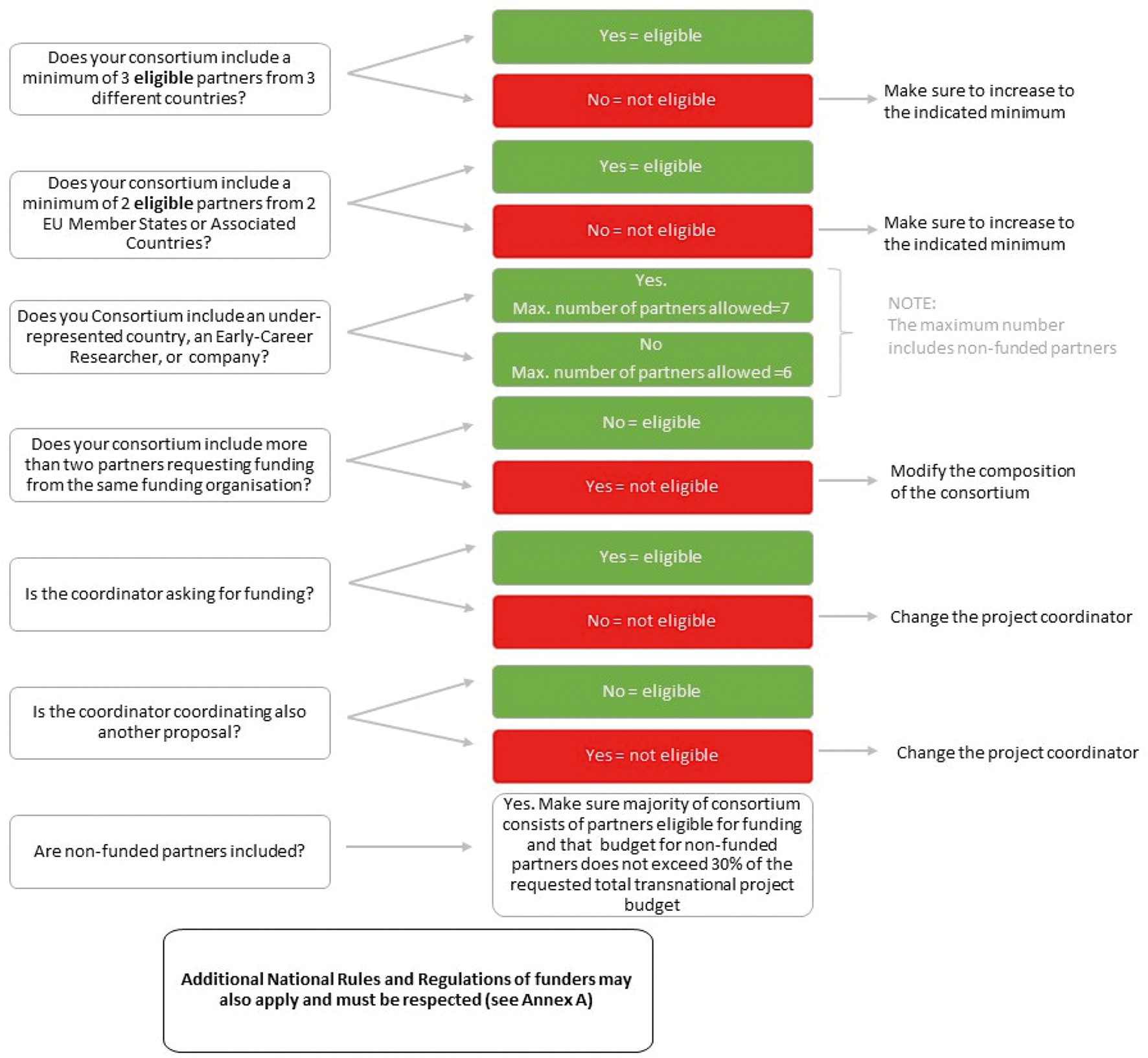
– The consortium must include a minimum of three (3) eligible partners asking for funding from three (3) different eligible countries (including at least two amongst EU Member States or Associated Countries).
– The consortium can include a maximum of six (6) project partners (including non-funded partners, Figure 1). The maximum number of partners can be increased to seven (7) if the consortium includes:
○ at least one partner from an under-represented country or
○ at least one partner where the Principal Investigator meets the definition of an Early-Career Researcher1 or
○ a start-up, SME, or an Industry.
– For the purpose of this call, the under-represented countries are
○ Czech Republic, Estonia, Hungary, Latvia, Lithuania, Malta, Moldova, Poland, and Slovakia.
– A consortium cannot include more than two (2) partners requesting funding from the same funding organisation2.
– Hungarian legal entities affected by the Council Implementing Decision (EU) 2022/2.506 are eligible to apply to calls for proposals as non-funded partners (i.e. without requesting or receiving funding from the Call).
– A consortium cannot include, as funded partners as well as non-funded partners, any legal entities established in Russia, Belarus, or in non-government-controlled territories of Ukraine, or any legal entities established outside Russia but whose proprietary rights are directly or indirectly owned for more than 50% by a legal person, entity or body established in Russia. This list is not extensive and may evolve. Please consult the general annexes of the 2023–2025 Horizon Europe funding programme for more information on other restrictive measures. A principal investigator can coordinate only one (1) submitted pre-proposal/ full proposal.
– At both the pre- and full proposal stages, all partners, including non-funded partners, must submit a signed letter of intent along with their pre-/full proposal (the templates to be used for the letters of intent are included in the pre-/full proposal templates). In the absence of these letters, the proposal will be declared ineligible. At the pre-proposal stage, the letter of intent must be signed by the project investigators representing the different partner institutions. At the full proposal stage, the letter of intent should also be signed by a person having the legal mandate to represent the partner institutions.
Joint research proposals may be submitted by partners belonging to the following categories (according to national/regional regulations; certain categories may not be eligible for funding by a specific funding organisation, or some categories may be mandatory, please see Annex A):
– Academia (public and private universities, other higher education institutions or research institutes).
– Clinical/public health sector (hospitals/public health and/or other health care settings and health organisations, including primary health care).
– Enterprises (private companies of all sizes involved in research and innovation).
– Operational stakeholders – e.g. patient advocacy organisations, municipalities and local governments, local/national NGOs. Operational stakeholders should be able to provide useful knowledge to the consortium, ensure the consortium’s research is useful and translatable to their (or other) organizational contexts, and/or influence decision making or create change within their organisations. Operational stakeholders should be engaged in the research process from conception of the study to dissemination.
Each partner institution will be represented by one Principal Investigator who will be a researcher scientifically responsible for the implementation of tasks assigned.
To avoid conflicts of interest, employees of the EUP OHAMR beneficiaries are not allowed to apply to this call, with the exception of the staff working in AGES, ISCIII, IACS, TUBITAK and DLR. AGES has been excluded from the call preparation. Firewall measures (such as organisation of the work in separate divisions) have been put in place internally in ISCIII, IACS, TUBITAK and DLR to guarantee an equal treatment of the applicants and applications. In particular, the persons working on the call implementation will ensure that no confidential information will be shared with their research community.
– Project partners not eligible for funding (e.g. from countries not participating in the call or not fundable according to national/regional regulations of the funding partner organisations) may be involved in projects if they bring their own funding.
– The budget of non-funded partners must be included in the proposal (In-Kind Budget) and shall not exceed 30% of the requested total transnational project budget.
– The number of non-funded project partners in a consortium must not exceed the number of funded partners.
– A project partner not receiving funding cannot be the coordinator of a proposal.
– Non-funded partners have the same responsibilities as funded partners, i.e. they must accept all EUP OHAMR rules and guidelines as set out in this Call Text.
Composition of the consortium should not be modified between the pre- and the full proposal except for widening (see below), in case of force majeure/unforeseen event (e.g. change of professional affiliation, lab relocation, prolonged absence of the Principal Investigator, etc.), or upon recommendation of the Peer Review Panel or request of the Call Steering Group. In any case, changes in the composition of the consortium must be approved by the board of funders organising the call ahead of the submission of the full proposal. In particular, the Principal Investigator representing the coordinating research institution should send an e-mail to the JCS, and to the respective funding organisations, at least 15 calendar days before the full proposal submission deadline to confirm the eligibility of the proposed modifications.
• Widening: Consortia which are invited to the second stage of the call (full proposal) will be able to increase their initial size by adding one (1) new partner eligible for funding by an under-subscribed funding organisation. The total number of partners in the consortium must not exceed eight (8). An under-subscribed funding organisation is a funding organisation that may underspend the full amount of funds it has committed to the call. Consortium coordinators will be notified of this option in their invitation letter to submit a full proposal. The list of under-subscribed funding organisations will be included in the full proposal template. The widening process promotes inclusiveness, ensure global participation, relevance and impact of the submitted projects in and outside Europe, as well as maximisation of the use of the committed resources.
Funding is initially granted for a maximum of three years in accordance with national/regional regulations and applicable legal provisions.
Project partners will be funded by their relevant national/regional funding organisation. Therefore, eligible costs, funding rules and the type of studies allowed will vary between the respective funding organisations (see Annex A). Thus, it is recommended that each project partner defines their own budget in accordance with the funding rules of their own country/region. Please note that some funding organisations may limit the number of national/regional applicants per proposal or may limit the maximum budget national/regional applicants can request within a consortium.
For information on the specific funding rules and eligibility criteria of the national/regional fundingorganisation:
– read Annex A carefully
– in addition, applicants are strongly advised to reach out to their relevant funding organisation before applying; please note that for some countries/regions it might be mandatory.
Any budget change between the pre-proposal and the full proposal must be approved by the national/regional funding organisations before submission (provided that: it complies with the national / regional rules, that the oversubscription of the funding organisation does not surpasses the threshold, that the newly requested budget still complies with the eligibility rules regarding the composition of the consortium and that the changes are duly justified and related to the scope and ambition of the proposal).
Please note that if a partner is found to be non-eligible at any step of the process by one of the funding organisations, the entire proposal could be rejected without further review.
It is important that consortia and research proposals are founded upon principles of social and gender equity, cultural sensitivity and economic viability. Consortia are highly encouraged to apply these principles to the composition, leadership and management of research projects. Especially where Low-and Middle-income countries are involved in the proposal, the impact to improving health and wellbeing should be considered.
Where relevant, research projects are expected to apply an intersectional and multi-dimensional approach by integrating sex, gender and other individual and population-level determinants of health (such as age, socio-economic status, ethnicity) into the project’s design, implementation, monitoring, evaluation and knowledge translation activities.
Research projects are expected to consider individual- and population-level determinants of health when collecting and analysing data to design and/or implement interventions in ways that are accessible and affordable to target beneficiaries, to systematically capture and report on sex, gender, and other relevant factors in the project research outputs, and to meaningfully engage the participation of targeted marginalised groups in the research activities.
The evaluation process will comply with the principles of transparency, equal treatment and non-discrimination.
Formal check and evaluation of pre-proposals
The JCS will check all proposals to ensure that they meet the call’s formal criteria (i.e. date of submission; number and category of participating countries; inclusion of all necessary information in English; appropriate limits on length; signature of the letters of intent). In parallel, the JCS will forward the proposals to the national/regional funding organisations, which will perform a check for compliance with national/regional regulations. Each proposal passing both eligibility checks will be evaluated independently by three reviewers for a first evaluation (see evaluation criteria below). Potential conflicts of interests of the evaluators will be taken into consideration during the allocation of the proposals. The reviewers will perform the assessment of the pre-proposals and complete a written evaluation form with scores and comments for each evaluation criterion. During a Peer Review Panel (PRP) meeting, the reviewers will discuss all proposals and agree on a consensus score for each proposal. The outcome of the PRP will consist of 3 ranking lists (one ranking list for each topic). To avoid conflicts of interest, evaluators with a conflict related to a specific proposal (i.e. co-publication with one of the applicants during the last 5 years, current collaboration with one of the applicants, same research centre as one of the applicants, personal or professional links with one of the applicants that may compromises the evaluator impartiality, involvement in the preparation of the proposal) will not participate in the discussion of that proposal. The board of funders will meet to decide which proposals will be invited to submit a full proposal based on the reviewers’ recommendations and to ensure a reasonable balance of requested and available national/regional budgets. Pre-proposals which do not pass this assessment will not be invited for the full proposal stage. The consortia will receive a summary review report without scores written by one of the experts in charge of evaluating the proposal.
Formal check and evaluation of full proposals
The JCS will check the full proposals to ensure that they meet the call’s formal criteria and have not changed substantially from the respective pre-proposals (e.g. composition of the consortium, the objectives of the project or the requested budget). In parallel, the JCS will forward the proposals to the national/regional funding organisations, which will perform a check for compliance with national/regional regulations. Each full proposal passing both checks will be allocated to three reviewers taking the potential conflicts of interest into consideration. The reviewers will perform the assessment of the full proposal and complete a written evaluation form with scores and comments for each criterion (see evaluation criteria below). During a second PRP meeting, the reviewers will discuss all proposals and produce 3 ranking lists of proposals recommended for funding (one ranking list for each call topic). To avoid conflicts of interest, evaluators with a conflict related to a specific proposal will not participate in the discussion of that proposal. The final summary review report prepared by the evaluators will be sent to the respective project coordinators.
Ethics and legal requirements
Please note that at the full proposal stage, applicants will be required to complete a self-assessment checklist for ethics and to provide details on safety, animal studies, genetically modified organisms and microorganisms, environmental hazards and waste handling, data management, statistical methods, ethics and legal issues. Applicants should anticipate this requirement and ensure that they have consulted with relevant experts to verify the feasibility of the project, and that the proposal can be completed within the defined budget and within the prescribed time window.
Full proposals recommended for funding by the PRP and selected for funding by the board of funders will undergo an ethics review by an Ethics Panel. Ethics experts will remotely check the selected proposal for their compliance with ethical norms and regulations. A meeting will also be organised for a discussion between the various ethics experts. If necessary, the ethics experts may ask the consortium for clarifications. The Ethics experts may highlight some vigilance points that need to be monitored during the implementation of the funded project. Only those proposals approved by both the scientific evaluation and ethics assessment (complying with all central Horizon Europe and regional/national ethical requirements) will be funded.
Decision
The funders will take their funding decision, based on the ranking lists established by the PRP, the available funding and the Ethics panel recommendations. The JCS will send by e-mail the funding recommendation to the project coordinator, who is then responsible to communicate this information to the respective project partners.
Redress Procedure
Applicants can appeal against the evaluation outcome if they suspect a breach in the implementation of the evaluation and selection procedures. This redress procedure only covers the procedural aspects of the evaluation.
A mere disagreement with peer reviewers or panel members’ comments are not grounds for an appeal. The redress procedure will not call into question the scientific or technical judgement of appropriately qualified experts.
The applicants shall submit their appeal against the evaluation outcome to the JCS via e-mail (EUPOHAMR_calls@agencerecherche.fr) up to 7 calendar days after the date of the notification of evaluation outcome sent by the JCS at the end of each step (evaluation of the pre- or full proposal).
For an appeal to be admissible the following conditions must be met:
– The appeal must be submitted by the project coordinator of the proposal to which the appeal relates
– Only one appeal per proposal can be submitted after each step
– The appeal must contain the following minimum information: the name of the call for proposals, the proposal acronym, the title of the proposal, a description of the alleged shortcomings of the evaluation procedure.
The appeal must demonstrate a procedural irregularity, factual or manifest errors in the evaluation process, misuse of powers, or a conflict of interests. Appeals that do not meet the above conditions, or do not deal with the evaluation of a specific proposal or express mere disagreement with the result or the reasoning of the evaluation will be judged as not suitable for redress.
Upon receipt of an appeal, an acknowledgement of receipt will be sent by the JCS as soon as the e-mail is read. The acknowledgement shall report the redress process and the anticipated date by which a decision on the appeal will be communicated to the appellant. All appeals received by the 7 calendar days deadline will be processed together by a designated redress Committee and the decision will be communicated to the appellant within 14 calendar days from the deadline for submitting the appeals.
Questions related to the national/regional eligibility decisions will not be handled by the JCS and need to be addressed to the respective national/regional funding organisation (see Annex A).
1. Excellence
– Clarity and pertinence of the objectives (pre-proposal and full proposal)
– Credibility of the proposed approach and methodology, in relation to the research objectives (pre-proposal and full proposal)
– Soundness and research base of the concept (pre-proposal and full proposal)
– Novelty, potential to advance the field, timeliness, and innovation (pre-proposal and full proposal)
– Scientific excellence of the consortium (pre-proposal and full proposal)
2. Impact
– Impact of the proposal to achieve the objectives of the call topic (pre-proposal and full proposal)
– Potential of the expected results for clinical, public health, and animal health, agriculture, or environmental benefit (including economic viability/sustainability where appropriate) (pre-proposal and full proposal)
– Relevance and consideration of the One Health concept (pre-proposal and full proposal)
– Potential for fostering a longer-term international network of researchers. For example, bringing together specific know-how and/or innovative technologies, gathering a critical mass of patients or biological material, sharing of resources (models, databases, biobanks, etc.), and international comparisons (pre-proposal and full proposal)
– Potential reach of the project results, including dissemination and communication measures. Accessibility of the proposed innovative strategy (different geographical areas, different populations including low-resource or underserved populations) (full proposal only)
– Appropriateness of end-user and stakeholder participation/engagement, for example, policy makers, industry, patient organisation, health and veterinary care, farmers, etc. (full proposal only)
3. Quality and efficiency of the implementation
– Coherence and effectiveness of the work plan, including appropriateness of the allocation of tasks within the given timeframe (pre-proposal and full proposal)
– Adequate distribution of the tasks between the project partners considering the required expertise (pre-proposal and full proposal)
– Strength of the transnational collaboration (balanced geographical distribution of the tasks) (pre-proposal and full proposal)
– Integration of social, economic, equity and cultural dimensions into the proposed research (pre-proposal and full proposal)
– Quality of the proposed Open Science practices, data management, Intellectual Property management, and Freedom to Operate where appropriate (full proposal only)
– Appropriateness of the management and governance structures and procedures, including risk and innovation management (full proposal only)
– Potential exploitation (including strategy to identify and address potential barriers) and relevance of the outcomes of the findings beyond the current project. (long term strategy) (full proposal only)
– Contingency plan, including risk assessment and mitigation (including of unforeseen circumstances like Covid-19) (full proposal only)
– Justification of the requested budget and cost-effectiveness of the project (appropriate distribution of resources in relation to project’s activities, partner responsibilities and time frame) (full proposal only)
Proposals not relevant to the call topics and objectives (out of the scope) will not be funded, independently of their scientific quality. The decision if a project is in/out of scope will be taken by the reviewers and evaluation panel in the pre-proposal stage.
Evaluation scores will be awarded for the three main criteria (Excellence, Impact and Implementation), and not singularly for the different aspects listed below the criteria, although these different aspects will be taken into consideration in scoring the main criteria.
The weight of each of the three main criteria (Excellence, Impact and Implementation) is equal.
0: Failure. The proposal fails to address the criterion in question or cannot be judged because of missing or incomplete information.
1: Poor. The proposal shows serious weaknesses in relation to the criterion in question.
2: Fair. The proposal generally addresses the criterion, but there are significant weaknesses that need corrections.
3: Good. The proposal addresses the criterion in question well, but few improvements are possible.
4: Very good. The proposal addresses the criterion very well, but minor improvements are possible.
5: Excellent. The proposal successfully addresses all aspects of the criterion in question, there are no suggestions for improvement.
In order for an application to be considered fundable, the threshold score for individual criteria is set at three (3) (of a maximum of five (5)). The overall threshold for the score for all three criteria together is set at ten (10). The maximum score that can be reached from all three criteria together is fifteen (15) points.
The responsibilities of the grantees are described in Annex B. Applicants should ensure to keep in mind these obligations while drafting their budget and planning their workload.
By submitting an application, the applicants consent to the use, processing and retention of their personal data in accordance with article 6.1 (e) and (c) of the General Data Protection Regulation (GDPR) (2016/679) and for the purposes of:
– processing and evaluating the pre- and full proposal where processing shall be lawful only if and to the extent that processing is necessary for the performance of a task carried out in the public interest or in the exercise of official authority vested in the controller;
– administering any subsequent funding award;
– managing the relationship between the applicant and the Funding Partner Organisations;
– analysing and evaluating the call;
– providing aggregate data to national and European surveys and analyses on the funded projects;
– complying with audits that may be initiated by the Funding Partner Organisations and the European Commission (or its agencies).
In addition, by submitting an application (pre- and full proposal) to this call, the applicants agree to share their personal data with Funding Partner Organizations based outside the European Economic Area and with third parties such as evaluators (some of which may be based outside the European Economic Area) in relation to the above activities.
The following Funding organisations outside the European Economic Area will use their national data protection rules:
• Canada (CIHR)
• Israel (CSO-MOH)
• Moldova (ANCD)
• South Africa (SAMRC)
• Switzerland (SNSF)
• Turkey (TUBITAK)
• the United Kingdom (UKRI)
By the time of the call launch, the European Commission issued adequacy decisions for personal data protection laws in Israel, Switzerland and the United Kingdom.
Funding Organizations and third parties may link the data that applicants provide in the application with national, bibliographic or external research funding data which is available through public subscription-based databases (e.g. Scopus, Web of Science, etc.) or other national/open datasets.
The content of the pre-proposals and full proposals received under this Joint Call is deemed to be confidential, except for consortia including project partners applying for funding from the Swedish funding organisation (SRC). For those consortia, the applications (pre- and full proposals) may be made available upon request after the respective call deadlines.
Responding to a EUP OHAMR call for proposals, both as project coordinator or project partner, gives the EUP OHAMR, the European Commission and the Funding Partner Organisations the right to use and store the information submitted for analysis of the call success rate, national response rate, etc.
The proposals will be handled confidentially by the JCS and by the national/regional funding organisations. In selecting the international experts for the PRP, the JCS shall endeavour to avoid any possible conflicts of interest. Each expert will sign a declaration of confidentiality and confirm the absence of conflicts of interest. In case of a conflict of interest the reviewer will be withdrawn from evaluating the respective proposal. Conflicts of interest are managed and recorded throughout the evaluation process.
Accepting a EUP OHAMR grant award and associated grant contract from a national funding organisation gives the EUP OHAMR, the European Commission and Funding Partner Organisations the right to store, share, and analyse information on beneficiaries and consortia (rules may differ between different countries). Composition of the awarded consortia (Principal investigators, Institution) as well as the title, acronym and abstract of funded projects will be published and openly accessible. No data will be shared with third parties or commercial entities without the formal consent of the project coordinators, except for consortia including project partners applying for funding from the Swedish Funder (SRC). For those consortia, the applications (pre- and full proposals) may be made available upon request after the respective call deadlines.
|
Important note to applicants: Applications to EUP OHAMR joint transnational calls can require the submission of additional information on national funding platforms. All applicants must have fulfilled both joint and national requirements for an application to be eligible. |
|
This is only a summary. Refer to national websites and contact the respective contact person for full details. |
|
Full name of the funding organisation: |
Fonds zur Förderung der Wissenschaftlichen Forschung |
|
National/ Regional Financial Commitment: |
1,400,000 € |
|
Expected number of funded projects: |
3–4 |
|
Contact details: (person (s), e-mail, telephone): |
Christoph Gross christoph.gross@fwf.ac.at, +43 676 83487 8910 |
Maximum/ Minimum funding per grant Awarded to a project partner:
The FWF generally does not have any minimum limit. The maximum limit is 450,000 €.
Exchange Rate: NA
Eligible Call Topics: Topic 1, and 3
Eligible One Health Settings: Human Health, Animal Health, Environment and Plant Health
Eligible institutions:
All Austrian research institutions are eligible to apply if they are registered in the FWF's research institution portal. Applications are to be submitted by the research institution where the project is to be carried out.
Eligible experimental approaches and disciplines:
Funding may be requested for projects in basic research that are clearly defined, innovative, with plausibly described objectives and methods, and are limited in duration (see FWF Application Guidelines section 1.2).
Eligibility criteria for the Principal Investigator:
The proposed research must be carried out in Austria under the auspices of the Austrian lead research institution. The principal investigator must be employed at the Austrian research institution applying for funding at the time the project is scheduled to begin. All Austrian research institutions are eligible to apply if they are registered in the FWF’s research institution portal. Applications are to be submitted by the research institution where the project is to be carried out. Neither a specific academic degree nor Austrian citizenship is required to act as principal investigator. The principal investigator must, however, have appropriate scientific qualifications (see FWF Application Guidelines section 1.4) and sufficient time resources to carry out the proposed research. Please refer to the general FWF Application Guidelines and the respective Application and project number limit.
For information on submitting an application from abroad please refer to the FWF Website Applying from Abroad.
Eligible costs:
Project-specific costs are eligible for funding. These include personnel and non-personnel costs that are needed to carry out the project and that are not included in the infrastructure provided by the research institution. The FWF does not finance the infrastructure or basic equipment of research institutions. The research institution must provide the necessary infrastructure. Personnel costs for administrative tasks cannot be funded by the FWF. The current FWF Personnel Costs and Salary Rates scale indicates the salaries that may be requested. The FWF grants an annual salary adjustment to compensate for inflation, which is applied automatically to all contracts of employment in Principal Investigator projects that are valid when the adjustment takes effect. Please refer to the FWF Application Guidelines.
Submission of the proposal (or other information) at the national level:
In addition to the application at the OHAMR level, administrative data (in accordance with the FWF Guidelines for Principal Investigator Projects) must be submitted online to the FWF at https://elane.fwf.ac.at/. This is required already at the pre-proposal stage via the programme category “PIK – International Projects preproposal” no later than Tuesday 3rd February 2026, 14:00 CET. For the full proposal stage applicants must choose the programme category “KIN-International – Multilateral Initiatives” (Deadline Thursday 18th June 2026, 14:00 CET). Both steps are mandatory.
The initial grant period must be 36 months – in accordance with the OHAMR regulations (in contrast to the duration specified in the FWF Guidelines for Principal Investigator Projects).
All proposals must be submitted using the elane online portal. Project funding is administered through the research institution (PROFI mode); for this reason, the submission must be approved in the application portal both by the applicant and by the respective research institution before the respective deadlines (see above).
Please note that the number of ongoing/approved projects in which one researcher can serve as principal investigator is limited to three in the Stand-Alone Projects Programme, International Programmes, Clinical Research and Arts-Based Research Programmes. Information on the limit of the number of ongoing/approved projects and the limit of applications that can be submitted can be found here.
Further guidance:
The principal investigator’s publication record over the last five years must be internationally visible and commensurate with the expected career path in their field. The following criteria apply for the assessment of an applicant’s publication record and initiation of the review process:
– Quality assurance: Most relevant in assessing the applicant’s publication record are those publications that have been subject to a quality assurance procedure in line with international standards (peer review or an equivalent procedure; in the natural and life sciences, peer review is expected). Journals must usually be listed in Web of Science, Scopus, or the Directory of Open Access Journals (DOAJ). For journals not listed in those databases, or for monographs, edited volumes, contributions to edited volumes, or other publication types, the applicant must provide a link to the publisher’s website which contains a description of the applicable quality assurance procedure. Should no such description be available on the website, it is the applicant’s responsibility to provide evidence that the publication has been subject to a quality assurance procedure in accordance with the standards of the field.
– International visibility: The majority of the applicant’s publications must have a wider than national reach. In the natural sciences, life sciences, and social sciences, most of the publications listed must be in English.
Number/scope and quality of the publications must be commensurate with the researcher’s expectable career path and the respective discipline. At least two publications must be quality-assured and internationally visible publications with a substantial and independent contribution by the applicant. At least one publication with first, last, or corresponding authorship is required, with the exception of publications in journals (or disciplines) that rank authors alphabetically. If any such publications are included in the required document PI_publication.pdf, the applicant’s contribution must be specified.
If there is any uncertainty about general application requirements or about accounting for career interruptions, the FWF recommends contacting the FWF Office or the FWF Equal Opportunities and Diversity in Research Funding unit in good time before submitting the application to confirm that all requirements are met and that any career interruptions can be accounted for. In cases of doubt, the appropriate decision-making bodies of the FWF shall decide on applicants’ eligibility.
|
Full name of the funding organisation: |
Fonds de la Recherche Scientifique |
|
National/ Regional Financial Commitment: |
300,000 € |
|
Expected number of funded projects: |
1 |
|
Contact details: (person (s), e-mail, telephone): |
Dr. Maxime Bonsir +32 2 504 92 36 Dr. Florence Quist +32 2 504 93 51 international@frs-fnrs.be |
Maximum/ Minimum funding per grant Awarded to a project partner:
Maximum 300.000 € for a total period of three years. If the project involves the recruitment of a PhD student, the project duration of the F.R.S.-FNRS sub-project could be up to four years (see PINT-MULTI Regulations for details).
Exchange Rate: NA
Eligible Call Topics: Topic 1, 2, and 3
Eligible One Health Settings: Human Health, Animal Health, Environment and Plant Health
Eligible institutions:
All eligibility rules and criteria can be found in the PINT-MULTI Regulations.
Eligible experimental approaches and disciplines:
Please note that the F.R.S.-FNRS only funds Basic research (low Technology Readiness Level) carried out in a research institution from the “Fédération Wallonie-Bruxelles”. The F.R.S.-FNRS will not fund industrial partners or any activity related to the private sector. Nevertheless, partners funded by the F.R.S.-FNRS can be in a consortium where there are also partners from the private sector.
Clinical trials are not eligible for funding by the F.R.S.-FNRS.
Eligibility criteria for the Principal Investigator:
All eligibility rules and criteria can be found in the PINT-MULTI Regulations.
Eligible costs:
All eligibility rules and criteria can be found in the PINT-MULTI Regulations.
Please note that personnel costs have an annual average cap of 80,000 euros for this call.
For “overhead” costs:
– Operating expenses: up to 1% within the granted budget. This percentage should be included in the requested operating budget.
– Personnel: up to 2% outside of the granted budget. This percentage will be paid upon reimbursement of expenses to institutions by the F.R.S.-FNRS.
Please check the Practical guide on costs for any other questions.
Submission of the proposal (or other information) at the national level:
Applicants to F.R.S.-FNRS funding must provide basic administrative data by submitting an administrative application on e-space within 5 working days after the general deadline of OH-AMR to be eligible. Please select the “PINT-MULTI” funding instrument when creating the administrative application. Proposals invited to the second stage will be able to complete the pre-proposal form and provide information for the full proposal upon validation by the F.R.S.-FNRS
Further guidance: PINT-MULTI regulations, e-space
|
Full name of the funding organisation: |
Fonds Wetenschappelijk Onderzoek-Vlaanderen |
|
National/ Regional Financial Commitment: |
700,000 € |
|
Expected number of funded projects: |
2–3 |
|
Contact details: (person (s), e-mail, telephone): |
Toon Monbaliu (FO) Europe@fwo.be +32 (0)2 550 15 70 Kristien Peeters (SBO) Europe@fwo.be +32 (0)2 550 15 95 |
Maximum/ Minimum funding per grant Awarded to a project partner:
Maximum 350,000 EUR per project (overhead included). If several FWO-funded partners are involved in one project, the funding must be shared between them.
Exchange Rate: NA
Eligible Call Topics: Topic 1, 2, and 3
Eligible One Health Settings: Human Health, Animal Health, Environment and Plant Health
Eligible institutions:
Academic. In this call, FWO deploys two of its regular funding channels: Fundamental Research Projects (FO) and Strategic Basic Research Projects (SBO). Researchers should choose the appropriate channel based on their project type, with eligibility details available in the regulations on the FWO website.
Eligible experimental approaches and disciplines:
Fundamental and strategic basic research in all scientific disciplines. Projects aiming at the development of a spin-off company are not eligible.
Clinical research and innovative intervention studies (including medical devices, technologies and tools for prevention, diagnosis and treatment of human and animal diseases) are eligible only if they address a fundamental scientific question.
Eligibility criteria for the Principal Investigator:
In this call, the PI can be a coordinator on one proposal or a partner on up to two proposals. Participating in this call does not affect FWO’s national project submission limits. The PI must have an appointment covering the full project duration. PIs who become emeritus during the application year or project period are ineligible, i.e. art. 10 §7 of the regulations FO does not apply.
Eligible costs:
Different cost models and overhead calculations apply to each channel (FO vs. SBO). For overhead calculation, apply a structural rate to total costs: FO projects use 6% and SBO projects use 17%. For example, an SBO project costing 250,000 EUR amounts to 292,500 EUR with a 17% overhead, staying within the budget cap of 350,000 EUR. On FWO’s e-portal, enter only the actual cost; FWO will add the overhead. The project has a duration of 36 months and all allocated funds must be spent within this timeframe. There are no automatic extensions granted, nor may any unused funds be carried forward after the project's end date, i.e. article 28 of the regulations FO and article 14 of the regulations SBO do not apply.
Submission of the proposal (or other information) at the national level:
Applicants for FWO funding must submit a mandatory administrative application through FWO’s e-portal. Select “Research projects – European programme fundamental research” for FO projects or “Research projects – European programme strategic basic research” for SBO projects. If multiple Flemish partners request FWO funding, include all relevant partner details in a single e-portal submission. The national submission deadline matches the joint transnational call's preproposal stage. However, to confirm eligibility, it is recommended to consult the FWO administration at least one week prior. Failure to comply with these requirements may result in ineligibility.
Further guidance:
To avoid any potential issues, we encourage you to contact the FWO administration in advance. We are pleased to assist you in ensuring the eligibility of your project proposal and consortium.
|
Full name of the funding organisation: |
Service Public de Wallonie |
|
National/ Regional Financial Commitment: |
1,000,000 € |
|
Expected number of funded projects: |
1–2 |
|
Contact details: (person (s), e-mail, telephone): |
Fleur Roland fleur.roland@spw.wallonie.be Cédric Morana cedric.morana@spw.wallonie.be |
Maximum/ Minimum funding per grant Awarded to a project partner: NA
Exchange Rate: NA
Eligible Call Topics: Topic 1
Eligible One Health Settings: Human Health, Animal Health, Environment and Plant Health
Eligible institutions: Universities, Higher education institution, Research Centres, Large companies, SME’s
Eligible experimental approaches and disciplines: Applied Research. SPW can cover pre-clinical trials but not clinical trials.
Eligibility criteria for the Principal Investigator: The Walloon partners should include at least one company established in Wallonia. The research budget of the Walloon companies must account for at least 40% of the total research budget of all Walloon partners.
Eligible costs: The Walloon “guide des dépenses éligibles” is applicable.
Submission of the proposal (or other information) at the national level: Walloon applicants must contact SPW at least 2 weeks before submission deadline. They must also submit a proposal on the regional submission platform: ONTIME.
Further guidance:
– Applicants to SPW funding must submit their pre-proposal on the regional application platform ONTIME. Proposals invited to the second stage must also be submitted on the same platform. The submission deadlines are the same as the general deadline of the OH-AMR call.
– Applicants who want to submit a proposal are requested to contact SPW at least 2 weeks before the submission deadline.
– Participants must be companies, universities/higher education institutions, accredited or certified research centers, established in the Walloon Region and conduct R&D activities within the project.
– Walloon partners in the consortium must include at least one company, and the research budget of the Walloon partner companies must account for at least 40% of the total research budget of all Walloon partners.
– Participants must be based in Wallonia, and the Walloon companies must have an operational unit in Wallonia.
– Participants cannot receive any other public funding for the same activities.
– Participants must have fulfilled their obligations under any previous support granted by the Region.
– At the time of submission, companies must not be in difficulty according to the European Union guidelines.
– Projects must focus solely on civilian technologies, products, processes, and services.
– Participants must present an innovative R&D project that has a positive impact on the Walloon economy and aligns with the priority of the regional Smart Specialization Strategy (S3 Wallonia).
– Participants must demonstrate their ability to carry out the tasks assigned to them in the project, to exploit its results, and to have a positive socio-economic and sustainable development impact on Wallonia.
– The project cannot start at a TRL (Technology Readiness Level) lower than 3.
|
Full name of the funding organisation: |
Canadian Institutes of Health Research |
|
National/ Regional Financial Commitment: |
$ 600,000 CAD |
|
Expected number of funded projects: |
1 |
|
Contact details: (person (s), e-mail, telephone): |
CIHR Contact Centre support-soutien@cihr-irsc.gc.ca +1 613-954-1968, 1-888-603-4178 |
Maximum/ Minimum funding per grant Awarded to a project partner:
Up to $ 600,000 CAD per grant Awarded to a project partner.
Exchange Rate: 1 Euro = 1.5998 CAD (Bank of Canada rate as July 10, 2025)
Eligible Call Topics:
Consistent with the One Health approach embedded within the Pan-Canadian Action Plan on AMR and prioritized within CIHR-III’s Strategic Plan for 2021–2026, projects must be relevant to Call Topic 3 to receive CIHR funding. Projects addressing call topic 3 are eligible for funding, provided they include human health research activities. Projects can include only one (1) Canadian component.
Eligible One Health Settings:
Projects addressing human health will be eligible for funding. CIHR will NOT be funding projects on animal health, plants, food, and/or environment that do not include human health research activities.
Eligible institutions:
Details regarding eligible applicants for a given competition will be specified in the funding opportunity on ResearchNet. Individuals in the Nominated Principal Applicant role must be affiliated with a CIHR eligible Canadian postsecondary institution and/or their affiliated institutions; non-governmental organisations with a research or knowledge translation mandate; individuals working with municipal, provincial, and/or territorial governments are also eligible where the research proposed is not already funded by that Government of Canada sector.
Eligible experimental approaches and disciplines:
Projects involving pre-clinical studies or clinical trial pilots are eligible under this Funding Opportunity.
Eligibility criteria for the Principal Investigator:
Individuals in the Nominated Principal Applicant role must have their substantive role in Canada for the duration of the requested grant term. Note that CIHR is not prescriptive regarding the duration of time that a NPA must physically reside in Canada, as this falls under the purview of applicable policies of the administering institution, employment terms and conditions, and or collective agreements Appointments and/or positions that can be renewed prior to the end of the requested grant term are eligible at the discretion of the administering institution.
Projects receiving a CIHR grant must comply fully with the CIHR Funding Policies. Policies and guidelines cover areas such as Applicant Responsibilities, Official Languages policy, Access to Information and Privacy Acts. For more information, please refer to Tri-Council Policy Statement: Ethical Conduct for Research Involving Humans (TCPS 2) and Tri-Agency Framework: Responsible Conduct of Research.
Eligible costs:
Applicants should review the Use of Grant Funds Section of the Tri-Agency (CIHR, NSERC and SSHRC) Guide on Financial Administration for a complete listing and description of allowable costs and activities.
Submission of the proposal (or other information) at the national level:
Canadian applicants will need to submit both the pre and full proposals through ResearchNet in addition to submitting to the Joint Call Secretariat.
Further guidance:
Applications submitted to CIHR require applicant consent and institutional approval (if applicable) to the use and disclosure of full application and nominative information for relevance review and funding decisions at the time of application.
• The applicant will be required to submit all reporting requirements to CIHR in addition to the JCS.
• The Nominated Principal Applicant will be required to submit an Electronic Final Report to CIHR. This online report will be made available to the Nominated Principal Applicant on ResearchNet at the beginning of the grant funding period and can be filled in as the research progresses.
• All reports may be shared with partners supporting the grant.
• The Nominated Principal Applicant must have successfully completed one of the sex-and gender-based analysis training modules available online through the CIHR Institute of Gender and Health and have submitted a Certificate of Completion (see How to Apply section). Select and complete the training module most applicable to your research project. Applicants are encouraged to review the “How to integrate sex and gender in research” section on the CIHR website.
CIHR is committed to promoting the inclusion and advancement of groups underrepresented in science as one of the means to enhance excellence in research, training and knowledge translation. CIHR's position on equity, diversity and inclusion (EDI) is available in the Tri Agency Statement on Equity, Diversity and Inclusion. Additional guidance can be found on the Best practices in Equity, Diversity and Inclusion in Research webpage.
It is noted that CIHR does not retain or claim any rights to IP in relation to research that if funds. Accordingly, the Canadian researchers retain full freedom in negotiating the Partner Consortium Agreement (PCA) required, including whether or not to accept the IP conditions. The Nominated Principal Applicants do NOT need to send a signed copy of the PCA to CIHR.
The proposals will be funded based on the ranking list recommended by the Peer Review Panel and decided by the Call Steering Group. The final funding decision will be made by the national/regional funding organizations and will be subject to budgetary considerations with the goal of optimal usage of the available budget. Approved joint transnational teams may receive an across-the-board cut to the budget, if necessary, to maximize the number of funded opportunities. For full details of CIHR’s requirements, please refer to the Funding Opportunity on ResearchNet.
|
Full name of the funding organisation: |
Agentura pro zdravotnicky vyzkum (AZVCR) Ministerstvo Zdravotnictvi Ceske Republiky (MZCR) |
|
National/ Regional Financial Commitment: |
500,000 € |
|
Expected number of funded projects: |
2 |
|
Contact details: (person (s), e-mail, telephone): |
Monika Kocmanova; National coordinator on Health-related European Partnerships (AZVCR); Email: monika.kocmanova@azvcr.cz; Phone: + 420 778 973 186 Olga Laaksonen; Head of the Science, Research, and Subsidies for Education Unit (MZCR); Email: olga.laaksonen@mzd.gov.cz; Phone: +420 604 786 141 |
Maximum/ Minimum funding per grant Awarded to a project partner:
The maximum funding must not exceed EUR 250,000.
Exchange Rate: NA
Eligible Call Topics: Topic 1, 2, and 3
Eligible One Health Settings: Human Health
Eligible institutions: Research Organisations, Enterprises. All eligibility rules and criteria can be found on the Czech Health Research website (Výzva 2026 – AZV ČR). It is recommended to contact the responsible person at the Czech Health Research Council (prior to submission regarding the eligibility criteria).
Conditions for PO funding – Patients organisations can receive direct funding if they take an active role in the project´s research activities. This means they must contribute to specific research objectives (for example, by being involved in one or more work packages) and these types of research activities must be clearly described in their statues.
Eligible experimental approaches and disciplines:
The Ministry of Health of the Czech Republic (MZCR) is not permitted to finance projects focused exclusively on basic research. It may, however, support projects that combine basic and applied research, provided that applied research plays the principal role.
Eligibility criteria for the Principal Investigator:
The PI must hold a Ph.D. degree. MZCR/AZVCR sets a criterion for the maximum workload, which must not exceed 1.00 FTE across all funded projects. There is no minimum workload requirement for the PI in relation to European Partnerships in health-care area imposed by the national funding authority (MZCR).
Eligible costs:
All eligibility of costs, types and their caps can be found on the Czech Health Research Council (Výzva 2026 – AZV ČR). It is recommended to contact the responsible person at the Czech Health Research Council (prior to submission regarding the eligibility criteria).
Submission of the proposal (or other information) at the national level:
Prior to submission of the pre-proposal to EUP OH AMR, Czech researchers need to submit to the Czech Health Research Council the following documents:
1. Sworn Statement of a Legal Entity / Natural Person (mandatory)
2. Sworn Statement for a Research Organisation (if relevant)
3. Sworn Statement of composition consortium (only if SMEs or industry are involved in the project proposal from the Czech side)
4. Application Form
Czech partners are required to complete a national Application Form, providing basic information about the applicant and any co-applicant(s), if applicable, including their respective budgets. It is necessary to list all national institutions involved in the project due to funding requirements.
All these documents are available on the website at the Czech Health Research Council AZV ČR – Výzva 2026 – AZV ČR.
Prior to submission of the full proposal to EUP OH AMR, Czech researchers need to submit to the Czech Health Research Council the following documents:
1. Documents related to professional competence, depending on the nature of the project, must be provided in the form of a Sworn Statement, which will be available on the website at the Czech Health Research Council AZV ČR – Výzva 2026 – AZV ČR.
2. Updated Application Form
Czech partners are required to complete the updated national Application Form, providing basic information about the applicant and any co-applicant(s), if applicable, including their respective budgets. It is necessary to list all national institutions involved in the project due to funding requirements.
According to Czech regulations, the main Czech applicant will sign a grant agreement with the national funding authority (MZCR) and, if there are any other Czech co-applicant(s), will subsequently enter into a cooperatoin agreement with them.
At the international level (pre- or full proposal), it is preferable to list only one Czech partner – the main applicant. If needed, it is possible to list more than one partner (in accordance with the call rules);
however, at the national level, there will be one main Czech applicant while the remaining national institutions will act as co-applicants. Together, they must share the allocated project budget among themselves.
The total project budget must not exceed EUR 250,000.
In case the projects of Czech participants are recommended for funding based on the results of the international evaluation and after the approval of the representatives of the funding authorities of the countries participating in the EP PerMed calls, the Ministry of Health of the Czech Republic / the Czech Health Research Council may ask the successful Czech participants to submit additional documents in order to issue a decision on the provision of purpose-special support according to the rules established by the Ministry of Health of the Czech Republic / Czech Health Research Council.
Further guidance: Výzva 2026 – AZV ČR
|
Full name of the funding organisation: |
Innovationsfonden, Innovation Fund Denmark |
|
National/ Regional Financial Commitment: |
1,300,000 € |
|
Expected number of funded projects: |
2–5 |
|
Contact details: (person (s), e-mail, telephone): |
Stine Holm stine.holm@innofond.dk, +4561905074 |
Maximum/ Minimum funding per grant Awarded to a project partner:
Min: 50,000 EUR
Max: 300,000 EUR /500,000 for all Danish partners in a project
Exchange Rate: 7,5 Danish Crown for 1 Euro
Eligible Call Topics: Topic 1, 2, and 3
Eligible One Health Settings: Human Health, Animal Health, Environment and Plant Health
Eligible institutions: All
Eligible experimental approaches and disciplines:
All experimental approaches and disciplines eligible under the general call conditions are eligible for IFD.
Eligibility criteria for the Principal Investigator:
No specific eligibility criteria requested.
Eligible costs: See Guidelines for International Collaborations
Submission of the proposal (or other information) at the national level:
Danish applicants will be invited to e-grant, where they must upload declarations.
Further guidance:
|
Full name of the funding organisation: |
Sihtasutus Eesti Teadusagentuur |
|
National/ Regional Financial Commitment: |
300,000 € |
|
Expected number of funded projects: |
1 |
|
Contact details: (person (s), e-mail, telephone): |
Margit Suuroja, margit.suuroja@etag.ee +372 731 7360 |
Maximum/ Minimum funding per grant Awarded to a project partner:
Max. 150,000 EUR as a project partner and max. 300,000 EUR as a project coordinator.
All project-related costs must be incurred no later than 31.08.2029, i.e. the Estonian partner's activities must be completed by that time.
Exchange Rate: NA
Eligible Call Topics: Topic 1, 2, and 3
Eligible One Health Settings: Human Health, Animal Health, Plant Health and Environment
Eligible institutions:
The Host Institution may be any legal entity that is registered and located in Estonia and has an Estonian bank account. If the Host Institution is a for-profit institution, the State aid and de minimis aid regulations must be taken into account.
Eligible experimental approaches and disciplines: ETAG cannot fund innovation.
Eligibility criteria for the Principal Investigator:
The Principal Investigator:
1. must have an updated public profile in the Estonian Research Information System (ETIS) by the preproposal submission deadline;
2. must hold a doctoral degree or an equivalent qualification. The degree must be awarded by the preproposal submission deadline of the grant application at the latest;
3. must have published at least three articles that comply with the requirements of Clause 1.1 of the ETIS classification of publications, or at least five articles that comply with the requirements of Clauses 1.1, 1.2, 2.1 or 3.1, within the last five calendar years prior to the proposal submission deadline.1 International patents are equalled with publications specified under Clause 1.1. A monograph (ETIS Clause 2.1) is equalled with three publications specified in Clause 1.1 if the number of authors is three or fewer. If the applicant has been on pregnancy and maternity or parental leave or performed compulsory service in the Defence Forces, or has another good reason, they can request the publication period requirement to be extended by the relevant period of time.
If the Principal Investigator has received the PhD degree outside Estonia, its correspondence to an Estonian doctoral degree must be recognised by either the Estonian ENIC-NARIC Center or the Host Institution in accordance with the Regulation of the Government of the Republic of April 6, 2006, No. 89 "Evaluation and academic recognition of documents proving foreign education and the name of the qualification awarded in the foreign education system terms and conditions of use". The Funding Organisation may ask for a relevant Evaluation Report.
If several Estonian institutions participate in a proposal, all institutions must have a Principal Investigator who meets the national eligibility requirements.
Eligible costs:
Direct costs:
1. Personnel costs are monthly salaries (along with all state taxes, contributions, and compensations arising from law) of the project participants, calculated according to their commitment and in proportion to their total workload at their Host Institution.
2. Other direct costs are:
– travel costs that may cover expenses for transport, accommodation, daily allowances and travel Insurance. If the project is funded from the European Regional Development Fund (Mobilitas 3.0) resources, travel costs are eligible only for travels abroad;
– consumables and minor equipment directly and fully related to the project;
– publication and dissemination of project results;
– organising meetings, seminars or conferences (e.g room rent, catering, equipment rental and related costs);
– fees for participating in scientific forums, conferences and other events directly and fully related to the project;
– patent costs;
– all other costs that are identifiable as clearly required for carrying out the project (e.g. translation, copy editing, webpage hosting, etc.) and are directly and fully related to the project.
3. Indirect costs (overhead) are costs that cannot be identified as specific costs directly linked to the performance of the action and/or should cover the general expenses of the Host Institution related to the management of the grant. Office consumables and costs for equipment and services intended for general use (e.g., phone bills, copy service, printer) should be covered from the indirect costs. Indirect costs are 15% of the personnel costs.
4. Subcontracting costs are direct costs. Subcontracting costs should cover only additional or complementary research related tasks (e.g. analyses, conducting surveys, building a prototype, etc.) performed by third parties. Subcontracting costs should not be included in the overhead calculation. The activities and budget should be described in the proposal. Core project tasks should not be subcontracted. Subcontracting costs may not exceed 15% of the total costs.
5. Double funding of activities is not acceptable.
6. If several Estonian institutions participate in one proposal, the sum of their requested budgets may not exceed the maximum contribution of the respective national Funding Organisation indicated in the call documents.
EU Regulations on State aid and de minimis aid must be taken into account when requesting funding.
Submission of the proposal (or other information) at the national level: NA
Further guidance:
https://etag.ee/wp-content/uploads/2022/07/Vastavusnouded-RV-uhiskonkurssidel_aprill-2025.pdf
|
Full name of the funding organisation: |
Suomen Akatemia |
|
National/ Regional Financial Commitment: |
1,000,000 € |
|
Expected number of funded projects: |
2–4 |
|
Contact details: (person (s), e-mail, telephone): |
Rita Rinnankoski-Tuikka, rita.rinnankoski@aka.fi |
Maximum/ Minimum funding per grant Awarded to a project partner:
A typical funding ranges from 250,000 – 350,000 € per project partner.
Exchange Rate: NA
Eligible Call Topics: Topic 1, 2, and 3
Eligible One Health Settings: Human Health, Animal Health, Plant Health and Environment
Eligible institutions:
Finnish research organisations such as higher education institutes, research institutes, technology transfer organisations, innovation intermediaries, regardless of their legal status (organised under public or private law).
The funding is not granted to support economic activity. Economic activity is defined as all activity where goods or services are offered on an open market regardless of whether profits are pursued or generated. When an organisation is also engaged in economic activities, separate accounts must be kept of the funding and costs of and the revenue generated by such activities. Funding may be granted for economic activity only if it can be granted in keeping with the EU’s state aid rules in the form of de minimis aid.
Eligible experimental approaches and disciplines:
Clinical trials can be funded by AKA.
Eligibility criteria for the Principal Investigator:
In addition to a doctoral degree, the principal investigator (PI) of the proposed project must also have other significant scientific merits.
Eligible costs:
The funding can be used to cover both direct costs (e.g. salaries, mobility of researchers, consumables, travel expenses, purchases of services, overheads) and indirect costs (e.g. rents for premises) of a research project. All costs are covered with the same funding percentage. Research Council’s contribution to funding can be up to 70% of the total project costs. The host institution has to commit at least 30% of the total project costs. Please ensure the commitment of the host institution before submitting the proposal.
Submission of the proposal (or other information) at the national level: In case of positive funding recommendation from this call, the applicant is invited to submit the proposal also in the Research Council of Finland’s online services for national decision.
Submission of the proposal (or other information) at the national level:
In case of positive funding recommendation from this call, the applicant is invited to submit the proposal also in the Research Council of Finland’s online services for national decision.
Further guidance:
Finnish partners of projects that have been selected for funding will be invited to submit national applications through the Research Council of Finland's online services. The applications must include a research security risk assessment and risk management plan. https://www.aka.fi/en/research-funding/apply-for-funding/how-to-apply-for-funding/az-index-of-application-guidelines/research-security/
Please refer to the Research Council of Finland’s standard terms for funding for further detail (https://www.aka.fi/en/research-funding/apply-for-funding/how-to-use-funding/). Terms concerning Academy Project funding apply.
|
Full name of the funding organisation: |
Agence Nationale de la Recherche |
|
National/ Regional Financial Commitment: |
2,000,000 € |
|
Expected number of funded projects: |
10 |
|
Contact details: (person (s), e-mail, telephone): |
Dr Yue XIAO/ Dr Sophie GAY EUPOHAMR_calls@agencerecherche.fr +33 1 73 54 82 41/+33 1 78 09 80 39 |
Maximum/ Minimum funding per grant Awarded to a project partner:
Maximum amount per project if two French partners are involved: 450,000 €
Maximum funding per partner: 250,000 € (Increased to 330,000 € for coordinators)
Minimum amount per partner: 15,000 €
Eligible Call Topics: Topic 1, 2 and 3
Eligible One Health Settings: Human Health, Animal Health, Environment and Plant Health
Eligible institutions: Research organisations and undertakings
As for research organisations, only those that have their primary establishment in France may be funded. As for undertakings, those that have their real head office in an EU member State and an establishment (primary or secondary) in France may be funded.
Within this framework, research institutions such as EPST, EPIC, Universities, Hospitals, Foundations, as well as companies and NGOs (associations) can apply. This list is not comprehensive and funding rates vary. Please fill the form related to economical activities to identify your funding rate and consult the “Règlement financier – aide à coûts réels” (https://anr.fr/fileadmin/documents/2025/ANR-RF-072025-cout-reel.pdf) for more details.
Please note that companies in difficulty cannot receive ANR funding.
Eligible experimental approaches and disciplines: ANR may finance fundamental research, industrial research in all research disciplines. ANR can cover pre-clinical trials but not clinical trials.
Eligibility criteria for the Principal Investigator:
To be eligible for this call as Principal Investigator, researchers must hold a research position in an eligible institution covering the duration of the project. The salary of the Principal Investigator will not be covered by the present grant. Researchers who will apply to this call as Principal Investigator while not having a permanent position must imperatively send the documents (working contract covering the duration of the project, chair announcement covering the duration of the project, commitment of the employer) proving their eligibility by mail to the ANR contact point (EUPOHAMR_calls@agencerecherche.fr) before the closing of the call. Researchers do not need to head their own lab, or group while applying. If a researcher does not head its own research group/lab, the signature of the head of the department should be included in the letter of intent, even at the pre-proposal stage.
Eligible costs:
Except where specified in the Call text or in the “Modalités de participation”, the ANR funding rules described in the “Règlement financier-aide à coûts réels” will apply.
Eligible costs (e.g.: personnel costs of non-permanent researchers, costs of equipment, subcontracting, other operating expenses incurred directly as a result of the research project such as, for instance: travel costs or consumable and overheads) and funding rates vary based on the type of research, type of research partners and composition of the consortium. Please note that expenses related to permanent staff are not eligible for the beneficiaries “à coût marginal”. For the Beneficiaries “à coût marginal”, please note that, in 2026, overheads correspond to 13.5% of the total eligible costs (10.5% dedicated to “tutelle gestionnaire” and 3% to the laboratory).
Double funding of research projects is not permitted. ANR will perform cross-checks of submissions against other joint transnational (JPIAMR, EUP AHW…) and national calls (including AAPG and the PPR “antibiorésistance”). Partners may not apply for funding for the same research activities in different calls. In case of any doubts, please contact ANR before submission.
Submission of the proposal (or other information) at the national level:
Parallel submission to ANR is not required. The only document that must be transmitted to ANR prior to submission is, for the Principals Investigators not having a permanent position, the document proving that their salary will be covered by a funding source other than the OHAMR Grant (see above for more details). If a project is selected for funding, French partners will have to fill administrative and financial data on the ANR platform.
Further guidance:
More details for the participation of French partners (“Modalités de participation”) at https://anr.fr/fileadmin/aap/2025/aap-EUPOHAMR-OH-TREAT-2025-annexe-fr.pdf.
If applicable, Declarations of Due Diligence for the funded projects (Nagoya Protocol) must be transmitted to ANR in due time.
In keeping with the national PPST policy (Protection of the scientific and technological national potential) applicants to ANR should consult their local “FSD” (security and defence officer, where available) on their project before applying. Applications to ANR may be forwarded to the HFSD of the French Ministry of research and higher education for screening. A negative appraisal by the HFSD may cause ANR to reject the proposal.
The ANR funded partners must communicate to ANR the required Scientific reports, Consortium Agreement, Data management plans according to the funding contract. The financial reports or closure certificate must be communicated to ANR according to the provisions of the ANR Funding regulations. In case of a conflict of interpretation between the terms and conditions stated in this annex and the “Modalités de participation” and “Règlement financier – aide à coûts réels”, the latter shall prevail.
|
Full name of the funding organisation: |
Bundesministerium für Forschung, Technologie und Raumfahrt (BMFTR) Deutsches Zentrum für Luft- und Raumfahrt Projektträger (DLR-PT) |
|
National/ Regional Financial Commitment: |
2,500,000 € |
|
Expected number of funded projects: |
10 |
|
Contact details: (person (s), e-mail, telephone): |
Barbara Junker, Patricia Ruiz Noppinger EUP-OHAMR@DLR.de +49 228 3821-1326 |
Maximum/ Minimum funding per grant Awarded to a project partner: 300,000 €
Exchange Rate: NA
Eligible Call Topics: Topic 1, and 2
Eligible One Health Settings: Human Health, Animal Health, Environment and Plant Health
Eligible institutions:
• Universities
• University hospitals
• Non-university research institutes
• Industry
Note: industry is funded with a maximum of 50–60% of their costs.
Eligible experimental approaches and disciplines:
The funding organisation DLR-PT can cover pre-clinical trials, but no clinical trials.
Eligibility criteria for the Principal Investigator: None
Eligible costs: Personnel, Consumables, Animals, Subcontracts, Equipment, Travel, Overheads.
Overheads refer to “Gemeinkosten” (applicable e.g. for Helmholtz centres and Fraunhofer-Society) as well as “Projektpauschale” (applicable for universities and university hospitals).
Individual project coordinators/partners may request up to 300,000 Euro including overheads. A project consisting of two German partners may request a maximum of 500,000 Euro including overheads.
Submission of the proposal (or other information) at the national level: Not necessary
Further guidance: For further details please refer to the national guidelines.
|
Full name of the funding organisation: |
Nemzeti Kutatási, Fejlesztési Innovációs Hivatal |
|
National/ Regional Financial Commitment: |
300,000 € |
|
Expected number of funded projects: |
1–2 |
|
Contact details: (person (s), e-mail, telephone): |
Zsuzsanna Kürti ncp@nkfih.gov.hu +36 1 795 9500 |
Maximum/ Minimum funding per grant Awarded to a project partner:
300,000 EUR / project
Exchange Rate: NA
Eligible Call Topics: Topic 1, 2, and 3
Eligible One Health Settings: Human Health, Animal Health, Environment and Plant Health
Eligible institutions:
Institution of higher education, Other budgetary research institution, Other budgetary institution (outside education or research), Enterprise-based research organisation, Enterprise (non-research type), Non-profit research organisation, Other non-profit organisation (outside research), HUN-REN Hungarian Research Network
For more details, please refer to the Guide for Applicants for the 2024-1.2.1-HE_PARTNERSÉG national call:
Eligible experimental approaches and disciplines: All.
Eligibility criteria for the Principal Investigator:
For details, please refer to the Guide for Applicants for the 2024-1.2.1-HE_PARTNERSÉG national call: https://nkfih.gov.hu/palyazoknak/nkfi-alap/horizont-europa-europai-partnersegek-magyar-szervezetek-tamogatasa-2024-121-he-partnerseg/palyazati-felhivas
Eligible costs:
For details, please refer to the Guide for Applicants for the 2024-1.2.1-HE_PARTNERSÉG national call: https://nkfih.gov.hu/palyazoknak/nkfi-alap/horizont-europa-europai-partnersegek-magyar-szervezetek-tamogatasa-2024-121-he-partnerseg/palyazati-felhivas
Submission of the proposal (or other information) at the national level:
For details, please refer to the Guide for Applicants for the 2024-1.2.1-HE_PARTNERSÉG national call: https://nkfih.gov.hu/palyazoknak/nkfi-alap/horizont-europa-europai-partnersegek-magyar-szervezetek-tamogatasa-2024-121-he-partnerseg/palyazati-felhivas
Further guidance:
The Guide for Applicants for 2024-1.2.1-HE_PARTNERSÉG national call is applicable.
|
Full name of the funding organisation: |
Department of Agriculture, Food and the Marine |
|
National/ Regional Financial Commitment: |
600,000 € |
|
Expected number of funded projects: |
2–3 |
|
Contact details: (person (s), e-mail, telephone): |
Dr. Willie Ryan willie.ryan@agriculture.gov.ie |
Maximum/ Minimum funding per grant Awarded to a project partner:
Maximum of € 300,000 per project, subject to funding budget.
Exchange Rate: NA
Eligible Call Topics:
Topic 3 (Inform the policies related to the restriction of some antimicrobials for human use only).
Eligible One Health Settings: Animal Health, Environment and Plant Health
Eligible institutions:
Research Performing Organisations (RPO) as described in National Annex Call_Guidelines_for_Irish_Applicants_GEH_011025.pdf
Eligible experimental approaches and disciplines:
Eligibility criteria for the Principal Investigator:
Permanent staff member of RPO as described in National Annex Call_Guidelines_for_Irish_Applicants_GEH_011025.pdf
Eligible costs:
as described in National Annex Call_Guidelines_for_Irish_Applicants_GEH_011025.pdf
Submission of the proposal (or other information) at the national level:
further information from willie.ryan@agriculture.gov.ie
Further guidance:
Additional Guidance can be found in National Annex
|
Full name of the funding organisation: |
Taighde Eireann – Research Ireland |
|
National/ Regional Financial Commitment: |
1,000,000 € |
|
Expected number of funded projects: |
2–3 |
|
Contact details: (person (s), e-mail, telephone): |
Dr Emma McGrath emma.mcgrath@researchireland.ie General mailbox eu-cofund@researchireland.ie |
Maximum/ Minimum funding per grant Awarded to a project partner:
Up to € 330,000 direct costs* for Irish-based researchers applying as a project partner
Up to € 405,000 direct costs* for Irish-based researchers applying as a project coordinator
*The maximum total award, including 30% overhead contribution, will be € 430,000, for a partner and € 530,000 for applicants who take on the role of coordinator.
Exchange Rate: NA
Eligible Call Topics: Topic 1, 2, and 3
Eligible One Health Settings: Human Health, Animal Health, Environment and Plant Health
Eligible institutions:
Irish Host Research bodies eligible for Research Ireland funding.
Please refer to Research Ireland’s Policies and Guidance for the list of eligible Research Performing Organisations: Eligibility Information
Eligible experimental approaches and disciplines:
All disciplines are eligible for Research Ireland funding.
Clinical trials and investigations are not eligible for funding by Research Ireland for the Irish-based applicant. Where clinical studies are proposed within the workplan of a proposal, study sites and the delineation of activities among proposal partners should be made clear.
Eligibility criteria for the Principal Investigator:
Only an academic partner or coordinator based in an eligible Irish Host Research body may apply for Research Ireland funding.
The Irish-based applicant must:
• hold a PhD or equivalent qualification for at least 3 years by the pre-proposal deadline. The official date is defined as the day, month and year that the degree was conferred i.e., the month and year printed on the official PhD certificate.
AND
• be a member of the academic staff of an eligible Research Body (permanent or with an active contract that covers the period of the grant)
OR
• be a contract researcher with a contract that covers the period of the grant, who is recognised by the eligible Research Body as an independent investigator and will have an independent office and research space for which he/she will be fully responsible for at least the duration of the Research Ireland grant
OR
• be an individual who will be recognised by the eligible Research Body upon receipt of the grant as an academic staff or as a contract researcher as defined above. The applicant does not necessarily need to be employed by the Research Body at the time of the application submission.
AND
• be an author on at least three international peer-reviewed articles. Only original research publications, and not review articles or other secondary research literature, are acceptable.
Please refer to the Research Ireland call webpage for more information on eligibility criteria. Please note that Research Ireland may contact applicants directly to confirm eligibility post submission.
Eligible costs:
Funding is provided for up to 100% of eligible costs. The following indicates the maximum levels of funding that may be requested:
Up to € 330,000 direct costs* for Irish-based researchers applying as a project partner
Up to € 405,000 direct costs* for Irish-based researchers applying as a project coordinator
*The maximum total award, including 30% overhead contribution, will be € 430,000, for a partner and € 530,000 for applicants who take on the role of coordinator.
Eligible costs
1. Salary-related costs for research personnel. Please use current Research Ireland Team Member Salary Scales. The Irish partner cannot request their own salary or buy-out.
2. Small equipment costs up to a maximum value of € 10K
3. Travel costs with consideration for Research Ireland’s Guidance for Sustainable Travel Policy
4. Direct running costs (materials and consumables)
5. Dissemination and knowledge exchange costs
6. Subcontracting costs are considered an eligible budget category however strong justification for subcontracting must be provided and pre-approved directly with Research Ireland in advance of proposal submission.
Submission of the proposal (or other information) at the national level:
Please give a brief notification of your intent to submit a pre-proposal through email to eu-cofund@researchireland.ie before the submission deadline. Within the notification, please include the following information:
• Call topic
• List of project partners
• Irish Host institution*
• Total budget request to Research Ireland
• Whether you intend to apply as a coordinating or non-coordinating partner
*Please note it is also the responsibility of the applicant to notify the Research Office of their Host Institution of their intention to submit a pre-proposal.
Further guidance:
State Aid: Applicants are advised that funding awarded by Research Ireland under the One Health Antimicrobial Resistance (OHAMR) Partnership Programme will be subject to, and must comply with, State aid rules and the conditions of the EU Commission General Block Exemption Regulation (GBER). Funding will be awarded to successful applicants under Article 25, in respect of aid for research and development projects. For further details please consult: Taighde Éireann-Research Ireland Research and Innovation Scheme 2021–2026
|
Full name of the funding organisation: |
Health Research Board |
|
National/ Regional Financial Commitment: |
530,000 € |
|
Expected number of funded projects: |
1–2 |
|
Contact details: (person (s), e-mail, telephone): |
Marcia Aranha HRB-JTCs@hrb.ie |
Maximum/ Minimum funding per grant Awarded to a project partner:
• Project Partners:
€ 330,000 direct costs;
€ 430,000 including overheads.
• Project Coordinators:
€ 405,000 direct costs (with the additional € 75,000 for coordination-specific activities);
€ 530,000 including overheads.
For more details, please visit https://www.hrb.ie/funding-scheme/eup-ohamr-2026/
Exchange Rate: NA
Eligible Call Topics: Topic 2.
For more details, please visit https://www.hrb.ie/funding-scheme/eup-ohamr-2026/
Eligible One Health Settings:
At least one of the settings must be in Human Health and the Irish partner’s activities must primarily target this area.
Eligible institutions:
Lead applicants must be affiliated with approved HRB Host Institutions. See also the Policy on Approval of HRB Host Institutions
Eligible experimental approaches and disciplines:
All Irish partners who are undertaking feasibility and/or interventional studies must adhere to the HRB Clinical Trial and Interventions Research Governance Policy.
Eligibility criteria for the Principal Investigator:
For more details, please visit https://www.hrb.ie/funding-scheme/eup-ohamr-2026/
Eligible costs:
For more details, please visit https://www.hrb.ie/funding-scheme/eup-ohamr-2026/
Submission of the proposal (or other information) at the national level:
The Host Institution must send the application to HRB-JTCs@hrb.iewithin three working days following the submission deadline, along with the completed Host Institution sign off form. Eligibility form must be completed for new applicants. For more details visit https://www.hrb.ie/funding-scheme/eup-ohamr-2026/
Further guidance:
Please see HRB’s dedicated scheme page on HRB’s funding page for more detailed guidance and FAQs specific to applicants based in Ireland.
|
Full name of the funding organisation: |
Ministry Of Health – Chief Scientist Office |
|
National/ Regional Financial Commitment: |
360,000 € |
|
Expected number of funded projects: |
2 |
|
Contact details: (person (s), e-mail, telephone): |
Dr. Ronit Meyuhas ronit.meyuhas@moh.gov.il +97225082159 |
Maximum/ Minimum funding per grant Awarded to a project partner:
0.36M (up to 2 projects. 140K per project + additional 40K per project coordinators)
Exchange Rate: NA
Eligible Call Topics: All with relation to human health.
Eligible One Health Settings:
Human health, Animal health and Environmental health (Only with relation to human health).
Eligible institutions:
Hospitals, clinics, laboratories, academic and public research institutions.
Eligible experimental approaches and disciplines:
Standard National Grant Conditions apply.
Eligibility criteria for the Principal Investigator:
PI should hold a Ph.D., M.D., D.M.D., D. Sc or equivalent degree and employed by an eligible institution.
Eligible costs:
Materials and consumables; Travel (up to 10%); No salaries for PIs; No heavy equipment, Institutional overhead 10%.
Submission of the proposal (or other information) at the national level:
Prior to submission, researchers will submit to CSO-MOH an abstract approved by their research authority including budget distribution. No submission of abstract can result in declaration of the consortium as ineligible. If the application involves human or animal experiments, bioethics approvals must be submitted with the application or up to 4 months later. Research will not be funded simultaneously by CSO-MOH on more than one grant (Era-NET or national). Researchers can not apply for more than one grant from any ERA-NET funded by CSO-MOH or submit more than one proposal for any programme.
Further guidance:
Please see detailed instructions of application at the national level and reporting at https://www.gov.il/he/service/era-net-instructions-for-israeli-researchers
|
Full name of the funding organisation: |
Fondazione Regionale per la Ricerca Biomedica |
|
National/ Regional Financial Commitment: |
1,500,000 € |
|
Expected number of funded projects: |
3 |
|
Contact details: (person (s), e-mail, telephone): |
Giulia Maria Rossignolo, giuliamaria.rossignolo@frrb.it Fabio Rondini, fabio.rondini@frrb.it bandi@frrb.it |
Maximum/ Minimum funding per grant Awarded to a project partner:
Maximum € 500,000 per project (in case of two Lombardy partners in the same consortium, the amount of € 500,000 will be shared).
Exchange Rate: NA
Eligible Call Topics: Topic 1, 2, and 3
Eligible One Health Settings: Human Health, Animal Health, Environment and Plant Health
Eligible institutions:
MAXIMUM TWO PARTNERS from Lombardy PER PROJECT
1. Public or Private Italian IRCCS (Scientific Institutes for Health Research, Hospitalization and Health Care)
2. Public Health Care Providers (ASST)
3. Agenzie di Tutela della Salute (ATS)
4. Azienda Regionale Emergenza Urgenza (AREU)
5. Universities – only in in partnership with one of the organizations above (1,2,3,4) located in Lombardy and requesting funding to FRRB
6. Research Institutes – only in in partnership with one of the organizations above (1,2,3,4) located in Lombardy and requesting funding to FRRB.
All applicants must be located in Lombardy and their activities should take place in Lombardy. Enterprises and for-profit Organisation are NOT eligible.
Eligible experimental approaches and disciplines:
Biomedical research ONLY in human settings. In case of clinical studies, the size and the duration should be compatible with the project timeline-studies should be completed by the end of the project.
Eligibility criteria for the Principal Investigator:
A PI cannot simultaneously hold more than one FRRB grant. PIs who are currently FRRB grant holders cannot apply to a new JTC unless their project is closed before the deadline of the new JTC pre-proposals. A project is considered closed when the final financial and scientific reports have been sent to FRRB. This rule applies only to PIs, not to team members.
Personnel costs of PIs who have a permanent contract with their own organisation are NOT eligible.
Eligible costs:
Direct costs:
• Personnel (for public IRCCS and ASST, ATS and AREU, ONLY staff recruited specifically on the project). Personnel costs of PIs who have a permanent contract (contratto indeterminato) with their own organisation are NOT eligible.
• Consumables, animals purchase, maintenance and breeding.
• Equipment (on hire or eligible amortization rate).
• Travel: max 10% of the total direct costs (overheads and subcontracting costs excluded).
• Publications (only Open Access): max 5% of the total direct costs (overheads and subcontracting costs excluded).
• Overheads: 20% flat rate calculated on direct costs (Subcontracting costs excluded from this calculation).
• Other direct costs: please include here other costs, including those related to patient involvement (insurance, reimbursement, etc.).
• Subcontracting: max 20% of the total direct costs (overheads costs excluded).
FRRB will require the submission of a financial audit certificate together with the final financial report. This cost, to be included under the “Subcontracting” category will be eligible up to a maximum of € 8,000. Only costs generated over the lifetime of the project will be considered eligible.
Submission of the proposal (or other information) at the national level:
It is not necessary to send the proposal to FRRB. However, FRRB requires a Pre-eligibility form. According to internal procedures, FRRB will carry out an eligibility check to potential applicants prior to the submission of the pre-proposals.
The eligibility check will be based on the verification of a dedicated form (“Pre-eligibility form”), available on the FRRB platform, to be completed and signed by the Principal Investigator at least 10 working days before the pre-proposal submission deadline.
FRRB will provide feedback on the “Pre-eligibility form”, ONLY in case of major non-eligibility issues.
In addition, FRRB provides an excel sheet to help applicants abide by FRRB funding rules. This form is meant to support the PIs in the elaboration of the proposal budget, but it does not need to be sent to FRRB.
Information and instructions on how to fill the “Pre-eligibility form” will be published on the dedicated FRRB platform.
Following the award, Lombardy beneficiaries will be requested to submit annual scientific and financial reports.
Further guidance:
|
Full name of the funding organisation: |
Ministero della Salute |
|
National/ Regional Financial Commitment: |
1,000,000 € |
|
Expected number of funded projects: |
2–3 |
|
Contact details: (person (s), e-mail, telephone): |
Maria Jose Ruiz Alvarez mj.ruizalvarez-esterno@sanita.it, +39 06 4990 6836 Francesca Martorina, f.martorina@sanita.it +39 06 5994 2240 |
Maximum/ Minimum funding per grant Awarded to a project partner: 400,000 EUR
Exchange Rate: NA
Eligible Call Topics: Topic 1, 2, and 3
Eligible One Health Settings:
Funding eligibility is limited to researchers working in clinical research from the IRCCS. However, projects may encompass activities across the different One Health domains – including Human Health, Animal Health, Plant Health, and the Environment – as long as they are relevant to the clinical research objectives.
Eligible institutions:
Only IRCCS (Istituti di Ricovero e Cura a Carattere Scientifico) researchers are eligible to apply. Universities, other research Institutes, companies are not eligible.
Eligible experimental approaches and disciplines:
The ItMoH can cover research teams working on clinical studies.
Eligibility criteria for the Principal Investigator:
For the JTCs during the 2026, simultaneous participation of the same Principal Investigator (PI) from a IRCCS in different proposals funded by the Ministry of Health is not permitted. A maximum of two Italian PIs may apply within the same project.
Eligible costs:
Direct Costs:
• Personnel (only temporary contracts or permanent contracts for the amount of hours dedicated to the project, <60%);
• Consumables/Supplies;
• Animals/Model costs;
• Equipment (only on leasing or rent);
• Travel (<30%);
• Dissemination activities (<1%);
• Publication costs: <2%; open access <5%;
• Patients recruitment costs;
• IT Services and Data Bases;
• Coordination costs
Indirect Costs:
• Overhead (<10%, included in the total);
Other indirect costs are not eligible.
Transfer of eligible funds abroad is not allowed.
Subcontracts are allowed only upon approval, by presenting via Workflow – code ER, a request together with the National pre-eligibility form, the latest 20 days before the deadline of the pre-proposal submission.
Submission of the proposal (or other information) at the national level:
To expedite the eligibility check process, the Ministry of Health will grant eligibility clearance to applicants prior to the submission of proposals.
For this purpose, applicants are required to complete and return a pre-submission eligibility check form to the IT-MoH, through their IRCCS, using the WFR System and the ER communication code, before submitting their proposal to the Joint Call Secretariat.
It is strongly recommended that the completed form be submitted at least 10 working days before the proposal submission deadline. Applicants will receive written notification of their eligibility status. Please note that changes to acronyms or budgets provided in the pre-submission eligibility check are not allowed without agreement.
Further guidance:
The pre-eligibility form can be downloaded here:
https://www.salute.gov.it/imgs/C_17_pagineAree_4441_0_file.pdf
At the national level, submission of annual scientific and financial reports will be required in accordance with the rules of the Ministry of Health (Ricerca Finalizzata).
Further information on these rules may be requested from the national contact persons
|
Full name of the funding organisation: |
Latvijas Zinatnes Padome |
|
National/ Regional Financial Commitment: |
600,000 € |
|
Expected number of funded projects: |
1–2 |
|
Contact details: (person (s), e-mail, telephone): |
Maija Bundule Maija.Bundule@lzp.gov.lv, +371-26514481 |
Maximum/ Minimum funding per grant Awarded to a project partner:
Maximum 100,000 EUR per project year per partner
Exchange Rate: NA
Eligible Call Topics: Topic 1, 2, and 3
Eligible One Health Settings: Human Health, Animal Health, Environment and Plant Health
Eligible institutions:
R&D institutions (research institutes, universities, higher education establishments, research centres etc.) and small, medium or large enterprises. R&D institutions must be listed in the Registry of Research Institution operated by the Ministry of Education and Science of the Republic of Latvia. Legal entities must be registered in the Registry of Enterprises of the Republic of Latvia and provide most of its R&D&I activities in the Republic of Latvia and must be able to submit financial reports for at least two years. No more than two partners from Latvia may participate in the same project.
Eligible experimental approaches and disciplines:
LZP can cover pre-clinical trials, but no clinical trials.
Eligibility criteria for the Principal Investigator: No specific eligibility criteria.
Eligible costs:
1. Direct costs: personnel costs, travel costs, subcontracts (up to 25% from total direct costs), equipment (only depreciation costs), materials and other direct costs such as consumables, publication costs etc.
2. Indirect costs: can reach a maximum of 25% from total direct costs, excluding subcontracting costs.
Double funding of the same project, as a whole or in part, is prohibited, whether the funding comes from LZP or from another source.
Submission of the proposal (or other information) at the national level: Not necessary.
Further guidance:
Further information on the conditions for receiving funding can be found on the LZP website: www.lzp.gov.lv
The funding of RTD activities is provided pursuant in accordance with: – the Regulation of the Council of Ministers of the Republic of Latvia No 259 on the procedure for providing support for participation in international cooperation programs for research and technology (adopted on 26 June 2015), – the COMMISSION REGULATION (EU) No 651/2014 of 17 June 2014 declaring certain categories of aid compatible with the internal market in application of Articles 107 and 108 of the Treaty.
|
Full name of the funding organisation: |
Lietuvos Mokslo Taryba |
|
National/ Regional Financial Commitment: |
300,000 € |
|
Expected number of funded projects: |
1–2 |
|
Contact details: (person (s), e-mail, telephone): |
Živilė Ruželė, zivile.ruzele@lmt.lt, +370 676 14 383 Miglė Palujanskaitė, migle.palujanskaite@lmt.lt, +370 663 45 395 |
Maximum/ Minimum funding per grant Awarded to a project partner: 150,000 €
Exchange Rate: NA
Eligible Call Topics: Topic 1, 2, and 3
Eligible One Health Settings: Human Health, Animal Health, Environment and Plant Health
Eligible institutions: academic (research and study institutions)
The implementing institution must be a Lithuanian research and study institution included in the Register of Education and Science Institutions. A private legal entity registered in the Republic of Lithuania may be a project partner. Research Council of Lithuania may allocate funding to this partner in accordance with Commission Regulation (EU) 2023/2831 of 13 December 2023 on the application of Articles 107 and 108 of the Treaty on the Functioning of the European Union to de minimis aid.
Eligible experimental approaches and disciplines:
All approaches and disciplines are eligible.
Eligibility criteria for the Principal Investigator:
Principal Investigator must be a PhD holder.
Principal investigators from Lithuania cannot be involved in more than 1 proposal submitted to this call.
Principal investigator may be involved in the EUP OHAMR grants while being already funded for another project at the national level
Eligible costs:
All costs mentioned in the Call text as Investigational costs are eligible: site costs (personnel, clinical procedure, site services, patient/participant renumeration), country management sites (site selection and coordination at the country level), and clinical study management costs at national or regional level (e.g. monitoring and insurance).
Additional cross-cutting trial management costs can also be eligible if some of the sponsor’s tasks are delegated to Lithuanian team.
Only costs generated during the lifetime of the project, related to the project, are eligible. Eligible cost types: personnel, consumables, subcontracting, equipment and instruments, other direct costs, costs for dissemination of results, data handling and analysis, overheads (up to 20% from direct costs).
More details about eligibility of costs:
https://www.e-tar.lt/portal/lt/legalAct/0a8bead0577611e9975f9c35aedfe438/asr
Submission of the proposal (or other information) at the national level:
The submission of the proposal at the national level is not required.
Following funding decision, grant signing institution and the PI must complete and submit the national document (the template can be found following this link) containing this information: more detailed planed budget, foreseen dissemination and communication activities and expected outputs from clinical study results with the granted research team contribution (scientific papers, patents, etc.)
Further guidance:
For any information, please refer to contact person. All information about the call is published on LMT website under Calls webpage.
General information for applicants submitting proposals to European Partnerships calls can be found here.
|
Full name of the funding organisation: |
Xjenza Malta |
|
National/ Regional Financial Commitment: |
500,000 € |
|
Expected number of funded projects: |
1–2 |
|
Contact details: (person (s), e-mail, telephone): |
Ms Oksana Pachomcik oksana.pachomcik@gov.mt cc eusubmissions.xjenzamalta@gov.mt +356 23602257 |
Maximum/ Minimum funding per grant Awarded to a project partner:
The maximum amount that national partner/s can jointly request per project is € 500,000.
Exchange Rate: NA
Eligible Call Topics: Topic 1, 2, and 3
Eligible One Health Settings: Human Health, Animal Health, Plant Health and Environment
Eligible institutions:
1. Malta-based applicants that are Eligible Undertakings, with an Operating Base in Malta, planning to carry out Fundamental Research, Industrial Research and/or Experimental Development projects and must either be:
a) A partnership constituted under the Companies Act, being a partnership en nom collectif, en commandite or a limited liability company; or
b) Be duly registered as a co-operative society under the Co-Operative Societies Act, or
c) Professional body; or
d) NGOs; or
e) Non-profit making entities (including Foundations).
will be eligible for funding subject to the terms and conditions laid out in the latest version of the National Rules for Participation (State Aid).
2. Any Public Entity or Public Research or Knowledge-Dissemination Organisation registered in Malta, that do not carry out an economic activity within the meaning of Article 107 TFEU, will be eligible for funding subject to the terms and conditions laid out in the latest version of the National Rules for Participation (Non-State Aid).
Eligible experimental approaches and disciplines: All approaches and disciplines.
Eligibility criteria for the Principal Investigator:
Researchers, technicians, and supporting staff, to the extent that they are employed on the relevant project or activity by the eligible Malta-based entity. Further information can be found in the detailed National Rules accessible from the Xjenza Malta website: https://xjenzamalta.mt/media/funding-schemes/
Eligible costs:
Eligible costs and rates of funding depend on the type of the Malta-based entities and the funding route choses (caps apply).
Eligible costs include the following: personnel; instruments, specialised equipment, and research consumables; IP and knowledge transfer activities; travel and subsistence; subcontracted activities; overheads and other operating expenses.
Further information can be found in the detailed National Rules accessible from the Xjenza Malta website: https://xjenzamalta.mt/media/funding-schemes/
Submission of the proposal (or other information) at the national level:
The national application form together with the required annexes can be downloaded from the Xjenza Malta website (https://xjenzamalta.mt/media/funding-schemes/) and must be sent to eusubmissions.xjenzamalta@gov.mtby the national deadline specified in the detailed National Rules.
Further guidance:
Further information can be found in the detailed National Rules accessible from the Xjenza Malta website: https://xjenzamalta.mt/media/funding-schemes/
|
Full name of the funding organisation: |
National Agency for Research and Development |
|
National/ Regional Financial Commitment: |
100,000 € |
|
Expected number of funded projects: |
1 |
|
Contact details: (person (s), e-mail, telephone): |
Mrs Natalia Bolocan, natalia.bolocan@ancd.gov.md (373) 22 29 28 26 Mrs Aurelia Hanganu, aurelia.hanganu@ancd.gov.md, (373) 22 23 49 20 Ms Iana Tihon, iana.tihon@ancd.gov.md (373) 22 27 27 91 |
Maximum/ Minimum funding per grant Awarded to a project partner: 100,000 EUR
Exchange Rate: 1 EUR = 19.6 MDL (23/09/2025)
Eligible Call Topics: Topic 1, 2, and 3
Eligible One Health Settings: Human Health, Animal Health, Environment and Plant Health
Eligible institutions:
• Beneficiary institutions eligible for funding must be public organizations that operate within the fields of research and innovation. This eligibility is in line with Articles 95 and 96 of the Science and Innovation Code of the Republic of Moldova No. 259/2004 and with points 3, 6, and 19 of Government Decision No. 382/2019, which outlines the Methodology for financing projects in these domains.
• Private institutions may be beneficiaries only in a consortium with a public organisation, according to Government Decision No. 382/2019.
• Eligible institutions must not be declared insolvent or have their bank accounts blocked by an irrevocable court decision.
• Eligible institutions must have the legal right to carry out research and innovation activities as stipulated in its incorporation documents or statutes.
• Eligible institutions must not have violated any terms of previously signed contracts for research and innovation funding.
Eligible experimental approaches and disciplines:
National Agency for Research and Development can cover all eligible experimental approaches and disciplines, provided that all activities comply with applicable national legislation and regulatory requirements, e.g., the Law No. 15 of 19 June 2025 on Medicinal Products regarding clinical trials.
Eligibility criteria for the Principal Investigator:
• The Principal Investigator must hold a doctoral or habilitated doctoral degree in a relevant scientific field and be employed by a research institution within the Republic of Moldova.
• A person may not serve as Principal Investigator for more than one proposal within the same call, in order to prevent conflicts of interest and ensure equitable distribution of leadership responsibilities.
• The Principal Investigator’s scientific experience must be relevant to the proposed project, as demonstrated by published work and other scientific activities carried out over the past 5–10 years.
Eligible costs:
Applicants can apply for the following types of costs under their project proposals:
• Personnel Costs: This includes the remuneration of research team members, which must comply with national legislation. The remuneration of research team members must not exceed 60% of the total eligible costs. Salaries for administrative, financial, and technical staff may account for up to 5% of the researchers salaries.
• Service Costs: This includes the acquisition of services necessary for the research project. Services must be contracted with legal entities, specifying details such as quantity, unit price, and total cost.
• Other Costs: This includes various additional expenses, for example: participation fees for events, intangible assets (including patent acquisition expenses), procurement of raw materials, consumables (including reagents), animals, and laboratory inventory necessary for project experiments.
Non-eligible Costs:
• Costs related to the maintenance and development of public research infrastructure used in the project.
Expenses are incurred only after the contract has been signed and registered by the Contracting Authority. The budget must clearly detail the allocation of state funds and co-financing, with calculations supported by estimates. Proposals that do not meet these criteria, or that include costs for activities already funded or in the process of being funded from other sources, will be declared ineligible. Additionally, no modifications or improvements to proposals will be accepted after submission.
Submission of the proposal (or other information) at the national level:
Proposals are submitted in two stages:
• Pre-proposal by 2nd February, 2026, and
• Full proposal by 17th June, 2026
Further guidance:
Science and Innovation Code of the Republic of Moldova No. 259/2004 and Government Decision No. 382/2019, which outlines the Methodology for financing projects in these domains. Please consult the call announcement on ancd.gov.md.
|
Full name of the funding organisation: |
Nederlandse Organisatie voor Wetenschappelijk Onderzoek |
|
National/ Regional Financial Commitment: |
2,000,000 € |
|
Expected number of funded projects: |
5 |
|
Contact details: (person (s), e-mail, telephone): |
Dr L. (Lisette) Waanders, ohamr@nwo.nl +31703494374 |
Maximum/ Minimum funding per grant Awarded to a project partner:
EUR 400,000 per consortium of Dutch partners
Exchange Rate: NA
Eligible Call Topics: Topic 1, 2, and 3
Eligible One Health Settings: Human Health, Animal Health, Environment and Plant Health
Eligible institutions: An application for funding from NWO may consider the following roles:
– National main applicant (mandatory): the applicant who leads the application to NWO and is the foreseen national project leader, in case a project is granted.
– National co-applicant (optional): national applicants in addition to the national main applicant with an active role and responsibility in realising the project and requesting funding from NWO.
National main applicants:
Researchers may submit an application as a national main applicant if they have a tenured position (and therefore a paid position for an indefinite period*) or a tenure track agreement at one of the following research organisations:
– Universities and universities of applied sciences (UAS) as referred to in Article 1.8 paragraph 1 of the Higher Education and Scientific Research Act and universities listed in the Policy Rules for Universities located in the Kingdom of the Netherlands;
– University medical centres by which is meant academic hospitals as referred to in Article 1.13 paragraph 1 of the Higher Education and Scientific Research Act;
– Institutes affiliated to the Royal Netherlands Academy of Arts and Sciences (KNAW) or NWO;
– TO2 institutions;
– Netherlands Cancer Institute;
– the Max Planck Institute for Psycholinguistics in Nijmegen;
– Naturalis Biodiversity Center;
– Advanced Research Centre for NanoLithography (ARCNL);
– Princess Máxima Center.
*Professors employed at a university of applied sciences and researchers employed at a TO2 institute may also submit as a main national applicant provided that they have at least a salaried position for a limited period of time.
Persons with a zero-hour employment agreement or with a contract for a limited period of time (other than a tenure track appointment) may not submit a proposal.
It could be the case that the applicant’s tenure track agreement ends before the intended completion date of the project for which funding is applied for, or that before that date, the applicant’s tenured contract ends due to the applicant reaching retirement age. In that case, the applicant needs to include a statement from their employer in which the organisation concerned guarantees that the project and all project members for whom funding has been requested will receive adequate supervision for the full duration of the project. Such a statement should be submitted in the full proposal stage.
The main national applicant employed by a university of applied sciences or TO2 institute whose employment ends before the intended completion date of the project for which the grant is being applied for must also attach such a statement.
Applicants with a part-time contract should guarantee adequate supervision of the project and all project members for whom funding is requested.
National co-applicants
Researchers interested to apply as a national co-applicant, i.e. together with a national main applicant, may submit as a national co-applicant if they have a tenured position (and therefore a paid position for an indefinite period*) or a tenure track agreement at one of to the research organisations listed under ‘National main applicants’ or at other research organisations as referred to in Article 1.1, paragraph 4 of the NWO Grant Rules 2024 that meet the following cumulative conditions:
– be established in the Netherlands;
– be a foundation, association or legal entity governed by public law (“publiekrechtelijke rechtspersoon”);
– have as its primary goal the independent conduct of its own fundamental research or industrial research or with widely disseminating the results of those activities through teaching, publications or knowledge transfer;
– be able to state that the organisation keeps separate accounts with regard to economic/non-economic activities and that undertakings with decisive influence on the organisation do not enjoy preferential access to the organisation’s results.
Please note: Prior to the submission of an application, NWO assesses on the basis of the above-mentioned conditions whether an organisation complies with Article 1.1, paragraph 4 of the NWO Grant Rules 2024 and may therefore participate as a national co-applicant. NWO performs this assessment to preclude the granting of prohibited state aid.
The organisation of the prospective national co-applicant must provide the following documents no less than 20 working days prior to the submission deadline for pre-proposals (meaning no later than 5 January 2026, 14:00:00 CET) by email to ohamr@nwo.nl:
– a recent extract from the Netherlands Chamber of Commerce;
– the deed of incorporation or current articles of association;
– the latest available annual accounts accompanied by an audit statement3;
– the completed form ‘Declaration research organisation’, available on the funding page of this Call for proposals on the NWO website.
Other relevant documentation may be added. NWO may request additional information if the above documents are not sufficiently conclusive to determine whether the organisation may act as a national co-applicant.
If the organisation of the prospective national co-applicant does not submit the necessary documents for this assessment in time, NWO cannot accept the organisation as a national co-applicant. If the addition of new co-applicants to the consortium is allowed in the full proposal and these new co-applicants are not affiliated to a research organisation listed above, these conditions will also be checked for this organisation/these organisations. The documents listed above as a requirement in the pre-proposal stage must then be submitted by email no less than 20 working days before the submission deadline for full proposals (meaning no later than 20 May 2026, 14:00:00 CEST).
Eligible experimental approaches and disciplines: NWO aims to fund pre-clinical research.
Eligibility criteria for the Principal Investigator:
Eligible costs:
The available budget modules are listed below:
Personnel
– Personnel at a university in the Kingdom of the Netherlands, umc or a research organisation, as referred to in Article 1.1, first paragraph, subparagraphs c to h of the NWO Grant Rules 2024 salary costs can be claimed for the following positions:
○ Postdoc: at least 1 position, for at least 12 months, for at least 0.5 fte, according to UNL or NFU rates, a benchfee is available;
○ Non-scientific personnel (NWP): according to UNL or NFU rates;
○ Research leave: max. 5% of the grant amount, according to UNL or NFU rates.
– Personnel of universities of applied sciences, TO2 institutes and other research organisations using the Government Tariff Manual (HOT), Table 2, under 2.2 ‘average total salary cost per salary scale’, column 'Hourly rate productive hours, excluding VAT';
– Students: according to the usual internship fee or HOT rates, may be added to material costs
Material: for project-specific material costs, up to 25% of the grant amount. Subsequently, up to 50% of the material budget can be used for work by third parties;
Knowledge utilisation4: for activities that promote the use of knowledge from the research following the Impact Plan approach, mandatory 5–20% of the grant amount;
Project management: up to 5% of the grant amount.
Please note the following:
– PhD positions cannot be applied for in this call, due to the maximum project duration of 3 years.
– NWO funds project-related costs. Therefore overhead costs are not eligible for NWO funding.
A more detailed explanation of the budget modules and eligible costs can be found on the funding page on the NWO website.
It is recommended to use the NWO budget template in the pre-proposal stage to confirm eligibility of budget items. For full proposals, it is mandatory to submit the NWO budget form for the funding requested at NWO at the time of the transnational deadline. Please submit it to ohamr@nwo.nl.
Do not hesitate to contact the national contact point in case of questions via the aforementioned email address.
Submission of the proposal (or other information) at the national level:
Once proposals are selected for funding, the consortia will be notified by the Joint Call Secretariat and subsequently, the national granting process will be initiated by NWO.
An application for NWO funding has one national main applicant, responsible for scientific and financial management. National co-applicants within an application for NWO funding are allowed.
– A researcher may only request NWO funding for one project (part of a European consortium) in this Call for proposals, either as main applicant or co-applicant within an application for NWO funding.
– Researchers employed at a university in the Kingdom of the Netherlands, umc or a research organisation, as referred to in Article 1.1, first paragraph, subparagraphs c to h of the NWO Grant Rules 2024 may not apply for a scientific or post-doc position for themselves.
The NWO Grant Rules 2024 and the Agreement on the Payment of Costs for Scientific Research are applicable to all applications for NWO funding. Any arrangements made regarding the grant from NWO, for instance in a Consortium Agreement, must comply with the NWO Grant Rules 2024 and the European legislation on state aid.
As stipulated in the NWO Grant Rules, Article 3.2, paragraph 2, the project cannot start until the conditions set out in the grant award decision regarding the start of the project are met. Please note, these conditions will include a signed Consortium agreement by all partners in the transnational project.
Under the Dutch General Administrative Law Act, any interested party has the right to lodge an objection to the decision taken by NWO within six weeks of the date of the decision letter. Further information about the objections procedure can be found on the NWO website: https://www.nwo.nl/en/lodging-an-objection.
NWO will, if necessary, apply a one-off indexation of personnel costs when awarding the grant. The UNL/NFU/HOT rate at the time of the decision date applies and the date on which the rates take effect is used for this purpose.
Submission of financial and scientific reports at national level is required in accordance with the rules of NWO. Granted consortia will be informed in due time.
Further guidance:
|
Full name of the funding organisation: |
Research Council of Norway |
|
National/ Regional Financial Commitment: |
1,000,000 € |
|
Expected number of funded projects: |
3 or 4 |
|
Contact details: (person (s), e-mail, telephone): |
Hilde G. Nielsen, hgn@rcn.no, +47 40 92 22 60 |
Maximum/ Minimum funding per grant Awarded to a project partner:
• Research Council of Norway do not operate with minimum funding per grant.
• Within a single project, the maximum funding is 300,000 €. If the Norwegian participant has a coordinator role, the maximum funding is about 400,000 €.
• If there are more than one Norwegian partners in a consortium they have to share the maximum RCN’s funding per project between them.
• Depending on the volume of submitted and eligible projects, up to 25% additional funding may be allocated to the call to fund additional projects on the ranking list.
Exchange Rate:
• For funded projects, the contractual budget will be in Norwegian kroner (NOK) using the exchange rate from the pre-proposal deadline. The official exchange rate can be found on the websites of the European Central Bank (https://www.ecb.europa.eu/stats/policy_and_exchange_rates/euro_reference_exchange_rates/html/eurofxref-graph-nok.en.html).
Eligible Call Topics: Topic 1, 2, and 3
Eligible One Health Settings:
• The entire value chain for research and innovation should be safeguarded.
• All One Health settings (human, animal, plan, environment, social sciences) related to human health are qualified.
Eligible institutions:
• Norwegian universities, university colleges, hospitals, research institutes, public sector, user organisations, NGOs, SME and other private industry.
• Organisations excluded from funding:
○ The Research Council cannot award support to an enterprise that is defined as an “undertaking in difficulty” under the state aid rules (see the “Definition of ‘undertaking in difficulty’” on our website).
○ "Enkeltpersonforetak", that is Norwegian companies with sole proprietorship, cannot participate as coordinator, but can participate as subcontractors.
• Additional eligibility criteria:
○ All applicants and partners must comply with the State Aid rules. All projects are to be carried out as effective collaboration between the partners. Undertakings (companies) that participate in the consortium must also not receive indirect state aid in the form of advantageous conditions for cooperation with the research institutions taking part in the consortium. SME or industry/large enterprise partners are funded with up to 50% of their eligible project costs. See Conditions for awarding state aid (https://www.forskningsradet.no/en/state-aid) for more details.
○ The Research Council of Norway does not award personal doctoral scholarships. Costs for doctoral (PhD) and postdoctoral fellowship positions must be included in the project application.
○ For postdoctoral fellowships, duration of the support is limited to a minimum of three years and a maximum of four years. The overhead cost is included in the rates for personnel.
Eligible experimental approaches and disciplines:
• The entire value chain for research and innovation should be safeguarded.
• All one health settings (human, animal, plan, environment, social sciences) related to human health are qualified.
• Clinical studies are eligible, please read the Requirements and guidelines for registration anddisclosure of medical and health-related studies involving human participants.
Eligibility criteria for the Principal Investigator:
• Principal investigators must come from an approved Norwegian research organization: https://www.forskningsradet.no/en/financing/research-organisations/approved-research-organisations/.
Eligible costs:
• Payroll expenses, consumables, operating expenses, network measures.
• The participation must follow RCN’s General Terms and Conditions for R&D Projects.
• See What to enter in the project budget (https://www.forskningsradet.no/en/financing/how/budget). Note that the cost category "Procurement of R&D services" will not be used in this call.
• Funding to Norwegian SMEs and Industry will be provided according to the State aid rules. See Conditions for awarding state aid (https://www.forskningsradet.no/en/state-aid/) for more details.
• For funded projects, the contractual budget will be in Norwegian kroner (NOK) using the exchange rate from the pre-proposal deadline.
Submission of the proposal (or other information) at the national level:
• Data Management Plan must be in place to sign the contract with RCN for funded projects.
• The Research Council is a driving force in making research as open as possible. Participation must follow RCN´s policy for Open Science.
• Submission of the proposal (or other information) at the national level: If the proposal is granted, information about national registration will be given.
Further guidance:
|
Full name of the funding organisation: |
Narodowe Centrum Nauki |
|
National/ Regional Financial Commitment: |
750,000 € |
|
Expected number of funded projects: |
2–3 |
|
Contact details: (person (s), e-mail, telephone): |
Alicja Dyląg, alicja.dylag@ncn.gov.pl, +48 532 086 494 Dr Anna Fiust, anna.fiust@ncn.gov.pl |
Maximum/ Minimum funding per grant Awarded to a project partner: NA
Exchange Rate: 1 EUR = 4.3463 PLN
Eligible Call Topics: Topic 1, 2, and 3
Eligible One Health Settings: Human Health, Animal Health, Environment and Plant Health
Eligible institutions:
Proposals may be submitted by the entities specified in Article 27 (1) of the Act on the National Science Centre (NCN Act).
Eligible experimental approaches and disciplines:
NCN can cover research on clinical trials and can fund projects in all scientific disciplines.
Eligibility criteria for the Principal Investigator:
The principal investigator of the Polish research team shall hold at least a PhD degree when submitting the national proposal to NCN. Other eligibility criteria are described in Chapter IV of the UNISONO Resolution no. 74/2025 of the Council of National Science Centre, dated September 11, 2025.
Eligible costs:
Applicants may apply for funding of costs relevant, necessary, and directly connected to the proposed research project, including:
• Salaries and scholarships (including post-doc positions and scholarships/salaries for students and PhD students).
Please note: Limits apply depending on the size of the research team – please refer to the UNISONO Resolution. If the principal investigator is also the coordinator of an international consortium submitting a joint proposal the budget of salaries and scholarships may be increased.
• Research equipment, devices and software: applicants may seek funding for research equipment up to PLN 500,000 per unit.
• Other direct costs: materials and consumables, outsourcing and subcontracting, business trips, visits and consultations, collective investigators, other costs;
• Overheads: Indirect costs of open access of up to 2% of direct costs that may be spent on open access to publications and research data; other indirect costs of up to 20% of direct costs that may be spent on costs that are related indirectly to the research project, including the cost of open access to publications and research data.
Submission of the proposal (or other information) at the national level:
At the pre-proposal stage applicants may consult the Polish team’s budget table with NCN project officers no later than January 19, 2026. At the full proposal stage, applicants must submit their national proposals in the Polish submission system (OSF).
Further guidance:
For full details of NCN requirements, please refer to the Call Announcement published on the NCN website.
|
Full name of the funding organisation: |
Fundacao para a Ciencia e a Tecnologia |
|
National/ Regional Financial Commitment: |
400,000 € |
|
Expected number of funded projects: |
2–4 |
|
Contact details: (person (s), e-mail, telephone): |
Marta Abrantes marta.abrantes@fct.pt,+351 213911596 Joana Pinheiro joana.pinheiro@fct.pt,+351 213911567 |
Maximum/ Minimum funding per grant Awarded to a project partner:
The maximum amount of funding to be requested to FCT by a consortium with a Portuguese Main Applicant is 150,000.00 €.
The maximum amount of funding to be requested to FCT by a consortium with a Portuguese Project Applicant is 100,000.00 €.
If more than one Portuguese applicant participating in the same international consortium applies for funding by FCT, the combined funding demanded by all the Portuguese applicants may not exceed the maximum financial threshold for proposals with a Portuguese Coordinator (150,000.00€) or with a Portuguese Partner (100,000.00€). Portuguese Coordinator and/or Partners in the same international consortium will therefore have to share the funding that will be granted by FCT.
For information on funding rates, see no. 2 of article 7 of FCT Regulation.
Exchange Rate: NA
Eligible Call Topics: All call topics are eligible
Eligible One Health Settings: FCT may fund projects in any of the different One Health settings (Human Health, Animal Health, Plants, Environment
Eligible institutions: For information on the type of beneficiaries eligible for FCT funding under this call, see article 3 of FCT Regulation. For information on the criteria of beneficiaries‘ eligibility, see article 5 of FCT Regulation.
Eligible experimental approaches and disciplines: Not applicable
Eligibility criteria for the Principal Investigator: The transnational rules indicated in this call text apply.
Eligible costs:
For the purposes of defining the budget, the terms defined in article 8 of FCT Regulation apply to eligible expenses and in article 9 to non-eligible expenses.
Excluded from the range of eligible expenses are the salaries and other remuneration supplements of teachers, researchers and other staff with a previously established indefinite contract with the Public Administration. Expenditure on adapting buildings and facilities is limited to a maximum of 10% of the project’s total eligible expenses. The project’s indirect costs are based on the application of a flat rate of 25% of the direct eligible costs.
Submission of the proposal (or other information) at the national level:
Statement of Commitment – available on FCT’s webpage dedicated to this call:
• Within 10 working days after the deadline for submitting the pre-proposal, a Statement of Commitment duly signed by the Researcher in Charge (partner and/or coordinators) and by the legal representant of the Portuguese Proposing Institution must be sent to the Contact Point.
• The stamp or white seal of the Portuguese Proposing Institution will not be required on a digitally signed Statement of Commitment.Portuguese applicants of transnational consortia that do not apply for funding from FCT do not need to submit the Statement of Commitment to FCT.
Further guidance:
Applications requesting funding from FCT under this call will be subject to Regulation on projects funded solely by national funds, published in Regulation No. 999/2016, in its current wording, that is, as amended and republished by Regulation No. 5/2024 of 3 January, and corrected by Rectification Statement No. 366/2024/2, published in the Diário da República, 2nd series, No. 100, of 23 May 2024, and by all other applicable national and European Union legislation.
Applicable forms of payment: in accordance with no. 1 of article 7 of the FCT Regulation, the funding to be granted to proposals requesting funding from FCT under this call is non-reimbursable and is based on real costs. As such it must be justified through invoices paid or other accounting documents of similar probationary value, under the terms of no. 5 of article 8 of FCT Regulation.
For information on the criteria of projects‘ eligibility, see article 6 of FCT Regulation.
The percentage of time dedicated to transnational projects will not be added to the percentage of time dedicated to existing national projects.
Please consult FCT’s webpage dedicated to this call.
|
Full name of the funding organisation: |
Centrum Vedecko Technickych Informacii Slovenskej Republiky |
|
National/ Regional Financial Commitment: |
1,200,000 € |
|
Expected number of funded projects: |
2–6 |
|
Contact details: (person (s), e-mail, telephone): |
Erika Jankajová, Contact Point EU Missions / European Partnerships Coordinator rika.jankajova@cvtisr.sk +421 904 859 228 Magdaléna Švorcová, European Partnerships Coordinator magdalena.svorcova@cvtisr.sk +421 917 733 493 |
Maximum/ Minimum funding per grant Awarded to a project partner:
The maximum funding amount per Slovak partner in international projects is 400,000 EUR. The maximum funding amount per project for all Slovak partners, if the project has two or more Slovak partners, is 800,000 EUR.The minimum funding amount is 100,000 EUR per partner.
Exchange Rate: NA
Eligible Call Topics: Topic 1, 2, and 3
Eligible One Health Settings: Human Health, Animal Health, Environment and Plant Health
Eligible institutions:
Legal entities established in the Slovak Republic, such as public or private research and academic institutions, higher education institutions, SMEs, public sector entities, and other relevant organizations actively involved in research, development, and innovation.
• Research institutions (e.g. the Slovak Academy of Sciences and its institutes)
• Academic sector (e.g. universities and higher education institutions)
• Public administration bodies and organizations established by them, including local and regional government authorities
• Non-governmental non-profit organizations
• Cluster organizations
• Private sector entities (entrepreneurial/business sector)
Eligible experimental approaches and disciplines:
Eligibility criteria for the Principal Investigator:
Eligible costs:
• Personnel costs (salaries of researchers, technicians and other support staff employed by the beneficiary, to the extent that they are directly involved in the project, salaries of project management personnel and other essential positions necessary for the implementation and coordination of the project;
• Costs of instruments and equipment;
• Costs for contract research, technical knowledge and patents purchased or licensed from external sources under market conditions, as well as costs for consultancy and equivalent services used exclusively for the project.
General eligibility rule:
All expenditures incurred by Slovak project participants must comply with:
• Programme Slovakia, specifically Priority 1P1 Science, Research and Innovation, Specific objective RSO1.1: Development and enhancement of research and innovation capacities and the uptake of advanced technologies, Measure 1.1.3: Support for international cooperation in the field of research, development and innovation
• The provisions of the State Aid Scheme to Support Partnerships in the Field of Research, Development and Innovation under the Programme Slovakia;
• Strategy for Financing the ERDF, ESF+, CF, FST, and ENRAF 2021–2027.
Submission of the proposal (or other information) at the national level:
Submission of pre-proposal: Submit pre-proposals to the OHAMR Call Secretariat only.
Submisison of full proposal: After having been informed about the international funding decision, CVTI SR will require also submission of separate application for national funding into the national submission platform.
Further guidance:
All Slovak applicants are strongly advised to contact the CVTI SR’s contact points before submitting their proposals.
The proposed project activities must be in line with the priorities defined in the Research and Innovation Strategy for Smart Specialisation of the Slovak Republic 2021–2027 (SK RIS3 2021+), which serves as the strategic framework for research, development and innovation investments in Slovakia.
All Slovak entities must have their contractual financial matters settled with CVTI SR by the end of 2029.
Relevant national documents:
Programme Slovakia, Research and Innovation Strategy for Smart Specialisation of the Slovak Republic 2021-2027 (SK RIS3 2021+), State Aid Scheme to Support Partnerships in the Field of Research, Development and Innovation under the Programme Slovakia.
|
Full name of the funding organisation: |
South African Medical Research Council |
|
National/ Regional Financial Commitment: |
250,000 € |
|
Expected number of funded projects: |
1–2 |
|
Contact details: (person (s), e-mail, telephone): |
Zoleka Ngcete Andiswa Nene ship.rfps@mrc.ac.za |
Maximum/ Minimum funding per grant Awarded to a project partner:
Exchange Rate: 1 Euro = ZAR 20
Eligible Call Topics: Topic 1, 2, and 3
Eligible One Health Settings:
The SAMRC will fund projects with direct relation to Human Health only, although proposals may include other One Health Settings.
Eligible institutions:
South African research institutions eligible as leading institutions include universities, science councils and other legally constituted institutions or organisations wherein research is one of the primary purposes for its existence. Other NGOs registered in South Africa may be eligible for funding, but they are not eligible as leading institution. Private companies (entities registered as private, for-profit companies in South Africa) are not eligible to apply as lead institutions for this Call for Proposals, but may be included as sub-contractors, in compliance with the lead institution’s procurement policies, if they provide a service or capability that is not available among the project partners but is essential for the completion of project deliverables. Alternatively, private entities can join the project as non-beneficiary partners.
Eligible experimental approaches and disciplines:
The SAMRC cannot cover research teams working on social sciences for this call. The SAMRC can contribute towards pre-clinical and clinical trials, provided that partners ensure that any agreement concluded for commercialization of products arising from the research shall be made available and accessible at an affordable price to people most in need within developing countries, including the Republic of South Africa.
Eligibility criteria for the Principal Investigator:
The investigator needs to be employed at an Eligible Institution (South African universities, science councils and other legally constituted institutions or organisations wherein research is one of the primary purposes for its existence), and must either be a South African citizen or permanent resident. Investigators may only submit one application each as the Principal Investigator, but may be involved in more that one application as a co-investigator.
Eligible costs:
• Personnel: Individuals working on the project who are employed by or associated with the host institutions (e.g. principal and co-principal investigators, researchers, post-docs, students, technicians, project managers) may be funded, provided an accurate estimation of time allocation is provided and that time is not already funded from other means.
• Consultants: These may include both local and/or foreign consultants who provide a service or capability that is not available among the project partners but is essential for the completion of project deliverables.
• Supplies, consumables and other direct laboratory or research costs.
• Sub-contracts: These may be to any local or international organization that provides a service or capability that is not available among the project partners or other South African public institutions but is essential for the completion of project deliverables
• Travel and accommodation that is directly related to the execution of the project.
• Institutional overhead: An indirect costs rate of 5% (up to a maximum of R250.000) is allowed for this call.
• Equipment: Partial or full support for the cost of equipment is generally allowed (capped at 10% of the total project budget) in special circumstances where such equipment is strictly required for the project and substantially motivated. Due to the limited funding available for this call, projects that already have the necessary equipment in place will be prioritized to maximize the impact of the funding.
Non-Allowable costs:
• Salaries of permanent or fixed term staff, e.g. tenured staff, professors etc., that are fully covered by the host institutions or other grants.
• Purchase or construction of a building.
• Rental costs for space that is owned by the institutions participating in the project.
• Recruitment or retrenchment costs for staff.
• Purchase of office furniture.
Submission of the proposal (or other information) at the national level:
Applicants do not need to submit a separate proposal to the SAMRC. At the full proposal stage, South African applicants may be required to submit their detailed budget on a separate SAMRC budget template.
Further guidance:
|
Full name of the funding organisation: |
Instituto Aragones de Ciencias de la Salud |
|
National/ Regional Financial Commitment: |
150,000 € |
|
Expected number of funded projects: |
1–2 |
|
Contact details: (person (s), e-mail, telephone): |
Elena Portero – eportero.iacs@aragon.es |
Maximum/ Minimum funding per grant Awarded to a project partner:
No minimum funding per project.
Maximum 150,000€ participating as coordinator and 100,000€ participating as partner.
Exchange Rate: NA
Eligible Call Topics: Topic 1, 2, and 3
Eligible One Health Settings: Human Health, Animal Health and Environment
Eligible institutions: Public Research institutions that carry out their activity in Aragon.
Eligible experimental approaches and disciplines: IACS will not fund pre-clinical nor clinical trials.
Eligibility criteria for the Principal Investigator:
PI must be linked, through a civil servant, statutory or labour relationship, with the applicant institution for the whole project duration.
Coordinating PIs may only participate in this role in a single project in this call.
Eligible costs:
Personnel costs related to personnel specifically hired for the project by the applicant institution, including salaries, employer Social Security contributions, legally established compensations and other duly justified expenses derived.
Travel, accommodation and subsistence costs directly incurred as a result of the research project, exclusively for people who are part of the project research team or hired under the funded project. Applicants must follow their respective internal travel policies.
Consumables, services costs and expenses related to the publication in open access and dissemination of project results, duly justified and necessary for the successful completion of the project.
Registration fees for congresses or conferences for the presentation and dissemination of the results.
It is compulsory to include the cost of an external independent financial audit certificate up to a maximum of € 1.500.
Indirect costs 15% of total direct costs.
Submission of the proposal (or other information) at the national level: NA
Further guidance:
All members of the research team must be linked through a civil servant, statutory or labour relationship with the applicant institution.
More than one partner from Aragon may participate in the same project. Double funding of the same concept is not allowed.
The projects must respect the fundamental principles established in national and international declarations, protocols and conventions on research ethics, as well as respect the requirements established in national and regional legislation in the field of biomedical research, development and innovation, personal data protection and bioethics.
Project funding will be subject to compliance with the relevant subsidy regulations and other applicable legislation at both the national and Aragon regional levels.
|
Full name of the funding organisation: |
Agencia Estatal de Investigación |
|
National/ Regional Financial Commitment: |
1,000,000 € |
|
Expected number of funded projects: |
5–6 |
|
Contact details: (person (s), e-mail, telephone): |
Ana Revilla, amr@aei.gob.es |
Maximum/ Minimum funding per grant Awarded to a project partner:
The following funding limits for a three-year project are considered eligibility criteria. Proposals not respecting these limits could be declared ineligible.
Two partners per project asking to the AEI are allowed only if one of them is the coordinator of the international proposal. The budget distribution in this case should be balanced.
This condition applies also if more partners are involved funded by other Spanish funders (ISCIII, IACS).
Maximum funding per project:
One AEI applicant (partner):
CD (€)*: 140,000
CI (25%) (€)*: 35,000
TOTAL (€)*: 175,000
One AEI applicant – (coordinator)
CD (€)*: 220,000
CI (25%) (€)*: 55,000
TOTAL (€)*: 275,000
One coordinator and one applicant-(balanced budgets)
CD (€)*: 260,000
CI (25%) (€)*: 65,000
TOTAL (€)*: 325,000
Additional funding for substantial experimental tasks (per project)
CD (€)*: 30,000
CI (25%) (€)*: 7,500
TOTAL (€)*: 37,500
* The direct costs must be rounded to the thousands in the application. Indirect costs are 25% of direct costs requested.
Exchange Rate: NA
Eligible Call Topics: Topic 1, 2, and 3
Eligible One Health Settings: Human Health, Animal Health, Environment and Plant Health
Eligible institutions:
The AEI will fund non-profit research organizations (such as universities, research centres, technological centres and other private non-profit institutions performing RDI activities in Spain). They must have been previously beneficiaries of any of the AEI calls, and they must ensure contractual relationship with the Principal Investigator (PI) during the whole duration of the project.
Be aware that applicants from the Accredited Health Research Institutes (IIS), hospitals, primary health care or public health administration of the Spanish National Health System (SNS) and CIBER must apply for funding to the Instituto de Salud Carlos III (ISCIII), also participating in this call.
After the evaluation process and based on their budgetary availability and requested funding of selected projects, AEI and ISCIII reserve the right to exchange applicants to each other to optimize the available funds, provided the respective eligibility rules are met.
IMPORTANT: Spanish legal entities which are part of mixed centres will be considered as a unique beneficiary, and thus the maximum funding should not exceed the limits per proposal established above.
Although not fundable by the AEI, the private sector is encouraged to participate in consortia with Spanish academic groups, using their own funds or applying to national or regional calls by CDTI or regional innovation agencies. This is especially encouraged when there are for profit companies from other countries in the consortium or for projects coordinated by Spanish PIs.
Eligible experimental approaches and disciplines:
Only excellent proposals with exclusively RDI activities will be funded by the AEI. Entire communication work packages, without research associated, are not eligible costs for AEI.
The final funding will take into account the transnational evaluation of the collaborative proposal, the scientific quality of the Spanish group, the added value of the international collaboration and the financial resources available.
Clinical trials are eligible up to phase 1 (please contact the national contact point for further details).
Eligibility criteria for the Principal Investigator:
Eligibility criteria for PIs:
The Spanish Principal Investigators (PIs) must hold a PhD degree.
PIs must be eligible according to the PCI general requirements of the corresponding PCI call (read PCI2025_2 call as an example) and must have experience as investigators (not necessarily as PIs) in projects funded by any of the National Plans of I+D+i from 2013 onwards, ERC Grants, European Framework Programmes or other relevant national or international programmes.
Incompatibilities (these must be considered when participating in different ERA-Nets, partnerships or other international initiatives funded by PCI):
○ PIs will not be eligible for funding if they apply as PIs to more than one proposal in this transnational joint call (including those requesting to the ISCIII), to more than one proposal in the same Spanish PCI call and/or to PCI calls of consecutive years.
○ If the same PI submits two or more proposals to the present call, all but one will be declared ineligible, without the possibility of future changes. Changing PI will not be allowed.
○ PI granted the previous year with a PCI will be declared ineligible, without the possibility of changing the PI.
○ PIs must remain unchanged between the pre and full proposal of this transnational joint call, and the national PCI call.
The AEI will avoid double funding and will not grant projects or parts of projects already funded through other national or EU calls.
Eligible costs:
○ Please, consult “Artículo 8. Conceptos financiables”, especially letter a) Costes de Personal, in PCI2025_2 call resolution as a reference, since eligible costs will be similar.
○ Contracts for supporting personnel (gross remuneration and social security contributions) related to the implementation of the funded project are eligible costs. The contract must specify the percentage of the hired person's time dedicated to the project. The costs of permanent staff linked to the beneficiary entity or members of the research team will not be considered eligible costs.
○ Direct costs such as current costs, disposable materials, travelling expenses, coordination costs, and other costs that can be justified as necessary to carry out the proposed activities are eligible.
○ Indirect costs (overheads) are eligible costs (25% of total direct costs, including subcontracting).
○ Subcontracting should not exceed 25% of total requested budget.
○ Clinical trials are eligible up to phase 1, with a maximum of 50% of the total budget.
Submission of the proposal (or other information) at the national level:
Funding Programme:
The framework for this funding action is the “Plan Estatal de Investigación Científica, Técnica e Innovación 2024–2027”. On a national level, the call will be managed by the “Subdivisión de Programas Científico-Técnicos Transversales, Fortalecimiento y Excelencia (STRAN)) of the AEI.
Instrument for funding
The instrument for funding the Spanish groups is the call for “Proyectos de Colaboración Internacional (PCI)”. Please, read carefully PCI2025_2 call resolution as an example.
Submission of the pre and full proposal at the national level:
PIs and beneficiaries are strongly encouraged to check eligibility before submitting a pre-proposal, since no changes will be accepted afterwords. No PI or beneficiary changes will be accepted between pre and full proposal as well as during the national call phase.
1) Within one week after the pre-proposal submission in the partnership website, the Spanish PI must ALSO submit a copy of the international joint pre-proposal at the new AEI application website.
2) Maximum one week after the deadline of the call, the Spanish PI must send duly signed the “Declaración Responsable”* to amr@aei.gob.es.
*This document can also be downloaded from the AEI application website.
Applicants should include both the PI’s full name (with both surnames, if applicable) and the full legal name of their institution as it is stated in the Sistema de Entidades (SISEN).
Further guidance:
Submission of financial and scientific reports at the national level:
Financial and scientific reports are required as indicated in the national PCI2025_2 call resolution since will be similar.
Acknowledgement:
Any publication or dissemination activity resulting from the granted projects must acknowledge funding by the “Agencia Estatal de Investigación” according to AEI’s web guidelines.
Beneficiaries are obliged by these requirements and those of the international call.
Data Protection:
By submitting a grant application, the applicants consent to communication of the data contained in the application to other public administrations, with the aim of further processing of the data for historical, statistical or scientific purposes, within the framework of the Organic Law 3/2018, of December 5, on Personal Data.
|
Full name of the funding organisation: |
Instituto de Salud Carlos III |
|
National/ Regional Financial Commitment: |
The Strategic Action in Health (Strategic Lines of Health Research 2024–2027, hereinafter AES 2026) → 750,000€ |
|
Expected number of funded projects: |
2–3 |
|
Contact details: (person (s), e-mail, telephone): |
Cándida Sánchez Barco cbarco@isciii.es |
Maximum/ Minimum funding per grant Awarded to a project partner:
The maximum amount of funding that ISCII may allocate to each awarded Spanish partner depends on whether the Spanish partner is acting as Coordinator of the transnational project and the number of Spanish partners requesting ISCIII funding within the proposal.
If the Spanish partner is not the Coordinator of the transnational project:
• 220,000 € (overheads included), if there is only one Spanish partner requesting ISCIII funding in the proposal.
• 275,000 € (overheads included), if there are two Spanish partners requesting ISCIII funding in the proposal.
If the Spanish partner is the Coordinator of the transnational project:
• 300,000 € (overheads included), if there is only one Spanish partner in the proposal, acting as a coordinator.
• 400,000 € (overheads included), if there is one additional Spanish partner in the proposal, alongside the Spanish Coordinator, and both are requesting ISCIII funding.
Exchange Rate: NA
Eligible Call Topics: Topic 1, 2, and 3
Eligible One Health Settings: Human Health, Animal Health, and Environment
Human Health (eligible for funding). Animal Health (ISCIII can only fund research groups working on AH related to zoonotic diseases). Environment (eligible only if the research has a direct connection to human health)
Eligible institutions:
• Hospitals, primary health care centers, or public health administration bodies within the Spanish National Health System (SNS). These institutions may manage research activities through a foundation regulated under Spanish Act 50/2002, of December 26. A copy of the foundation’s statutes may be submitted, if applicable.
• Accredited Health Research Institutes (Institutos de Investigación Sanitaria acreditados, IIS). Institutes accredited under RD 279/2016. These institutions may manage research activities through a foundation regulated by Spanish Act 50/ 2002, of December 26th. A list of accredited IIS can be found at the following link: IIS.
• CIBER. Only one Principal Investigator (PI) per consortium may be eligible by ISCIII. To meet the eligibility criteria, the research team must include members from at least two different CIBER groups based in separate home institutions. At least one of these two institutions must be either a hospital, a primary health care or a public health administration body within of the SNS or an IIS. For further information regarding CIBER´s eligibility, contact directly pai@ciberisciii.es.
• Applicants not related with the National Health System from non-profit research organizations such as universities, OPIs, technological centres and other private non-profit institutions performing RDI activities in Spain need to apply for funding to the Agencia Estatal de Investigación (AEI), following their eligibility criteria. It is highly recommended to this type of members to integrate in their consortium other Spanish clinical partner (IIS/SNS/CIBER) eligible for funding by ISCIII.
NOT eligible institutions:
Those declared ineligible to receive funding by the AES 2026 of the ISCIII.
PLEASE NOTE:
• Please be aware that in 2026, some Institutions may be declared ineligible to receive funds from ISCIII under this call. Spanish applicants are advised to consult the ISCIII website and the National Contact Point of this call to confirm institutional eligibility.
• The same beneficiary institution cannot participate as more than one Principal Investigator (PI) within the same project proposal.
Eligible experimental approaches and disciplines:
Spanish research groups involved in the implementation of a clinical trial within the proposal are strongly recommended to include in their team a representative from their scientific node of the EU Clinical Trials Network (SCReN or ECRIN-ERIC). If such a node does not exist at their institution, it is recommended to include a staff member from their institution´s Clinical Research Supporting Platform (Unidad de Investigación Clinica-UIC).
Eligibility criteria for the Principal Investigator:
• PIs must hold a PhD degree. This is a mandatory requirement.
• Each PI may only participate in one project proposal per call.
• PIs affiliated with an IIS, may apply ONLY through the IIS.
• The PI and all research team must be affiliated with institutions that are eligible under the terms of this call.
• Only one PI per beneficiary institution may be funded within the same proposal.
• PIs currently coordinating or participation in an ongoing International Collaboration (PCIN) project funded by the JPI AMR, with an end date after the 31st of December 2026, are no eligible to apply for this call as PI. This incompatibility applies only to the PI, not to other team members. This restriction does not apply in the case that the PI participate as coordinator in the new application or in the ongoing project.
• Additional incompatibilities may apply. Please consult the AES 2026 for full details.
The following categories of researchers are not eligible to apply as PI:
• Individuals undergoing postgraduate training in health specialization programs (e.g. MIR, EIR, FIR, QIR, BIR, PIR, RFIR)
• Individuals undergoing research training, such as PhD students or those with a “Río Hortega” contract.
• Individuals in postdoctoral training, such as those holding “Sara Borrell” or “Juan de la Cierva” contracts.
• Researchers contracted under RICORs or platforms funded by ISCIII.
Eligible costs:
– Personnel must be contracted under the appropriate professional category required for the development of the project (e.g. superior technician, BSc (Grado), MSc (Máster), or PhD (Doctor)). All contracts must be align with the official salary tables published on the ISCIII website/ AES 2026. No deviation from these salary tables will be accepted. Personnel cost must strictly to the defined amounts, neither higher and lower salaries will be eligible.
– Contracts for PhD students must be framed with the National Subprogramme for Training (scholarships are not eligible).
– Personnel costs will be eligible for a maximum of 36 person-months in total, across all personnel contracts in the project.
– Contracts may cover the full duration or a specific part of the project period, depending on project needs.
– Personnel costs will not be eligible if they correspond to civil servants or equivalent personnel, as defined in Article 3.4 of the AES 2026 whether they are employed by the beneficiary institution or are members of the research team.
– Personnel costs will be eligible when corresponding to contracts under the frame of Art. 23bis of Law 14/2011, 1st June, following the specifications established in AES 2026.
Other eligible costs may include: current costs expenses, small scientific equipment, disposable materials, travel and accommodation expenses, complementary expenses (use of central and general research support services of the beneficiary institution) cost related to publication and dissemination of results and additional costs included in the AES 2026, provided they are clearly justify as necessary for carrying out the proposed activities.
• Overheads (indirect cost) are eligible up to a maximum of the 25% of the total direct costs, in accordance with the AES 2026.
• Double funding of the same concept is not allowed. Cost already covered by other grants or funding sources may not be charged to this project.
Submission of the proposal (or other information) at the national level:
• Full proposal applicants selected must submit a national application to ISCIIII, in accordance with the timeline and procedures outlined in the AES 2026, except for those whose proposals have been declared ineligible for funding by Joint Call Secretariat prior to the national application deadline.
• Due to administrative and legal regulations, ISCIII has set 31 of October 2026 as the national deadline for the Call Steering Committee to decide on the fundable project consortia that include Spanish partners requesting funding from ISCIII. Any national applicant whose proposal is declared fundable after this date will be considered ineligible for funding from ISCIII
Further guidance:
• Submission of a pre-eligibility form needed at national level
In order to expedite the eligibility check process, it is mandatory for all the applicants to submit the PI´s CVA-ISCIII. This document must be sent by the PI by via email before the pre-proposal submission deadline to the following addresses cbarco@isciii.es. The email subject line must include the PI´s full name and the proposal acronym
• Additional clause regarding available grant
After the evaluation process and based on their budgetary availability and requested funding of selected projects, AEI and ISCIII may exchange applicants to each other to optimize the available funds, provided the respective eligibility rules are met.
• Requirements on data and repositories
Researchers funded by ISCIII are required to make public the human genomic data, as well as relevant data (including phenotype and exposition data) generated within the funded project, by depositing them in open access repositories. In addition, researchers must provide all necessary information to enable the interpretation of these genomic data, including laboratory protocols, data instruments, and survey tools. For the purpose of this requirement, genomic data refers to the association of complete genomes (GWAS), single nucleotide polymorphism (SPN) matrices, genome sequences, as well as transcriptomic, metagenomic, epigenomic, and gene expression data. Researchers funded by ISCIII are recommended to store their scientific data at the “ELIXIR Core Data Resources". If non-European repositories or databases are used, they must be certified by ELIXIR.
ISCIII may no fund projects that require the creation of new repositories and/or databases if they do not include a decommissioning plan or clear strategy to ensure sustainability beyond the end of the funding period.
• Acknowledgements
Any publication, database, product, or event – whether protected by intellectual property rights (IPR)or not-resulting from the funded projects must be include the following acknowledge: “Award no. XX by ISCIII through the AES 2026 and within the EUP OHAMR framework”. This acknowledgment must be included even after the project has ended, and must also incorporate additional acknowledgments that may be specifically requested by ISCIII. For further information, please consult ISCIII’s ROR here.
|
Full name of the funding organisation: |
Vetenskapsrådet, Swedish Research Council |
|
National/ Regional Financial Commitment: |
17,000,000 SEK (approx. 1,530,000 Euro) |
|
Expected number of funded projects: |
3–5 |
|
Contact details: (person (s), e-mail, telephone): |
Emmanouil Tsakoumis, emmanouil.tsakoumis@vr.se +46 (0) 73 302 13 54 |
Maximum/ Minimum funding per grant Awarded to a project partner:
Minimum 1,200,000 SEK (approx. 108,000 Euro) in total per Swedish partner in a project.
Maximum 3,500,000 SEK (approx. 315,000 Euro) in total per consortium for Swedish participation with maximum 2 Swedish partners.
Maximum 5,000,000 SEK (approx. 450,000 Euro) in total for Swedish participation in a consortium with a Swedish coordinator.
Exchange Rate:
Use the exchange rate of 1 Euro=11.11 SEK to calculate actual grant amounts for the application.
Eligible Call Topics: Topic 1, 2 and 3
Eligible One Health Settings: Human Health, Animal Health, Plant Health and Environment
Eligible institutions:
An administrating organisation approved by the Swedish Research Council (higher education institutions (academic), regions, public agencies, research institutes and other organisations performing research).
Eligible experimental approaches and disciplines:
The Swedish Research Council can cover all disciplines.
The Swedish Research Council can cover clinical trials.
Eligibility criteria for the Principal Investigator:
• The applicant must be an individual researcher holding a PhD. Only researchers at an administrating organisation approved by the Swedish Research Council may apply. Please refer to general applicant eligibility requirements found here.
• The applicant may not have an ongoing JPIAMR project grant, or any other project grant concerning the same project idea funded by the Swedish Research Council at the start of the grant period.
• All Swedish applicants are encouraged to communicate with the EUP OHAMR national contact person regarding their intention to participate in the Call, before submission of the consortium application.
• You can only take part in one consortium within this call, either as coordinator or partner.
• The number of Swedish partners in one consortium could not be more than two (2).
• No funding of industrial partners.
• All Swedish project leaders participating in the Call for support from the Swedish Research Council shall also submit a parallel application using the Swedish Research Council’s application system Prisma. The application form in Prisma can be reached from the national call text at the Swedish Research Council’s website.
Parallel application is a mandatory eligibility criterion. Failure to submit the parallel application to the Swedish Research Council before the deadline of the Prisma call may result in the Swedish partner being declared ineligible.
Eligible costs:
The project grant may be used to fund all types of project-related costs, such as salaries (including your own salary, however no more than corresponding to the person’s activity level in the project), running costs (such as consumables, travel including stays at research facilities, publication costs and minor equipment), premises and depreciation costs.
Grants may not be used for scholarships. If a doctoral student participates, project funds may not be paid out as salary during teaching or other departmental duties.
Submission of the proposal (or other information) at the national level:
A parallel application must be submitted in the Swedish Research Council’s application system Prisma. See above for more information.
|
Full name of the funding organisation: |
Schweizerischer Nationalfonds zur Förderung der Wissenschaftlichen Forschung |
|
National/ Regional Financial Commitment: |
1’214’285 CHF |
|
Expected number of funded projects: |
3–4 |
|
Contact details: (person (s), e-mail, telephone): |
Clémence Le Cornec / Cornelia Sommer amr@snf.ch – +41 31 308 22 60 / +41 31 308 23 61 |
Maximum/ Minimum funding per grant Awarded to a project partner:
Minimum funding per award: CHF 100’000 / project
Maximum funding per award: CHF 400’000 / partner
Applicants should have in mind that the SNSFs anticipates funding ca. 3–4 projects under this call.
Exchange Rate:
Please use the monthly average exchange rate from the European Central Bank (Swiss franc (CHF)).
Please note that the budget submitted on mysnf must be in CHF. You only need to convert to EUR for the budget submitted to the OH AMR call platform.
Eligible Call Topics: Topic 1, 2 and 3
Eligible One Health Settings: Human Health, Animal Health, Plant Health and Environment
Eligible institutions:
The SNSF exclusively funds research conducted for purposes that are not directly commercial. Pursuant to the Research and Innovation Promotion Act RIPA and the legal framework of the SNSF, no research grants are awarded if the relevant research is conducted for directly commercial purposes or if the persons involved in the research work do not enjoy scientific independence. The SNSF only funds research conducted within eligible Swiss-based non-commercial research institutions. Commercial institutions are not eligible.
Eligible experimental approaches and disciplines: All
Eligibility criteria for the Principal Investigator:
Applicants must comply with the SNSF Funding Regulations and the SNSF Regulations on project funding.
Participation of Swiss-based partners requesting financial support from the SNSF is restricted to one project (Art.6.3, SNSF Regulations on project funding). They may, however, participate in other consortia projects as self-financed partners.
The maximum number of grants in the project funding scheme for the same funding period from the SNSF is limited to three grants, provided at least one grant is for an EU consortium project or has been granted on the basis of a lead agency, Weave or International Co-investigator scheme evaluation. Swiss-based investigators who already hold three SNSF grants in project funding cannot request financial support from the SNSF to participate in this call (Article 13 of the Amended Project Funding Regulations). The list of projects counting toward the maximal number of projects allowed can be found here.
Proposals with overlapping funding periods with ongoing SNSF projects are only approved if the research projects pursue different goals (Article 17 of the SNSF Funding Regulations).
Swiss-based investigators are not permitted to join research consortia as full partners at the stage of full-proposal submission. However, replacement of an existing Swiss-based, full partner may be permitted if duly justified. Swiss-based investigators joining as self-funded partner at full-proposal submission stage is permitted.
Eligible costs:
Eligible costs are outlined in the SNSF Funding Regulations (Art. 28) and the SNSF General Implementation Regulations (Section 2).
Project overhead costs cannot be applied for. They are calculated on the basis of the research funding acquired by eligible institutions under eligible funding schemes. Overhead contributions are paid in retrospect at a flat rate to the institutions of the SNSF awardees.
Submission of the proposal (or other information) at the national level:
Mandatory, parallel submission of pre- and full-proposal via mySNF
Swiss-based full consortium partners who apply for SNSF funding to participate in this Call must submit pre-proposals and full proposals via mySNF at the same submission deadline of the consortium application. These submissions are mandatory and do not replace the submission of the consortium application to the Call Secretariat.
Pre-proposal forms are created by selecting "Projects: Partnership: OH AMR: Pre-proposal".
Full-proposal forms are created by selecting "Projects: Partnership: OH AMR: Full proposal" and are to be linked to the pre-proposal by selecting its number in the data container "Relation to pre-proposal".
In case of multiple, Swiss-based partners participating in the same consortium, only one application is to be submitted on mySNF, whereby one Swiss-based partner must act as "corresponding applicant" and the other Swiss-based partners are to be listed as "other applicants".
Self-funded partners and international partners of the consortium applying for funding at different funding agencies from the SNSF and cannot be declared as "project partners" in the sense of article 11.2 of the SNSF Funding Regulations. For the submission via mySNF, they are to be declared as "consortium partners" instead and must apply for their funding at their respective research funding organisation.
Further guidance:
Data management plan
Applicants will have to complete the DMP on mySNF once the project is approved, regardless of whether a DMP is requested by the consortium. The DMP has to cover the research data, which are collected, observed, generated or reused in the Swiss part of the project and has to comply with the SNSF Open Research Data Policy.
Grant management
Grants will be managed according to standard SNSF rules described in SNSF Funding Regulations. Yearly financial reports for the use of SNSF funds must be submitted via mySNF. As a final scientific report, the SNSF requests the submission of the final scientific report submitted to the OH AMR Call Secretariat. No other scientific report is requested.
Information available at:
Please contact the SNSF administrative offices should anything be unclear.
|
Full name of the funding organisation: |
Turkiye Bilimsel ve Teknolojik Arastirma Kurumu |
|
National/ Regional Financial Commitment: |
500,000 € |
|
Expected number of funded projects: |
3–4 |
|
Contact details: (person (s), e-mail, telephone): |
Hatice Mahur TURAN DAYAN mahur.turan@tubitak.gov.tr; +90 312 298 12 70 Damla AVCI damla.avci@tubitak.gov.tr; +90 312 298 12 92 |
Maximum/ Minimum funding per grant Awarded to a project partner:
• Max. funding per partner (Universities, Training and research hospitals, Public organizations and institutions): 125,000 €
• Max. funding per private organization partner: 200,000 €
Exchange Rate: 48.96
Eligible Call Topics: Topic 1, 2, and 3
Eligible One Health Settings: Human Health, Animal Health, Environment and Plant Health
Eligible institutions:
– Universities
– Training and research hospitals
– Public organizations and institutions
– Private Organizations
*Applications submitted by foundations, associations and their economic enterprises, cooperatives, unions, sole proprietorships, and ordinary partnerships are not eligible.
Eligible experimental approaches and disciplines:
All research areas are eligible for support, except for clinical trials.
Eligibility criteria for the Principal Investigator:
• Principal Investigators must hold a PhD degree or an equivalent qualification and be employed as permanent/full-time staff at the host institution where the project will be implemented (i.e., higher education institutions, public institutions, or private sector organizations). The requirement of permanent/full-time employment does not apply to retired researchers or post-doctoral researchers who are not affiliated with any institution/organization.
• For projects to be carried out within private sector organizations, the project leader must have been employed at the respective organization for a minimum of six months as of the project proposal submission date.
• Principal Investigators are required to reside within the borders of the Republic of Türkiye.
Eligible costs:
TÜBİTAK 1071 Program** rules are eligible.
Submission of the proposal (or other information) at the national level: Yes
For the international pre-proposal stage, National application procedure is applied as well.
Further guidance:
** https://tubitak.gov.tr/sites/default/files/256_sayili_bk_islenmis_hali-1071-1_0.pdf
|
Full name of the funding organisation: |
Medical Research Council – United Kingdom Research and Innovation (MRC – UKRI) Department of Health and Social Care (DHSC) |
|
National/ Regional Financial Commitment: |
Subject to conditions of eligibility and peer review being fully met £ 1 million will be available to UK researchers. |
|
Expected number of funded projects: |
6 |
|
Contact details: (person (s), e-mail, telephone): |
Emma Mitchell UKRI-AMR@ukri.org |
Maximum/ Minimum funding per grant Awarded to a project partner:
Individual consortia may request up to a maximum of € 230,000 (£ 200,000) MRC-UKRI funding, per application. This maximum amount refers to the 80% fEC value and not the 100% fEC value.
Exchange Rate: £ 1: € 1.15
Eligible Call Topics: Topic 3
Eligible One Health Settings:
MRC, part of UK Research and Innovation, and DHSC are able to support all research areas that fall within the remit of MRC and DHSC. Potential applicants are strongly advised to contact the MRC National contact (UKRI-AMR@ukri.org), in advance of making an application, to resolve any eligibility queries.
Eligible institutions:
Applicants must be eligible to receive UKRI research funding. Details of eligibility for MRC funding can be found on the UKRI website: https://www.ukri.org/apply-for-funding/how-to-apply/check-if-you-are-eligible-for-research-and-innovation-funding/ Industrial partners may not request costs from MRC-UKRI. Any organisations that are using the UKRI Horizon Europe Participant Identification Code (PIC, which is 906446474) are not eligible for funding in this first OHAMR call.
Eligible experimental approaches and disciplines:
All work must fall within the specific remits of the MRC or of NIHR – work primarily within the remit of the other UKRI councils will not be supported and applicants are strongly encouraged to contact the MRC prior to submission to confirm remit and suitability.
All experimental approaches, including in vitro, in silico and in vivo pre-clinical, phase I or IIa clinical trials are eligible for funding.
Eligibility criteria for the Principal Investigator:
Awards will be made through MRC on behalf of MRC and DHSC. Potential applicants are strongly advised to contact the National Call Secretariat, or the MRC-UKRI contact, in advance of making an application, to resolve any eligibility queries.
Applicants must be eligible to receive MRC research funding. Details of eligibility for MRC funding can be found on the UKRI website: https://www.ukri.org/apply-for-funding/how-to-apply/check-if-you-are-eligible-for-research-and-innovation-funding/ Industrial partners may not request costs from MRC-UKRI. Any organisations that are using the UKRI Horizon Europe Participant Identification Code (PIC, which is 906446474) are not eligible for funding from in this call.
For the purposes of this call, a ‘partner’ requesting funding from MRC-UKRI is a legal entity. Multiple researchers from the same legal entity form a single partner, but only one of these researchers should be named on the OHAMR application form.
Applicants who intend to collaborate with industrial or other non-academic partners should note that any costs incurred, direct or otherwise, by these partners cannot be met by MRC and that these partners cannot claim funding.
Eligible costs:
• The MRC-UKRI component of applications should use full economic costings (fEC). The total amount requested must be the 80% fEC value. The submitting organisations must agree to find the balance of fEC for the project from other resources. In the ‘financial plan’ section of the OHAMR application form, the ‘sum requested’ is the 80% fEC amount. The ‘total’ is the 100% fEC amount plus any further resources or in kind contributions.
• Eligible costs include project-related costs incurred after the award start date, including:
• Project leads and Project co-Leads time
• Research and technical staff
• Estates and Indirect costs
• Animal costs
• Travel and Subsistence
• Equipment
• Consumables
• Recruitment and advertising costs for staff directly employed on the project
• Costs related to research data management
• NHS Research costs.
• Ineligible costs include:
• NHS support and NHS treatment costs
• PhD students
• Publication costs, including open access publication costs.
• Industrial partners
• For more information regarding eligible costs, please see the MRC Guidance for Applicants.
Submission of the proposal (or other information) at the national level:
• As well as the OHAMR application form, MRC-UKRI applicants must also complete a UK Budget Proforma at both the pre-application and full application stage (please email UKRI-AMR@ukri.orgto receive a form).
○ Costs should be included in pounds sterling (GBP) on the UK budget proforma and included on the OHAMR application form in Euros using an exchange rate of £ 1:€ 1.15.
○ Applicants should include a statement on the UK budget proforma to confirm the exchange rate used, and that costs are entered at 80% fEC according to standard Research Council funding policy.
• Applications that incur excess treatment costs for studies involving patients will be required to complete a SoECAT form if invited for a full application. Please see the MRC Guidance for Applicants for further information.
• If your consortium is conducting research with animals outside the UK, it must be conducted in accordance with welfare standards consistent with those in the UK, as in Responsibility in the use of animals in bioscience research. Ensure all named applicants in the UK and overseas are aware of this requirement. You must complete a template for each species used, at both the pre-application and full-application stage which can be found on the following link: The use of animals outside of the UK | NC3Rs
Please submit these additional forms separately to MRC-UKRI by emailing UKRI-AMR@ukri.org (including the consortium acronym and number); do not add them to the OH AMR consortium application submissions.
Please note successful UK partners in transnational consortia will be required to upload a single application to UKRI within one month of the notice of award. This is a purely administrative step and will not be peer-reviewed again; this must exactly replicate the UKRI component of the OHAMR application. A single UKRI award will be issued to all UK partners within a consortium, who will be responsible for disseminating the funding as per the application. The UK partners must therefore identify which researcher is the lead UK applicant, who will be responsible for submitting the UKRI application and whose institution will be responsible for disbursing UKRI funds to any other UKRI-funded partners.
Awards are subject to UKRI Terms and Conditions for funding. Award letters will include any additional terms and conditions specific to the call.
Further guidance:
For further details please refer to: MRC guidance for applicants – UKRI
|
Full name of the funding organisation: |
Innovate UK – United Kingdom Research and Innovation (IUK-UKRI) |
|
National/ Regional Financial Commitment: |
Subject to conditions of eligibility and peer review being fully met up to £ 1,086,000 of IUK-UKRI funding, will be available to UK innovators. |
|
Expected number of funded projects: |
3–6 |
|
Contact details: (person (s), e-mail, telephone): |
Francesca Hodges francesca.hodges@iuk.ukri.org and cc future.medicines@iuk.ukri.org |
Maximum/ Minimum funding per grant Awarded to a project partner:
Applicants to IUK-UKRI funding may request up to a maximum of £ 361,000 or 70% of project cost (whichever is lower), per OHAMR application. If more than one UK registered organisation is involved in a OHAMR application, the figure above is the maximum funding available across all UK organisations.
Exchange Rate: £ 1: € 1.15 – to be used when completing the OHAMR application form.
Eligible Call Topics: Topic 1, and 2
Eligible One Health Settings:
IUK-UKRI are able to support all research areas that fall within the remit of IUK-UKRI. Potential applicants are strongly advised to contact the IUK-UKRI Innovation Lead for OHAMR (Francesca Hodges, future.medicines@iuk.ukri.org), in advance of making an application, to resolve any eligibility queries.
Eligible institutions:
Within the OHAMR main call text, the term ‘consortium’ is used for the group of eligible partner organisations asking for funding and the term ‘Principal Investigator’ for a single person from each consortium partner organisation responsible for the implementation of tasks assigned.
For the purposes of outlining eligibility for IUK-UKRI funding, IUK-UKRI uses the term ‘UK main applicant’ for the UK registered partner organisation leading the IUK-UKRI funded component of the project. The UK main applicant must be a UK registered micro, small or medium-sized enterprise (SME). IUK-UKRI uses the term 'UK collaborative organisation’ for any other UK registered partner organisation participating in the OHAMR consortium as a partner. The UK collaborative organisation must be a UK registered SME, academic institution, research and technology organisation (RTO), public sector organisation, not for profit organisation, or charity.
UK registered SMEs are eligible to lead the IUK-UKRI funded component of the project as the UK main applicant or work as a UK collaborative organisation with another UK registered SME as the UK main applicant.
UK registered academic institutions, RTOs, public sector organisations, not for profit organisations, and charities cannot lead the IUK-UKRI funded component of the project as the UK main applicant and are not eligible to receive funding from IUK-UKRI to work alone. UK registered academic institutions, RTOs, public sector organisations, not for profit organisations, and charities are eligible to receive IUK-UKRI funding when applying as a UK collaborative organisation working alongside a UK registered SME as the UK main applicant.
Any organisations that are using the UKRI Horizon Europe Participant Identification Code (PIC, which is 906446474) are not eligible for funding through this call.
Eligible experimental approaches and disciplines:
We will fund industrial research projects and experimental development projects, as defined in the IUK-UKRI guidance on categories of research.
Eligibility criteria for the Principal Investigator:
Potential applicants are strongly advised to contact the IUK-UKRI contact, in advance of making an application, to resolve any eligibility queries.
To be eligible for funding from IUK-UKRI, organisations must be a UK registered micro, small or medium-sized enterprise (SME). Any organisations that are using the UKRI Horizon Europe Participant Identification Code (PIC, which is 906446474) are not eligible for funding through this call.
Please see the Innovate UK Guidance for Applicants for full information of eligibility and resourcing of grants.
Eligible costs:
Applicants to IUK-UKRI funding may request up to a maximum of £ 361,000 or 70% of project cost (whichever is lower), per application. We will fund industrial research projects and experimental development projects, as defined in the Innovate UK guidance on categories of research.
Please see the Innovate UK Guidance for Applicants for full information of eligibility and resourcing of grants. For full details on what costs you can claim see the Innovate UK project costs guidance for non-academic organisations.
Submission of the proposal (or other information) at the national level:
1. If you have any queries, need clarification on anything, or would like further information prior to submitting your proposal to the One Health AMR Partnership (OHAMR), please contact the IUK-UKRI Innovation Lead Francesca Hodges, francesca.hodges@iuk.ukri.org and cc future.medicines@iuk.ukri.org.
2. At the point of submitting your proposal to the One Health AMR Partnership (OHAMR):
• Contact the IUK-UKRI Innovation Lead (Francesca Hodges, francesca.hodges@iuk.ukri.organd cc future.medicines@iuk.ukri.org) for information on what needs to be submitted to IUK-UKRI which is likely to include a IUK-UKRI Budget Proforma.
• Costs should be included in pounds sterling (GBP) on the UK budget proforma and included on the OHAMR application form in Euros (EUR) using an exchange rate of £ 1: € 1.15.
• Applicants should include a statement on the IUK-UKRI budget proforma to confirm the exchange rate used, and that costs are entered according to standard IUK-UKRI funding rules.
3. Projects selected for funding:
• Successful IUK-UKRI funded partners in transnational consortia will be required to submit an IUK-UKRI application.
• This must replicate the IUK-UKRI component of the OHAMR application and will not be peer-reviewed.
• The IUK-UKRI funded partners must therefore identify which participant is the lead IUK-UKRI funded applicant, who will be responsible for submitting the IUK-UKRI Innovation Funding Service (IFS).
Awards are subject to Innovate UK funding rules. Award letters will include any additional terms and conditions specific to the call.
Further guidance:
For further details please refer to Innovate UK Guidance for Applicants.
Partners from the projects approved for funding will subsequently enter into granting arrangements with the relevant funding organisations, according to their applicable grant awarding process and will be funded directly by the respective Funding organisations. Partners from the projects approved for funding must fix a common scientific project start date, which will be the reference date for the progress reports. Projects are expected to start between December 2026 and April 2027.
The ultimate goal of the EUP OHAMR is to bring together national research efforts in order to make better use of public Research and Development (R&D) resources and to tackle common global challenges more effectively in selected key areas.
For EUP OHAMR activities to contribute effectively to socioeconomic progress, the results of the research activities must be exploited. This requires appropriate identification and protection of the intellectual property being generated and effective knowledge transfer. Any particular protection and exploitation strategy should be agreed before the research activities start. The ten principles of Socially Responsible Licensing should be part of this strategy.
Depending on the nature of the research and on the interests of the different parties, if there are opportunities for exploitation, it is recommended that parties decide in advance on either adopting a common exploitation strategy or leaving exploitation of results to the party best placed to commercialise it, with appropriate compensation mechanisms for the contributing parties. Please see section below for a link to a simplified consortium agreement template, available on the DESCA website. National rules and regulations may apply, please consult Annex A.
The partners of each funded project are required to set up and sign a Project Consortium Agreement (PCA) in order to deal with issues related to the role, tasks and responsibilities within the consortium, the protection of intellectual property, and where applicable how the consortium will address the ten principles of Socially Responsible Licensing. The coordinator is responsible for providing the PCA signed by all partners to the EUP OHAMR secretariat (reporting@ohamr.eu) when requested during the mid-term progress reporting. Upon request, this consortium agreement must be made available to the concerned funding organisations. The project consortium is strongly encouraged to sign the PCA before the official project start date and, in any case, the PCA should be signed no later than six months after the scientific project start date. The PCA needs to be in accordance with the national funding rules of the respective funding partner organisations – see Annex A. Please note that certain funding organisations may need the signed PCA to release the funds.
The PCA must address (as a minimum), the following points:
• common start date and duration of the research project and the duration of the PCA;
• organisation and management of the project;
• role, tasks, and responsibilities of each partner;
• the resources and funding;
• confidentiality and publishing;
• Intellectual Property Rights (if applicable);
• how the ten principles of Socially Responsible Licensing will be addressed (if applicable);
• decision making within the consortium;
• handling of internal disputes;
• the liabilities of the research partners towards one another (including the handling of default of contract).
Any issues regarding funding are a bilateral matter between each project partner and the relevant funding organisation and should be excluded from the PCA.
Please see the DESCA website for further information and templates of a simplified consortium agreement under the Horizon Europe Framework.
EUP OHAMR requires grant holders to make data and research findings resulting from their project available following the principle “as open as possible, as closed as necessary”. To this end, EUP OHAMR supports research consortia in implementing Open Science practices, focusing on data management according to FAIR principles (Findable, Accessible, Interoperable, Re-usable), and sharing research findings via open access publications. The open science requirements for EUP OHAMR funded projects are in line with the guidelines for research data management of Horizon Europe.
Data Management
Data management is mandatory for EUP OHAMR funded projects. It involves first that applicants are strongly encouraged to look for options for re-using existing data, standards, tools, and infrastructures, particularly those familiar to the AMR research community, to enhance interoperability.
Secondly, applicants must ensure that they plan the appropriate activities for their project, enabling them to make data available as soon as possible and re-usable for verifying results, and future research and innovation. Their plan must include the necessary expertise on data stewardship5 and sufficient budget to be able to manage research data, in line with the FAIR principles. Grant holders will receive more details on the requirements later in the process.
Note that all requirements and guidelines referring to ‘data’, also apply to other resources that are used to perform the research, and are needed to re-use or validate the data and published research findings. These resources include for instance physical research outputs (such as biological samples, molecular derivatives), research software, (meta)data standards and tools.
Capacity and community building
The EUP OHAMR plans to organize online-awareness and -training workshops for granted projects. These activities will be organized throughout the course of the partnership. Attendance (on-line) to the workshops will be mandatory for the coordinators and partners of the funded projects (FAIR awareness) and for the project’s data stewards and/or other members of the project group who are involved in data-related tasks (data FAIRification).
The aim is to improve knowledge and skills in creating re-usable and machine-actionable (i.e. FAIR) data, and to build an OHAMR-community of data-experts. Funded projects benefit from the workshops as they lead to a common understanding on data FAIRification and its benefits in research, an equal playing field for researchers, and preventing the reinvention of the wheel by individual research groups.
The EUP OHAMR as a whole benefits as the workshops facilitate the research community to benefit optimally from reusable data and emerging AI-approaches to advance knowledge generation on OHAMR.
What needs to be done in the application phase?
Applicants must check the requirements for data management and data sharing of the relevant national funder. EUP-OHAMR specific requirements will be provided later in the process, when grants are awarded.
Applicants do not need to deliver a data management plan (DMP) yet. However, already in this phase, they must plan carefully what is needed for re-using existing data (including the permission required therefore), and for managing data (and other resources) to become findable and re-usable for future users. The application must particularly include:
– A plan to involve experts on data stewardship, who are facilitated to dedicate their expertise to the project to realise data re-usability. The data-experts must also be able to participate in workshops aimed at building FAIR data-expertise and community engagement.
– Sufficient budget to enable the data-experts to be involved in the project.
– Sufficient budget to make use of tools, services and infrastructures to realise planned and required data re-usability. Be aware of the requirement to provide access to research data in trusted repositories.
What needs to be done once the project is funded?
Once the project is funded, a DMP must be developed. The Project Coordinator must prepare a DMP no later than six months after the scientific project start date. The project coordinator is responsible for sending an updated DMP with the midterm and the final term progress reports of the project to the EUP OHAMR secretariat (reporting@ohamr.eu). The Horizon Europe template for DMP should be used. Grant holders will receive further information, when grants are awarded.
Finalising data management: At the end of the project, research data and other outputs, software and other tools or instruments necessary to validate the publications’ conclusions must be made available by depositing in a trusted repository.
The final DMP must be completed and delivered, including information on how resources can be found, where they are stored, and access conditions.
Open Access Publications
Beneficiaries must disseminate results, including scientific publications, to the public as soon as possible. Peer-reviewed scientific publications must be made available in open access. Guidelines and options to comply to the requirements are available on How to comply with Horizon Europe mandate for publications.
Peer-reviewed publications issued from EUP OHAMR funded projects must be open access by depositing the final version or peer-reviewed manuscripts in a trusted repository. For journal articles, a Creative Commons Attribution (CC BY) or equivalent open license should be requested to the editor. For publishing long-texts, Creative Commons Attribution Non-Commercial/Non-Derivatives licenses ware also allowed. In addition, the research outputs, tools, or instruments necessary to validate the publications’ conclusions should be deposited in a trusted repository.
Each participant may also be required to comply with the Open Access policy of its funding organisation (See country-specific information in Annex A). To find out if a scientific journal complies with open access, check on the Directory of Open Access Journals or the Journal Checker tool. All research projects funded by EUP OHAMR are eligible to publish on Open Research Europe (ORE), the Platform of the EC at no cost.
Overall project monitoring will be the responsibility of the EUP OHAMR Secretariat (reporting@ohamr.eu). On behalf of the project consortium, the coordinator is required to submit progress reports (mid-term and final-term) as to be outlined in the monitoring policy of the transnational projects supported under the EUP OHAMR.
The monitoring outputs and outcomes from the reports will be collected and made accessible to all funding organisations. In addition, the monitoring of each funded project will also be done through follow-up meetings with expert panel to assess the outcomes and impact of projects. The EUP OHAMR Secretariat will contact the coordinator requesting the reports as per required timeline and will provide to provide detailed information on the reporting needs.
Other than the progress reports, grantees have an obligation to provide the EUP OHAMR with updated information of the consortium and its results, if requested, even beyond the tenure of the projects.
Each funded consortium must have all necessary ethics approvals for research on animals, and/or research involving human subjects or data/samples obtained from human subjects according to national/regional law and regulation and in compliance with EU Horizon Europe rules before initiation of such research. Applications for ethics approval and ethics approvals should be made available immediately to the EUP OHAMR Secretariat upon request. The EUP OHAMR may perform an ethics review of the research at any time (evaluation and/or follow-up of the funded projects).
Project coordinators must inform the EUP OHAMR Secretariat as well as the funders supporting the project if ethics approvals are denied. The notification should be communicated no more than 14 calendar days after the rejection and the proposed rescue plan (new request for ethics approval, modification of the workplan/ project scope) must be approved by the funders supporting the project.
Any partner of a consortium in breach of research ethics regulations will subject the whole project for re-evaluation by all funding organisations of the project resulting in potential inhibition of all activities, withdrawal of funds, cancelling of contracts, and /or legal action or other sanctions according to national law.
The funded projects may need to request changes in the project consortium (for e.g. change of organisation, change of coordinator/partner) or in the project workplan due to circumstances beyond their control that might prevent them from conducting research and thereby hinder implementation of their project during its tenure. These changes should be exceptional and supported by reasonings due to scientific or administrative constraints. Substantial changes must be approved by the different funding organisations involved in the project. The project coordinator should inform the EUP OHAMR Secretariat (postaward@ohamr.eu) as soon as possible using the project change request form. The EUP OHAMR Secretariat will inform the relevant funding organisations, who will decide upon the proper action to be taken.
Coordinators of the funded projects are required to deliver, upon request, an abstract or a short video presenting their project or a summary of their project results suitable for communication and dissemination purposes.
The project coordinators should be available to participate in meetings/workshops/podcast with the aim of:
• disseminating project results;
• developing a joint strategy to coordinate and facilitate integration of the planned activities of the EUP OHAMR;
• supporting the uptake of the research results by stakeholders;
• communicating results across EUP OHAMR.
Importantly, all funding recipients must ensure that all research outcomes (i.e. publications, tools, software, databases) of transnational EUP OHAMR funded projects include proper acknowledgement of the EUP OHAMR and the respective funding partner organisations using the text below:
“This project received funding from [name of funding organisations, or an acknowledgment as requested by your national/regional funding organisations] under the umbrella of the European Partnership on One Health Antimicrobial Resistance (EUP OHAMR) (GA N° 101217154 of the EU Horizon Europe Research and Innovation Programme).”
For any oral presentation, the EUP OHAMR logo, the logo of the national/regional funders as well as the EU emblem “co-funded by the European Union” should be displayed (with the same size for each logo).
For the purpose of this call, an Early-Career Researcher (ECR) is a PhD holder, up to 8 years after the year of PhD award, holding a position at a recognized institution. The 8-year period may be extended to allow for career breaks including documented: parental leave, positions of trust in trade union organizations and student organizations, mandatory military or civil service, illness (own illness or care for close family members), medical internships or medical fellowship (applies to clinically active professionals). The last two categories may involve periods of up to 24 months each. Please note that the EUP OHAMR definition of an ECR may differ from the national/regional definition. Please contact the JCS and your national/regional funding organisation to confirm your eligibility.
Please note that for UK partners, the limit of two applies to both UK funding organisations, meaning that the consortium cannot include more than 2 UK partners funded either by MRC-UKRI or by Innovate-UK.
Organisations that are not legally obliged to have their annual accounts audited do not need to provide such an auditor’s statement. They must however be able to demonstrate that this legal requirement is not applicable to the organisation concerned.
All activities applied for under this budget module must fit within the definition of "Knowledge Transfer Activities" used by the European Commission in the Framework for State Aid for Research, Development and Innovation (OJEU 2022, C 414).
Data stewardship is the responsible planning and executing of all actions on digital data before, during and after a research project, with the aim of optimising the usability, reusability and reproducibility of the resulting data.
Kopieer de link naar uw clipboard
https://zoek.officielebekendmakingen.nl/stcrt-2025-44112.html
De hier aangeboden pdf-bestanden van het Staatsblad, Staatscourant, Tractatenblad, provinciaal blad, gemeenteblad, waterschapsblad en blad gemeenschappelijke regeling vormen de formele bekendmakingen in de zin van de Bekendmakingswet en de Rijkswet goedkeuring en bekendmaking verdragen voor zover ze na 1 juli 2009 zijn uitgegeven. Voor pdf-publicaties van vóór deze datum geldt dat alleen de in papieren vorm uitgegeven bladen formele status hebben; de hier aangeboden elektronische versies daarvan worden bij wijze van service aangeboden.
 Authentieke versie (PDF)
 Informatie
 Printen
 Delen
Delen