Staatscourant van het Koninkrijk der Nederlanden
| Datum publicatie | Organisatie | Jaargang en nummer | Rubriek |
|---|---|---|---|
| Nederlandse Organisatie voor Wetenschappelijk Onderzoek | Staatscourant 2024, 32237 | overige overheidsinformatie |

U bent nu hier: Publicaties Officiële publicaties
Zoals vergunningen, bouwplannen en lokale regelgeving.
Adressen en contactpersonen van overheidsorganisaties.

Clean Energy Transition Partnership
18 september 2024
The Clean Energy Transition Partnership is a transnational joint programming initiative to boost and accelerate the energy transition, building upon regional and national RDI funding programmes. The initiative is receiving funding from the European Union’s research and innovation programme “Horizon Europe” under grant agreement No 101069750.
|
1. |
INTRODUCTION |
2 |
|
1.1. |
Structure of the Call text |
2 |
|
1.2. |
Clean Energy Transition Partnership (CETPartnership) |
3 |
|
1.3. |
CETPartnership Joint Call 2024 (Call) |
3 |
|
1.4. |
Participating Funding Organisations |
4 |
|
2. |
DEFINITIONS |
5 |
|
3. |
CALL OVERVIEW |
6 |
|
4. |
ELIGIBILITY CRITERIA AND GUIDELINES |
7 |
|
4.1. |
Proposal submission |
7 |
|
4.2. |
Project Consortium Partners |
7 |
|
4.3. |
Project duration and budget |
8 |
|
4.4. |
Research, development and innovation (RDI) approaches / Technology Readiness Levels |
8 |
|
4.5. |
Cross-cutting dimensions |
9 |
|
4.6. |
Reporting and Knowledge Community work package |
9 |
|
4.7. |
Open science |
9 |
|
4.8. |
Gender dimension |
9 |
|
5. |
EVALUATION CRITERIA |
9 |
|
6. |
CALL PROCESS |
10 |
|
6.1. |
Pre-proposal stage – Stage 1 |
10 |
|
6.1.1. |
Submission of pre-proposals |
10 |
|
6.1.2. |
Eligibility check of pre-proposals |
11 |
|
6.1.3. |
Evaluation of pre-proposals |
11 |
|
6.1.4. |
Selection of pre-proposals |
11 |
|
6.2. |
Full proposal stage – Stage 2 |
12 |
|
6.2.1. |
Submission of full proposal |
12 |
|
6.2.2. |
Eligibility check of full proposals |
12 |
|
6.2.3. |
Evaluation of full proposals |
13 |
|
6.2.4. |
Selection of full proposals |
13 |
|
6.3. |
Redress |
13 |
|
7. |
PROJECT IMPLEMENTATION |
13 |
|
7.1. |
Funding arrangements and period |
13 |
|
7.2. |
Consortium Agreement (CA) |
13 |
|
7.3. |
Gender Equality Plans |
14 |
|
7.4. |
Changes in projects |
14 |
|
7.5. |
Project reporting |
14 |
|
7.6. |
Project communication and dissemination |
14 |
|
8. |
CALL MODULES |
14 |
|
CM2024-01 Data spaces and interoperability |
14 |
|
|
CM2024-02 Energy system flexibility: renewables production, storage and system integration |
17 |
|
|
CM2024-03A/03B Advanced renewable energy (RE) technologies for power production |
19 |
|
|
CM2024-04 Carbon capture, utilisation and storage (CCUS) |
22 |
|
|
CM2024-05 Hydrogen & renewable fuels |
24 |
|
|
CM2024-06 Heating and cooling technologies |
26 |
|
|
CM2024-07 Geothermal energy technologies |
28 |
|
|
CM2024-08 Integrated regional energy systems |
31 |
|
|
CM2024-09 Integrated industrial energy systems |
33 |
|
|
CM2024-10 Clean energy integration in the built environment |
37 |
|
|
ANNEX A. REPORTING AND KNOWLEDGE COMMUNITY WORK PACKAGE |
39 |
|
|
Task 1. Reporting |
39 |
|
|
Task 2. Collaboration in the CETPartnership Knowledge Community co-creation activities |
39 |
|
|
ANNEX B. THREE DIMENSIONS OF INNOVATION FOR SYSTEM SOLUTIONS |
40 |
|
|
Dimension 1: Technologies, infrastructures and system solutions |
40 |
|
|
Dimension 2: Organisation of energy systems |
40 |
|
|
Dimension 3: Transition of energy systems |
40 |
|
|
Three dimensions in CETPartnership projects |
41 |
|
|
CETPartnership Knowledge Community |
41 |
|
|
ANNEX C. NATIONAL/REGIONAL REQUIREMENTS |
43 |
|
|
AUSTRIA – AUSTRIAN RESEARCH PROMOTION AGENCY-ÖSTERREICHISCHE FORSCHUNGSFÖRDERUNGSGESELLSCHAFT MBH (FFG) |
43 |
|
|
BELGIUM/FLANDERS – FONDS INNOVATIE EN ONDERNEMEN (FIO/VLAIO) |
44 |
|
|
BELGIUM/WALLONIA – SERVICE PUBLIC DE WALLONIE (SPW) |
45 |
|
|
CANADA/ALBERTA – EMISSIONS REDUCTION ALBERTA (ERA) |
46 |
|
|
CZECH REPUBLIC – TECHNOLOGY AGENCY OF THE CZECH REPUBLIC (TA CR) |
47 |
|
|
DENMARK – ENERGY TECHNOLOGY DEVELOPMENT AND DEMONSTRATION PROGRAMME (EUDP) |
50 |
|
|
DENMARK – INNOVATION FUND DENMARK (IFD) |
50 |
|
|
ESTONIA – ESTONIAN RESEARCH COUNCIL (ETAG) |
52 |
|
|
FRANCE – AGENCE DE LA TRANSITION ÉCOLOGIQUE (ADEME) |
55 |
|
|
FRANCE – AGENCE NATIONALE DE LA RECHERCHE (ANR) |
56 |
|
|
FRANCE/PAYS DE LA LOIRE – PAYS DE LA LOIRE REGION COUNCIL (RPL) |
57 |
|
|
GERMANY/FEDERAL – PROJECT MANAGEMENT JÜLICH (PtJ (BMWK)) |
58 |
|
|
GERMANY/NRW – FORSCHUNGSZENTRUM JÜLICH – PROJEKTTRÄGER JÜLICH ON BEHALF OF MWIKE (PtJ-MWIKE) |
60 |
|
|
GERMANY/SAXONY – SAXON STATE MINISTRY FOR SCIENCE, CULTURE AND TOURISM (SMWK) |
61 |
|
|
GREECE – GENERAL SECRETARIAT FOR RESEARCH AND INNOVATION (GSRI) |
62 |
|
|
HUNGARY – NATIONAL RESEARCH, DEVELOPMENT AND INNOVATION OFFICE (NKFI) |
65 |
|
|
ICELAND – THE ICELANDIC CENTRE FOR RESEARCH (RANNIS) |
65 |
|
|
INDIA/NEW DELHI – DEPARTMENT OF SCIENCE AND TECHNOLOGY, MINISTRY OF SCIENCE & TECHNOLOGY, GOVERNMENT OF INDIA (DST) |
66 |
|
|
IRELAND – GEOLOGICAL SURVEY IRELAND (GSI) |
68 |
|
|
IRELAND – TAIGHDE ÉIREANN – RESEARCH IRELAND (earlier SCIENCE FOUNDATION IRELAND) (TA-RI) |
69 |
|
|
IRELAND – SUSTAINABLE ENERGY AUTHORITY OF IRELAND (SEAI) |
71 |
|
|
ISRAEL – MINISTRY OF ENERGY (MOE) |
72 |
|
|
ITALY – MINISTERO DELL’UNIVERSITA’ E DELLA RICERCA (MUR) |
73 |
|
|
LATVIA – LATVIJAS ZINĀTNES PADOME (LZP) |
75 |
|
|
LITHUANIA – LIETUVOS MOKSLO TARYBA (LMT) |
76 |
|
|
MALTA – MALTA COUNCIL FOR SCIENCE AND TECHNOLOGY (MCST) / SCIENCE MALTA (SM) |
77 |
|
|
NETHERLANDS – DUTCH RESEARCH COUNCIL (NWO) |
78 |
|
|
NETHERLANDS – RIJKSDIENST VOOR ONDERNEMEND NEDERLAND (RVO) |
80 |
|
|
NORWAY – THE RESEARCH COUNCIL OF NORWAY (RCN) |
82 |
|
|
POLAND – THE NATIONAL CENTRE FOR RESEARCH AND DEVELOPMENT (NCBR) |
84 |
|
|
PORTUGAL – FUNDAÇÃO PARA A CIÊNCIA E A TECNOLOGIA I.P. (FCT) |
86 |
|
|
ROMANIA – EXECUTIVE AGENCY FOR HIGHER EDUCATION, RESEARCH, DEVELOPMENT AND INNOVATION FUNDING (UEFISCDI) |
87 |
|
|
SOUTH KOREA – KOREA AGENCY FOR INFRASTRUCTURE TECHNOLOGYADVANCEMENT (KAIA) |
88 |
|
|
SPAIN – CENTRE FOR THE DEVELOPMENT OF TECHNOLOGY AND INNOVATION (CDTI) |
89 |
|
|
SPAIN/ASTURIAS – FUNDACIÓN PARA EL FOMENTO EN ASTURIAS DE LA INVESTIGACIÓN CIENTÍFICA APLICADA Y LA TECNOLOGÍA (FICYT) – AGENCIA DE CIENCIA, |
91 |
|
|
SPAIN/BASQUE COUNTRY – DEPARTAMENTO DE DESARROLLO ECONÓMICO, SOSTENIBILIDAD Y MEDIO AMBIENTE. EUSKO JAURLARITZA-GOBIERNO VASCO (EUSKADI) |
92 |
|
|
SPAIN/CANTABRIA – REGIONAL DEVELOPMENT AGENCY – CANTABRIA REGION (SODERCAN) |
92 |
|
|
SWEDEN – SWEDISH ENERGY AGENCY (SWEA) |
93 |
|
|
SWITZERLAND – SWISS FEDERAL OFFICE OF ENERGY (SFOE) |
94 |
|
|
TUNISIA -MINISTRY OF HIGHER EDUCATION AND SCIENTIFIC RESEARCH (MHESR) |
95 |
|
|
TÜRKİYE – THE SCIENTIFIC AND TECHNOLOGICAL RESEARCH COUNCIL OF TÜRKIYE (TÜBİTAK) |
96 |
|
|
UNITED KINGDOM/SCOTLAND – SCOTTISH ENTERPRISE (SE) |
97 |
|
|
UNITED STATES OF AMERICA – DEPARTMENT OF ENERGY OFFICE OF FOSSIL ENERGY AND CARBON MANAGEMENT (DOE-FECM) |
98 |
|
|
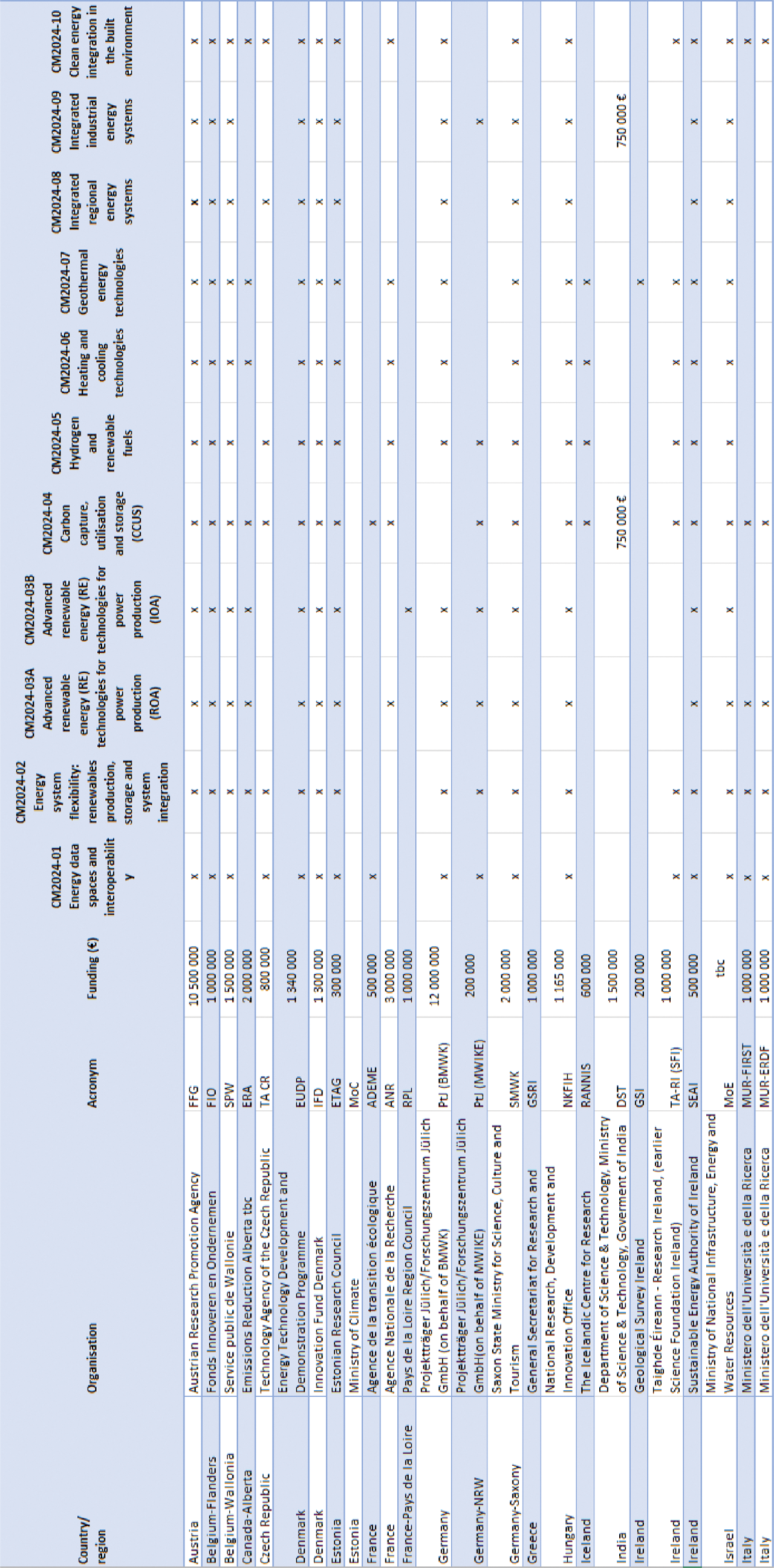
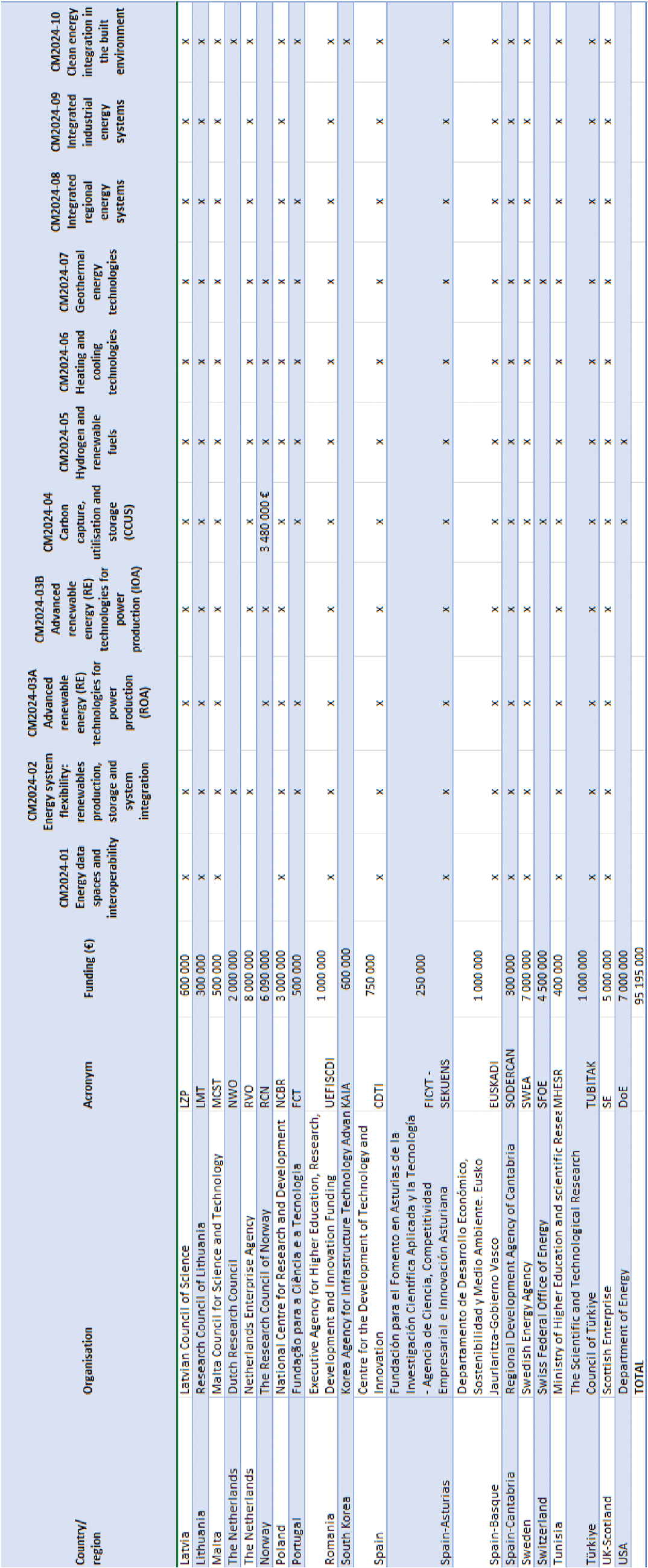
ANNEX D. FUNDING ORGANISATIONS’ PARTICIPATION PER CALL MODULE (THIS INFORMATION IS INDICATIVE) |
100 |
|
This Call text is structured as follows:
• Chapter 1 and 2 introduce the Clean Energy Transition Partnership (CETPartnership), the CETPartnership Joint Call 2024 (Call) and definitions used in this document.
• Chapter 3–6 provides instructions on the Call procedure, including an overview, the eligibility criteria and guidelines, the evaluation criteria and the process of the Call.
• Chapter 7 presents information to be considered at project implementation.
• Chapter 8 presents aims and topics of the Call Modules in the Call.
• Annex A describes the Reporting and Knowledge Community work package that is mandatory for all proposals and projects in the CETPartnership.
• Annex B describes the three dimensions of innovation for system solutions that can be applied to project design, as well as the CETPartnership Knowledge Community that involves projects funded by the Call.
• Annex C presents national/regional requirements of Funding Organisations participating in the Call.
• Annex D presents a matrix of Funding Organisations’ participation in the Call Modules.
The Clean Energy Transition Partnership (CETPartnership)1 aims to accelerate the clean energy transition and to contribute the goal of climate neutrality by 2050. It is a transnational and strategic partnership to align research, development and innovation (RDI) strategies, leverage knowledge and experience and foster a system transformation. Around 50 national/regional Funding Organisations from more than 30 countries in Europe and beyond participate in the CETPartnership with co-funding from the European Union (EU) through the Horizon Europe (HE) RDI Framework Programme.
The CETPartnership not only funds transnational RDI projects which will contribute to revolutionising the energy system. It also helps change makers find each other and collaborate, co-create strategic, evidence-based knowledge and impact, and develop transferable solutions, through the CETPartnership Knowledge Community2 and CETPartnership Impact Network3. This will further help policy makers and decision makers in the private and public sector and contribute to further development of the partnership and a clean energy system. All relevant stakeholders are invited to join the CETPartnership community4 .
While building on the achievements of pre-existing European Research Area Networks (ERA-NETs) in different areas of energy technologies and systems, the CETPartnership allows a broader ambition and a larger portfolio of topics and projects. The CETPartnership has developed the Strategic Research and Innovation Agenda (SRIA) 5, describing the common vision and objectives of the CETPartnership’s transformative, challenge-driven and transdisciplinary approach. Based on thematic challenges identified in SRIA, seven Transition Initiatives (TRIs) have been developed as the main acting bodies and configurations of Funding Organisations.
The CETPartnership’s annual joint calls cover a wide range of RDI disciplines and welcome interdisciplinary approaches. So far, the CETPartnership has implemented two joint calls in 2022 and 2023. The first call resulted in 46 projects, involving more than 350 organisations and about EUR 80 million from funding organisations in 26 countries.
The CETPartnership Joint Call 2024 (Call) is the third annual joint call under the CETPartnership. The Call consists of Call Modules, addressing different energy technology and system challenges as well as different RDI approaches and thus complementing and completing each other.
Call Modules focusing on enabling technologies (CM2024-02, 03A, 03B, 04, 05, 06 and 07, see Table 1.1 and Chapter 8) typically address approaches with reference to the Technology Readiness Levels (TRLs) 6 or Commercial Readiness Index (CRI) 7 . Some distinguish between research-oriented approaches (ROA, CM2024-03A) and innovation-oriented approaches (IOA, CM2024-03B).
Call Modules focusing on system integration (CM2024-01, 02, 08, 09 and 10, see Table 1.1 and Chapter 8) typically address holistic, integrated and transdisciplinary approaches with three dimensions: “technologies and infrastructures”, “organisation of energy systems” and “transition of energy systems” (see Annex B).
|
No. |
Title |
|---|---|
|
CM2024-01 |
Energy data spaces and interoperability |
|
CM2024-02 |
Energy system flexibility: renewables production, storage and system integration |
|
CM2024-03A |
Advanced renewable energy (RE) technologies for power production (ROA) |
|
\CM2024-03B |
Advanced renewable energy (RE) technologies for power production (IOA) |
|
CM2024-04 |
Carbon capture, utilisation and storage (CCUS) |
|
CM2024-05 |
Hydrogen and renewable fuels |
|
CM2024-06 |
Heating and cooling technologies |
|
CM2024-07 |
Geothermal energy technologies |
|
CM2024-08 |
Integrated regional energy systems |
|
CM2024-09 |
Integrated industrial energy systems |
|
CM2024-10 |
Clean energy integration in the built environment |
All projects funded by the Call are expected to actively participate in the CETPartnership Knowledge Community8 and work on topics of relevant Call Modules as well as cross-cutting issues outlined in CETPartnership SRIA 9. In addition, the projects will be supported in exploitation and impact maximisation with an Impact Library, training and networking. Read more about the mandatory Reporting and Knowledge Community Work Package in Annex A, and about the CETPartnership Knowledge Community in Annex B.
At the global level, the Call is part of the Mission Innovation (MI)10 call series. As such, some of the Call Modules are prepared directly in collaboration with MI missions, and all Call Modules are open to applications that directly and/or indirectly contribute to the work of MI missions.
Around 45 national/regional Funding Organisations (see Table 1.2) participate in the Call with budget for funding in different Call Modules (around EUR 100 million in total11). The Funding Organisations will fund eligible costs of Beneficiary Partners based in their country/region according to their budgets and requirements (see Annex C and Annex D).
|
Country |
Region |
Organisation name |
Acronym |
|---|---|---|---|
|
Austria |
Austrian Research Promotion Agency |
FFG |
|
|
Belgium |
Flanders |
Fonds Innoveren en Ondernemen |
FIO |
|
Wallonia |
Service public de Wallonie |
SPW |
|
|
Canada |
Alberta |
Emissions Reduction Alberta |
ERA |
|
Czech Republic |
Technology Agency of the Czech Republic |
TA CR |
|
|
Denmark |
Energy Technology Development and Demonstration Programme |
EUDP |
|
|
Innovation Fund Denmark |
IFD |
||
|
Estonia |
Estonian Research Council |
ETAG |
|
|
France |
(Federal) |
Agence de la transition écologique |
ADEME |
|
Agence Nationale de la Recherche |
ANR |
||
|
Pays de la Loire |
Pays de la Loire Region Council |
RPL |
|
|
Germany |
(Federal) |
Projektträger Jülich/Forschungszentrum Jülich GmbH (BMWK) |
PtJ (BMWK) |
|
North Rhine-Westphalia |
Projektträger Jülich/Forschungszentrum Jülich GmbH (MWIKE) |
PtJ (MWIKE) |
|
|
Saxony |
Saxon State Ministry for Science, Culture and Tourism |
SMWK |
|
|
Greece |
General Secretariat for Research and Innovation |
GSRI |
|
|
Hungary |
National Research, Development and Innovation Office |
NKFIH |
|
|
Iceland |
The Icelandic Centre for Research |
RANNIS |
|
|
India |
Department of Science & Technology, Ministry of Science & Technology, Government of India |
DST |
|
|
Ireland |
Geological Survey Ireland |
GSI |
|
|
Taighde Éireann – Research Ireland (earlier Science Foundation Ireland) |
TA-RI (SFI) |
||
|
Sustainable Energy Authority of Ireland |
SEAI |
||
|
Israel |
Ministry of EnergyTBC |
MoE |
|
|
Italy |
Ministero dell’Università e della Ricerca |
MUR |
|
|
Latvia |
Latvian Council of Science |
LZP |
|
|
Lithuania |
Research Council of Lithuania |
LMT |
|
|
Malta |
Malta Council For Science And Technology / Science Malta |
MCST/SM |
|
|
The Netherlands |
Dutch Research Council |
NWO |
|
|
Netherlands Enterprise Agency |
RVO |
||
|
Norway |
The Research Council of Norway |
RCN |
|
|
Poland |
National Centre for Research and Development |
NCBR |
|
|
Portugal |
Fundação para a Ciência e a Tecnologia |
FCT |
|
|
Romania |
Executive Agency for Higher Education, Research, Development and Innovation Funding |
UEFISCDI |
|
|
South Korea |
Korea Agency for Infrastructure Technology Advancement |
KAIA |
|
|
Spain |
Federal |
Centre for the Development of Technology and Innovation. |
CDTI |
|
Asturias |
Fundación para el Fomento en Asturias de la Investigación Científica Aplicada y la Tecnología – Agencia de Ciencia, Competitividad Empresarial e Innovación Asturiana |
FICYT-SEKUENS |
|
|
Basque |
Departmento de Desarrollo Económico, Sostenibilidad y Medio Ambiente. Eusko Jaurlaritza-Gobierno Vasco |
EUSKADI |
|
|
Cantabria |
Regional Development Agency of Cantabria |
SODERCAN |
|
|
Sweden |
Swedish Energy Agency |
SWEA |
|
|
Switzerland |
Federal Department of the Environment, Transport, Energy and Communications |
DETEC |
|
|
Tunisia |
Ministry of Higher Education and Scientific Research |
MHESR |
|
|
Türkiye |
The Scientific and Technological Research Council of Türkiye |
TUBITAK |
|
|
The United Kingdom |
Scotland |
Scottish Enterprise |
SE |
|
The United States of America |
Department of Energy |
DOE |
|
In the Call, the following definitions apply.
The Call process includes two stages:
• a pre-proposal stage (Stage 1)
• a full proposal stage (Stage 2)
The term proposal refers to both the pre-proposal and the full proposal.
A proposal is submitted by a Project Consortium that may consist of the following Project Consortium Partners:
• Coordinator: A legal entity applying for funding in the Call and responsible for coordinating and managing the proposal. The Coordinator cannot be changed after the deadline for pre-proposal submission (Stage 1) and before the selection of full proposals to be funded (Stage 2) in the Call process.
• Beneficiary Partners: All Project Consortium Partners applying for funding in the Call (including the Coordinator).
• Self-financed Partner(s): Project Consortium Partner(s) participating from any country with their costs declared but without applying for funding in the Call. Each Self-financed Partner submits a Letter of Commitment in Stage 2 of the Call process (see Subsection 6.2.1).
The Project Consortium Partners are legal entities of any organisation type such as:
• Secondary and higher education establishments
• Research organisations
• Private for-profit companies
• Public bodies
• Other entities (e.g. non-profit organisations)
Each Project Consortium Partner may have the following persons:
• APrincipal Investigator (PI)
• Any Team Members
The CETPartnership Joint Call 2024 (Call) is the third annual co-funded call under the CETPartnership and is open for Beneficiary Partners from countries participating in the Call and for Self-financed Partners from all over the world12 . The Call consists of 11 Call Modules, addressing different energy technology and system challenges as well as different RDI approaches (see Chapter 8), thus complementing, and completing each other. All Project Consortia are therefore encouraged to check carefully the coverage and requirements of their intended Call Module.
Around 45 national/regional Funding Organisations participate in the Call with budget for funding in different Call Modules (around EUR 100 million in total13), for eligible costs of Beneficiary Partners based in their country/region (see Annex C and Annex D). All Project Consortia, above all the Beneficiary Partners, are encouraged to check carefully the coverage and requirements of relevant Funding Organisations.
The Call follows a 2-stage procedure; a pre-proposal stage (Stage 1) and a full proposal stage (Stage 2), see Table 3.1 and Chapter 6. A Project Consortium chooses one Call Module to submit its pre-proposal (Stage 1). If the pre-proposal is selected in Stage 1, the Project Consortium is invited to submit a full proposal to the same Call Module (Stage 2). If the proposal is selected for funding in Stage 2, the eligible Beneficiary Partners will receive funding from their relevant Funding Organisations.
Funding Organisations may additionally require submission according to own submission procedure such as deadlines, portals and templates, see respective national/regional requirements in Annex C.
|
Opening for pre-proposal submission (Stage 1) |
19 September 2024 |
|
Deadline for pre-proposal submission |
21 November 2024, 14:00 CET |
|
National/regional deadline for pre-proposal submission |
See Annex C |
|
Opening for full proposal submission (Stage 2) |
29 January 2025 |
|
Deadline for full proposal submission |
2 April 2025, 14:00 CEST |
|
National/regional deadline for full proposal submission |
See Annex C |
|
Funding decision communicated |
Beginning of July 2025 |
|
Project start |
1 September-15 December 2025 |
In both Stage 1 and 2, the proposals will be checked according to eligibility criteria and requirements set for the Call in general (see Chapter 4), Call Modules (see Chapter 8) and Funding Organisations (see Annex C) and will be evaluated according to evaluation criteria (see Chapter 5), ranked per Call Module and selected according to the available funding. Failing to meet a criterion or requirement can lead to exclusion from the selection in both Stage 1 and 2. All Project Consortia are therefore encouraged to check carefully all the criteria and requirements, with relevant contacts if necessary.
In short, for a proposal to be considered for funding, it must:
• have met all the transnational criteria (see Chapter 4) and Call Module requirements (see Chapter 8), including a Project Consortium including Beneficiary Partners deemed eligible by relevant Funding Organisations participating in the Call Module (see Annex C and Annex D), and;
• have been selected according to the ranking and available funding.
Questions about the Call in general should be addressed to the CETPartnership Call Management (Call Management, callmanagement@cetpartnership.eu).
Questions about the Call Modules should be addressed to respective Call Module contacts, see Chapter 8. Questions about the national/regional requirements should be addressed to respective Funding Organisations see Annex C.
The Call includes the following eligibility criteria and requirements:
• Transnational eligibility criteria, applicable for all Project Consortia applying to the Call
• Call Module requirements, applicable for Project Consortia applying to Call Modules with specific requirements, see also Chapter 8
• National/regional requirements, applicable for Beneficiary Partners applying for funding from Funding Organisations in the Call, see also Annex C
|
1 |
A proposal must be written in English and submitted on the CETPartnership Submission Platform before the deadlines, following mandatory proposal templates. |
|
2 |
A Project Consortium must consist of a minimum of three Beneficiary Partners (including one Coordinator) adhering to relevant national/regional eligibility criteria, from a minimum of three different countries participating in the selected Call Module. Of these three Beneficiary Partners, at least two must be from EU Member States or HE Associated Countries. |
|
3 |
The total effort of one Project Consortium Partner in the Project Consortium can be maximum 60% of the total project efforts (measured in person months). |
|
4 |
The total effort of Project Consortium Partners from one country/region in the Project Consortium can be maximum 75% of the total project efforts (measured in person months). |
|
5 |
The following individuals are ineligible for proposal submission: CETPartnership Governing Board members, CETPartnership General Assembly members and researchers from the Funding Organisations in the Call.1 |
|
6 |
A project must finish in 36 months from the start of the project. |
|
7 |
A proposal must include a work package called Reporting and Knowledge Community in their work plan. |
Legal entities who are able to provide written proof that their organisational structure is completely separated from those of the Funding Organisation participating in the Call may under these exceptional circumstances submit their proposal to the Call.
For a proposal to be considered for funding, it must have met all the transnational criteria (see this chapter) and Call Module requirements (see Chapter 8), with a Project Consortium including Beneficiary Partners deemed eligible by relevant Funding Organisations participating in the Call Module (see Annex C and Annex D). Failing to meet an eligibility criterion or requirement can lead to exclusion from the selection. All Project Consortia are therefore encouraged to check carefully all the eligibility criteria and requirements.
Below, eligibility criteria and requirements are described in lists (→) and guidelines and recommendations in texts.
• A proposal must be written in English and submitted on the CETPartnership Submission Platform 14 before the deadlines, following mandatory proposal templates available for download on the start page of the Submission Platform. To be considered for funding, submission of a pre-proposal is mandatory for each Project Consortium, and submission of a full proposal is mandatory for each invited Project Consortium. Resubmission or revision of a proposal will be denied after the submission deadline unless it is requested by the Call Management. (Transnational eligibility criterion 1)
• National/regional Funding Organisations may additionally require submission according to own sub-mission procedure such as deadlines, portals and templates, see respective national/regional requirements in Annex C.
• A Project Consortium must consist of a minimum of three Beneficiary Partners (including one Coordinator) adhering to relevant national/regional eligibility criteria, from a minimum of three different countries participating in the selected Call Module. Of these three Beneficiary Partners, at least two must be from EU Member States or HE Associated Countries 15 (Transnational eligibility criterion 2).
• The total effort of one Project Consortium Partner in the Project Consortium can be maximum 60% of the total project efforts (measured in person months). (Transnational eligibility criterion 3).
• The total effort of Project Consortium Partners from one country/region in the Project Consortium can be maximum 75% of the total project efforts (measured in person months). (Transnational eligibility criterion 4).
• The following individuals are ineligible for proposal submission: CETPartnership Governing Board members, CETPartnership General Assembly members or researchers from the Funding Organisations in the Call. However, legal entities who are able to provide written proof that their organisational structure is completely separated from those of the Funding Organisation participating in the Call may under these exceptional circumstances submit their proposal to the Call. (Transnational eligibility criterion 5).
• Specific Call Module requirements may apply regarding the Project Consortia, see Call Module requirements in respective Call Modules in Chapter 8.
• Specific National/regional requirements may apply regarding the Project Consortia, see respective national/regional requirements in Annex C.
Each Self-financed Partner is expected to enclose a Letter of Commitment with the full proposal (see Subsection 6.2.1).
No individual involved in a proposal can act as an evaluator in the Call.
• A project must finish in 36 months from the start of the project. (Transnational eligibility criterion 6).
• Specific Call Module requirements may apply regarding the project budget; see Call Module requirements in respective Call Modules in Chapter 8.
• Specific National/regional requirements may apply regarding the project duration and/or budget; see respective national/regional requirements in Annex C.
The Call generally aims to support projects with a duration between 12 and 36 months and applying for funding in the Call in the range of (but not limited to) EUR 0.5–5 million, besides possible self-financing.
• Specific Call Module requirements may apply regarding the RDI approaches/TRLs; see Call Module requirements in respective Call Modules in Chapter 8.
• Specific National/regional requirements may apply regarding the RDI approaches/TRIs; see respective national/regional requirements in Annex C.
The Call applies the definition of TRLs in the HE Work Programme 16 .
Since the CETPartnership aims to accelerate the clean energy transition to achieve the goal of climate neutrality by 2050, the Call generally aims to fund projects increasing their TRL and reaching medium to high TRLs (4–8), in combination between technological and system solutions with societal, commercial, financial, environmental, regulatory and other critical aspects. TRL increase of 1–2 is considered usual, increase of 3 ambitious and increase of 4 infeasible. Projects may include activities at lower or higher TRLs based on specific needs to reach project goals or meet national/regional requirements.
Other frameworks than TRLs may apply as well in some Call Modules. For example, the Commercial Readiness Index (CRI)17 describes solutions in terms of their commercial value proposition and ability to obtain financing for deployment. The Societal Readiness Level (SRL)18 is a way of assessing the level of societal adaptation of solutions. In addition, the Smart Readiness Indicator (SRI) 19 is a common EU scheme for rating the smart readiness of buildings.
The CETPartnership Exploitation Guidelines 20 developed by the CETPartnership Impact Network will be of help in planning a project with activities to advance on such scales as well as to exploit outcomes and maximise impact.
• Specific Call Module requirements may apply regarding the cross-cutting dimensions; see Call Module requirements in respective Call Modules in Chapter 8.
The cross-cutting dimensions are an integral part of the CETPartnership. They can be transition pathways, circularity, digitalisation as well as policy and social aspects and include different societal stakeholders and innovation ecosystems. Read more about the cross-cutting dimensions in the CETPartnership SRIA21 .
• A proposal must include a work package called Reporting and Knowledge Community in their work plan (see Annex A). (Transnational eligibility criterion 7).
When developing a proposal, it is important to consider the concept and content of the CETPartnership Knowledge Community, in which projects funded by the Call are expected to actively participate. Read more about the Knowledge Community in Annex B and the CETPartnership’s website22 .
The CETPartnership promotes and asks Project Consortia to carefully consider open science practices, including the FAIR principles (Findable, Accessible, Interoperable, and Reusable), with a strong emphasis on high accessibility of funded projects’ findings (see the evaluation criterion Excellence in Chapter 5). Read more about open science in the EU’s open science policy 23.
The CETPartnership considers eliminating gender inequality and intersecting socioeconomic inequalities throughout research and innovation systems, for example by addressing unconscious bias and systemic structural barriers. The CETPartnership integrates the gender dimension in the research and innovation content of the Joint Calls (see the evaluation criterion Excellence in Chapter 5) and promotes gender balance among personnel in a Project Consortium.
In both Stage 1 and 2, proposals will be evaluated according to the following main evaluation criteria:
• Excellence
• Impact
• Quality and efficiency of the implementation
The following sub-criteria will be used in all the Call Modules to determine the scores for the three main evaluation criteria. Sub-criteria with asterisk (*) will be used in Stage 2 only.
Excellence
• Clarity and pertinence of the project’s objectives in relation to the Call and Call Module.
• Extent to which the project’s objectives are ambitious, and go beyond the state-of-the-art of the proposed work in terms of research/innovation for the clean energy transition.
• Soundness of the proposed methodology, including the underlying concepts, models, assumptions, and interdisciplinary approaches.
• *Appropriate consideration of the diversity and gender dimension in research/innovation content.
• *The quality of open science practices including sharing and management of research/innovation outputs and engagement of citizens, civil society and end users where appropriate.
Impact
• Credibility of the pathways to achieve the expected outcomes and impacts for the clean energy transition specified in the Call and Call Module.
• Likely scale and significance of the contributions due to the project, through appropriate involvement of end-users and other relevant target groups.
• The added value of the transnational collaboration.
• Suitability and quality of the measures to maximise expected outcomes and impacts, as set out in the dissemination and exploitation plan through use of the solutions by target groups where appropriate, including communication activities.
Quality and efficiency of the implementation
• Quality and effectiveness of the work plan.
• *Assessment of risks.
• *Appropriateness of the effort assigned to work packages and the resources overall.
• Capacity and role of each participant, and extent to which the consortium as a whole brings together the necessary expertise.
Gender balance in personnel named in the proposal will be one of the criteria to decide in case of ex aequo proposals.
For proposal evaluation, a full score in the range of 0–5 (see Table 5.1) will be awarded at individual evaluations and panel meetings for each of the three main evaluation criteria, not for any sub-criteria. Each main evaluation criterion will be equally weighted.
|
Score |
Description |
|---|---|
|
0 |
Fail/Missing: The proposal fails to address the criterion or cannot be assessed due to missing or incomplete information (unless the result of an ‘obvious clerical error’). |
|
1 |
Poor: The criterion is inadequately addressed or there are serious inherent weaknesses. |
|
2 |
Fair: The proposal broadly addresses the criterion but there are significant weaknesses. |
|
3 |
Good: The proposal addresses the criterion well but with a number of shortcomings. |
|
4 |
Very good: The proposal addresses the criterion very well but with a small number of shortcomings. |
|
5 |
Excellent: The proposal successfully addresses all relevant aspects of the criterion. Any shortcomings are minor. |
The Call process includes two stages: the pre-proposal stage (Stage 1) and the full proposal stage (Stage 2). To be considered for funding, a proposal must be submitted on time, complete and concise. Direct submission of a full proposal in Stage 2 is impossible.
A pre-proposal must be submitted by a Coordinator (see Section 4.2 for the eligibility criteria and guidelines on Project Consortia) in reference to a Call Module before 21 November 2024, 14:00 CET on the CETPartnership Submission Platform 24, in collaboration with the other Project Consortium Partners (including possible Self-financed Partners). On the Submission Platform, the Coordinator must invite all the other Project Consortium Partners. At submission, every Project Consortium Partner invited by the Coordinator must have accepted the invitation and entered its information and budget on the Submission Platform, while any irrelevant partners must have been removed.
The pre-proposal has a draft status until it is submitted. Once it is submitted, it can still be revised and resubmitted as many times as needed before the deadline.
The pre-proposal must include a project description (max 10 pages using the mandatory pre-proposal template available for download on the start page of the Submission Platform and following instructions there) and any possible supporting documents. See Section 4.1 for the eligibility criteria and guidelines on submission. See Section 4.2–4.8 for the eligibility criteria and guidelines on how to formulate the pre-proposal.
Please consider that Funding Organisations may additionally require submission according to own submission procedure such as deadlines, portals and templates. See respective national/regional requirements in Annex C.
Eligibility checks will be performed on a submitted pre-proposal according to:
• Transnational eligibility criteria (see Chapter 4) by the Call Management.
• Call Module requirements (see Chapter 8) by a relevant TRI.
• National/regional requirements (see Annex C) by relevant Funding Organisations.
The TRI deems the pre-proposal:
• Eligible for submitting a full proposal
• Conditionally eligible for submitting a full proposal, requesting more information or requirements to be included in a full proposal
• Ineligible for submitting a full proposal.
The Funding Organisations deem the Beneficiary Partners in the pre-proposal:
• Eligible for submitting a full proposal
• Conditionally eligible, for submitting a full proposal, requesting more information or requirements to be included in a full proposal
• Ineligible for submitting a full proposal.
Considering any Beneficiary Partner deemed ineligible in this step, please note that requirements to proceed to the next step deviate from Transnational eligibility criterion 2, 3 and 4, namely that a pre-proposal must meet the following requirements in addition to Transnational eligibility criterion 1, 5, 6 and 7:
• The Project Consortium consists of a minimum of two Beneficiary Partners (including the Coordinator) deemed eligible or conditionally eligible by relevant Funding Organisations from a minimum of two different countries participating in the selected Call Module. Of these two Project Consortium Partners, at least one must be from EU Member States or HE Associated Countries.
• The total effort of Beneficiary Partners deemed ineligible by relevant Funding Organisations in Stage 1 covers less than 25% of the total project efforts (measured in person months).
Please also note that the final eligibility checks for funding will be performed in Stage 2. To be considered for funding, proposal must then have fully met all the transnational eligibility criteria, including a Project Consortium deemed eligible by relevant Funding Organisations.
Each pre-proposal will be evaluated according to the evaluation criteria described in Chapter 5, by an evaluation panel of at least three independent evaluators25. The pre-proposal will receive individual scores from the independent evaluators for each of the three main evaluation criteria in the range of 0–5 and individual total scores in the range of 0–15 from the independent evaluators. This will result in an average score for each of the three main evaluation criteria in the range of 0–5, and a total average score in the range of 0–15. In case of strong disagreement between the individual scores by the independent evaluators (differing 6 or more between the lowest and the highest individual total scores), the evaluation panel will have a meeting to reach a consensus and provide a full score for each of the three main evaluation criteria in the range of 0–5, resulting in a total score in the range of 0–15.
A ranking list will be developed for each Call Module with pre-proposals having an average or consensus score at or above 3 for all the three evaluation criteria and a total average or consensus score at or above 10.
Following the ranking lists developed in the former step, the Funding Organisations will agree on a list of pre-proposals to be invited to Stage 2, while ensuring that the total funding requested by the invited pre-proposals is maximum four times the available budget for each Funding Organisation.
In case of budgetary constraints, pre-proposals will be selected considering the following core principles:
• Maximising the total number of projects funded.
• Maximising the number of countries/regions involved in the projects funded.
• Having a good balance between the Call Modules in terms of the number of projects funded.
• Having similar success rates between the Call Modules.
• Maximising the amount of EU financial contribution generated.
The outcome of Stage 1 will be notified by the Call Management to each Coordinator with a report on the eligibility checks and, if applicable, the evaluation of the pre-proposal, as well as information on the means of redress, see Section 6.3.
A full proposal must be submitted by the Coordinator of each invited Project Consortium (see Section 4.2 for the eligibility criteria and guidelines on Project Consortia) to the same Call Module before 2 April 2025, 14:00 CEST on the CETPartnership Submission Platform 26 , in a similar manner to the pre-proposal, in collaboration with the other Project Consortium Partners (including Self-financed Partners). The difference from the submission of the pre-proposal (Subsection 6.1.1) is that the full proposal must include:
• A project description of max 30 pages (instead of max 10 pages).
• A Letter of Commitment by each Self-financed Partner (with information about its active participation and role).
The following changes between the pre-proposal and the full proposal will be allowed.
1. Addition of a Self-financed Partner.
2. Replacement of (a) Beneficiary Partner(s) deemed ineligible in Stage 1 with (a) Self-financed Partner(s).
3. Changes (other than the case 1 or 2 stated above) initiated by any relevant Funding Organisation or the Call Management.
4. Changes (other than the case 1 or 2 stated above) initiated by a Project Consortium and related to the Project Consortium, duration and budget, only when:
○ the Coordinator stays the same,
○ the changes are well motivated in relation to the project ambition and scope, and
○ the changes are approved by the relevant Funding Organisations and all the Project Consortium Partners.
However, addition of any Beneficiary Partner applying for funding from a Funding Organisation oversubscribed by more than four times its available budget in Stage 1 will be denied.
If any Funding Organisation turns out to be undersubscribed in Stage 127, the CETPartnership will encourage Project Consortia to include Beneficiary Partners applying for funding from the undersubscribed Funding Organisations to widen the involvement of Funding Organisations.
Changes in a Project Consortium other than the case 1 or 2 stated above must be notified with written proof from relevant Funding Organisations to the Call Management (callmanagement@cetpartnership.eu) before the panel meeting described in Section 6.2.3.
Please again consider that Funding Organisations may additionally require submission according to own submission procedure such as deadlines, portals and templates. See respective national/regional requirements in Annex C.
Eligibility checks will be performed on a submitted full proposal according to:
• Transnational eligibility criteria (see Chapter 4) by the Call Management.
• Call Module requirements (see Chapter 8) by a relevant TRI.
• National/regional requirements (see Annex C) by relevant Funding Organisations.
The TRI deems the full proposal:
• Eligible for funding in the Call
• Ineligible for funding in the Call
The Funding Organisations deem the Beneficiary Partners in the full proposal:
• Eligible for funding in the Call
• Ineligible for funding in the Call
A full proposal meeting all the transnational eligibility criteria and Call Module requirements can proceed to the next step. A full proposal with any ineligible Beneficiary Partners may proceed to the next step if the total effort of ineligible Beneficiary Partners only covers less than 25% of the total project efforts (measured in person months).
Each full proposal will be individually evaluated according to the evaluation criteria described in Chapter 5, by an evaluation panel of at least three independent evaluators 28. The evaluation panel will then have a meeting to reach a consensus and provide a full score for each of the three main evaluation criteria in the range of 0–5, resulting in a total consensus score in the range of 0–15.
A ranking list will be developed for each Call Module with full proposals having a consensus score at or above 3 for all the three evaluation criteria and a total consensus score at or above 10.
The Funding Organisations will agree on a list of full proposals to be funded following the ranking lists in the former step, the available budgets, and the same core principles as in Subsection 6.1.4.
The outcome of Stage 2 will be notified by the Call Management to each Coordinator with a report on the eligibility checks and, if applicable, the evaluation of the full proposal, as well as information about redress, see Section 6.3.
The Coordinator of a Project Consortium, who considers that the outcome was based on an error in the selection procedure, can submit a written complaint. An eligible complaint must:
• be submitted as a single PDF document, including all relevant documents and written in English, to the Call Management (callmanagement@cetpartnership.eu) within 30 days of receiving the outcome.
• indicate which proposal the complaint applies to by stating the proposal code;
• state in what way the outcome is considered incorrect and what change is requested;
• focus on aspects concerning the outcome on the proposal (e.g. admissibility or eligibility checks, evaluation procedure, etc.), not its merits,
• raise procedural irregularities, factual errors, manifest errors of assessment or abuse of powers (e.g. lack of coherence between scores and comments, lack or inadequate reasoning of the conclusions, the existence of a conflict of interests, exceeding the limits of discretion, etc.). Mere repetitions of the content of the proposal or disagreements with the result or reasoning of the technical evaluation will not be considered.
Only one request for review per proposal will be considered in Stage 1 and 2 respectively. The request cannot refer to the outcome of proposals submitted by other Project Consortia or under different or previous calls.
An eligible and complete request for review will be referred to a committee convened by the Call Management and comprised of staff who were not involved in the process for eligibility checks or evaluation of the proposal. All requests for review will be treated as confidential but shared with the relevant Funding Organisations.
Funding arrangements will be made directly between the Project Consortium Partners and their national/regional Funding Organisations according to the Funding Organisations’ procedure. The project must start before 15 December 2025 and finish in 36 months. It is highly recommended that all Project Consortium Partners in the Project Consortium synchronise their project start and end dates, even though their national/regional funding arrangements can be desynchronised.
Each Project Consortium must have a signed Consortium Agreement (CA) between all the Project Consortium Partners, including intellectual property rights (IPR) issues. It is recommended to have it already at the project start or within 6 months after the project start and to involve the Coordinator’s legal department in this process. There are several models for CA in Horizon Europe projects, which can be modified to fit a CETPartnership project (e.g. DESCA, DIGITALEUROPE MCARD-HEU and EUCAR).
The Beneficiary Partners must follow HE Guidance on Gender Equality Plans (GEPs)29. It means that public bodies as well as public and private higher education establishments and research organisations established in EU Member States and Associated Countries must have a GEP.
Any changes in a project selected for funding must be communicated with and approved by relevant Funding Organisations and reported to the CETPartnership Knowledge Community Management (knowledgecommunity@cetpartnership.eu). Such changes may affect the funding from the CETPartnership.
The Coordinator must submit annual reports and a final report on the transnational level to the CETPartnership, see Task 1 in Annex A. The collected data will be used for monitoring purposes.
Specific national/regional requirements may apply regarding the reporting.
Each project is expected to acknowledge the CETPartnership, EU and relevant Funding Organisations, have a webpage, to prepare popular scientific summaries and to actihvely participate in the CETPartnership Knowledge Community (see Section 1.4) for increased knowledge sharing and dissemination of results. For more details please read the Annex A and the CETPartnership Communication Guidelines 30.
Specific national/regional requirements may apply regarding the communication and dissemination.
The Call consists of 11 Call Modules, addressing different energy technology and system challenges as well as different RDI approaches, thus complementing, and completing each other.
In addition to the transnational eligibility criteria (see Chapter 4) and national/regional requirements (see Annex C), specific Call Module requirements may apply, see Call Module requirements in the table below each Call Module title. More information about the Call Module requirements may be described in relevant sections of the Call Module text.
|
Target RDI approaches/TRLs |
Project start: TRL 3 or higher Project end: TRL 6 or higher |
|
Project Consortium Partners |
Consortium possessing the necessary expertise across relevant disciplines. |
|
Project budget |
Approximately EUR 5 million |
|
Call Module requirements |
None |
|
Contact |
TRI1 and TRI5 |
This Call Module will fund a pilot of an IT framework consisting of software services, which will enable the interoperable connection of data spaces at multi-lateral (i.e. involving different regions or countries) and cross-sector level. The pilot may use experience of multi-lateral interoperability successfully developed in other sectors (e.g. eProcurement, eID, eHealth) and will serve as a blueprint for the architecture and services in the energy sector. This will ensure future cross-sector interoperability.
This Call Module focuses on the development of an IT framework that could be used for the implementation of many different Use Cases at multi-lateral and cross-sector levels. In order to validate the approach and the IT framework, a specific Use Case is proposed, e.g. communication in the EV-charging infrastructure enabling the provision/request of ancillary services to/from the electricity network through data exchange and integration between energy and mobility.
Different Use Cases could be proposed, provided that they address multi-lateral and cross-sectoral applications.
In order to achieve the maximum impact, this Call Module is meant to fund one single project.
Data spaces are ecosystems in which data is the strategic resource used by data providers, intermediaries, and users. These stakeholders can access them to share data and enable the functionalities of the energy systems (e.g. observability and control of networks, market participation of storage operators, EV charging, etc.).
According to the European Interoperability Framework (EIF) 31, “interoperability is the ability of organisations to interact towards mutually beneficial goals, involving the sharing of information and knowledge between these organisations, through the business processes they support, by means of the exchange of data between their ICT systems”.
The energy transition will necessarily make use of multi-lateral data exchange. European data spaces in the energy field should rely on an interoperable IT framework for multi-lateral and cross-sector data exchange, in order to enable energy system integration from local to pan-European dimension.
Multi-lateral rules and opportunities for EU data access are fragmented (e.g. smart meter data in the Member States), making use of data collected in Member States particularly difficult. There are various data spaces in the energy sector that are not always interoperable among each other (e.g. electricity) and, more generally, among sectors (e.g. P2X).
This Call Module will fund a pilot of an IT framework consisting of software services, which will enable the interoperable connection of data spaces at multi-lateral and cross-sector level. The concepts of authorisation, authentication and cybersecurity must be considered by design.
The aim of the pilot project is to demonstrate the potential for multi-lateral data exchange and sharing by building on existing solutions, also in other sectors like healthcare or mobility sector, to show the potential benefits and added value of an EU-wide large-scale IT framework. It should build on existing data spaces and initiatives and draw inspiration from best practices in other areas, such as:
The Use Case(s) of this pilot project aims to demonstrate the potential of multi-lateral data sharing by using, where possible, the existing data authorisation bodies or access authorities (i.e. national authorities, contact or access points) and other EU organisations (e.g. European agencies) and to show the potential benefits and added value of a large-scale IT framework. The funded project shall support the development of interoperable European multi-lateral energy data spaces. It should design, develop, set up and operate a pilot network of nodes (representing different data brokers, holders, consumers, and providing IT services) interconnected by centralised services.
Proposals must include the following:
• define and select the Use Case(s) (including necessary energy datasets) for the validation, that builds on energy data made available by the consortium partners to demonstrate added value of multi-lateral standardised data exchange
• define requirements (business, functional and non-functional) for an IT framework to enable EU-wide standardised exchange of energy data
• design the architecture and the specifications for the building blocks necessary for an IT framework based on experience of other sectors (nodes and central services) to enable EU-wide use of energy data; use as much as possible the existing IT infrastructure on EU and national levels e.g. CEF building blocks
• develop, customise or integrate technology to fulfil the agreed requirements, architecture and specifications, as indicated in points above
• test the Use Case(s) before implementation for ensuring effective interoperability. Facilities of the CETPartnership / ERA Net European Collaboration Network of Interoperability Testing are available for interoperability testing
• run the selected Use Case(s) over the implemented IT framework (validation of the process)
The project shall address the scalability of the developed IT framework to the widest possible European geographical context and evidence the added value of multi-lateral use and exchange of energy data.
In order to validate the approach and the IT framework, a specific Use Case is proposed, i.e. communication in the charging infrastructure for electric vehicles, which enables the provision/request of ancillary services to/from the electricity grid through data exchange and integration, thus enabling a cross-sector connection of energy and mobility.
This demonstration Use Case should include the multi-lateral identification of the electric vehicle, the communication of the availability or reservation of charging points and the communication for the interaction of the charging point for the provision/request of ancillary services. For the communication, the existing standards and regulations have to be taken into account.
Please note that the scope of the solution for the pilot is the implementation of the communication framework and not the physical processes.
Expected results of this pilot:
• requirements, architecture and specifications for the technological building blocks for an IT and data framework to enable EU-wide use of energy data; following the principles of EIRA 42 , which is based on the European Interoperability Framework (EIF)
• demonstrating the pilot of a working framework across at least 5 countries
Specific requirements:
• the use of Connecting Europe Facility (CEF) building blocks and the adoption of open standards should be considered in the definition of specifications
• the use of DCAT Application Profile43 for data portals in Europe (DCAT-AP) as baseline specification for metadata records should be explored as cornerstone for semantic interoperability with other European data spaces
• ensure open-source results, made available through a public repository under a permissive license
• develop, test, deploy and operate a reusable IT framework for use of energy data with a sufficient number of nodes to demonstrate scalability and flexibility
Additionally, Project consortia shall consider overarching challenges, such as:
• Organisational challenges:
○ Federation of data spaces in the ecosystem
○ Mechanisms for the long-term maintenance of the data space
• Social challenges:
○ Trust
○ Privacy
○ Involvement of end users
Experience in other sectors (particularly the health sector) shows that in the development of such an IT framework it is advisable to start focusing on specific limited Use Case(s) although keeping in mind the overall picture, thus ensuring the modularity of the approach.
Scalability, replicability and maintainability can be achieved more efficiently if interoperability is considered by design. In addition, the transnationality of the CETPartnership provides a good opportunity to create a sustainable and accepted solution.
It is expected that the project will work closely with relevant initiatives at European level, exchange ideas and adopt or expand existing approaches, such as the CETP / ERA Net European Collaboration Network of Interoperability Testing, International Data Spaces e. V. or Gaia-X.
Projects shall drive innovation, lead to findings and create evidence-based knowledge in the three dimensions of innovation as outlined in Annex B as follows:
|
Dimension 1: Technologies, Infrastructures and System Solutions |
Dimension 2: Organisation of Energy Systems |
Dimension 3: Transition of Energy Systems |
|---|---|---|
|
Develop software services |
Federation of data spaces involved in energy sector, even if from different sectors (e.g. mobility) Mechanisms for the long-term operation of the data space |
Trust Privacy Involvement of end users |
Individual proposals have to address the development of technologies, infrastructures and system solutions (Dimension 1) as well as the outlined aspects in the dimensions 2 and 3.
|
Target RDI approaches/TRLs |
Project start: TRL 3 or higher Project end: TRL increase of 1–2 from project start |
|
Project Consortium Partners |
• Secondary and higher education establishments • Research organisations • Private for-profit companies, bringing in expertise, knowledge, and know-how for the implementation of innovative and breakthrough solutions, such as: ○ system operators ○ SMEs ○ spin-off companies |
|
Project budget |
Applied funding from the Call in the range of (but not limited to) EUR 1–2 million. |
|
Call Module requirements |
None |
|
Contact |
TRI1 and TRI2 |
This Call Module, developed in collaboration between the Mission Innovation (MI) Green Powered Future Mission (GPFM) and the CETPartnership TRI1 44 and TRI2 45 , aims to increase opportunities for international cooperation and represents the implementation of the GPFM Flagship Project 2 (FP2) “Multilateral Research Programme” to take forward a selection of the identified Innovation Priorities (IP) for the power system decarbonisation and transformation. FP2 was launched by the GPFM at the Global Clean Energy Action Forum held in Pittsburgh (September 2022) as part of the GPFM Action Plan 2022–2024 46.
The MI GPFM aims to demonstrate that by 2030, power systems in different geographies and climates can effectively integrate up to 100% variable renewable energies (e.g. wind and solar) in their generation mix, and maintain a cost-efficient, secure and resilient system.
This Call Module addresses key aspects of the clean energy transition ranging from large-scale integration of renewable energy sources into the power grids, considering storage as a possible solution to deal with their intermittent nature, to broad technological and market aspects as well as approaches towards system integration. Moreover, digitalisation and standardisation, being key enablers for the deployment of innovative system flexibility solutions, need to be duly considered by the proposed projects.
Among the 50 Innovation Priorities considered in the GPFM Action Plan, 14 of them have been selected for the present Call Module as most relevant for the CETPartnership and for the short-term perspective of the GPFM Action Plan. The selection has been carried out by a task force set up within the GPFM during the development of the FP2 Multilateral research programme and by joint discussions between the GPFM and the CETPartnership. These challenges are well aligned with the CETPartnership SRIA 47: funded projects are therefore expected to contribute to reach the targets of both initiatives.
Proposals must address one or more of the following Innovation Priorities:
1. Large-scale renewable energy generation for improving system reliability & stability (GPFM IP 1.3.2)
2. Variable renewable energy flexibility provision & contribution to generation capacity (GPFM IP 2.1.1)
3. Innovation in energy storage technologies (GPFM IP 1.5.3)
4. Utility scale storage systems for innovative flexibility services (GPFM IP 2.4.3)
5. System stability assessment considering high VRE penetration (GPFM IP 2.3.1)
6. Enhanced TSO-DSO coordination platform for flexibility markets optimisation (GPFM IP 2.3.2)
7. Flexibility markets for innovative ancillary services by VRE and storage (GPFM IP 2.7.1)
8. Unlocking commercial and residential buildings flexibility potential (GPFM IP 2.5.2)
9. Connected data platforms for enhanced forecasting and flexible operation (GPFM IP 3.3.2)
10. Standardisation of devices and control platforms (GPFM IP 3.1.2)
11. Identify priority dataset for system security (GPFM IP 3.2.2)
12. Grid supporting technologies from inverter-based resources (GPFM IP 1.6.2)
13. Tools and solution for DSO flexibility management (GPFM IP 2.3.4)
14. Demand response, EV services and grid impact assessment (GPFM IP 2.5.4)
The Call Module mainly focuses on research and development, while demonstration and implementation are considered as subordinate. Nevertheless, it is expected to possibly involve industry, bringing in expertise, knowledge, and know-how for the implementation of innovative and breakthrough solutions.
The involvement of Research Performing Organisations (RPO), system operators and private technology and service providers in a Project Consortium will constitute a competitive advantage for the project proposal. The participation of SMEs and spin-off companies are considered preferential. Projects should preferably be designed building on top of existing initiatives or assets and propose replicable and scalable solutions.
The Call Module expects mainly international consortia, as it aims to engage with GPFM country member organisations, among which are included extra-European countries (countries outside the EU and not associated to Horizon Europe), contributing to foster the CETPartnership approach worldwide and link Mission Innovation to the CETPartnership Knowledge Community.
The 14 selected Innovation Priorities listed above are clustered into 5 main R&I topics, and proposals must cover at least one or more of them:
1. Large-scale renewable generation and system stability and reliability
2. Energy storage technologies and systems for flexibility services
3. System stability and flexible operations
4. Innovative flexibility sources and demand side for flexibility markets
5. System digitalisation and related tools & technologies, including AI and digital twin.
This Call Module is intended to concentrate efforts and financial resources to accelerate the deployment of key innovations thus enabling the realisation of clean energy solutions in the near future.
The Call Module, coherently with CETPartnership and GPFM objectives, has the goal of demonstrating that power systems, regardless of geography or climates, can effectively integrate up to 100% variable renewable energy in their generation mix by 2030 while ensuring the system is cost-efficient, secure and resilient.
The potential impact of this Call Module is that by supporting projects involving partners outside of Europe, the Call Module will facilitate the dissemination of this approach globally. Consequently, this may prompt more countries to embrace clean energy technologies and practices. The participation of partners from member countries of the GPFM (even if not members of the CETPartnership) is not a compulsory prerequisite but a preferential attribute.
Synergies with one or more projects supported under the following Horizon Europe topics are strongly recommended where relevant and applicable:
• HORIZON-CL5-2023-D2-01-04, Battery management system (BMS) and battery system design for stationary energy storage systems (ESS) to improve interoperability and facilitate the integration of second life batteries
• HORIZON-CL5-2023-D2-01-05, Hybrid electric energy storage solutions for grid support and charging infrastructure
• HORIZON-CL5-2024-D2-01-02, Non-Li Sustainable Batteries with European Supply Chains for Stationary Storage.
|
Target RDI approaches/TRLs |
CM2024-03A: TRL 3–5 Project start: TRL 3 or higher Project end: TRL 4 or higher CM2024-03B: TRL 5–7 Project start: TRL 5 or higher Project end: TRL 6 or higher |
|
Project Consortium Partners |
• Secondary and higher education establishments • Research organisations • Private for-profit companies such as: ○ SMEs ○ Spin-off companies ○ Large companies ○ Technology providers |
|
Project budget |
CM2024-03A: in the range of (but not limited to) EUR 1–2 million CM2024-03B: in the range of (but not limited to) EUR 2.5–5 million including possible self-financing. |
|
Call Module requirements |
Projects applying as IOA shall comprise at least one industry partner / private for-profit companies |
|
Contact |
TRI2 |
The following RDI approaches, Research-oriented approach (ROA) and Innovation-oriented approach (IOA), apply to CM2024-03A/03B respectively:
• Research-oriented approach (ROA) aims to create knowledge or explore the feasibility of a new or improved technology, product, process, service or solution and includes applied research, technology development and integration, testing, demonstration and validation of a small-scale prototype in a laboratory or simulated environment.
• Innovation-oriented approach (IOA) aims to develop plans and arrangements or designs for new or improved products, processes or services and includes prototyping, testing, demonstrating, piloting, large-scale product validation in an operational environment, and market replication.
These Call Modules, following the challenge of the CETPartnership TRI2 48 , aims to contribute to global leadership in renewables, with specific reference to the key actions 1 and 2 of the SET Plan 49. See also the relevant IWGs’ Implementation Plans in the section Expected impact below.
Building on the CETPartnership SRIA 50, the Call Modules address critical gaps in R&I and push the boundaries of renewable energy technologies in order to bring onto the market more efficient, reliable, cost-effective and sustainable solutions for a net zero-emission power system.
The Call Modules target innovative projects in order to have a balanced portfolio of RE technologies for power production at different TRL stages. CM2024-03A calls for ROA (Research-Oriented Approach) projects, and CM2024-03B calls for IOA (Innovation-Oriented Approach) projects. Projects can apply for either CM2024-03A (ROA) or CM2024-03B (IOA), according to the targeted TRL at the end of the project.
The Call Modules are open to all the broad portfolio of RE zero-emission power technologies. Specific focus is on RE technologies for power generation on a utility scale or for distributed generation such as: onshore and offshore wind, ocean energy (tidal and wave) and other offshore renewables, solar energy (PV and CSP/STE), etc. Bioenergy for power generation (with carbon capture and storage (BECCS)) is also in scope. Please note that bioenergy applications dedicated to fuel production are considered in CM2024-05.
Projects are expected to contribute to one or more of the following challenges:
• Integration of generation facilities and technologies combining different renewable energy sources (RES) and/or storage on the same site/point of connection to the grid.
• Hybridisation: Producing power together with other energy vectors with the objective of optimising the overall system efficiency (PV-T, PV-Hydrogen, CSP-STE power and heat, biomass power and heat, power and H2 or other energy vectors).
• Advancing technologies and improving performance: Improving the efficiency and performance of renewable technologies through innovative/improved components, materials and technologies.
• Improving operational efficiency: Developing advanced monitoring and predictive analytics, real-time monitoring of renewable energy assets for early detection of issues to prevent system failures and maximise energy generation.
• Next generation RES: New breakthrough and emerging technologies: exploring innovative approaches to increase efficiency or sustainability of RE technologies.
• Site-specific marine/atmospheric modelling and forecasting: Developing marine / meteorological models on a sub-regional scale to improve performance, reliability, availability of RES.
• Digitalisation and digital twins: Design, development and application of digital twins for renewable energy technologies, such as wind turbines and solar panels.
Projects shall address one or more of the following topics:
Bioenergy with carbon capture and storage (BECCS) for power generation
• High efficiency biomass (co)generation of power with improved performance and higher share of power production ratio, using residues / wastes as feedstocks, with carbon capture and storage (BECCS)
• Integrated cogeneration/CHP (combined heat and power) systems enhancing annual total efficiency and power capacity factor, with carbon capture and storage (BECCS)
Concentrated solar power (CSP) / solar thermal energy (STE)
• Line-focus solar power plants technology: Component development; process innovation and cost optimisation for molten salts systems; solar collector fields with silicone oil as a heat transfer fluid (HTF)
• Central Receiver power plants technology: Innovative concepts, materials and components for central receiver molten salt technology; quality characterisation and standardisation of receivers for tower power plants; particle receiver technology; solar thermal chemical receiver
• Reliable and cost-effective heat transfer media to innovative high-temperature thermal storage systems; next generation of thermal energy storage (TES) technologies for CSP/STE applications; quality characterisation and standardisation of heat transfer media
• Digitalisation of CSP plants for a more efficient flexibility, monitoring, operation maintenance and control, including interfaces for remote control
• Materials: Innovative coatings for mirrors and absorbers; quality characterisation and standardisation of reflectors (fouling and degradation)
• Integration of meteorological forecasts: Yield determination and standardisation of hybrid power plants (PV+CSP)
Ocean energy
• Direct Generation Wave Energy Converter design and development: Direct generation technologies that can directly transfer wave motion into electricity through the properties of electroactive metamaterials, e.g. Dielectric Elastomer Generators (DEGs) and dielectric fluid generators
• Dry-testing of power take-off for wave energy devices to debug, improve, stabilise, fine-tune and optimise wave energy devices before offshore operations
• Tidal stream power take-off: Improving the survivability and efficiency of tidal blades/drivetrains to enhance performance and reliability of the device
Cross-cutting offshore renewables technologies (for ocean/marine renewables, floating wind/PV, etc.)
• Critical technologies for arrays: Intra-array cabling, subsea hubs or other subsea electrical architecture etc. applicable to multiple device types
• Materials for moorings, foundations and components: Materials with improved fatigue, damping, stiffness, biofouling management or other cost-reducing characteristics
• Mooring and foundations: Advanced mooring and connection systems for floating ocean/offshore energy devices; innovative foundations for bottom-fixed devices integrating biodiversity and sustainability aspects
• Connections and cabling systems: Solutions to reduce the cost of connection and cabling systems, maintenance requirements and costs, dynamic cable repair solutions
• Operation and maintenance (O&M): Innovative solutions to reduce costs of maintenance and optimise operations, including data analytics and predictive maintenance; instrumentation for condition monitoring; autonomous solutions and vehicles; self-healing materials
• Site-specific marine observation, modelling and forecasting: marine / meteorological data to improve performance, reliability, availability of offshore renewables
Solar photovoltaics
• Performance enhancement and cost reduction through advanced PV technologies
• Lifetime, reliability and sustainability: Advanced PV technologies and applications; low environmental impact materials, processes, products
• Digitalisation for O&M: Advanced data analytics; digital twin of assets and components; predictive maintenance
• New applications through integration of PV: Agro-voltaic and landscape integration; floating PV; infrastructure integrated PV (IIPV)
Wind energy (offshore and onshore)
• Next generation of wind energy systems: New technology solutions in rotor, drive train, support structures and electrical system; smart rotor technology to reduce loads; adaptive blade and turbine control
• Digital solutions and digital twins for turbine and optimised wind energy applications, big data analytics and AI combined with system modelling for control and performance optimisation
• O&M: Digital solutions for wind energy operation, maintenance and installation, optimisation tools for operational efficiency
• Lifetime extension: Solutions for control and monitoring of the degradation; self-diagnostic systems and multi-sensor constructions; innovative solutions to extend the lifetime of wind farms
• Sustainable wind farms: Modelling of wind farm impacts and cumulative environmental impacts on ecosystems; mitigation and deterrent technologies preventing collision of birds and bats with the wind turbine rotor; nature-inclusive design
• Site allocation and public acceptance: Tools to map stakeholder concerns; new ways, practices and tools for increasing public dialogue, enhancing social acceptance and facilitating deployment
Hybridisation and integration
• Site and system integration of co-located RES (onshore and offshore) and/or with storage: Site and technology integration of multiple RES and/or with energy storage and power-to-X
• Hybrid systems: Combined electricity generation with heat or other energy carriers in hybrid systems
Projects shall address one or more of the following outcomes:
• Increase the energy conversion efficiency, contributing to zero-emission power production
• Increase technology performance (with reference to SET Plan Implementation Plans51) and/or lifetime
• Increase system efficiency by new modelling approaches, tools and methodologies
• Decrease investment cost and LCOE and/or improve the overall economics of the energy technology
• Optimise and decrease cost by coupling different power production technologies on the same site
• Contribute to the security of supply combining different renewable energy sources (RES) and/or storage on the same site
Projects shall also contribute to sustainability:
• Reduce environmental impact (e. g. land use, effects landscape, on biodiversity and animal life) or significantly improve multiple use of occupied land surface / or maritime space
• Minimise the use of critical raw materials (CRM)
• Consider extension of the end of life and apply circularity-by-design approaches
The following SET Plan Implementation Plans shall be considered as references concerning impact KPIs:
• Ocean Energy: Ocean Energy – Implementation Plan (2021)
• PV: Implementation Working Group (IWG) on Photovoltaics (PV) Implementation Plan (2023 revision)
• Wind: 2nd SET Plan Implementation Plan for offshore wind (2022)
• Bioenergy: Implementation Working Group (IWG) on bioenergy and renewable fuels (for the bioenergy to heat and power R&I activities and targets)
|
Target RDI approaches/TRLs |
Project end: TRL 5 or higher Activities at lower TRLs may be included if they contribute to the higher TRL goal of the overall project. See additional information under Scope in the text below. |
|
Project Consortium Partners |
• Secondary and higher education establishments • Research organisations • Private for-profit companies • Public bodies (local/regional governments) • Non-profit organisations Proposals must demonstrate the interest of industry partner(s) by actively involving them in the project |
|
Project budget |
Applied funding from the Call in the range of (but not limited to) EUR 1–4 million. |
|
Call Module requirements |
Proposals targeting lower TRL than indicated above are ineligible. Active industrial involvement in research and innovation activities. |
|
Contact |
TRI3 |
This Call Module, following the challenge of the CETPartnership TRI3 52, aims to contribute to global decarbonisation efforts and accelerate development and implementation of capture, utilisation and storage (CCUS) technologies by supporting targeted research and innovation activities. It will support global efforts to reduce CO2 emissions by more than 50 percent by 2030 compared to 1990 and further efforts for climate neutrality.
The Call Module supports projects to develop and implement CCUS technologies, primarily in the industrial and energy sector.
To accelerate the time to market for the CCUS technologies, projects require cost-shared participation from the industrial sector, especially from energy intensive and heavy industries, which will benefit strongly from implementing the technologies.
Proposals must illustrate the potential for upscaling to industrial size either in a demonstration phase or an early-commercial phase. Proposals focusing on developing new pilot and demonstration facilities are of special interest.
In addition to technological solutions, proposals should also address environmental, social, and economic implications that might impact industrial application of the proposed technology. Proposals addressing only environmental, social or economic implications of existing and commercial ready technologies are outside the scope of the Call Module.
The term CCUS refers to all areas of the CCU and CCS chains. It encompasses a wide spectrum of technologies to capture CO2 from point sources or directly from the air, transport captured CO2 through multi-modal approaches and either store it in porous geological formations that are typically located several kilometres under the earth’s surface, onshore or offshore (CCS), or use the CO2 to produce valuable products like fuels or energy, chemicals, and other materials (CCU). Under this call, CCU does not include the use of CO2 as a non-reactive working fluid, unless it is combined with other renewable systems (such as geothermal) to constitute a CCUS system.
This Call Module complements CM2024-09. In case of uncertainty about where to best propose your project, consult with relevant Funding Organisations or TRIs.
The acceleration of CCU/CCS technology deployment also depends on costs, markets and supporting frameworks. The Australian Renewable Energy Agency (ARENA) has developed and applied the concept of a Commercial Readiness Index, CRI, as shown in the figure below. The CRI casts technologies in terms of their commercial value proposition and ability to obtain financing for deployment.
Proposals must illustrate how their projects will help accelerate the time to market of affordable, cost-effective, low environmental impact and resource efficient CCU/CCS technologies. References to CRI and TRL should be included in applications (as seen in the figure below).
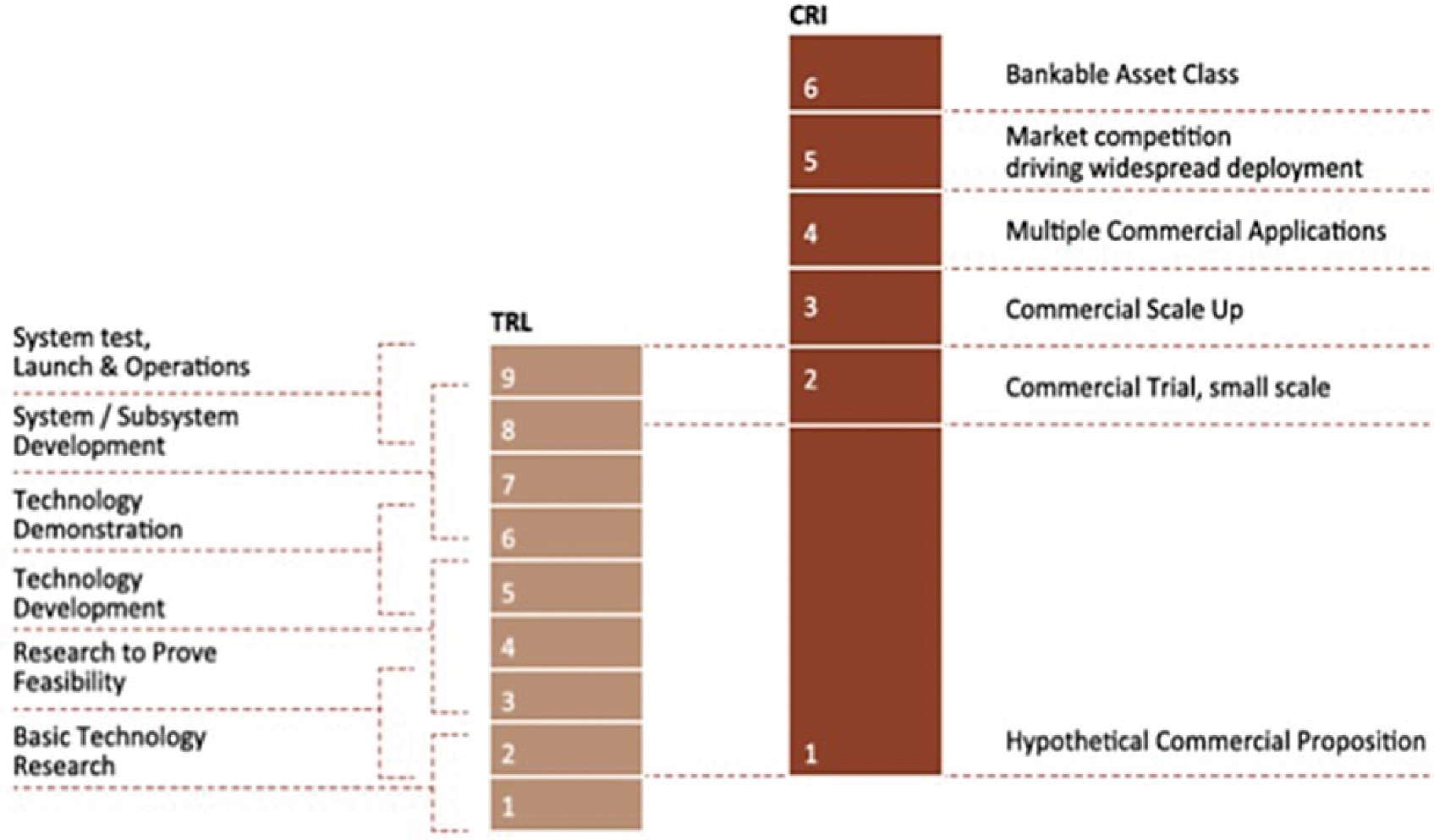
Figure 8.1. Technology Readiness level (TRL) and the Commercial Readiness Index (CRI)
Projects must address one or more of the research and innovation activities described by the CCUS Roadmap to 2030 of the SET Plan IWG953 and the Mission Innovation Research Priorities54, with special emphasis on the following topics:
• CO2 capture from energy intensive or heavy industry sectors (waste to energy, cement, iron/steel, aluminium, other metals, etc.), power generation, maritime transport, and hydrogen production from natural gas.
• Advancing lower cost CO2 capture technologies that can effectively remove 95–100% of CO2 from flue gases with dilute CO2 concentrations.
• CO2 transport and storage infrastructure (pipelines, ships and other non-pipeline transport, intermodal options, monitoring and metering within CO2 networks, temporary storage, well integrity and well technology).
• Developing commercial CO2 storage sites effective sites, including elements that are needed for screening and characterisation, safe management, and low-cost effective monitoring.
• Enabling CCUS technologies, including the CO2 capture, conversion, and utilisation value chain.
• Negative emission technologies: carbon dioxide removal (CDR), reactive capture (RC), direct air capture (DAC), biomass with CCS (BECCS), and biomass carbon removal and storage (BiCRS).
Proposals must also address at least one of the following topics:
• Improvement of the cost-efficiency and energy-efficiency along the value chain (scale-up, storage at basin-scale including hubs, by digital tools, or by effective collaboration among the stakeholders etc.).
• Faster scale-up of CCU/CCS technologies at lower risk (by design, demonstration, development of legal framework, measures to strengthen the innovation system, knowledge sharing from full-scale operations, integration into the energy system, etc.).
• Development of lower cost solutions for efficient CO2 capture from hydrogen produced using natural gas, and new technologies for processing, shipping, transport, and storage of hydrogen.
• Design and manufacturing of new materials that can make CCU/CCS more affordable.
• Development of CCU/CCS market and business case.
• Assessments of risks to the environment and human health throughout the CCU/CCS life cycle and development of mitigation approaches and strategies.
• Development of circular economy strategies to reduce CO2 footprint throughout the CCU/CCS life cycle.
• Development of best practices and strategies for educating the general public about the benefits and risks of CCU/CCS.
• Development of strategies for engagement between CCU/CCS project developers and communities that lead to projects with mutual benefits and social acceptance.
• Development of a robust life-cycle assessment (LCA) and techno-economic analysis (TEA) for full CCU/CCS value chains and life cycles. Alternatively, development of a more complex sustainability assessment addressing social sciences and humanities (SSH) disciplines (e.g., sociology, social psychology and economics).
• Develop net negative CO2 emission solutions, such as direct air carbon capture and storage (DACCS) or Biomass Carbon Removal and Storage (BiCRS).
• Development of technologies and approaches for monitoring and managing basin-wide effects and impacts from multiple CCS projects within a basin.
Access to top class research infrastructure is key for reaching the objectives of this call. Project proposals should, if relevant, seek to maximise synergies with existing infrastructures, such as, for example ECCSEL55, members of the International Test Centre Network56 , the Alberta Carbon Conversion Centre (ACCTC57) or similar world class infrastructures.
Funded projects must advance the state-of-the art for CCU/CCS technologies and contribute new knowledge and competence that bring CCU/CCS closer to commercialisation by bridging the gap between technology development and its implementation by the industry.
Funded projects are expected to lead to at least one of the following:
• CO2 capture on an industrial scale by early 2030s.
• CO2 storage on megaton scale by early 2030s and gigaton scale by 2050.
• Pave way for deployment of large-scale infrastructure for CO2 capture from multiple sources, cross-border CO2 transport, and CO2 storage of ten million tons of CO2 annually by mid 2030s.
• Be a bridge to implementation of CO2 utilisation projects on an industrial scale by early 2030s that will have a sustainable and significant effect on reducing CO2 emissions.
• Pave way for net zero or negative CO2 emission technologies implemented on an industrial scale by mid 2030s.
|
Target RDI approaches/TRLs |
Project end: TRL 5 or higher Activities at lower TRLs may be included if they contribute to the higher TRL goal of the overall project. The Social Readiness Level (SRL) is also relevant to consider when evaluating opportunities for deployment and commercialisation. |
|
Project consortia partners |
• Higher education establishments • Research organisations • Private for-profit companies • Public bodies (local/regional governments) • Non-profit organisations |
|
Project budget |
See Section 4.3. |
|
Call Module requirements |
Industrial involvement in research and innovation activities |
|
Contact |
TRI3 |
This Call Module, following the challenge of the CETPartnership TRI358 , aims to accelerate the substitution of fossil fuels by facilitating the development and implementation of technologies for effective and efficient production, distribution, storage and end-use of hydrogen (blue and green)59, and renewable and advanced fuels60, including aspects related to security of supply, through support to research and innovation activities.
Hydrogen plays a key role in the clean energy transition, since it can be used for many essential chemical processes, as a fuel to power gas turbines and fuel cells, and as an input to produce electro fuels (e-fuels)61, biofuels and other hydrogen carriers like ammonia. Further development of hydrogen technologies is necessary to facilitate process integration and cost reduction.
Hydrogen can be produced from fossil fuels, i.e. natural gas with CCS (so-called blue hydrogen), or from biomass or renewable electricity (so-called green hydrogen). High purity (>99.9%) of hydrogen can be achieved by water electrolysis, by natural gas reforming, and by gasification of biomass and other solid feedstock (coal, waste plastics and municipal solid waste) through further hydrogen separation or purification. Integration of hydrogen production with CCS offers significant opportunities for cost reduction and needs to be implemented in a large scale. Hydrogen production with bioCCS can be done through anaerobic digestion, fermentation, gasification or pyrolysis and is attractive, as it would deliver negative emissions, although it would compete with other sources of demand for biomass.
Renewable fuels are environmentally friendly energy carriers and can offer important, flexible and cost-effective options required to achieve a sustainable, net-zero energy system, particularly when they are produced with surplus electric power (i.e. power-to-X) and CCUS. Example of renewable fuels are thermo-, photo- and electrochemical solar fuels, as well as advanced biofuels from sustainable biomass62. The provision of such renewable fuels is crucial for sectors that are difficult to electrify: the industrial, residential and especially transport sectors, with heavy-duty road transport, shipping, and aviation.
The use of renewable ammonia is expected to increase for both fertiliser and e-fuels. The advantage of renewable ammonia is that its production does not require a CO₂ source, it is easy to transport, and it is an established commodity, although it is difficult to handle on board when it is used as a shipping fuel. Thus, ammonia can be produced at remote locations with access to cheap renewable electricity but requires specific safety conditions for handling and using as transport fuel.
Advanced fuels with reduced emissions are expected to impact aviation and shipping in all countries, most likely as sustainable fuels for aviation and as ammonia or methanol for marine applications. For short distance ferries, batteries or hydrogen will be an option.
The Call Module supports projects to develop and implement technologies for effective and efficient production, distribution, storage and end-use of hydrogen (blue and green) and renewable and advanced fuels. To accelerate the time to market for the technologies, the Call Module seeks innovative projects, which have industrial involvement and can support new or already existing pilot or demonstration facilities. The Call Module also addresses environmental, societal and economic challenges requiring solutions. It means that proposals must illustrate how the projects will help accelerate the time to develop and implement environmentally friendly, resource- and cost-efficient technologies to produce, distribute, store and use hydrogen and renewable fuels along the whole value chain.
The Call Module is in line with the SET Plan priorities and its new directions63 and strives to complement the Horizon Europe work programmes and other funding opportunities including the national and regional programmes of the Funding Organisations in the CETPartnership. It is also in line with the priorities set by the Mission Innovation Clean Hydrogen mission and international cooperation is stimulated.
Projects must address one or more of the following research and innovation topics described by the SET Plan IWG on Renewable Fuels and bioenergy for Sustainable Transport64 , the ERA pilot on Green Hydrogen65 and the Research Priorities (Houston 2017)66:
• Hydrogen and renewable fuel production using new and improved processes
• Reliable and low-cost production technologies of new and advanced fuels
• Hydrogen and renewable fuel distribution using new and adapted infrastructures, and in the case of hydrogen considering different types of carriers
• Secure and safe fuel storage, in the case of hydrogen including geological storage, and using solid and liquid carriers
• New and adapted end-use technologies, including the industrial, residential and transport (e.g. heavy-duty vehicles, off-road and agricultural machinery, and including aviation and maritime) sectors
Projects are also required to consider one or several of cross-cutting dimensions, such as:
• Consumer attitudes, risk perception and levers which could influence technology acceptance
• Life cycle, techno-economic and environmental impact analyses
• Barriers, opportunities, and solutions in scaling up and market uptake
• System analysis and process integration considering continuity/intermittence
• Infrastructure and distribution aspects, including pipelines considering reuse and cost competitive materials
• Monitoring and safety aspects
• Digitalisation
Projects are expected to have a significant impact on accelerating the development and implementation of hydrogen, advanced and renewable fuels technologies and provide results that will lead to significant CO2 reduction by 2030. Projects must contribute to new knowledge and new competences for cost-effective and cleaner technological solutions to substitute fossil fuels.
|
Target RDI approaches/TRLs |
Project start: TRL 3 or higher Project end: TRL 4 or higher All projects must have a valid proof-of-concept before starting, for all Work Packages. |
|
Project Consortium Partners |
Partners from a broad geographic spectrum. • Private for-profit companies (small, middle-sized, and large companies) • Research organisations • Secondary and higher education establishments • Non-profit organisations |
|
Project budget |
Applied funding from the Call in the range of (but not limited to) EUR 1.5–5 million. |
|
Call Module requirements |
Industrial involvement in project activities. |
|
Contact |
TRI4 |
This Call Module, following the challenge of the CETPartnership TRI4 67, 68, aims to contribute to efficient zero-emission heating and cooling solutions”, as formulated in the CETPartnership SRIA.
The overarching goals are to provide enhanced and improved heating and cooling technologies and systems for all major parts or climate zones of Europe around 2030 and to enable 100% climate-neutral heating and cooling by 2050. The energy crisis caused by the war in Ukraine has clearly shown that Europe needs to repower and rethink its heating and cooling policy (ref. REPowerEU69), and the revised Renewable Energy Directive70 (RED III) increases focus on the heating transition. Better, cheaper, easier applicable and climate-neutral heating and cooling technologies are needed to provide thermal comfort while phasing out fossil fuel-fired dependence.
The Call Module supports 1. pilot and demo projects and 2. applied research and development projects that will develop technologies, methods, knowledge or innovations for heating and cooling:
1. Pilot and demo projects (achieving TRL 7, 8 or 9 after project completion) must be realised in real-life operational environments and address at least one of the following compared to state-of-the-art today:
○ cost reduction
○ increase in competitive market opportunities
○ increase in environmental protection
In addition, projects could address innovations impacting societal acceptability, safety, and/or circularity.
2. Applied research and development projects (achieving TRL 4, 5 or 6 after project completion) must have a valid proof-of-concept before starting, typically develop the innovation in detail in a laboratory or similar setting, and address at least one of the following compared to state-of-the-art today:
○ significant cost reduction
○ significant increase in competitive market opportunities
○ significant increase in environmental protection
○ better tools and methodologies
In addition, projects could address innovations significantly impacting societal acceptability, knowledge development, experience sharing, safety, and/or circularity.
Proposals are expected to explain their contribution to the objectives of the Call Module and quantify this contribution to the extent that this is possible.
Proposals are encouraged to consider cross-cutting issues such as economic modelling, social aspects, environmental concerns, etc. However, applicants must ensure that their proposed work meets national funding instruments. Proposals that exclusively consider research on sustainability or social acceptance cannot be funded.
This Call Module complements various Call modules in the Call. In case of uncertainty about where to best propose your project, consult with relevant Funding Organisations or TRIs.
• PV/T is covered in CM2024-03.
• Concentrated solar power is covered in CM2024-03, while concentrated solar for thermal applications in the industry is covered by this Call module (CM2023-06).
• Geothermal energy technologies are covered in Call module CM2024-07.
• Thermal storage technologies to be integrated into the built environment or industrial applications are covered in this Call module, whereas thermal storage technologies with a focus on subsurface utilisation are referred to in Call module CM2024-07.
• Projects focusing on integrating heating and cooling in regional or industrial energy systems or the built environment are referred to CM2024-08, 09, and 10, respectively.
Projects should address one or more of the following topics to develop a secure, sustainable, competitive and affordable climate-neutral heating and cooling supply:
Heat and cold sources, Innovative approaches for solar thermal, local and regional excess resources, renewable cooling technologies, concentrated solar for (industrial) thermal energy purposes, ambient heat and cold from the air, surface water, sewers etc., shallow geothermal71 biomass and organic waste and excess heat from industry.
Thermal storage, new storage technologies and storage-related innovations aiming at, e.g. small-scale hour-to-day thermal storage in industry and the built environment, smart systems balancing supply and demand, excess power to thermal energy, seasonal thermal storage integrated into a building or DHC (District heating and cooling) system.
Heating and cooling networks, conversion, and integration, including but not limited to innovations for more cost-efficient heating and/or cooling networks and their operation, retrofit of heating and/or cooling networks, conversion technologies such as heat pumping technologies, in the built environment and industry.
End-use systems: innovative distribution systems within the end-user system (typically a building or a home) are relevant to the heating and/or cooling system because the temperature level matters.
This Call Module is expected to encompass projects both relating to the built environment or industrial end-users. For the built environment, the projects may focus on district heating and/or cooling systems and other collective systems, but also on individual solutions.
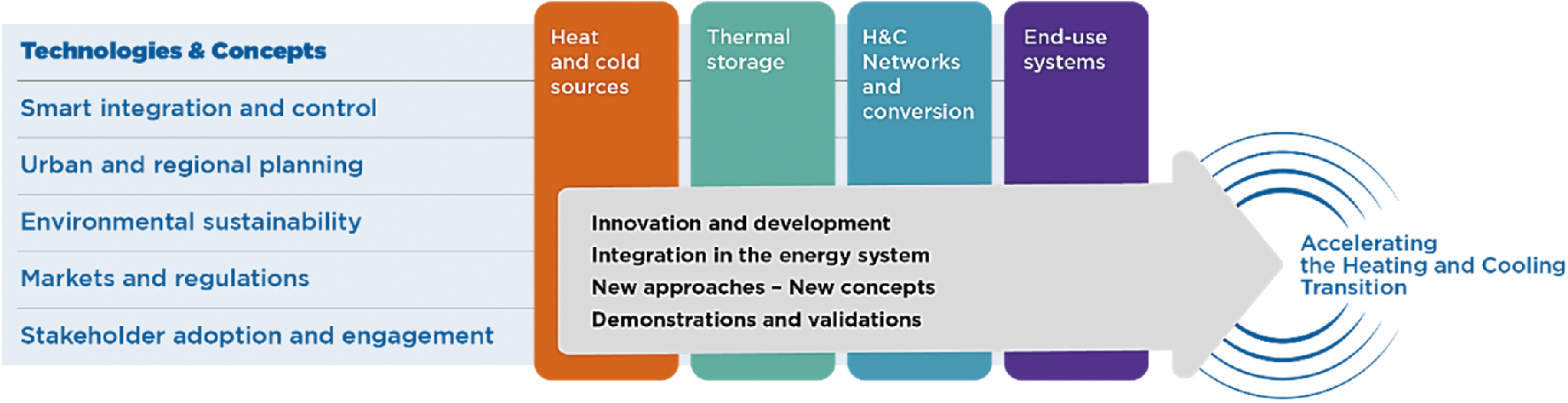
Figure 8.2. Heating and cooling technologies and concepts
The vertical bars in Figure 8.2 indicate the technological scope. The horizontal bars indicate the dimensions which successful projects could address. The arrow in the figure symbolises the forward and future-oriented approach that builds on these various aspects.
Successful projects in the Call Module should address technologies or concepts, and should contribute to one or more relevant cross-cutting, non-technological dimensions whenever appropriate. Figure. 8.2 highlights the central role of ‘Technologies and concepts’, and also indicates the cross-cutting, non-technological themes in the horizontal bars. A close interconnection between sources and their temperature level, conversion and distribution technologies, flexibility for the energy system and end-user requirements should be sought for heating and thermal storage operations. Projects should demonstrate their market relevance and potential impact.
Proposals are encouraged to describe how the project will support the energy transition with a view on circularity, resource efficiency and recovery, recycling, and substitution of critical raw materials. Projects that aim at technologies with little or no critical raw materials72 may identify this as a project quality in their project plan.
Applicants must ensure that their proposed work agrees with the funding instrument of their relevant Funding Organisation – consult Annex C to the Call.
Projects funded in this Call Module should improve business cases and/or increase the competitive market opportunities and environmental protection, compared to state-of-the-art today, through research and innovation. The projects' results must emphasise market-driven innovation activities, aimed to be ready for large-scale implementation around 2030. However, projects may include lower TRLs depending on national funding rules.
Project outcomes are expected to help accelerate the time to market of secure, sustainable, competitive, affordable and climate-neutral heating and/or cooling solutions. Projects can also focus on bringing upcoming technologies to a level of validation in a relevant environment or integrating their activities into already viable and ongoing demonstration or piloting projects.
|
Target RDI approaches/TRLs |
Project start: TRL 3 or higher Project end: TRL 4 or higher All projects must have a valid proof-of-concept before starting, for all Work Packages. |
|
Project Consortium Partners |
Partners from a broad geographic spectrum. • Private for-profit companies (small, middle-sized, and large companies) • Research organisations • Secondary and higher education establishments • Non-profit organisations |
|
Project budget |
Applied funding from the Call in the range of (but not limited to) EUR 1.5–5 million |
|
Call Module requirements |
Industrial involvement in project activities |
|
Contact |
TRI4 |
This Call Module, following the challenges of the CETPartnership TRI4 73 and TRI2 74, addresses various geothermal energy technologies and aims to contribute to Challenges zero emission heating and cooling solutions (Challenge 4) and zero emission power technologies (Challenge 2) described in the CETPartnership SRIA 75.
This Call module targets research, development and innovation in how geothermal energy is developed, supplied and integrated into Europe’s future energy system. The scope includes:
• Geothermal energy for heating and cooling.
• Geothermal energy for power generation.
• Underground thermal energy storage (UTES).
• Geothermal energy with the co-production of minerals.
The Call Module supports 1. pilot and demo projects and 2. applied research and development projects that will develop technologies, methods, knowledge or innovations for geothermal energy:
1. Pilot and demo projects (achieving TRL7, 8 or 9 after project completion) must be realised in real-life operation environments and enable at least one of the following compared to state-of-the-art today:
○ cost reduction
○ increase in competitive market opportunities
○ increase in environmental protection
In addition, projects could address innovations significantly impacting societal acceptability, safety, and/or circularity.
2. Applied research and development projects (achieving TRL4, 5 or 6 after project completion) must have a valid proof-of-concept before starting, typically work in a laboratory or similar setting and address at least one of the following compared to state-of-the-art today:
○ ° significant cost reduction
○ ° significant increase in competitive market opportunities
○ ° significant increase in environmental protection and/or reduction of risks associated with the development or operation of a geothermal installation
○ ° better tools and methodologies
In addition, project output could significantly impact societal acceptability, knowledge development, experience sharing, safety, and/or circularity.
The Call Module considers all geological depth levels.
Proposals are expected to explain their contribution to the objectives of this Call Module and quantify this contribution to the extent that this is possible.
Proposals are encouraged to consider cross-cutting issues such as economic modelling, social aspects, environmental concerns, etc. However, applicants must ensure that their proposed work meets national funding rules. Proposals that exclusively consider research on sustainability or social acceptance cannot be funded.
This Call module complements other Call Modules in this Call. In case of uncertainty about where to best propose your project, consult with relevant Funding Organisations or TRIs.
• Thermal storage focusing on geological storage is covered in this Call Module (CM2024-07), while CM2024-06 focuses more broadly on thermal storage technologies.
• Projects focusing on integrating geothermal energy and thermal storage in regional or industrial energy systems or the built environment are referred to CM2024-08, 09, and 10, respectively.
Successful projects should address one or more of the three topics shown in Figure 8.3, which cover all stages in the development cycle of a secure, sustainable, competitive, and affordable geothermal installation.
Identifying and assessing geothermal and underground thermal energy storage (UTES) resources, reserves and reservoirs: Innovative and improved prospecting and exploration techniques and modelling methods to identify and assess geothermal resources at all depth levels.
Geothermal & underground thermal energy storage (UTES) resource development: New drilling and well completion technologies, reservoir optimisation, stimulation and innovative systems to manage induced seismicity.
Geothermal operation and integration into the energy system: Innovative concepts with geothermal energy as part of the energy system; geothermal reservoirs for heating, cooling and storage; innovative power cycles; novel revenue streams from additional side benefits from geothermal utilisation (such as mineral extraction); innovative applications in the built environment and industry. For operation, novel approaches to improve well injectivity and reliability and availability of injection operations; novel equipment, materials and methods for lowering and optimising operating expenses; disruptive smart reservoir management technologies; and innovative approaches to managing induced seismicity during production.
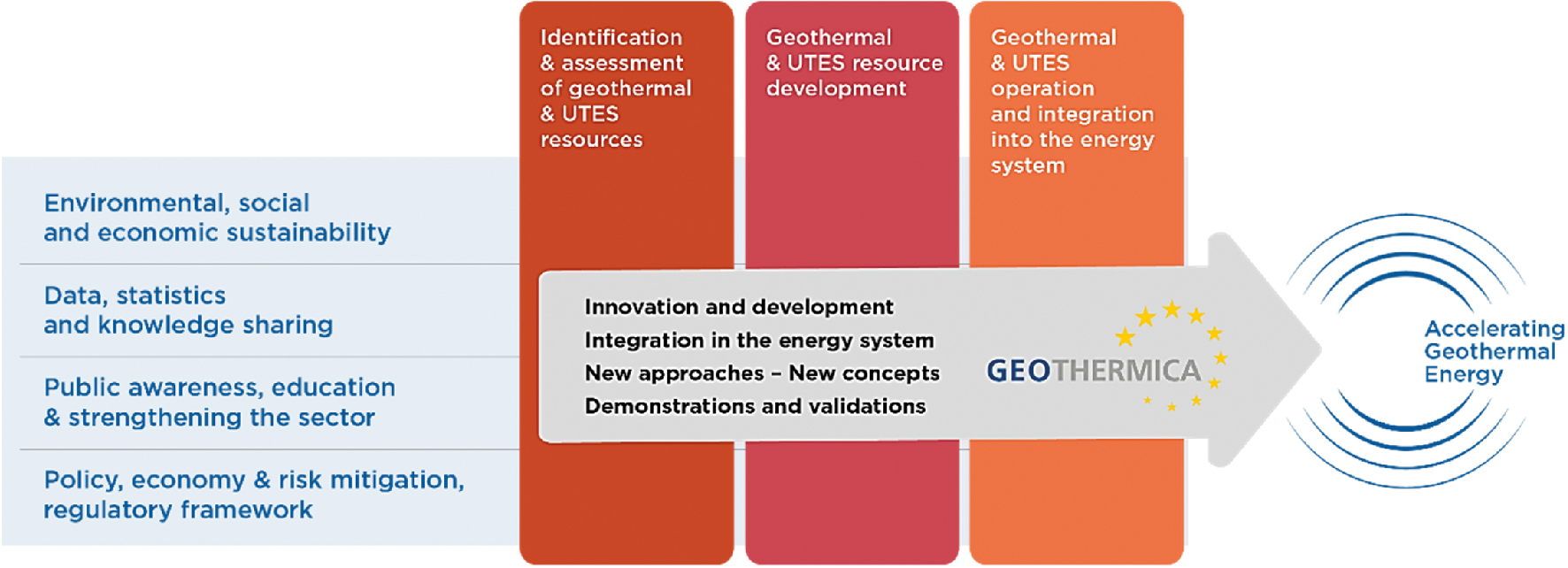
Figure 8.3. Geothermal energy technologies
The vertical bars in Figure 8.3 indicate the technological scope. The horizontal bars indicate the cross-cutting, non-technological dimensions that are relevant for geothermal energy technologies: sustainability and safety, knowledge sharing, enhancing public awareness and the sector's strength, and activities related to policies and regulations (Figure 8.3).
Successful projects in this Call Module should contribute to one or more relevant cross-cutting, non-technological dimensions. A close interconnection between sources and their temperature level, conversion and distribution technologies, flexibility for the energy system and end-user requirements should be sought for heating and thermal storage operations. Projects should demonstrate their market relevance and potential impact.
Proposals are encouraged to describe how the project will support the energy transition with a view on circularity, resource efficiency and recovery, recycling, and substitution of critical raw materials. Projects that aim at technologies with little or no critical raw materials76 may identify this as a project quality in their project plan.
Project Consortium Partners must ensure that their proposed work agrees with the funding instrument of their relevant Funding Organisation – consult Annex C.
Projects funded in this Call Module should improve business cases and/or increase the competitive market opportunities and/or improve tools and methodologies and/or environmental protection, social acceptability, strategic knowledge, safety and/or circularity for geothermal energy. The projects' results must emphasise market-driven innovation activities, aimed to be ready for large-scale implementation around 2030. However, projects may include lower TRLs depending on national funding rules.
Project outcomes are expected to help accelerate and implement geothermal energy solutions. Projects can also focus on bringing upcoming technologies to a level of validation in a relevant environment or integrating their activities into already viable and ongoing demonstration or piloting projects.
|
Target RDI approaches/TRLs |
Project start: TRL 4–6 Project end: TRL 7 or higher |
|
Project Consortium Partners |
Participation of public and private organisations or networks and clusters or existing initiatives is encouraged. • Private for-profit companies • Public bodies (municipalities, local and regional governments) • Innovation clusters • Infrastructure providers and operators • Interregional and transnational innovation ecosystems such as • Cluster networks • Start-ups networks • Secondary and higher education establishments • Research organisations |
|
Project budget |
Applied funding from the Call in the range of (but not limited to) EUR 1.5–5 million |
|
Call Module requirements |
None |
|
Contact |
TRI5 |
This Call Module, following the challenge of the CETPartnership TRI5 77, aims to contribute to the regional challenges of the energy transition by supporting need owners78 in a regional/geographical context to develop model system solutions that can be transferred to other regions. These solutions should provide opportunities and synergies for active participation in the energy system and have a high potential for implementation. Solutions should be replicable, i.e. there should be a high probability that the solution can be replicated in similar environments across Europe. As the impact of the projects is central for this Call Module, it is preferable if they target regions and sectors with high potential for improvement.
This Call Module supports projects to demonstrate how local stakeholders, regulations and markets enable various technologies on different levels to work together in an integrated system to address the regional challenges of the energy transition.
It follows the implementation of the SET Plan Action 4: Increase the resilience and security of the energy system79 . Funded projects in this Call Module should contribute to this by addressing specific regional aspects that can be transferred to other European regions, following Challenge 5 in the CETPartnership SRIA80.
Therefore, proposals must define measurable Key Performance Indicators (KPIs) to prove and quantify their approach. This can be done, for example, by referring to existing local/regional climate, energy and implementation plans or roadmaps and describing their contribution to these plans.
The following are some examples of regional challenges for the energy transition, even though applicants can also choose their own challenge covering a relevant solution approach.
• Increase the share of renewables among all energy sectors and / or the holistic energy efficiency in the region by smart solutions
• Increase sustainability and circularity along the whole value chain of renewables
• Increase the seasonal shift of renewable energy in the targeted region
• Increase the hosting capacity of the system to reduce energy dependence and improve the added value in the region
• Increase resilience in the regional energy system
• Demonstrate and validate solutions to overcome energy poverty and contribute to a just energy transition
• Enable citizens, need-owners and other stakeholders to take part in the related value chains
As one of the Call Modules for systems integration, funded projects should have focus on appropriate systems approaches in a specific local and regional context, rather than primarily on the technological development of individual solutions, which should then only be one aspect of a wider framework. The project's starting point will ideally build on existing results and initiatives and combine them together into an integrated systems approach that offers a solution for a well-defined need in the region involved in the project. Addressing the needs of a region requires the involvement of regional or locally anchored transition ecosystems with the need owners of the region at the centre. Projects funded in this Call Module are expected to have greater relevance to the energy system as they focus on demonstration rather than development. Projects shall drive innovation, lead to findings and create evidence-based knowledge in the three dimensions of innovation described in the Integrative Innovation Model (see Annex B).
The Call Module supports a portfolio of projects dealing with solutions for different regional characteristics and bring them together on a European level. The characteristic can be freely described by the consortium, according to their perception of what is relevant in their specific geographical context e.g. industrial or agricultural setting, wind or solar dominated system, and may or may not include geographical terrain (e.g. plains or mountain valleys), specific infrastructure such as heating grid, etc.
Examples of possible starting points of potential projects:
• Refer to existing local/regional climate, energy and implementation plans or roadmaps
• In order to increase the regional relevance of the projects, they should build on the knowledge, experience and networks developed in the framework of ongoing or recently completed projects
• Use of flexibility of locally and regionally available energy sources for meeting the individual local and regional requirements in terms of generation, demand and goals
• Increase participation of regional need owning private and public companies and utilities, institutions, and people, intending to implement innovative solutions in order to take an active role in the future energy supply and energy system (producing energy, providing flexibility, etc.)
• Design the structure around integrated approaches, involving cross-sectoral and interdisciplinary research and innovation.
This Call Module does not support the singular technological development of individual solutions, although technological development can be part of the project. To achieve better evaluation results, applications should build on ongoing or recently completed demonstration projects, and make use of existing test infrastructure, knowledge, collaboration of key demos, transfer of results, openness, etc. We encourage consortia to further develop already existing regional initiatives by adding either new aspects/objectives or new partners.
For this reason, we recommend that applicants carefully check the national requirements for consortia of the respective funding organisations. This can be decisive for the composition of applicant consortia and their eligibility for funding.
In order to meet the challenges on the regional level of the energy transition, proposals should cover aspects like listed below.
Examples of specific regional aspects covered by the projects
• Develop integrated regional and local energy systems that enable a secure, resilient, and fossil free regional energy supply, up to and beyond 100% in the dynamic local or regional supply
• Include regional infrastructures as well as the user and consumer structures driven by local municipalities, communities, industry, and stakeholders from different sectors
• Develop a replicable model for a region that can either be dominated by large urban systems, the integration of municipalities or smart energy communities, or have a focus on the integration of, for example industry, agriculture or the tourism sector
• Leverage synergies and utilise flexibilities in locally and regionally available energy sources (including aspects of heating, cooling, electricity and local fuels)
• Involve cross-sectoral integration of multiple (economic) sectors like transport, industry, trade, etc.
• Coordinate and link research activities with e.g. living labs to facilitate the development and field-testing of prototypes
Examples for contributions to a secure and resilient European energy system
• Contribute to inter-regional exchange of energy
• Demonstrate the ability of providing management of flexibility by cross-energy vector coupling, and by efficiently integrating different energy carriers as a blueprint for other regions in Europe
• Work on harmonised business processes for solutions by developing interoperable solutions
• Development of regional climate strategies and Key Performance Indicators (KPI’s) for climate neutral energy systems that can guide policy makers and actors when adopting market design on European level
Expectations for regions through transnational collaboration
• Building transnational projects will contribute to a deeper understanding of the different infrastructural and socio-economic contexts and provide the opportunity to involve regional actors with sufficient capacity to take up the results of the funded projects
• Knowledge transfer and the transfer of solutions to other regions with similar conditions, gain in larger markets for solution providers and more efficient use of resources and will speed up the co-transition of regional energy systems
• The benefit for addressing also cross-cutting issues in a transnational approach is that good practice and learnings can be shared across Europe to make the transition pathways robust across Europe
Projects shall drive innovation, lead to findings and create evidence-based knowledge in the “Three Dimensions of Innovation for System Solutions” (see Annex B) and by that achieve impacts in the three dimensions. Projects shall use the three dimensions of innovation as a framework for the description of their expected outcomes. Projects funded in this call module are not intended to cover only the technology level. For integrated solutions, we expect that in the best case all layers are covered within the project.
The projects must clearly describe how the results will subsequently be utilised to have an impact in the regions concerned or in other, similar regions. The chances of achieving this impact must be assessed, taking into consideration that projects based on previous or ongoing transnational projects have a better chance to roll out solutions at the regional level as well as to transfer solutions to other regions.
Furthermore, it must be specified which stakeholders will implement the actions. If these are not part of the consortium, it must be explained how they are to be reached. Proposals should have integrated the local or regional public authorities as partners or via Letter of Intent (LoI).
Projects should reflect the needs of a region of interest and cover as many local target groups as possible. Furthermore, the consortium should be able to implement the outlined exploitation plan successfully and independently after the end of the project.
For proposals that intend to work with former ERA-Net Projects, Interreg transnational Projects, Demonstration, Real-Lab or Living-Lab approach, it is recommended to consider the JPP SES Living Lab and Test Bed Network81 when looking for partners. For Matchmaking opportunities please register at CETPartnership’s B2Match82 site.
For proposals that intend to work with data service solutions, it is recommended to consider the JPP SES network of Digital Platform Providers83 when looking for partners.
To help in developing proposals building on suitable transnational projects, the keep.eu84 database can be used.
Synergies with the projects supported under the Horizon Europe call HORIZON-CL5-2023-D3-01-01: Renewable Energy Valleys to increase energy security while accelerating the green transition in Europe are strongly recommended.
Dimensions of innovation
Projects shall drive innovation, lead to findings and create evidence-based knowledge in the three dimensions of innovation described in Annex B. Individual proposals have to address aspects at least in 2 of the three dimensions. In order to realise this, they are encouraged to consider the project design options described in Annex B. Here some examples, how different aspects connect with the three dimensions.
|
Target RDI approaches/TRLs |
Project start: TRL 3 or higher Project end: TRL 8 or lower |
|
Project Consortium Partners |
• Secondary and higher education establishments (social science, humanities, technology, economic and science disciplines) • Research organisations • Private for-profit companies (such as industrial companies, suppliers of technology and services) • Public bodies (may include municipal companies) |
|
Project budget |
Applied funding from the Call in the range of (but not limited to) EUR 1.5–5 million |
|
Call Module requirements |
At least one industrial end-user must participate in the Project Consortium |
|
Contact |
TRI6 |
This Call Module, following the challenge of CETPartnership TRI685 , aims to develop and demonstrate a set of technical solutions for integrated industrial energy systems that enables efficient carbon-neutral industrial production sites and takes industrial energy systems into development as part of the entire energy system. It focuses specifically on integrated solutions across industries, across energy sectors and across public and private sectors86 .
Special emphasis in the Call Module is placed on solutions for system- and process-level integrations for efficient industrial power, heating, and cooling. The main industries that are considered include iron & steel, cement, pulp & paper, chemical, and food and beverage industries.
The Call Module will contribute to an innovation-based growth of the European economy and the European energy transition by supporting projects that accelerate the development of clean technologies by capitalising on synergies between programmes, both nationally and internationally, as well as by addressing key cross-cutting issues, lead to faster market uptake, upscaling, and increase EU’s technological independence and global competitiveness87. Projects are expected to increase their Technology Readiness Level (TRL) up to TRL 8 throughout the duration of the project so that they move closer to commercial readiness.
The Call Module will address topics such as sustainability, circularity, environmental impact, integration with local and regional energy systems, energy storage, CCUS and digitalisation and Artificial Intelligence. There are synergies with TRI388 and TRI4 89 within the CETPartnership.
In the future, electricity will play a significant role as a “primary” energy source for the industries, and new innovations are needed to accomplish the transformation of industrial electrification. Further, a large share of the industrial energy supply shall be based on renewable sources. Where carbon emissions cannot be avoided, CO2 shall be captured, utilised for production of preferably long-lifetime products, or permanently stored. To produce negative emissions, capture, utilisation in long-lifetime products and storage of biogenic CO2 from the exhaust gases, i.e., bioCCUS, is an option.
While the energy transition of industries advances, industrial energy systems shall integrate with local, regional, and national heat and power networks and systems. Moreover, the energy and industrial systems shall together integrate as renewable power will also be used to produce hydrogen, which can be utilised as energy carrier or raw materials in industrial processes or with CO2 utilisation (CCU) to synthesise electro products for the replacement of fossil-based fuels and chemicals.
The integration of industrial energy systems with local, regional, or trans-regional energy systems supports national and European goals for carbon neutrality. As research, development, and innovation activities (RDI) for industrial carbon-neutrality are already funded at a national level in many countries, a broader experience and knowledge sharing at an international level will be an advantage. Transnational co-operation will boost efficient technology transfer and leverage complementarities for building competitive European value chains.
This Call Module is in line with the REPowerEU Plan 90 and has a focus on the need for reducing energy consumption, substituting fossil fuels, and accelerating Europe’s clean energy transition to bring down emissions and dependencies91. Therefore, the Call Module welcomes proposals for research, development and innovation projects that address one or more of the following challenges:
Challenge 1 – Reducing emissions from the industrial energy system
This challenge is addressed to projects that will contribute to reducing the industry's process-related emissions, in particular emissions to air. The objective is to support technological leaps and industry's ambitions to change to more sustainable production by integrated industrial energy systems.
Process-related emissions refer to emissions directly from industrial processes according to environmental reporting as well as to emissions that occur during the combustion of residual products from fossil raw materials in production processes, such as flaring of industrial residual gases. Emissions with an indirect connection to industrial processes are, for example, combustion emissions from on-site power and heat production.
Projects that focus on reduction of indirect emissions from industry can only be supported in cases where a reduction in direct emissions from processes is also included in the project or when they involve a technological leap for the industry. Therefore, projects that only involve conventional fuel changes will not be funded.
Challenge 2 – Integrating energy and resource efficient industrial energy systems
This challenge is addressed to projects that will contribute to increasing knowledge and develop new and innovative processes and system integrations that will improve sector coupling in an energy and resource efficient way between industrial energy systems and the energy system in general. System-level integrations across sectoral boundaries will provide support for a more flexible and robust European energy system based on a high degree of variable renewable energy sources.
The projects in this area can include the role of industry in a larger perspective, i.e., integration between processes within an industrial site, between different industries or integration between an industrial site and the surrounding local or regional energy system, to create an energy- and resource-efficient system from a holistic perspective. The area thus comprises industrial and cross-sectoral symbiosis, including new industrial and system-integrated structures, i.e., projects that study physical exchanges of energy, material or residual streams in the form of, for example, excess heating or cooling, operational and municipal wastes, and residual materials and flows. This area can thus help create circular economy solutions for industry and local communities and regions.
Challenge 3 – Removing carbon emissions from industrial energy systems
This challenge is addressed to projects that will contribute to removing industrial greenhouse gases from the carbon cycle through emission separation combined with long lifetime utilisation or long-term storage of carbon. Special emphasis is placed on greenhouse gases of biogenic origin and on CO2 removed from the atmosphere to advance development of carbon sinks. The challenge is also addressed to projects that enable industries to implement bioCCU to produce chemicals from their biological CO2 emissions, or such energy carriers that would serve as energy storages and support balancing of the renewable-based future energy system. CCU production pathways might involve bioprocesses, e.g. with algae, or synthesis processes with clean hydrogen. Implementation of CCU, might open new business opportunities beyond today’s industrial production.
Following are examples of topics that proposals could cover to meet the above challenges:
Challenge 1 – Reducing emissions from the industrial energy system
• Industrial electrification
• Energy and resource efficient process technologies
• Solar CSP/STE for reducing emissions from heat demand in industries
Challenge 2 – Integrating energy and resource efficient industrial energy systems
• Solutions for advanced industrial sector coupling
• Solar CSP /STE for coupling electricity and heat in industries
• Recovery of excess heat and upgrade (e.g. with heat pump) for reuse within or outside the industrial site
Challenge 3 – Removing carbon emissions from industrial energy systems
• Industrial bioCCUS
• CO2 logistics supporting value chain development for CCU
• Clean hydrogen for energy-intensive industrial applications
Cross-cutting issues:
• Circular industry, industrial symbioses and infrastructure
• Digitalisation and Artificial Intelligence
This Call Module complements other Call Modules in the Call:
• Concentrated solar for thermal applications in the industry is covered by CM2024-06, while it is covered by this Call Module if linked to industry application and energy system integration.
• CCU/S technology is covered by CM2024-04, while it is covered by this Call Module if linked to industrial processes, industry symbiosis and energy system integration.
In case of uncertainty about where to best propose your project, consult with relevant Funding Organisations or TRIs.
The expected impact from projects funded in the Call Module are that they contribute to making European industry a part of a climate-neutral economy. Funded projects will strive to:
• increase European industry’s competitiveness.
• support the development and pre-commercialisation of future disruptive technologies.
• support a wider use of renewable energy sources as well as emission control technologies for reducing industrial emissions.
• integrate renewable energy into the industrial energy system to aid increased industrial electrification.
• Increase resource -and energy efficiency of industrial energy systems through novel process and system integrations.
• increase circularity through, for example CCU or the reuse of industrial excess heat.
• Increase the use of bioCCUS in industrial processes.
• develop sustainable bioenergy and biofuels.
• develop and integrate hydrogen-based technologies into the industrial energy system and infrastructures.
Projects that are funded are expected to provide solutions to the challenges in the call module through new knowledge, skills, and technologies. The funded projects will also be expected to include need-owners, industrial advisory boards and/or a challenge driven approach to improve fit with industrial needs, to foster industrial acceptance and to boost exploitation of research results. Projects shall participate in CETP’s working groups and workshops to share information, knowledge, ideas, and results to strengthen national and regional research, development and innovation policies.
Involvement of industry either directly as a partner or partners in the project consortium or in an industrial advisory or steering board is an advantage. Involvement of sectoral industrial associations in project’s advisory board is encouraged to foster wide deployment of the developed solutions across Europe.
Projects are encouraged to advance solution development towards TRL 7 by the end of the project so that the consortium members are ready to apply for follow-up funding for piloting or demonstration projects from other funding programs like EU’s Innovation fund92. This drives clean energy solutions faster towards commercial readiness and contributes to a more competitive European industry and a sustainable and de-carbonised European energy system based on renewable energy sources.
Projects shall drive innovation, lead to findings and create evidence-based knowledge in the three dimensions of innovation as outlined in the Integrative Innovation Model as follows:
|
Topics |
Dimension 1: Technologies, Infrastructures and System Solutions |
Dimension 2: Organisation of Energy Systems |
Dimension 3: Transition of Energy Systems |
|---|---|---|---|
|
Challenge 1 – Reducing emissions from the industrial energy system |
X |
||
|
Challenge 2 – Integrating energy and resource efficient industrial energy systems |
X |
X |
X |
|
Challenge 3 – Removing carbon emissions from the carbon cycle in industrial energy systems |
X |
X |
Individual projects are expected to have a strong focus on the technology dimension (Dimension 1). However, some challenges require additionally considering aspects that address dimensions 2 and 3.
|
Target RDI approaches/TRLs |
Project start: TRL 3 or higher Project end: TRL 5 or higher |
|
Project Consortium Partners |
• Private for-profit companies (small and medium-sized enterprises (SMEs)) • Public bodies (municipalities, local and regional governments) • Innovation clusters • Ecosystems and programmes • Infrastructure providers and operators • Interregional and transnational innovation ecosystems such as ○ Cluster networks ○ Start-ups networks • Secondary and higher education establishments • Research organisations |
|
Project budget |
Applied funding from the Call in the range of (but not limited to) EUR 1–5 million |
|
Call Module requirements |
Proposals targeting lower TRL than described above are ineligible |
|
Contact |
TRI7 |
This Call Module, following the challenge of the CETPartnership TRI7 93 , aims at enabling transnational projects to provide new solutions for the built environment and develop from a pure energy consumer into a prosumer (producer-consumer) of renewable energy and from a passive into an active and integrated role in the future energy landscape.
Proposals applying to this Call Module should clearly include integration aspects to demonstrate their expected role in the built environment, reflecting integrated approaches used in the New European Bauhaus94. This should be achieved by focusing on the physical, technical and, where applicable, aesthetical integration of clean energy conversion and storage technologies for power, heating and cooling as well as mobility concepts into buildings and more generally into the built infrastructure. The proposals should also demonstrate their contribution to technology improvements through new solutions and capabilities, proof of concepts or optimisations including formalised test and validations.
Three challenges are defined in this Call Module, namely:
• Challenge 1: Transformation of the building / built environment to an active part within the energy system
• Challenge 2: Digitalisation of the whole life cycle of a building (planning, construction, commissioning, operation, decommissioning and disposal)
• Challenge 3: Development of new concepts and technologies to renovate and refurbish the built environment
Proposals should identify any foreseen application of the developments in different building contexts:
• Existing and new buildings
• Residential (urban, rural and isolated) and non-residential buildings (large public and private buildings, commercial malls, service and mobility infrastructures, logistics platforms such as ports, airports, railway terminals, roads, large parking areas)
• Old, historical and special buildings (cultural and built heritage)
• Different climate and geographical areas
Proposals should also include a perspective for technology transfer including plans for verification and validation, data management and exploitation.
The following are examples of target topics that proposals should cover to meet the challenges listed under the Scope.
Challenge 1
• Production of renewable energy within the building / built environment
• Seamless integration of renewable energy technologies like PV, small wind etc. in the urban environment
• Integration of electrical and thermal storage to increase self-supply and efficiency in buildings
• Integration of e-mobility concepts to reduce emissions
• Building-to-building energy and Active Buildings concepts
• New air-conditioning and ventilation concepts
• New active building elements like facades, windows, switchable thermal insulation and their building integration
Challenge 2
• Digitalisation of in-building energy management
• Increase of self-consumption and energy efficiency during operation through digitalisation
• Active energy production and storage management within buildings through digitalisation
• Digitalisation of networks for heating and cooling
• Building Information Modelling (BIM) from the cradle to the grave
• New circular-oriented services at different levels of the Construction and Demolition Waste (CDW) supply/value chain
Challenge 3
• Prefabricated elements to boost the renovation processes
• New planning tools for efficient renovation pathways
• Novel holistic plus economically viable renovation concepts including demonstration, LCA, etc.
• Serial renovation
• Specific renovation concepts and solutions for heritage buildings
• LCA including grey energy of renovation
• ”User” acceptance and economic viability of renovation
In addition to proposing technological solutions, proposals should also address the environmental, social, and economic implications that might impact the adoption of the proposed technology into the built environment. Proposals addressing only environmental, social, and economic aspects of existing and commercially-ready technologies are not eligible for funding.
Projects funded in this Call Module should develop technologies and methodologies to raise energy production and energy storage capacities within the built environment and to increase the overall energy efficiency compared to state-of-the-art today. These developments need to focus on the integration aspect into the existing or new built environment. Projects are expected to provide results to lower the environmental footprint of the built environment and to accelerate the transformation from being only consumers to prosumers and from an exclusive passive role to an active role in the overall energy system. Project outcomes are expected to help accelerate the time to market of sustainable, competitive and affordable solutions for new buildings and the renovation of the existing built environment. Projects should also focus on upcoming validation and standardisation of newly developed technologies.
A proposal must foresee a Reporting and Knowledge Community Work Package with necessary resources (efforts (measured in person months) and budgets). Appropriate resources depend on the Project Consortium composition, project duration, etc. As a general guideline, the work package should include reporting (Task 1, covering 10 days/year/project), and contribution to the CETPartnership Knowledge Community (Knowledge Community) co-creation activities (Task 2, covering up to about 3% of the total project efforts (measured in person months)).
The Knowledge Community activities mostly take place online, with the support of a dedicated management team (CETPartnership Knowledge Community Management, KCM, knowledgecommunity@cetpartnership.eu) and the Digital Information-System for Communication and Collaboration, DISCCO95.
The Coordinator must submit annual reports and a final report on the transnational level to the CETPartnership. For a project with a duration of 36 months, the first annual report will cover the initial year, the second report the first two years, and the third and final report the entire project duration. The reporting includes a publishable factsheet and deliverables.
The Knowledge Community offers various activities for collaboration and discussion on different topics and formats. Participation of funded projects depends on the Project Consortium Participants’ objectives, target topics, RDI approaches, etc. Considering the expected benefits, a Project Consortium should plan the participation with appropriate Project Consortium Partners and resources.
Since the Knowledge Community will annually decide its topics, and since a Project Consortium will decide its participation in specific activities throughout the project duration, please be referred to a tentative portfolio in Table A1 and estimate efforts of the Project Consortium Partners.
Please note that certain types of Project Consortium Partners may be more appropriate to carry out some activities than others, e.g. some national/regional funding programme can only support public organisations in dissemination activities. Consult with relevant Funding Organisations in case of uncertainty.
|
Subtask |
Description |
Indicative effort (%)1 |
|---|---|---|
|
2.1 |
Participation in CETPartnership Knowledge Community events (4–5 events/year) • Annual CETPartnership Conference (online) • Thematic webinars/workshops for knowledge sharing on topics of relevant Call Module(s) (onsite/hybrid, 1–2 sessions/year/project) • Working group meetings on cross-cutting issues (2 sessions) |
40 |
|
2.2 |
Peer-to-peer exchange on project progress (online and mandatory) • Peer-to-peer feedback exchange among projects, Funding Organisations, TRI leading experts and KCM |
25 |
|
2.3 |
Collaboration on specific topics For example working on a joint document, deep-diving in working groups interested in your project outcomes, or organising joint events (e.g. webinars/seminars) on a thematic topic (depending on scope of your project) |
25 |
|
2.4 |
Representing the Knowledge Community externally For example on social media or at external events such as the European Sustainable Energy Week |
10 |
% of each subtask in Task 2 (measured in person months). The activities may be suitable to cover up to about 3% of the total project efforts and are voluntary except for Subtask 2.2.
The transition of our energy system requires the further development of clean technologies to convert, store and transport energy. It further requires a clear vision of the future design of our energy systems to make the best use of new technologies and to seamlessly integrate them into a highly performant and efficient technology-service ecosystem. This however imposes investigation into how different technologies and infrastructures can interoperate seamlessly across single energy vectors and sectors.
Moreover it also requires investigation into how the interplay of the different actors and technologies in the whole network, from production to end-use, can be organised in a way so that the various forms of renewable energy can be combined for a continuous and flexible supply of services and processes. On top of all that, it is necessary to consider how a controlled and well-regulated “Just Transition” from established energy systems to the new, clean energy systems can be facilitated. This concerns organisations and companies as well as individuals, citizens and communities, in short all parts of society. We need to answer the question about how the new solutions finally become part of our everyday businesses and lives, how and by whom decisions are taken to adopt a new solution and how we can involve the responsible stakeholders in the innovation process. Not to forget that we always need to keep the implications on nature, ecology and resources in focus, with CO2 and the climate crisis as a leading motive.
The CETPartnership Integrative Innovation Model as described below is meant as a framework that facilitates a structured approach for fostering different dimensions of innovation in project design. The three dimensions have been designed to classify activities in groups with similar character, which also require a common set of skills and quality assuring guidelines. In all three dimensions, barriers can be identified for approaches with the research, development and innovation (RDI) toolbox. The systematic can be applied as well to the RDI activities, as to the crosscutting issues that have been described in the CETPartnership SRIA96. It can be used to better describe the research questions, activities and planned outcomes as well as intended impacts of a project. It can also be used to cluster projects e.g. for the work in the knowledge community.
“Which technologies, infrastructures and their combination into technical system solutions do we need and how can we provide them?”
The focus is here on the design and production of technologies to convert, store and transport clean energy. This includes how different technologies and infrastructures can technically interoperate seamlessly across single energy vectors and sectors, achieving flexibility and sector coupling. It also comprises technical aspects of CO2 management systems and circularity. Moreover, it concerns aspects of operation and maintenance of infrastructures and components.
“How do we organise the interaction of players from different sectors in the operation of energy systems”. This concerns how the interplay of the different actors and their related system elements in the whole network, from production to end-use, can be organised in a way, so that the various forms of renewable energy can be combined for a continuous and flexible supply of services and processes. This includes aspects of the exchange of values between the actors (with their related system elements) – like market and business models or communities. It also includes aspects of the legal and regulatory framework.
Moreover, it also considers the interaction related to CO2 management. Interactions of players to assemble and disassemble the systems are also considered to be part of their operation, including organisational aspects of circularity.
“How do the new solutions become an integral part of the daily lives and businesses of citizens, communities and regions, companies and infrastructure providers?”
This comprises the nurture and facilitation of innovation ecosystems as well as the design of systems, technologies and services at the human-technology interface. But it also affects the change in companies with their personnel and organisational structures, aspects of social acceptance, the change in values and user behaviour as well as cultural discourse (e.g. spatial planning), and other socio-technical aspects. The sustainable provision of materials, components and systems in global supply chains is an essential prerequisite for the successful energy transition. In the course of the transition, impacts on the climate (with a focus on the CO2 effect and climate crisis as a leading motivation), nature and ecology as well as resources in general must be kept in view.
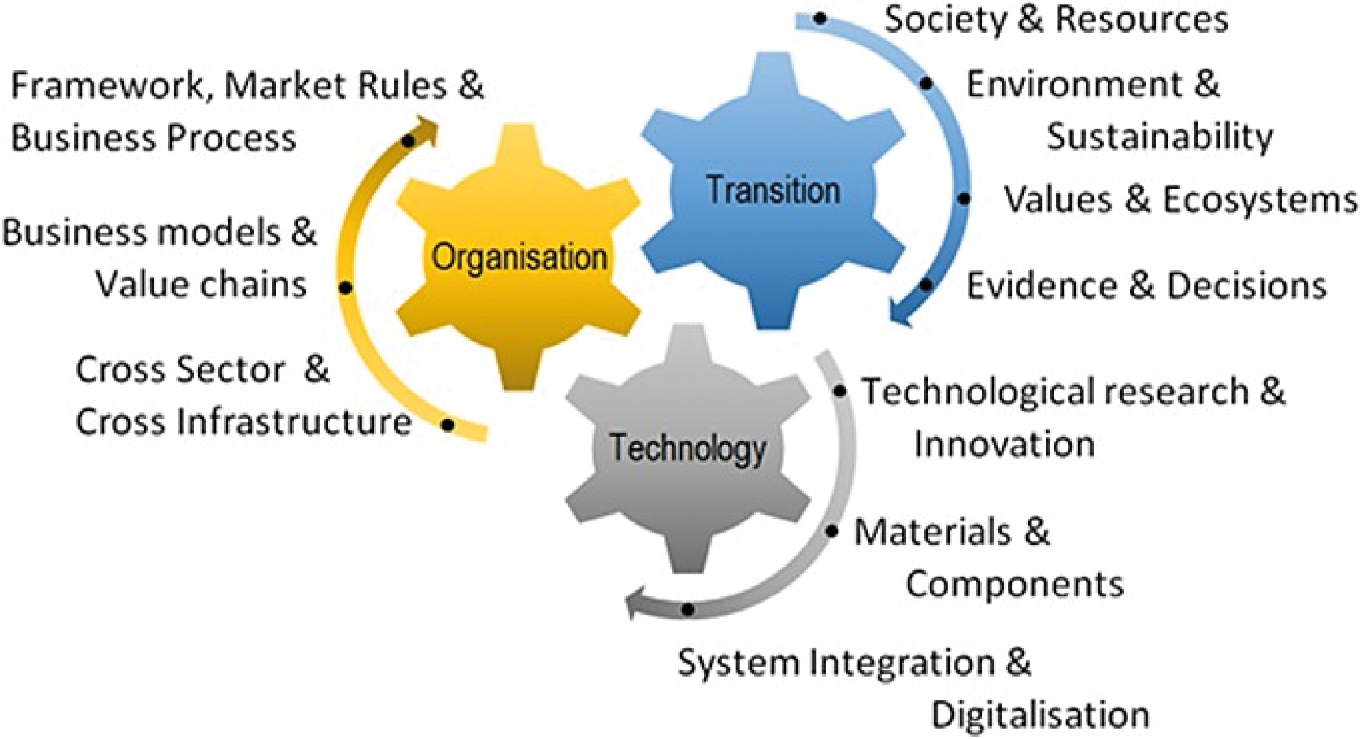
Figure B1. Integrated Innovation Model – three dimensions of innovation for system solutions
The methods and approaches used to create project outcomes in the different dimensions could be clearly defined. According to the aspects considered and particularly in case that more than one dimension is addressed, inter- or transdisciplinary teams with partners and/or experts from different backgrounds can be of great value to the project. E.g. already in the technological dimension, when it comes to the integration of technologies and infrastructures, expertise from different technology and infrastructure sectors is required. If a project intends to address aspects in the second or third dimension, expertise in economics, market design, management and organisation, social sciences, communication, industrial design, co-creation, etc. may be required. In case a proposal covers more than one of the dimensions, it is also important that the risk assessments for the project fully consider all dimensions involved in that project and not just potential aspects of one dimension.
While different Call Modules of the Call could ask a funded project to cover more than one of the dimensions, every part and work package of the project does not necessarily address all the required dimensions. This would also help to cope with different funding schemes and instruments that relevant Funding Organisations provide. Some Funding Organisations may be able to fund project parts that concentrate on or include a non-technological dimension, others may not. The Project Consortium Partners need to make sure that their relevant Funding Organisations can support their specific work packages or tasks.
Thus, a project could address one (see P1 in Figure B1) or more (P2, P3 and P4) of the three dimensions. Project Consortium Partners could be specialised and implement a particular work package, addressing only one of the dimensions which relevant Funding Organisations are able to support. Alternatively, they could combine technological aspects, which are required by the funding scheme of their Funding Organisations with non-technical aspects, so that their parts of the project can be funded.
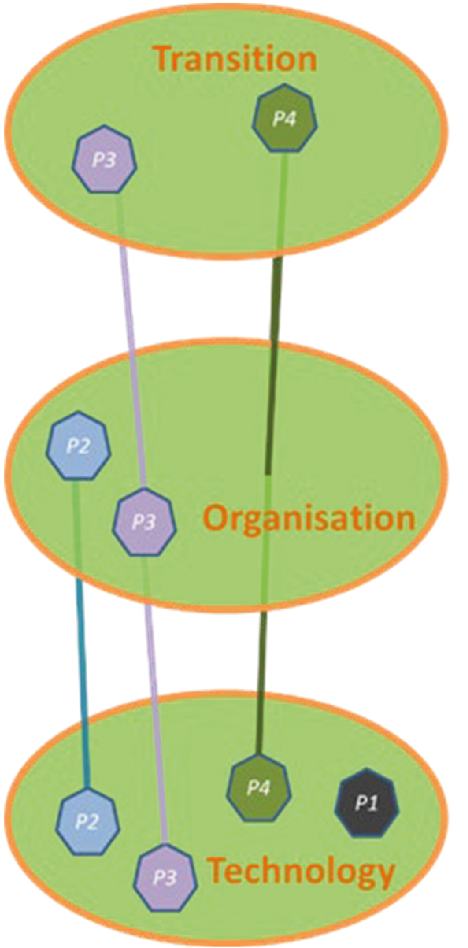
Figure B2. Examples of projects addressing the three dimensions of innovation
The CETPartnership Knowledge Community 97 is an integral part of the CETPartnership and aims to leverage exchange and co-create knowledge involving CETPartnership funded projects, RDI experts and other national, transnational and international stakeholders. It is intended to act as an information platform, to develop and present state-of-the-art knowledge, to lead discussions and to strengthen multilateral collaboration between research, industry, policy and society in the field of the clean energy transition. Through strategic knowledge management, outcomes of RDI will provide an evidence and fact base for policymaking to support the clean energy transition in domains of innovation, market entry and diffusion as well as regulation and procurement.
The Knowledge Community is committed to enhancing collaboration and knowledge co-creation in thematic challenges addressed by TRIs and in cross-cutting dimensions aligned with the CETPartnership SRIA98. We have implemented a robust monitoring and reporting framework that not only evaluates the progress of the funded projects and the effectiveness of the entire community, but also integrates these insights directly into the knowledge creation processes of the partnership. Above all, joint knowledge generation and dissemination shall help the funded projects to improve their efficiency, results, and outreach. The Knowledge Community will also relate to the Impact Network partners of the CETPartnership who can contribute to dissemination and exploitation of knowledge.
The CETPartnership Impact & Exploitation 99 supports the funded projects in exploiting results and maximising impact through various means. The Impact Network includes Living Labs, validation test beds, industry associations, innovation clusters, and networks of SMEs and start-ups across Europe. The Impact Library offers training, tools, and interaction concepts to identify and engage the various stakeholder groups, to exploit the key results, and to plan effective market and commercialisation strategies. In addition, online training and match-making events support projects at different stages of the journey from lab to market.
Projects shall use the Knowledge Community as their main contact to the CETPartnership. To ease reporting and monitoring as well as knowledge management and access to the Impact & Exploitation support measures, CETPartnership operates a Digital Information-System for Communication and Collaboration (DISCCO)100. Projects will be invited to exchange with each other and the CETPartnership management entities in well protected workspaces.
|
Contact Point |
Paul Kuttner paul.kuttner@ffg.at +43 5 7755 5069 Helfried Mährenbach helfried.maehrenbach@ffg.at +43 5 7755 5058 Johannes Bockstefl johannes.bockstefl@ffg.at +43 5 7755 5042 For Call Module 5: Johannes Fritzer johannes.fritzer@ffg.at +43 5 7755 5032 |
|
Funding commitment |
Call Modules 1, 2, 3, 8 and 10: 3.5 Mio. € (financed by the Federal Ministry for Climate Action, Environment, Energy, Mobility, Innovation and Technology [BMK] – thematic focus energy transition) Call Module 5: 2.0 Mio. € (financed by the Federal Ministry for Climate Action, Environment, Energy, Mobility, Innovation and Technology [BMK] – thematic focus mobility transition) Call Modules 4, 6, 7, 9: 5.0 Mio. € (financed by the Austrian Climate and Energy Fund) |
|
Anticipated number of projects to be funded |
n.a. |
|
Maximum funding per awarded project/per partner |
Maximum funding per project 1 Mio. € (exploratory projects for preparing further R&D&I projects in the form of an R&D projects in CM 8: 0.3 Mio. €) |
|
Eligible types of organisations |
In general, universities, research institutes, SMEs and large companies, cities, municipalities and NGOs (legal entities) are eligible for funding. The complete eligibility criteria and definitions may be found in the national guidelines. |
|
Eligible Call Modules |
All |
|
Eligible types of RDI and TRL |
Industrial research & experimental development TRL 2–8 |
|
Submission of proposal/documentation at national/regional level |
National application via eCall is mandatory: Submission deadline pre-proposals: 26 November, 2024 at 12:00 (CET) Submission deadline full proposals: 2 April, 2025 at 15:00 (CEST) |
|
Additional eligibility criteria |
At least one enterprise that receives funding is mandatory as a partner in any transnational consortium involving Austrian partners. It is not mandatory for this enterprise to be located in Austria. All Austrian partners in one project must select the same research type. For Call Module 4 applications: Thematic restriction for Austrian participants: With regard to potential implementations in Austria, the Austrian legal restrictions regarding the maximum volume of geological CO2 storage are to be kept. Only unavoidable residual emissions reduced to a technical minimum are to be offset by technical sinks in CCUS projects. For Call Module 5 applications: Thematic restriction for Austrian participants to climate-neutral hydrogen (as a fuel, produced by electrolysis or based on biogenic raw materials) or fuels produced by the use of green hydrogen as a reactant (e.g. Power-Liquid, Power-to-Gas, Power-to-Ammonia). The contribution of Austrian participants in submitted proposals must be focused on the development and use of hydrogen and fuel cells in mobile applications. According to the goals of Austria’s National Hydrogen Strategy, the proposals must focus on applications in the transport sector, where electrification is difficult to achieve (e.g. aviation, heavy-duty road and rail transport, shipping). |
|
Eligible costs |
Personnel costs, Overhead costs (flat rate), Use of R&D infrastructure, Costs of materials, Third-party costs, Travel costs. For detailed information see the national cost guidelines. Costs must be allocated directly to the project, incurred during the funding period in addition to normal operating expenses, correspond to the funding contract and can be proven. |
|
Information available at |
... the CETP Call 2024 national website |
|
Other |
Applicants are strongly encouraged to contact FFG before submitting a pre-proposal. In parallel to the submission of the joint proposal by the coordinator, a simplified national application is to be submitted via the FFG electronic submission system eCall by participants requesting funding by FFG (both in the pre-proposal and in the full proposal stage). For projects awarded funding scientific and financial reporting via eCall on an annual basis is mandatory. |
Maximum funding percentages:
|
Basic research |
Industrial/Applied Research |
Experimental development/innovation |
|
|---|---|---|---|
|
Large Enterprises |
n.a. |
55% |
35% |
|
Medium Enterprises |
n.a. |
70% |
50% |
|
Small Enterprises |
n.a. |
80% |
60% |
|
Universities, public research organisations |
n.a. |
85% |
60% |
|
Public authorities |
n.a. |
80% |
60% |
|
Associations without economic activities, NGOs |
n.a. |
80% |
60% |
|
Contact Point |
Frank Verschraegen, frank.verschraegen@vlaio.be, +32 471 55 98 19 |
|
Funding commitment |
1.000.000 euro, excluding EC topup |
|
Anticipated number of projects to be funded |
2–3 |
|
Maximum funding per awarded project/per partner |
500.000 euro per awarded project |
|
Eligible types of organisations |
VLAIO is involving the Programmes for Development projects and Research projects. Therefore the involvement of at least one private company (SME or large company) based in Flanders is mandatory (with the possibility to cooperate with research organisations). |
|
Eligible Call Modules |
All Modules. |
|
Eligible types of RDI and TRL |
Research projects and Development projects, up to TRL 7. |
|
Submission of proposal/documentation at national/regional level |
An annex is to be submitted together with the international project proposal to Flanders Innovation and Entrepreneurship. The annex(es) must be read together with the international project proposal. For this reason the focus of this annex should only be on the role of the (Flemish) company in the project, the nature of the activities to be carried out by the Flemish partners and the impact of the project results for the company in particular. |
|
Additional eligibility criteria |
Applicants should motivate how the realization of the project will create added value for the company in Flanders. Subsidies range from: 35–60% for development projects 60–70% for research projects |
|
Eligible costs |
Personnel costs and related direct and indirect costs according to VLAIO rules. |
|
Information available at |
Application process for research project grant | Agentschap Innoveren en Ondernemen (vlaio.be) The template annex for international and interregional projects can be found under the documents section. The template budget application can also be found here. |
|
Other |
It is advised to contact VLAIO before submission (see contact point above), in order to avoid ineligible projects and consortia. |
Maximum funding percentages (in case the Flemish company cooperates with 1 or more Flemish research organisations):
|
Basic research |
Industrial/Applied Research |
Experimental development /innovation |
|
|---|---|---|---|
|
Large Enterprises |
N/A |
65% |
40% |
|
Medium Enterprises |
N/A |
70% |
50% |
|
Small Enterprises |
N/A |
70% |
60% |
|
Universities, public research organisations |
N/A |
As research partner of the enterprise, same funding rates as above. |
As research partner of the enterprise, same funding rates as above. |
|
Public authorities |
N/A |
Not funded |
Not funded |
|
Associations without economic activities, NGOs |
N/A |
Not funded |
Not funded |
Maximum funding percentages (in case the Flemish company does not cooperate with 1 or more Flemish research organisations):
|
Basic research |
Industrial/Applied Research |
Experimental development /innovation |
|
|---|---|---|---|
|
Large Enterprises |
N/A |
60% |
35% |
|
Medium Enterprises |
N/A |
60% |
45% |
|
Small Enterprises |
N/A |
60% |
50% |
|
Universities, public research organisations |
N/A |
As research partner of the enterprise, same funding rates as above. |
As research partner of the enterprise, same funding rates as above. |
|
Public authorities |
N/A |
Not funded |
Not funded |
|
Associations without economic activities, NGOs |
N/A |
Not funded |
Not funded |
|
Contact Point |
Suleau Marie marie.suleau@spw.walonie.beGilles Tihon gilles.tihon@spw.wallonie.be |
|
Funding commitment |
1.500.000 |
|
Anticipated number of projects to be funded |
/ |
|
Maximum funding per awarded project/per partner |
/ |
|
Eligible types of organisations |
Participation of a private company is mandatory (minimum 40% of total Walloon budget). According to the rules of SPW. – Industrial Researches (TRL 3 to 5): Universities, Research Centers, SME, large companies, settled in Wallonia – Experimental Development (TRL 6 to 7 (8)): only SMEs and large companies settled in Wallonia – other companies or NGOs for promotion activities |
|
Eligible Call Modules |
All TRI 1 to 7 |
|
Eligible types of RDI and TRL |
RI & RIA All TRL, regarding the conditions on TRL per call module |
|
Submission of proposal/documentation at national/regional level |
The pre-proposal has also to be submitted on our own portal by our “regional partner”. The pre-proposal can be in English. If selected for presenting a proposal, this proposal must be in French AND English |
|
Additional eligibility criteria |
– The partners in Wallonia MUST give a pdf file from their 2021 balance published on Banque Nationale de Belgique – The project cannot receive double funding; a specific form has to be filled in; – The budget for the Walloon partners should follow the SPW-EER (DGO6) cost model; – The funding rate will be the maximum allowed by the decree of the 3rd of July 2008, modified; – The beneficiary must have a stable financial situation; A financial viability check has to be carried out before being recommended for full proposal. – The beneficiary must have Operational offices in the Walloon Region; – The project must add benefit to the regional economy; – All information needed for evaluation should be available; |
|
Eligible costs |
|
|
Information available at |
Will be published on recherche.wallonie.be/home.html and energie.wallonie.be/fr/index.html?IDC=6018 |
|
Other |
Maximum funding percentages:
|
Basic research |
Industrial/Applied Research |
Experimental development /innovation |
|
|---|---|---|---|
|
Large Enterprises |
65% |
65% |
40% |
|
Medium Enterprises |
75% |
75% |
50% |
|
Small Enterprises |
80% |
80% |
60% |
|
Universities, HE |
100% |
100% |
100% |
|
Research Centers |
75% |
75% |
75% |
All the conditions are available on: recherche.wallonie.be/home/nos-aides-1/minscrire-dans-une-demarche-internationale-international.html
|
Contact Point |
Isabella Tarasco, Technology Investment Lead (Main Contact) Email: itarasco@eralberta.ca Christophe Owttrim (Executive Director, Technology and Innovation) Email: cowttrim@eralberta.ca |
|
Funding commitment |
Total ERA funding envelope is $ 3 million CAD (~€ 2 million at current exchange rate). ERA in its sole discretion reserves the right to modify the total funding available under this Call. |
|
Anticipated number of projects to be funded |
Approximately 3–4 anticipated. |
|
Maximum funding per awarded project/per partner |
$ 1 million CAD (~€ 0.68 million at current exchange rate) per project. ERA in its sole discretion reserves the right to modify the maximum funding awarded per project. ERA will not award less than $ 250,000 CAD (~€ 170,000 at current exchange rate) per project. |
|
Eligible types of organisations |
ERA funding is open to all categories of applicant, including technology developers, industry, industrial associations, small and medium-sized enterprises (SMEs), research and development (R&D) organizations, universities, municipalities, not-for-profit organizations, government research labs, and individuals. |
|
Eligible Call Modules |
All focus areas mentioned in the CETP Joint Call 2024 guidelines for Modules 2, 3, 4, 6, 7 and 10are eligible for Alberta/Canada. However, the following areas for CCUS are NOT eligible for Canada/Alberta region: • Acid gas injection • Offshore storage For all focus areas, ERA funding will NOT be provided to projects whose primary focus is commercially proven technologies/processes, activities assessed to be business-as-usual, or to address only financial barriers. |
|
Eligible types of RDI and TRL |
ERA funding is targeted for projects at the technology scale-up, field pilot, commercial demonstration, or commercial implementation stages (TRL 5–9). |
|
Submission of proposal /documentation at national/regional level |
In addition to the CETP Joint Call 2024 proposal, ERA may require applicants, during the full proposal stage ONLY, to provide supplemental information to support due diligence and portfolio reporting. This information may include detailed budget information, financial report(s), an extended Greenhouse Gas benefits analysis, and/or additional information on the specific alignment with the Alberta market. Supplemental information relates to both the overall project and the component of the project based in Alberta. The final document for the Supplemental Information must be no more than 20 pages in length excluding appendices. Financial reporting will be required for the Alberta-based partner(s) on the project and is mandatory for the project partner that will receive funding from ERA. The Supplemental Information document, budget sheet and appendices must be submitted via email to ERA Applications at applications@eralberta.ca. |
|
Additional eligibility criteria |
Applicants are NOT required to be located in Alberta, but all applicants must demonstrate a clear value proposition for the province. Applicants must demonstrate how the proposed project has the potential to support emissions reductions in Alberta. |
|
Eligible costs |
ERA will match applicant contributions toward eligible expenses on a one-to-one (1:1) basis. The maximum ERA contribution to a single project will be no more than 50% of the project’s eligible expenses. ERA will not match other government funds provided directly for the proposed project (federal, provincial, or international), or future revenue associated with the outcomes of the project such as offset credits or emissions performance credits associated with the project, tax incentives associated with the project (e.g., Canadian SR&ED credits), revenue from sales of the project’s end-products (e.g., from offtake agreement), or non-eligible contributions. Applicants must justify the amount of funding requested. For information about eligible expenses and costs, please refer to the ERA Eligible Expenses and Cost Instructions document available HERE. |
|
Information available at |
|
|
Other |
Applicants are encouraged to partner with Alberta’s post-secondary and research institutions, Indigenous communities, and municipalities where appropriate. These partnerships can offer significant benefits, including the attraction and training of highly skilled workers, increasing Alberta’s innovation capacity, engagement of local communities, and leveraging complementary resources. ERA is working in partnership with other funding organizations in Alberta and across Canada. In some cases, there may be an opportunity for ERA to share applicants’ proposals with trusted partners and other funders in the system to explore possibilities to leverage funding available from these organizations. Potential funding programs and opportunities that may align with the Call or be of interest to applicants include: • Alberta Indigenous Opportunities Corporation • Alberta Indian Investment Corporation • ISED Strategic Innovation Fund • Natural Resources Canada Programming • Prairies Economic Development Canada • Canadian Agri-food Automation and Intelligence Network • Results-Driven Agriculture Research A complete list of trusted funding partners can be found on ERA’s website. |
Maximum funding percentages:
|
Basic research |
Industrial/Applied Research |
Experimental development /innovation |
|
|---|---|---|---|
|
Large Enterprises |
Ineligible |
50% |
50% |
|
Medium Enterprises |
Ineligible |
50% |
50% |
|
Small Enterprises |
Ineligible |
50% |
50% |
|
Universities, public research organisations |
Ineligible |
50% |
50% |
|
Public authorities |
Ineligible |
Ineligible |
Ineligible |
|
Associations without economic activities, NGOs |
Ineligible |
50% |
50% |
|
Contact Point |
Name: Magdalena Pillasagua Ptakova E-mail: magdalena.pillasagua@tacr.cz Tel: +420 775 871 321 |
|
Funding commitment |
800.000 EUR |
|
Anticipated number of projects to be funded |
4–5 |
|
Maximum funding per awarded project/per partner |
Maximum funding rate (intensity) per project (Czech part): 80% Maximum funding (amount) per project (Czech part): 200.000 EUR per project |
|
Eligible types of organisations |
• Enterprises (according to Annex 1 of the Regulation) • Enterprises who act as natural persons according to Annex 1 of the Regulation engaged in an economic activity pursuant to Act no. 455/1991 coll. on Trades (Trade Act). • Research organisations (according to Article 2 paragraph 83 of the Regulation) TA CR excludes the disbursement of individual aid to an enterprise: • against which a recovery order has been issued which is unpaid • meeting the definition of an “undertaking in difficulty” • which has not met the obligation to publish the financial statements for the years 2021, 2022, 2023 in the respective register – the so-called "Veřejný rejstřík” • which has not disclosed its ownership structure in the so-called “Evidence skutečných majitelů” |
|
Eligible Call Modules |
* Czech Applicants are eligible to participate in Call Modules under TRI 1, TRI 3, TRI 5 and TRI 7. Eligible Call Modules: • CM2024-01 Energy data spaces and interoperability • CM2024-02 Energy system flexibility: renewables production, storage and system integration • CM2024-04 Carbon capture, utilisation and storage (CCUS) • CM2024-05 Hydrogen and renewable fuels • CM2024-08 Integrated regional energy systems • CM2024-10 Clean energy integration in the built environment |
|
Eligible types of RDI and TRL |
Applied research (industrial research and experimental development) TRL: 3–9 |
|
Submission of proposal/documentation at national/regional level |
Mandatory forms to be submitted The Czech applicants are requested to submit: • A Sworn statement of the applicant • Completed “TACR Application Form” Excel file (submitted by the main Czech applicant only)1 • if the applicant plans to achieve “Nmet” type of result, the mandatory form for Nmet result needs to be attached1 • if the applicant plans to achieve the “Patent” type of result, patent search must be substantiated1 • Sworn statement of the composition of the consortium (only if Czech enterprise is part of the project consortium; submitted by the main Czech applicant only) All mandatory documents to be found on TA CR website. Deadline for submitting all documents is the same as the deadline for submitting pre-proposals. All documents proving the eligibility of the Czech partner stated above shall be submitted via the TACR data box (TACR data box ID: afth9xp). Project start Please note that following national legislation, Czech applicants shall start within 120 days from the funding decision being communicated by the Call Management (60-day period to enter into a contract + 60-day period to start the project). |
|
Additional eligibility criteria |
Eligible projects for TA CR • the project meets the definition of applied research • the research results correspond to the national rules and are applicable / exploitable. (The project proposal has to include a clear description of the exploitation plan and results.) • the aim of the project has to be relevant to the overall aim of the funding programme SIGMA • the declared share of industrial research and experimental development corresponds to the activities of the Czech partner described in the project proposal • the requested funding meets the national regulations for aid intensity Supported results Projects that achieve at least one of the following types of results can be supported in this Call. The type of the result has to be clearly described in the project proposal: • P – patent • G – technically realised results – prototype, functional sample • Z – pilot plant, proven technology • R – software • F – results with legal protection – utility model, industrial design • N – Certified methodologies and practices, treatment, conservation methods, procedures and specialised maps with professional expert content • O – Miscellaneous Results supported only in combination with at least one other result listed above: • H – results reflected in non-legislative directives and regulations binding within the competence of the respective provider and results reflected in the approved strategic and conceptual documents of the state or public administration Intellectual Property Rights The applicants are required to enter into a contract with their foreign partners (sign the so-called Consortium Agreement) which will define the conditions of cooperation on the project where, among other things, they specify the method of allocating rights to the research results, as well as adjustment and management of the rights imported or created during the project's implementation, which are necessary to address the project. Submission of financial and scientific reports at the national/regionallevel Czech beneficiaries must follow the rules of TA CR for reporting on the project (i.e. submission of interim- and final reports and reports on the implementation of the results). Publicity obligations While promoting the project and its results Czech beneficiaries must follow the publicity rules of TA CR. |
|
Eligible costs |
• personnel costs (including scholarships) • subcontracting costs (max. 20% of total eligible costs throughout the whole project period) • other direct costs (write-offs, protection of intellectual property, operating expenses, travel costs, consumables) • indirect costs (overheads) – full cost/flat rate 25% (indirect costs in the respective year are calculated as 25% of the sum of the personnel costs and other direct costs in the same year) Specific categories of eligible costs are defined under Article 18 of the General Terms & Conditions. |
|
Information available at |
ERA-NET Cofund Scheme on TA CR website (in Czech) ERA-NET Cofund Scheme on TA CR website (in English) National research programme SIGMA (in Czech) National research programme SIGMA (in English) “Guide for Czech applicants” and all mandatory forms will be available on TA CR website (in Czech). |
Applicants who will not submit this mandatory form (if relevant) via databox before the deadline will be considered as not eligible for TA CR funding.
Maximum funding percentages:
The aid intensity for each Czech applicant in the project is determined based on the type of entity according to the Regulation and at the same time must not exceed the maximum permissible aid intensity for the Czech part of the project, which is 80% of the total eligible costs.
|
Basic research |
Industrial/Applied Research |
Experimental development /innovation |
|
|---|---|---|---|
|
Large Enterprises |
x |
50–65%1 |
25–40%1 |
|
Medium Enterprises |
x |
60–75%1 |
35–50%1 |
|
Small Enterprises |
x |
70–80%1 |
45–60%1 |
|
Universities, public research organisations2 |
x |
up to 100%3 |
up to 100%3 |
|
Contact Point |
Wickie Lassen Agdal wbl@ens.dk +45 33 92 92 73 |
|
Funding commitment |
1.340.000 EUR |
|
Anticipated number of projects to be funded |
N/A |
|
Maximum funding per awarded project/per partner |
1.340.000 EUR |
|
Eligibile types of organisations |
Private business enterprises, knowledge institutions and public business enterprises are eligible for aid. However, for the project to be eligible at least one Danish private business enterprise should participate as an active partner (more information under “Additional eligibility criteria” below). |
|
Eligible Call Modules |
All NB: EUDP does not support research activities under CETP. The applicant should choose “Innovation Fund Denmark” for research focused projects and “EUDP” for development and demonstration focused projects. Contact the relevant national contact point for guidance as early in the application process as possible. |
|
Eligible types of RDI and TRL |
EUDP supports projects focused on development and demonstration of new energy technology (TRL 4–8). |
|
Submission of proposal /documentation at national/regional level |
EUDP require submission of specific appendices for national eligibility check (national proposal). Appendices and more information are available at: eudp.dk/soeg-tilskud (Scroll and choose the page relevant to CETPartnership 2024). |
|
Additional eligibility criteria |
It is required that a project is Industry driven, where at least one Danish private business enterprise (with a Danish CVR-nr.) participates as an active partner. An active partner should have a significant expected contribution and the potential to generate effects in a Danish context such as growth and/or employment and/or contribute to Danish climate policy objectives (e.g. CO2-reductions and/or security of supply). The above-mentioned criteria must be clearly substantiated in the separately submitted national proposal to EUDP. EUDP’s assessment criteria for national proposals under CETPartnership can be found in the EUDP document package here: eudp.dk/soeg-tilskud (Scroll and choose the page relevant to CETPartnership 2024). |
|
Eligible costs |
Eligible costs include: • Personnel costs. • Instruments and equipment. • Buildings. • Other operating expenses, including materials. • External/sub-supplies. • Overhead costs. • Other/travelling/dissemination. Danish applicants must comply with the EUDP rules which can be found here: Danish version / English version. It is not possible to receive funding for activities, which aim to: • Conduct research. • Develop business models, market analyses, direct sales promotion and other commercial market activities, including deploying existing technology or commercial operation of plant and similar. • Expand infrastructure. • Implement preproduction planning or to streamline production or control processes and similar. • Establish new institutions or continue existing institutions through operating grants etc. • Fund operating expenses in connection with partnerships, as these are expected to be paid by the participating parties. • Purchase land and to fund related costs. • Complete case-processing by the authorities in connection with building projects, environmental approvals and similar. • Obtain patents and similar rights. |
|
Information available at |
|
|
Other |
It is highly recommended that you reach out to the national contact point prior to submitting the application. |
Maximum funding percentages:
|
Basic research |
Industrial/Applied Research |
Experimental development /innovation |
|
|---|---|---|---|
|
Large Enterprises |
N/A |
N/A |
40% |
|
Medium Enterprises |
N/A |
N/A |
50% |
|
Small Enterprises |
N/A |
N/A |
60% |
|
Universities, public research organisations |
N/A |
N/A |
90% |
|
Public authorities |
N/A |
N/A |
40% |
|
Associations without economic activities, NGOs |
N/A |
N/A |
Depends on organisation size |
|
Contact Point |
Daniel G. Marques daniel.g.marques@innofond.dk, +45 6190 5006 General mailbox: internationale@innofond.dk |
|
Funding commitment |
1.3 MEUR |
|
Anticipated number of projects to be funded |
5–7 projects |
|
Maximum funding per awarded project/per partner |
The maximum funding amount per Danish partner in international projects is 300.000 €. The maximum funding amount per project, if the project has two or more Danish partners, is 500.000 €. Maximum funding rates apply according to IFD’s Guidelines for International Collaborations. |
|
Eligible types of organisations |
All Danish organizations directly involved in activities in the projects are eligible as applicants to Innovation Fund Denmark. |
|
Eligible Call Modules |
All call modules are eligible. |
|
Eligible types of RDI and TRL |
All TRL levels are eligible. For call modules where the Danish Energy Technology Development and Demonstration Programme (EUDP) also participates, the applicant must choose IFD for more research-focused projects and EUDP for more development-focused projects (see EUDP’s national annex for specific conditions). |
|
Submission of proposal /documentation at national/regional level |
After the deadline for pre-proposals, Innovation Fund Denmark will, via our national e-grant platform, invite applicants to upload a the project proposal with annexes. The invitation is sent approximately 2–4 weeks after the application deadline. Non-public organisations will be requested to upload a ‘No undertaking in difficulty’ declaration. In addition, SME’s will be required to upload an ‘SME declaration’ and an ‘Ability to co-finance’ declaration. If requesting de minimis funding, then a ‘de minimis aid compliance form’ is required. |
|
Additional eligibility criteria |
Please see documentation above. |
|
Eligible costs |
• Salaries • Equipment • Other project-related costs (events, travel, accommodation, communication and knowledge sharing) • External services (consultancy costs and other services) • Any overhead, if applicable For more details see IFD’s Guidelines for International Collaborations. |
|
Information available at |
Innovation Fund Denmark – International Collaborations Website |
|
Other |
N/A |
Maximum funding rates (incl. overhead): please refer to the Guidelines for International Collaborations (pp. 11–14).
|
Contact Point |
Maria Habicht E-Mail: maria.habicht@etag.eePhone: +372 51 74 058 |
|
Funding commitment |
150.000 300.000 for a coordinator |
|
Anticipated number of projects to be funded |
1 |
|
Maximum funding per awarded project/per partner |
150.000 300.000 for a coordinator |
|
Eligible types of organisations |
Large enterprises, medium enterprises, small enterprises, universities, public research organisations, public authorities, associations without economic activities, NGOs |
|
Eligible Call Modules |
All topics |
|
Eligible types of RDI and TRL |
Basic research, industrial/applied research, TRL 1–6 |
|
Submission of proposal /documentation at national/regional level |
No |
|
Additional eligibility criteria |
N/A |
|
Eligible costs |
Budget 1 Research expenses consist of direct costs (personnel costs, travel costs and other direct costs) and subcontracting costs. The research expenses must be used to carry out the project and be separately identifiable. 2 Direct costs 2.1 Personnel costs are monthly salaries with social security charges and all the other statutory costs of the project participants, calculated according to their commitment and in proportion to their total workload at their Host Institution. 2.2 Travel costs may cover expenses for transport, accommodation, daily allowances and travel insurance. 3 Other direct costs are: – consumables and minor equipment related to the project; – publication and dissemination of project results; – organising meetings, seminars or conferences (room rent, catering); – fees for participating in scientific forums, conferences and other events related to the project; – patent costs; – all other costs that are identifiable as clearly required for carrying out the project (e.g. translation, copy editing, webpage hosting, etc.) and comply with the eligible costs. 4 Subcontracting costs should cover only the additional or complementary research related tasks (e.g. analyses, conducting surveys, building a prototype, etc.) performed by third parties. Subcontracting costs should not be included in the overhead calculation. The activities and budget should be described in the proposal. Core project tasks should not be subcontracted. Subcontracting costs may not exceed 15% of the total costs. 5 Indirect costs are overhead from the personnel costs only, which may not exceed 15% and should cover the general expenses of the Host Institution. Costs for equipment and services intended for public use (a copy machine or a printer that is publicly used, phone bills, copy service, etc.) should be covered from the overhead. 6. Double funding of activities is not acceptable. |
|
Information available at |
etag.ee/en/cooperation/horizon-europe/eu-partnerships/era-nets/ |
|
Other |
State Aid EU Regulations on State aid and de minimis aid must be taken into account when requesting funding from the Estonian Research Council (ETAg). Support is not considered to be State aid for research and development, if the project has ties to the non-economic activities of the Research (or Host) Institution, as long as the research and development activities and the related costs, funding and revenue can be clearly separated, thus avoiding the cross subsidization of economic activity. The criteria defined in Clauses 17–22 of Communication from the European Commission – Framework for State aid for research and development and innovation (2014/C 198/01) forms the basis for determining whether the activities carried out are economic activities and whether the Host Institution is an undertaking who is considered to be a State aid recipient when it receives support. When an entity applies for State aid or de minimis aid, it has to fill in the State aid form. No tax arrears are allowed on the proposal submission date. If State aid and de minimis aid are given, the documents related to giving the support must be kept for 10 years as of the date when the agreement was entered into. State aid pursuant to the Block Exemption Regulation If the support is considered to be State aid, then support is given on the basis of Article 25, 25a or 25c of Commission Regulation (EU) No 651/2014 declaring certain categories of aid compatible with the internal market in application of Articles 107 and 108 of the Treaty (OJ L 187, 26.6.2014, p. 1–78) (hereinafter the Block Exemption Regulation), and the provisions of the Commission Regulation and Section 34² of the Estonian Competition Act apply. State aid is not given in cases specified under Articles 1(2) to (5) of the Block Exemption Regulation. If State aid is given on the basis of Article 25, the eligible costs of the project activities must comply with the requirements specified under Article 25(3) of the Block Exemption Regulation (except clause (c)), and the maximum aid intensity must comply with Articles 25(5) and (6). For State aid given on the basis of Articles 25a or 25c, see rules laid down in mentioned Articles accordingly. If the support applied for can be considered to be State aid, the application must include the information specified in Article 6(2) of the Block Exemption Regulation, and the application has to be submitted before the start of the activities. If State aid is given, then the costs of the activities carried out before application submission will not be eligible for aid. De minimis aid If support is considered de minimis aid, then giving support is subject to Commission Regulation (EU) No 1407/2013 on the application of Articles 107 and 108 of the Treaty on the Functioning of the European Union to de minimis aid (OJ L 352, 24.12.2013, p. 1–8) (hereinafter the De Minimis Aid Regulation), and the provisions of the Regulation and Section 33 of the Estonian Competition Act apply. De minimis aid is not given in cases specified under Article 1(1) of the De Minimis Aid Regulation. In case of de minimis aid, the maximum aid intensity must comply with Article 3 of the De Minimis Aid Regulation. De minimis aid given to the Host Institution together with de minimis aid applied for as support cannot exceed 200,000 euros during the current financial year and the two previous financial years. Article 5 of the De Minimis Aid Regulation applies to cumulating de minimis aid. A single undertaking is an undertaking specified in Article 2(1) of the De Minimis Aid Regulation. Grant Agreement If a positive funding decision is made, the Estonian Research Council enters into a grant agreement with the Host Institution. Information on the transnational project must be entered into ETIS once the agreement has been signed. The Consortium Agreement should be signed at the latest six months after the grant agreement has been signed. If one year has elapsed and the CA has not been signed, the next instalment of funding will not be paid out. Research Involving Human Subjects or Animal Testing If human research or animal testing are intended in the project, a positive resolution by the Human Research Ethics Committee or the Authorisation Committee for Animal Experiments must be submitted to the Estonian Research Council by the start of the relevant activities. Nagoya Protocol By applying for funding by the Estonian Research Council, the applicants agree to consider the relevance of the Nagoya protocol for their research, and to submit the Due Diligence Declaration, if applicable. |
Maximum funding percentages:
|
Basic research |
Industrial/Applied Research |
Experimental development /innovation |
|
|---|---|---|---|
|
Large Enterprises |
100% |
100% |
N/A |
|
Medium Enterprises |
100% |
100% |
N/A |
|
Small Enterprises |
100% |
100% |
N/A |
|
Universities, public research organisations |
100% |
100% |
N/A |
|
Public authorities |
100% |
100% |
N/A |
|
Associations without economic activities, NGOs |
100% |
100% |
N/A |
|
Contact Point |
Name: Kherrouf Samira E-mail: samira.kherrouf@ademe.fr Tel: +33 4 93 95 79 06 |
|
Funding commitment |
500 k€ |
|
Anticipated number of projects to be funded |
3–5 |
|
Maximum funding per awarded project/per partner |
300k€ |
|
Eligible types of organisations |
Universities, research institutes, SME’s and large companies, public authorities, NGOs… |
|
Eligible Call Modules |
CM2024-01 Data spaces and interoperability CM2024-04 Carbon capture, utilisation and storage (CCUS). ADEME does not wish to cofund projects on the following topics: • power, maritime transport, hydrogen produced from natural gas, and CO2 removal • Develop lower cost solutions for efficient capture of CO2 from hydrogen produced from natural gas, and new technologies for processing, shipping, transport, and storage of hydrogen |
|
Eligible types of RDI and TRL |
Applied research, experimental development from TRL 5 to 8 |
|
Submission of proposal /documentation at national/regional level |
No |
|
Additional eligibility criteria |
|
|
Eligible costs |
○ Personnel costs ○ Operational costs ○ Investment costs ○ Indirect costs ○ Subcontracting |
|
Information available at |
|
|
Other |
Maximum funding percentages:
|
Basic research |
Industrial/Applied Research |
Experimental development /innovation |
|
|---|---|---|---|
|
Large Enterprises |
50% |
50% |
25% |
|
Medium Enterprises |
60% |
60% |
35% |
|
Small Enterprises |
70% |
70% |
45% |
|
Universities, public research organisations (non-economic activity) |
100% |
50% |
50% |
|
Public authorities |
100% |
50% |
50% |
|
Associations without economic activities, NGOs |
100% |
50% |
50% |
|
Contact Point |
Name: Pascal Bain Head of the SPICE Scientific Department Pascal.bain@agencerecherche.fr Name: Negar Naghavi-Fleury Scientific Officer Negar.NAGHAVI-FLEURY@agencerecherche.frmailto: Name: Elisa Meriggio for TRI 2 and TRI 4 Scientific Project Manager Elisa.meriggio@agencerecherche.fr Name: Thamires Moreira for TRI 3 and TRI 7 Scientific Project Manager Thamires.moreira@agencerecherche.fr |
|
Funding commitment |
3.000.000 € |
|
Anticipated number of projects to be funded |
8 to 10 |
|
Maximum funding per awarded project/per partner |
500.000 € per project as a maximum in exceptional and highly justified cases. However, ANR expects typical funding requests per project to range between 200.000 and 350.000 €, depending on the number of ANR-funded partners involved and whether the coordinator of the project is funded by ANR or not. |
|
Eligible types of organisations |
Please consult the ANR Funding regulations and the Appendix for applicants to ANR on the ANR website for detailed information anr.fr/CETP-2024 Within this framework, public research organisations (such as Universities, EPST or EPIC) as well as private entities (such as companies, NGOs and foundations) and public authorities may be eligible (provided that at least one French public research organisation requesting funding to ANR is involved in the consortium). |
|
Eligible Call Modules |
Only the following Call Modules are eligible for ANR: – TRI2 CM2024-03A Advanced renewable energy (RE) technologies for power production (ROA) – TRI3 CM2024-04 Carbon capture, utilisation and storage (CCUS) – TRI3 CM2024-05 Hydrogen & renewable fuels. Concerning hydrogen production only green hydrogen production will be eligible for ANR. – TRI4 CM2024-06 Heating and cooling technologies – TRI4 CM2024-07 Geothermal energy technologies – TRI7 CM2024-10 Clean energy integration in the built environment |
|
Eligible types of RDI and TRL |
Basic Research, Industrial/ Applied Research/ Experimental development. TRL 3–5 (activities at TRL above 5 are possible but must be marginal for partners requesting funding from ANR). |
|
Submission of proposal /documentation at national/regional level |
No for the pre-proposal stage. For the full-proposal stage, partners requesting funding from ANR will be asked to apply on the ANR submission platform. |
|
Additional eligibility criteria |
A project proposal cannot be similar in whole or in part to another proposal submitted for a call currently being evaluated by ANR (all calls for proposals and evaluation stages considered) or already funded by ANR. The similarity between two projects is established when these projects (in their entirety or in part) describe identical main objectives or result from a simple adaptation. The minimal funding per partner by ANR is 15.000 €. Companies with economic difficulties are excluded from ANR subventions. Partners from countries subject to sanctions applicable to the research field by the European Union authorities are excluded from this call for ANR. ANR will declare Partners requesting its support ineligible if they apply with Partners established in these countries. At the date of publication, these exclusions concern Partners from the following countries: Russia, Belarus. This list may evolve in case of new sanctions decided by the European Union. |
|
Eligible costs |
ANR funds basic, industrial research and experimental development activities. The eligibility of costs and rates of funding depend on types of partners, consortia composition and types of research activities. See ANR funding regulations for more details: anr.fr/fr/rf/ |
|
Information available at |
A specific web page on the ANR web site is published at the opening of the Call, with details for potential applicants to ANR. anr.fr/CETP-2024 |
|
Other |
It is highly recommended to contact the national contacts during the preparation of the project. Depending on the consortium composition, a Consortium Agreement may be mandatory for ANR at the funding stage for successful applications. Please refer to the ANR funding regulations for more details: anr.fr/fr/rf/ |
Maximum funding percentages:
|
Basic research |
Industrial/Applied Research |
Experimental development /innovation |
|
|---|---|---|---|
|
Large Enterprises |
30% |
30% |
25% |
|
Medium Enterprises |
45% |
35–45% |
35–45% |
|
Small Enterprises |
45% |
35–45% |
35–45% |
|
Universities, public research organisations |
see ANR funding regulations anr.fr/fr/rf/ |
see ANR funding regulations anr.fr/fr/rf/ |
see ANR funding regulations anr.fr/fr/rf/ |
|
Public authorities |
see ANR funding regulations anr.fr/fr/rf/ |
see ANR funding regulations anr.fr/fr/rf/ |
see ANR funding regulations anr.fr/fr/rf/ |
|
Associations without economic activities, NGOs |
see ANR funding regulations anr.fr/fr/rf/ |
see ANR funding regulations anr.fr/fr/rf/ |
see ANR funding regulations anr.fr/fr/rf/ |
|
Contact Point |
Gaelle FROSTIN – gaelle.frostin@paysdelaloire.frCharlotte NOBLOT – charlotte.noblot@paysdelaloire.fr |
|
Funding commitment |
1 M€ |
|
Anticipated number of projects to be funded |
– |
|
Maximum funding per awarded project/per partner |
No maximum funding |
|
Eligible types of organisations |
Small, Medium and large companies established and carrying out R&D activities in Pays de la Loire. Other entities such as universities, public research institutions, technological centres, and other private non-profit institutions may also participate: they will be funded only if a company from Pays de la Loire is also partner of the consortium and is funded. Project activities in the proposed work plan funded by the Regional Council Pays de la Loire must be implemented in Pays de la Loire, or at least mobilise resources based in Pays de la Loire. |
|
Eligible Call Modules |
TRI2 – Call Module 3B (Innovation Oriented Action): Advanced Renewable Energy (RE) technologies for power production |
|
Eligible types of RDI and TRL |
Projects may comprise industrial/applied research or experimental activities. Projects (IOA) are expected to make relevant progress towards the demonstration of technology to TRL 6 or above (target TRL). |
|
Submission of proposal /documentation at national/regional level |
No additional submission of proposal at regional level |
|
Additional eligibility criteria |
Companies must have been created since more than one year and have generated sufficient revenues. |
|
Eligible costs |
Personnel costs i.e. the cost of researchers, technicians and other supporting staff to the extent employed on the relevant project or activity (gross salary, without overheads). Indirect costs: 15% of personnel costs. Contractual research costs, technical knowledge and patents bought or licensed from outside sources at market prices, and costs for consulting and equivalent services intended exclusively for the research activity. Other operating expenses, including costs for material, supplies and similar products, which result directly from the research project. Instrument and equipment costs, to the extent and during the period in which they are used for the research project. |
|
Information available at |
www.paysdelaloire.fr/clean-energy-transition-partnership-cetp |
|
Other |
Maximum funding percentages:
|
Basic research |
Industrial/Applied Research |
Experimental development /innovation |
|
|---|---|---|---|
|
Large Enterprises |
Ineligible |
65% |
40% |
|
Medium Enterprises |
Ineligible |
75% |
50% |
|
Small Enterprises |
Ineligible |
80% |
60% |
|
Universities, public research organisations |
Ineligible |
75% of total eligible costs or 100% of marginal costs |
75% of total eligible costs or 100% of marginal costs |
|
Public authorities |
Ineligible |
Ineligible |
Ineligible |
|
Associations without economic activities, NGOs |
Ineligible |
Ineligible |
Ineligible |
Support levels will be determined by the legal status of the applicant, the size of company and the proposed activity. The support level may vary from one work package to another. The final support level and its form will be definitively defined after the selection phase.
|
Contact Point |
Forschungszentrum Jülich GmbH Project Management Jülich Energy and Climate D-52425 Jülich CM2024-01 Energy data spaces and interoperability Ralf Eickhoff: r.eickhoff@ptj.de, +49 2461 61-9419 Nelli Hambach: n.hambach@ptj.de, +49 2461 61-2615 CM2024-02 Energy system flexibility: renewables production, storage and system integration Ralf Eickhoff: r.eickhoff@ptj.de, +49 2461 61-9419 Nelli Hambach: n.hambach@ptj.de, +49 2461 61-2615 CM2024-03A/03B Advanced renewable energy (RE) technologies for power production (Research-oriented approach (ROA) and Innovation-oriented approach (IOA)) Renate Horbelt (PV): r.horbelt@ptj.de+49 2461 61-9874 Franciska Klein (Wind): f.klein@ptj.de+49 2461 61-8803 Tarik Schwarzer (CSP, STE): t.schwarzer@ptj.de+49 2461 61-9157 CM2024-05 Hydrogen and renewable fuels Margret Waschbüsch: m.waschbuesch@ptj.de+49 2461 61-9108 CM2024-06 Heating and cooling technologies Norbert Rohde: n.rohde@ptj.de, +49 30 20199 3232 CM2024-07 Geothermal energy technologies Stephan Schreiber: k.schreiber@ptj.de, +49 2461 61-4743 CM2024-08 Integrated regional energy systems Ralf Eickhoff: r.eickhoff@ptj.de, +49 2461 61-9419 Nelli Hambach: n.hambach@ptj.de, +49 2461 61-2615 CM2024-09 Integrated industrial energy systems Dmitri Tabakajew: d.tabakajew@ptj.de, +49 2461 61-1665 CM2024-10 Clean energy integration in the built environment Eerke Bunte: e.bunte@ptj.de+49 2461 61-1646 |
|
Funding commitment |
12.000.000 € |
|
Anticipated number of projects to be funded |
Not applicable |
|
Maximum funding per awarded project/per partner |
Not applicable |
|
Eligible types of organisations |
Potentially private and public applicants are funded, e.g. (non-exclusive) • Private – SME • Private – large companies • Private – Non-profit research organisations • Higher education institutions (e.g. universities) • Public research organisations • Public organisations and municipalities |
|
Eligible Call Modules |
Please note, that not all Call Modules are supported. This refers to CM2024-04 “Carbon capture, utilisation and storage (CCUS)”, which is not supported in the Joint Call 2024. All other Call Modules are supported. Please also note the additional national eligibility criteria for the individual Call Modules described below. CM2024-01 “Energy data spaces and interoperability”: Priority will be given to research organisations (private or public) and non-profit organisations. Industrial relevance results from the call module itself. CM2024-02 “Energy system flexibility: renewables production, storage and system integration”: The tasks of the German partners must be relevant to the electricity grid, electrical energy storage systems and/or their integration (including digitalisation). Self-funded partners or partners with regional funding are possible. CM2024-03A/B “Advanced renewable energy (RE) technologies for power production”: Please note the exceptions: 1. Bioenergy for power generation (with carbon capture and storage (BECCS)) and for combined heat generation is not eligible for funding of the Federal Ministry for Economic Affairs and Climate Action (BMWK). German partners with own financing or funding are possible as “fully self-financed partners”. 2. Bioenergy applications for fuel production are not in the scope of “CM2024-03A/03B Advanced renewable energy (RE) technologies for power production”. 3. Ocean energy as well as hybrid-RES solutions with ocean energy for power generation (with negative CO2 emissions) are not eligible for funding of BMWK. German partners with own financing or funding are possible as “fully self-financed partners”. CM2024-05 “Hydrogen and renewable fuels”: Renewable fuels are not in the focus of BMWK funding. German partners with own financing or funding are possible as “fully self-financed partners”. |
|
Eligible Call Modules |
CM2024-08 “Integrated regional energy systems”: The tasks of the German partners must be relevant to the electricity grid, electrical energy storage systems and/or their integration (including digitalisation). Self-funded partners or partners with regional funding are possible. CM2024-09 “Integrated industrial energy systems”: BioCCUS are not in the focus of BMWK funding. German partners with own financing or funding are possible as “fully self-financed partners”. CM2024-10 “Clean energy integration in the built environment”: Please note that zero emission fuel and hydrogen for heating in buildings as well as mobility infrastructures and e-mobility concepts are not eligible for funding of BMWK. German partners with own financing or funding are possible as “fully self-financed partners”. |
|
Eligible types of RDI and TRL |
Focus on applied research (TRL 5–8, lower TRL down to 3 only in special and justified cases) |
|
Submission of proposal /documentation at national/regional level |
Full Proposal Phase We may request additional documents (e.g. German project description, credit rating documents, cost breakdown, information about planned exploitation of results etc.) for successful pre-proposals in individual Call Modules. These documents must be submitted at the same deadline as the Full Proposals and contain information on the evaluation criteria of the 8th Energy Research Programme: www.bmwk.de/Redaktion/DE/Publikationen/Energie/20240531-energieforschung-im-rahmen-des-8-energieforschungsprogramms.html. Detailed information will follow after a successful pre-proposal. Successful proposals Successfully selected full proposals must later submit formal national applications (“Anträge”) and additional, tangible exploitation plans via the national application system easy-Online. (Applicants will be informed about the direct link for submission). |
|
Additional eligibility criteria |
The projects must fit thematically into the currently effective 8th Energy Research Programme of the Federal Ministry for Economic Affairs and Climate Action (BMWK). Industrial relevance and industrial participation are further requirements and eligibility criteria. Proposals must provide sound cost calculations breakdowns and clear exploitation plans. Proposals must show significant progress on state of the art and compared to nationally funded projects. |
|
Eligible costs |
All project related costs (e.g., personnel, equipment [depreciations], consumables, travel expenses, etc.). Funding rates will be granted based on the targeted TRL, type of organisation, expected impact of results and financial situation of applicants. An appropriate self-financial engagement of the industry is mandatory. Applicants are strongly advised to consult the BMWK guidelines on eligible costs (Richtlinien für Zuwendungsanträge (AZA/AZK)): foerderportal.bund.de/easy/easy_index.php?auswahl=formularschrank_foerderportal&formularschrank=bmwk. |
|
Information available at |
8th Energy Research Programme of the Federal Ministry for Economic Affairs and Climate Action (BMWK) www.bmwk.de/Redaktion/DE/Publikationen/Energie/20240531-energieforschung-im-rahmen-des-8-energieforschungsprogramms.html |
|
Other |
We strongly recommend to contact the above named contact persons for detailed information in advance. |
Maximum funding percentages:
|
Basic research |
Industrial/Applied Research |
Experimental development/innovation |
|
|---|---|---|---|
|
Large Enterprises |
n.a. |
50% |
40% |
|
Medium Enterprises |
n.a. |
60% |
50% |
|
Small Enterprises |
n.a. |
70% |
60% |
|
Universities, public research organisations |
n.a. |
100% |
90% |
|
Public authorities |
n.a. |
100% |
100% |
|
Associations without economic activities, NGOs |
n.a. |
100% |
50% |
|
Contact Point |
Forschungszentrum Jülich GmbH Projektträger Jülich Geschäftsbereich ETN Melanie Dürr: me.duerr@fz-juelich.de, +49 2461 61-84026 Timur Galiullin: t.galliulin@fz-juelich.de, +49 2461 61-84090 |
|
Funding commitment |
200.000 € |
|
Anticipated number of projects to be funded |
Depends strongly on the single project volumes. |
|
Maximum funding per awarded project/per partner |
No limitation (Maximum funding per partner may of course not exceed the total funding commitment mentioned above.) |
|
Eligible types of organisations |
The Agency potentially supports all private and public applicants, namely: • Private – SME • Private – large companies • Private – Non-profit research organisation • Higher education institution • Public research organisation • Public organisation Applicants must be located in NRW. |
|
Eligible Call Modules |
We participate in the following call modules: • CM2024-01 Data spaces and Interoperability • CM2024-02 Energy system flexibility: renewables production, storage and system integration • CM2024-03 (A/B) Advanced renewable energy technologies for power production • CM2024-04 Carbon capture, utilisation, and storage (CCUS) • CM2024-05 Hydrogen and renewable fuels • CM2024-09 Integrated regional energy systems For further information have a look at the funding guidelines of the state of North Rhine-Westphalia progres. NRW-Innovation (see link below at “Information available at”). Applicants from NRW should also compare the conditions for the funding owner Federal Republic of Germany, where all call modules can be supported. |
|
Eligible types of RDI and TRL |
The Agency potentially supports the following types of RTD, namely: • Industrial / applied research • Experimental Development TRL level: 3–8 |
|
Submission of proposal /documentation at national/regional level |
Winners of the joint call that are funded by the federal state of NRW have to fill out the regional application form. Please contact one of the responsible persons mentioned above. |
|
Additional eligibility criteria |
• Only applicants located in North Rhine-Westphalia are eligible for funding • A significant industrial relevance or industrial application must be apparent. • good credit standing • depreciation for investments has to be considered • overhead costs are funded according directive progres.NRW-Innovation (see link below) |
|
Eligible costs |
Personnel costs, travel costs, Consumables / Equipment, Subcontracts, indirect costs |
|
Information available at |
Applicants from North Rhine-Westphalia have the opportunity to receive funding from the Federal State of NRW or by the Federal Republic of Germany. The Federal State of NRW supports TRI1, TRI2, TRI3 and TRI6, while the Federal Republic of Germany supports all TRI. To maximise funding opportunities please contact Projektträger Jülich, Forschungszentrum Jülich GmbH as soon as possible. Projects funded by the federal state of NRW are bound by the funding guideline progress.NRW-Innovation: www.ptj.de/projektfoerderung/progres-nrw/progres-nrw-innovation Contacts: Melanie Dürr: me.duerr@fz-juelich.de, +49 2461 61-84026 Timur Galiullin: t.galliulin@fz-juelich.de, +49 2461 61-84090 |
|
Other |
Maximum funding percentages:
|
Basic research |
Industrial/Applied Research |
Experimental development /innovation |
|
|---|---|---|---|
|
Large Enterprises |
0 |
65% |
40% |
|
Medium Enterprises |
0 |
75% |
50% |
|
Small Enterprises |
0 |
80% |
60% |
|
Universities, public research organisations |
0 |
100% |
100% |
|
Public authorities |
0 |
N.N. |
N.N. |
|
Associations without economic activities, NGOs |
0 |
N.N. |
N.N. |
|
Contact Point |
Gabriele Süptitz E-Mail: gabriele.sueptitz@smwk.sachsen.de Phone: +49351 564-64210 |
|
Funding commitment |
Approx. 2 Mio. EUR |
|
Anticipated number of projects to be funded |
No limitations |
|
Maximum funding per awarded project/per partner |
No limitations |
|
Eligible types of organisations |
For Saxon Universities and Research Institutions: see RL EuProNet For Saxon Enterprises: see also RL EFRE/JTF Technologie-förderung 2021 bis 2027. Important note for Saxon Enterprises: Projects funded by the EFRE/JTF-Technologieförderung 2021bis 2027 may have a maximum duration until July 2028. |
|
Eligible Call Modules |
All Call Modules are eligible for funding. |
|
Eligible types of RDI and TRL |
For Saxon universities and research institutions: all type of research and TRL is eligible for funding. For Saxon enterprises: only project parts related to applied research or experimental development are eligible for funding (TRL 2–7) |
|
Submission of proposal /documentation at national/regional level |
No regional schedules, cut-off dates or deadlines No additional submissions of regional applications during the evaluation processes (pre- and fullproposal stage) Only in the case of a positive funding recommendation of the full proposal, Saxon applicants will be asked to submit a regional application according to the related Saxon guidelines (for Saxon universities and research organisations: RL EuProNet; for Saxon enterprises: RL EFRE/JTF-Technologieförderung 2021 bis 2027) |
|
Additional eligibility criteria |
No thematic restrictions; Saxony will support projects within the entire scientific scope outlined in the Call Announcement, Other eligible criteria: For Saxon universities and research organisations: see RL EuProNet. For Saxon enterprises: see RL EFRE/JTF -Technologieförderung 2021 bis 2027 |
|
Eligible costs |
For Saxon universities and research organisations: see RL EuProNet For Saxon SMEs/large industries: see RL EFRE/JTF – Technologieförderung 2021 bis 2027 |
|
Information available at |
revosax.sachsen.de/vorschrift/17180-RL-EuProNet www.revosax.sachsen.de/vorschrift/19834-FRL-EFRE-JTF- Technologiefoerderung-2021-bis-2027 |
|
Other |
In case of further questions please contact SMWK/Gabriele Süptitz gabriele.sueptitz@smwk.sachsen.de |
Maximum funding percentages:
For Saxon universities and research organisations: see RL EuProNet
For Saxon SMEs/large industries: see RL EFRE/JTF -Technologieförderung 2021 bis 2027
|
Basic research |
Industrial/Applied Research |
Experimental development/innovation |
|
|---|---|---|---|
|
Large Enterprises |
– |
see RL EFRE/JTF - Technologieförderung 2021 bis 2027 |
see RL EFRE/JTF - Technologieförderung 2021 bis 2027 |
|
Medium Enterprises |
– |
up to 75% see RL EFRE/JTF - Technologieförderung 2021 bis 2027 |
up to 50% see RL EFRE/JTF - Technologieförderung 2021 bis 2027 |
|
Small Enterprises |
– |
up to 80% see RL EFRE/JTF - Technologieförderung 2021 bis 2027 |
up to 60% see RL EFRE/JTF - Technologieförderung 2021 bis 2027 |
|
Universities, public research organisations |
up to 100% (see RL EuProNet) |
up to 100% (see RL EuProNet) |
up to 100% (see RL EuProNet) |
|
Public authorities |
|||
|
Associations without economic activities, NGOs |
|
Contact Point |
-Dr Anna Rosenberg International S&T Cooperation Directorate Bilateral and Multilateral Cooperation Department 14–18, Mesogeion Ave., GR-115 27 Athens, Greece Tel.: +30 213 13 00 095 Fax: +30 210 7714153 E-mail: a.rosenberg@gsrt.gr -Ms. Aliki – Maria Argyri International S&T Cooperation Directorate European Union and International Organizations Department 14–18, Mesogeion Ave., GR-115 27 Athens, Greece Tel: +30 213 1300101 E-mail: a.argyri@gsrt.gr |
|
Funding commitment |
1.000.000,00€ |
|
Anticipated number of projects to be funded |
|
|
Maximum funding per awarded project/per partner |
Upper limit of the total public funding will be 180.000 € per project (including indirect costs). Please note that this amount can be increased to 230.000 € per project if Greek partner assumes the project coordination. The maximum state aid intensity will be calculated according to the provisions of the European state aid rules and regulations in force (type of research activity, size of the participating enterprise, collaborative research etc). |
|
Eligible types of organisations |
GSRI potentially supports private and public legal entities namely: private enterprises (such as SMEs, large-companies etc), research organizations, higher education institutions, and other public organizations with R&D activities, associations without economic activities, NGOs. Individuals as well as individual enterprises are not eligible under this scheme. Besides natural persons, the following categories of undertakings are also not eligible: An “undertaking in difficulty” (according to art.2 of Reg. (EU) 651/20141). whose affairs are being administered by the court, who have entered into an arrangement with creditors, who have suspended business activities or who are in any analogous situation An undertaking which is subject to an outstanding recovery order following a previous Commission decision declaring an aid illegal and incompatible with the internal market. Large enterprises are eligible to receive funding under the condition that a Greek SME participates in the consortium. Applicants may submit, if they are enterprises, up to two (2) proposals from the same enterprise in the current call, and for Public research Institutes and Universities up to two (2) proposals at the level of the same Laboratory or School or Institute or Department. |
|
Eligible Call Modules |
Call Modules 1, 2, 4, 5 |
|
Eligible types of RDI and TRL |
TRL3-(8) in compliance with the (COMMISSION REGULATION (EU) 2021/1237 of 23 July 2021 amending Regulation (EU) No 651/2014 declaring certain categories of aid compatible with the internal market in application of Articles 107 and 108 of the Treaty, page 3, article 13) |
|
Submission of proposal /documentation at national/regional level |
At national level, only eligibility check is conducted and not a full peer review at pre-proposal and full proposal stages. We rely on the evaluation made by the Call Evaluation Committee and external reviewers. Submission at the national level is required at a later stage. A national procedure will follow for the approved for funding, at the transnational level, proposals only. For more information please contact the NCP. |
|
Eligible costs AN Partnership: cetpartn |
• Aid intensity Public research Institutes and Universities: the aid intensity can reach 100% for performing non-economic activities in accordance with point 19, article 2.1.1 of the «Framework for State aid for research and development and innovation» (2014/C 198/01). Private Sector: (a) 50% of the eligible costs for industrial research; (b) 25% of the eligible costs for experimental development; (c) 50% of the eligible costs for feasibility studies.- The aid intensities for industrial research and experimental development may be increased up to a maximum aid intensity of 80% of the eligible costs as follows: (a) by 10 percentage points for medium-sized enterprises and by 20 percentage points for small enterprises; (b) by 15 percentage points if one of the following conditions is fulfilled: (i) the project involves effective collaboration: – between undertakings among which at least one is an SME, or is carried out in at least two Member States, or in a Member State and in a Contracting Party of the EEA Agreement, and no single undertaking bears more than 70% of the eligible costs, or – between an undertaking and one or more research and knowledge-dissemination organisations, where the latter bear at least 10% of the eligible costs and have the right to publish their own research results; (ii) the results of the project are widely disseminated through conferences, publication, open access repositories, or free or open source software. – The aid intensity for feasibility studies may be increased by 10 percentage points for medium-sized enterprises and by 20 percentage points for small enterprises. • Foreseen cost categories: (a) personnel costs: researchers, technicians and other supporting staff to the extent employed on the project. (b) costs of instruments and equipment to the extent and for the period used for the project. Where such instruments and equipment are not used for their full life for the project, only the depreciation costs corresponding to the life of the project, as calculated on the basis of generally accepted accounting principles are considered as eligible (c) costs of contractual research, knowledge and patents bought or licensed from outside sources at arm's length conditions, as well as costs of consultancy and equivalent services used exclusively for the project (d) additional general costs and other operating expenses, including costs of materials, supplies, travel expenses, organization of meetings, dissemination/publicity costs, audit costs, incurred directly as a result of the project implementation (e) indirect costs = flat rate of 25% of direct costs (except subcontracting costs). Indirect costs are eligible for all legal entities and include costs that do not incur directly as a result of the project implementation (e.g. administrative and management costs, utility costs) In compliance with the (COMMISSION REGULATION (EU) 2021/1237 of 23 July 2021 amending Regulation (EU) No 651/2014 declaring certain categories of aid compatible with the internal market in application of Articles 107 and 108 of the Treaty. ership.eu |
|
Information available at |
• General Secretariat for Research and Innovation |
|
Other |
Maximum funding percentages:
|
Basic research |
Industrial/Applied Research |
Experimental development/innovation |
|
|---|---|---|---|
|
Large Enterprises |
– |
50–65% |
25–40% |
|
Medium Enterprises |
– |
60–75% |
35–50% |
|
Small Enterprises |
– |
70–80% |
45–60% |
|
Universities, public research organisations |
100% |
– |
– |
|
Public authorities with R&D activities |
100% |
– |
– |
|
Associations without economic activities, NGOs |
– |
Large 50–65% Medium 60–75% Small 70–80% |
Large 25–40% Medium 35–50% Small 45–60% |
|
Contact Point |
Dr. Mónika Józon monika.jozon@nkfih.gov.huTel: +36 (1) 7953489 |
|
Funding commitment |
1.165.000 EUR |
|
Anticipated number of projects to be funded |
5 projects |
|
Maximum funding per awarded project/per partner |
Max. 300.000 EUR per awarded project Max. 150.000 EUR/partner (if the Hungarian partner is the main applicant/coordinator – 200.000 EUR) |
|
Eligible types of organisations |
Institution of higher education, other budgetary research institution, enterprise based research organisation, enterprise (non-research type), non-profit research organisation, urban/local authorities, municipal companies (as partners of research-oriented applicant) |
|
Eligible Call Modules |
All |
|
Eligible types of RDI and TRL |
All type of research: strategic (basic) research, applied research, experimental development. TRL: 1–9 |
|
Submission of proposal/documentation at national/regional level |
Proposals must be submitted to NKFIH through the dedicated call for Partnerships (call will be published at 2024 Q3) www.horizonteuropa.nkfih.gov.hu/partnersegek/futo-europai-partnersegek nkfih.gov.hu/palyazoknak/palyazatok/aktualis-felhivasok?save=1&cimke=NKFI |
|
Additional eligibility criteria |
n. a. |
|
Eligible costs |
Max. 300.000 € per project Personnel (temporary, permanent), subcontracting and services, including travel, consumables, equipment, coordination, travel, communication and dissemination, overhead (20%), overhead for travel related activities (5%) |
|
Information available at |
www.horizonteuropa.nkfih.gov.hu/partnersegek/futo-europai-partnersegek nkfih.gov.hu/palyazoknak/palyazatok/aktualis-felhivasok?save=1&cimke=NKFI |
|
Other |
Information for Partners: All Hungarian entities are eligible to participate and receive funding in the Call. The top-up funding for universities affected by Council Implementing Decision 2022/2506 will be covered by the Hungarian Government’s Guarantee Fund. |
Maximum funding percentages:
|
Organisation type |
Basic research |
Industrial/Applied Research |
Experimental development/Innovation |
|---|---|---|---|
|
Large Enterprises |
100% |
65% |
40% |
|
Medium Enterprises |
100% |
75% |
50% |
|
Small Enterprises |
100% |
80% |
60% |
|
Universities, public research organisations |
100% |
100% |
100% |
|
Public authorities |
100% |
65% |
40% |
|
Associations without economic activities, NGOs |
100% |
100% |
100% |
|
Contact Point |
Sigurdur Björnsson sigurdur.bjornsson@rannis.isKatrin Jonsdottir katrin.jonsdottir@rannis.is Tel.: +354 515 5800 www.rannis.is/ |
|
Funding commitment |
€ 600.000 |
|
Anticipated number of projects to be funded |
3–4 |
|
Maximum funding per awarded project/per partner |
€ 300.000 |
|
Eligible types of organisations |
Applicants have to follow the general guidelines of the Technology Development Fund, were own contribution can vary – further information on www.rannis.is/sjodir/rannsoknir/taeknithrounarsjodur/ |
|
Eligible Call Modules |
Call modules no. 4, 5, 6 and 7 (TRI3 and TRI4) |
|
Eligible types of RDI and TRL |
Industrial/Applied research and Experimental development/innovation TRL 4+ |
|
Submission of proposal /documentation at national/regional level |
Not required but registration at Rannis of Icelandic applicants in a proposal is requested |
|
Additional eligibility criteria |
Applicants have to follow the general guidelines of the Technology Development Fund, were own contribution can vary – further information on www.rannis.is/sjodir/rannsoknir/taeknithrounarsjodur/ |
|
Eligible costs |
Applicants have to follow the general guidelines of the Technology Development Fund, were own contribution can vary – further information on www.rannis.is/sjodir/rannsoknir/taeknithrounarsjodur/ |
|
Information available at |
|
|
Other |
Applicants have to follow the general guidelines of the Technology Development Fund, were own contribution can vary – further information on www.rannis.is/sjodir/rannsoknir/taeknithrounarsjodur/ |
Maximum funding percentages:
|
Basic research |
Industrial/Applied Research |
Experimental development /innovation |
|
|---|---|---|---|
|
Large Enterprises |
N/A |
50–65 |
25–40 |
|
Medium Enterprises |
N/A |
60–75 |
35–50 |
|
Small Enterprises |
N/A |
70–80 |
45–60 |
|
Universities, public research organisations |
N/A |
80 |
80 |
|
Public authorities |
N/A |
N/A |
N/A |
|
Associations without economic activities, NGOs |
N/A |
N/A |
N/A |
|
Contact Point |
Primary Contact 1: Dr Neelima Alam, Email: neelima.alam@nic.in, Phone No.: +91-11-26590467 Primary Contact 2: Dr Sanjai Kumar Email: sanjai.k@gov.in, Phone No.: +91-11-26590270 Secondary Contact: Dr Anita Gupta, Email: anigupta@nic.in, Phone No.: +91-11-26590213 |
|
Funding Commitment |
TRI 3: Call Module 2024-04 CCUS: 0.75 Million Euro (Equivalent Indian Rupees: Approx. Rs 6.70 Crore) TRI 6: Call Module 2024-09 Challenge 1: 0.75 Million Euro (Equivalent Indian Rupees: Approx. Rs 6.70 Crore) |
|
Anticipated number of projects to be funded |
Max. 2 projects for TRI3 CM2024-04 CCUS and Max. 2 projects for TRI6 CM2024-09 Challenge 1 (The numbers can be modified for the suitable project within the funding limit). Funding will be divided into approx. equal weightage to carbon capture, carbon utilization/conversion and storage/sequestration. |
|
Maximum funding per awarded project/per Indian partner |
Maximum funding for Indian partners for awarded project will be restricted to maximum 0.37 Million Euro (Equivalent Indian Rupees: Approx. Rs 3.35 Crore). |
|
Eligible types of organisations |
For TRI3 Call Module 2024-04 CCUS proposals • The proposals are to be led by faculties/scientists working in regular position in recognized Academic Organizations/Public funded R&D Institutions/Laboratories, Central and State Government autonomous organizations in partnership with other academic/R&D organisation, DSIR recognized SIRO organizations, Central and state autonomous organisations, industry association, industries etc. For TRI6 Call Module 2024-09 Challenge 1 proposals • The proposals have to be submitted in the consortium mode only (Academia/Researcher and Industry). The consortium is expected to be led by faculties/ scientists working in regular position in recognized academic institutions, public funded R&D Institution/ Laboratories, etc. Participation of relevant industries/ PSUs/ startups is mandatory. The consortium should essentially include at least a technology designer and a technology provider. Installation, Testing and Validation to be done in collaborating site with participating Industry. For all Call Modules • The proposals submitted with well-defined and synergistic institute – user – industry partnership are encouraged. • All Indian partners in a single project must be separate legal entities. However, there can be more than one investigator from the same entity. • Participating Indian companies must: 1) Be incorporated in India under the Companies Act 1956/2013. 2) Have at least 51% stake of the Company be owned by Indian citizens and Headquartered in India. 3) Have been in operation for at least 3 financial years before the closing date for application. 4) Be registered under relevant provisions of Good & Services Taxation (GST) Act. 5) Have required expertise and capacity to technically contribute to the proposed project. 6) The maximum funding for Industry will not be more than their MSME definition based on Investment in plant and machinery for manufacturing Sector and Investment in equipment for Service Sector (MSMED Act 2006 or their consecutive amendments). 7) DST funding for Industry will be inline with the rates mentioned in the table at Annexure -I enclosed. 8) Industry contribution should only be in cash. 9) The man-hours of existing workforce, utilization of facilities etc. will not be counted as industry contribution. 10) Indian industry/association may receive their part of the eligible costs on a “Reimbursement Basis”, for costs already incurred on a proportionate basis. • Companies need to provide the following with the First Stage application: ■ Evidence they have the resources and finances to undertake the project. ■ An audited copy of their submitted annual accounts for the last three fiscal years. Please note: • Sole proprietors and partnership firms are not eligible for support under this programme. • Companies headquartered and owned outside India and their subsidiaries in India, or vice versa, are not eligible to receive funding directly or indirectly. |
|
Eligible Call Modules |
TRI 3: CM (Call Module) 2024-04 CCUS: 0.75 Million Euro (Equivalent Indian Rupees: Approx. Rs 6.70 Crore) Carbon Capture, Utilisation, and Storage (CCUS) TRI 6: CM 2024-09 Challenge 1: 0.75 Million Euro (Equivalent Indian Rupees: Approx. Rs 6.70 Crore) To develop or deploy GHG Mitigation Technologies in industrial sectors such as Oil and Natural Gas, Coal Mining, Cement, Steel, etc. |
|
Eligible types of RDI and TRL |
TRL 1–5 |
|
Submission of proposal /documentation at national/regional level |
The applicant is required to submit a full copy of the proposal to the Department of Science and Technology at onlinedst.gov.in/ This proposal must be identical to what has been submitted to CETP and needs to be submitted to DST immediately after submission to CETP secretariat. The dates for submission and requirement for additional documentation for Indian applicants. |
|
Additional eligibility criteria |
YES. The evaluation and selection of project proposals to fund will be as per the steps described in the CETP Programme managers handbook. |
|
Eligible costs |
• All project-related costs (e.g. Equipment, Personnel, Consumables, Contingencies, Travels, Other Costs, Overheads etc.) will be covered. • Capital/Non-recurring costs are to be capped at max. 30% of the total project cost. • Indian applicants must comply with the Department of Science & Technology (DST), India Rules and Regulations regarding all eligible costs. Unless agreed otherwise: ○ Subcontracting is to be capped at a maximum of 20% of the Indian budget. ○ All India eligible costs, including sub-contracts, should be incurred within India. ○ Project management costs cannot be sub-contracted. |
|
Information available at |
|
|
Other |
All the funded projects would be bound by guidelines stipulated by the Department of Science and Technology from time to time. The detailed guidelines for this call will appear on DST website, which will supercede anything stated here. The applicants may approach the national contact for specific queries at any stage of the project. |
Maximum funding percentages:
|
Basic research |
Industrial/Applied Research |
Experimental development/innovation |
|
|---|---|---|---|
|
Large Enterprises |
75% |
75% |
75% |
|
Medium Enterprises |
75% |
75% |
75% |
|
Small Enterprises |
75% |
75% |
75% |
|
Start-ups |
90% |
90% |
90% |
|
Universities, public research organisations |
100% |
100% |
100 |
|
Public authorities |
75% |
75% |
75% |
|
Associations without economic activities, NGOs |
– |
– |
– |
Note:
(1) Indian Enterprises may receive their part of the eligible costs on a “Reimbursement Basis”, for costs already incurred on a proportionate basis through the lead organization.
(2) Rates mentioned above will be the maximum cap on funding lines subject to DST funding guidelines.
|
Contact Point |
Aoife Braiden, Geological Survey Ireland (Department of the Environment, Climate and Communications) research@gsi.ie |
|
Funding commitment |
€ 200,000 |
|
Anticipated number of projects to be funded |
1–2 |
|
Maximum funding per awarded project/per partner |
€ 200,000 |
|
Eligible types of organisations |
SMEs and research organisations are eligible to apply. All funding must be in line with State Aid (it is the responsibility of the beneficiary to ensure compliance) |
|
Eligible Call Modules |
Geothermal Call Module, TRI4 |
|
Eligible types of RDI and TRL |
Geothermal heating and cooling. For example: resource estimation, resource management, subsurface management, geoscience data, social acceptance of geothermal energy, geology and geotechnical engineering related to subsurface thermal storage. Applicants must check in advance with GSI if the proposed topic is eligible TRL 1–7 eligible |
|
Submission of proposal/documentation at national/regional level |
Applicants must be eligible under GSI rules to apply – all applicants must contact GSI in advance of submission. The proposal will not be reviewed for quality of scientific content at national level, but will be assessed to ensure the topic is within the remit of the GSI and adhering to budget and eligibility rules. |
|
Additional eligibility criteria |
Eligibility check will be conducted regarding (a) topic, (b) eligibility of the host organisation and (c) budget. |
|
Eligible costs |
Direct costs (staff, fieldwork, travel, consumables etc) + indirect costs, max 15% (of total direct costs excluding subcontracting). Durable equipment of < € 15,000 is eligible but must be clearly justified and depreciation rules applied. Applicants must have pre-approval from GSI for any equipment > € 15,000 with depreciation and standard accounting rules applied. |
|
Information available at |
research@gsi.ie |
|
Other |
Maximum funding percentages:
|
Basic research |
Industrial/Applied Research |
Experimental development /innovation |
|
|---|---|---|---|
|
Large Enterprises |
|||
|
Medium Enterprises |
100 |
75 |
75 |
|
Small Enterprises |
100 |
75 |
75 |
|
Universities, public research organisations |
100 |
100 |
100 |
|
Public authorities |
|||
|
Associations without economic activities, NGOs |
100 |
100 |
100 |
*As of 1st August 2024, Taighde Éireann – Research Ireland. Research Ireland is the new national competitive research and innovation funding agency, established through the amalgamation of the activities and functions of Science Foundation Ireland and the Irish Research Council.
|
Contact Point |
Dr. Emma McGrath, EU Programmes Officer emma.mcgrath@researchireland.ie General mailbox enquiries eu-cofund@researchireland.ie |
|
Funding commitment |
1,000,000 |
|
Anticipated number of projects to be funded |
2–3 |
|
Maximum funding per awarded project/per partner |
Up to € 330,000 direct costs for Irish-based researchers applying as a project partner Up to € 405,000 direct costs for Irish-based researchers applying as a project coordinator |
|
Eligible types of organisations |
Irish Host Research bodies eligible for Research Ireland funding. Please refer to Research Ireland’s Policies and Guidance for the list of eligible Research Performing Organisations: Eligibility Information |
|
Eligible Call Modules |
TRI1 • CM2024-01: Energy data spaces and interoperability • CM2024-02: Energy system flexibility: renewables production, storage and system integration TRI3 • CM2024-04: Carbon capture, utilisation and storage (CCUS) • CM2024-05: Hydrogen and renewable fuels TRI4 • CM2024-06: Heating and cooling technologies • CM2024-07: Geothermal energy technologies TRI7 • CM2024-010: Clean energy integration in the built environment |
|
Eligible types of RDI and TRL |
Oriented basic and proof-of-concept activities/projects (TRL 1,2 or 3) Applied research and development activities/projects (TRL 4, 5) Projects moving to a TRL higher than 5 at project completion may be considered eligible if the activities and contributions of the Irish partner over the duration of the project remain within the allowable TRLs. |
|
Submission of proposal/documentation at national/regional level |
Please refer to the Research Ireland call webpage for details of submission requirements |
|
Additional eligibility criteria |
The Irish-based applicant must: • hold a PhD or equivalent qualification 1 for at least 3 years by the pre-proposal deadline. The official date is defined as the day, month and year that the degree was conferred i.e., the month and year printed on the official PhD certificate. AND • be a member of the academic staff of an eligible Research Body (permanent or with an active contract that covers the period of the grant) OR • be a contract researcher with a contract that covers the period of the grant, who is recognised by the eligible Research Body as an independent investigator and will have an independent office and research space for which he/she will be fully responsible for at least the duration of the Research Ireland grant OR • be an individual who will be recognised by the eligible Research Body upon receipt of the grant as an academic staff or as a contract researcher as defined above. The applicant does not necessarily need to be employed by the Research Body at the time of the application submission. AND • be an author on at least three international peer-reviewed articles. Only original research publications, and not review articles or other secondary research literature, are acceptable. Please refer to the Research Ireland CETP call webpage for more information on eligibility criteria. Please note that Research Ireland may contact applicants directly to confirm eligibility post submission. |
|
Eligible costs |
Funding is provided for up to 100% of eligible costs. The following indicates the maximum levels of funding that may be requested: Up to € 330,000 direct costs for Irish-based researchers applying as a project partner Up to € 405,000 direct costs for Irish-based researchers applying as a project coordinator Eligible costs Salary-related costs for research personnel. Please use current Research Ireland Team Member Salary Scales. The Irish partner cannot request a salary. Small equipment costs up to a maximum value of € 50K Travel costs with consideration for Research Ireland’s Guidance for Sustainable Travel Policy Direct running costs (materials and consumables) Dissemination and knowledge exchange costs Subcontracting costs are considered an eligible budget category however strong justification for subcontracting must be provided and pre-approved directly with Research Ireland in advance of proposal submission. Overheads should be calculated as 30% of the direct costs, but excluding therefrom the cost of all equipment identified in the application Unless otherwise stated, all rules regarding listed eligible costs apply as defined within Research Ireland’s grant budget policy Ineligible costs Research Ireland will not provide a contribution towards the salary of the applicant, international co-applicants or collaborators. All additional ineligible costs apply as described in Research Ireland’s grant budget policy. Please refer to the FAQs on the Research Ireland CETP call webpage for more information on eligible costs. |
|
Information available at |
|
|
Other |
State Aid: Applicants are advised that funding awarded by Research Ireland under the Clean Energy Transition Partnership Programme will be subject to, and must comply with, State aid rules and the conditions of the EU Commission General Block Exemption Regulation (GBER). Funding will be awarded to successful applicants under Article 25, in respect of aid for research and development projects. For further details please consult: Taighde Éireann-Research Ireland Research and Innovation Scheme 2021–2026 |
Maximum funding percentages:
|
Basic research |
Industrial/Applied Research |
Experimental development/innovation |
|
|---|---|---|---|
|
Large Enterprises |
|||
|
Medium Enterprises |
|||
|
Small Enterprises |
|||
|
Universities, public research organisations |
X |
X |
|
|
Public authorities |
|||
|
Associations without economic activities, NGOs |
|
Contact Point |
Joanne Fitzgerald energyresearch@seai.ie |
|
Funding commitment |
€ 500,000 |
|
Anticipated number of projects to be funded |
|
|
Maximum funding per awarded project/per partner |
€ 200,000 maximum per partner € 200,000 maximum per project |
|
Eligible types of organisations |
SEAI research funding programmes are open to public and private sector organisations based in the Republic of Ireland (including Irish subsidiaries of overseas companies) who wish to carry out projects in Ireland. Applications will be accepted from companies, 3rd level educational bodies, public sector bodies and semi-state bodies who are based in the Republic of Ireland. It is strongly recommended that interested applicants contact the SEAI national contact point in the early stages of project proposal preparation. |
|
Eligible Call Modules |
All Call Modules, where proposals align with SEAI’s remit and the overarching objectives of the SEAI National Energy Research, Development and Demonstration (RD&D) Funding Programme are eligible to apply. Applicants should refer to the SEAI website and the following link for an overview of the RD&D programme objectives: www.seai.ie/grants/research-funding/research-development-and-demonstration-fund/ |
|
Eligible types of RDI and TRL |
Applicants should refer to the SEAI RD&D Budget Policy and to the SEAI website for further details of SEAI’s remit and SEAI research funding programme objectives and eligibility guidelines SEAI RD&D Budget Policy: SEAI-RDD-Budget-Policy.pdf |
|
Submission of proposal/documentation at national/regional level |
Separate national application required. Please contact the SEAI national contact point for further details on the national application process. |
|
Additional eligibility criteria |
Applicants should refer to the SEAI RD&D Budget Policy and to the SEAI website for further details of SEAI’s remit and SEAI research funding programme objectives and eligibility guidelines. |
|
Eligible costs |
Eligible costs are those actual, necessary and economic costs that are incurred during the grant duration. Only costs directly associated with delivery of a project are considered eligible costs. Please review the SEAI RD&D Budget Policy for further guidance on budgetary policies and financial requirements associated with the SEAI National Energy RD&D Funding Programme, including further guidance in relation to eligible costs and funding rates. |
|
Information available at |
SEAI National Energy Research Development and Demonstration (RD&D) Funding Programme: SEAI-RDD-Budget-Policy.pdf |
|
Other |
Maximum funding percentages:
Applicants should refer to the SEAI RD&D Budget Policy for guidance on eligible research categories and funding rates. SEAI-RDD-Budget-Policy.pdf
|
Basic research |
Industrial/Applied Research |
Experimental development /innovation |
|
|---|---|---|---|
|
Large Enterprises |
|||
|
Medium Enterprises |
|||
|
Small Enterprises |
|||
|
Universities, public research organisations |
|||
|
Public authorities |
|||
|
Associations without economic activities, NGOs |
|
Contact Point |
Michael Danon – michaeld@energy.gov.il Olga Zlatkin – OlgaZ@energy.gov.il Yael Barash Harman – yaelh@energy.gov.il |
|
Funding commitment |
TBD It is advised to contact MoE for updates on research budget |
|
Anticipated number of projects to be funded |
TBD |
|
Maximum funding per awarded project/per partner |
• Pilot and Demonstration Support Program: 50% up to 3M ILS • Start-ups Support Program: 62.5% up to 1.2M ILS • Academic Support Program: 100% up to 0.75M ILS |
|
Eligible types of organisations |
Academic Institutions, Companies, Municipalities, citizens from Israel |
|
Eligible Call Modules |
All. It is advised to check the MoE research policy for the eligible topics for proposals and see the current issues defined as of high priority (marked: ***). |
|
Eligible types of RDI and TRL |
All. MoE would assess the project contribution advancing TRL of the developed technology. |
|
Submission of proposal /documentation at national/regional level |
The Israeli partner is required to submit a full proposal to the chief scientist in the Ministry of Energy of Israel. This must include a detailed work plan, project Gantt chart and budget as in the terms and conditions in previous calls for proposals. MoE publish the call for proposals in two public tenders: Academia tender and Pilot& start-ups tender. To receive updated on the national level calls, one should sign to the mailing list in this link: sign to CSO mailing list NOW • Pilot and Demonstration Support Program • Startups Support Program • Academic Support Program |
|
Additional eligibility criteria for the funding agency |
Full proposal submitted on stage 2 would be subjected to eligibility check on a national level assessing the project contribution to the local energy sector and innovation level as fundamental criteria. |
|
Eligible costs |
All costs directly related to the project, excluding overhead costs (e.g. office lease, insurance, office supplies), which are limited to fixed costs. Salaries may not exceed 16,666 ILS per month per full time job. |
|
Information available at |
About MoE grants and |
|
Other |
Maximum funding percentages:
|
Basic research |
Industrial/Applied Research |
Experimental development/innovation |
|
|---|---|---|---|
|
Large Enterprises |
X |
X |
|
|
Medium Enterprises |
X |
X |
|
|
Small Enterprises |
X |
X |
|
|
Universities, public research organisations |
X |
X |
X |
|
Public authorities |
X |
||
|
Associations without economic activities, NGOs |
X |
CETPartnership Joint Call 2024
|
Contact Point |
Rachele Nocera (Rachele.nocera@mur.gov.it) Silvia Reale (silvia.reale@est.mur.gov.it) |
|
Funding commitment |
€ 1.000.000,00 National Funds [MUR-FIRST] |
|
€ 1.000.000,00 Structural Funds/ERDF [MUR-ERDF] (TBC) |
|
|
Anticipated number of projects to be funded |
# |
|
Maximum funding per awarded project/per partner |
• MINIMUM funding request: € 100.000,00 per project |
|
MUR-FIRST • MAXIMUM funding request: € 200.000,00 per project • MAXIMUM funding request: € 300.000,00 per project in case the applicant is the Coordinator (See: Joint Call 2024 Section 1. ‘Definitions’) |
|
|
MUR-ERDF • MAXIMUM funding request: € 300.000,00 per project • MAXIMUM funding request: € 400.000,00 per project in case the applicant is the Coordinator (See: Joint Call 2024 Section 1. ‘Definitions’) |
|
|
Eligible types of organisations |
MUR-FIRST Eligible partners are the following legal entities having stable organization in Italy: • Enterprises (legally registered in the Register of Companies): large companies, medium companies and SMEs, spin offs etc., including municipal/local governments’ investee/in-house companies • Higher education institutions (State universities and legally recognized universities as defined in L. 29 July 1991, n. 243) and their consortia. • Public research institutions (as listed in D.Lgs. n. 218/2016 Art 1). • Public and private research organisations (‘organismo di ricerca’) including research foundations in accordance with EU Reg. n. 651/2014 of the European Commission – June 17, 2014. • Other not-for-profit registered legal entities (foundations and associations provided they are registered legal entities) are eligible if participating in cooperation with one (or more) Italian Higher Education Institution(s) or public or private Research Organisa- tion(s)/Institution(s). MUR-ERDF Eligible partners are the following legal entities carrying out research activities in the regions Basilicata, Calabria, Campania, Molise, Puglia, Sardegna, Sicilia: • Enterprises (legally registered in the Register of Companies): large companies, medium companies and SMEs, spin offs etc., including municipal/local governments’ investee/in-house companies • Higher education institutions (State universities and legally recognized universities as defined in L. 29 July 1991, n. 243) and their consortia (jointly with a private company/enterprise) • Public research institutions (as listed in D.Lgs. n. 218/2016 Art 1) (jointly with a private company/enterprise). • Public and private research organisations (‘organismo di ricerca’) including research foundations in accordance with EU Reg. n. 651/2014 of the European Commission – June 17, 2014 (jointly with a private company/enterprise) IMPORTANT NOTICE 1: Public and private legal entities carrying out research activities in a local unit (laboratory, research centre, workshop, plant, branch, agency etc.) located in in the regions of: Basilicata, Calabria, Campania, Molise, Puglia, Sardegna, Sicilia, are supported primarily through the Structural Funds (ERDF) component and shall therefore select the appropriate option in the application form (transnational and national). IMPORTANT NOTICE 2: For applicants eligible for MUR-ERDF (Structural Funds component) the joint participation with at least a private company in the consortium is mandatory. IMPORTANT NOTICE 3: Other specific eligibility requirements or restrictions may apply to applicants supported by Structural Funds component. Further details will be included in the “Avviso integrativo nazionale”, published at a later stage. |
|
Eligible Call Modules |
CM2024-01 Energy data spaces and interoperability CM2024-02 Energy system flexibility: renewables production, storage and system integration CM2024-03A (ROA) Advanced renewable energy (RE) technologies for power production CM2024-04 Carbon capture, utilisation and storage (CCUS) CM2024-10 Clean energy integration in the built environment |
|
Eligible types of RDI and TRL |
MUR-FIRST: Basic research, Industrial/Applied research and Experimental development are eligible for funding. However, Basic Research and Industrial/Applied research activities must be predominantwith respect to Experimental development activities (in terms of budget share). TRL: 3–6 indicatively |
|
MUR-ERDF: Industrial/Applied Research and Experimental development TRL: 4–7 indicatively |
|
|
Submission of proposal/documentation at national/regional level |
Additional National application: In addition to the project proposal which shall be submitted at European level, Italian participants are requested to submit a national additional application to MUR, through the national web platform, at the following link: banditransnazionali.mur.gov.it/ [NEW PLATFORM – AVAILABLE SOON – ATHENTICATION WITH ‘SPID’ REQUIRED] The national additional application must be submitted by the same deadline established in the international joint call. Participant who does not submit national documentation by the deadline are considered not eligible for funding. More information on the national documentation to be submitted to MUR is available at the web page dedicated to the CETPartnership Joint Call 2024: www.ricercainternazionale.mur.gov.it/era/European-partnership-2021-27/cetp.aspx It is recommended to contact the National Contact Persons already in early stage of project preparation. The admission to funding is subject to the adoption of the necessary accounting and administrative measures for the allocation of the resources. |
|
Additional eligibility criteria |
Applicants shall: • not be defaulting with regard to other funding received by the Ministry of University and Research • not have requested/got any other funding for the same project • be compliant to the Italian law "D.Lgs. n 159 del 6/09/2011 e successive modificazioni ed integrazioni" • not be subject to bankruptcy proceedings as of art. 5, comma 4, letter b) of DM 1314/2021 or must not be a company in difficulty according to the definition under number 18) of article 2 "Definitions" of Regulation (EU) no. 651/2014 • be in compliance with the obligations laid down in the contributory and social security regulations (DURC) Applicants shall demonstrate their viability and financial soundness regarding their own contribution to the project. For any private entity, if the following financial criteria listed under a) and b), calculated using the data reported in the last approved balance sheet, are not fulfilled, the applicant can be funded only if a bank guarantee is provided: a) CN > (CP – I)/2 Where: • CN = net assets (Capitale netto) • CP = sum of the costs of all the projects for which public funding has been requested by the participant during the year • I = sum of the contributions received, approved or requested for the same projects b) OF/F < 8% Where: • OF = financial charges (Oneri finanziari) • F = turnover (Fatturato) IMPORTANT NOTICE: Other specific eligibility requirements or restrictions may apply to applicants supported by Structural Funds component. Further details will be included in the “Avviso integrativo nazionale”, published at a later stage. |
|
Eligible costs |
All costs incurred during the lifetime of the project under the following categories are eligible: • A) Personnel, • B) Consulting and equivalent services (subcontracting) • C.1) Travel and subsistence • C.2) Equipment • C.3) Other goods and Services • E) Indirect Costs/Overheads (“Spese generali”) calculated at 25% flat rate of all direct costs excluding cost category B) Consulting and equivalent services [E) = 25% of (A) + C.1) + C.2) + C.3)] |
|
Information available at |
www.ricercainternazionale.mur.gov.it/era/european-partnership-2021-27/cetp.aspx |
|
Other |
National Reporting Funded participants will be requested to submit financial and scientific reports to MUR. Applicable laws and rules: (www.ricercainternazionale.miur.it/evidenza/normativa-prog-internazionali.aspx): • Decreto legge n. 83/2012 • Decreto Ministeriale n. 1314 del 14 dicembre 2021 • Decreto Ministeriale n. 1368 del 24 dicembre 2021 |
Maximum funding percentages:
|
MUR-FIRST |
|||
|---|---|---|---|
|
Basic research |
Industrial/Applied Research |
Experimental development/innovation |
|
|
Companies (large companies, small and medium, start-ups, etc.) |
70% |
70% |
25% |
|
Universities, public and private research organi- sations, including research foundations (‘organismo di ricerca’) |
|||
|
Foundations/Associations registered as legal entities |
|||
|
MUR-ERDF (STRUCTURAL FUNDS) [TBC] |
|||
|---|---|---|---|
|
Basic research |
Industrial/Applied Research |
Experimental development/innovation |
|
|
Companies (large companies, small and medium, start-ups, etc.) |
NOT FUNDED |
100% [TBC] |
25% |
|
Universities, public and private research organisations, including research foundations (‘organismo di ricerca’) |
|||
|
Contact Point |
Maija Bundule, Maija.bundule@lzp.gov.lv; +371 26514481 |
|
Funding commitment |
600.000 EUR |
|
Anticipated number of projects to be funded by the funding partner |
2–3 |
|
Maximum funding per awarded project/per partner |
100.000 EUR per project year/ per partner |
|
Eligibility of a partner as a beneficiary institution |
– R&D institutions (research institutes, universities, higher education establishments, research centres etc.) – Private entities, companies, SMEs, large enterprises |
|
Eligible topics |
All topics |
|
Eligible type of research and TRL |
TRL 1–8 |
|
Submission of the proposal at national/regional level |
N/A |
|
Additional eligibility criteria for the funding agency |
R&D institution must be listed in the Registry of Research Institutions operated by the Ministry of Education and Science of the Republic of Latvia. Private entity must be registered in the Registry of Enterprises of the Republic of Latvia and must perform its core business and implement the project in the territory of the Republic of Latvia |
|
Eligible costs |
Direct costs: – Personnel costs incl. taxes; – Travels; – Subcontracts (up to 25% of direct costs), needs detailed justification, includes all external services, project core activities cannot be subcontracted; – Equipment (only depreciation costs); – Consumables, replaceable and fully consumable during project elements of equipment (electrodes), reagents and materials; – Other costs. Indirect costs (up to 25% of direct costs excluding subcontracting). |
|
Information available at |
lzp.gov.lv/starptautiskas-sadarbibas-programmas/eiropas-partneribas/ |
|
Other |
Maximum 100.000 € per project year can be requested by each project partner. No more than two partners from Latvia may participate in the project. The funding of RTD activities is provided pursuant in accordance with the Regulation of the Council of Ministers of the Republic of Latvia No 259 on the procedure for providing support for participation in international cooperation programs for research and technology (adopted on 26 June 2015) and provisions of Commission Regulation (EC) No651/2014 of 17 June 2014 declaring certain categories of aid compatible with the common market in application Articles 107 and 108 of the Treaty. Further information on the conditions for receiving funding can be found on the LZP website: lzp.gov.lv/starptautiskas-sadarbibas-programmas/atbalsts-projektiem/ |
Maximum funding percentages:
|
Basic research |
Industrial/Applied Research |
Experimental development /innovation |
|
|---|---|---|---|
|
Large Enterprises |
100 |
65 |
40 |
|
Medium Enterprises |
100 |
75 |
50 |
|
Small Enterprises |
100 |
80 |
60 |
|
Universities, public research organisations |
100 |
100 |
100 |
|
Public authorities |
N/A |
N/A |
N/A |
|
Associations without economic activities, NGOs |
N/A |
N/A |
N/A |
|
Contact Point |
Asta Aleksandraviciene Programme Coordinator Lietuvos mokslo taryba |Research Council of Lithuania Tel. +370 676 18 297 E.p. asta.aleksandraviciene@lmt.lt |
|
Funding commitment |
300.000 Eur |
|
Anticipated number of projects to be funded |
1–2 |
|
Maximum funding per awarded project/per partner |
150.000 Eur or 200.000 Eur or 250.000 Eur. |
|
Eligible types of organisations |
Eligible for funding institutions are Lithuanian research and higher education institutions that are included in the Register of Education and Research institutions. A legal entity of Lithuania can be a partner of the main applicant from Lithuania – eligible Lithuanian research and higher education institution. |
|
Eligible Call Modules |
All Call Modules within all Transition Initiatives |
|
Eligible types of RDI and TRL |
From TRL 1 up to TRL 9 |
|
Submission of proposal /documentation at national/regional level |
No National official paperwork at application stage is required. |
|
Additional eligibility criteria |
Within a single project proposal, the maximum funding can be: up to EUR 150.000 – for a consortium partner (main applicant or main applicant and legal entity (or entities) of Lithuania); up to EUR 200.000 – for a coordinator or 2 consortium partners; up to EUR 250.000 – for a coordinator and 1 consortium partner. The applicant who intends to act as a principal investigator for Lithuanian institution has to be a scientist (researcher holding at least a Ph.D. degree). A person may only submit one proposal for the same Call as PI (principal investigator) or PPI (primary project implementer). Work scope of each PPI (including PI) within the project must be at least 20 hours of project time multiplied by the duration of the project in months. For more information about Lithuanian conditions for funding, please consult the call text in Lithuanian. |
|
Eligible costs |
Only costs generated during the lifetime of the project, related to project are eligible: personnel, travel, consumables, subcontracting, equipment, overheads (up to 20% from direct costs). |
|
Information available at |
|
|
Other |
n/a |
|
Basic research |
Industrial/Applied Research |
Experimental development /innovation |
|
|---|---|---|---|
|
Large Enterprises |
|||
|
Medium Enterprises |
|||
|
Small Enterprises |
|||
|
Universities, public research organisations |
100 |
100 |
100 |
|
Public authorities |
|||
|
Associations without economic activities, NGOs |
|
Contact Point |
Christy Baldacchino christy.baldacchino.2@gov.mt +356 2360 2158 |
|
Funding commitment |
Grant |
|
Anticipated number of projects to be funded |
Circa 1–3 per year (up to a maximum of 500,000 euros) |
|
Maximum funding per awarded project/per partner |
500,000 Euros |
|
Eligible types of organisations |
Public, private and academia (Limited Liability Companies, Partnerships, Non-profit making Organisations, Voluntary Organisations, Professional Bodies, Cooperatives, Public entities, Research & Knowledge – Dissemination Organisations). |
|
Eligible Call Modules |
Malta-based applicants are eligible to submit under all the call modules. |
|
Eligible types of RDI and TRL |
TRL 3–7 |
|
Submission of proposal /documentation at na- tional/regional level |
Yes, national applicants are required to submit a national application form as well as it’s require annexes, as applicable. |
|
Additional eligibility criteria |
For assistance provided under Regulation A(de minimis) of the National Rules for Participation, all sectors are eligible unless excluded by Commission Regulation (EU) No. 1407/2013 of 18 December 2013 on the application of Articles 107 and 108 of the Treaty on the Functioning of the European Union to de minimis aid (the de minimis Regulation) as amended, and as may be subsequently amended. For assistance provided under Regulation B(GBER) of the National Rules for Participation all sectors are eligible unless excluded by Commission Regulation (EU) No 651/2014 of 17 June 2014 declaring certain categories of aid compatible with the internal market in application of Articles 107 and 108 of the Treaty, as amended. Furthermore, undertakings in difficulty are excluded from benefiting under Regulation B. |
|
Eligible costs |
Personnel, Equipment & Consumables, Subcontracting, Costs of IP and Knowledge Transfer activities, Travel & Subsistence, Overheads & Other Operating Expenses. Although some restrictions apply. |
|
Information available at |
|
|
Other |
Maximum funding percentages:
|
Basic research |
Industrial/Applied Research |
Experimental development/innovation |
|
|---|---|---|---|
|
Large Enterprises |
75% (DeMinimis) 50% (GBER) |
75% (DeMinimis) 50% (GBER) |
75% (DeMinimis) 50% (GBER) |
|
Medium Enterprises |
75% (DeMinimis) 60% (GBER) |
75% (DeMinimis) 60% (GBER) |
75% (DeMinimis) 60% (GBER) |
|
Small Enterprises |
75% (DeMinimis) 70% (GBER) |
75% (DeMinimis) 70% (GBER) |
75% (DeMinimis) 70% (GBER) |
|
Universities, public research organisations |
100% |
100% |
100% |
|
Public authorities |
100% |
100% |
100% |
|
Associations without economic activities, NGOs |
100% |
100% |
100% |
|
Contact Point |
Leon Leu, Dutch Research Council, +31 6 1395 2854 Tom van Rens, Dutch Research Council, +31 6 2307 6121 Email: cetpartnership@nwo.nl |
|
Funding commitment |
€ 2,000,000 |
|
Anticipated number of projects to be funded |
A minimum of 5 |
|
Maximum funding per awarded project/per partner |
€ 400,000 per application |
|
Eligible types of organisations |
Full, associate and assistant professors, lectors employed by an university of applied sciences (HBO) and other researchers with a comparable position1 may submit an application (i.e. participate in a consortium and request NWO funding) if they have a tenured position (and therefore a paid position for an indefinite period) or a tenure track agreement at one of the following organisations: – Universities located in the Kingdom of the Netherlands; – University medical centres; – Institutes affiliated to the Royal Netherlands Academy of Arts and Sciences (KNAW) or NWO; – Universities of applied sciences as referred to in Article 1.8 of the Higher Education and Scientific Research Act (WHW); – The Netherlands Cancer Institute; – The Max Planck Institute for Psycholinguistics in Nijmegen; – Naturalis Biodiversity Center; – Advanced Research Centre for NanoLithography (ARCNL); – Princess Máxima Center. Persons with a zero-hour employment agreement or with a contract for a limited period of time (other than a tenure track appointment) may not submit a proposal. It could be the case that a tenure track agreement ends before the intended completion date of the project for which funding is applied for, or that before that date, the tenured contract ends due to a researcher reaching retirement age. In that case, the researcher needs to include a statement from their employer in which the organisation concerned guarantees that the project and all project members for whom funding has been requested will receive adequate supervision for the full duration of the project. Applicants with a part-time contract should guarantee adequate supervision of the project and all project members for whom funding is requested. |
|
Eligible Call Modules |
CM2024-02 Energy system flexibility: renewables production, storage and system integration CM2024-10 Clean energy integration in the built environment |
|
Eligible types of RDI and TRL |
TRL level as specified per eligible Call Module (see module description in call for proposals). |
|
Submission of proposal /documentation at national/regional level |
In the Full Proposal stage, please return your NWO budget form to cetpartnership@NWO.nl. More information under “Eligible costs”. At the Full Proposal phase, it is required to submit a NWO budget form for financial details separately to cetpartnership@NWO.nl. This form is available on: www.nwo.nl/cetp |
|
Additional eligibility criteria |
– An application for NWO funding has a single main applicant responsible for scientific and financial management. – An applicant may only request NWO funding for one project (part of a European consortium) in this call. – Applicants may not apply for a post-doc position for themselves. |
|
Eligible costs |
The NWO budget modules (including the maximum amount) available for this Call for proposals are listed in the table below. Apply only for funding that is vital to realise the project. Proposals are required to have at least one personnel position of 12 fulltime months. Available budget modules: – Postdoc – at least 12 full-time months and at most 36 full-time months, according to UNL or NFU rates – Research leave – max. 5 months, 1 fte, according to UNL or NFU rates – Material costs – max. € 15,000 per year per full-time scientific position (postdoc) – Personnel at universities of applied sciences and TO2 institutes – Rates according to the Hourly rate productive hours, excl. Dutch VAT’ from the Handleiding Overheidstarieven [HOT-Manual Dutch Government rates]**. Personnel TO2 institutes only in combination with an application for a postdoc position. – Non-scientific staff (NSS) at universities – Knowledge utilisation – € 25,000 – Internationalisation – max. € 25,000 Please note the following: – For the budget module “Postdoc”, a one-off individual bench fee of € 5,000 is added on top of the salary costs to encourage the scientific career of the project employee funded by NWO. – PhD positions cannot be applied for in this call, due to the maximum project duration of 3 years. – Overhead costs are not eligible for NWO funding. A more detailed explanation of the budget modules and eligible costs can be found at www.nwo.nl/cetp. Do not hesitate to contact the National Contact Point in case of questions. For Full Proposals, it is mandatory to submit the NWO budget template for the funding requested at NWO at the time of the deadline. Please send this form to cetpartnership@nwo.nl. It is recommended to use the NWO budget form already in the pre-proposal stage to confirm eligibility of budget items. |
|
Information available at |
|
|
Other |
The NWO Grant Rules 2017 and the Approval of funding for scientific research 2.008 are applicable to the part of the project’s budget covered by the grant from NWO. Any arrangements made regarding the part of the project’s budget covered by the grant from NWO, for instance in a Consortium Agreement, must comply with the NWO Grant Rules 2017 and the European legislation on state aid. Under the Dutch General Administrative Law Act, any interested party has the right to lodge an objection to the decision taken by NWO within six weeks of the date of the decision letter. Contrary to paragraph 6.3 of the CETPartnership Joint Call 2024, objections to decisions taken by NWO must be submitted directly to NWO. Further information about the objections procedure, including instructions on how to submit an objection, can be found on the NWO website: www.nwo.nl/en/lodging-an-objection |
A comparable position refers to a researcher that has a demonstrable and comparable number of years of experience in carrying out scientific research and supervising other researchers as a full, associate or assistant professor.
Maximum funding percentages:
|
Basic research |
Industrial/Applied Research |
Experimental development/innovation |
|
|---|---|---|---|
|
Large Enterprises |
|||
|
Medium Enterprises |
|||
|
Small Enterprises |
|||
|
Universities, public research organisations |
100% |
100% |
100% |
|
Public authorities |
|||
|
Associations without economic activities, NGOs |
|
Contact Point |
Gerdi Breembroek | Gerdi.breembroek@rvo.nl | +31 6 5256 4480 Jirka Berka | Jirka.berka@rvo.nl José van Koppen | jose.vankoppen@rvo.nl |
|
Funding commitment |
8 million euros total commitment, from Regeling nationale EZK- en LNV-subsidies (RNES) § 4.2.10 ‘Demonstratie energie en klimaatinnovatie’ (DEI+) and § 4.2.18 ‘Horizon Europe Partnerships’ (HEP). 7 million euros reservation for HEP, and 2 million of that amount is earmarked for topic 4, CCUS. Actual funding will be adapted to volume of eligible projects. |
|
Anticipated number of projects to be funded by the funding partner |
5–10 projects |
|
Maximum funding per awarded project/per partner |
For DEI+: limitation as in funding instrument. For HEP: Maximum € 1.000.000 funding per project |
|
Eligibility of a partner as a beneficiary institution |
All instruments: at least one Dutch company should be collaborating in the consortium. The company should take a sufficient financial risk and participate actively in the research and development activities. Municipalities and provinces are not eligible. For DEI+, companies should realise the majority of the project cost as per the DEI+ requirements. |
|
Eligible topics |
2. Energy system flexibility: renewables production, storage and system integration: HEP, DEI+ 3B. Advanced renewable energy technologies for power production: HEP, DEI+ 4. Carbon capture, utilisation, and storage (CCUS): HEP (2 million earmarked), DEI+ 5. Hydrogen and renewable fuels: HEP for advanced fuels from sustainable biomass only, DEI+ 6. Heating and cooling technologies: HEP, DEI+ 7. Geothermal energy technologies: HEP, DEI+ 8. Integrated regional energy systems: DEI+ 9. Integrated industrial energy systems: DEI+ 10. Clean energy integration in the built environment: HEP |
|
Eligible type of research and TRL |
For DEI+: Pilots (experimental development) and demonstration, indicative TRL 6–9. For HEP: Industrial research, experimental development, indicative TRL 4–5. All pilots and demos should be proposed in DEI+. It is not possible to use both schemes for the same CETPartnership project (pre-)proposal. |
|
Submission of the proposal at national/regional level |
Always consult your national contacts! HEP Pre-proposal: Submission ‘Projectidee’ to RVO – Deadline 25 November 2024 – ‘Projectidee’: highlight the chances for a successful implementation of the innovation in the Netherlands, and the role and activities of the Dutch partners in the project – Submit through RVOs ‘Projectidee’ tool, and by E-mail to the national contacts mentioned above as well. Full proposal: Submission HEP proposal to RVO – Deadline 2 April 2025 17:00 uur. – Submission though RVO’s electronic submission system – National proposal, specifying the Dutch funding request, roles and activities, with a national project Annex to explain the Dutch activities. – Please note that “E-herkenning niveau 3” is required. DEI+ Pre-proposal: Submission ‘Projectidee’ to RVO – Deadline 25 November 2024 – ‘Projectidee’: highlight how the international project objectives contribute to the aim of DEI+, and the role and activities of the Dutch partners in the project – Submit through RVOs ‘Projectidee’ tool, and by E-mail to the national contacts mentioned above as well. Full proposal: Submission DEI+ proposal to RVO – Deadline 2 April 2025, unless instructed otherwise by the national contacts. – Submission though RVO’s electronic submission system – Full national proposal, specifying the Dutch funding request roles and activities, with a full national project plan. The DEI+ proposal should be readable on its own, without the need to refer to the international proposal. – Please note that “E-herkenning niveau 3” is required. |
|
Additional eligibility criteria for the funding agency |
The DEI+ has its own requirements and conditions. In order to be eligible for this scheme, you have to positively meet these requirements. Please consult the relevant information, see links below. For HEP, you need to meet the following criteria: – At least one Dutch company should be part of the consortium. The company should take a sufficient financial risk and participate actively in the research and development activities – The innovation should have a substantiated chance for successful implementation into the Dutch market and society. – Sufficient CO2 emissions reduction in 10 years after project start should be substantiated |
|
Eligible costs |
Definitions according to the guidelines laid down in the General Block Exemption Regulation (GBER – In Dutch AGVV), Article 25 covers Research and development, other articles cover investment aid in specific categories. HEP: GBER Article 25 DEI+: GBER Articles 25, 36, 38, 38a, 41, 46, 47, 56, see Internet pages and manual (Dutch). |
|
Information available at |
www.rvo.nl/tse – select the relevant funding scheme. Please read the “Handleiding” (=manual) carefully for HEP www.rvo.nl/subsidies-financiering/hep for DEI+ www.rvo.nl/subsidies-financiering/dei Handleiding: Go through DEI pages for the up-to-date version |
|
Other |
– The national evaluation process will be the customary process for DEI+, please consult the respective manual. International evaluation leading in case of HEP. – For obvious reasons, the results of the national evaluation process shall be communicated after the trans-national funding recommendations have been made, irrespective of your date of submission. Without the international partners, the project cannot be implemented as proposed and will not be funded. – Customary national progress reporting will be required for all funded projects. – The information contained in this annex is not complete about the national regulations. For specific details and conditions you should always consult the original regulation texts, manuals and websites. – It is strongly recommended to contact the national contact points to discuss the pre-proposal as well as full-proposal before submission. |
Maximum funding percentages:
|
Basic research |
Industrial/Applied Research |
Experimental development/innovation |
|
|---|---|---|---|
|
Large Enterprises |
Not applicable |
See www.rvo.nl/tse |
See www.rvo.nl/tse |
|
Medium Enterprises |
Not applicable |
See www.rvo.nl/tse |
See www.rvo.nl/tse |
|
Small Enterprises |
Not applicable |
See www.rvo.nl/tse |
See www.rvo.nl/tse |
|
Universities, public research organisations |
Not applicable |
See www.rvo.nl/tse |
See www.rvo.nl/tse |
|
Public authorities |
Not applicable |
Not applicable |
Not applicable |
|
Associations without economic activities, NGOs |
Not applicable |
See www.rvo.nl/tse |
See www.rvo.nl/tse |
|
Contact Point |
Main contact point: Aage Stangeland, ast@rcn.noCall Module contact points: • Marianne Haavardsholm Aandahl, mhaa@rcn.no; ○ Call Module 3A and 3B: Advanced renewable energy (RE) technologies for power production • Aage Stangeland, ast@rcn.no; ○ Call Module 4: Carbon capture, utilization, and storage (CCUS) ○ Call Module 5: Hydrogen & renewable fuels • Per Arne Karlsen, pak@rcn.no; ○ Call Module 6: Heating and cooling technologies ○ Call Module 7: Geothermal energy technologies |
|
Funding commitment |
• NOK 40 M (approximately € 3.48 M) for Call Module 4: CCUS • NOK 30 M (approximately € 2.61 M) all together for: ○ Call Module 3A and 3B: Advanced renewable energy (RE) technologies for power production ○ Call Module 5: Hydrogen & renewable fuels ○ Call Module 6: Heating and cooling technologies ○ Call Module 7: Geothermal energy technologies |
|
Anticipated number of projects to be funded |
From 7 to 12 |
|
Maximum funding per awarded project |
• Maximum NOK 10 M for Call Module 4 projects • Maximum NOK 6 M for projects under Call Modules 3A and 3B, 5, 6 and 7 |
|
Eligible types of organisations |
The call is open to approved Norwegian research organisations, actors from public sector entities, non-governmental organisations, and companies from the business sector. The main Norwegian partner must be either an approved Norwegian research organisation or a Norwegian company that has been issued an enterprise number under the Norwegian Register of Business Enterprises (Brønnøysundregistrene) and carry out economic activity in Norway. |
|
Eligible Call Modules |
• Call Module 3A and 3B: Advanced renewable energy (RE) technologies for power production • Call Module 4: Carbon capture, utilization, and storage (CCUS): • Call Module 5: Hydrogen & renewable fuels • Call Module 6: Heating and cooling technologies • Call Module 7: Geothermal energy technologies |
|
Eligible types of RDI and TRL |
For Call Module 4: • The Norwegian activities must comply with topics listed in the CLIMIT Program Plan • Norwegian activities must lead to long-term CO2 storage. Hence, CCU activities without long-term CO2 storage are in-eligible • TRL: max. 6 at the end of the project For Call Modules 3A and 3B: • The Norwegian activities must comply with priorities listed in the Portfolio Plan for Energy, transport and low emissions and the priorities in the Energy 21 strategy. • The projects shall address one of the following target topics: ○ Wind Energy (onshore/offshore) ○ Solar PV ○ Offshore renewables (cabling, mooring, foundations, O&M, etc.) • TRL: max. 6 at the end of the project. For international projects reaching a higher TRL level (Innovation-Oriented Approach, IOA), Norwegian partners can participate in work-packages ending on max TRL 6. For Call Modules 5, 6, and 7: • The Norwegian activities must comply with priorities listed in the Portfolio Plan for Energy, transport and low emissions and the priorities in the Energy 21 strategy • TRL: max 6 at the end of the project |
|
Submission of proposal /documentation at national/regional level |
A detailed budget for Norwegian partners must be sent on e-mail to the relevant RCN contact persons within 21st November 2024, end of business. The budget must include details listed at the RCN web site; Please specify all cost items per partner per year. A template will be provided from your RCN contact person upon request – please send us an e-mail. |
|
Additional eligibility criteria |
The Norwegian team of participants must fulfil the criteria of one of these two alternative project types: 1. Knowledge building project – Projects aimed at developing new knowledge and generating research competence needed by society or the business sector to address important societal challenges. – Collaboration between research group(s) and relevant actors from outside the research sector is required. The Norwegian team must include at least one approved Norwegian research organisation and at least two relevant Norwegian companies. – Companies are not eligible for financial support. – The Norwegian applicants must document (in their budget) that at least 10% of the Norwegian total costs will be used by the Norwegian industrial or end-user partners. – The Norwegian industrial or end-user partners may contribute with financial support (cash) in addition to the required in-kind efforts. – Companies must be registered as self-financed partners in the CETP submission portal – Letters of Intent from all Norwegian companies are required in stage 1 (pre-proposal), and Letters of Commitment in stage 2 (full proposal). The letters must be uploaded in the CETP submission portal – Note: Applications without required industrial participation at stage 1 will be in-eligible and not evaluated for potential proceedings to stage 2 2. Innovation project for the industrial sector – Open for projects in which companies are engaged in business-led innovation and where research and development (R&D) is a critical part of the innovation process. – The main Norwegian applicant must be a Norwegian company. – Norwegian research organisation(s) may be partner(s). The cost for research organisation(s) must be covered by the companie(s) – Letters of Intent from all Norwegian companies are required in stage 1 (pre-proposal), and Letters of Commitment in stage 2 (full proposal). The letters must be uploaded in the CETP submission portal – The maximum funding rate for the Norwegian companie(s) is 50% |
|
Eligible costs |
Eligible costs for Norwegian applicants are specified at the RCN website. |
|
Information available at |
Relevant links are provided above |
|
Other |
Applied funding rates for all Norwegian applicants must comply with European state aid guidelines. Details are available at the RCN website. Please use exchange rates between NOK and Euro close to the due date for submission of your pre-proposal. Specify the exchange rate applied in your application. The applied exchange rate will be binding for all proposals invited further to full proposal and will not be subject to any change. |
Maximum funding percentages:
|
Basic research |
Industrial/Applied Research |
Experimental development/innovation |
|
|---|---|---|---|
|
Large Enterprises |
NA |
0 / 50 1 |
0 / 252 |
|
Medium Enterprises |
NA |
0 / 501 |
0 / 352 |
|
Small Enterprises |
NA |
0 / 501 |
0 / 452 |
|
Universities, public research organisations |
100 |
100 |
NA |
|
Public authorities |
100 |
100 |
NA |
|
Associations without economic activities, NGOs |
100 |
100 |
NA |
0% funding rate for Knowledge building projects and maximum 50% funding rate for Innovation projects for the industrial sector.
For large enterprises: 0% funding rate for Knowledge building projects and maximum 25% funding rate for Innovation projects for the industrial sector.
For medium enterprises: 0% funding rate for Knowledge building projects and maximum 35% funding rate for Innovation projects for the industrial sector.
For small enterprises: 0% funding rate for Knowledge building projects and maximum 45% funding rate for Innovation projects for the industrial sector.
|
Contact Point |
Name: Jolanta Drożdż E-mail: jolanta.drozdz@ncbr.gov.pl Tel: +48 22 39 07 106, +48 509 216 759 |
|
Funding commitment |
3.000.000 EUR |
|
Anticipated number of projects to be funded |
6 or more (all within available funding commitment) |
|
Maximum funding per awarded project/per partner |
700.000 EUR per project or all Polish partners in one project |
|
Eligible types of organisations |
• Enterprises1 – SME and Large, • Groups of enterprises composed of at least two enterprises, • Groups of entities composed of at least one research organisation2 and at least one enterprise. Entities must be established as a legal person3 and must conduct its business, R&D or any other activity on the territory of the Republic of Poland, confirmed by an entry into the relevant register4. A condition for the participation of a group of entities as the Applicant in the call is its formal existence on the date of submission of the pre-proposal, confirmed by its members concluding, at least conditionally, an agreement on the creation of a group of entities. |
|
Eligible Call Modules |
• CM2024-01 Energy data spaces and interoperability • CM2024-02 Energy system flexibility: renewables production, storage and system integration • CM2024-03A Advanced renewable energy (RE) technologies for power production (ROA) • CM2024-03B Advanced renewable energy (RE) technologies for power production (IOA) • CM2024-04 Carbon capture, utilisation and storage (CCUS) • CM2024-05 Hydrogen and renewable fuels • CM2024-06 Heating and cooling technologies • CM2024-07 Geothermal energy technologies • CM2024-08 Integrated regional energy systems • CM2024-09 Integrated industrial energy systems • CM2024-10 Clean energy integration in the built environment |
|
Eligible types of RDI and TRL |
Type of research: • Industrial/Applied research • Experimental development TRL: 4–8 Polish applicants shall declare the TRL of their research in the pre-proposals and full proposals. |
|
Submission of proposal /documentation at national/regional level |
Polish Participants will be informed and invited to submit Polish full proposal once the international evaluation and the ranking list will be established. Only projects recommended for funding will be asked to submit a national application form (NAF). All eligible entities, invited to submit Polish full proposal are obliged to use the rate of exchange of The European Central Bank dated on the day of opening the call. If more than one Polish entity participates in the project, the national application is submitted by a consortium (group of entities) of all Polish entities. |
|
Additional eligibility criteria |
n/a |
|
Eligible costs |
The eligible costs shall be the following: 1. personnel costs (researchers, technicians and other supporting staff to the extent employed on the research project); 2. costs of subcontracting, costs of consultancy and equivalent services used exclusively for the research activity; this cost type cannot account for more than 70% of all eligible costs of a project; the subcontracting can be obtained from consortium partner only in justified case, this need will be verified by a national experts panel 3. operating costs including (depending on the type of eligible institution): Research Organizations: • costs of instruments and equipment, technical knowledge and patents to the extent and for the period used for the research project; if such instruments and equipment are not used for their full life for the research project, only the depreciation costs corresponding to the life of the research project, as calculated on the basis of good accounting practice, shall be considered eligible; • costs for buildings and land, to the extent and for the duration used for the research project; with regard to buildings, only the depreciation costs corresponding to the life of the research project, as calculated on the basis of good accounting practice shall be considered eligible; for land, costs of commercial transfer or actually incurred capital costs shall be eligible; • other operating costs including: costs of materials, supplies and similar products incurred directly as a result of the research activity; training costs; travel costs including conference fees; cost of required external audit, costs of project promotion (e.g. articles, project webpage); Enterprises: • costs of instruments and equipment, technical knowledge and patents to the extent and for the period used for the research project; if such instruments and equipment are not used for their full life for the research project, only the depreciation costs corresponding to the life of the research project, as calculated on the basis of good accounting practice, shall be considered eligible; • costs for buildings and land, to the extent and for the duration used for the research project; with regard to buildings, only the depreciation costs corresponding to the life of the research project, as calculated on the basis of good accounting practice shall be considered eligible; for land, costs of commercial transfer or actually incurred capital costs shall be eligible. 4. additional overheads incurred indirectly as a result of the research project (depending on the type of eligible institution); Research Organizations: additional overheads for research organizations should account 25% of all eligible direct costs; That costs (4) are counted as a multiplication by percentage given above (called x%) and the rest of direct costs for research organizations, excluding subcontracting (2); It means 4=(1+3)*25%. Enterprises: additional overheads for enterprises include also other operating costs, eg. costs of materials, supplies and similar products incurred directly as a result of the research activity, training costs; travel costs including conference fees; cost of required external audit, costs of project promotion (e.g. articles, project webpage). That costs should account 20% of all eligible direct project costs; Additional overheads (4) are counted as a multiplication by percentage given above (called x%) and the rest of direct costs for enterprises; It means 4=(1+2+3)*20%. Projects requesting more than PLN 3 million funding are entitled to claim the cost of the audit. For more details on eligible costs, please check the guidelines in the call announcement on NCBR webpage. |
|
Information available at |
|
|
Other |
All proposals must be aligned with national regulations, inter alia: • The Act of 20 July 2018 – Law on Higher Education and Science; • The Act of 30 April 2010 on the National Centre for Research and Development; • The Regulation of the Minister of Science and Higher Education of 19 August 2020 on granting state aid by the National Centre for Research and Development, which is in line with the Commission Regulation (EU) No 651/2014 of 17 June 2014 declaring certain categories of aid compatible with the internal market in application of Articles 107 and 108 of the Treaty (General Block Exemption Regulation); • The Regulation of the Minister of Science and Higher Education of 17 September 2010 on the detailed mode of performance of tasks of the National Centre for Research and Development. |
defined in Annex I to Commission Regulation (EU) No 651/2014 of 17 June 2014 declaring certain categories of aid compatible with the internal market in application of Articles 107 and 108 of the Treaty (hereinafter referred to as “Commission Regulation (EU) No 651/2014”);
Legal person (juridical person) – an entity that is capable of having and amend legal rights and obligations within a certain legal system, such as to enter into contracts, sue, and be sued, excluding natural persons;
Maximum funding percentages:
|
Basic research |
Industrial/Applied Research |
Experimental development /innovation |
|
|---|---|---|---|
|
Large Enterprises |
not eligible |
Up to 50+5/15/25 (max 75%) |
Up to 25+5/15/25 (max 50%) |
|
Medium Enterprises |
not eligible |
Up to 50+10+5/15/25 (max 80%) |
Up to 25+10+5/15/25 (max 60%) |
|
Small Enterprises |
not eligible |
Up to 50+20+5/15/25 (max 80%) |
Up to 25+20+5/15/25 (max 70%) |
|
Universities, public research organisations |
not eligible |
Up to 100% |
Up to 100% |
|
Public authorities |
not eligible |
not eligible |
not eligible |
|
Associations without economic activities, NGOs |
not eligible |
not eligible |
not eligible |
Funding quota for Polish participants may be up to 100% for universities and research organisations. In case of enterprises, funding quota will be decided on a case-by-case basis depending on the size of the company and type of research/development under Section 2 of the Regulation of the Minister of Science and Higher Education of 19 August 2020 on granting state aid by the National Centre for Research and Development, published in Journal of Laws item 1456, 2020.
In any case only Industrial Research and Experimental Development will be funded. Other type of activities (e.g. coordination, dissemination, management) cannot be included into separate task.
For entrepreneurs independently undertaking projects at the national level (meaning there is no Polish group of entities or Polish group of enterprises), there is no possibility of increasing the intensity of state aid for industrial research and experimental development based on the condition of effective cooperation between entrepreneurs or between entrepreneurs and research organisations.
Applications requesting funding from FCT under this call will be subject to FCT Regulation on projects funded solely by national funds, as amended by the Regulation no. 5/2024, of 3 January, hereinafter referred to as FCT Regulation, which amends and republishes Regulation no. 999/2016, of 31 October, and to other applicable national and EU legislation.
|
Contact Point |
Joana Pinheiro T: [+351] 213 911 567 joana.pinheiro@fct.pt Alexandre Maurício T: [+351] 213 917 648 alexandre.mauricio@fct.pt |
|
Funding commitment |
FCT budget allocation for this call is 500.000,00 €. |
|
Anticipated number of projects to be funded |
4 to 5 (four to five) |
|
Maximum funding per awarded project/per partner |
The maximum amount of funding to be requested to FCT by a consortium with a Portuguese Main Applicant is 200.000,00 €. The maximum amount of funding to be requested to FCT by a consortium with a Portuguese Project Applicant is 125.000,00 €. If more than one Portuguese applicant participating in the same international consortium applies for funding by FCT, the combined funding demanded by all the Portuguese applicants may not exceed the maximum financial threshold for proposals with a Portuguese Main Applicant (200.000,00 €) or with a Project Applicant (125.000,00 €). Portuguese Main Applicants and/or Project Applicants in the same international consortium will therefore have to share the funding that will be granted by FCT. For information on funding rates, see no. 2 of article 7 of FCT Regulation. |
|
Eligible types of organisations |
For information on the type of beneficiaries eligible for FCT funding under this call, see article 3 of FCT Regulation. |
|
Eligible Call Modules |
FCT WILL FUND: • CM2024-02 • CM2024-03A • CM2024-04 • CM2024-05 • CM2024-06 • CM2024-07 • CM2024-08 • CM2024-10 |
|
Eligible types of RDI and TRL |
Type of research: strategic (basic) research, applied research. TRL: 1 to 8 |
|
Submission of proposal /documentation at national/regional level |
Statement of Commitment: • Within 10 working days after the deadline for submitting the pre-proposal, a Statement of Commitment duly signed by the Researcher in Charge (partner and/or coordinators) and by the legal representant of the Portuguese Proposing Institution must be sent to joana.pinheiro@fct.pt. • The stamp or white seal of the Portuguese Proposing Institution will not be required on a digitally signed Statement of Commitment, as long as it is signed, in the Authenticação.gov application, with professional attributes that identify the functions performed by the signatory. Portuguese applicants of transnational consortia that do not apply forfunding from FCT do not need to submit the Statement of Commitment to FCT. |
|
Additional eligibility criteria |
For information on the criteria of beneficiaries’ eligibility, see article 5 of FCT Regulation. For information on the criteria of projects’ eligibility, see article 6 of FCT Regulation. |
|
Eligible costs |
For the purposes of defining the budget, the terms defined in article 8 of FCT regulation apply to eligible expenses and in article 9 to non-eligible expenses. Excluded from the range of eligible expenses are the salaries and other remuneration supplements of teachers, researchers and other staff with a previously established indefinite contract with the Public Administration. Expenditure on adapting buildings and facilities is limited to a maximum of 10% of the project's total eligible expenses. The project's indirect costs are based on the application of a flat rate of 25% of the direct eligible costs. Applicable forms of payment: in accordance with no. 1 of article 7 of the FCT Regulation, the funding to be granted to proposals requesting funding from FCT under this call is non-reimbursable and is based on real costs. As such it must be justified through invoices paid or other accounting documents of similar probationary value, under the terms of no. 5 of article 8 of FCT Regulation. |
|
Information available at |
www.fct.pt/concursos/concurso-2024-da-parceria-clean-energy-transition-cetp- |
|
Other |
For additional information please check FCT Regulation on projects funded solely by national funds. The percentage of time dedicated to transnational projects will notbe added to the percentage of time dedicated to existing national projects. |
Maximum funding percentages:
|
Basic research |
Industrial/Applied Research |
Experimental development /innovation |
|
|---|---|---|---|
|
Large Enterprises1 |
50%2 |
50%2 |
Non-fundable |
|
Medium Enterprises1 |
50%2 |
50%2 |
Non-fundable |
|
Small Enterprises1 |
50%2 |
50%2 |
Non-fundable |
|
Universities, public research organisations1 |
100% |
100% |
Non-fundable |
|
Public authorities1 |
100% |
100% |
Non-fundable |
|
Associations without economic activities, NGOs1 |
100% |
100% |
Non-fundable |
Please check Article 3 of FCT Regulation on projects funded solely by national funds for confirming beneficiary eligibility.
Please check Article 7 of FCT Regulation on projects funded solely by national funds for form of support and funding rate.
|
Contact Point |
Elena Simion E-mail: elena.simion@uefiscdi.ro Tel: +4021 307 19 93 Nicoleta Dumitrache E-mail: nicoleta.dumitrache@uefiscdi.ro Tel: +4021 302 38 86 Domnica Cotet E-mail: domnica.cotet@uefiscdi.ro Tel: +4021 302 38 80 |
|
Funding commitment |
1.000.000 EUR (tbc) |
|
Anticipated number of projects to be funded |
4–5 |
|
Maximum funding per awarded project/per partner |
• 250.000 euro in case a Romanian institution is the coordinator (together with other Romanian partner(s) – if it is the case); • 200.000 for one/all Romanian partner(s) participating in a proposal. |
|
Eligible types of organisations |
Eligibility of project duration: up to 36 months Eligible entities for funding are universities, public institutions, R&D national institutions, joint-stock companies, SME’s and Large companies, NGOs (associations, foundations, etc.), others. Funding rates vary in accordance with state aid legislation. |
|
Eligible Call Modules |
All TRIs |
|
Eligible types of RDI and TRL |
UEFISCDI will fund strategic (basic) research, applied/industrial research, experimental development implemented by research organisations and/or SMEs, according to the national rules and to the State Aid legislation. |
|
Submission of proposal /documentation at national/regional level |
Not required during the submission phase |
|
Additional eligibility criteria |
N/A |
|
Eligible costs |
For more information: uefiscdi.gov.ro/parteneriate-si-misiuni-europene Cost eligibility: a. Staff costs; b. Logistics expenses – Capital expenditure 30% of the funding from the public budget; – Expenditure on stocks – supplies and inventory items; – Expenditure on services performed by third parties cannot exceed 25% of the funding from the public budget. The subcontracted parts should not be core/substantial parts of the project work; c. Travel expenses; d. Overheads (indirect costs) are calculated as a percentage of direct costs: staff costs, logistics costs (excluding capital costs and cost for subcontracting) and travel expenses. Indirect costs will not exceed 20% of direct costs. |
|
Information available at |
|
|
Other |
It is strongly advised to contact UEFISCDI before submission, in order to verify the eligibility of the researchers and avoid ineligible projects/research consortia. |
Maximum funding percentages:
|
Basic research |
Industrial/Applied Research |
Experimental development /innovation |
|
|---|---|---|---|
|
Large Enterprises |
100% |
Up to 65% |
Up to 40% |
|
Medium Enterprises |
100% |
Up to 75% |
Up to 50% |
|
Small Enterprises |
100% |
Up to 80% |
Up to 60% |
|
Universities, public research organisations |
100% |
100% |
100% |
|
Public authorities |
Up to 100% |
||
|
Associations without economic activities, NGOs1 |
|||
Please check the national rules to confirm beneficiary eligibility for the requested form of support and funding rate.
|
Contact Point |
Yoo Choi yoochoi@kaia.re.kr +82-31-389-6540 Kayoung Kim global@kaia.re.kr +82-31-389-6496 Heewon Lee global@kaia.re.kr +82-31-389-6585 |
|
Funding commitment |
EUR 600,000 (900,000,000 Korean Won) * Funding for 2024 (KRW 300 million for Korean Government’s Fiscal Year (FY) 2025) is confirmed, 2025 (FY2026) and 2026 (FY2027) may vary depending on the results of Korean government and National Assembly’s budget deliberation every year |
|
Anticipated number of projects to be funded |
1–2 |
|
Maximum funding per awarded project/per partner |
N/A |
|
Eligible types of organisations |
In general, universities, research institutes, SME’s and large companies, non-profit organisations founded according to the civil law are eligible for funding. The complete eligibility criteria and definitions may be found in the National Research and Development Innovation Act and the relevant enforcement decree in the following website: www.law.go.kr/LSW/eng/engMain.do?eventGubun=060124 |
|
Eligible Call Modules |
Module 10 – Clean energy integration in the built environment |
|
Eligible types of RDI and TRL |
Project start: TRL 3 or higher Project end: TRL 5 or higher |
|
Submission of proposal /documentation at national/regional level |
Official Submission to CETP: – Submission deadline pre-proposals: November 21st, 2024 at 14:00 (CEST) / 21:00 (Korea Standard Time) – Submission deadline full proposals: April 2nd, 2025 at 14:00 (CEST) / 21:00 (Korea Standard Time) Korean applicants will be invited to upload the International Application along with the standard required documents and evidences to the Korean national R&D management system (IRIS): (pms.iris.go.kr) Submission deadline full proposals to Korean R&D system (IRIS): April 2nd, 2025 at 21:00 (Korea Standard Time) – only for full proposal applicants |
|
Additional eligibility criteria |
Please check the Korean National R&D Innovation Act and the relevant manual found at the following website: www.kaia.re.kr/portal/bbs/list/B0000050.do?option1=2&menuNo=200131 |
|
Eligible costs |
– Personnel costs – Operational costs (Research activities) – Indirect costs (according to the defined rate) – Others Cost items shall be allocated in compliance with the Korean National R&D Innovation Act and the relevant manual found at the following website: www.kaia.re.kr/portal/bbs/list/B0000050.do?option1=2&menuNo=200131 |
|
Information available at |
KAIA website: www.kaia.re.kr E-mail contact: global@kaia.re.kr |
|
Other |
Korean applicants should begin their projects by September 2025, regardless of the start date of their consortium |
Maximum funding percentages:
|
Basic research |
Industrial/Applied Research |
Experimental development/innovation |
|
|---|---|---|---|
|
Large Enterprises |
Up to 50% |
Up to 50% |
Up to 50% |
|
Medium Enterprises |
Up to 70% |
Up to 70% |
Up to 70% |
|
Small Enterprises |
Up to 75% |
Up to 75% |
Up to 75% |
|
Universities, public research organisations |
Up to 100% |
Up to 100% |
Up to 100% |
|
Public authorities |
Up to 100% |
Up to 100% |
Up to 100% |
|
Associations without economic activities, NGOs |
N/A |
N/A |
N/A |
|
Contact Point |
Marina Sopeña partenariadoshe@cdti.es +34 91 581 04 89 |
|
Funding commitment |
750.000 € |
|
Anticipated number of projects to be funded |
3–4 |
|
Maximum funding per awarded project/per partner |
N.A. |
|
Eligible types of organisations |
Companies (large and SME) with tax residence or permanent establishment in Spain |
|
Eligible Call Modules |
All |
|
Eligible types of RDI and TRL |
Industrial research and/or experimental development activities, in accordance with the definitions of the COMMISSION REGULATION (EU) No 651/2014 of 17 June 2014 TRL 4–7 |
|
Submission of proposal /documentation at national/regional level |
Each Spanish company participating in a project and requesting funding from CDTI, must apply via CDTI´s electronic submission system. CDTI´s application process consists of completing an online application form which is accompanied by a short technical report written in Spanish. The report must focus on the activities (and associated budget) that the company will assume in the project (please check Type of research funded and Eligible costs sections in this table). Deadline to complete CDTI´s application process: 21/11/2023 Please note that failing to comply with the national application process by the deadline, will deem the company ineligible to participate in the call. Applicants are strongly advised to check the detailed information available on CDTI website and to contact the NCP for advice about national funding rules, before submitting a proposal. |
|
Additional eligibility criteria |
• Projects should support transnational collaboration; therefore, no single participant or country can exceed 70% of the total project costs. • The Spanish applicant's activities must be carried out in Spain and represent a high scientific-technical quality and a relevant innovative nature. • Projects can have a duration of between 12 and 36 months. |
|
Eligible costs |
• Costs of the personnel performing R&D tasks, including up to 58 hours per month for project management. • Overheads (up to 25% of all direct cost, excluding subcontracting). • Instruments, equipment, materials, supplies and similar products incurred directly as a result of the project (to the extent that they are used and for the duration of the project). • Contractual research, knowledge and patents. • Subcontracting costs cannot exceed 50% of the participant eligible costs. • Subcontracting a consultancy firm (up to 8.000€). • Travel expenses (up to 8.000€). • Audit reports (up to 2.000€ per financial year). Other operating expenses are not eligible for funding. The activities and tasks related to communication, dissemination, preparation for entry into the market, commercialisation, industrialscale trials and registration of industrial property are not eligible for funding. Only the costs incurred during the project duration (since the project start date to the project end date) are eligible for funding. |
|
Information available at |
|
|
Other |
It is recommended a minimum budget of 200.000€ The funding will be implemented in the modality of grants. CDTI´s funding is subject to final availability. |
Maximum funding percentages101:
|
Basic research |
Industrial/Applied Research |
Experimental development /innovation |
|
|---|---|---|---|
|
Large Enterprises |
Up to 40% |
Up to 40% |
|
|
Medium Enterprises |
Up to 50% |
Up to 50% |
|
|
Small Enterprises |
Up to 60% |
Up to 60% |
|
|
Universities, public research organisations |
|||
|
Public authorities |
|||
|
Associations without economic activities, NGOs |
|
Contact Points |
Ana Elena Fernández – anae@sekuens.es Raquel Ochoa – raquel.ochoa@ficyt.es |
|
Funding commitment |
€ 250.000 |
|
Anticipated number of projects to be funded |
Expected: 2–3 projects. |
|
Maximum funding per awarded project/per partner |
Maximum: € 150.000 per partner and per project.1 Expected: 100.000€.1 |
|
Eligible types of organisations |
Micro, small, medium and large enterprises University of Oviedo Research organisations Technology centers Private non-profit research centers |
|
Eligible Call Modules |
All topics of CETP are eligible |
|
Eligible types of RDI and TRL |
Basic/Industrial Research and Experimental Development. TRL 3–8. |
|
Submission of proposal/documentation at regional level |
Yes. The applicants will have to submit a proposal at regional level, meeting all the requirements of the regional call. |
|
Additional eligibility criteria |
• The eligible budget must be at least of € 100.000.1 • The contribution of the regional partner to the proposal must be an R&D project. • The project will not start before the submission of the application at regional level. • Only actions to be carried out by applicants located in the Principality of Asturias will be eligible for funding. For companies only: Eligible budgets submitted by applicants to any R&D call launched by SEKUENS in the same year must be less than, or equal, to 50% of the turnover of the last financial year (except for companies less than 2 years old). |
|
Eligible costs |
The following costs are eligible if related to the project:1 • Personnel costs: new researchers and/or technicians hired for the project. Only staff under Group 1,2 or 3 will be eligible. Only for companies: own staff hired under Group 1, 2 or 3 (excluding social security costs). Supporting staff will be eligible only in case of coordination of the proposal. Indirect costs (15% of eligible personnel costs). • Costs of materials and supplies. • Equipment costs. • Costs of contractual research, knowledge, patents and consultancy services. • Travel, accommodation and subsistence costs. • Other direct costs, like audit fees. • Subcontracting costs (up to the maximum limit of 50% of the budget). |
|
Information available at |
Yearly calls. Actual funding programme under revision. |
|
Other |
– |
Maximum funding percentages102:
|
Basic research |
Industrial/Applied Research |
Experimental development /innovation |
|
|---|---|---|---|
|
Large Enterprises /Technology centers |
65% |
40% |
|
|
Medium Enterprises /Technology centers |
75% |
50% |
|
|
Small Enterprises /Technology centers |
80% |
60% |
|
|
Universities, research organisations |
100% |
100% |
100% |
|
Contact Point |
Cristina Ugarte. Innovation technician. SPRI cugartev@spri.eus |
|
Funding commitment |
1M€ |
|
Anticipated number of projects to be funded |
|
|
Maximum funding per awarded project/per partner |
Up to 500 k€/year |
|
Eligible types of organisations |
Large, medium and small enterprises |
|
Eligible Call Modules |
All Call modules |
|
Eligible types of RDI and TRL |
Industrial/Applied Research and Experimental Development (TRL3–7) |
|
Submission of proposal /documentation at national/regional level |
Yes. Hazitek programme |
|
Additional eligibility criteria |
• Have a production facility in the Basque Country from where develop its economic activity and where it will have its own staff involved in the R&D project. • Develop directly from its facilities in the Basque Country the eligible activities. • Minimum annual budget/project/year 100.000 €. • Minimum annual budget per Basque company in the consortium 50.000 €. |
|
Eligible costs |
• Personnel expenses in the project (direct and indirect). • External advisory services and equivalent expenses. • Outsourcing highly specialized parts of the project. • Subcontracting expenses to Basque Science, Technology and Innovation Network agents. • Operating expenses (such as materials costs, supplies...) incurred directly as a result of the research activity. • Intellectual property rights expenses. • Amortization expenses for infrastructure and equipment used in the project. |
|
Information available at |
|
|
Other |
Maximum funding percentages:
|
Basic research |
Industrial/Applied Research |
Experimental development/innovation |
|
|---|---|---|---|
|
Large Enterprises |
Up to 70% |
Up to 70% |
|
|
Medium Enterprises |
Up to 70% |
Up to 70% |
|
|
Small Enterprises |
Up to 70% |
Up to 70% |
|
|
Universities, public research organisations |
|||
|
Public authorities |
|||
|
Associations without economic activities, NGOs |
|
Contact Point |
Ignacio Abaitua Fernández (iabaitua@gruposodercan.es) |
|
Funding commitment |
300.000€ |
|
Anticipated number of projects to be funded |
|
|
Maximum funding per awarded project/per partner |
70% |
|
Eligible types of organisations |
Companies with any legal form, legally existent and with an economic activity in the Region of Cantabria. In addition, Foundations are also eligible only if they carry out a business activity. |
|
Eligible Call Modules |
All |
|
Eligible types of RDI and TRL |
All |
|
Submission of proposal/documentation at national/regional level |
|
|
Additional eligibility criteria |
|
|
Eligible costs |
– Staff costs – Equipment (depreciation) – Fungible assets and supplies – Subcontracting: Technical assistance and contractual research. – Travel expenses, associated to the project and staff assigned to the project. |
|
Information available at |
|
|
Other |
Maximum funding percentages:
|
Basic research |
Industrial/Applied Research |
Experimental development /innovation |
|
|---|---|---|---|
|
Large Enterprises |
50% |
25% |
|
|
Medium Enterprises |
60% |
35% |
|
|
Small Enterprises |
70% |
45% |
|
|
Universities, public research organisations |
|||
|
Public authorities |
|||
|
Associations without economic activities, NGOs |
|
Contact Point |
CETPartnership@energimyndigheten.se +46 (0)16 544 20 00 More information: Utlysningar och stöd (energimyndigheten.se) |
|
Funding commitment |
7 MEUR available funding for Swedish partners |
|
Anticipated number of projects to be funded |
10–15 projects |
|
Maximum funding per awarded project/per partner |
No specific limitation |
|
Eligible types of organisations |
All actors operating in Sweden are eligible for funding. Some examples include universities, research institutes, SME’s and large companies, public authorities, NGOs, civil sector. Specifications: The applicant must be a Swedish legal entity. Decisions on funding research, development, and innovation in the energy area are taken according to the ordinance SFS 2008:761 in the Swedish Code of Statues. Decisions on funding research, development, and innovation in the industry's climate transition area are taken according to the ordinance SFS 2017:1319 in the Swedish Code of Statues. Decisions on funding research, development and innovation for academia and research institutes are taken according to regulation 2024 for The Swedish Energy Agency: Regleringsbrev 2024 Myndighet Statens energimyndighet (esv.se) |
|
Eligible Call Modules |
All |
|
Eligible types of RDI and TRL |
Industrial research and experimental development can be supported if overall project scope is relevant to the call text. |
|
Submission of proposal /documentation at national/regional level |
Only consortia selected for funding after final evaluation of full proposal will be invited to write a full proposal at the national level. |
|
Additional eligibility criteria |
Swedish sub-consortia need to include at least one non-research organization. Please note that the Swedish Energy Agency will examine the ability of the applicant organisation and individual to carry out the proposed activities in the project proposed with regards to available time and commitment considering their participation in applications and on-going projects funded by the Swedish Energy Agency. |
|
Eligible costs |
Personnel costs, travel costs, consultancy, material costs, laboratory costs, equipment costs, patent, indirect costs (only academia and research institutes). For more information regarding eligible costs and SWEA’s legislation see the Swedish national information on the call information on CETPartnership call information at the Swedish Energy Agency web site: Utlysningar och stöd (energimyndigheten.se) |
|
Information available at |
Follow the links below |
|
Other |
The Swedish Energy Agency (SWEA) funds research and innovation projects that support energy system transformation into a modern and sustainable, fossil-free society. Submission of the proposal at the national level: Following the full proposal stage of the international Expert Panel evaluation, the Swedish Principal Investigators in the projects recommended for funding will be invited to submit a national application to SWEA (via mina sidor). Information about the submission will be provided in the invitation and by the contact person. Submission of financial and progress reports at the national level: Following the national project decision: the funded projects will be required to submit one financial and one progress report annually to SWEA (via mina sidor) |
Maximum funding percentages:
|
Basic research |
Industrial/Applied Research |
Experimental development/innovation |
|
|---|---|---|---|
|
Large Enterprises |
n.a |
50% |
25% |
|
Medium Enterprises |
n.a |
60% |
35% |
|
Small Enterprises |
n.a |
70% |
45% |
|
Universities, public research organisations |
n.a |
100% |
100% |
|
Public authorities |
n.a |
100% |
100% |
|
Associations without economic activities, NGOs |
n.a |
100% |
100% |
|
Contact Point |
Dr Florence BÉGUÉ, florence.begue@bfe.admin.ch, +41 58 462 98 40 Dr Stefano BENATO, stefano.benato@bfe.admin.ch, +41 58 465 92 79 |
|
Funding commitment |
€ 4’000’000 from SFOE P+D Programme € 500’000 from SFOE R+D Programme (Note that proposals can be submitted either to the R+D OR the P+D programme and R+D and P+D funding cannot be cumulated) |
|
Anticipated numberof projects to be funded |
3–4 P+D projects 2–3 R+D projects |
|
Maximum funding per awarded project/per partner |
No maximum per project/per partner. The SFOE P+D Programme covers max. 50%of the eligible project costs, while the R+D Programme covers max. 75%of the eligible project costs. |
|
Eligible types of organisations |
In principle, all types of partners such as universities (including ETH-domain), universities of applied science, public authorities, NGOs, research organizations and the private sector in Switzerland are eligible. Federal authorities can be involved but are not eligible for funding. All partners must comply with the SFOE Directive for energyresearch(R+D) and P+D projects. |
|
Eligible Call Modules |
CM2024-04: Carbon capture, utilization and storage (CCUS) CM2024-07: Geothermal energy technologies |
|
Eligible types of RDI and TRL |
P+D projects: TRL 4–9 R+D projects: TRL 1–6 (Note that proposals can be submitted either to the R+D OR the P+D programme, not to both simultaneously |
|
Submission of proposal/documentationat national/regional level |
For Swiss applicants invited to submit a full proposal: the SFOE-specific full proposal and financial sheet must be submitted to the SFOE by February 2025 (exact date to be determined). |
|
Additional eligibility criteria |
Eligibility criteria for the Swiss partners are based on the SFOE Directive for energy research (R+D) and P+D projects and the project must demonstrate its relevance to Switzerland. Direct communication through a formal expression of interest with the national contact point at SFOE is strongly recommended by 15 October 2024. |
|
Eligible costs |
• Personnel costs • Operational costs (P+D projects only) • Investment costs (P+D projects only) • Subcontracting Please refer to the SFOE Directive for energy research (R+D) and P+D projects |
|
Information available at |
For details see SFOE guidelines at www.bfe.admin.ch/cetp Information available on this website soon. |
|
Other |
The funded Swiss partner may use and commercialize the project results. In return the project results will be made publicly available by SFOE through public project reports. SFOE disclaims the IPRs. The subsidy recipients can utilize the project results. |
Maximum funding percentages:
|
Basic research |
Industrial/Applied Research |
Experimental Development /innovation |
|
|---|---|---|---|
|
Large Enterprises |
n.a. |
75% |
50% |
|
Medium Enterprises |
n.a. |
75% |
50% |
|
Small Enterprises |
n.a. |
75% |
50% |
|
Universities, public research organisations |
n.a. |
75% |
50% |
|
Public authorities |
n.a. |
75% federal authorities can be involved but are not eligible for funding |
50% federal authorities can be involved but are not eligible for funding |
|
Associationswithout economic activities, NGOs |
n.a. |
75% |
50% |
|
Contact Point |
Mrs. Hayet Souai E-mail: Hayet.Souai@mes.rnu.tn / souaihayet@gmail.com Mrs. Saida Rafrafi Email: saida.rafrafi@mesrs.tn/coopint2@gmail.com +216 93 658 976 |
|
Funding commitment |
400.000 € |
|
Anticipated number of projects to be funded |
04 |
|
Maximum funding per awarded project/per partner |
100.000 € |
|
Eligible types of organisations |
The Ministry of Higher Education and Scientific Research (MHESR) will fund activities, which will be carried out by research teams belonging to one or more MHESR research structures. This call is open to Tunisian public research entities: – institutes or centres and universities – laboratory / units of research – SMEs, NGO, …. are encouraged to participate in the project but they are not eligible to receive funding from MHESR) |
|
Eligible Call Modules |
all |
|
Eligible types of RDI and TRL |
Research and development project TRL 2–8 |
|
Submission of proposal /documentation at national/regional level |
No |
|
Additional eligibility criteria |
The Tunisian principal investigator of the project should be: – Professor; – Associate Professor. |
|
Eligible costs |
Eligible costs are those spent directly by the project partner during the duration of the project and used exclusively for achieving the objectives of the project. All expenses must be incurred between the start date and the end date of the project and must be limited to the allocated budget the following expenses would be eligible: – Travel and daily allowances, – Small equipment, logistics and consumables, – Service contracts and research contracts (non-permanent staff), – Organization and participation in the scientific events and meetings. – Publication and filing fees required (scientific publications, filing of patents), – Expenses for carrying out analyzes and processing samples. |
|
Information available at |
|
|
Other |
– The conditions of execution and financing of the projects upon the completion of the selection process shall be defined in the national grant award agreements, where the PI of the selected project for financing will sign an agreement with the MHESR/General Directorate of Scientific Research. – If several Tunisian partners are in the same project, the budget will be shared between them. – The acquisition of computer and office equipment is an ineligible expense |
Maximum funding percentages:
|
Basic research |
Industrial/Applied Research |
Experimental development /innovation |
|
|---|---|---|---|
|
Large Enterprises |
x |
x |
x |
|
Medium Enterprises |
x |
x |
x |
|
Small Enterprises |
x |
x |
x |
|
Universities, public research organisations |
x |
100% |
100% |
|
Public authorities |
x |
x |
x |
|
Associations without economic activities, NGOs |
x |
x |
x |
|
Contact Point |
Hanife TUZCUOĞLU e-mail: ncpenergy@tubitak.gov.trand cetp@tubitak.gov.tr |
|
Funding commitment |
1.000.000 € |
|
Anticipated number of projects to be funded |
n.a |
|
Maximum funding per awarded project/per partner |
Funding amount per project excluding project incentive payment and overhead costs: 300.000 EUR • Per organization: – For higher education institutions, training and research hospitals and public institutions and organisations (including city, metropolitan and district municipalities): ■ In case of being a “coordinator” in an international consortium: 125.000 EUR ■ In case of being a “beneficiary partner” in an international consortium: 100.000 EUR – For Private entities: 300.000 EUR Detailed information can be found in the “CETPartnership 2024 YILIORTAK ÇAĞRISI ULUSAL BAŞVURU KURALLARI (in Turkish)” document. |
|
Eligible types of organisations |
– Higher education institutions, – Training and research hospitals, – Public institutions and organisations (including city, metropolitan and district municipalities) – SMEs and large companies established in Türkiye |
|
Eligible Call Modules |
All call modules |
|
Eligible types of RDI and TRL |
Type of research: strategic (basic) research, applied research, experimental development TRL: 1–8 |
|
Submission of proposal/documentation at national/regional level |
Electronic application is required via: uidb-pbs.tubitak.gov.tr/ |
|
Additional eligibility criteria |
National ”1071 Programme – Support Programme for Increasing Capacity to Benefit from International Research Funds and Participation in International R&D Cooperation” Programme will be implemented. Further information will be announced on ufukavrupa.org.tr/ and tubitak.gov.tr/tr |
|
Eligible costs |
Personnel, travel, equipment/tool/software, consultancy and service procurement, consumables are eligible for funding. |
|
Information available at |
Further information will be announced on ufukavrupa.org.tr/ and tubitak.gov.tr/tr |
|
Other |
Maximum funding percentages:
|
Basic research |
Industrial/Applied Research |
Experimental development/innovation |
|
|---|---|---|---|
|
Large Enterprises |
60% |
60% |
60% |
|
Medium Enterprises |
75% |
75% |
75% |
|
Small Enterprises |
75% |
75% |
75% |
|
Universities, public research organisations |
100% |
100% |
100% |
|
Public authorities |
100% |
100% |
100% |
|
Associations without economic activities, NGOs |
N/A |
N/A |
N/A |
|
Contact Point |
Richard Buxbaum richard.buxbaum@scotent.co.uk |
|
Funding commitment |
€ 5M |
|
Anticipated number of projects to be funded |
6–10 projects |
|
Maximum funding per awarded project/per partner |
No maximum |
|
Eligible types of organisations |
Companies that are legal entities operating and carrying out research and development activities within Scotland or companies intending to establish a presence within the area to carry out research and development activities. This includes subsidiaries of overseas companies. Universities or other research organisations (ROs) that are legal entities registered and operating in Scotland, subject to the following conditions: • ROs will only be eligible if there are at least two companies involved in the collaborative project, one of which must be located in Scotland and be eligible for and requesting SE funding • The work being carried out by the research organisation should be of direct relevance to at least one of the participating Scottish companies; • The total budget of the research organisation should be no greater than the combined total budgets of the Scottish companies involved in the collaborative project and seeking funding from SE. |
|
Eligible Call Modules |
We will consider applications under all Call Modules. However, as part of our eligibility process, projects will be expected to demonstrate relevance to Scottish Government energy strategies and expected contribution to economic development in Scotland. |
|
Eligible types of RDI and TRL |
No specific rules on TRLs; please refer to CETP call modules. Projects should include the development of new products, processes or services for Scottish companies. |
|
Submission of proposal /documentation at national/regional level |
Yes, at Full Proposal stage. Further information will be provided to applicants invited to Stage 2. |
|
Additional eligibility criteria |
Project-specific costs including salaries, overheads, equipment, subcontracting, consultancy, training, materials, trials, IP management (SMEs only), travel and subsistence, and audit certificates for financial claims (SMEs only). Detailed guidance available on request. |
|
Eligible costs |
Yes, at Full Proposal stage. Further information will be provided to applicants invited to Stage 2. • The project / activity must be strategically important to the Scottish company(ies) and in line with its business plan. • The project must involve research and development activity in Scotland. However, testing in a demonstration site outside Scotland is also eligible. • Projects must have the potential to deliver benefits to Scotland’s economy and the new product, process or service must, in the case of non-SMEs, be able to compete in a global marketplace. |
|
Information available at |
From contacts above |
|
Other |
Please speak to Scottish Enterprise contact prior to submitting a proposal to discuss the project scope. |
Maximum funding percentages:
|
Basic research |
Industrial/Applied Research |
Experimental development/innovation |
|
|---|---|---|---|
|
Large Enterprises |
Up to 40% |
Up to 40% |
Up to 40% |
|
Medium Enterprises |
Up to 50% |
Up to 50% |
Up to 50% |
|
Small Enterprises |
Up to 50% |
Up to 50% |
Up to 50% |
|
Universities, public research organisations |
Up to 100% (equivalent to 80% FEC) |
Up to 100% (equivalent to 80% FEC) |
Up to 100% (equivalent to 80% FEC) |
|
Public authorities |
n/a |
n/a |
n/a |
|
Associations without economic activities, NGOs |
n/a |
n/a |
n/a |
|
Contact Point |
Darin Damiani, darin.damiani@hq.doe.gov, (Contact point for Carbon Storage and Transport) Robert Schrecengost, Robert.schrecengost@hq.doe.gov, (Contact point for Blue Hydrogen) Aaron Fuller, aaron.fuller@hq.doe.gov, (Contact point for Carbon Utilization/Conversion) Andrew HLasko, Andrew.hlasko@hq.doe.gov, (Contact point for Carbon Capture) Rory Jacobson, rory.jacobson@hq.doe.gov, (Contact point for Carbon Dioxide Removal (CDR)) |
|
Funding commitment |
Up to USD8M (approx. € 7 M) for Call Module 4 on CCUS and Call Module 5 on Hydrogen and Renewable Fuels (2M Capture; 2M Transport & Storage; 2M Utilization; 1M Hydrogen; 1M CDR) |
|
Anticipated number of projects to be funded |
Between 6–12 |
|
Maximum funding per awarded project/per partner |
• Maximum USD 1 M pr project for Call Module 4 on CCUS • Maximum USD 1 M pr project for Call Module 5 on Hydrogen and Renewable Fuels |
|
Eligible types of organizations |
• The call is open to U.S. National Laboratories and their public or private research partners. • The main U.S. partner must be one of the designated DOE national laboratories. • National laboratories can subcontract to any entity using their standard procedures and terms and conditions followed. |
|
Eligible Call Modules |
• Call Module 4 CCU, CCS, CO2 Transport, and Call Module 5 Hydrogen and Renewable Fuels: ○ Information on the R&D areas of interest to the United States may be found in the DOE FECM Strategic Vision ○ Activities that do not strongly align with these areas will be deemed ineligible |
|
Eligible types of RDI and TRL |
The U.S. team must meet all requirements related to the DOE strategies defined in the DOE FECM Strategic Vision ranging from TRL 3–6 as defined in the U.S. DOE Technology Readiness Assessment Guide. In addition, the Pathways to Commercial Liftoff: Carbon Management report (at the bottom of the page) provides other goals across the full technology value chain. |
|
Submission of proposal/documentation at national/regional level |
No |
|
Additional eligibility criteria |
Yes. The United States applicants must meet all eligibility criteria related to application types listed under "Eligibility type of research and TRL." United States applicants are encouraged (not required) to include scope and budget for making project data available to the international research community through the CO2DataShare portal (co2datashare.org/). |
|
Eligible costs |
Eligible costs for United States applicants are defined in the DOE Guide to Financial Assistance. |
|
Information available at |
The DOE FECM web site; www.energy.gov/fecm/office-fossil-energy-and-carbon-management |
|
Other |
N/A |
Maximum funding percentages:
|
Basic research |
Industrial/Applied Research |
Experimental development /innovation |
|
|---|---|---|---|
|
National Laboratories |
100 |
100 |
100 |
Definition in Horizon Europe Work Programme 2023–2024 13. General Annexes, ec.europa.eu/info/funding-tenders/opportunities/docs/2021-2027/horizon/wp-call/2023-2024/wp-13-general-annexes_horizon-2023-2024_en.pdf
energy.ec.europa.eu/topics/energy-efficiency/energy-efficient-buildings/smart-readiness-indicator_en
cetpartnership.eu/sites/default/files/documentation/CETP%20SRIA_v1.0_endorsed_compressed_0.pdf
research-and-innovation.ec.Europa.eu/strategy/strategy-2020-2024/our-digital-future/open-science_en
All independent evaluators declare their confidentiality, impartiality and independence prior to the start of the individual evaluation. They assess a conflict of interest prior to access to each proposal. In a conflict of interest, the evaluator will be excluded from the further evaluation process. Evaluators working in the same organisations as any Project Consortium Partner may be included in the evaluation process if deemed appropriate.
Potential Funding Organisations will be found on the start page of the CETPartnership Submission Platform after Stage 1.
All independent evaluators declare their confidentiality, impartiality and independence prior to the start of the individual evaluation. They assess a conflict of interest prior to access to each proposal. In a conflict of interest, the evaluator will be excluded from the further evaluation process.
The European interoperability framework is a commonly agreed approach to the delivery of European public services in an interoperable manner. It defines basic interoperability guidelines in the form of common principles, models and recommendations. European Commission, Directorate-General for Digital Services, New European interoperability framework – Promoting seamless services and data flows for European public administrations, Publications Office, 2017, data.Europa.eu/doi/10.2799/78681
Biofuels, bioliquids, biomass fuels and renewable fuels of non-biological origin (Directive (EU) 2023/2413)
Electro fuels or e-fuels are a class of synthetic fuels and drop-in replacement fuels that are made by storing energy from renewable sources in the chemical bonds of liquid or gas fuels, aiming to be a carbon-neutral fuel. The primary targets are butanol, biodiesel, and hydrogen, but include other alcohols and carbon-containing gases such as methane and butane.
Advanced biofuels mean biofuels that are produced from the feedstock listed in Part A of Annex IX, Directive (EU)2018/2001.
Action 8 Implementation Plan setis.ec.europa.eu/system/files/2021-07/setplan_bioenergy_implementationplan.pdf
For shallow geothermal inclusion, contact your funding agency to determine the relevant Call Module, as national descriptions may vary.
See Critical raw materials – European Commission (europa.eu), and including copper and nickel, in line with the Critical Raw Materials act
cetpartnership.eu/sites/default/files/documentation/CETP%20SRIA_v1.0_endorsed_compressed_0.pdf
See Critical raw materials – European Commission (europa.eu), and including copper and nickel, in line with the Critical Raw Materials act
“Need-owner” refers to the role of an entity (e.g. public agency, local/regional authority, energy grid manager/owner, company, building owner etc.), that seek a solution to a specified need (problem) within its area of operation. The “need-owner” has practical insights into what the actual need is and an interest to be involved in the development of a solution. This ensures the development of an optimal solution and facilitates the “need-owner(s)” acceptance and implementation of the solution. There can be more than one “need-owner” to the same need.
setis.ec.europa.eu/system/files/2022-02/SET%20Plan%20ENERGY%20SYSTEMS%20Implementation%20plan.pdf
cetpartnership.eu/sites/default/files/documentation/CETP%20SRIA_v1.0_endorsed_compressed_0.pdf
[2] cetpartnership.eu/sites/default/files/documentation/CETP%20SRIA_v1.0_endorsed_compressed_0.pdf
The percentages shown in this table are subject to changes according to the publication of the regional regulations and call.
Kopieer de link naar uw clipboard
https://zoek.officielebekendmakingen.nl/stcrt-2024-32237.html
De hier aangeboden pdf-bestanden van het Staatsblad, Staatscourant, Tractatenblad, provinciaal blad, gemeenteblad, waterschapsblad en blad gemeenschappelijke regeling vormen de formele bekendmakingen in de zin van de Bekendmakingswet en de Rijkswet goedkeuring en bekendmaking verdragen voor zover ze na 1 juli 2009 zijn uitgegeven. Voor pdf-publicaties van vóór deze datum geldt dat alleen de in papieren vorm uitgegeven bladen formele status hebben; de hier aangeboden elektronische versies daarvan worden bij wijze van service aangeboden.
 Authentieke versie (PDF)
 Informatie
 Printen
 Delen
Delen