Staatscourant van het Koninkrijk der Nederlanden
| Datum publicatie | Organisatie | Jaargang en nummer | Rubriek |
|---|---|---|---|
| Nederlandse Organisatie voor Wetenschappelijk Onderzoek | Staatscourant 2023, 6530 | overige overheidsinformatie |

U bent nu hier: Publicaties Officiële publicaties
Zoals vergunningen, bouwplannen en lokale regelgeving.
Adressen en contactpersonen van overheidsorganisaties.

A Joint Call within the European Union’s Horizon 2020 research and innovation programme ERA-NET Cofund Urban Transformation Capacities (ENUTC) under Grant Agreement No. 101003758
Call Text
Call open 22 February
One-step evaluation
IMPORTANT DEADLINE
Full proposal submission deadline:
25 April 2023 at 14:00 (CET)
2023-02-21
Building transformation capacity through arts and design: Unlocking the full potential for urban transitions
Opening Date: Planned 22 February 2023
Application Deadline: 25 April 2023
Date of Decision: Preliminary September 2023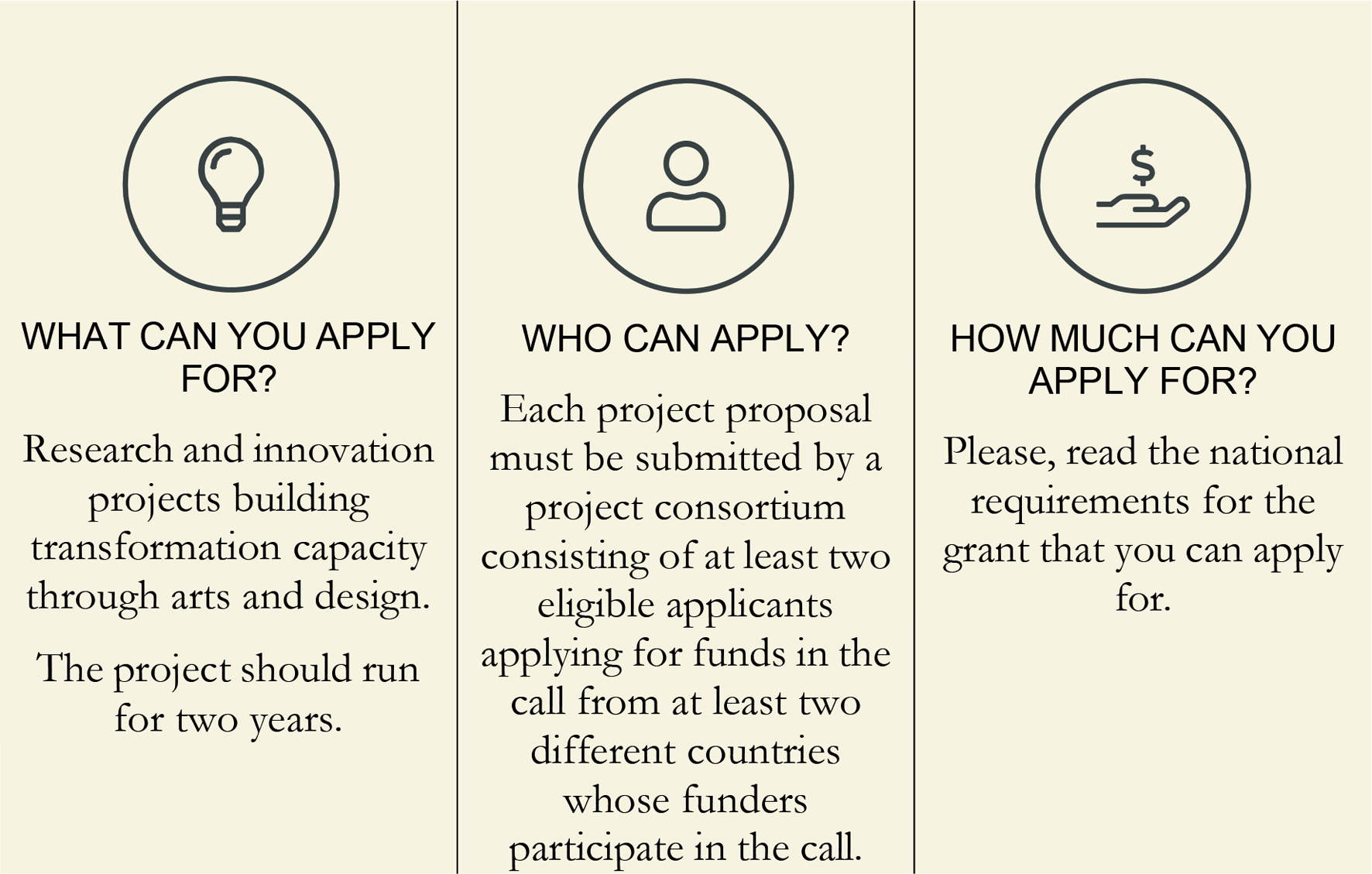
The call targets the following Sustainable Development Goals:
Revision history
Any changes to the call text are listed below.
|
Date |
Change |
|---|---|
|
1. |
Introduction to the call |
3 |
|
|
1.1 |
Challenge |
3 |
|
|
1.2 |
Purpose |
3 |
|
|
1.3 |
Aim |
4 |
|
|
1.4 |
Request on the projects and its participants |
4 |
|
|
2. |
Topics |
4 |
|
|
2.1 |
Experimentation and co-creation for a beautiful and sustainable urban future |
4 |
|
|
2.2 |
Transformation to sustainable cities / urban transformation |
5 |
|
|
2.3 |
Designing Inclusive, Liveable and Green Neighbourhoods |
5 |
|
|
3. |
Example of methodology for projects: Key Enabling Methodologies (KEMs) |
6 |
|
|
4. |
Cross-sectorial projects involving neighbourhoods and community organisation |
6 |
|
|
4.1 |
Examples of project members |
7 |
|
|
4.2 |
Investigating existing priorities, needs and challenges of urban government authorities |
7 |
|
|
5. |
Eligibility criteria and guidelines for applicants |
7 |
|
|
5.1 |
Who can participate and apply |
7 |
|
|
5.2 |
Available budget and funding scheme |
9 |
|
|
5.3 |
What you can apply for |
9 |
|
|
5.4 |
Deadline for proposals |
9 |
|
|
5.5 |
Preparing and submitting an application |
10 |
|
|
5.6 |
Summary of the transnational eligibility criteria |
10 |
|
|
5.7 |
Eligibility check |
10 |
|
|
6. |
Assessment procedure |
11 |
|
|
6.1 |
Evaluation of proposal |
11 |
|
|
6.2 |
Redress Procedure |
11 |
|
|
6.3 |
Funding decision |
11 |
|
|
6.4 |
Time Schedule |
11 |
|
|
6.5 |
Evaluation criteria |
12 |
|
|
6.6 |
Conflicts of interest (Expert Panel) |
12 |
|
|
7. |
Project implementation |
13 |
|
|
7.1 |
Data management |
13 |
|
|
7.2 |
Project monitoring and reporting |
13 |
|
|
7.3 |
Programme activities |
13 |
|
|
7.4 |
Data protection |
13 |
|
|
8. |
Contact details and other information |
14 |
|
|
Annex A: Specific Funding Agencies’ Budgets and Rules of Eligibility |
15 |
||
|
Annex B: Data Management |
23 |
||
|
Annex C: Glossary |
24 |
||
This is the second call within the ERA Net Cofund Urban Transformation Capacities: ENUTC partnership. The first ENUTC-call generated transnational research and innovation projects that support capacity building for urban transformations. This second call has a similar scope but emphasizes the importance of imagination, creativity and the cultural sector, to support and enable the transformation of our societies towards a sustainable, climate neutral and just future.
Eight funding agencies from seven European countries have together an available budget for this call of approximately 4 million EUR. Each national/regional funding agency will provide funds directly to their eligible beneficiaries (applicants) in accordance with the agencies’ rules and regulations (see Annex A).
The call will be opened for two months (22 February – 25 April 2023) with the recommendations for funding end of September. The projects (consortium) will run for two years.
The projects will be evaluated in a one-step evaluation process by an international expert panel. Based on the results from the expert panel, the Call Steering Committee, consisting of one representative from each funding agency, will recommend the highest ranked projects for funding to their funding agencies.
Contracts will be settled between each funding agency and its beneficiaries during autumn 2023.
The start of the projects will be in November, and a Kick-Off meeting is planned to be held during November 2023.
Key elements: New European Bauhaus; Culture and Creative Sector; urban neighbourhood, Climate Neutral and Smart Cities.
Our current crisis is not only about the environment and the climate, but also a crisis of the imagination: we seem simply not capable of imagining the sustainable societies of tomorrow but are stuck in current modes of thinking and old solutions that were perhaps useful to solve old problems.
By involving the culture and creative sector1, the call will include new perspectives on the implementation of urban strategies that adapt and mitigate to climate change in urban districts, and more specific in the redesign of various specific neighbourhoods.
Involving the Culture and Creative Sector may have the potential to bring mechanisms to change by methodology and methods to envision the future, to imagine and create, open up new worlds, futures and imaginaries, and transform our minds, processes and tools in ways needed to achieve what needs to be achieved for the urban transition to occur.
Municipalities, city planners, construction companies, architects and other actors are developing urban strategies, based on the scientific results and the knowledge of urgent needs, to adapt or mitigate to a long term or radical climate change. The challenge is to implement these strategies and make change happen. This call focus on the building of transformation capacities with new perspectives to make the urban transition really happening by going beyond the usual procedures and by being more innovative and creative.
The purpose of the call “Building Transformation Capacities through arts and design: Unlocking the full potential for urban transitions” is to fund projects that focus on impact creation and implementation that Build Urban Transformation capacities inspired by the new perspectives, methodologies and approaches connected to the EU initiatives: the New European Bauhaus2 and the EU Mission: Climate Neutral and Smart Cities3.
In this call we use the same definition on Urban Transformation Capacities as in the first call ENUTC call4: as the process of building capacities such as skills, insights, tools, organisational and personal capabilities, working methods and processes, access to experiences and verifiable knowledge.
The aim of the call is to fund projects that are building transformation capacities towards climate neutral and sustainable cities by 2030 and that rely on aesthetic perspectives and approaches in terms of design, form architecture, art and cultural heritage and new forms of governance and collaboration, as well as by engaging citizens. The culture and creative sector, with artists, designers and/or other actors are important to resolve societal challenges. Scientists and practitioners, from the culture and creative sector or from other disciplines need each other to resolve these complex urban transitions.
The projects should have a scientific and theoretical background and a scientific perspective on its methodology and methods as well as on its analysis of the implementation. The projects can thus be connected to basic research or/and applied research or/and innovation, depending on the projects aim, purpose and selected methodology.
The call invites a main applicant who is coordinating a transnational consortium with applicants and participants from different sectors.
Developing and building upon processes and strategies, to enhance urban transformation capacities, involves a collaboration within society in general. In this call we specifically target the arts, cultural and creative sector to (re)design and (re)development the urban neighbourhood by collaborating with local organisations in cities. Applicants from different disciplines, organisations (example citizens organisations or grassroot organisations), and municipalities as well as from science, practice and innovation are welcome to apply.
More information regarding applicants eligible for funding and possibilities for applicants to participate with in-kind contributions are specified in the national regulations (Annex A).
The applicants can select between three topics when developing their projects. The three topics can be combined when relevant for the projects purpose, aim and methodology. The topics are
1. Experimentation and co-creation for a beautiful and sustainable urban future
2. Transformation to sustainable cities / urban transformation
3. Designing Inclusive, Liveable and Green Neighbourhoods
Key elements: inclusiveness; co-creation; experimentation; (re)design; (re)develop.
The New European Bauhaus is built upon the principle of inclusiveness: “from valuing diversity, to securing accessibility and affordability”. This principle resonates greatly with JPI Urban Europe’s and ENUTC’s ambitions of supporting co-creative and experimental projects, approaches and tools, that ensure that various bodies of knowledge(s) are mobilised to bridge the gap between science, technology, the arts, culture (cultural heritage) and ecology. Civil society play an important role in these innovative processes. Ensuring that local experiences and tacit knowledge of every day settings is part of the co-creation process to enable the building of sustainable and inclusive futures together. A future that is “beautiful for our eyes, minds, and souls”. As such, the arts and creative sectors have an important role to play as boundary spanners for urban transformation5. The ambitions for the transformation of our societies are high. To be able to deliver new ways to build sustainable, climate neutral neighbourhoods it is fundamental to use co-creation and radical mobilisation between disciplines, sectors, civil society, bodies of knowledge, etc.
In this call we look at the (re)design of neighbourhoods and new methodologies to (re)develop neighbourhoods in cities that are liveable, green and nature-based, and that rely on renewable energy and sustainable modes of transport with strong participation of the arts and creative sectors. Different approaches, disciplines, and methodologies than we are used to, are needed. In this call, we look specifically to fund collaborative projects that bring practitioners from arts and design together with urban planning and architecture.
Key elements: residential and public environments; architecture and design; biodiversity; ecological footprint.
Sustainable residential and public urban environments must rely on equal access to adequate, safe and financially attainable living accommodations, basic services and green areas for all socio-economic groups. Architecture and design must consider how their work affects individuals, socio-economic groups, communities, etc. to be able to design sustainable built urban environments. There is a need for inclusive public spaces6, blue-green infrastructure and an understanding for how the design of urban spaces can e.g., influence urban future(s) anticipating anthropogenic effects impact civic influence and participation, ecosystem services, gender equality and security.
It is central to use natural and cultural environments as resources when designing inclusive public urban environments such as parks, squares and courtyards. It is also important that people with different needs, abilities, beliefs and in different phases of life have equal access to services, cultural environments, nature and green areas. In a sustainable city, such urban spaces are not loosely connected parts, but the very building blocks for liveable neighbourhoods and communities in the urban context.
For transforming human practices towards an urban future which anticipated the anthropogenic effects, it is important to integrate issues of design, consumption behaviours, circular economy, energy use, mobility patterns, waste management and management of existing built environments. Furthermore, it is important to develop and design urban areas, neighbourhoods, streets, squares, etc. that promote more sustainable mobility patterns, renewable energy use and reduced consumption. For an urban future which anticipates climate change induced effects and crises, ensuring that human processes are not overshooting planetary boundaries while short falling on the social foundation7 is essential. One of the key questions is how we can decrease the ecological footprint by different multi-functional greening approaches, biophilic design and urban ecosystem restoration, without resulting in dilemma situations, where transforming one urban aspect has negative impacts on another8. An approach that is expected to be useful is for example nature-based solutions.
Last, but not least, there is a need for increased understanding of and new approaches and solutions for how social, financial and technical aspects of sustainable building, greening of neighbourhoods and renovation/redeveloping intertwine.
Key elements: different interests; democracy and participation; civil society.
To transform neighbourhoods and at the same time address and adhere to the needs of different groups of society will potentially lead to many conflict-laden decisions and processes. Taking measures to reduce car traffic, will lead to the need to adapt behaviour and to find new ways of how we move and can access urban services and infrastructure. Such conflicts can put democracy to the test as different interests need to be considered and it requires us to take a serious view on the tendency to mistrust democratic institutions and carve out clever participatory processes that address the conflict areas dead on. Well-functioning urban planning presupposes democracy and participation. There is a need for more knowledge and new solutions that bring into focus conflicts, accountability, legitimacy, justice, trust, consequences, and opportunities that come with democracy and participation. Specific capacities are required to address those needs, however, “what kind of capacity can actually deliver change towards sustainability that is transformative”9 remains a question to be addressed.
Here, new and accountable forms of dialogue with residents and co-creative dialogues in early stages of the planning process may be needed. Collaboration between the public sector, non-profit organisations, the arts and creative sectors and businesses need to be developed and enhanced, as well as the role of civil society in change and transition processes. To a high degree, public spaces and natural and cultural environments should be designed and used in ways that foster co-creation, social inclusion and a sense of community. There is a need for more knowledge, novel approaches and new solutions to how policies, laws, regulations, designs, management and innovations can contribute to sustainable and good urban environments for all.
Through resident proposals, dialogues, advocacy activities, social media and mobilisation, civil society and various social groups can be given the opportunity to influence how our cities are designed and governed. It is of great importance to investigate and develop how these processes are designed and given legitimacy.
We need more knowledge of what threatens basic democratic freedoms and rights, what obstructs participation and how spatial planning processes can be developed to ensure that democratic freedoms and rights are taken into consideration.
Key elements: vision and imagination; participation and co-creation; behaviour and empowerment; experimental environments and urban living labs.
In this call, we are inspired by the Key Enabling Methodologies that were developed in the Netherlands in order to have a successful Mission-driven Innovation Policy for the overarching theme Social Earning Capacity. Some of these KEMs provide a good framework for building transformation capacities in neighbourhoods and are described here to give insight in the expected approaches for this call (which may make use of other methods as well).
– Vision and imagination
Transformations require that we know where we are heading. Sometimes that goal is obvious, but more often it is necessary to design that goal, make an inspiring vision of the future visible and tangible by using imagination, thereby giving direction to change.
When (re)developing and/or (re)designing urban neighbourhoods it may help to map the current world and imagine new worlds, and view phenomena and problems differently. Methods could be described as foresight & imagination, shared vision development and pathways.
– Participation and co-creation
Missions involve many players with diverse interests. From citizens and companies to governments and domain experts. You want to involve them in the process, for the knowledge and experience they bring in, to enable them to take the initiative, but also to achieve commitment and support and to increase the chance that transitions will actually take place.
When (re)developing and/or (re)designing urban neighbourhoods the cultural and creative sector, residents, entrepreneurs and scientists need to be involved, co-creation may be the way to do this. There is a wide range of methods to involve stakeholders in co-creation and co-design, and projects applying in this call should somehow rely on such in their project design.
– Behaviour and empowerment
In order for a transition to succeed, a behavioural change is often required. And to do so, people must be able to make conscious choices and take control, but also in others, in addition to the citizen or consumer, behavioural change may be necessary to achieve transitions.
To change urban neighbourhoods into becoming more inclusive, liveable and green, more is needed than architecture and planning, since change is not merely in bricks and mortar or planting more trees. A liveable neighbourhood is also coloured by customs, individual beliefs, social norms and practices (etcetera: values, utopian thought, sense of community, participation, joy, excitement, happiness and love…) as well as by the design of the environment.
– Experimental Environments and urban living labs
There is therefore a need for environments in which a great diversity of groups (residents, artists, governments, researchers, companies, etc.) have the opportunity to come together and work together on different societal challenges. The experimental environments described here allow for simple interventions and early prototypes and can quickly be tested in the “real” world, without waiting for proof that something actually works.
To be able to build transformation capacities in neighbourhoods we expect real life experiments and testing using tools such as urban living labs. Urban transitions do not start in books or policy briefs, but are made in real neighbourhoods with real people.
The purpose of the call is that the project contributes to impact creation and implementation that build urban transformation capacities inspired by the new perspectives, methodologies and approaches connected to the EU initiatives: the New European Bauhaus11 and the EU Mission: Climate Neutral and Smart Cities12.
In order to build transformation capacities towards climate neutral and sustainable cities by 2030 and rely on aesthetic perspectives and approaches in terms of design, form architecture, art and cultural heritage and new forms of governance and collaboration, as well as by engaging citizens, it is imperative that projects are cross-sectorial.
The culture and creative sector, with artists, designers, and/or scientists and practitioners should be represented in the project. The extent of involvement of other project members may vary according to the context of the study proposed and national regulations of participating funding organisations (see Annex A).
Here are examples of projects members that can participate in the project:
– Research organisations (such as universities, university colleges, research institutes or other authorities with research undertakings).
– Urban government authorities (such as regional and local government institutions, municipalities and municipal organisations, city authorities, urban governments, urban public administrations, and infrastructure and service providers).
– Companies and commercial organisations (from industry, cooperatives, and small, medium and large enterprises), especially public utility companies (e.g. in the field of energy supply, other communal supply and disposal systems); infrastructure and service providers; real estate developers; investors; facility management providers; actors from the fields of energy, spatial and transport planning; transport authorities; entrepreneurs and innovators.
– Consumers (e.g. business enterprises and test households).
– Civil society including local and community organisations, non-governmental organisations, not-for-profit organisations, urban communities and inhabitants, as actors and agents of open innovation and systemic urban transformation towards climate neutral, inclusive, resilient and sustainable cities.
– Urban stakeholders might, for example, be involved in the choice of the topic of the proposal, in the design and advising on the project or/and in carrying out parts of the work programme. Therefore, consortia submitting proposals for this call are asked to describe how stakeholders, including urban government authorities, are actively involved in the project (such as throughout the various stages of project design, conduct, analysis and dissemination).
• Projects are expected to investigate to the ‘day-to-day’ work of urban government authorities by linking to ongoing processes and initiatives of urban government authorities as well as fitting into urban government authority policies and strategies (contributing to aims and/or implementation). This means that projects are expected to begin with an existing challenge or urban government authority project.
• Projects are expected to be relevant for urban government authorities and specify the reasons for urban government authority participation as well as the usefulness of outcomes through aligning with urban government authority needs to ensure matching priorities and impacts of research/ innovation projects. Therefore, projects are expected be practice-based, and apply and demonstrate science into everyday life urban settings including policies, strategies and ‘day-to-day’ practices.
• Urban government authorities can be involved in the co-creation and co-design, and in setting the goals and objectives of the project, ideally from proposal development stage, so that the project can sufficiently take the urban government authority perspective into account.
• Project outcomes are expected to be useful and practical, to be relevant for urban government authority officials. Ideally, they would be practice-based and adapted to needs and language of urban government authorities. Effective communication, i.e. ‘translation’ of complex science and technology concepts to risk-averse city decision-makers is thus key.
Some requirements are common for all applicants and all funding agencies.
In addition to these general requirements, there are specific funding agency rules which apply to applicants that claim funds from a specific funding agency (see Annex A). Applicants must pay careful attention to the relevant national funding rules and contact the relevant national contact person with any queries to avoid any issues related to national eligibility.
Each project proposal must be submitted by a project consortium consisting of at least two eligible applicants applying for funds in the call from at least two different countries whose funders participate in the call.
Applicants
Applicants are defined as organisations/institutions/companies (i.e. legal entities).
The Principal Investigator (PI) is defined as the person who is the lead investigator for an Applicant. Therefore, a consortium has the same number of PIs as applicants.
The Main Applicant coordinates the whole project.
In addition, a proposal must have at least one additional Co-applicants. The proposal may also include Cooperation Partners, described below.
Each PI is only allowed to participate in a maximum of two proposals, and only once as the PI of a Main Applicant.
Only applicants eligible for funding from participating organisations from the following countries are eligible to apply as a Main Applicant or Co-applicant: Belgium, Bulgaria, Latvia, Lithuania, the Netherlands, Poland, Romania and Sweden.
Further descriptions of Main Applicant, Co-applicant, Cooperation Partner and Project Consortium are outlined in Table 1 below.
Please, note that a specific funding agency may not fund each type of organisation. If a partner is ineligible for funding, the partner can still participate as a Cooperation Partner. Please see Annex A for specific national requirements.
Consortium
A consortium must consist primarily of eligible and fundable applicants active in different parts of the research and innovation system (i.e. strategic research, applied research, innovation/implementation) and across disciplines (such as natural sciences, social sciences, technical sciences and applied fields). See Table 1 for definitions and roles in a project consortium.
The applicants can be associated to the project as Main or Co-applicants (this is particularly expected for applied research and innovation proposals), or as Cooperation Partners that do not directly receive funding but can contribute to the project through various other forms (steering committee, advisor, provider of data). See Annex A for individual funders’ rules.
As the focus of this call is to fund projects that are building transformation capacities towards climate neutral and sustainable cities by 2030 the consortium must include at least one applicant from the culture and creative sector, and preferably at least one representative from citizens inhabitants (neighbourhoods) or a community organisation. either as a Main Applicant, Co-applicant, or Cooperation Partner, depending on the national eligibility criteria.
This call includes both a set of transnational requirements common for all applicants (i.e. transnational eligibility criteria) as well as national requirements for applicants participating in a consortium (i.e. national eligibility criteria).
All funded partners in this call will be funded by their national funding agencies in accordance with their respective national eligibility criteria. Please note that a specific national agency may not be able to fund all types of organisations. The national eligibility criteria for specific funding agencies can be found in Annex A. This also contains links to their respective websites. Applicants are encouraged to contact the relevant national contact person at the national funding agency about questions concerning the national eligibility.
|
Roles in project consortium |
Definition and description of the role |
|---|---|
|
Main Applicant |
• The Main Applicant coordinate the whole project. • Main Applicants are applicants eligible for funding included in the consortium and located in one of the countries participating in the call. • The Main Applicant is a person representing an applicant eligible for funding and submits a project proposal on behalf of the consortium. • The Main Applicant is responsible for running and managing the project. • The Main Applicant will be the contact point for the programme on behalf of the whole consortium throughout the duration of the application procedure and project. • The Main Applicant is responsible for the administrative management of the complete project. • The Main Applicant is responsible for overseeing the project activities. |
|
Co-applicants |
• Co-applicants are applicants other than the Main Applicant, eligible for funding included in the consortium and located in one of the countries participating in the call. • There may be more than one Co-applicant from any one country, if eligible in the national requirements. • If there is more than one Co-applicant from the same country, one of them may need to be identified as the national PI, depending on the national requirements. Please check with your national contact outlined in Annex A. |
|
Cooperation Partners |
• Consortium Partners that are ineligible for funding from participating agencies, e.g. partners from countries not participating in this call, or ineligible to receive funding from a participating country, may be included in a project application as Cooperation Partners. • A clear description/indication of the role and form of engagement of these Cooperation Partners should be included in the proposal. • A written commitment (Letter of Intent) from Cooperation Partners, participating with their own funding or with an in-kind contribution should be submitted with the proposal. Cooperation Partners do not count toward the minimum of two eligible applicants from at least two different participating countries. |
|
Project consortium |
• The consortium needs to be balanced between countries both in terms of number of the eligible partners and distribution of budget. • There is no limit to the total number of partners who may be involved in each project. However, proposals for projects submitted by a consortium comprising applicants (main applicant and co-applicants) from approximately 2–4 funding agencies are expected. |
The total available budget for this call is approximately 3,5 million EUR. Based on this budget, the ENUTC funding agencies expect to fund approximately 5–8 proposals.
Each national/regional funding agency will provide funds directly to their eligible beneficiaries in accordance with the agencies’ rules and regulations. Annex A outlines the national and regional contribution that is available for this call from each funding agency, and funding rules and guidelines for each national/regional funding agency.
Project duration
The expected project duration is two years i.e. the project duration applied for may not exceed 24 months. The end date of a project should be harmonised for all applicants in the same consortium. Please check the regional/national eligibility guidelines (in Annex A) for further requirements.
Funding
There are no fixed minimum or maximum limits for a project size.
There are national funding limits for the respective applicants in the consortium. Annex A indicates the interval of funds available from each of the participating national funding agencies in this call and more information on the specific funding agencies’ rules.
In the proposal a justification of the requested budget is required. The estimated budget must be given in EUR only. The proposal template for the budget must be used. In case of doubt, applicants should consult their respective funding agencies. Please note, that some funding agencies require the submission of a national budget form as an attachment to the proposal at this stage (see Annex A).
Funding agencies’ rules and eligibility criteria
In addition to the general rules and procedures laid out in this document, there may be specific funding agencies’ rules (e.g. funding agencies’ eligibility criteria for certain organisations, co-funding requirements, national evaluation rules, etc.).
Please note also there are limitations regarding the types of activities that different funding agencies can support.
It is strongly recommended that these are checked with the contact person at the respective funding agency before submitting a proposal. See Annex A for more information.
Proposals must be submitted on the UEFISCDI electronic submission system, UDiManager (www.uefiscdi-direct.ro).
An online help document with guidelines for submission will be provided, detailing the procedures and duties of the Main Applicant and of its Co-applicants.
It is not possible to resubmit or revise the proposal after the submission deadline, unless it pertains corrections to technical-administrative details and per request of the funding agencies.
By submitting a proposal, applicants agree that it will be forwarded to the responsible funding agency as well as to all other participating funding agencies involved in this action.
If technical questions about the use of the system remain, please contact the Call Secretariat at UEFISCDI (see section 6).
• Each consortium submitting a proposal must involve at least two eligible applicants applying for funds in the call from at least two different countries whose funders participate in the call. All three legal entities must be independent from each other.
• The culture and creative sector, with artists, designers, and/or scientists and practitioners should be represented in the project. The extent of involvement of other project members may vary according to the context of the study proposed and national regulations of participating funding organisations (see Annex A).
• Main and Co-Applicants must be eligible to be funded by their national/regional participating funding organisation(s).
• The duration of a project must not exceed 2 years (i.e. 24 months).
• Proposals must be written in English using the required application form. Proposals written in other languages will be inadmissible. The whole application form must be filled in.
Incomplete application forms will be inadmissible. The detailed budget and the funding demand must also be uploaded on the submission platform.
• Proposals must be submitted before the corresponding deadline indicated in section 5.4 of this call for proposals.
• Each Main Applicant/PI must only participate in a maximum of two proposals, andonly once as a Main Applicant. Some countries only allow the participation of a PI in one proposal, please check the regional/national eligibility guidelines in Annex A for further requirements.
• Each PI must include their CV in English including their complete first and last name and with information about participation in previous projects.
• Ineligible applicants (e.g. from other countries or ineligible to receive funding from a participating country) can be included in the consortium as a Cooperation Partner if:
a: they finance their activity from other sources, and
b: the consortium in general fulfils the requirements on the number of applicants from participating countries.
• A written commitment (Letter of Intent) from the Cooperation Partners, participating with their own finance or with an in-kind contribution should be submitted with the proposal.
• No applicant may represent more than 60% of the total budget of the project (some countries may also impose lower participation levels or maximum budgets for their funding, regional/national eligibility guidelines can be found in Annex A). It is strongly recommended that the budget is checked with the contact person at the respective funding agency before submitting a proposal.
The Call Secretariat will verify the eligibility of the proposals according to the transnational eligibility criteria described in the previous section.
The participating funding agencies will perform a check for compliance according to their funding rules.
Both transnational and funding agencies’ eligibility criteria must be met. In the case that errors occur, applicants may receive the opportunity to correct these.
If either the Main Applicant or the proposal does not meet the eligibility requirements, the proposal will not be admitted to the evaluation procedure.
In case (a) Co-applicant(s) is (are) ineligible, the proposal may still be eligible if and when the eligibility criteria are met by the proposal without this (these) partner(s). In both cases, this will be communicated to the Main Applicant.
If a proposal is “eligible”, this does not mean that it will be awarded funding, but only that the proposal will be admitted to the evaluation procedure.
The proposals will be assessed by an Expert Panel composed of international experts. The Expert Panel will consist of recognised experts in relevant fields, academics as well as practitioners and innovators, who can assess the scientific as well as the innovative and practical value of the submitted full proposals. The panel will be appointed by the funding agencies. No other external referees or reviewers will be part of the assessment at this stage. The Expert Panel will assess the proposals using the evaluation criteria described in section 6.5.
Each proposal will be evaluated by at least four independent experts. The Expert Panel will meet to discuss all proposals, to produce an assessment report for each proposal and a ranking list of proposals recommended to be considered for funding to the funding agencies.
Applicants will have no possibility to rebut the Expert Panel’s evaluation.
Based on the ranking by the Expert Panel and considering the available (national) budgets, the participating national and regional funding agencies will make funding decisions.
Applicants can appeal against the evaluation outcome if they suspect a breach in the application of the evaluation and selection procedures. This redress procedure only covers the procedural aspects of the evaluation and/or eligibility checks, including the national eligibility checks. The redress will not call into question the scientific or technical judgement of appropriately qualified experts. In this case of an appeal the main applicant shall submit the appeal to the ENUTC partnership Coordination Team (readdress: enutc@formas.se) and the call secretariat (btc_enutc@formas.se) via e-mail up to 14 calendar days after the date of dispatch of the evaluation outcome. The proposal outcome e-mail containing the results of the evaluation will give information on the appeals procedure.
Funding decisions are final and cannot be appealed at the transnational level. A written statement on the evaluation of each full proposal will be sent to the Main Applicants by the Call Secretariat. The Call Secretariat will inform the Main Applicants of proposals that have been recommended for funding, and on the subsequent granting procedure. All consortia will be provided with an overall assessment of the quality of their proposal.
Note: Each project recommended for funding is required to have a signed consortium agreement (CA) between all partners within six months following the start of the project, addressing at least the following topics:
• Internal organisation and management of the consortium.
• Intellectual property arrangements.
• Settlement of internal disputes.
The CA is needed prior to the start of the project for all projects together with enterprises. See: https://eurlex.europa.eu/legal-content/EN/TXT/PDF/?uri=CELEX:52014XC0627(01)&from=EN, par. 27.
Please note that national and regional funding agencies’ regulations concerning the requirement for a CA, including the date of the signature, may also apply.
|
22 February 2023 |
Call opens |
|
25 April 2023, 14:00:00 CET |
Deadline submission of proposals |
|
May – August 2023 |
Eligibility check, evaluation of proposals |
|
September 2023 |
Meeting of Expert Panel |
|
September 2023 |
Funding recommendation by the Call Steering Committee |
|
October 2023 |
National funding decisions and announcement of results to Main Applicants |
|
November 2023 |
Granting and start of the projects |
|
November 2023 |
Kick-off meeting |
|
November 2024 |
Mid-term projects event |
|
November 2025 |
Final projects event |
Proposals will be assessed according to specific evaluation criteria by using a common evaluation form. A scoring system from 0 to 5 will be used to evaluate the proposal’s performance with respect to the different evaluation criteria.
|
Excellence – Merit |
5 points |
|
■ Clarity and pertinence of the objectives ■ Appropriateness of conceptual approach ■ Added value of transnational cooperation ■ Feasibility of aims and objectives of project ■ Feasibility and suitability of project design and methods ■ Handling of development risks ■ Originality, contribution to new strategic knowledge, advancing the state of the art ■ Innovativeness of the approach compared to existing solutions |
|
|
Impact and User Engagement (societal and broader impacts of project results) |
5 points |
|
■ Fit to address the aims, expectations, expected impacts, challenges and topics of the call text ■ Integration of gender and diversity perspectives in the project plan and goals when applicable ■ Engagement of urban stakeholders (e.g. government authorities, civil societies and the private sector) in co-creation and co-design, and the extent to which the project is likely to be of value to urban stakeholders ■ Suitability of proposed arrangements for disseminating and communicating outcomes of the project ■ Potential of the project to provide insights to an important societal issue and produce useful knowledge for stakeholders/decision-makers/practitioners ■ Market potential of the project, capacity to respond to a demand or a need ■ Use of new technologies and tools aiming towards implementation of research and innovation and ensure possibilities for scaling up |
|
|
Quality (Transdisciplinarity and Personnel) and Efficiency of Project Implementation |
5 points |
|
■ Value for money ■ Appropriateness of costing ■ Feasibility and appropriateness of timescale ■ Suitability of expertise, balance of substantial contributions of members to project consortium ■ Composition of consortium compared to the topic’s needs, transnational relevance and complementarities ■ Transdisciplinary, cross-sectorial collaboration, and co-creation ■ Adequateness of the work package structure and work plan ■ Appropriateness of governance/management arrangements for project ■ Risk assessment, regulatory and ethics issues properly addressed (when necessary) ■ Other key expertise of consortium members ■ Involvement from widening countries |
|
Evaluation scores will be awarded for each of the three main criterion and not for the individual sub-criteria. For proposals, each main criterion will be scored by the Expert Panel, using the following scale:
0: Failure. The proposal fails to address the criterion in question or cannot be judged because of missing or incomplete information.
1: Poor. The proposal shows serious weaknesses in relation to the criterion in question.
2: Fair. The proposal generally addresses the criterion, but there are significant weaknesses that need corrections.
3: Good. The proposal addresses the criterion in question well, but certain improvements are necessary.
4: Very good. The proposal addresses the criterion very well, but small improvements are possible.
5: Excellent. The proposal successfully addresses all aspects of the criterion in question.
All projects are ranked by the Expert Panel. The Call Steering Committee will recommend the highest ranked projects for funding based on the available funding and provided that the projects are above the threshold for the evaluation criteria. The threshold for individual criteria is 3. The overall threshold, applying to the sum of the three individual scores, is 10. The funding agencies make the final decision about which proposals will be funded based on the ranking list and available funding.
All necessary steps will be taken by the Call Secretariat to ensure no major conflict of interest by Expert Panel members. The Expert Panel members will be required to formally declare that no conflict of interest exists at any time of their evaluation duty and will sign a confidentiality agreement concerning all documents and the entire process. In case of breaching the rule of no conflict of interest, means of reconciliation will be sought with the support of the Call Secretariat. In cases of major conflict of interest that cannot be dealt with, the Expert Panel member will be discharged from participation in the evaluation process for the specific proposal, which is the subject of the conflict of interest. Projects that were assigned to the respective Expert Panel member will be assigned to another Expert Panel member.
The Call Secretariat will perform a first review of potential conflicts of interest before sending the proposals to the Expert Panel members. Expert Panel members are bound to indicate after receiving the proposals whether there is a conflict of interest with any of the researchers or research groups in the proposals for review. Expert Panel members will sign a formal declaration that they will not participate in the call nor have any conflicting interests regarding the researchers or research groups participating in the projects that they review.
This call is part of JPI Urban Europe and connected to the DUT partnership that includes various joint programme activities (e.g. knowledge sharing and networking) described in this section. Projects funded via this call will become part of the programme of JPI Urban Europe. Participants of projects funded in this call are expected to actively participate in the programme activities and to consider this in the planning of their project proposal by including a budget to participate in the programme activities.
JPI Urban Europe wish to promote open, transparent and robust urban and global change research by encouraging more open sharing of research data, leading to wider data analysis, more data reuse and the combination of datasets from multiple sources. JPI Urban Europe believes that an increased emphasis on the open sharing of research data has the potential to stimulate new approaches to the collection, analysis, validation and management of data, and to the transparency of the research process. However, JPI Urban Europe also recognise that not all research data can be shared openly, and that there will be legitimate reasons to constrain access, for example the risks to the privacy of individuals must always be considered where data arise from, or are derived from, personally identifiable data.
Project monitoring and reporting will be in accordance with the respective funding agency’s rules. In addition to the funding agency’s requirements, the consortia are expected to deliver progress reports to the Call Secretariat, in English, on an annual basis, including a description of their transnational cooperation and a publishable summary of the project status. Project reports should also be published openly. A reporting template will be provided on the programme website. A detailed survey must be completed by the Main Applicant together with the annual joint reports. This survey includes key performance indicators for project progress and their contribution to the overall aim of the call. The funding agencies will follow the progress of the transnational cooperation in the projects.
The coordination of the programme is seen as very important for creating added value to the researchers involved in the programme. Three project events are foreseen. A project kick-off will be organised in 2023, a mid-term event in 2024 and a final event in 2025. Active participation of the funded projects is obligatory, e.g. by preparing short project presentations and/or posters. All consortia of funded projects are expected to prepare popular science summaries of the project contents for programme activities and JPI Urban Europe publications (e.g. for brochures, (digital) newsletters, the website etc.). Time and budget (of a maximum of EUR 20 000) should be reserved by the consortium for monitoring and programme activities.
All funded projects are expected to deliver openly publishable reports for promoting the research results. In the final phase, BTC_ENUTC communication activities strive to engage researchers to take part in knowledge sharing that involves researchers in other fields, and in dialogue with practitioners and policymakers. Projects will typically be grouped for coordinated outreach activities. Publishable reports and results will be published on the JPI Urban Europe website. Results will also be distributed through interviews, policy briefs, fact sheets, and in the Projects Catalogue. Projects will be involved in dedicated activities to implement and exploit results and outcomes. A final report is to be delivered to the Call Secretariat.
The provisions of the General Data Protection Regulation (GDPR) shall be complied by the Call Secretariat and the funding agencies participating in the organisation of this call with respect to the processing of personal data.
Depending on the country and the participating funding agency, different national laws might apply, and different electronic systems will be used regarding the processing of personal data.
Please note that by submitting your proposal, the proposal will be forwarded to your responsible funding agency as well as to all other participating funding agencies involved in this call and the Expert Panel.
General information on the joint call
Updated information on this joint call and all relevant documents/templates are published on www.jpiurbaneurope.eu.
Call Secretariat
If you have questions on the general call process and proposal submission, please contact the call secretariat: btc_enutc@formas.se
Contact Points Call Secretariat:
Kristina Laurell, Chair of Call Secretariat
Formas – Formas – A Swedish Research Council for Sustainable Development
Email: kristina.laurell@formas.ses
Tel.: +46 70 775 40 59
Elena Simion, Responsible for submission platform and technical questions
UEFISCDI – Executive Agency for Higher Education, Research, Development and Innovation Funding
Email: elena.simion@uefiscdi.ro
Tel.: +40 21 307 19 93
Contact points of participating funding agencies
Specific information about funding agencies’ rules and additional forms, as will the details of national contact persons at the participating funding agencies are listed in Annex A.
|
Country |
Funding agency |
Budget: Funding (€) |
What can be funded |
Maximum funding per project |
Anticipated number of projects |
Organisations eligible for funding Universities and research organisation |
Organisations eligible for funding Municipalities |
Organisations eligible for funding Business organisations and companies |
Organisations eligible for funding NGOs and similar |
|---|---|---|---|---|---|---|---|---|---|
|
Belgium |
Innoviris |
300 000 € |
– Strategic research – Applied research – Innovation |
N/A |
1–2 |
Yes |
Yes |
Yes |
Yes |
|
Bulgaria |
BNSF |
383 468 € |
– Strategic/basic research projects only |
102 258 € |
3 |
YES |
NO |
NO |
NO |
|
Latvia |
LZP |
600 000 € |
– Strategic research – Applied research |
100.000 EUR/year |
3 |
Yes |
No |
Yes (subject to eligibility rules) |
No |
|
The Netherlands |
Regieorgaan SIA |
600 000 € |
Applied Research |
N/A |
3 |
YES (universities of applied sciences) |
YES (max. 25% of funding) |
YES (max. 25% of funding) |
YES (max. 25% of funding) |
|
Poland |
NCN |
500 000 € |
– Strategic/basic research |
N/A |
N/A |
YES |
YES |
YES |
YES |
|
Romania |
UEFISCDI |
500 000 € |
– Strategic research – Applied research – Innovation and implementation |
250 000 € if Romanian Main Applicant/PI 200 000 € otherwise |
2-3 |
YES |
YES (under conditions) |
YES |
YES |
|
Sweden |
Formas and SWEA |
600 000 € 400 000 € |
– Strategic research – Applied research – Innovation and implementation |
N/A |
5 |
YES |
YES |
YES |
YES |
|
Country/ Region |
Belgium/Brussels Region |
||||||
|---|---|---|---|---|---|---|---|
|
Funding organisation |
Innoviris |
||||||
|
National contacts |
Kourosch ABBASPOUR TEHRANI E-mail: katehrani@innoviris.brussels Tel: +32 2 600 50 30 Website: www.innoviris.be |
||||||
|
Funding commitment |
300 000€ |
||||||
|
Anticipated number of projects with Belgian partners |
1–2 |
||||||
|
Maximum funding per awarded project |
N/A |
||||||
|
Eligibility of a partner as a beneficiary institution |
Innoviris can fund private and public enterprises, regional administrations,municipalities, associations, and research organisations. Associations, municipalities and public administrations must submit at Innoviris an official document called “declaration of activities”. This document will be analysed and will allow to determine the eligibility and funding level. Regional criteria for funding: 1) Brussels projects needs to fulfil specific regional eligibility and funding criteria • The applicant must have at least one place of business in the Brussels Capital Region • Regional beneficiary will perform a research or innovation activity in the project • The project will be innovative and will present the positive impact on the Region (on the economy or the society) • Regional Beneficiary has not received public funding for the same activities • Regional Beneficiary has fulfilled the obligations in the context of previous grants allocated by the Region • The research work may not have started before the application for funding is submitted. • All applicants should demonstrate their viability and financial soundness regarding their own contribution to the project and the implementation of the results. 2) The involvement of a public actor from the Brussels Region is mandatory (urban administration, municipality, etc.). They can participate as co-applicant or cooperation partner. All applicants should demonstrate their viability and financial soundness regarding their own contribution to the project and the implementation of the results. 3) A project that significantly harms the social and environmental objectives of the Region cannot receive financial support. |
||||||
|
Eligibility of costs |
Maximum funding rates |
||||||
|
Large enterprises |
Medium size enterprises |
Small enterprises |
Research organisations, universities associations and administrations without economic activity |
||||
|
applied research |
65% |
75% |
80% |
100% |
|||
|
experimental research-innovation |
40% |
50% |
60% |
100% |
|||
|
Eligible costs |
○ Please check detailed eligible costs categories at: https://innoviris.brussels/documents/general-accounting-directives-2021 |
||||||
|
Submission of the proposals at the national level |
The proposal of the Brussels participants needs to be submitted, using the regional templates, to Innoviris by April 25 2023 at 14h (UTC+1). These templates are mandatory to check the regional eligibility. We recommend that the applicants contact Innoviris as soon as possible and ultimately 2 weeks before the deadline to check the eligibility aspects. A dedicated web page and regional application template will be published at www.innoviris.be. |
||||||
|
Submission of financial and progress reports at the national level |
Annual financial and activity reporting. |
||||||
|
Information available at |
|||||||
|
Other |
Please note that Innoviris does not allow multiple funding; the principal investigator should clearly state how the proposed project differs from other granted projects. We strongly recommend contacting the regional NCP during the preparation of the project: https://hub.brussels/en/services/european-subsidies-for-research-and-innovation. |
||||||
|
Country/Region |
Bulgaria |
|---|---|
|
Funding organisation |
Bulgarian National Science Fund |
|
National contacts |
Mrs. Milena Aleksandrova Email: aleksandrova@mon.bg Tel.: +359 884 171 363 |
|
Funding commitment |
306 775 € |
|
Anticipated number of projects with Bulgarian partners |
3 projects |
|
Maximum funding per awarded project |
102 258 € |
|
Eligibility of a partner as a beneficiary institution |
1) Accredited universities as defined in Art.85 para.1, p. 7 of the Higher Education Act; 2) Research organizations as defined in Art. 47, para 1 of the Higher Education Act. http://lll.mon.bg/uploaded_files/zkn_visseto_obr_01.03.2016_EN.pdf |
|
Eligibility of costs |
Eligible costs are specified in” National requirements and eligibility conditions” of Bulgarian National Science Fund available at: https://www.fni.bg/sites/default/files/competition/12_2016/ERA/BNSF_I nternational_Programs-2017_ENG.pdf |
|
Submission of the proposals at the national level |
Applicants have to submit an application form for national eligibility when submitting the proposals. The form, entitled „Administrative description of the project“ should be filled in both Bulgarian and in English and signed. Application forms can be obtained at: https://www.fni.bg/?q=node/578 They have to be sent it back by post or in person to BNSF Registry Office before the deadline of 1stage proposal submission. |
|
Submission of financial and progress reports at the national level |
Yes, annual financial and activity reporting |
|
Information available at |
|
|
Other |
Applicants under this procedure shall be directly responsible for the implementation of the activities under the project proposal and shall not act as intermediaries, but they shall carry out activities under the project proposal on their behalf and at their expense. Applicants to this procedure must be entities: – Carrying out fundamental research studies; and – Whose activities are entirely of a non-profit nature; or – Whose activities are of both for-profit and not-for-profit nature, but these activities are clearly distinguished, and their organization allows tracking of revenue and expenditures connected with their implementation, including by keeping analytical accounting. In the event that an applicant is involved in both for-profit and not-for-profit activities, the funding, expenditures and revenues shall be taken into account separately for each type of activity and on the basis of consistently applied principles of accounting of expenditures being justifiable. |
|
Country/Region |
Latvia |
|---|---|
|
Funding organisation |
Latvian Council of Science (LCS) |
|
National contacts |
Maija Bundule E-mail: Maija.Bundule@lzp.gov.lv Tel: +371-26514481 Uldis Berkis E-mail: Uldis.Berkis@lzp.gov.lv Tel.: +371-29472349 |
|
Funding commitment |
600 000 € |
|
Anticipated number of projects with Latvian partners |
Max 2 |
|
Maximum funding per awarded project |
100 000 €/year (i.e. 200.000 per partner for a 24m project), max 2 Latvian partners per project |
|
Eligibility of a partner as a beneficiary institution |
1) Research institutions registered in the Latvian Registry of Scientific Institutions, e.g. – Research Institutes – Universities And must have the status of Research and knowledge dissemination organization (Regulation EC 651/2014) 2) Business enterprises entered into the Latvian Commercial registry as companies, assumed they are eligible to do the specific research and have specific capacity and resources to do the research in Latvia and have their main activity in Latvia. Limitations of EU legislation apply (R651/2014) together with financial reporting requirements, in this case this is state aid. Two previous statements with sworn auditor’s approval should be provided and they must reflect the correspondence to the regulation as well as evidence of previous scientific activity and presence of capacity. Any other type of partner can not be funded by LCS |
|
Eligibility of costs |
• Personnel costs incl. taxes; • Consumables; • Subcontracts (up to 25% of direct costs), needs detailed justification, includes all external services, project core activities cannot be subcontracted; • Equipment (only depreciation costs); • Travels (according to travel plan); • Indirect costs (up to 25% of direct costs excluding subcontracting). Costs must be research costs, there is no support for other activities. |
|
Submission of the proposals at the national level |
No |
|
Submission of financial and progress reports at the national level |
Yes, according to national agreement |
|
Information available at |
Support is provided according to Provisions Nr 259, 26.05.2015 of the Latvian Cabinet of Ministers (http://likumi.lv/ta/id/274671-atbalsta-pieskirsanas-kartiba-dalibaistarptautiskas-sadarbibas-programmas-petniecibas-un-tehnologiju-joma) These provisions should be respected without exceptions. The maximum rates should respect the Provisions. The requirements in the provisions to specific applicant groups must be respected. |
|
Other |
Applicants might be asked to provide additional information in order to assess their eligibility. Applicants are obliged to provide any information specified by Provisions of the Cabinet of ministers No 259, 26.05.2015 upon request. To release the funding, duly signed Consortium Agreement must be presented to LCS. LCS cannot fund implementation support, nor training activities. LCS is not funding infrastructures. |
|
Country/Region |
The Netherlands |
|||
|---|---|---|---|---|
|
Funding organisation |
Taskforce for Applied Research SIA (Regieorgaan SIA) |
|||
|
National contact person |
Marcus van Leeuwen E-mail: marcus.vanleeuwen@regieorgaan-sia.nl Tel.: +31 6 12 25 32 27 |
|||
|
Funding commitment SIA |
€ 600,000 |
|||
|
Anticipated number of projects with Dutch partners |
3 |
|||
|
Maximum funding per awarded project |
€ 200,000 |
|||
|
Eligibility of a partner as a beneficiary institution |
Universities of Applied Sciences (UAS) Specifications: as referred to in Article 1.8 of the Dutch Higher Education and Research Act (Wet op het hoger onderwijs en wetenschappelijk onderzoek, WHW). The board of the UAS should be informed about the submission of this proposal and agree with its content. |
|||
|
Eligibility of costs |
Funding for UAS: no limit on number of positions, rates based on Handleiding Overheidstarieven 2023 (HOT), costs for the participation of students and material costs (including costs of other partners then UAS). The tariffs of 2023 may be applied for the entire duration of the project. Personnel at UAS The accepted tariff of the HOT are as follows: |
|||
|
Scale |
tariff per hour |
Scale |
tariff per hour |
|
|
1 |
€ 47 |
10 |
€ 78 |
|
|
2 |
€ 49 |
11 |
€ 86 |
|
|
3 |
€ 52 |
12 |
€ 97 |
|
|
4 |
€ 54 |
13 |
€ 108 |
|
|
5 |
€ 57 |
14 |
€ 118 |
|
|
6 |
€ 59 |
15 |
€ 127 |
|
|
7 |
€ 63 |
16 |
€ 136 |
|
|
8 |
€ 67 |
17 |
€ 146 |
|
|
9 |
€ 72 |
18 |
€ 158 |
|
|
Higher tariffs than HOT are not allowed. |
||||
|
Other partners Other partners (than UAS), like enterprises, public authorities and/or NGO’s may be funded within the project and are always part of the material costs. The maximum hourly tariff that is available for funding is limited to € 130 per hour. In total the maximum allowed funding for other consortium partners, not being the universities of applied sciences, is 25% of the funding by SIA. Participation of students It is allowed for students, connected to the university of applied sciences, to work within the project. Costs related to the activities of students within the project are applicable for funding maximum tariff of € 25 per hour). Material Costs Material costs include consumables, equipment, test set-ups, open access publications, (inter)national travel and accommodation costs, access to major (inter)national facilities and costs for permits, software licenses, patents, fieldwork, guest researchers and audit reports necessary for implementation of the research project. For goods and services it must be demonstrable that they are mainly presented for the benefit of the project. The overheads, including basic facilities in housing, automation, finance and maintenance, and commuting expenses are not eligible for subsidy. Do not hesitate to contact the national contact person in case of questions. |
||||
|
Submission of the proposal at the national level |
This is not necessary. SIA will receive your application via the Call Secretariat at UEFISCDI. Applicants are required to submit a mandatory SIA budget form. |
|||
|
Submission of financial and progress reports at the national level |
Yes, submission of financial and scientific reports at national level is required in accordance with the rules of SIA. |
|||
|
Information available at |
For full details of the general SIA funding rules, please refer to: https://regieorgaan-sia.nl/financiering/projectbeheer/And for financial details: https://regieorgaan-sia.nl/financiering/projectfinanci%C3%ABn/ |
|||
|
Other |
The NWO Grant Rules 2.017 are applicable to the part of the project’s budget covered by Regieorgaan SIA. The NWO Grant Rules 2017 is applicable to the part of the project’s budget covered by Regieorgaan SIA. It is required to attach a SIA financial details form to the application (similar to RAAK-Publiek). This form will be available on the SIA-website www.regieorgaan-sia.nl or via www.regieorgaan-sia.nl/utc. Under the Dutch General Administrative Law Act, any interested party has the right to lodge an objection to the decision taken by Regieorgaan SIA, within six weeks of the date of the decision letter. Further information about the objections procedure can be found on the SIA website: https://regieorgaan-sia.nl/financiering/bezwaar-maken/ |
|||
|
maximum funding percentages |
|
|---|---|
|
Large Enterprises |
– |
|
Medium Enterprises |
50% |
|
Small Enterprises |
50% |
|
Universities of applied sciences, public research organisations |
100% |
|
Public authorities |
50% |
|
Associations without economic activities, NGOs |
50% |
|
Country/Region |
Poland |
|---|---|
|
Funding organisation |
National Science Centre |
|
National contacts |
Dr Katarzyna Jarecka – Stępień e-mail: katarzyna.jarecka-stepien@ncn.gov.pl Alicja Dyląg e-mail: alicja.dylag@ncn.gov.pl |
|
Funding commitment |
0,5 M€ |
|
Anticipated number of projects with Polish partners |
N/A |
|
Maximum funding per awarded project |
N/A |
|
Eligibility of a partner as a beneficiary institution |
Proposals may be submitted by entities specified in Article 27 (1) of the Act on the National Science Centre (NCN). For further details on eligibility of applicants, as well as terms of entry, please check the Annex to the NCN Council’s Resolution on funding granted within calls for proposals for international research projects (UNISONO). |
|
Eligibility of costs |
We recommend all applicants to read information on eligible costs included in the Annex to NCN Council’s Resolution on funding granted within calls for proposals for international research projects (UNISONO) Applicants may apply for funding of costs relevant, necessary and directly connected to the proposed research project, including: • Salaries and scholarships (including → post-doc → positions and scholarships/salaries for students and PhD students); • Research equipment, devices and software: applicants may seek funding for research equipment up to PLN 500,000 per unit; • Other direct costs: materials and consumables, outsourcing and subcontracting, business trips, visits and consultations, collective investigators, other costs; • Overheads: overheads may not exceed a maximum of 20% of eligible costs and may not be increased during the course of a research project. Additionally, overheads of up to 2% of direct costs may be spent on open access to publications and research data. Please note that administrative personnel costs, as well as costs of organizing conferences, workshops, seminars, meetings are not considered direct costs and can only be funded from overheads. If one international project includes partners from at least two different Polish institutions, these institutions must apply as a group of entities (co-applicants). Each institution (co-applicant) comprising this group has a separate budget, but the limit on the remuneration applies to the group as a whole. The entity (co-applicant) that employs the Principal Investigator shall act as the leader of a group of entities (co-applicants). |
|
Submission of the proposals at the national level |
National level: the applicant prepares an NCN proposal and submits it to the NCN electronically via the ZSUN/OSF submission system available at www.osf.opi.org.pl, within 7 calendar days of the end of the last stage of submitting full proposals. The application will include a budget table that should be calculated according to the Annex to NCN Council’s Resolution on funding granted within calls for proposals for international research projects (UNISONO). Budget of the Polish part of the research project in the ZSUN/OSF system should be given in PLN (EURO exchange rate: 1 EUR = 4,2344 PLN). Project duration: 24 or 36 months. At the pre-proposal stage, Polish applicants are not required to send any additional documents to the NCN. |
|
Submission of financial and progress reports at the national level |
Submission of financial and scientific annual reports at national level is required. |
|
Information available at |
Applicants are obliged to adhere to the rules included in Annex to NCN Council’s Resolution on funding granted within calls for proposals for international research projects (UNISONO). More information can be found at: https://www.ncn.gov.pl/finansowanie-nauki/konkursy |
|
Other |
Only proposals involving basic research may be submitted by Polishapplicants in response to the call for proposals. Basic research is defined as experimental or theoretical endeavours undertaken to gain new knowledge of the foundations of phenomena and observable facts, without any direct commercial use. Other applicable documents: |
|
Country/Region |
Romania |
|---|---|
|
Funding organisation |
UEFISCDI (Executive Agency for Higher Education, Research, Development and Innovation Funding) |
|
National contacts |
Elena Simion E-mail: elena.simion@uefiscdi.ro Tel.: +4021 307 19 93 |
|
Funding commitment |
500.000 EUR |
|
Anticipated number of projects with Romanian partners |
2–3 |
|
Maximum funding per awarded project |
250.000 EUR if Romanian Main Applicant 200.000 EUR otherwise |
|
Eligibility of a partner as a beneficiary institution |
Legal entities established in Romania are eligible to get funding – public and private accredited universities, national R&D institutes, other research organisations, SMEs, large industrial enterprises |
|
Eligibility of costs |
Personnel costs, consumables, equipment, subcontracting, travel, overhead. |
|
Submission of the proposals at the national level |
Not required |
|
Submission of financial and progress reports at the national level |
Yearly basis |
|
Information available at |
https://uefiscdi.gov.ro/pachet-de-informatii-suprogramul-3-2-orizont-2020 |
|
Other |
Additional documents might be required from Romanian participants for determining national eligibility after the submission of pre-proposal/full proposals. |
|
Country/Region |
Sweden |
||||
|---|---|---|---|---|---|
|
Funding organisation |
Formas and The Swedish Energy Agency (SWEA). SWEA and Formas are collaborating closely. |
||||
|
National contact person |
Emina Pasic SWEA Email: Emina.Pasic@energimyndigheten.se Telephone: +46 (0)16 544 21 89 Kristina Laurell Formas Email: kristina.laurell@formas.ses Tel.: +46 70 775 40 59 |
||||
|
Funding commitment |
1 000 000 € (the total budget for Formas 600 000 and SWEA 400 000) |
||||
|
Anticipated number of projects with Swedish partners |
5 |
||||
|
Maximum funding per awarded project |
N/A |
||||
|
Eligibility of a partner as a beneficiary institution |
All actors operating in Sweden are eligible for funding. For example, public research organisations/institutions, cities/municipalities and civil sector can receive grants as well as large, medium sized and small enterprises. |
||||
|
Eligibility of costs |
The Swedish agencies can fund projects within both the research and the innovation pathways in the call. The Swedish agencies welcome projects related to all of the topics described in the call text. For information regarding eligible costs and the Swedish Energy Agency legislation see the Swedish National Call text for BTC_ ENUTC in link: http://www.energimyndigheten.se/utlysningar/ The proportion of a company’s level of support is determined partly based on which research category the various activities in the project are deemed to correspond to and partly based on the size of the company in receipt of the support. Table. 1. Overview of maximum level of support – the actual rate of funding will be decided case by case. |
||||
|
Type of research and development |
Non-economic actors* |
Small company14F1 |
Medium company |
Big company |
|
|
Fundamental research |
100% |
100% |
100% |
100% |
|
|
Industrial research |
100% |
70% |
60% |
50% |
|
|
Experimental development |
100% |
45% |
35% |
25% |
|
|
*) For example universities, university colleges, research institutes and cities/municipalities (excluding their economic entities). National criteria Research projects: ○ Up to 100% of the eligible project costs can be financed for research projects. See Table 1 Innovation projects: ○ Co-financing rate for innovation projects ((innovation projects (vetgedrukt) should be at least 50% of the total project costs. See Table 1 |
|||||
|
Submission of the proposal at the national level |
Following the full proposal stage of the international Expert Panel evaluation, the Swedish Principal Investigators in the projects recommended for funding will be invited to submit a national application to SWEA (via E-kanalen). Information about the submission will be provided in the invitation and by the contact person. |
||||
|
Submission of financial and progress reports at the national level |
Following the national project decision: the funded projects will be required to submit one financial and one progress report annually to SWEA (via E-kanalen). |
||||
|
Information available at |
For full information see the Swedish national call information for the BTC_ENUTC call on the SWEA webpage: http://www.energimyndigheten.se/utlysningar/ or www.swedishenergyagency.se and Formas webpage: ENUTC-utlysning 2023: Urban omställning i Europa genom konst och design – Formas |
||||
|
Other |
The Swedish funding agencies fund research and innovation projects that support system transformation into a modern and sustainable, fossil-free welfare society – applying our credibility, a comprehensive approach and courage. |
||||
Data Management Plan Requirements
A Data Management Plan (DMP) describes the data management life cycle for the data to be collected, processed and/or generated by a research project funded within this call. As part of making research data findable, accessible, interoperable and re-usable (FAIR), a DMP should include information on:
• the handling of research data during and after the end of the project;
• the types of data, samples, physical collections, software, curriculum materials, and other materials to be collected, processed and/or generated during the project;
• the standards to be used for data and metadata format and content (where existing standards are
• absent or deemed inadequate, this should be documented along with proposed solutions or remedies);
• policies for broad access and sharing including provisions for appropriate protection of privacy, confidentiality, security, intellectual property, or other rights or requirements;
• policies and provisions for re-use, re-distribution, and the production of derivatives;
• plans for archiving data, samples, and other research products, and for preservation of access to them via an institutionally supported repository.
|
Co-creation |
An approach where heterogenous actors collaborate to produce knowledge, instruments, technology, artefacts, policy, know-how, etc. |
|
Innovation |
A process in which new ideas (technologies, designs, procedures, etc.), and combinations of them, bring about changes in (sub)systems like supply chains, markets, urban regions, etc. This process can be incremental, radical or even disruptive. |
|
Interdisciplinarity |
A collaboration spanning multiple academic disciplines (e.g. natural sciences, social sciences, engineering sciences, technological sciences, medical sciences) and involving the application of complementary methodologies to more innovatively and comprehensively tackle a common problem than would otherwise be possible. |
|
Liveability |
The degree to which a place is suitable or good for living in. |
|
Open data |
Data that can be freely used, re-used and distributed by anyone. |
|
Resilience |
Resilience is the capacity of a system to cope with change and continue to develop. |
|
Sustainability |
A multifaceted property that describes the extent to which social, economic and environmental objectives are in balance; that economic activity is not declining, that non-renewable resource throughputs are minimised, and that society has high capital and is cohesive, equitable and inclusive. |
|
Transdisciplinarity |
A collaboration spanning multiple partners, both academic and non-academic, to solve a common problem. Non-academic partners may include city officials, (non-) governmental agencies and offices, charitable organisations, companies, civil society, grassroots movements etc. |
|
Transformation Capacity |
An urban system’s ability to adapt and implement more sustainable practices in environmental, technical, institutional and human resources dimensions. |
|
Urban area |
From a morphological perspective: an area encompassing one or more cities plus its built-up environs, irrespective of local body administrative boundaries, often subject to a minimum built-up density threshold and a minimum population size (e.g. clusters of contiguous grid cells of at least 300 inhabitants per km2 and a minimum population of 5 000). From a functional perspective: a continuous area including one or several urban centre(s) and all population settlements in which a significant proportion of the employed population works in the urban centre(s) or in localities connected to the urban centre(s). |
Cultural and creative sectors are comprised of all sectors whose activities are based on cultural values, or other artistic individual or collective creativeexpressions and are defined in the legal basis of the Creative Europe Programme Cultural and creative sectors | Culture and Creativity (Europa.eu).
https://research-and-innovation.ec.europa.eu/funding/funding-opportunities/funding-programmes-and-open-calls/horizon-europe/eu-missions- horizon-europe/climate-neutral-and-smart-cities_en.
ERA-NET Cofund Urban Transformation Capacities (ENUTC) | JPI Urban Europe (jpi-urbaneurope.eu).
Wolfram (2016) Conceptualizing urban transformative capacity: A framework for research and policy https://www.sciencedirect.com/science/article/abs/pii/S0264275115300032?via%3Dihub.
https://jpi-urbaneurope.eu/wp-content/uploads/2020/10/AGORA_PublicSpaces_PolicyPaper_Online.pdf.
Raworth, K. (2017). Doughnut economics: seven ways to think like a 21st-century economist. London: Random House.
For more on urban dilemmas see JPI Urban Europe (2019:14) Strategic Research and Innovation Agenda 2.0.
Wolfram, M., Borgström, S. & Farrelly, M (2019) Urban transformative capacity: From concept to practice. Ambio 48, 437–448.
Kopieer de link naar uw clipboard
https://zoek.officielebekendmakingen.nl/stcrt-2023-6530.html
De hier aangeboden pdf-bestanden van het Staatsblad, Staatscourant, Tractatenblad, provinciaal blad, gemeenteblad, waterschapsblad en blad gemeenschappelijke regeling vormen de formele bekendmakingen in de zin van de Bekendmakingswet en de Rijkswet goedkeuring en bekendmaking verdragen voor zover ze na 1 juli 2009 zijn uitgegeven. Voor pdf-publicaties van vóór deze datum geldt dat alleen de in papieren vorm uitgegeven bladen formele status hebben; de hier aangeboden elektronische versies daarvan worden bij wijze van service aangeboden.
 Authentieke versie (PDF)
 Informatie
 Printen
 Delen
Delen