Staatscourant van het Koninkrijk der Nederlanden
| Datum publicatie | Organisatie | Jaargang en nummer | Rubriek |
|---|---|---|---|
| Nederlandse Organisatie voor Wetenschappelijk Onderzoek | Staatscourant 2020, 38447 | Overig |

U bent nu hier: Publicaties Officiële publicaties
Zoals vergunningen, bouwplannen en lokale regelgeving.
Adressen en contactpersonen van overheidsorganisaties.

Science
2020 DeepNL call 2a
Contents
|
1 |
Introduction |
1 |
|
|
1.1 |
Background |
1 |
|
|
1.2 |
Available budget |
2 |
|
|
1.3 |
Validity of the call for proposals |
2 |
|
|
2 |
Aim |
2 |
|
|
2.1 |
DeepNL programme |
2 |
|
|
2.2 |
This Call for Proposals (DeepNL call 2a) |
3 |
|
|
3 |
Guidelines for applicants 5 |
3 |
|
|
3.1 |
Who can apply |
4 |
|
|
3.2 |
What can be applied for |
4 |
|
|
3.3 |
When can applications be submitted |
4 |
|
|
3.4 |
Preparing an application |
4 |
|
|
3.5 |
Conditions on granting |
4 |
|
|
3.6 |
Submitting an application |
6 |
|
|
4 |
Assessment procedure |
6 |
|
|
4.1 |
Procedure |
6 |
|
|
4.2 |
Criteria |
7 |
|
|
5 |
Contact details and other information |
8 |
|
|
5.1 |
Contact |
8 |
|
|
5.2 |
Other information |
8 |
|
|
6 |
Annexes: |
8 |
|
|
6.1 |
Explanation of the budget modules |
8 |
|
|
6.2 |
DeepNL programme description |
11 |
|
|
6.3 |
Description of current projects within the DeepNL programme |
23 |
|
The deep subsurface of the Netherlands has been relatively well characterised, and there is a qualitative understanding of the broad range of processes that are responsible for subsidence and seismic activity. However, we lack a sufficiently thorough quantitative understanding that can serve as a basis for deterministic models and predictions of the effect of human interventions in the deep subsurface. In this context, NWO has initiated the long-term DeepNL research programme. DeepNL will integrate and expand existing expertise within the Solid Earth Sciences field in the Netherlands and strengthen the related research disciplines. The DeepNL programme is part of NWO's contribution to the Top Sector Energyand addresses several scientific questions in the Dutch National Research Agenda,notably #55 ‘How do we protect ourselves against natural disasters?’, but also others such as #23 ‘How can we optimise our use of geothermal energy?’, #26 ‘How can we store, convert, and transport energy efficiently?’, #112 ‘Can we use big data and big data collection to define values, generate insights, and get answers?’ and #124 ‘How can we bridge different scales when modelling dynamic systems?’.
With DeepNL, NWO provides a concrete response to the report ‘Earthquake risks in Groningen’(published in 2015) in which the Dutch Safety Board recommended NWO, the Ministry of Economic Affairs & Climate Policy and the mining industry to ensure a structural and long-term research programme is put in place, in which integral and independent scientific and applied research is conducted into the effects and risks of gas extraction in Groningen and (planned) activities in the deep underground in other parts of the Netherlands. The aim of the Dutch Safety Board is to ensure that safety interests are given sufficient attention where activities deep underground are concerned.
This NWO research programme has, in part, been made possible by a substantial financial contribution from the natural gas exploration company NAM (‘Nederlandse Aardolie Maatschappij’). DeepNL will be realised in accordance with the rigorous NWO procedures and quality standards and is entirely independent. The NAM is not involved in the decision- making process or the management of the programme and its research. The full agreement between NWO and the NAM concerning the DeepNL programme can be found on the DeepNL website.
In the context of the DeepNL programme, several sequential funding rounds are organised between 2018 and 2023. For each funding round a call for proposals is published with the aim to select high quality research projects that will contribute to realising the objectives of the overarching programme (see chapter 2 and appendix 6.1). The first call for proposals (call 1a) was published in December 2017 and resulted in the first eight DeepNL projects.A second call for proposals (call 1b) was published in December 2019 and aims at increasing the continuity of research at Dutch universities on DeepNL topics by financing several tenure track positions, each with an associated research project. The outcome of this latter funding round is expected for the beginning of 2021. For both call 1a and 1b the emphasis of the research question lies on improving the knowledge of the dynamics of the subsurface related to gas production in the Groningen reservoir. The current document is the call for proposals for the third funding round (call 2a) and its goals are described in chapter 2. The tentative plans for the next years encompass one more funding round within the currently available overall DeepNL budget. In addition to the funding rounds, the DeepNL programme initiates activities to foster the integration of knowledge, synergy with stakeholders, network formation and outreach.
The maximum total budget available for this call for proposals is 2.5 million euros.
To be eligible for funding, a proposal must receive at least the qualification very good. This could mean that the available budget for this call is not completely used, and that part of it will be used in a later funding round within DeepNL.
DeepNL is a long-term NWO research programme which has the aim to improve the fundamental understanding of the dynamics of the subsurface under the influence of human activities. The focus of DeepNL is on developing quantitative and physics-based understanding of subsurface response to activities in the Netherlands, such as gas extraction, geothermal energy production, salt mining and CO2, energy and waste storage. The research addresses scientific questions concerning surface subsidence, induced seismicity and the integrity of the subsurface system. It requires the expansion and integration of scientific knowledge in various (sub)disciplines, both within and outside the field of Solid Earth Science. Ultimately, DeepNL should contribute to the development of a ground-breaking quantitative forecasting capacity, which can be used as a (geo)scientific basis for assessing the hazards and risks of human interventions in the deep subsurface.
DeepNL uses an integrated multidisciplinary approach in which research projects complement each other as much as possible and jointly form a focussed, coherent programme. The programme will develop a multi-scale, multi-physics, data-driven modelling methodology. This requires an integrated effort by the core research fields geomechanics and seismology (seismic imaging and physics of the seismic source), together with enabling (sub-)disciplines and methodologies such as rock and fault physics, multiphase fluid flow studies, applied mathematics, computational science, quantitative process modelling, analogue modelling, sensor development, up- and down-scaling, advanced data processing and statistical approaches.
A full description of the research theme, scientific challenges, objectives and the intended results can be found in the DeepNL programme description (see annex 6.2). In addition to the scientific objectives, the DeepNL programme aims to sustainably strengthen the research community in the Netherlands around this theme and to increase the coherency within the research field. Finally, each research project within the programme is expected to pay due attention to disseminating the knowledge and data generated within the DeepNL network, but also to other related research programmes, professionals from public and private sector and the general public.
In order to achieve the overarching objectives of DeepNL, research teams are expected to participate in activities in the context of progress monitoring and reporting, network building, knowledge dissemination (within and outside the DeepNL network) and outreach. These activities will be coordinated and initiated by the DeepNL programme committee in consultation with the researchers in the programme and facilitated by the NWO programme office.
Within this call for proposals applicants can request funding for a research project with the approximate size of one PhD or postdoc position. The call was developed with the aim to provide opportunities for: i) relevant and promising parts of proposals that could not be funded in the first DeepNL call, ii) improving the coherence and impact of DeepNL by addressing knowledge gaps, and iii) broadening of the DeepNL network with new researchers and expertise.
Research proposals have to fit within the scope of the DeepNL programme and contribute to reaching the goals and intended results of the programme (see annex 6.2). The research in the present phase of the DeepNL programme has a strong emphasis on improving quantitative modelling and forecasting of the dynamics of the subsurface as a consequence of gas production in the Groningen reservoir. Much is unknown about the processes related to the induced seismicity and subsidence experienced in this area and new questions still arise. It is, for example, not fully understood how the subsurface will respond to the reduction and eventual ending of gas production in 2022. This focus on the Groningen Gas Field consolidates the coherence within the DeepNL programme and the Groningen reservoir offers a uniquely monitored and defined situation, allowing scientists to advance the fundamental understanding of processes and development of methodologies. These advances will provide a more general knowledge platform for other (future) subsurface activities like production from small gas fields, geothermal energy production and CO2 and energy storage. Applications in this call for proposals are therefore required to contribute to the joint effort focussing on the Groningen reservoir, but are encouraged to develop process understanding and methodologies that are also relevant for other subsurface activities.
Applicants may focus their research either on the deepening or broadening of knowledge compared to the current DeepNL projects (see annex 6.3 for the current projects). In either case it has to be clear that the proposed research provides an added value compared to the current projects. In the assessment of the applications the criterion relevance and added value of for the DeepNL programme has the same weight as the criterion scientific quality, innovative character and academic impact (see Section 4.2).
Full, associate and assistant professors and other researchers1 with a comparable appointment can submit an application if:
– they are employed (i.e. hold a salaried position) at one of the following organisations:
○ Universities established in the Kingdom of the Netherlands;
○ University medical centres;
○ NWO and KNAW institutes;
○ the Netherlands Cancer Institute;
○ the Max Planck Institute for Psycholinguistics in Nijmegen;
○ the DUBBLE Beamline at the ESRF in Grenoble;
○ NCB Naturalis;
○ Advanced Research Centre for NanoLithography (ARCNL);
○ Princess Máxima Center.
– and also have an appointment period for at least the duration of the application procedure and the entire duration of the research for which the grant is being applied for. Personnel with a zero-hour appointment is excluded from applying.
An exception to the required duration of appointment can be made for:
– applicants with a “tenure track” appointment that does not cover the entire duration of the project. The applicants should then demonstrate by means of a letter that adequate supervision is guaranteed for the entire duration of the research for all researchers that they request funding for.
Additional conditions2:
– A proposal is submitted by a single main applicant and may include one single co-applicant if this is considered necessary due to the multidisciplinary nature of the proposal. It should be clear from the application that their expertise is complementary.
– An applicant may only submit one proposal as main applicant.
For a research proposal in this round, a maximum of € 350,000 can be applied for. The budget modules (including the maximum amounts) that are available within this call for proposals are stated in the table below. You should only request that which is essential for realising the research. Each research proposal should include at least one PhD or postdoc position.
|
Budget module |
Maximum amount |
|---|---|
|
PhD |
1 position, according to VSNU or NFU rates1 |
|
Postdoc |
1 position, according to VSNU or NFU rates1 |
|
Non-scientific staff at (NSS) universities |
€ 100.000, according to VSNU or NFU rates1, in combination with PhD and/or postdoc |
|
Research leave |
5 months, 1 fte, according to VSNU or NFU rates1 |
|
Material costs |
€ 15,000 per year per scientific position |
|
Investments (up to € 150.000) |
maximum of € 150,000 |
|
Knowledge utilisation |
€ 25.000 |
|
Internationalisation |
€ 25.000 |
|
Money follows Cooperation |
less than 50% of the total budget applied for |
For personnel outside the Netherlands, the local rates are reimbursed up to a maximum of the VSNU rates.
An explanation of the budget modules can be found in the annex 6.1 to this call.
Involvement of civilians, so-called ‘citizen science’, might have an added value to the quality of science. They could offer data and insights that would not be available for science in other set-ups. NWO wants to finance citizen science as well and offers the possibility from 2020 onwards to apply for reimbursement of citizen involvement in research projects via the budget module ‘material, project-related goods or services, work by third parties’. This module offers researchers a possibility; this is by no means an obligation. Researchers can decide whether the involvement of citizens is desirable and how the budget is used for this (e.g. reimbursement of expenses for civilians, offering skill training or technical aids for participating citizens).
The deadline for the submission of proposals is November 17, 2020, 14:00:00 CE(S)T.
When you submit your application to ISAAC you will also need to enter additional details online. You should therefore start submitting your application at least one day before the deadline of this call for proposals.
Applications submitted after the deadline will not be taken into consideration.
– Download the application form from the electronic application system ISAAC or from NWO’s website (on the grant page for this programme).
– Complete the application form.
– Save the application form as a pdf file and upload it in ISAAC.
– Applicants with a “tenure track” appointment that does not cover the entire duration of the project must upload a letter that guarantees adequate supervision for the entire duration of the research for all researchers that they request funding for.
The NWO Grant Rules 2017and the Agreement on the Payment of Costs for Scientific Research apply to all applications.
The research should start within six months after receiving the Grant Award Decision. The project can start as soon as the data management plan has been approved by NWO and all required information has been provided.
In order to achieve the overarching aims of the DeepNL programme, research teams are expected to collaborate in the programme's activities. For example by participating in activities in the context of progress monitoring, knowledge dissemination, outreach and scientific meetings. These activities will be coordinated and initiated by the DeepNL programme committee in consultation with the researchers within the programme.
All research within DeepNL should be as freely accessible as possible. An additional condition of granting is therefore that no patents or other (intellectual property) rights may be derived from knowledge developed within DeepNL, with the exception of copyright for the publications concerned. Throughout the duration of the research, researchers are expected to share the knowledge and data within the DeepNL network to facilitate the synergy between projects.
As a signatory to the Berlin Declaration on Open Access to Knowlegde in the Sciences and Humanities (2003), NWO is committed to making the results of scientific research funded by NWO freely available in open access on the internet. In doing so, NWO is implementing the ambitions of the Dutch government to make all publicly funded research openly available. All scientific publications of research funded on the basis of this call for proposals should therefore be available in open access immediately (at the time of publication). NWO accepts various routes:
− publication in an full open access journal,
− deposit a version of the article in a repository or
− publication in a hybrid journal covered by one of the agreements between the VSNU and publishers. See www.openaccess.nl.
Any costs for publication in full open access journals can be incurred in the projectbudget. NWO does not reimburse costs for publications in hybrid journals. These conditions apply to all forms of scholarly publications arising from grants awarded on the basis of this call for proposals. Also academic monographs, edited volumes, proceedings and book chapters. For more information on the NWO's open access policy, see: www.nwo.nl/openscience.
The results of scientific research must be replicable, verifiable and falsifiable. In the digital age this means that, in addition to publications, research data must also be freely accessible. As much as possible, NWO expects that research data resulting from NWO-funded projects will be made publicly available for reuse by other researchers. “As open as possible, as closed as necessary” is the guiding principle in this respect. As a minimum, NWO requires that the data underpinning research papers should be made available at the time of the article’s publication. The costs for doing so are eligible for funding and can be included in the project budget. In the data management section, and in the data management template if the project is awarded funding, researchers explain how they plan to manage the data expected to be generated by the project.
1. Data management section
The data management section is part of the research proposal. Researchers are asked to prospectively consider how they will manage the data the project will generate and plan for which data will be preserved and be made publicly available. Measures will often need to be taken during the production and analysis of the data to make their later storage and dissemination possible. If not all data from the project can be made publicly available, the reasons for not doing so must be explained in the data management section. Due consideration is given to aspects such as privacy, public security, ethical limitations, property rights and commercial interests.
2. Data management plan
After a proposal has been awarded funding, the researcher should elaborate the data management section into a data management plan. In this plan, the researcher describes whether use will be made of existing data, whether new data will collected or generated, and how the data will be made FAIR: Findable, Accessible, Interoperable, Reusable. The data management plan must be completed in consultation with a data steward or equivalent research data management support staff at the home institution of the project leader. The plan should be submitted to NWO via ISAAC within four months after the proposal has been awarded funding. NWO will approve the plan as quickly as possible. Approval of the data management plan by NWO is a condition for disbursement of the funding. The plan can be adjusted during the research.
Further information on the NWO data management protocol can be found at: www.nwo.nl/datamanagement-en.
The Nagoya Protocol became effective on 12 October 2014 and ensures an honest and reasonable distribution of benefits emerging from the use of genetic resources (Access and Benefit Sharing; ABS). Researchers who make use of genetic sources from the Netherlands or abroad for their research should familiarise themselves with the Nagoya Protocol (www.absfocalpoint.nl). NWO assumes that researchers will take all necessary actions with respect to the Nagoya Protocol.
An application can only be submitted to NWO via the online application system ISAAC. Applications not submitted via ISAAC will not be taken into consideration.
A principal applicant must submit his/her application via his/her own ISAAC account. If the principal applicant does not have an ISAAC account yet, then this should be created at least one day before the application is submitted to ensure that any registration problems can be resolved on time. If the principal applicant already has an NWO-account, then he/she does not need to create a new account to submit an application.
For technical questions please contact the ISAAC helpdesk, see Section 5.1.2.
The NWO Code for Dealing with Personal Interests applies to all persons and NWO staff involved in the assessment and/or decision-making process. See also: www.nwo.nl/en/code
The first step in the assessment procedure is to determine whether an application is admissible. Only those proposals that have been submitted before the deadline, satisfy the criteria stated in Chapter 3 and adhere the format and instructions of the application form are admissible and will be taken into consideration. If it is determined that a correction of the proposal is necessary, the applicant will be given the opportunity to modify the proposal within five working days. Corrected proposals that are received on time and determined to be admissible will be taken into consideration.
Proposals will be assessed by external referees. These are independent experts in the area of the proposed research. For each proposal NWO strives to consult three referees, but at least two referees will be consulted for each proposal. These referees will issue an advice based on the assessment criteria of this call for proposals (see Section 4.2). Applicants may exclude potential referees by indicating a maximum of three non-referees.
The anonymised advice from the referees will be sent to the applicant. The applicant will be given the opportunity to respond to the referees' comments (rebuttal). The rebuttal is addressed to the assessment committee and must be written in English. The rebuttal may be no more than two pages of A4 in length, including illustrations, font Calibri 9,5. Applicants will have to submit their rebuttal via ISAAC within five working days after the referee reports were made available.
The Board of the NWO Domain Science will appoint an independent assessment committee. The committee will consist of experts with experience relevant for this call, who will act as generalists for the assessment of all proposals. The assessment committee uses the proposals, the referee reports and the rebuttal to reach an independent assessment of each proposal. The role of the assessment committee is different from that of the referees because, in contrast to the referees, the committee sees all proposals, review reports and rebuttals. Although the referees’ reports have a strong bearing on the assessment they will not be unquestioningly adopted by the assessment committee. The assessment committee conducts its assessment based on the criteria stated in this call for proposals (see Section 4.2). Based on its assessment and the resulting ranking of the proposals, the committee will draw up a granting advice for the Board of the NWO Domain Science.
The committee has the task to give due consideration to the overarching programme objectives through assessment criterion 2. In its granting advice the assessment committee also takes into account possible thematic overlap between research proposals. In case two or more eligible applications are considered to have too much thematic overlap within the proposals, only the application which has received the highest ranking by the committee will be recommended for granting. The application(s) which was ranked lower will be disregarded. There is a thematic overlap in case the similarity between the research proposals is such that the relevance and added value of these proposals for the DeepNL programme are affected.
The Board of the NWO Domain Science will take a granting decision about the awarding and rejection of proposals based on the advice of the assessment committee.
NWO will give a qualification to all proposals and will make this known to the applicant together with the decision about whether or not the application has been awarded funding. Only applications that receive the qualification "excellent" or "very good" will be eligible for funding. For more information about the qualifications please see www.nwo.nl/en/funding/funding+process+explained/nwo+qualification+system.
The data management section in the application is not evaluated and therefore not included in the decision about whether to award funding. However, both the referees and the committee can issue advice with respect to the data management section. After a proposal has been awarded funding, the researcher should elaborate the data management section into a data management plan. Applicants can use the advice from the referees and the committee when writing the data management plan. A project awarded funding can only start after NWO has approved the consortium agreement.
|
November 17, 2020, 14:00:00 CE(S)T |
Submission deadline full proposals |
|
December 2020 / January 2021 |
Referees are consulted |
|
February 2021 |
Applicants can submit a rebuttal |
|
March 2021 |
Assessment committee meeting |
|
May 2021 |
Decision by Board of the NWO Domain Science |
|
May 2021 |
NWO informs applicant about the decision |
All proposals will be assessed against the following two main criteria, which are of equal importance and of equal weight:
1. Scientific quality, innovative character and academic impact of the proposed research (see section 4.2.1);
2. Relevance and added value for the DeepNL programme (see Section 4.2.2).
– Clarity of the proposal, research question and objectives;
– Challenging content and innovative scientific elements;
– Effectiveness of the scientific approach and methodology;
– Potential for making an important contribution to the advancement of science;
– Appropriateness and complementarity of the expertise of involved researchers and the scientific embedding;
– Appropriateness within the scope and aims described in chapter 2;
– Potential for a relevant contribution to the scientific objectives and intended results of the DeepNL programme;
– Added value for the DeepNL programme compared to the current DeepNL projects;
– Effectiveness of the knowledge utilisation plan for the transfer of results within the DeepNL network and to other relevant knowledge users and stakeholders.
For specific questions about DeepNL and this call for proposals please contact:
Programme coördinator: Dr. Niels van den Berg Phone number: +31 (0)70 349 44 05
Email: deepnl@nwo.nl
Programme coördinator: Cindy Remijnse-Schrader, MSc Phone number: +31 (0)70 349 42 91
Email: deepnl@nwo.nl
For technical questions about the use of ISAAC please contact the ISAAC helpdesk. Please read the manual first before consulting the helpdesk. The ISAAC helpdesk can be contacted from Monday to Friday between 10:00 and 17:00 hours CE(S)T on +31 (0)20 346 71 79. However, you can also submit your question by e-mail to isaac.helpdesk@nwo.nl. You will then receive an answer within two working days.
More information on the DeepNL programme can be found on the website: www.nwo.nl/deepnl
Funding for the salary costs of personnel who make a substantial contribution to the research can be applied for. Funding of these salary costs depends on the type of appointment and the organisation where the personnel are or will be appointed.
− For university appointments, the salary costs are funded in accordance with the VSNU salary tables applicable at the moment the grant is awarded
− For university medical centres, the salary costs are funded in accordance with the NFU salary tables applicable at the moment the grant is awarded
− For personnel from universities of applied sciences and other institutions, the salary costs are funded on the basis of the collective labour agreement salary scale of the employee concerned, based on the Handleiding Overheidstarieven 2017.
− For the Caribbean Netherlands, the Dutch government employs civil servants on Bonaire, Sint Eustatius and Saba under different conditions than in the European part of the Netherlands. (https://www.rijksdienstcn.com/werken-bij-rijksdienst-caribisch-nederland/arbeidsvoorwaarden)
The rates for all budget modules are incorporated in the budget format that accompanies the application form. For the budget modules “PhD” and “Postdoc”, a one-off individual bench fee of € 5,000 is added on top of the salary costs. This bench fee is intended to encourage the scientific career of the project employee funded by NWO. Remunerations for PhD students/PhD scholarship students at a Dutch university are not eligible for funding from NWO.
The available budget modules are explained below.
PhD (including MD-PhD)
A PhD is appointed for 1.0 fte for a duration of 48 months. The equivalent of 48 full-time months, for example an appointment of 60 months for 0.8 fte is also possible. If a different duration of appointment is considered necessary for the realisation of the proposed research, then as long as this is properly justified, the standard time can be deviated from. However, the duration of appointment must always be at least 48 months.
Postdoc
The size of the appointment of a postdoc is at least 6 full-time months and at most 48 full-time months. The size and duration of the appointment is at the applicant’s discretion, but the appointment is always for at least 0.5 fte or for a duration of at least 12 months. The product of fte x duration of appointment should always be a minimum of 6 full-time months.
The material budget is available to cover the costs of a more limited appointment of a postdoc.
Non-scientific staff (NSS) at universities
Funding for the appointment of non-scientific personnel necessary for the realisation of the research project can only be applied for if funding for a PhD or postdoc is also applied for. A maximum of € 100,000 can be requested for NSS. This includes personnel such as student assistants, programmers, technical assistants or analysts. Depending on the level of the position, the appropriate salary table for non-scientific staff at MBO, HBO or university level applies.
The size of the appointment is at least 6 full-time months and at most 48 full-time months. The size and duration of the appointment is at the applicant’s discretion, but the appointment is always for at least 0.5 fte or for a duration of at least 12 months. The product of fte x duration of appointment should always be a minimum of 6 full-time months.
The material budget is available to cover the costs of a more limited appointment of non-scientific personnel.
Research leave for applicants
With this budget module, funding can be requested for the research leave costs of the main and/or co- applicant(s). The employer of the applicant concerned can use this to cover the costs of relinquishing him or her from educational, supervisory, administrative or management tasks (not research tasks). The time that is released through the research leave grant can only be used by the applicant(s) for activities in the context of the project. The proposal must describe which activities in the context of the project the applicant(s) will carry out in the time relinquished.
The maximum amount of research leave that can be applied for is the equivalent of five full-time months. NWO funds the research leave in accordance with the salary tables for a senior scientific employee (scale 11) at the time the grant is awarded (www.nwo.nl/salary-tables).
For each fte scientific position (PhD, postdoc, PDEng) applied for, a maximum of € 15,000 material budget can be applied for per year of the appointment. Material budget for smaller appointments can be applied for on a proportionate basis and will be made available by NWO accordingly3.
The applicant is responsible for distributing the total amount of material budget across the NWO-funded personnel positions. The material budget that can be applied for is specified according to the three categories below:
Project-related goods/services
− consumables (glassware, chemicals, cryogenic fluids, etc.)
− measurement and calculation time (e.g. access to supercomputer, etc.)
− costs for acquiring or using data collections (e.g. from Statistics Netherlands), for which the total amount may not be more than € 25,000 per proposal
− access to large national and international facilities (e.g. cleanroom, synchrotron, etc.)
− work by third parties (e.g. laboratory analyses, data collection, citizen science, etc.)
− personnel costs for the appointment of a post-doc and/or non-scientific personnel for a smaller appointment size than those offered in the personnel budget modules
Travel and accommodation costs for the personal positions applied for
− travel and accommodation costs
− conference attendance (maximum of two per year per scientific position applied for)
− fieldwork
− work visit
Implementation costs
– national symposium/conference/workshop organised within the research project
– costs for Open Access publishing (solely in full gold Open Access journals, registered in the “Directory of Open Access Journals” https://doaj.org/)
– data management costs
– costs involved in applying for licences (e.g. for animal experiments)
– audit costs (only for institutions that are not subject to the education accountants protocol of the Ministry of Education, Culture and Science), maximum € 5,000 per proposal; for projects with a duration of three years or less, a maximum of € 2,500 per proposal applies.
Costs that cannot be applied for are:
– basic facilities within the institution (e.g. laptops, desks, etc.);
– maintenance and insurance costs.
If the maximum amount of € 15,000 per year per full-time scientific position is not sufficient for realising the research, then it may be deviated from if a clear justification is provided in the proposal.
In this budget module, funding can be requested up to a maximum of € 150,000 for investments in equipment, datasets and/or software (e.g. lasers, specialised computers or computer programs).
The aim of this budget module is to facilitate the use of the knowledge that emerges from the research4. The budget applied for may not exceed € 25,000.
Because knowledge utilisation takes many different forms in different scientific fields, it is up to the applicant to specify the costs required, e.g. costs of producing a teaching package, conducting a feasibility study into potential applications, or filing a patent application.
The budget applied for should be adequately specified in the proposal.
The budget for internationalisation is intended to encourage international collaboration. The budget applied for may not exceed € 25,000. The amount requested must be specified. If the maximum amount is not sufficient for realising the research, then it may be deviated from if a clear justification is provided in the proposal.
Funding can be requested for:
– travel and accommodation costs in so far as these concern direct research costs emerging from the international collaboration and additional costs for internationalisation that cannot be covered in another manner, for example from the bench fee;
– travel and accommodation costs for foreign guest researchers;
– costs for organising international workshops/symposia/scientific meetings.
The module Money follows Cooperation provides the possibility of realising a part of the project at a publicly funded knowledge institution outside of the Netherlands. The applicant must convincingly argue how the researcher from the foreign knowledge institution will contribute specific expertise to the research project that is not available in the Netherlands at the level necessary for the project. This condition does not apply if NWO has concluded a bilateral agreement concerning Money follows Cooperation with the national research council of the country where the foreign knowledge institution is located. On this NWO website you will find an overview of research councils that signed a bilateral MfC agreement with NWO.
The budget applied for within this module cannot be more than 50% of the total budget applied for. A co- applicant from the participating foreign knowledge institution should satisfy the conditions set for co- applicants in Section 3.1 of this call for proposals, with the exception of the condition that the co-applicant should be employed in the Kingdom of the Netherlands.
The rates for the personnel costs of researchers at the foreign knowledge institution are calculated on the basis of the correction coefficients table of the Marie Skłodowska-Curie grants (EU, Horizon 2020), based on the Dutch VSNU rates. The table can be can be found on this web pageof NWO.
The main applicant receives the grant and is responsible for transferring the amount to the foreign knowledge institution and for providing accountability for the MfC part of the grant. The MfC part will be part of the overall financial accountability of the project. The exchange rate risk lies with the applicants. Therefore, gains or losses due to the exchange rate are not eligible for funding. The applicant is responsible for:
– The financial accountability for all costs in both euros and the local currency, for which the exchange rate used must be visible;
– a reasonable determination of the size of the exchange rate. If requested by NWO, the applicant must always be able to provide a description of this reasonable determination.
If more than 125,000 Euros is requested within this module, the final financial statement must be accompanied by an auditor's report.
NWO will not issue any funding to co-applicants in countries that fall under national or international sanction legislation and rules. The EU Sanctions Map (www.sanctionsmap.eu) is guiding in this respect.
DeepNL – programme description (version 28/09/2017)
DeepNL
A proposal for an Integrated Programme to Understand Subsurface Dynamics Caused by Human Activities.
|
Content |
11 |
|
|
0. |
Executive summary |
11 |
|
1. |
Background and scope |
12 |
|
1.1 |
The need for a research programme on the impact of subsurface activities |
12 |
|
1.2 |
National and international positioning |
13 |
|
2. |
Scientific Problem. |
14 |
|
3. |
Aim. |
15 |
|
4. |
What is needed? |
16 |
|
5. |
Scientific fields involved and challenges |
17 |
|
5.1 |
Seismic Data Analysis, imaging and monitoring |
17 |
|
5.2 |
Rock and Fault Physics: Laboratory work and multiscale analogue/numerical modelling |
18 |
|
5.3 |
Geomechanics and ground motion modelling |
18 |
|
5.4 |
Multi-phase fluid flow |
19 |
|
5.5 |
Mathematical up- and down-scaling |
19 |
|
5.6 |
Advanced data processing |
19 |
|
5.7 |
Integration |
19 |
|
6. |
Examples of infrastructural needs |
19 |
|
6.1 |
Data/computational infrastructure |
19 |
|
7. |
Time schedule |
20 |
|
7.1 |
Targets after 2 years |
20 |
|
7.2 |
Targets after 5 years: (Indicative, but not definitive) |
20 |
|
7.3 |
Targets after 10 years: (Indicative, but not definitive) |
21 |
|
8. |
Budget |
21 |
|
9. |
A well-integrated programme to achieve the objectives |
21 |
|
9.1 |
Governance |
21 |
|
9.2 |
Nature of the calls |
22 |
|
9.3 |
Outreach |
22 |
Over recent years, the development of subsurface resources in the Netherlands has gradually become a major source of concern to the general public, locally, regionally and nationally. Subsurface activities such as gas production, geothermal energy production, geological storage of CO2, geological storage of energy reserves and salt mining, can lead to undesired effects such as earthquakes, subsidence and leakage, which may lead to damage at the surface or pollution of groundwater, soil or air. A clear example is the public reaction to the tremors induced by the gas production in the Groningen field. Society is now demanding that such potential hazards are avoided and that the associated risks to people and assets are mitigated as far as possible. However, while the Dutch subsurface is relatively well characterised and the broad processes responsible for subsidence and seismicity in gas fields are qualitatively understood, quantitative predictive capability is as yet wholly lacking. As recognized by the Dutch Government in its reaction to the report of the Dutch Safety Board 2015, major advances in understanding of subsurface processes are required, enabled by fundamental and applied research as well as large-scale acquisition of relevant data over and above to what is already available.
The focus of the DeepNL research programme is on developing a quantitative, physics-based understanding of the subsurface response to activities such as resource production and geological storage. The programme aims to achieve this by integrating the expertise that exists in the Netherlands in the field of Solid Earth Sciences. The proposed programme will initially run over 6 years. A milestone evaluation will take place mid- term and a potential extension to a total of 10 years will depend on the results. Its initial focus will be to understand the surface effects caused by subsidence and induced seismicity in the Groningen Gas field.
The programme will develop a multi-scale, multi-physics, data-driven modelling methodology to investigate the response of the soil at the Earth's surface due to tremors at depth. A highly integrated effort involving geo- mechanics, seismic modelling techniques, rock physics, quasi-real time imaging tools, data at high sampling density, and massive and novel data processing capabilities is essential to achieve this goal. Existing monitoring infrastructure will be used for data acquisition, especially in the Groningen area. Large investments in infrastructure are not part of the initial programme, but may be defined on the basis of the scientific results.
The programme will reside under the umbrella of the NWO Exact and Natural Sciences domain, with day to day execution being overseen by a programme committee. This will be supported by a small programme office, residing at NWO. Stakeholders in the programme, such as scientific institutions, industry and governmental representatives, are involved via participation in a Stakeholder Advisory Board, which gives feedback on progress and direction of the research. Outreach to stakeholders and the general public is considered essential.
Therefore a comprehensive programme covering education, knowledge-sharing and popularisation of relevant Earth sciences topics is foreseen, but is senso stricto not part of the scientific problem definition of the first 6 years.
Funding through the programme is open to Dutch knowledge institutes with project proposals to be submitted via thematic NWO calls. It is envisaged that the first call will be published in the second half of 2017.
Triggered primarily by the recent increase in frequency and strength of induced earthquakes in the Groningen gas field, the development of subsurface resources in the Netherlands has become a major source of concern to the general public, locally, regionally and nationally. Subsurface activities such as gas production, geothermal energy production, geological storage of CO2, geological storage of energy reserves, and salt mining can lead to undesired effects such as earthquakes, subsidence and leakage which may lead to damage at the surface or pollution of groundwater, soil or air. Although more than 100 years of subsurface activities in the Netherlands shows a track record of relative safety, developments over the last decade point to an urgent need for new and more advanced understanding of subsurface processes. Amongst these developments, the subsurface activity level has increased substantially, both in intensity and areal coverage. This need for knowledge will continue to increase in future, due to the need to develop and implement options ranging from CO2 storage to energy storage and geothermal energy. Secondly, new activities such as injection of gases and liquids have not only resulted in changed conditions at reservoir level but also caused effects noticeable at the surface. Thirdly, and most importantly, as Dutch gas fields such as Groningen, and as operations like salt mining, have progressed into the mature and later stages of field life, phenomena such as subsidence and induced seismicity have been observed, which are relatively new in the Netherlands. Society is now demanding that these potential hazards are avoided and that the associated risks to people and assets are mitigated as far as possible. However, while the Dutch subsurface is relatively well characterised and the broad processes responsible for subsidence and seismicity in gas fields are qualitatively understood, quantitative predictive capability is as yet wholly lacking. As a result, a more deterministic basis for modelling and assessment of ground motion, which is the determining factor in assessing hazard and risk of earthquakes induced by gas production, is largely absent. As recognized by the Dutch Government in its reaction to the report of the Dutch Safety Board 2015, achieving this basis requires major advances in our understanding of subsurface processes, to be enabled by fundamental and applied research as well as large-scale acquisition of relevant data over and above what is already available.
The overall objective of the programme proposed here is to successfully develop a quantitative, physics-based understanding of how the subsurface responds to activities of resource production and geological storage, addressing in particular the issues of subsidence, induced seismicity and system integrity. The programme aims to achieve this by integrating the expertise and potential that exist in the Netherlands in the field of Solid Earth Sciences (seismology/seismics, rock and fault mechanics, tectonics/tectonophysics, computational geophysics, Earth materials, hydrogeology and geochemistry) in a concerted effort focused on addressing the hazards resulting from subsurface activities in the Netherlands, especially that of gas production from the Groningen Gasfield. Various Dutch research groups occupy internationally leading positions in the relevant geoscience fields, but are not necessarily focusing on integrated, quantitative approaches to study induced seismicity. This programme therefore provides an opportunity to integrate and improve this research power in the national interest, to investigate the hazards involved, thereby establishing a warranted science basis for risk assessment. Furthermore this programme aims to anchor the developed understanding in the scientific community in the Netherlands.
KNMI has been engaged in monitoring induced seismicity in the province of Groningen since the 1990’s. Similarly, TNO is actively involved in performing reservoir modelling to quantify subsidence and seismic hazard due to gas extraction in the Groningen and other Dutch gas fields. Both undertake these tasks mostly upon requests from EZ (Ministry of Economic Affairs) and SodM (Staatstoezicht op de Mijnen), or from NAM.
Some seismic and ground motion monitoring infrastructure has been put in place by NAM over the years, with a major upgrade being implemented in 2015, but more may be needed. The impact of this improved infrastructure, in terms of data already collected and future data potential, have not been fully evaluated yet. Nonetheless, the infrastructure now available, along with further developments in future, offer a major opportunity for the success of the proposed programme.5
Internationally, many researchers and national laboratories are involved in monitoring
induced seismicity due to gas production, water injection, enhanced geothermal systems,
fracking and CO2 storage. In comparison with these and other monitoring programmes, DeepNL will go
much further by addressing the processes that operate at depth in the Earth’s crust
(i.e. up to 5-6 km) in response to fluid extraction or injection, via integration
of input from the disciplines of seismology (source physics and seismic imaging) and
geomechanics (Figure 1). Key enabling (sub-)disciplines and methodologies include
rock physics, quantitative process modelling, up- and down-scaling, multi-phase fluid
flow studies, and data processing (i.e. pattern recognition techniques). Through integration
of these elements, DeepNL should lead to a deterministic capability for modelling
and assessment of ground motion. The results of the scientific programme will be communicated
with the stakeholders via workshops, outreach sessions, symposia and open day events
at the participating research organisations. Moreover, in the final years of the initial
programme, stakeholders and scientific partners will jointly work on applying the
results of the fundamental science programme to solve practical problems.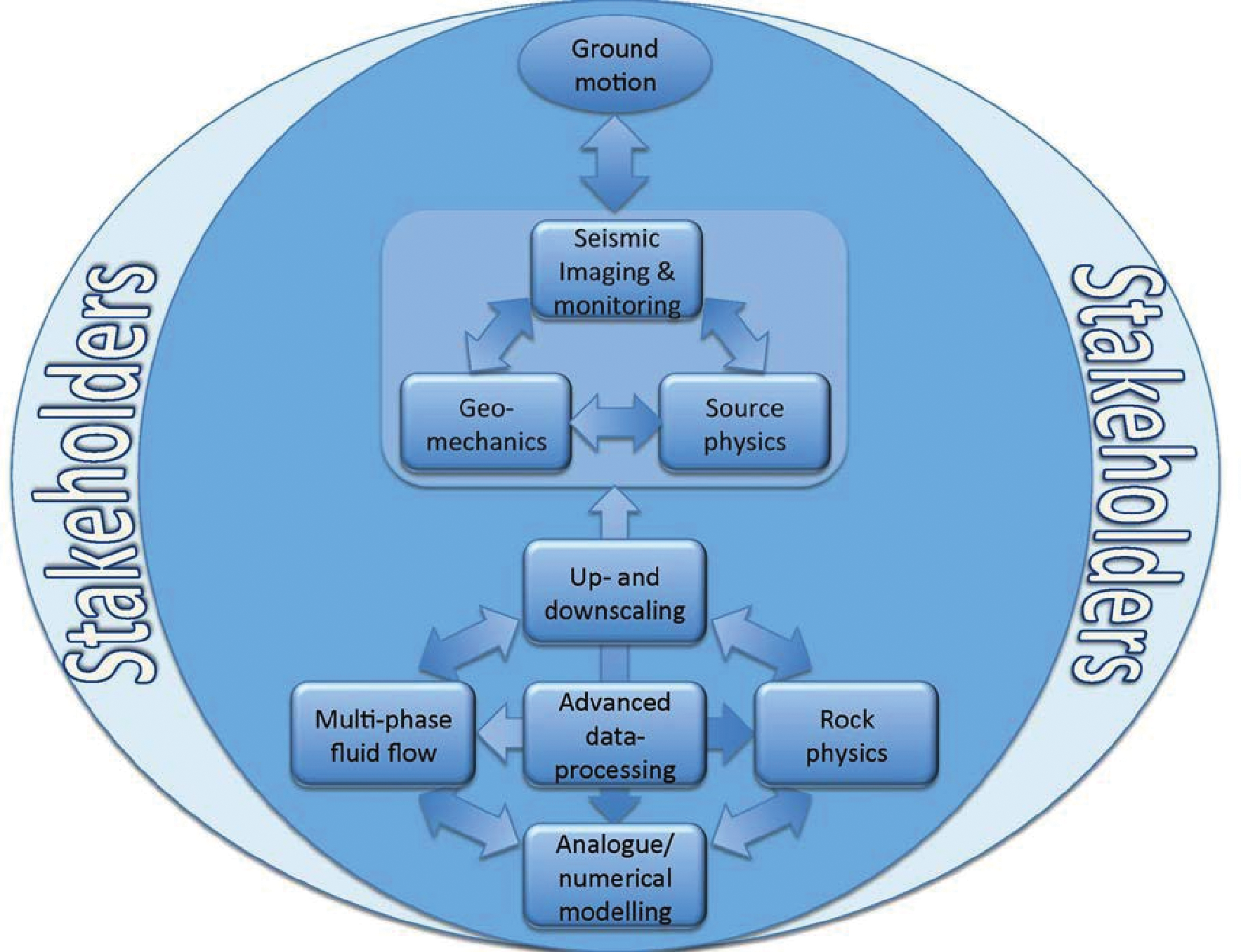
Figure 1: Scientific fields (sub-discipines, methodologies) and their interactions. The core fields are shown in the rectangle, the enabling fields are depicted below. The main stakeholders are KNMI, TNO, EZ, SodM and the local population in areas displaying induced subsidence and seismicity.
For the public, the most important questions related to deep subsurface extraction and storage activities, such as gas production in Groningen, are: what effects can these activities cause at the surface and what can the impact be on personal safety and property? For industry, economic institutions and government, a key question is: how can operations such as gas production be adjusted to avoid or minimise surface effects while remaining economic?
Of course, a crucial aspect underlying these questions is at what spatial and temporal resolution these questions can be answered? In particular, to be relevant in economic and societal context, the spatial and temporal resolution and accuracy of ground motion predictions must be improved over what can be achieved by present, conventional methods. Via a more deterministic, physics-based approach, coupled with the detailed geological and production data available for the Groningen field, as well as continuous data recording using the recently upgraded monitoring systems installed there, more accurate and higher resolution predictions (based on past as well as future production scenarios) should be possible. Importantly, the Groningen reservoir offers a uniquely defined situation allowing scientists to quantitatively integrate and validate fundamental aspects of geophysical, geomechanical and geological research to advance understanding of earthquake rupture processes in a manner that is not easily possible in other gas fields or in natural seismically active areas.
From a scientific perspective, the questions posed by society, government and industry regarding the surface impact of subsurface operations translate to the issue of how do subsurface systems respond to the changes in stress field that are induced by these operations, whether they be gas production, geothermal energy production, salt production or geological storage. For example, in the case of gas production from the Groningen reservoir, depletion of the reservoir results in vertical compaction of the reservoir rock, which becomes increasingly stressed, plus accompanying surface subsidence. Understanding the behaviour of such a system means understanding the stress-strain response of the reservoir and of its over- and underburden. At the same time, it is crucial to understand whether and how the evolving stress field within the subsurface system leads to fault reactivation and fracturing, where this will occur and whether the resulting motion may be seismic or may lead to losses in system integrity. If seismicity occurs, an essential requirement is to be able to constrain the likely ground motion, the maximum magnitude and to characterize frequency-magnitude relationships.
The problem accordingly reduces to determining the quasi-static stress-strain and stored (elastic) energy fields in the subsurface system and the resulting displacement field at the surface, as caused by changes in stress following fluid extraction or injection at depth, or by other activities that may modify stress state. Crucial here is to determine the distribution of stored strain energy versus dissipated mechanical work within the deforming subsurface system, as this determines the energy available for seismic release; the timescales of dissipation are of key importance. On the basis of such data, the potential for fault reactivation, unstable rupture propagation, stress-drop and associated seismicity and seismic energy release can be computed. Locally, we thus need to know the rock and fault mechanical properties, including elastic, inelastic, time- dependent creep and failure properties, which depend on temperature, lithostatic pressure, fluid pressure and chemical conditions. The elastic constants can be measured in the laboratory and an equation of state can be formulated to determine them at the relevant P-T-V conditions. They can also be obtained from geophysical imaging (mostly seismic). In neither case, however, are the elastic constants obtained at the relevant scale, and the difficult problem of up- or down- scaling needs to be addressed. Similar scaling is needed regarding other rock and fault properties.
If the rock and fault properties are known at the appropriate scales, advanced (dynamic) geo-mechanical and geophysical modelling can calculate the wave field and surface displacement or ground motion caused by seismic fault rupture, by forward propagating the stress or strain. This problem too can only be tackled if the properties of the affected rock mass are known in sufficient detail (fractures, fluid content, poro-elastic moduli) and in conjunction with data on in-situ temperature, pressure, stress and strain at points sampled as densely as possible. Currently, such data are obtained via monitoring of induced seismicity, but can be further constrained by direct downhole measurements, for example of temperature and stress state, and by petrophysical measurements made on core material. However, we need to remain aware that we can only ever access certain medium averages, and proper up- and down-scaling needs to be an integral part of any qualitative inference.
To answer the question of how a subsurface system responds to stress changes caused by a given activity, and in particular to understand how a seismic rupture nucleates, propagates and generates seismic waves, we have to understand the dynamics of the problem, which unfortunately are not directly observable. Statistics of earthquakes are usually taken as a proxy for unobservable dynamics using various assumptions. Conversely, seismological data and surface motion data provide crucial tools to critically test and validate forward models addressing the dynamics of subsurface stress-strain evolution, fault reactivation, rupture propagation and ground motion. The recently upgraded seismic infrastructure by NAM offers a unique opportunity to test such models and thus to realise the aims of this programme.
This deterministic approach is essential to provide physical understanding of the effects of subsurface activities, to constrain interpretation of seismic and surface deformation data obtained from field monitoring, to assess hazards and to design mitigation strategies. However, it inevitably relies on geomechanical, rupture propagation, wave propagation and ground motion modelling methods that are based on (at least) locally averaged effective medium properties and simplified structural and material property models. This means that the true complexity and variability of subsurface processes and their surface impact can never be captured in detail. It therefore remains crucial to the present programme to combine the deterministic approach with statistical inference methods based on continuous monitoring of seismicity and ambient noise. These data-driven methods provide important alternatives for predicting ground motion, which can likely be further improved by applying deterministic understanding to physically interpret monitoring data.
The route that needs to be followed to address the problem of how the subsurface responds to human activities is therefore clear. At present, though, our understanding and capabilities are far too limited and qualitative to provide the answers needed. The present programme accordingly needs to open with an initial phase of fundamental scientific research designed to begin to rectify this, followed by a second phase in which stakeholders will be involved to realise application. As already indicated, the programme will focus on Groningen in the initial period. In this context, the main emphasis will be placed on improving predictions of subsidence, seismicity, magnitude-frequency statistics and ground motion hazard resulting from gas production.
Against the background given above, the aim of the DeepNL programme is to make major fundamental advances in establishing an integrated, multi-scale, multiphysics- and chemistry-based understanding of the response of the subsurface (upper crust and surface) to activities such as gas production, geothermal energy production, well stimulation, CO2 storage, salt mining, energy storage and storage of wastes. The intention is to stimulate the development of a frontier-breaking, quantitative, forecasting capability to serve as an Earth Science basis for assessment of hazards posed by induced surface subsidence or heave, induced and triggered seismicity, fluid leakage and aquifer contamination. Initially, the focus of the initiative will be to improve modelling and prediction of ground motion effects due to gas production operations in the Groningen reservoir. The advances in methodologies achieved and understanding gained in this initial part of the programme will also provide a more general platform. At later stages, a broadening – based on this platform
– towards other subsurface settings will be considered. The scientific motivation for a focus on the Groningen Gas Field is mainly based on the already available surface and subsurface data as well as the future data acquisition and monitoring plans in place for the reservoir. This is in addition to the societal and economic relevance that the results of such a hazard oriented study would have on earthquake risk analysis in the Groningen area.
Pre-requisite to advances in understanding and modelling such complex systems and phenomena is access to large-scale data handling, processing and computational facilities and methods, as well as to cutting-edge field and laboratory instrumentation. Coupling the scientific aims with developing this research infrastructure may well lead to a unique Dutch lead in integrated computational geosciences capability, which may be called upon, not only in the national interest but internationally, for practical expertise in assessing the critical subsurface factors underpinning hazard and risk analysis.
To achieve the aims defined above in relation to the Groningen Gas Field and beyond, a multi-scale, multi- physics/chemistry (deterministic) modelling methodology must be developed to investigate the response of the subsurface to resource exploitation and to model wave propagation and ground motion at the surface due to point excitations at depth (forward and inverse). This will need to be combined with statistical approaches to seismic hazard analysis. Intimate integration of new modelling techniques, rock physics data, quasi-real time imaging tools, monitoring data obtained at high sampling density, and massive and novel data processing capabilities is essential here, as well as regular communication with and involvement of stakeholders via comprehensive scientific/technical and popularization outreach activities. Integration of the multiple new data sources and new collaborations targeted in the programme will be key to synergizing new advances.
Specific needs that must be fulfilled and issues that must be addressed by the programme, to develop the intended capability and new approach to ground motion modelling, for Groningen and in general, are as follows:
1. Access to a state of the art seismic measurement and monitoring system, with potential for surface deformation and downhole stress, temperature and fluid pressure measurement at a given site. This underpins the choice of the Groningen field as the first scientific target of the proposed programme. Access to such a system as that in place (and potentially to be developed further) in Groningen is crucial to establish the required understanding and modelling of the main factors determining risk and hazard analysis.
2. Development of (or access to) accurate regional and site-specific seismic wave velocity models. Development of new seismological methods for accurate subsurface imaging, earthquake location and event interpretation, and for detecting fluids and their motion (seismology/seismics). While much progress has recently been made in the area of event location, work is needed, for instance, in shear wave imaging, focal mechanism characterisation and imaging the time evolution of subsurface processes and effects.
3. Numerical modelling of in-situ temperature, fluid pressure and especially pre-production stress state at regional and site-specific scales. Modelling studies of regional tectonic stress field have been conducted previously but have not addressed the Dutch subsurface at scales relevant for evaluating induced seismicity hazards.
4. Determination of rock and fault mechanical properties and the controlling physical and chemical processes, at true in-situ conditions, via intensively instrumented rock-physics experiments, micro-scale process observation and microphysical modelling Much previous work has been done on the deformation/compaction behaviour of reservoir and other sedimentary rocks and on the frictional behaviour of faults systems, in a generic sense. However, little attention has been paid to effects of temperature, pore fluid chemistry and loading rate or time, all of which are now emerging as playing an important role under conditions relevant for fields such as Groningen. Moreover, the physical mechanisms controlling mechanical behaviour are poorly understood, as are the effects of experimentally applied boundary conditions, so that extrapolation of existing lab data to the field is fraught with uncertainties. In addition, virtually no data exist on the partitioning between elastic and permanent deformation, i.e. on elastic (seismic) energy storage versus (aseismic) dissipation, in upper crustal rocks.
5. Development of theory and methodology for up-scaling lab data to length scales on the modelling mesh and field scales (10-1000 m). It is widely recognized in the rock mechanics and earthquake science literature that scaling relations need to be found to apply laboratory data on rock and fault properties confidently in numerical models and at the field scale. This problem is often circumvented by tuning numerical models to both lab and field data, and has been quite successful in modelling tectonic earthquake cycles. In the context of induced crustal deformation and seismicity, however, a firmer basis for upscaling and for evaluating uncertainties is needed.
6. Large-scale computational modelling of the -(quasi-static) geomechanical response of reservoir-systems to subsurface activities, including stress-strain field evolution, fault and fracture (re)activation, surface deformation and fluid migration. Codes with this capability in 3-D are now becoming available, but have yet to be tailored to incorporating state-of-the-art descriptions of rock and fault mechanical behaviour.
7. Computational modelling of dynamic rupture and fracture, resulting seismic wave field and seismic ground motion, plus earthquake magnitude/frequency statistics and earthquake early warning signatures. Such modelling capability is now being developed and applied in relation to the modelling of both natural and induced earthquake rupture but is still requires major advancement for confident application in hazard analysis.
8. Laboratory-based validation and improvement of numerical models for subsurface response and fault rupture behaviour by comparison with massively instrumented (i.e. acoustic emission, acoustic CT and X- ray CT instrumented) analogue and scale model experiments. To date, virtually no studies of this type have been reported internationally, in the context of induced crustal deformation and seismicity.
9. Field-based validation and improvement of numerical models for subsurface response, surface deformation, fault rupture and seismicity by comparison with seismic monitoring data, down-hole monitoring data and surface-monitoring data. The focus of the first phase of the proposed programme on the well-characterised and newly instrumented Groningen Gas Field provides an unprecedented opportunity to achieve such validation, which will be of major value not only in the national context but to advancing earthquake science in general.
From the above, it is clear that processes in the Earth’s crust related to fluid extraction or injection involve complex interactions that can only be addressed by integrating efforts between the disciplines of seismology and geomechanics, with crucial input from the enabling fields of rock and fault physics, multi-phase fluid flow in porous media, applied mathematics and computational science (Figure 1). The key scientific methodologies needed include seismic imaging using (semi) continuous data streams, analogue and numerical modelling, experimental determination of rock mechanics parameters, up- and down-scaling, sensor development, and advanced data processing and visualization, including semi-automated (machine) learning methods (Deep Learning Principles).
Seismic imaging and monitoring form one of the main methodologies available for probing the geomechanical and fluid flow processes that operate in the deep subsurface. Traditionally the seismic method is applied with active sources (at the surface or in wells). In the past ten to fifteen years there have been exciting developments in the field of passive seismic imaging and monitoring. In this approach, instead of using active sources to generate the seismic wavefield, geophones and/or seismometers passively record ambient seismic noise, microseismicity, anthropogenic noise and the like. Using advanced data-analysis methods (commonly known as seismic interferometry), these recordings are turned into virtual seismic responses, i.e., responses that would be measured by the receivers if there were an active source at the position of any of the receivers. Passive seismic methods that employ surface-wave noise have proven to be particularly successful for monitoring minute changes in the constitutive parameters of the subsurface.
Other exciting developments in the field of seismic imaging and monitoring are full wavefield inversion and so-called Marchenko imaging. Both methodologies employ the full seismic response rather than primary waves only, and therefore have the potential to image and monitor the Earth with much higher spatial and temporal resolution. New breakthroughs in the monitoring of geomechanical processes, fluid-flow processes and seismic source mechanisms in the deep subsurface, and in deterministic modelling and assessment of ground motion can be expected by combining these recent advances in seismic interferometry, full wave form inversion and Marchenko imaging. Several groups in the Netherlands (Delft, Utrecht) have played pioneering roles in these fields and are therefore very well equipped to accomplish the breakthroughs needed.
In the proposed programme, recent success in Deep Learning opens new possibilities to train neural networks to infer reservoir dynamics based on real-time ground motion observations, i.e. from seismometer records obtained at the surface. The surface ground motion is a causal expression of the dynamic processes operating within the reservoir. Dedicated rock physics experiments will be used to calibrate these relations and neural networks have the potential for isolating and interpreting ground motion observations, however complicated they may appear.
Challenges related to this programme component are:
1. Determining moment tensors and source mechanisms (in particular of induced seismicity).
2. Development of accurate regional and site-specific, time-dependent anisotropic seismic wave velocity models.
3. Accurate ground motion forecasting.
4. Development of new seismological methods for detecting fluids and their motion and fractures.
Laboratory experiments, coupled with micromechanistic studies, analogue scale modelling, numerical modelling and upscaling methodologies, are crucial for characterizing and understanding the mechanical, wave transmission and fluid transport properties of rocks and faults at in-situ conditions. Few data are currently available on these properties at sufficiently deep subsurface conditions. Moreover, numerous uncertainties exist in extrapolating from the laboratory sample (cm or dm) scale to that of a geomechanical modelling mesh (1m- 100m) and ultimately to the field scale. New multiscale data must therefore be produced to provide the input on rock properties and controlling processes needed for modelling geosystem response to fluid extraction/injection, including seismic rupture and ground motion, and for interpreting seismic data. Key challenges that must be addressed in the present programme, with its initial focus on induced seismicity in the Groningen Gas Field, are described below. To achieve the necessary advances, the experimental work highlighted will need to employ the latest, real time sample-scale structural and process monitoring methods including acoustic emission monitoring, wave velocity monitoring, ultrasonic tomography, X-ray tomography, intra-sample P-T measurements and pore fluid chemical sampling, alongside more conventional methods.
The main challenges are:
1. Experimental determination of the poro-elastic, inelastic and time dependent deformation behaviour of field-specific reservoir rocks, caprocks and underburden formations, under true in-situ pressure- temperature- stress and pore fluid (chemical) conditions, with the aim of producing mechanism-based constitutive laws.
2. Determination of the partitioning of deformation between elastic and permanent, inelastic deformation. This is crucial for assessing the extent of elastic energy storage versus dissipation, and hence the energy available to drive seismicity in both reservoir and over/underburden rocks.
3. Verification that laboratory-characterized rock deformation mechanisms actually operate in-situ, using state-of-the-art optical, electron-optical and petrophysical studies of reservoir and over/underburden core samples (e.g. taken before and after gas production in the Groningen field).
4. Experimental determination of the failure and frictional behaviour of realistic, field-specific rock and fault rock materials, again under true in-situ P-T-stress and pore fluid (chemical) conditions. Essential here is to determine the key parameters and mechanisms controlling seismic versus aseismic fault (re)activation in the rupture nucleation and dynamic rupture propagation regimes.
5. Determination of the elastic wave transmission properties of site-specific reservoir, cover and underburden rocks under in-situ P-T-stress and pore fluid conditions.
6. Development of advanced ultrasonic and X-ray CT imaging capability, alongside new DEM and grain- scale- FEM or “digital rock” modelling capability. This should be aimed at quantifying the microstructure, mechanical behaviour and wave transmission properties of reservoir and fault rocks, advancing DEM capability by incorporating lab-verified microphysical process laws operating at the grain scale.
7. Development and testing of rules and models for upscaling laboratory data to representative fault and rock mass scales, through multiscale lab experiments.
8. Development, testing and tuning of numerical models for subsurface response and fault rupture by comparison with massively instrumented (i.e. acoustic emission, acoustic CT and X-ray CT instrumented) analogue and scale model experiments.
9. Estimation of in-situ reservoir and over/underburden stress states by exploring the applicability of stress- sensitive petrophysical and microstructural indicators to core samples. Tectonic modelling may also offer constraints on tectonic stress states before fieldoperatio.
Geomechanics forms one of the central disciplines of this programme. It encompasses modelling, at the scale of the reservoir system and beyond (to the extent required by the processes involved), of rock fracture and rock deformation, (re)activation of faults and fractures and the quantification of lateral and vertical subsurface stress and strain fields. Modelling, understanding and, ideally, influencing these phenomena involves the determination and monitoring of in-situ temperature, fluid pressure and the state of stress at regional and site-specific scales (using seismology, down-hole measurements, numerical and analogue tectonic modelling), and relies on experimental data on geomechanical rock properties for deterministic evaluation of fault movement. The challenge will be to combine laboratory-based constitutive laws with large-scale effective medium images into a quantitative modelling tool. Up- and down-scaling needs to be an integral part of such modelling as well as scale-dependent uncertainty analysis. While evaluating the impact of subsurface activities in producing subsidence and fault (re)activation lies in reservoir-scale numerical modelling of quasi static stress-strain field evolution, seismic rupture and dynamic wave field modelling, and hence ground motion and acceleration, require a fully dynamic modelling approach. This is presently in a relatively early stage of development, in part because of the massive computational intensity. An important challenge within the present programme will accordingly be to advance this field, drawing on both computational science and rupture modelling methods employed in natural earthquake simulations by groups in the US and Japan in particular. It is essential that this modelling is strongly data driven.
Geomechanical processes interact with fluid flow in heterogeneous porous and fractured media. Indeed, fluid pressure changes in the subsurface are the key drivers for changing the in-situ stress and strain field and hence for causing subsidence, heave, fault reactivation and induced seismicity. The study of multi-phase fluid flow in reservoir systems, including both physical and chemical effects, underlies understanding, predicting and influencing the effects of fluid injection and/or extraction of fluids. Fluid flow computations are therefore needed, alongside geomechanical modelling, to evaluate the effects of injection and extraction strategies. Moreover, multi-phase fluid flow modelling is of major importance for evaluating the integrity of potential future sequestration sites for liquids or gases, where the aim is to prevent leakage in the short term (e.g. natural gas or hydrogen fuel) as well as in the long run (e.g. Carbon Capture and Storage).
As mentioned at several locations above, to link the results of laboratory experiments and analogue modelling work to field-scale measurements and/or numerical experiments, mathematical up- and down-scaling methodology is required. Hence, in this programme ample attention needs to be paid to the development of theory and methodology for the up-scaling of laboratory data to length and time scales of the modelling mesh and field scales (10-1000 m) and viceversa.
Large sensor networks (be it existing ones, like the sensor network of the Groningen gas field, or new networks to be developed outside this programme), will provide a continuous stream of 'big-data'. This requires a rethinking of data handling, processing and visualisation, including the development of new methodologies for this purpose. Pattern recognition techniques are likely to be essential to relate dense surface observations to sub- surface processes. Seismic interferometry, described in detail above, is one of the new data processing tools needed in this programme.
Another essential tool is Deep Learning. It has been shown that deep neural networks can learn any complicated relation, non-linear and/or multi-valued. Provided that sufficient pairs of observations and corresponding model parameters are available, these networks can be successfully trained and rapidly applied to future observations. This is ideal for the forecasting of seismic hazard, for instance. The difficulty in this programme lies in finding sufficient pairs for training. In the Groningen case, this could be achieved via two complementary routes: Use refined classical geomechanical modelling together with seismic imaging to create realistic synthetic pairs to train the networks, and, once trained, use it on real observations. This approach has been successfully applied by Utrecht researchers. Another approach is learning directly from the real data observations using calibrations from dedicated rock physics experiments.
To be successful DeepNL needs to be strong in innovation within each of the programmes components (projects, subdisciplines, methodologies) as well as in the integration of these components. This integration requires attention as soon as developments or results in individual components allow or call for it.
It is not the purpose of this programme to make major infrastructural investments. However, limited project- based investments might be necessary for proofs-of-concept. Depending on the findings, major infrastructure investments should be found elsewhere.
The development of full-scale measurement networks lies beyond the scope of this scientific programme, which will, for instance, fully use the recently upgraded seismic network installed by NAM. However, limited- scale measurement networks for feasibility studies will be very useful, for testing the theories and methodologies developed under this programme and for verifying up- and down-scaling methods. The following are therefore examples of possibilities:
1. Development of a limited field-scale seismic network, designed for data-driven imaging, characterization and monitoring. Apart from standard multi-component sensors, this network could be supplemented with a glass fibre system (DAS: Distributed Acoustic Sensing), preferably a modified DAS for direct strain measurements.
2. Development of a limited field-scale facility for experiments with controlled dynamic production/injection strategies in a heavily instrumented reservoir. Ideally the seismic network, mentioned under point (1), would be combined with this facility.
In addition to facilities for field experiments, new lab facilities might for example be required in the long run as well:
1. High pressure-temperature equipment for investigating rock and fault failure phenomena under true in- situ P-T-Stress-Chemical conditions, and for testing numerical models of these phenomena, employing pervasive acoustic, ultrasonic CT and X-ray CT tomographic instrumentation for internal monitoring and imaging. This includes facilities for simulating, measuring and manipulating induced seismicity in the laboratory.
2. Analogue scale model facilities for simulating reservoir and field scale behaviour and for testing numerical models thereof, employing digital surface deformation mapping, acoustic emission monitoring, and ultrasonic CT and X-ray CT tomographic instrumentation for internal imaging.
The programme will need continuous access to computational facilities for big data processing, storage and imaging (data produced by seismic monitoring and massively instrumented laboratory and scale model experiments), as well as for large-scale numerical modelling and simulation. Computational infrastructure investments are not part of this programme, but proposals should demonstrate sufficient computational resources if required by the project.
These targets are formulated to stimulate and ensure progress in the programme and allow for evaluation thereof. Specifics obviously depend on the projects’ nature; examples of such targets are given below, for some of the programme’s components:
• Prototype software for data-driven seismic imaging and monitoring.
• Prototype modelling software for visco-poro-elastic seismic data.
• 3D seismic model from full waveform inversion using existingdata.
• Quasi real-time seismic hazard assessment based on Deep Learning.
• Automatic event location and focal mechanism determination based on Deep Learning.
• Existing lab facilities operational in addressing rock and fault physics and geomechanical properties of reservoir rock and faults.
• New lab facilities under construction and calibration.
• First lab data on overburden and underburden rock properties, with focus on potential inelastic effects.
• First recommendations regarding input data on reservoir rock and fault properties for geomechanical and wave-field modelling, based on previous work and results of present programme to date.
• Limited field-scale facilities, lab-facilities, and large-scale computational and data handling methods are in place.
• Three-dimensional software for data-driven seismic imaging and monitoring of micro-seismicity and fluidmotion.
• Three-dimensional modelling software for visco-poro-elastic seismic data, with realistic induced source mechanisms.
• Measurement and understanding of in situ conditions, rock and fault properties and up-scaling thereof.
• Three-dimensional modelling software for coupled flow and geomechanical behaviour and for rupture modelling.
• Detailed data on and understanding of in situ stress-temperature-pressure-chemical conditions, reservoir rock and fault properties and preliminary up-scaling thereof, with mechanism-based constitutive laws and energy partitioning relationships relevant for true in-situ conditions.
• System-theoretical basis for the development of operational protocols (dynamic production/injection strategies and optimization of well locations, with the aim to influence compaction and the chance of fault (re)activation.
• Integration of programme components and projects.
• Recognition of programme by societal stakeholders as reliable and independent.
Within 5 years after the start an (international) scientific evaluation of the results so far will be the basis for a decision on the second part of the programme.
• Lab-derived, mechanism-based, material behaviour models for all lithologies and fault rocks relevant to the Groningen field, with relevant and alidated upscaling.
• Full depletion-deformation-rupture-wavefield modelling capability validated against multi-scale lab and field data and with first forecasting capability.
• Integrated 'model-based feedback control approach', based on continuous measurements and fundamental understanding of source mechanisms, stresses and flow in the subsurface (from reservoir underburden to surface), to forecast and influence induced seismicity (spreading stored energy over multiple small events rather than a few large ones; optimal dynamic production/injection strategies for controlled build-up of stress in space and time).
• Quantitative evaluation of uncertainties of all measurements, models, and control measures.
• Results of all themes are available for embedding in the Dutch policy for the exploitation of the deep subsurface and in the definition of long term visions for energy supply, mitigation of emissions and supply of drinking water.
The budget of the programme will mainly be spent in two large calls. The proposed budget for the first call is 11.35M€, for the second call 9.5M€. For regular programme activities, such as workshops, outreach and organisation, a budget of 1.0 M€ is reserved. To allow for programme tuning and integration a further 1M€ is reserved for funding small projects in the course of the programme. The total budget is 23.75 M€, depending on the contributions of NAM (15M€), PPS-toeslag (3,75M€) and NWO (5M€). 6% of the private contribution is used to cover operational costs for NWO. The budget is summarised in the table below:
|
Contributions |
Expenses |
||
|---|---|---|---|
|
NAM |
15 M€ |
Subsidies |
21.85 M€ |
|
NWO |
5 M€ |
Programme activities |
1.0 M€ |
|
PPS-toeslag |
3.75 M€ |
Operational cost NWO |
0.9 M€ |
|
Total: |
23.75 M€ |
Total: |
23.75 M€ |
The programme will run under the umbrella of NWO within the science domain and in is part of the NWO contribution to the top sector energy (TKI gas). It has many connections to the Nationale Wetenschaps Agenda (NWA) in particular NWA questions 23, 55, 112 and 124. The programme will make use of existing, state-of- the-art infrastructure in terms of data acquisition and processing capability (NAM seismic network, laboratory equipment in many universities and the computational infrastructure of SURFSara and the universities). To achieve the objectives, a strong, effective and transparant governance structure is needed.
The governance of the programme can be seen in two phases: prior to the start of the research (call-phase) and after the start of research (research-phase).
For the call-phase the board of the NWO Science domain (DB NWO-ENW) will appoint a Programme Committee (PC) composed of the expertise needed to prepare a coherent programme in keeping with the high NWO standards of integrity and quality. The PC will advise the board on the procedure and possible members for an international assessment committee (IAC) which will have the task of evaluating all applications and of advising the board concerning the granting of an integral research programme based on the applications. The advice of the IAC should not merely be a ranking of the projects, but should be a comprehensive programme consisting of (parts of) the applied projects with the goal to make sure all topics which are required to reach the goals of the programme have excellent projects. This process will be further described in the calls.
During the research-phase the Programme Committee will be responsible for the day-to-day running of the programme. They will organize regular workshops for all scientists carrying out the research with the aim to develop a vibrant research environment in The Netherlands on the topics of the programme. The PC will commission a scientific evaluation of the programme. In the programme budget M€ 1,0 is reserved for the organisation of the activities of the programme committee and M€ 1,0 is reserved for granting small projects which have the aim of increasing the coherence and quality of the programme.
The Programme Committee and the International Assessment Committee will be assisted by a programme office provided by NWO-ENW for the logistics around the calls, project management, evaluation, workshop organization etc.
For the second call in the programme both the PC and the IAC will advise the NWO-ENW Domain Board if any changes to the (scope of the) call should be made.
In the research phase the IAC will take the form of an international advisory committee. It will evaluate the progress of the programme and suggest redirections to achieve the objectives more efficiently. The committee should be invited to the workshops, which will be instruments of community building and evaluation tools at the same time.
Industry, although a stakeholder, will not be part of any decision-making. They can be asked for advice and can be invited to the workshops to be informed of on-going progress. They may also be part of an internship programme in the context of PhD training.
The programme will be mainly focussed around two large calls. The first call will consist of two parts: one for projects up to 1.5M€ and one for new scientific staff and tenure trackers. Scientific quality and potential for – and commitment to – innovative integration will be important criteria for selection. Infrastructure/equipment (see examples above) demands could be part of the proposal, with a clear demonstration how the infrastructure/equipment will be used. It will be up to the evaluation panel to advise on the infrastructure allocation, which should not be the main aim of this programme. If the allocated budget is not used in the first call (due to a lack of qualifying proposals), this can be used in future calls within the DeepNL context.
The nature of the second call will be decided upon depending of the result of the first call. The expectation is that the second call will have a large focus on integration of activities and filling areas were not enough high- quality proposals were available.
Other than the two main calls there is a possibility for smaller calls with specific purposes, such as visiting scientists, integration with (inter)national programmes, utilisation etc.
In view of the societal relevance of the programme, a pro-active outreach strategy is chosen. Although the purpose of this programme is one of fundamental science, the results will be of direct interest to a wide spectrum of stakeholders, such as applied science institutes (TNO and KNMI), policymakers (EZ, SodM), industry (Shell, NAM), engineering companies and, last but not least, the general public. Given this diversity, the way the intentions, progress and outcomes of the scientific program are communicated should be tailored to common practices employed by different target groups. Most institutional, industrial and governmental stakeholders are expected to be members of the Stakeholder Advisory Board and will be informed on at least an annual basis regarding the intentions, progress and deliverables of the programme. Interested stakeholders will also be invited to the scientific workshops, where they can share their expertise in the relevant fields.
Given the sensitivity of the general public to risks and uncertainties associated with subsurface activities, a dedicated outreach programme is envisaged in collaboration with relevant national programmes, aimed at familiarization of the scientific results, both in terms achievements and shortcomings. This will be done by regularly and pro-actively approaching or employing the media (e.g.science pages in newspapers, television features, social media etc). Special focus should be placed on educational aspects via input to physics lessons at schools and contributions to science musea, such as Naturalis. Dedicated symposia can be considered, preferably in cooperation with local organisations such as provinces and municipalities.
It should be noted that the outreach programme is not only aimed at popularizing the Earth science results, but also serves as a vehicle to receive input and questions from stakeholders and society at large, in order to ensure appropriate embedding of the DeepNL programme.
For the outreach program to be successful, the scientists involved will need to have the right skills to be able to translate their research methods and results into layman's terms. If necessary the set up of a training programme could be considered, in particular for junior researchers. Also specific communication expertise needs to be available for the programme.
In parallel with the above, the scientific results will be published via standard channels, such as peer reviewed articles in magazines and contributions to international conferences. In order to avoid unnecessary delay in the sharing of knowledge and results between programme participants because of publication delays, a protocol for data sharing and dissemination needs to be developed.
If the decision of continuing the programme for the second term is made, a significant part of the budget will be reserved for a proof-of-concept programme (similar to the one pioneered by ERC). In this context, a stakeholder, together with a scientific partner, can make a joint proposal on how a component of fundamental science can be used to solve a practical problem.
This annex contains the abstracts of the current eight DeepNL projects. Additional information on workpackages, methods and progress can be found in the DeepNL annual reports which are available on the DeepNL website.
Surface subsidence, ground motion and induced seismicity caused by fluid extraction from geological formations, such as sandstone reservoirs, frequently have significant technical, environmental and economic impact. These phenomena are driven by reservoir compaction, resulting from fluid extraction. Modelling the reversible, elastic component of compaction is straightforward. However, permanent deformation can also occur, the rate and effects of which are very poorly constrained. Virtually no physics-based models exist to predict permanent compaction of reservoir sandstones under in-situ conditions. Hence, the long-term surface impact of fluid production, for fields such as Groningen, and many other fields around the world, cannot be confidently forecast. The key barrier to obtaining appropriate models is that the physical mechanisms responsible for reservoir compaction are poorly known and quantified at true reservoir conditions.
We will identify and quantitatively characterise the main mechanisms causing deformation of sands and sandstones under pressure, temperature and chemical conditions relevant to fluid extraction. Hypotheses regarding the dominant compaction processes will be tested through systematic experimental investigation using mm/cm-sized samples, intimately coupled to state-of-the-art micro- and nano- analytical techniques. Combining the observations with microscale theory and numerical modelling at the grain-scale (FEM) will result in grain-scale deformation and interaction laws.
Incorporating these relations into discrete element method (DEM) models will enable upscaling to dm- scale material behaviour models, which are the starting point for upscaling to the field-scale. We will advance, validate and improve these dm-scale models by comparison with dm-scale deformation experiments featuring real-time X-ray microtomography-imaging of the microscale processes operating. The proposed integration of experiments, microstructural observations, microphysics and numerical modelling of rock mechanical behaviour, under true subsurface physical/chemical conditions, is unprecedented in a single study. The project will provide a basis for strongly improving the predictive capability, needed for evaluating and mitigating long-term hazards related to fluid extraction.
Project leader
Dr Suzanne Hangx (Utrecht University)
Associate project leaders
Prof. Martyn Drury (Utrecht University)
Dr Helen King (Utrecht University)
Dr Oliver Plümper (Utrecht University)
Dr Cedric Thieulot (Utrecht University)
Gas production-induced surface subsidence is a significant problem in the province of Groningen, affecting the environment, infrastructure and water management. Also, there is correlation between surface subsidence and induced seismicity (Bourne et al., 2015). Both subsidence and seismicity are likely linked by their common origin of reservoir compaction. Adaptation to this primary subsidence, by changing and compartmentalizing the ground water table, causes a secondary subsidence signal, strongly dependent on soils and the shallow subsurface. Continuous, frequent and accurate estimates and predictions of subsidence over the entire Groningen field are therefore highly relevant.
The principal innovative aspect of this collaborative research proposal is that we will jointly use InSAR observations and process-driven models for the deep and shallow subsurface to significantly improve the accuracy of geodetic subsidence estimates and to better constrain the model parameters. The relevance of improving model parameters is that they control physical processes in the subsurface, e.g., rates of reservoir stress relaxation and fault creep, hence establishing an observationally constrained basis for forecasting hazards from various gas production scenarios. Similarly, model parameters of processes in the shallow subsurface are relevant since they are the main driver for strain on buildings and infrastructure. Recently developed data assimilation methods will be used to integrate the geodetic and geophysical observations and models. This way, subsidence is not only an undesired consequence of subsurface exploitation, but also an important source of information to understand it.
Project leader
Prof. Ramon Hanssen (Delft University of Technology)
Associate project leaders
Dr Rob Govers (Utrecht University)
Dr Esther Stouthamer (Utrecht University)
Dr Femke Vossepoel (Delft University of Technology)
The shallow layers in the top 20-30m below the ground surface account for about 80% of the site amplification and almost all of the permanent displacements. Research is urgently needed to improve understanding of the behaviour of the soft top layers during induced earthquakes, so that: (a) informed decisions can be taken on the amount of gas that can safely be produced; and (b) strengthening measures for buildings and infrastructures can be more effectively focussed on areas with the highest seismic risk. Currently, questions relating to the influence of soft deposits on earthquake progression and consequent soil response cannot be adequately answered. There is therefore a clear need for an integrated approach to wave propagation (leading to amplification), liquefaction (leading to damping and displacements), and cyclic degradation (leading to temporary reduction of shear strength and permanent deformation).
This research aims to expand the current analysis toolkit with proper constitutive models for sand and clay, the dominant soil types in the deltaic shallow subsurface, quantified within a framework for multiscale heterogeneity. The project will improve our capability to model the amplification and consequences of induced earthquakes through the soft top soil, under the complex conditions of the natural soil’s non-linearity and non-homogeneity. This will enable the determination of more realistic spatial distributions of deformations and accelerations at the surface. It will be achieved via the following inter-connected stages: (a) a novel reliability-based framework to assess the influence of the shallow subsurface and its variability; (b) laboratory and field tests to derive and validate stateoft- the-art constitutive models that adequately describe the cyclic behaviour of sand and clay layers; (c) the use of these techniques to assess the local site response and the displacement of the ground surface due to gas production; and (d) the development of industry guidance and prototype tools.
Project leader:
Prof. Michael Hicks (Delft University of Technology)
Associate project leaders:
Prof. Cristina Jommi (Delft University of Technology)
Dr Many Korff (Delft University of Technology / Deltares)
We propose a joint numerical-experimental research project to understand the effects of time-varying gas production and (re-)injection operations in Dutch gas fields in the Rotliegend formation. This concerns in particular the Groningen field which has experienced increasing production-induced seismicity over the past decade causing serious damage and societal unrest. We will perform physical experiments to quantify rock and fault properties and microseismicity evolution under reversed and cycled stress conditions. In parallel we will develop advanced numerical simulation tools and perform computational experiments to gain in-depth understanding of the coupled flow and dynamic geomechanical response of gas reservoirs under time-varying operational conditions at a variety of spatial and temporal scales.
The necessary constitutive relationships for compaction and fault friction under reversed or fluctuating loading will be developed in close cooperation between experimentalists and numerical modellers. With the aid of the developed computational tools and using system-theoretical concepts we will develop methods for model-based optimal control of coupled subsurface flow and mechanics under geological and parameter uncertainty. The overall aim of our project is to develop a body of new scientific knowledge that will support the construction (by industry or national research agencies) of model-based, data-informed operational systems aimed at forecasting and managing induced seismicity.
Project leader
Prof. Jan Dirk Jansen (Delft University of Technology)
Associate project leaders
Dr Auke Barnhoorn (Delft University of Technology) Dr Hadi Hajibeygi (Delft University of Technology) Dr Suzanne Hangx (Utrecht University)
Prof. Chris Spiers (Utrecht University)
Dr Denis Voskov (Delft University of Technology)
Earthquake slip is accompanied by substantial frictional heating which can activate numerous weakening mechanisms by raising the temperature of the fault gouge. Conversely, temperature anomalies observed across faults after large natural earthquakes have been used to infer the level of dynamic friction. Earthquake rupture models of slip on faults in the Groningen gas reservoir (NL) need to assume that frictional strength breaks down with accumulated slip but at present there is little constraint on the dynamic friction, how this might vary across the different lithologies and how it evolves with slip.
Constraining both the level of dynamic friction as well as its variation with lithology requires a thorough understanding of the temperature rise that can occur during seismic slip. Here, we propose to investigate the effect of frictional heating on pore fluid pressure and flow to constrain how much heat is available to raise the temperature and cause dynamic weakening. We will use a laboratory-calibrated magnetic geothermometer to measure temperature anomalies both in experimental faults of Slochteren sandstone and of Ten Boer claystone as well as in samples from faults that outcrop in the U.K., as a natural analogue for the faults presently active in the Groningen gas field to constrain frictional heating in small slip events. Combined, these measurements will constrain the evolution of dynamic friction and temperature within fault rocks of the Groningen reservoir for small magnitude induced events.
Project leader
Dr. André Niemeijer (Utrecht University)
Associate project leader
Dr Mark Dekkers (Utrecht University)
It is well known that the seismicity in the Groningen area is due to gas extraction. The dynamics of how the rate and place of extraction is related to the magnitude and frequency of seismicity, however, is not understood. In a synergetic collaboration between the Department of Applied Mathematics at the University of Twente and the Department of Earth Sciences at Utrecht University, we propose to develop state-of-the- art tools to comprehensively address this extraction-seismicity causality. We will infer 3D models of the subsurface using full waveform inversion. These 3D model will be used to calculate Green’s functions for changes in seismic sources, geometry, stress and elastic structure. Full waveform inversion and the generation of Green’s functions is computationally very expensive. We will therefore develop a reduced order model within the 3D wave propagation solver. In a time-lapse setting, these Green’s functions will be used to train neural networks, which will monitor the changes of the parameters of interest fast and in a fully probabilistic setting. As an application of the monitoring data we will generate during this work, we will develop, based on stochastic geometry, a prediction tool for seismicity using gas production and these monitoring data as input.
The monitoring tools we propose to develop will produce data, which are essential for any geomechanical modelling in the area. Of special interest is the near sub-surface. We will produce response functions essential for any structural engineering work. The prediction tool will be of crucial importance for decision makers who set future gas extraction policies. All our tools and data will be openly available.
Project leader
Prof. Jeannot Trampert (Utrecht University)
Associate project leaders
Prof. Marie-Colette van Lieshout (University Twente / CWI)
Dr Hanneke Paulssen (Utrecht University)
Dr Kathrin Smetana (University of Twente)
Induced seismicity is likely driven by changes in normal and shear stress on pre-existing faults. However, which processes govern these stresses and thereby seismicity remains a subject of debate. Compaction, fluid flow and friction each play a role. To estimate and ultimately forecast seismicity, it is thus crucial to estimate stresses and resolve these three aspects and their interactions. However, uncertainties in subsurface conditions, the inherent intermittent occurrence of fault slip, and the limited availability of insitu observations make it difficult to uniquely describe responsible mechanisms, let alone provide probabilistic estimates of seismicity. In InFocus, we propose to resolve the feedback between these mechanisms through coupling geomechanics, dynamic rupture and two-phase flow on an equation level, rather than by coupling separate models.
To do this, we will make use of existing simulation capability developed for subduction zones. An analysis of seismic observations over the Zeerijp area of the Groningen field will be used to calibrate this model and ensure applicability in reservoir-scale studies. We propose a statistical, Bayesian approach in which observations of subsurface variables, such as strain and (pore) pressure, and prior knowledge on physics are used to constrain stress state and parameters through data assimilation. To test the validity of this innovative approach we develop a simplified, controlled laboratory setup of a slipping fault monitored with acoustic emission sensors and strain sensors and a parallel numerical simulation of the laboratory configuration in which we assimilate the lab measurements. This approach also serves to assess what observations would be required to better understand and ultimately forecast seismicity as a result of fluid extraction. The extension of the datadriven simulation tools developed for subduction zones to laboratory and reservoir scales is an integrated, innovative modelling approach that is expected to shed light on the dynamics and occurrence of seismicity.
Project leader
Dr.ir. F.C. Vossepoel (Delft University of Technology)
Associate project leaders:
Dr. Ylona van Dinther (Utrecht University) Dr. André Niemeijer (Utrecht University)
We propose to develop an integrated methodology for seismic imaging and monitoring of the Groningen subsurface and its induced seismicity. This methodology will improve the forecasting of occurrence and effects of possible future induced seismicity. The proposed methodology will consist of:
1) Cutting-edge seismic imaging and monitoring methodology. We will develop imaging and monitoring methodology and apply it to seismic reflection data and passive induced-earthquake data. We will use this to derive a detailed velocity model, to monitor stress-related changes in the subsurface, to image the location of the induced sources and determine their moment tensor.
2) Innovative scaled rock-mechanics experiments. Production and injection of fluids into the subsurface result in local stress changes in the material, which drive compaction, failure and seismicity. We will develop acoustic monitoring techniques in the laboratory at cm-scale and mscale that forecast upcoming failure and seismicity before passive techniques can record seismicity.
3) Advanced numerical seismic modelling. In order to quantify and forecast the effects of induced seismicity in and around Groningen, we will numerically model the entire chain of processes, from the occurrence of induced earthquakes, through wave propagation through the different rock layers, to site effects at the near surface.
The main breakthroughs of our research will come from the integration:
• High-resolution monitoring of the location and moment tensor of induced seismic sources, constrained by empirical relations found in the laboratory, and of the seismic parameters of specific subsurface structures of interest.
• Detecting and forecasting the onset of fracturing and slip at laboratory scale and feasibility assessment to upscale these observations to field scale.
• Seismic modelling, including source properties, fault geomechanics, and propagation effects including poroelasticity.
• Reliable forecasting of ground motion, caused by possible future earthquakes, driven by empirical relations found in the laboratory.
Project leader
Prof. Kees Wapenaar (Delft University of Technology)
Associate project leaders
Dr Auke Barnhoorn (Delft University of Technology)
Dr Deyan Draganov (Delft University of Technology)
Dr Ranajit Ghose (Delft University of Technology)
Dr Kees Weemstra (Delft University of Technology)
Per 0.2 fte scientific employee at a university of applied sciences (junior, medior and senior level, with a minimum appointment of 0.2 fte for a period of 12 months), a maximum of € 15,000 material budget can be applied for each year of the appointment.
In this budget module, the definition for “knowledge transfer” used by the European Commission in the Framework for State Aid for research and development and innovation applies (PbEU, 2014, C198).
Kopieer de link naar uw clipboard
https://zoek.officielebekendmakingen.nl/stcrt-2020-38447.html
De hier aangeboden pdf-bestanden van het Staatsblad, Staatscourant, Tractatenblad, provinciaal blad, gemeenteblad, waterschapsblad en blad gemeenschappelijke regeling vormen de formele bekendmakingen in de zin van de Bekendmakingswet en de Rijkswet goedkeuring en bekendmaking verdragen voor zover ze na 1 juli 2009 zijn uitgegeven. Voor pdf-publicaties van vóór deze datum geldt dat alleen de in papieren vorm uitgegeven bladen formele status hebben; de hier aangeboden elektronische versies daarvan worden bij wijze van service aangeboden.
 Authentieke versie (PDF)
 Informatie
 Printen
 Delen
Delen