Staatscourant van het Koninkrijk der Nederlanden
| Datum publicatie | Organisatie | Jaargang en nummer | Rubriek |
|---|---|---|---|
| Nederlandse Organisatie voor Wetenschappelijk Onderzoek | Staatscourant 2020, 28936 | Overig |

U bent nu hier: Publicaties Officiële publicaties
Zoals vergunningen, bouwplannen en lokale regelgeving.
Adressen en contactpersonen van overheidsorganisaties.
Cooperation Indonesia-The Netherlands
WOTRO Science for Global Development 2020
|
1 |
Introduction |
1 |
|
|
1.1 |
Background |
1 |
|
|
1.2 |
Available budget |
1 |
|
|
1.3 |
Validity of the call for proposals |
2 |
|
|
2 |
Aim |
2 |
|
|
2.1 |
Thematic focus |
2 |
|
|
2.2 |
Specific project requirements |
3 |
|
|
3 |
Guidelines for applicants |
5 |
|
|
3.1 |
Who can apply |
5 |
|
|
3.2 |
What can be applied for |
8 |
|
|
3.3 |
When can applications be submitted |
12 |
|
|
3.4 |
Preparing an application |
13 |
|
|
3.5 |
Conditions on granting |
14 |
|
|
3.6 |
Submitting an application |
18 |
|
|
4 |
Assessment procedure |
18 |
|
|
4.1 |
Procedure |
18 |
|
|
4.2 |
Criteria |
19 |
|
|
5 |
Contact details and other information |
20 |
|
|
5.1 |
Contact |
20 |
|
|
6 |
Annexes |
20 |
|
|
6.1 |
Overview maximum costs RISTEKBRIN grant |
21 |
|
|
6.2 |
Format Letter of Commitment |
22 |
|
|
6.3 |
Universities in the Mandiri cluster |
22 |
|
|
6.4 |
Schematic of assessment procedure: |
22 |
|
There is a long history of scientific collaboration between Indonesia and the Netherlands. The Netherlands Organisation for Scientific Research (NWO), through the Merian Fund1, and the Indonesian Ministry for Research and Technology (RISTEKBRIN) aim to further stimulate long term research collaboration between their two countries by funding joint research, to strengthen the international position and global impact of their research. Funding is provided for interdisciplinary and transdisciplinary consortia of Indonesian and Dutch research groups and stakeholder partners, for high quality research that has the potential for societal and scientific impact.
NWO and RISTEKBRIN have agreed on strategic knowledge and innovation agendas. A Call for Proposals on a jointly agreed theme based on this agenda is planned to be published annually. Funded research should be in alignment with national research agendas, as well as international initiatives such as the UN Sustainable Development Goals, and build bridges between different actors in the knowledge chain, fundamental and applied research, and scientific disciplines.
The total budget for this call is € 1.4M on the Dutch side, which will be matched by RISTEKBRIN. With the available total budget, NWO and RISTEK aim to fund up to two projects with a duration of 3 years on the Indonesian side and 4 years on the Dutch side.
Projects can apply for a maximum of € 700,000 at NWO. Consortia can apply for multiple work packages from RISTEKBRIN, with a maximum of 400,000,000 Rupiah per year per work package. This maximum depends on the research area of the work package (see Annex 6.1), and is subject to assessment by a RISTEKBRIN reviewer. Each of these work packages must be led by a different Indonesian work package manager.
The work packages need to be integrated within the project, to create one large project.
The NWO Grant Rules 2.017 are applicable to the part of the project’s budget covered by the grant from NWO. The part of the budget covered by the grant from RISTEKBRIN must follow RISTEKBRIN’s SIMLITABMAS Guidelines grant conditions. Please see Chapter 3 for further details.
This call for proposals is valid until the closing date October 1, 2020, 14:00:00 CEST.
Many societal challenges are complex and interrelated. To address them requires sustainable collaboration, and flexibility and creativity to achieve sustainable results for effective and impactful solutions. The collaborative research financed by RISTEKBRIN and NWO in this Call is intended to work towards scientific knowledge and sustainable, innovative solutions for high scientific and societal impact. At the same time, RISTEKBRIN and NWO aim to stimulate strong, sustainable research collaboration between their two countries, for projects with sustainable results and high potential for impact. They do this by inviting consortia in which researchers from knowledge institutions from both countries will work with partners from public, semi-public and private organisations (for-profit and not-for-profit), in order to increase the societal relevance and impact of their research.
The collaborative research should work towards scientific knowledge and innovative solutions in the field of regional planning and sustainable urbanisation, in order to contribute to realising and supporting resilient societies. The objectives of this call for proposals are:
− to further develop the scientific and societal agenda on regional planning for sustainable urbanisation;
− to create the appropriate inter- and transdisciplinary research partnerships from both countries;
− to contribute to the Sustainable Development Goals (SDGs), in particular to SDG 112.
The sustainable development of urban areas is of key importance. The increasing rate of urbanisation requires resilient, sustainable cities, with efficient, low-carbon, and user-friendly technologies and services, safe and affordable housing, opportunities for work and education, and a healthy environment for its citizens.
However, these solutions need integrated approaches, both in terms of research and development of advanced technological solutions, as well as their deployment. Smart technologies within a city run the risk of only being available to a small group of people. The expansion or creation of cities impacts biodiversity and add new regional complexities. Recent floods, landslides, earthquakes and other natural hazards top up the necessity of incorporating disaster risk reduction (DRR), ecosystem based DRR and climate change adaptation into urban planning. Furthermore, the way a city is planned will invariably affect its citizens, and their access to work, housing, education, and health facilities. Keeping stakeholders engaged in the process of planning a city in a way that is meaningful can furthermore be a challenge. For who is a city sustainable and resilient?
The creation of new cities, such as Indonesia’s envisioned new capital, provides an opportunity to consider all these aspects from a city’s planning phase. This call for proposals therefore invites transdisciplinary consortia to submit research proposals on regional planning and sustainable urbanisation, addressing both:
• Ways of planning and governance of urbanisation, including disaster risk management and climate change adaptation; and
• The development of ecosystem based mechanism, tools and technologies to aid sustainable urban planning and urbanisation
Proposals should address both the social science and technical aspects mentioned above. How can a sustainable city be planned in a way that includes local stakeholders in a meaningful way? How can technically sustainable solutions be implemented, taking into account the social and environmental impacts of smart cities? How can tools such as GIS and remote sensing development and applications aid in the sustainable planning of cities? How to create a resilient urban community given current urban exposure to natural and human-induced disasters?
The main objective of this call is to support interdisciplinary research and innovative approaches in order to develop application-oriented solutions for sustainable urbanisation in Indonesia. The proposed solutions should therefore aim at balancing trade-offs and amplifying synergies between economic development, social demands, and environmental issues. Regional connectivities and externalities should also take into account to reduce regional gaps between sustainable urban and its surrounding areas.
The challenges addressed in this Call are interrelated and multi-scalar, and to reach impact require a holistic approach that spans the entire research and innovation chain. The consortia should be knowledge-chain wide, meaning they should crosscut scientific disciplinary boundaries (interdisciplinarity) and integrate scientific and practitioners’ knowledge in joint research (transdisciplinarity). The proposed research itself should be characterised by integrated perspectives. It should evolve in a process of co-creation with different partners: researchers from both countries and societal partners should be actively involved throughout the entire project, in (advising on) defining and conducting the research as well as in communicating the progress and results, in order to jointly produce a mutually valued outcome. Added value may be achieved by integrating and synthesising various sources of knowledge to create new knowledge and by creating sustainability through the development of long-term knowledge relations.
Proposals should be based on a thorough review of existing knowledge and should preferably be complementary to existing research initiatives and reinforce these were possible. Project teams are encouraged to use a combination of quantitative and qualitative and quasi-experimental research methods, including operational research, and should include research-into-use approaches.
Projects are also expected to collaborate with the other project awarded in this call, so as to enhance the impact of the call aim as a whole. As a part of this, projects will be expected to attend joint kick-off and midterm workshops, as well as a final call conference. Projects should budget for this accordingly.
Proposals should furthermore be characterised by equal partnership and sustainable collaboration between the [Indonesian] and Dutch partners. This includes inter-institutional cooperation, a balanced contribution to the proposed research, and frequent exchange between the partners, including exchange visits by both senior and junior researchers.
Projects must organise a maximum of four research visits (in total) of a minimum of three months each for PhD students and/or post docs, and of minimum three weeks each for senior researchers.
The research conducted in this Call for Proposals should have relevance and potential for impact beyond the academic world, such as in societal, technical, economical or cultural realms. This is why, in addition to having a societal or industry partner within the consortium, consortia should consider how relevant stakeholders can be involved in, or benefit from, the design and realisation of the proposed research project.
To further enhance the potential for impact of the proposed research, the application should state how approaches for achieving impact are integrated in the research design and conducted by the consortium in engagement with end users, such as practitioners, policymakers, and industry.
An integrated approach to impact
Developing a vision on desired change in collaboration between partners and stakeholders is pivotal for developing realistic and feasible strategies to enhance the potential for impact. To this end an integrated approach is required, which consists of the following elements:
− Co-creation
− Theory of Change and Impact Pathway
− Impact Strategy
Co-creation is form of cooperation in research where different parties (researchers and stakeholders) in the knowledge process (demand and supply) interact and engage in joint learning to define problems, formulate possible solutions, design the research, conduct the research, assess the results and to translate these into new practices and products.
A Theory of Change describes how the research process can contribute to impact, taking into account the context, actors involved and describing the sequence of logically-linked cause-effect relations. Developing a Theory of Change in joint effort with research partners as well as stakeholders allows for making explicit which (and whose) problem is being tackled, and how the desired change is perceived to happen through research efforts. Projections on expected change will be based on a myriad of assumptions; documenting these assumptions allows for reflection on whether and how expected pathways to impact remain adequate or need adjustment.
The Impact Pathway, which is part of the Theory of Change, is the visualisation of the change process following from research execution as described in the Theory of Change. It makes explicit how the research activities will lead to results (output) and how these will contribute to desired changes in behavior of partners and stakeholders that are considered essential to achieving the desired impact.
An Impact Strategy is the plan of the consortium that spells out how the activities contribute to outcomes. Outputs do not automatically lead to outcomes, thus strategies are needed of the research consortium to plan and monitor how their efforts will enhance the potential for outcomes. This strategy should spell out clearly:
− Stakeholder engagement: which are the relevant stakeholders to engage with, how is this engagement foreseen and whose responsibility is it
− Communication: which means of communication are foreseen from inception throughout and whose responsibility it is
− Capacity development: which capacities, of partners and stakeholders, need strengthening in order to achieve the outcomes, how is this organised and whose responsibility is it.
− Monitoring and Evaluation: how is monitoring of activities foreseen and how do lessons feed back into the research design, whose responsibility is it.
How to translate this approach in the proposal?
Co-creation: Specify how the different skills and expertise are complementary and how this is integrated in approaches. Co-creation within the consortium and with stakeholders is central to the development of the research proposal through to the execution of the research Describe how co-creation within the consortium and with stakeholders is organised and monitored.
The Theory of Change describes how the research process is expected to contribute to sustainable urbanisation via regional planning. Describe clearly the contribution of the proposed research from problem definition and the identification of knowledge gaps, through to the research design and how this is expected to contribute to change, including accompanying assumptions. The Theory of Change takes into account the context and the key groups of actors required to achieve the desired change. The Theory of Change is the vision narrative that is the background to the Research Impact Pathway.
Explicate in the Impact Pathway the expected change process that the proposed project contributes to through the realisation of output and outcomes, and the desired contribution to impact (see Box 1). Describe the sequence of expected logical cause-effect relations, including underlying assumptions. By formulating and revising the Impact Pathways in a collaborative effort between research partners, and stakeholders, it serves both as thought process (joint reflection) as well as method (tool) for formulating activities and strategies and monitoring and progress.
To further increase the potential for impact of the proposed research, the application should state how productive interactions around knowledge from the consortium to end users, such as government ministries, societal stakeholders and companies, will be facilitated. To this end, a clear impact strategy (including stakeholder engagement, capacity development, and communication, also with the aim to influence the enabling environment) needs to be provided. This impact strategy should contain descriptions of the actual knowledge transfer activities undertaken to encourage innovation and boost impact from inception through to the end stages of the proposed research.
Indicators, at output and outcome levels, facilitate monitoring progress and accordingly adjusting the research approach, where the assumptions proved insufficient or incorrect. Indicators should be formulated in SMART ways and be ambitious, yet realistic.
A Theory of Change is not fixed, but rather reflected on continuously throughout the research process. For this reason, it is also used as part of the monitoring, evaluation and learning trajectory.
|
Box 1: Output, outcome and impact |
|
Research outputs relate to the direct and immediate results obtained by a research project or programme; |
|
Research outcomes relate to the changes in behaviour, relationships, actions, or activities of stakeholders as a result of sharing and uptake of research; |
|
Research impact is defined as changes in economic, environmental and social conditions a project or programme is aiming at. |
|
Change is a complex process that depends on a variety of actors and factors of which research is only one. Where research outputs fall under the direct sphere of control of a research project or programme, outcomes belong to their sphere of influence, and impact to their sphere of interest. |
Eligible consortia are composed of researchers based in the Netherlands and in Indonesia, with active involvement in the project of a senior Principal Investigator (PI) on both the Dutch and the Indonesian side, as well as a Dutch and a Indonesian co-applicant from different organisations than the Principal Investigators. The consortium must also include a partner from a public, semi-public or private practitioner organisation (for-profit or not-for-profit).
Specifically, the Dutch and Indonesian sides of the consortium must fulfil the following requirements:
Dutch side of the consortium:
− One Principal Investigator who fulfils the requirements of 3.1.1;
− At least one co-applicant who fulfils the requirements of 3.1.2 and is of a different organisation than the Principal Investigator;
Indonesian side of the consortium:
− One Principal Investigator who fulfils the requirements of 3.1.1;
− Multiple work package managers who fulfil the requirements in 3.1.2. At least one work package manager has to be from a different organisation from the Principal Investigator
AND
− A partner from a public, semi-public or private practitioner organisation (for-profit or not-for-profit) from either The Netherlands or Indonesia. If registered as part of the Dutch side of the consortium, this organisation must be included as collaboration partner. If registered on the Indonesian side of the consortium and if they meet the criteria in 3.1.3, this organisation can be registered as co-applicant.
Together, the consortium members will 1) formulate relevant research questions and approaches; 2) formulate and submit the proposal through the Principal Investigators; 3) conduct the project activities; 4) coordinate knowledge sharing and support the application, dissemination and communication of the project results to a broader group of possible knowledge users that are not a member of the consortium; and 5) take responsibility for the adequate and timely reporting conditions.
Each Principal Investigator and consortium can only submit one proposal.
This call aims at knowledge chain-wide collaboration, to enhance demand articulation, ownership, and the effective uptake of results. For this reason, all consortium partners, as well as relevant stakeholders, are expected to be engaged in all phases of the project execution, from its inception to sharing the (emerging) results. Evidence of such active engagement will be an important element in the assessment of project proposals and may be demonstrated through references to involvement in project preparation, active involvement as a project partner and links between the proposed research project and ongoing projects of NGOs, private enterprises, and/or policy implementation.
A Consortium Agreement to regulate consortium governance, task division, resource management and ownership of results between the collaborating consortium organisations is obligatory (see section 3.5 for details).
A proposal should have two Principal Investigators: one based in The Netherlands or at a university established in the Kingdom of The Netherlands, and one based in Indonesia. The two Principal Investigators will serve as the recipients of the grants from their respective funding agencies, NWO and RISTEKBRIN. They will serve as the points of contact for their respective funding agencies. The Principal Investigators’ organisations will take responsibility for the project secretariat, the day-to-day management and all financial affairs of the research project, including the final financial accountability towards their respective funding agencies.
The Dutch Principal Investigator will furthermore serve as point of contact for NWO for the duration of the assessment procedure, and is responsible for ensuring that feedback on the eligibility of the application, reviewer reports, information regarding the rebuttal, and any further information such as the NWO grant award decision communicated regarding the assessment of the proposal is shared with the other consortium members. The Dutch Principal Investigator is also responsible for submission of the application in ISAAC, and for submitting any additional documentation such as the rebuttal.
Dutch Principal Investigator
Full, associate and assistant professors and other researchers3 with a comparable appointment can submit an application if:
– they are employed (i.e. hold a salaried position) at one of the following organisations:
○ Universities established in the Kingdom of the Netherlands;
○ University medical centres;
○ University of applied sciences funded by the Dutch Ministry of Education, Culture and Science (funded in accordance with Article 1.8 of the law on higher education and scientific research);
○ NWO and KNAW institutes;
○ the Netherlands Cancer Institute;
○ the Max Planck Institute for Psycholinguistics in Nijmegen;
○ the DUBBLE Beamline at the ESRF in Grenoble;
○ NCB Naturalis;
○ Advanced Research Centre for NanoLithography (ARCNL);
○ Princess Máxima Center.
– and also have an appointment period for at least the duration of the application procedure and the entire duration of the research for which the grant is being applied for. Personnel with a zero-hour appointment is excluded from applying.
Indonesian Principal Investigator
For Indonesian scientists, RISTEKBRIN requires the Principal Investigator to meet conditions in accordance to SIMLITABMAS Guideline, with a minimum requirements as follows:
− Indonesian citizens and hold a permanent or fixed-term contract in an eligible university or research institute in Indonesia;
− An employee of Higher Education Institutions/University;
− Competent in oral and writing English skills;
− Receive permission from employing Higher Education Institutions/University to administer the grant;
− Meet the minimum terms and conditions of the grant for international collaboration.
− The Principal Investigator shall also be willing to coordinate the Indonesian members of the consortium in the administrative process and substance of the research.
A Work Package Manager is the leader of the smaller unit of the research project that a project can be broken down to when creating a Work Breakdown Structure (WBS) on the Indonesian side of the consortium. A Work Package Manager will manage the grant from RISTEKBRIN. Each work package manager can only lead 1 work package. At least one work package manager must be from a different university than the Principal Investigator.
Please refer to the most recent SIMLITABMAS Guideline edition for complete requirements.
RISTEKBRIN requires the Work Package Manager to meet conditions in accordance to the SIMLITABMAS Guideline, with a minimum requirements as follows:
− Indonesian citizens and hold a permanent or fixed-term contract in an eligible university or research institute in Indonesia;
− An employee of Higher Education Institutions/University;
− Competent in oral and writing English skills;
− Receive permission from employing Higher Education Institutions/University to administer the grant;
− Meet the minimum terms and conditions of the grant for international collaboration.
A co-applicant is a participant in the consortium and receives funding through the Principal Investigator or through a work package manager.
Dutch co-applicants
NWO requires at least one co-applicant from a different organisation mentioned in 3.1.1 than the Dutch Principal Investigator. Co-applicants furthermore need to be one of the following:
– a researcher from one of the institutions listed in 3.1.1, who has an employment contract for at least the duration of the application procedure and the duration of the research the grant is applied for;
AND
has at least a PhD or an equivalent qualification.
Researchers with a 0 hour contract at one of the institutions above cannot be a co-applicant. An exemption can be made for researchers on a ‘tenure track’ contract at one of the institutions above.
– an experienced researcher (a professor, assistant professor, or a researcher with a similar appointment) with an appointment at an university of applied sciences funded by the Dutch Ministry of Education, Culture and Science for the duration of the application process and the project (funded in accordance with Article 1.8 of the law on higher education and scientific research).
– If the applicant is affiliated to an organisation not listed in paragraph 3.1.1 and is not from a university of applied sciences as specified above, the organisation must meet the following cumulative criteria:
i. is based in The Netherlands;
ii. is a public institute and carries out its research independently;
iii. receives at least 50% public funding;
iv. is not-for-profit other than for the purpose of carrying out further research;
v. its researchers enjoy freedom of publication in international scientific journals.
Please note: these conditions will be assessed by NWO prior to submission of the application. To this end, the co-applicant’s organisation must submit the following documents by email to Indonesia-nl@nwo.nlat least ten working days prior to the call deadline, being 17 September 2020:
− a recent extract from the Chamber of Commerce register;
− the deed of incorporation, articles of association or other formal document indicating the public task and the non-profit status;
− the latest available annual accounts accompanied by an auditor’s statement.
Indonesian co-applicants
Indonesian Co-Applicant could be from a university or from a non-University Institution, such as: LPNK, Balitbang Kementerian, Litbang BUMN, Private Research Unit Institution, or also LSM.
Consortia should contain a public and/or private practitioner collaboration partner. Public and/or private practitioner collaboration partners are partners from the public and/or semi-public sectors and/or industry. They are closely involved with the research and impact strategy. Please note that personnel of these organisations are excluded from payment of salaries and research costs from the NWO grant, unless they are hired through the NWO module 2 – work by third parties (see 3.2. What can be applied for). Costs for for-profit partners cannot be charged to the project budget. A public and/or private collaboration partner can receive funding from the RISTEKBRIN grant, and can be a co-applicant on the Indonesian side of the consortium.
All organisations participating in a consortium must be registered as a legal persona.
The Principal Investigators and consortia can apply for funds for a project with a maximum duration of 3 years on the Indonesian side and 4 years on the Dutch side.
This call invites full proposals to be submitted. All consortium members have to be involved in the formulation of the research questions, in the development of the proposal and in the execution of the research project. Each Principal Investigator and consortium can apply for one project only.
A maximum of € 700,000 can be applied for on the Dutch side. The maximum amount that can be requested per work package on the Indonesian side varies depending on the scientific content and research field of the work package. Please consult Annex 6.1 for the maximum that can be applied for per work package on the Indonesian side.
Reimbursable costs
Different costs can be reimbursed from the RISTEKBRIN and NWO grants. The application form allows you to specify which organisation you would like to cover a certain cost. You should complete two budgets, one specifying the costs to be covered by the NWO grant and one specifying the costs to be covered by the RISTEKBRIN grant.
Reimbursable costs NWO
For a research proposal in this round, a maximum of € 700,000 can be applied for on the Dutch side. The budget modules (including the maximum amounts) that are available within this call for proposals are stated in the table below. You should only request that which is essential for realising the research.
|
Budget module |
Maximum amount |
|---|---|
|
PhD |
According to VSNU or NFU rates1 |
|
Professional Doctorate in engineering (PDEng) |
Positions in combination with PhDs and/or postdoc(s), according to VSNU or NFU rates1 |
|
Postdoc |
According to VSNU or NFU rates1 |
|
Non-scientific staff at (NSS) universities |
€ 100.000, according to VSNU or NFU rates1in combination with PhDs and/or postdoc(s) |
|
Other scientific staff (OSS) at universities |
€ 100.000, in combination with PhDs and/or postdoc(s) |
|
Research leave |
5 months, 1 fte, according to VSNU or NFU rates1 |
|
Personnel universities of applied sciences and other institutions (such as applied research organisations (TO2) and SMEs) |
Rates based on Handleiding Overheidstarieven 2017 (HOT) |
|
Material costs |
€ 15,000 per year per scientific position |
|
Investments (up to € 150.000) |
maximum of € 150,000 |
|
Investments (€ 150.000 to € 500.000) |
greater than or equal to € 150,000 (for data collections, a minimum of € 25,000 applies) and less than or equal to € 500,000 |
|
Knowledge utilisation |
25,000 per module |
|
Internationalisation |
25,000 per module |
|
Money follows Cooperation |
less than 50% of the total budget applied for |
For personnel outside the Netherlands, the local rates are reimbursed up to a maximum of the VSNU rates.
Explanation of budget modules for personnel
Funding for the salary costs of personnel who make a substantial contribution to the research can be applied for. Funding of these salary costs depends on the type of appointment and the organisation where the personnel are or will be appointed.
− For university appointments, the salary costs are funded in accordance with the VSNU salary tables applicable at the moment the grant is awarded
(https://www.nwo.nl/en/funding/funding+process+explained/salary+tabless).
− For university medical centres, the salary costs are funded in accordance with the NFU salary tables applicable at the moment the grant is awarded
(https://www.nwo.nl/en/funding/funding+process+explained/salary+tables).
− For personnel from universities of applied sciences and other institutions, the salary costs are funded on the basis of the collective labour agreement salary scale of the employee concerned, based on the Handleiding Overheidstarieven 2017.
− For the Caribbean Netherlands, the Dutch government employs civil servants on Bonaire, Sint Eustatius and Saba under different conditions than in the European part of the Netherlands.
(https://www.rijksdienstcn.com/werken-bij-rijksdienst-caribisch-nederland/arbeidsvoorwaarden)
The rates for all budget modules are incorporated in the budget format that accompanies the application form. For the budget modules “PhD”, “PDEng” and “Postdoc”, a one-off individual bench fee of € 5,000 is added on top of the salary costs. This bench fee is intended to encourage the scientific career of the project employee funded by NWO. Remunerations for PhD students/PhD scholarship students at a Dutch university are not eligible for funding from NWO.
The available budget modules are explained below.
PhD (including MD-PhD)
A PhD is appointed for 1.0 fte for a duration of 48 months. The equivalent of 48 full-time months, for example an appointment of 60 months for 0.8 fte is also possible. If a different duration of appointment is considered necessary for the realisation of the proposed research, then as long as this is properly justified, the standard time can be deviated from. However, the duration of appointment must always be at least 48 months.
N.B.: please note that in this Call, you can only apply for funding for a maximum of 48 months from NWO.
Professional Doctorate in Engineering (PDEng)
Funding for the appointment of a PDEng can only be applied for if funding for a PhD or postdoc is also applied for.
The appointment for a PDEng position is a maximum of 1.0 fte for 24 months. The PDEng trainee is employed by the institution applying for funding and can realise activities within the research at an industrial partner for a specified time. If the research proposal is awarded funding, then an agreement must be concluded with the industrial partner(s) concerned. The underlying “Technological Designer Programme” should be described in the funding proposal.
Postdoc
The size of the appointment of a postdoc is at least 6 full-time months and at most 48 full-time months. The size and duration of the appointment is at the applicant’s discretion, but the appointment is always for at least 0.5 fte or for a duration of at least 12 months. The product of fte x duration of appointment should always be a minimum of 6 full-time months.
The material budget is available to cover the costs of a more limited appointment of a postdoc.
Non-scientific staff (NSS) at universities
Funding for the appointment of non-scientific personnel necessary for the realisation of the research project can only be applied for if funding for a PhD or postdoc is also applied for. A maximum of € 100,000 can be requested for NSS. This includes personnel such as student assistants, programmers, technical assistants or analysts. Depending on the level of the position, the appropriate salary table for non-scientific staff at MBO, HBO or university level applies.
The size of the appointment is at least 6 full-time months and at most 48 full-time months. The size and duration of the appointment is at the applicant’s discretion, but the appointment is always for at least 0.5 fte or for a duration of at least 12 months. The product of fte x duration of appointment should always be a minimum of 6 full-time months.
The material budget is available to cover the costs of a more limited appointment of non-scientific personnel.
Other scientific personnel (OSS) at universities
Budget for other scientific personnel such as AIOS (doctor training to be a specialist), ANIOS (doctor not training to be a specialist), scientific programmers or employees with a master’s degree can only be applied for if funding for a PhD or postdoc is also applied for. For this category, a maximum of € 100,000 can be applied for.
The size of the appointment is at least 6 full-time months and most 48 full-time months. The size and duration of the appointment is at the applicant’s discretion, but the appointment is always for at least 0.5 fte or for a duration of at least 12 months. The product of fte x duration of appointment should always be a minimum of 6 full-time months.
Research leave for applicants
With this budget module, funding can be requested for the research leave costs of the main and/or co-applicant(s). The employer of the applicant concerned can use this to cover the costs of relinquishing him or her from educational, supervisory, administrative or management tasks (not research tasks). The time that is released through the research leave grant can only be used by the applicant(s) for activities in the context of the project. The proposal must describe which activities in the context of the project the applicant(s) will carry out in the time relinquished.
The maximum amount of research leave that can be applied for is the equivalent of five full-time months. NWO funds the research leave in accordance with the salary tables for a senior scientific employee (scale 11) at the time the grant is awarded
(https://www.nwo.nl/en/funding/funding+process+explained/salary+tables).
Personnel universities of applied sciences and other institutions
For the funding of salary costs of personnel employed at a university of applied sciences or other type of institution (such as TO2 or SMEs), the following maximum rates (hours/day) are used in accordance with the Handleiding Overheidstarieven 2017 (HOT). For the Taskforce for Applied Research (NPRO SIA), the HOT table kostendekkend is used, and for the Netherlands Initiative for Education Research (NRO) and other institutions, it is the HOT table kostenplus.
Explanation of budget module Material
For each fte scientific position (PhD, postdoc, PDEng) applied for, a maximum of € 15,000 material budget can be applied for per year of the appointment. Material budget for smaller appointments can be applied for on a proportionate basis and will be made available by NWO accordingly4.
The applicant is responsible for distributing the total amount of material budget across the NWO-funded personnel positions. The material budget that can be applied for is specified according to the three categories below:
Project-related goods/services
− consumables (glassware, chemicals, cryogenic fluids, etc.)
− measurement and calculation time (e.g. access to supercomputer, etc.)
− costs for acquiring or using data collections (e.g. from Statistics Netherlands), for which the total amount may not be more than € 25,000 per proposal
− access to large national and international facilities (e.g. cleanroom, synchrotron, etc.)
− work by third parties (e.g. laboratory analyses, data collection, etc.)
− personnel costs for the appointment of a post-doc and/or non-scientific personnel for a smaller appointment size than those offered in the personnel budget modules
Travel and accommodation costs for the personal positions applied for
− travel and accommodation costs
− conference attendance (maximum of two per year per scientific position applied for)
− fieldwork
− work visit
Implementation costs
− national symposium/conference/workshop organised within the research project
− costs for Open Access publishing (solely in full gold Open Access journals, registered in the “Directory of Open Access Journals” https://doaj.org/)
− data management costs
− costs involved in applying for licences (e.g. for animal experiments)
− audit costs (only for institutions that are not subject to the education accountants protocol of the Ministry of Education, Culture and Science), maximum € 5,000 per proposal; for projects with a duration of three years or less, a maximum of € 2,500 per proposal applies.
Costs that cannot be applied for are:
− basic facilities within the institution (e.g. laptops, desks, etc.);
− maintenance and insurance costs.
If the maximum amount of € 15,000 per year per full-time scientific position is not sufficient for realising the research, then it may be deviated from if a clear justification is provided in the proposal.
Explanation of budget module Investments (up to € 150,000)
In this budget module, funding can be requested up to a maximum of € 150,000 for investments in equipment, datasets and/or software (e.g. lasers, specialised computers or computer programs).
Explanation of budget module Investments (€ 150,000 to € 500,000)
In this budget module, funding can be applied for project-related investments in scientifically innovative equipment and/or data collections of national and international importance. The costs for these project-related investments should be adequately specified and justified in the proposal. The minimum amount that can be applied for is € 150,000. The maximum amount that can be applied for is € 500,000.
The costs for investments should be adequately specified and motivated in the proposal. Funding can be requested for:
− costs for investment in scientific equipment;
− costs for investment in datasets;
− personnel costs for the setting up of databases and the initial digitisation of the bibliographical equipment, if these cannot be purchased;
− personnel costs for employees with specific, essential technical expertise needed in order to build or develop an investment.
If funding for personnel costs is applied for, then the need for these personnel costs should be justified. If the applicant does not have this expertise available, then it should be stated that this expertise needs to be procured with these costs. The internal procurement procedures and/or guidelines of the applicant apply. Funding cannot be requested for:
− costs of infrastructure facilities that can be regarded as part of the usual infrastructure;
− data collections and any associated software and bibliographies that are already available in other ways;
− other personnel costs, including personnel costs required to operate and conduct research with the facility;
− maintenance and use of equipment. The costs for researchers using equipment for a project can be covered via the material budget.
Explanation of budget module Knowledge utilisation
This module can be requested a maximum of 6 times. A maximum of € 140,000 can therefore be requested under this call as funding for knowledge utilisation activities. The following conditions apply per module:
The aim of this budget module is to facilitate the use of the knowledge that emerges from the research5. The budget applied for may not exceed € 25,000.
Because knowledge utilisation takes many different forms in different scientific fields, it is up to the applicant to specify the costs required, e.g. costs of producing a teaching package, conducting a feasibility study into potential applications, or filing a patent application.
The budget applied for should be adequately specified in the proposal.
NB: please take into account requirements of knowledge utilisation stated elsewhere in this call for proposals, such as budgeting for kick-off, midterm, and final workshops and 2.2.3 Impact Strategy.
Explanation of budget module Internationalisation
This module can be requested a maximum of six times. A maximum of € 140,000 can therefore be requested under this call as funding for internationalisation activities. The following conditions apply per module:
The budget for internationalisation is intended to encourage international collaboration. The budget applied for may not exceed € 25,000. The amount requested must be specified. If the maximum amount is not sufficient for realising the research, then it may be deviated from if a clear justification is provided in the proposal.
Funding can be requested for:
− travel and accommodation costs in so far as these concern direct research costs emerging from the international collaboration and additional costs for internationalisation that cannot be covered in another manner, for example from the bench fee;
− travel and accommodation costs for foreign guest researchers;
− costs for organising international workshops/symposia/scientific meetings.
NB: please take into account the requirements for internationalisation stated elsewhere in this call for proposals, such as in 2.2.2 International Collaboration
Explanation of the budget module Money follows Cooperation (MfC)
The module Money follows Cooperation provides the possibility of realising a part of the project at a publicly funded knowledge institution outside of the Netherlands.
The applicant must convincingly argue how the researcher from the foreign knowledge institution will contribute specific expertise to the research project that is not available in the Netherlands at the level necessary for the project.
This condition does not apply if NWO has concluded a bilateral agreement concerning Money follows Cooperation with the national research council of the country where the foreign knowledge institution is located.
The budget applied for within this module cannot be more than 50% of the total budget applied for.
A researcher from the foreign institution should satisfy the conditions set for co-applicants in Section 3.1 of this call for proposals, with the exception of the condition that the co-applicant should be employed in the Kingdom of the Netherlands.
The applicant receives the grant and is responsible for transferring the amount to the foreign knowledge institution and for providing accountability for the MfC part of the grant.
The exchange rate risk lies with the applicant. Therefore, gains or losses due to the exchange rate are not eligible for funding. The applicant is responsible for:
− The financial accountability for all costs in both euros and the local currency, for which the exchange rate used must be visible;
− a reasonable determination of the size of the exchange rate. If requested by NWO, the applicant must always be able to provide a description of this reasonable determination.
NWO will not issue any funding to co-applicants in countries that fall under national or international sanction legislation and rules. The EU Sanctions Map (www.sanctionsmap.eu) is guiding in this respect.
Reimbursable costs RISTEKBRIN
For researchers funded by the RISTEKBRIN, the budget should follow guidelines from Ministry of Finance of the Republic of Indonesia for the standard of input cost (Ministry of Finance Regulation No. 78/2019) and standard of output cost (Ministry of Finance Regulation No. 127/PMK.02/2019).
Please consult Annex 6.1 for the maximum that can be requested per work package.
Examples of limitations for budget of Indonesian researchers are as follows:
− Indonesian grant cannot be used for equipment, salary, communication, and mobility that are not related to the topic of their research
− Personnel Costs for student research assistants can be covered if their work is clearly related to the research project, by referring to the Regulation of the Minister of Finance of the Republic of Indonesia, specifically the ”Standar Biaya Masukan (Standard of input cost)”.
− Mobility of Indonesian research cover:
− Flight to and from destination: economy class flight
− Visa costs
− Transfer to and from the airport
− Daily allowance (the amount depends on the destination)
− Insurance fees
The deadline for the submission of proposals is 1 October 2020, 14:00:00 CEST.
When you submit your application to ISAAC you will also need to enter additional details online. You should therefore start submitting your application at least one day before the deadline of this call for proposals.
Applications submitted after the deadline will not be taken into consideration.
Webinar
A webinar on the Theory of Change and Impact Pathway approach will be held on 2 September 2020. In this webinar, you will be given more information regarding this approach, as well as have the opportunity to ask questions. It is not mandatory. More information, including the link to join the webinar, will be made available on the Cooperation Indonesia-The Netherlands programme page.
Proposal
Indonesian-Dutch research teams must prepare a joint research application.
− Download the application form and Excel budget format from the electronic application system ISAAC or from NWO’s website (on the grant page for this programme).
− Complete the application form and Excel budget.
− Save the application form as a pdf file, including the required annexes, and upload it in ISAAC.
− Save the Excel budget format as Excel and upload it as separate document in ISAAC.
Applications should include:
− The application form for full applications;
− A completed budget, using the Excel budget format;
− A letter of commitment from the organisations of the Principal Investigators, work package managers, co-applicants, and collaboration partner(s), in which the institution or organisation confirms that they agree to the conditions required for the execution of the project. The letter must be signed by the Dean of the faculty or director of the organisation and be printed on the letterhead of the institution or organisation. See the format in Annex 6.2;
− A draft consortium agreement;
− CVs of both Principal Investigators and all work package managers, co-applicants, and public or private collaboration partners mentioned in question 2b, 2d and 2e (each max 1 A4 page);
− In case of co-financing: a letter of guarantee from the co-financing institution confirming the numeric amount that will be provided as co-financing. In case the institution of a consortium member provides co-financing, this confirmation can be included in the letter of commitment. Letters of guarantee or commitment letters which include co-financing are unconditional and do not contain opt-out clauses.
If correction of an application, or the submission of necessary additional information to NWO, is possible, the Dutch Principal Investigator will be given the opportunity to correct their application and/or submit the necessary additional information within five working days. RISTEKBRIN will communicate any corrections necessary to NWO, who will communicate them to the Dutch Principal Investigator. If the Dutch Principal Investigator is unable or unwilling to comply with this request, the application will not be admitted to the assessment procedure.
Eligibility concerns compliance with the conditions set in this call. Formal criteria include all criteria mentioned in Chapter 3 of this call for proposals, including:
− Timely received application via NWO’s electronic application system ISAAC;
− Application has been submitted by the Dutch Principal Investigator;
− All consortium members meet national eligibility criteria (section 3.1 of the Call for Proposals);
− Specific conditions (as outlined in Section 3 of the Call for Proposals, the annexes, and the notes in the application form) have been applied;
− Completed and signed application form, signed by both Principal Investigators and all work package managers, co-applicants, and collaboration partners;
− Composition of consortium complies with the requirements;
− Format, length of text, language is as required;
− Budget conditions are met;
− Completed annexes are added.
The following annexes should be added:
− CVs of the Principal Investigators, work package managers, co-applicants, and collaboration partners mentioned in questions 1b, 1d and 1e of the application form (max. 1 A4 each). Please do NOT include religion in your CV;
− Letters of commitment of all consortium organisations, outlining the availability and commitment of consortium members, signed by the Dean of the faculty or director of the organisation and be printed on the letterhead of the institution or organisation. If a consortium organisation is providing co-funding, this co-funding must be specified in the letter of commitment. These letters must be unconditional and do not contain opt-out clauses;
− Draft Consortium Agreement;
− Letters of guarantee from parties providing co-financing who are not part of the consortium (if applicable). Letters of guarantee should be on the letterhead of the co-financing organisation, and are unconditional and do not contain opt-out clauses;
− Budget requested from NWO in Excel budget format (to be uploaded as a separate document).
− A Work Breakdown Structure, clearly showing the division of work packages and the work package managers.
− No additional annexes are allowed. Please include the annexes in your application. Do not upload them as separate documents in ISAAC unless otherwise specified.
Applicants will receive written confirmation of receipt within three weeks after the deadline of this Call, stating whether or not the application has been accepted into the assessment procedure. If an application is declared not eligible by either RISTEKBRIN or NWO, it will not be admitted to the assessment procedure.
The NWO Grant Rules 2017 and the Agreement on the Payment of Costs for Scientific Research apply to all grants provided by NWO. The SIMLITABMAS guidelines apply to all grants provided by RISTEKBRIN.
Start
The project should start by 1 June 2021. At least one researcher must be appointed to the project at the time of its start. If the project has not started by 1 June 2021, the NWO-WOTRO Steering Committee, on behalf of NWO, and the accredited officials at RISTEKBRIN can decide to revoke the granting decision.
Start documents
The Dutch Principal Investigator and the Indonesian Principal Investigator are responsible for ensuring the necessary documents for the start of the project are submitted to their respective funding agencies, so that the project in its entirety can start on time.
NWO
The project can start if the following documents have been approved by NWO:
− A project notification form with information of project staff;
− A data management plan;
− A consortium agreement, signed by all consortium organisations6;
− (If applicable) approval of relevant ethics committees;
− (If applicable) receipt by NWO of the first tranche of in-cash co-financing.
RISTEKBRIN
Once the assessment process is complete, the Indonesian Principal Investigator and Work Package Managers who are selected and become part of the awarded consortia will need to submit their proposals via SIMLITABMAS for administrative and budget assessments. The opening and deadline for this selection will be announced later through NWO and RISTEKBRIN’s communication channels.
For the Indonesian researchers, the projects can start if:
− Each Work Package Manager has submitted their proposal into the SIMLITABMAS. The Indonesian PI must coordinate and ensure all members’ submission.
− All proposals have been reviewed by the reviewer especially in regards to budget and financial feasibility
− Contract between RISTEKBRIN and the Indonesian researchers’ employing organization have been signed. Funding will be disbursed to through the institution.
Publications
When publishing the results of the subsidised research, the support by NWO and RISTEKBRIN should be mentioned.
Mid-term report
The project must submit a midterm report to inform NWO and RISTEKBRIN on the overall project progress, experiences and output. The Dutch Principal Investigator will receive instructions and a format for this report in advance.
The projects will also be evaluated at about the mid-term of the projects’ running time by self-assessment. This includes a workshop of the project team organised by the consortium and a discussion of the results with stakeholders from outside the project team. Consortia should include this workshop in their budget. The mid-term report will be based on the conclusions of the workshop, including a reflection on and, if required, revision of the impact strategy, the underlying assumptions and the indicators. The International Advisory Committee (IAC, see 4.1) created by RISTEKBRIN and NWO will evaluate the progress of the projects based on mid-term reports submitted by the consortia. Interviews or field visits may be organised to evaluate the progress and impact of the projects. The IAC will give recommendations to the projects based on their evaluations.
The mid-term report of all the projects of a call need to be submitted before the joint mid-term workshop and will be used as input for organising the mid-term workshop.
Final accountability to NWO
A substantive final report should be submitted within three months after the end of the project’s runtime, detailing the research done and the achieved results, as well as a reflection on the project’s impact strategy and its indicators. As part of this, projects will be asked to again complete a self-assessment, and hold a final workshop and a discussion with stakeholders from outside the project team. The final substantive report will again be evaluated by the International Advisory Committee, created by RISTEKBRIN and NWO. The final workshop should again be taken into account in the consortium’s budget.
Simultaneously, the Dutch Principal Investigator and the controller/financial manager of the Principal Investigator’s institution should submit a signed financial end report, organised according to the budget lines of the approved NWO budget. The report should detail, among others, the effective duration (period) and size (FTE) of the personnel appointed to the project using the module Personnel of the NWO grant, and, if applicable, how eventual replacements were arranged. The realised in-cash and in-kind co-financing should also be accounted for.
If the Dutch Principal Investigator is not based at a Dutch university, an external audit report must also be submitted. NWO reserves the right to conduct an external financial audit.
NWO reserves the right to externally evaluate projects financed under this call. The project ends with the issuing of the grant settlement decision. This decision is taken after approval of the final document(s) by NWO.
Financial accountability to RISTEKBRIN:
The Work Package Manager is obligated to provide progress reports, annual reports, and final research report that will be regulated in the contract.
− The Work Package Manager must report the progress of the research output, and the daily record of research activities.
− Research output and daily records of research activities, Research Progress Report, are reported through SIMLITABMAS.
− The Work Package Manager is obligated to make a Final Report of Research through SIMLITABMAS
Research Budget Planning (RAB) for Indonesian researchers refers to the Minister of Finance Regulation (PMK) on Output base research budget Standards (SBK). SBK is the maximum research budget that can be agreed to achieve mandatory outcome targets. RAB must be broken down in accordance with the Input Cost Standards (SBM). Justification of RAB is made based on research needs. The details of the RAB contain material expenditure components, data collection, data analysis, equipment rental, reporting, mandatory outputs, and additional outcomes. The financial report in terms of financial accountability must refer to the Finance Ministry regulation about output base research financial implementation.
Programmatic coherence
The projects awarded under this call should contribute to sustainable urbanisation through regional planning. To this end, Principal Investigators, researchers and other consortium members are expected to contribute to knowledge exchange and knowledge utilisation at a programme level, and to participate in and contribute to the meetings organised for that purpose. This includes a joint kick-off and mid-term workshop with all projects of the call, as well as a final conference. This is in addition to the activities organised by the individual projects for this purpose. Consortia should budget for their participation in these meetings in their application (€ 25,000).
Co-financing
− Co-financing by private and/or public parties is not a requirement for this call, but if available, can take the form of in-kind or in-cash co-financing, with a maximum of 50% of the total project budget;
− It is possible for contributions to be partially in-kind and partially in-cash. The amounts of co-financing specified in the budget should correspond to the amount of co-financing specified in the letter of guarantee or, in case of co-financing by an organisation that is part of the consortium, in the letter of commitment. Letters of guarantee are unconditional and do not contain opt-out clauses;
− The private and/or public parties that are part of the consortium should be involved in the research for the duration of the project;
− Co-financing provided by an Indonesian institution or organisation should preferably be included in the RISTEKBRIN budget, and should be accounted for to RISTEKBRIN. Co-financing provided by other institutions or organisations should preferably be included in the NWO budget, and accounted for to NWO;
− After a research proposal has been awarded funding, NWO will invoice the private or public party that has pledged an in-cash contribution if that in-cash contribution to the NWO budget is equal to or exceeds € 5,000. After the contribution has been received, the money will be awarded to the project. It is the responsibility of the Dutch Principal Investigator to invoice cash co-funding organisations who are contributing less than € 5,000.
Consortium agreement
For research partnerships to be effective, they have to be fair. A consortium agreement should be signed by all consortium partners prior to the start of the awarded project, detailing agreements regarding rights (such as copyright, publications, intellectual property, etc. of products or other developments in the project), knowledge utilisation, as well as affairs such as payments, progress and final reports, and confidentiality. The agreement furthermore details agreements on governance of the consortium (to the extent that it gives sufficient guarantee for effective collaboration), finances, and if applicable, basic knowledge to be contributed, liability, disputes, and information sharing within the consortium. The agreement has to be drafted in a spirit of equity.
The initiative for the concluding of these agreements lies with the Principal Investigators. The agreement will be tested for consistency with the NWO and RISTEKBRIN agreement, NWO Grant Rules 2017, and RISTEKBRIN SIMLITABMAS Guideline. For intellectual property (IP) rights, the provisions as specified in Chapter 4 of the NWO Grant Rules 2.017 are applicable, according to which the IP rights to the results belong to the research institution, whose employee generated the results in question (ownership follows inventorship). For the IP rights of the results of possible co-financing institutions, the percentages shown are applicable, unless an appropriate reflection justifies deviation from this.
Open Access
As a signatory to the Berlin Declaration on Open Access to Knowlegde in the Sciences and Humanities (2003), NWO is committed to making the results of scientific research funded by NWO freely available in open access on the internet. RISTEKBRIN, too, is committed to making the results of their funded research available. In doing so, NWO and RISTEKBRIN are implementing the ambitions of their respective government to make all publicly funded research openly available. All scientific publications of research funded on the basis of this call for proposals should therefore be available in open access immediately (at the time of publication). NWO and RISTEKBRIN accept various routes:
− publication in an full open access journal,
− deposit a version of the article in a repository or
− publication in a hybrid journal covered by one of the agreements between the VSNU and publishers. See www.openaccess.nl.
Any costs for publication in full open access journals can be incurred in the project budget. NWO and RISTEKBRIN do not reimburse costs for publications in hybrid journals7. These conditions apply to all forms of scholarly publications arising from grants awarded on the basis of this call for proposals. Also academic monographs, edited volumes, proceedings and book chapters. For more information on the NWO's open access policy, see: www.nwo.nl/openscience.
Data management
The results of scientific research must be replicable, verifiable and falsifiable. In the digital age this means that, in addition to publications, research data must also be freely accessible. As much as possible, NWO and RISTEKBRIN expect that research data resulting from projects funded in this programme will be made publicly available for reuse by other researchers. “As open as possible, as closed as necessary” is the guiding principle in this respect. As a minimum, NWO and RISTEKBRIN require that the data underpinning research papers should be made available at the time of the article’s publication. The costs for doing so are eligible for funding and can be included in the project budget. In the data management section, and in the data management template if the project is awarded funding, researchers explain how they plan to manage the data expected to be generated by the project.
1. Data management section
The data management section is part of the research proposal. Researchers are asked to prospectively consider how they will manage the data the project will generate and plan for which data will be preserved and be made publicly available. Measures will often need to be taken during the production and analysis of the data to make their later storage and dissemination possible. If not all data from the project can be made publicly available, the reasons for not doing so must be explained in the data management section. Due consideration is given to aspects such as privacy, public security, ethical limitations, property rights and commercial interests.
2. Data management plan
After a proposal has been awarded funding, the researcher should elaborate the data management section into a data management plan. In this plan, the researcher describes whether use will be made of existing data, whether new data will collected or generated, and how the data will be made FAIR: Findable, Accessible, Interoperable, Reusable. The data management plan must be completed in consultation with a data steward or equivalent research data management support staff at the home institution of the project leader. The plan should be submitted to NWO via ISAAC as part of the starting documents. NWO will approve the plan as quickly as possible. Approval of the data management plan by NWO is a condition for disbursement of the funding. The plan can be adjusted during the research.
Further information on the NWO data management protocol can be found at www.nwo.nl/datamanagement-en.
Nagoya Protocol
The Nagoya Protocol became effective on 12 October 2014 and ensures an honest and reasonable distribution of benefits emerging from the use of genetic resources (Access and Benefit Sharing; ABS). Researchers who make use of genetic sources from the Netherlands or abroad for their research should familiarise themselves with the Nagoya Protocol (www.absfocalpoint.nl). NWO and RISTEKBRIN assume that researchers will take all necessary actions with respect to the Nagoya Protocol.
Ethical aspects
Any research proposal that raises ethical issues must be carefully considered in advance. The applicants need to assess what ethical challenges will be met in the proposed research, consider how these will be addressed, and how ethical clearance will be obtained. In The Netherlands, certain research projects require a statement of approval from a recognised (medical) ethics review committee or an animal experiments committee. In addition, some research proposals require a licence under the Population Screening Act (WBO). Similar laws and regulations in Indonesia must be adhered to if required and applicable. Applicants must subscribe to and comply with the prevailing codes.
Applicants themselves are responsible for determining whether their research proposal raises possible ethical issues. If so, they are also responsible for obtaining any necessary statement of approval from the appropriate ethics review committees and/or license under the Population Screening Act or similar organisations. A research project can only start when NWO has received a copy of the necessary approving ethical statement and/or Population Screening Act license (if applicable). For complex questions related to ethical issues and in case applicants would question the need for ethical clearance, NWO and RISTEKBRIN reserve the right to consult an external adviser. If after consulting the applicant, NWO and RISTEKBRIN are of the opinion that an ethical assessment is needed for the application, then the applicant is obliged to take the necessary measures for such an assessment. If the applicant fails to obtain the necessary statement of approval from an ethics review committee then the grant shall be immediately withdrawn.
Once the project has started the research must be conducted in an ethically responsible way. The Global Code of Conduct for Research in Resource-Poor Settings can be complementary in this aspect to the Code of Conduct for Research Integrity. If the applicant fails to conduct the research in an ethically responsible way, NWO and RISTEKBRIN shall reserve the right to withdraw the grant immediately.
Applications submitted after the deadline will not be included in the assessment procedure.
An application can only be submitted to NWO via the online application system ISAAC. Applications not submitted via ISAAC will not be taken into consideration.
The Dutch Principal Investigator must submit his/her application via his/her own ISAAC account. If the Dutch Principal Investigator does not have an ISAAC account yet, then this should be created at least one day before the application is submitted to ensure that any registration problems can be resolved on time. If the Dutch Principal Investigator already has an NWO-account, then he/she does not need to create a new account to submit an application.
For technical questions please contact the ISAAC helpdesk, see Section 5.1.2.
The first step in the assessment procedure is to test whether an application is admissible. Only those proposals that satisfy the criteria stated in Chapter 3 are admissible and will be taken into consideration.
Code for dealing with personal interests (Personal Interest Code)
The assessment and/or decision-taking process for this funding round will be carried out according to the Personal Interest Code. More information concerning the Personal Interest Code can be found on the NWO website. See: https://www.nwo.nl/en/common/subsidies/funding-process-explained/code-for-dealing-with-personal-interests.
Eligibility
After the deadline, the administrative eligibility of the applications is assessed by NWO and RISTEKBRIN, based on the eligibility criteria in Chapter 3. All applicants and their institutions must fulfil national eligibility rules for research proposals as set by the relevant organisation (see section 3.1, Who can apply). Only those proposals that satisfy the criteria stated in Chapter 3 are admissible and will be taken into consideration.
If correction of the application submitted to NWO is possible and necessary, the Dutch Principal Investigator will be given the opportunity to adjust his or her application. If the application is not corrected within the given time frame, NWO and RISTEKBRIN will not include the application in the assessment process.
Corrected applications will, after approval of eligibility by both NWO and RISTEKBRIN, be included in the assessment procedure.
The remainder of the assessment procedure will subsequently be conducted through the online system of NWO.
Substantive assessment
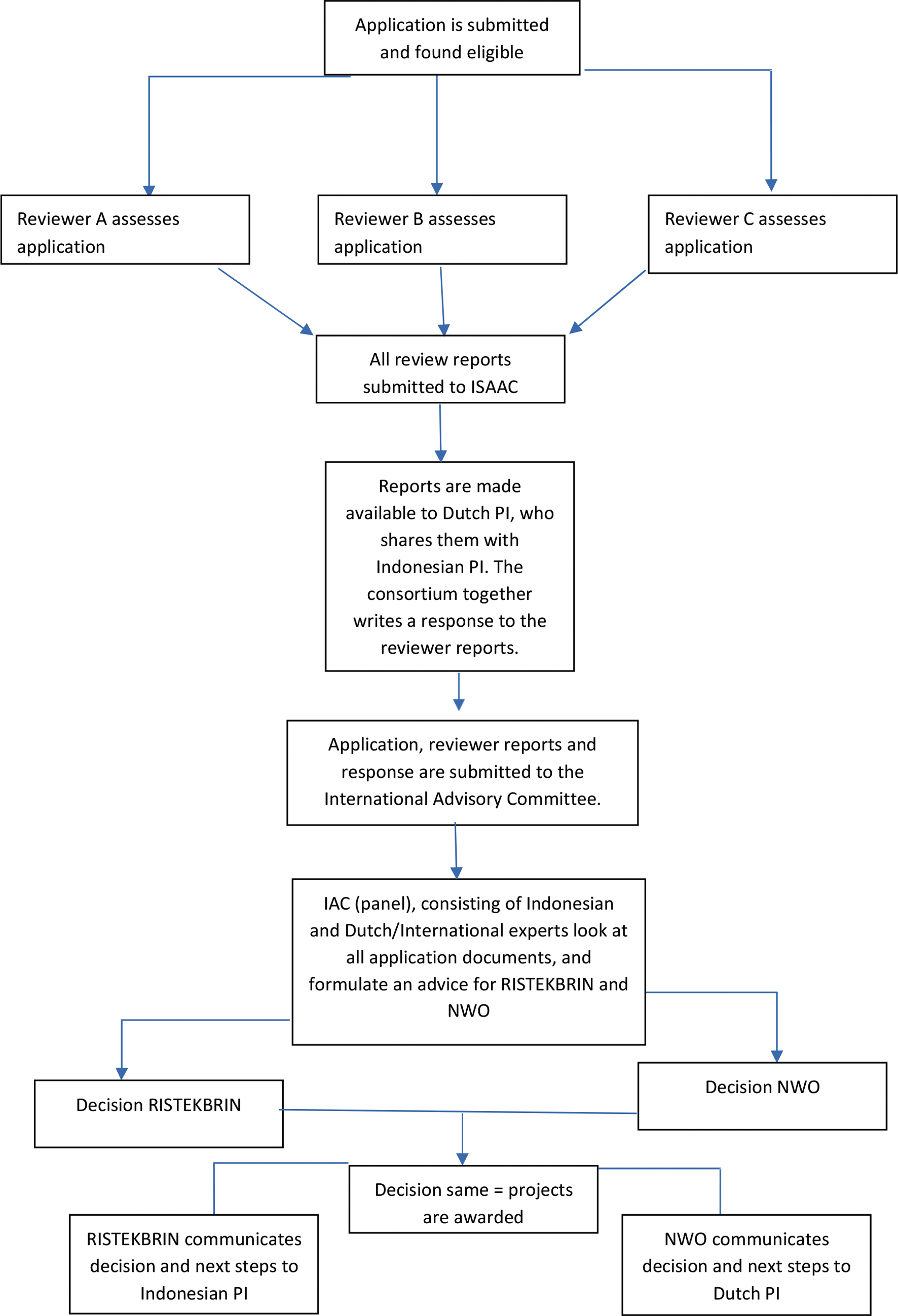
All eligible applications will be sent to independent, (inter)national reviewers, who will assess the application based on the criteria specified in 4.2. Each application will be assessed by a minimum of three reviewers. The reports by the external reviewers will be made available to the Dutch Principal Investigator via ISAAC, who should share them with the Indonesian Principal Investigator. The consortium will have five working days to write a joint response to the reviewers’ reports. The response should be submitted by the Dutch Principal Investigator on behalf of the consortium, via his or her ISAAC account.
Assessment and grant advice.
NWO and RISTEKBRIN will jointly compose an International Advisory Committee (IAC), with international experts. All applications are assessed in competition by the IAC, according to the criteria specified in paragraph 4.2. The IAC will make a final assessment of the application, based on the application, the reviewer reports, and the response, according to the criteria in section 4.2. The IAC will subsequently rank all applications. The IAC will subsequently present a substantiated advice to the NWO-WOTRO Steering Committee and the accredited RISTEKBRIN officials regarding which applications are to be awarded. In case of an ex-aequo prioritisation, preference will be given to the application that includes a university from outside the Mandiri cluster.
Decision
The NWO-WOTRO Steering Committee, on behalf of NWO, and the accredited RISTEKBRIN officials will check the assessment procedure has been carried out in accordance with the call for proposals, and will provisionally decide on the projects to be awarded, based on the advice of the IAC. The decision becomes definitive when the NWO-WOTRO Steering Committee and the accredited RISTEKBRIN officials have come to the same provisional decision.
Data management
The data management section in the application is not evaluated and therefore not included in the decision about whether to award funding. However, both the referees and the committee can issue advice with respect to the data management section. After a proposal has been awarded funding, the researcher should elaborate the data management section into a data management plan. Applicants can use the advice from the referees and the committee when writing the data management plan. A project awarded funding can only start after NWO has approved the data management plan.
Qualification
NWO will award a qualification to all full proposals and will make this known to the researcher with the decision about whether or not the application has been awarded funding.
Only applications that receive the qualification "excellent” or “very good" will be eligible for funding. For more information about the qualifications please see www.nwo.nl/en/funding/funding+process+explained/nwo+qualification+system.
|
2 September |
Webinar |
|
Full proposals |
|
|
1 October 2020, 14:00:00 CEST |
Submission deadline full proposals |
|
October to January |
Referees are consulted |
|
Mid-January |
Applicants can submit a rebuttal |
|
End of February-beginning of March |
IAC meeting |
|
March |
Decision NWO-WOTRO Steering Committee and accredited RISTEKBRIN officials |
|
End of March |
NWO and RISTEKBRIN inform applicant about the decision |
Applications will be assessed according to the following criteria:
I. Quality of the research proposal
II. Quality of the consortium
III. Potential scientific and/or societal breakthrough
The criteria carry equal weight and each count for one-third of the final assessment. In case of an ex-aequo prioritisation, preference will be given to the application which includes a university from outside the Mandiri cluster on the Indonesian side of the consortium.
The assessment criteria are further operationalised below:
I. Quality of the research proposal
– Scientific importance of the proposed research;
– Complementarity to other research programmes or (inter)national research agendas, including the Indonesia National Research Priorities;
– Alignment with the thematic focus of the call for proposals;
– Innovativeness of the research question and approach;
– Interdisciplinarity and transdisciplinarity; the proposal incorporates the scientific disciplines necessary for addressing the problem, as well as knowledge from outside the scientific community;
– Clarity of problem statement and rigour of research
– Suitability and feasibility of the approach and methodology;
II. Quality of the consortium
– Quality of the involved research partners;
– Quality of the Indonesian-Dutch collaboration, including equality in the partnership;
– Potential for long-term knowledge relations;
– Coherence and complementarity of the consortium, including organisation of the research;
– Quality of knowledge co-creation, including attention to and involvement of the complete knowledge chain;
III. Potential scientific and/or societal breakthroughs
– Relevance for society;
– Degree to which the proposal aims for scientific and societal breakthroughs;
– Quality of involvement of wider public/specific target groups;
– Quality of impact strategy, including utilisation and valorisation;
– Quality of communication plan for knowledge transfer, including outreach to industry, societal partners, and/or other stakeholders.
For specific questions about Cooperation Indonesia-The Netherlands and this call for proposals please contact:
NWO:
Dr Arina Schrier Coordinator
+31 (0) 30 600 1293
Ms. Maaike Spiekerman
Academic Secretary
+31 (0)70 349 4094
Indonesia-nl@nwo.nl
RISTEKBRIN:
Mr. Adhi Indra Hermanu
+62 8788 444 3873
manoe@ristekbrin.go.id
For technical questions about the use of ISAAC please contact the ISAAC helpdesk. Please read the manual first before consulting the helpdesk. The ISAAC helpdesk can be contacted from Monday to Friday between 10:00 and 17:00 hours CEST on +31 (0)20 346 71 79. However, you can also submit your question by e-mail to isaac.helpdesk@nwo.nl. You will then receive an answer within two working days.
Annex 6.1: Maximum costs RISTEKBRIN grant per scientific field
Annex 6.2: Format Letter of Commitment
Annex 6.3: Universities in the Mandiri cluster
Annex 6.4: Schematic of assessment procedure
The following maxima apply for different work packages from the RISTEKBRIN grant, based on the scientific content of the work package. Please consult RISTEKBRIN if you are unsure which category your work package would fall under.
STANDARD COST OF OUTPUT
A. BASIC RESEARCH
|
No |
Field of Focus |
Volume and Unit of Measurement |
Cost (IDR) |
|---|---|---|---|
|
1 |
Food – Agriculture |
1 Report |
151.320.000 |
|
2 |
Renewable energy |
1 Report |
135.670.000 |
|
3 |
Health – Medicine |
1 Report |
307.000.000 |
|
4 |
Transportation |
1 Report |
168.400.000 |
|
5 |
Information and Communication Technology |
1 Report |
90.000.000 |
|
6 |
Defense and Security |
1 Report |
235.000.000 |
|
7 |
Advanced Material |
1 Report |
179.960.000 |
|
8 |
Maritime Affairs |
1 Report |
151.050.000 |
|
9 |
Disaster |
1 Report |
123.800.000 |
|
10 |
Socio, Art, Culture, and Education Desk Study (Domestic) |
1 Report |
120.000.000 |
|
11 |
Social, Art, Culture, and Education Desk Study (Overseas) |
1 Report |
230.000.000 |
|
12 |
Social, Art, Culture, and Education Field Research (Domestic-Basic) |
1 Report |
290.000.000 |
|
13 |
Social, Art, Culture, and Education Field Research (Domestic-Intermediate) |
1 Report |
80.000.000 |
|
14 |
Social, Art, Culture, and Education Field Research (Domestic-Advance) |
1 Report |
665.000.000 |
|
15 |
Social, Art, Culture, and Education Field Research (Overseas) |
1 Report |
640.000.000 |
|
16 |
Theoretical Basic Research |
1 Report |
40.546.200 |
STANDARD COST OF OUTPUT
B. APPLIED RESEACRH
|
No |
Field of Focus |
Max Cost (IDR) |
|---|---|---|
|
1 |
Food – Agriculture |
216.000.000 |
|
2 |
Renewable Energy |
221.900.000 |
|
3 |
Health – Medicine |
448.800.000 |
|
4 |
Transportation |
143.200.000 |
|
5 |
Information and Communication Technology |
208.400.000 |
|
6 |
Defense and Security |
400.200.000 |
|
7 |
Advanced Material |
370.800.000 |
|
8 |
Maritime Affairs |
209.000.000 |
|
9 |
Disaster |
327.500.000 |
|
10 |
Socio, Art, Culture, and Education Desk Study (Domestic) |
150.000.000 |
|
11 |
Social, Art, Culture, and Education Desk Study (Overseas) |
165.000.000 |
|
12 |
Social, Art, Culture, and Education Field Research (Domestic-Basic) |
290.000.000 |
|
13 |
Social, Art, Culture, and Education Field Research (Domestic-Intermediate) |
480.000.000 |
|
14 |
Social, Art, Culture, and Education Field Research (Domestic-Advance) |
665.000.000 |
|
15 |
Social, Art, Culture, and Education Field Research (Overseas) |
640.000.000 |
|
[Template letter of commitment for consortium organisation] |
|
|
[The letter should be printed on the stationery of the consortium organisation concerned] |
|
|
[address main applicant] Concerns: Letter of Commitment |
|
|
[Location], [date] |
|
|
Dear [name principal investigator], |
|
|
Through this letter, I confirm that [name consortium organisation] is available and committed to participate in the proposed project, entitled ‘[proposal title], which was submitted to the ‘[Title of call]’. |
|
|
[outline the availability and commitment of the consortium organisation, including the availability and commitment of the individual consortium members, and confirm that the PI and/or co-applicant(s) have a contract for the duration of the assessment process and the research] |
|
|
[if applicable, indicate the consortium organisation’s total contribution in cash, or quantify the in kind contribution. This amount should be the same as indicated in the application form] |
|
|
Yours sincerely, |
|
|
[signed by the head of the organisation/department] |
|
|
Location: [..] |
...... [signature] |
|
Date: [..] |
[NAME + POSITION] |
|
Universitas Gadjah Mada Institut Pertanian Bogor Universitas Diponegoro Universitas Andalas Institut Teknologi Bandung Universitas Airlangga Universitas Padjadjaran Universitas Hasanuddin Institut Teknologi Sepuluh Nopember Universitas Udayana Universitas Brawijaya Universitas Indonesia Universitas Sebelas Maret Universitas Negeri Malang Universitas Sumatera Utara Universitas Riau Universitas Negeri Semarang Universitas Pendidikan Indonesia Universitas Negeri Yogyakarta Universitas Syiah Kuala Universitas Jember Universitas Islam Indonesia Universitas Lampung Universitas Mataram |
Universitas Negeri Jakarta Universitas Negeri Padang Universitas Muhammadiyah Surakarta Universitas Sam Ratulangi Universitas Sriwijaya Universitas Pembangunan Nasional Veteran Jawa Timur Universitas Kristen Satya Wacana Universitas Telkom Universitas Bina Nusantara Universitas Muhammadiyah Yogyakarta Universitas Halu Oleo Universitas Jenderal Soedirman Universitas Katolik Indonesia Atma Jaya Universitas Negeri Surabaya Universitas Muhammadiyah Malang Universitas Tarumanagara Universitas Negeri Medan Universitas Atma JayaYogyakarta Universitas Katolik Parahyangan Universitas Gunadarma Universitas Pancasila Universitas Tanjungpura Universitas Kristen Petra |
The Merian Fund is part of NWO, and was founded to stimulate long-term collaboration with important (emerging) science nations and increase the visibility and profile of Dutch science abroad. The Merian Fund focuses on broad scientific themes of societal importance that require a mission-oriented approach. Programmes in the Merian Fund are aligned with the National research Agenda (NWA) of the Netherlands. For more information see https://www.nwo.nl/en/policies/international+collaboration/merian+fund
Per 0.2 fte scientific employee at a university of applied sciences (junior, medior and senior level, with a minimum appointment of 0.2 fte for a period of 12 months), a maximum of € 15,000 material budget can be applied for each year of the appointment.
In this budget module, the definition for “knowledge transfer” used by the European Commission in the Framework for State Aid for research and development and innovation applies (PbEU, 2014, C198).
A format can be found here: https://www.nwo.nl/en/documents/wotro/wotro---format-consortium-agreement
A hybrid journal is a scientific journal that is based on subscription income but which offers researchers the possibility to make individual articles Open Access by paying an extra article processing charge. In one issue of a journal you may therefore find both articles that can only be read with a subscription and articles that are freely accessible.
Kopieer de link naar uw clipboard
https://zoek.officielebekendmakingen.nl/stcrt-2020-28936.html
De hier aangeboden pdf-bestanden van het Staatsblad, Staatscourant, Tractatenblad, provinciaal blad, gemeenteblad, waterschapsblad en blad gemeenschappelijke regeling vormen de formele bekendmakingen in de zin van de Bekendmakingswet en de Rijkswet goedkeuring en bekendmaking verdragen voor zover ze na 1 juli 2009 zijn uitgegeven. Voor pdf-publicaties van vóór deze datum geldt dat alleen de in papieren vorm uitgegeven bladen formele status hebben; de hier aangeboden elektronische versies daarvan worden bij wijze van service aangeboden.
 Authentieke versie (PDF)
 Informatie
 Printen
 Delen
Delen