Staatscourant van het Koninkrijk der Nederlanden
| Datum publicatie | Organisatie | Jaargang en nummer | Rubriek |
|---|---|---|---|
| Nederlandse Organisatie voor Wetenschappelijk Onderzoek | Staatscourant 2017, 62594 | Overig |

U bent nu hier: Publicaties Officiële publicaties
Zoals vergunningen, bouwplannen en lokale regelgeving.
Adressen en contactpersonen van overheidsorganisaties.

To improve yield, quality and stability of potato production
Guidelines for funding proposals for research under the Partnership NWO Domain TTW – H.I.P.
Deadline for submission of applications:
11 January 2018; 14:00h CE(S)T (Central European (Summer)Time)
Version: August 2017
Utrecht, August 2017
Netherlands Organisation for Scientific Research
NWO Domain Applied and Engineering Sciences
Partnership programme NWO Domain TTW – Holland Innovative Potato
|
Introduction |
2 |
||
|
About NWO Domain TTW and H.I.P |
3 |
||
|
NWO Domain TTW’s mission |
3 |
||
|
Utilisation |
3 |
||
|
Users |
3 |
||
|
Holland Innovative Potato |
3 |
||
|
Wageningen Research |
3 |
||
|
Background |
4 |
||
|
Objective of the programme |
4 |
||
|
Scope of the programme |
4 |
||
|
Objectives and application of results |
5 |
||
|
Major research areas |
5 |
||
|
Scientific challenges |
6 |
||
|
Specific requirements to the programme |
8 |
||
|
Who can apply |
8 |
||
|
Criteria for submission |
8 |
||
|
Co-funding criteria |
8 |
||
|
Partnership programme and budget |
9 |
||
|
Partnership project and budget |
9 |
||
|
Partnership and project agreement |
9 |
||
|
Funding conditions and Intellectual property (IP) policy |
9 |
||
|
Programme committee |
9 |
||
|
Resubmitting research proposals |
10 |
||
|
Submission of project idea for funding elsewhere |
10 |
||
|
Open Access |
10 |
||
|
Data management |
10 |
||
|
Nagoya Protocol |
11 |
||
|
Deadlines and Time frame |
|||
|
Deadlines for the submission of full proposal |
11 |
||
|
Time frame for full proposals |
11 |
||
|
Assessment procedure |
11 |
||
|
Formal requirements |
11 |
||
|
Assessment by referees |
12 |
||
|
Applicants’ rebuttal |
12 |
||
|
Assessment committee |
12 |
||
|
Decision by the NWO Domain TTW Board |
12 |
||
|
NWO Code of Conduct on Conflicts of Interest |
13 |
||
|
After award |
13 |
||
|
After awarding |
13 |
||
|
Start and starting date of the project |
13 |
||
|
User committees |
13 |
||
|
Programme committee and programme meetings |
14 |
||
|
Reporting |
14 |
||
|
Extension |
14 |
||
|
Termination and termination date |
14 |
||
|
Discontinuation |
15 |
||
|
Guidelines for applicants |
|||
|
Drawing up and submitting the proposal |
15 |
||
|
ISAAC |
15 |
||
|
Format |
15 |
||
|
Who can apply? |
16 |
||
|
Main and co-applicants |
16 |
||
|
Who can act as main and co-applicants? |
16 |
||
|
Main and co-applicants with a part-time appointment |
16 |
||
|
Who cannot apply? |
16 |
||
|
What can be applied for? |
16 |
||
|
Project-specific costs |
16 |
||
|
Notes on temporary personnel positions |
17 |
||
|
Notes on permanent staff |
17 |
||
|
Notes forWageningen Research personnel |
17 |
||
|
Notes on secondment |
17 |
||
|
Notes on PDEng trainee |
18 |
||
|
Notes on Casimir candidate |
18 |
||
|
2. Notes on costs of materials and domestic travel |
18 |
||
|
Notes on Material credit |
18 |
||
|
3. Notes on costs of foreign travel |
19 |
||
|
Notes on short travel abroad |
19 |
||
|
Notes on exchange visits |
19 |
||
|
4. Notes on costs of investments |
20 |
||
|
Notes on investments |
20 |
||
|
Notes on Users, co-funding and letters of support |
20 |
||
|
Users |
20 |
||
|
Co-funding |
20 |
||
|
Definitions |
20 |
||
|
Notes on Criteria relating to co-funding |
21 |
||
|
Notes on Criteria relating to in-kind co-funding |
21 |
||
|
NOT permissible as the co-funding |
21 |
||
|
Letters of support |
21 |
||
|
A. General requirements |
22 |
||
|
B. Specific requirements |
22 |
||
|
C. Declaration and signing by the User |
22 |
||
|
Notes on Intellectual Property policy (IP policy) & Publication arrangements |
22 |
||
|
Notes relating to the application form |
23 |
||
|
Contact information |
27 |
||
|
Technical questions about the online application system ISAAC |
27 |
||
|
Links |
27 |
||
|
Appendix 1: Notes for the completion of an FP form |
28 |
||
|
Appendix 2: Specimen form ‘Declaration and signing by the applicant’ |
29 |
||
|
Appendix 3: Partnership project Agreement |
30 |
||
|
Appendix 4: Evaluation items |
30 |
||
|
Appendix 5: Evaluation scales |
30 |
||
|
Appendix 6: Specimen form ‘Data management’ |
32 |
||
|
Appendix 7: Timeframe |
32 |
||
This brochure explains the objectives and working methods of NWO Domain Applied and Engineering Sciences (NL: NWO-domein Toegepaste en Technische Wetenschappen (TTW); further referred to as NWO Domain TTW or TTW. It details the conditions governing proposals submitted to NWO Domain TTW for the funding of scientific research under the Partnership programme NWO Domain TTW – Holland Innovative Potato.
NWO Domain TTW is part of the Netherlands Organisation for Scientific Research (NWO; see also www.nwo.nl) which supports a strong system of sciences in the Netherlands by encouraging quality and innovation in science. Responsibility for the national science and innovation policy lies with the Ministries of Education, Culture and Science (OCW) and Economic Affairs (EZ). As such, NWO Domain TTW provides government funding.
Before submitting your application electronically via ISAAC, NWO Domain TTW recommends that you visit its website (www.ttw.nwo.nl) to verify that you have the latest version of this brochure, and that you read the guidelines carefully. Moreover, please familiarize yourself with ISAAC (www.isaac.nwo.nl) before you start the submission of your proposa.
NWO Domain TTW connects people and resources to develop technology with economic value that contributes to societal challenges.
NWO Domain TTW does so by:
• bringing scientific researchers and potential users together;
• funding excellent research in the applied and technical sciences.
Research funded by NWO Domain TTW generates valuable knowledge. In addition to excellent science, NWO Domain TTW aims to promote the application of knowledge. The term used by NWO Domain TTW to refer to the set of activities aimed at maximising the possibility of research results being applied by third parties is ‘utilisation’. In order to promote utilisation in addition to scientific quality, NWO Domain TTW establishes a user committee for every project. NWO Domain TTW expects applicants and users to actively collaborate towards promoting utilisation and towards NWO Domain TTW’s objective of transferring knowledge to users. Users, user committees and intellectual property play a crucial role in utilisation.
Users of research are defined as natural persons or legal persons (at national or inter-national level) who are able to apply the results of the research. A distinction is sometimes drawn between direct users, usually companies, and end users. In that case, it is not sufficient to designate end users only. It is NWO Domain TTW’s explicit intention that potential technology users and end users outside the immediate circle and outside the research field of the researchers submitting the proposal should be involved in the project from beginning to end. Users should be able to apply the knowledge generated by the research in the medium to long term.
If identified before submission, (potential) users should be indicated in the utilisation section of the research proposal. In this particular Partnership members of the Holland Innovative Potato consortium will most probably act as single user in the Partnership projects.
Holland Innovative Potato, further referred to as H.I.P., is an initiative of 10 companies active in the potato value chain and prominent global players in the fields of potato breeding and processing. The 10 companies are: Avebe, Aviko, Bejo, Farm Frites, HZPC, Lamb Weston, McCain, Meier Potato, PepsiCo and Solynta.
These companies have a world leading position in potato processing and breeding. Research and Development enable the H.I.P. partners to breed and to produce better products to benefit society’s needs.
The objective of H.I.P. is to strengthen and to maintain the leading position of The Netherlands as global leader in sustainable potato business by increasing knowledge and knowhow to enable the development, by 2027, of potato products which distinguish themselves in the market and for society.
In order to achieve its objective H.I.P. contributes to implementation and realization of the Sustainable Development Goals by a) contributing to the world food supply by securing nutritious, healthy, safe and sufficient food and b)contributing to a resilient and sustainable agriculture.
H.I.P. is a precompetitive knowledge platform to develop and enable the flow of knowledge in all fields related to potato thereby strengthening the Dutch position and reputation as a worldwide market leader in the potato value chain and preparing the Dutch stakeholders, in the potato value chain, towards the future.
The Research Institutes of Wageningen University & Research, former DLO and further referred to as Wageningen Research, carry out application-oriented and field-based research. They are commissioned by the government, commercial businesses and non-profit organisations. In a research project there is often collaboration between several institutes, such as university and/or national or international partners.
Wageningen Research is not eligible for NWO funding, however Wageningen Research is able to contribute to the Partnership programme as project partners in projects that fit within this Partnership programme. The contribution of Wageningen Research employees consist of research capacity (in-kind manhours) for collaborative work to be executed in the project (see ‘Partnership project and budget’ for further information). This work should be integral part of the project proposal.
This in-kind contribution to the project is covered by the generous contribution of the Ministry of Economic Affairs to the Partnership programme.
NWO Domain TTW initiated the Partnership programmes to stimulate effective cooperation between academia and industries. This Partnership programme, is facilitated by the Holland Innovative Potato initiative, the Topsector Agri&Food, NWO Domain TTW and the Dutch Ministry of Economic Affairs.
Potato is a great carrier of nutritional value, well appreciated in many food products, eaten 3-5 times a week by consumers of all age. Potato is a balanced food with starch for energy and vitamins and minerals with high bio-availability. As the third world, staple crop potato is highly relevant to contribute to wellbeing and healthy ageing by bringing nutrition with calories to people and to feed the world responsibly.
Potato breeding and processing are knowledge intensive. Current developments in science and technology open new opportunities for variety and product innovation. Precompetitive research and development creates the opportunity for the H.I.P. partners to maintain and to expand their world leading role and competitive position. The H.I.P. partners aim to strengthen the relations with universities and knowledge institutions to support their precompetitive research collaboration.
Project collaboration in which i) university and knowledge institute research groups collaborate and ii) companies and university/knowledge institute groups exchange research personnel is regarded as an important aspect in the programme by the H.I.P. companies.
We invite scientists to submit a dedicated research proposal aligned with the scope of the programme that provide answers to the scientific and technological challenges in application areas of potato breeding and processing.
The economic yield of potato is a function of the processes in the complete production chain from the genetic composition of the cultivars to consumers’ behaviour. This Partnership programme focusses on the beginning of this chain: genetics and agronomy and their influence on yield, quality and stability of potato production.
One of the main drives of this Partnership is the need to feed the growing world population with high quality products. Potato has a major role in the global food security as it is relatively water efficient and the product has a high nutritional value in comparison with vegetables.
The yield and quality of potato can be improved by developing better cultivars with increased yield and product quality. This is based on the exploration and exploitation of genetic and genomics knowledge of the main components of these traits. The full potential of these traits requires optimal cropping systems. At present, there is often a great gap between the crops’ potential and realised economic yield, due to sub-optimal cultivation practises. The aim of H.I.P. is to get a better insight into the impact of these cultivation practises on crop growth, development and yield by using detailed analytical agronomic tools.
H.I.P. aims at an integrated research programme as genetics and agronomy have complex interrelationships. Therefore full advantage of the strong Netherlands potato knowledge infrastructure both in the public as well as in the private sector should be taken. Projects, whereby materials, experiments, trials and data are shared in an integrated approach, are encouraged.
Within the Partnership programme NWO Domain TTW – H.I.P. two (2) main objectives have been defined:
1. Thorough understanding of agronomy to increase the economic yield, quality and stability (higher average, less variance) as a function of the most important management factors in potato culture. Knowledge to be translated into practical guidelines to monitor and to control the cultivation of potatoes.
2. Understanding the genetics related to stable economic yield and quality.
The research activities within this Partnership programme will increase knowledge on the contribution of genetics, crop management and environmental factors that contribute to yield and stability in the context of resource efficiency, potato consumption and climate change. Exploiting data of environmental factors and analysis of such data through data sciences are also part of the objectives.
Potatoes are rich in protein, starch, vitamins and minerals like potassium and therefore are suitable in low salt diets. The rich genetic reservoir of potato in combination with enhanced potato breeding technology offers enormous perspectives in promoting potato as an ideal crop to develop highly nutritious and healthy, tasteful products serving the needs of the growing world population and global dietary shifts.
Potato processing is well advanced and builds on a long tradition of innovation in processing technology. The Netherlands has a long standing track record in this. Processing of potato into fries and chips is and remains a huge competitive market-driven innovation in potato culture and processing. Moreover, starch and other biomolecules as protein are of interest for large scale isolation from potato, especially in the anticipated shift from the carbon- to the green economy. Breeding and innovation in processing will be instrumental to this shift.
The Partnership programme focusses on projects on agronomy, genetics and the interaction between these two research areas.
The rationale for choosing agronomy and genetics as the scope of the programme is depicted in the figure below. A potato variety today has a certain genetically determined yield potential (100). However, there are many factors in practical cultivation leading to yield loss, resulting in the blue curve of realised yields. The aim of the research area agronomy is to minimize these yield losses and shift the yield distribution into the direction of the maximum achievable yield (higher average, less variance) – depicted by the red curve. As indicated by arrow 1, the expected result of the Agronomy research is a narrower yield distribution, resulting in a higher average and total yield at the same maximum yield.
The major deliverable of the genetics objective is to increase the maximum achievable yield and to lower the sensitivity to environmental factors. This is depicted by the green curve: less variation (narrower curve again, arrow 2), higher maximum yield (arrow 3) resulting in a higher average and total yield.
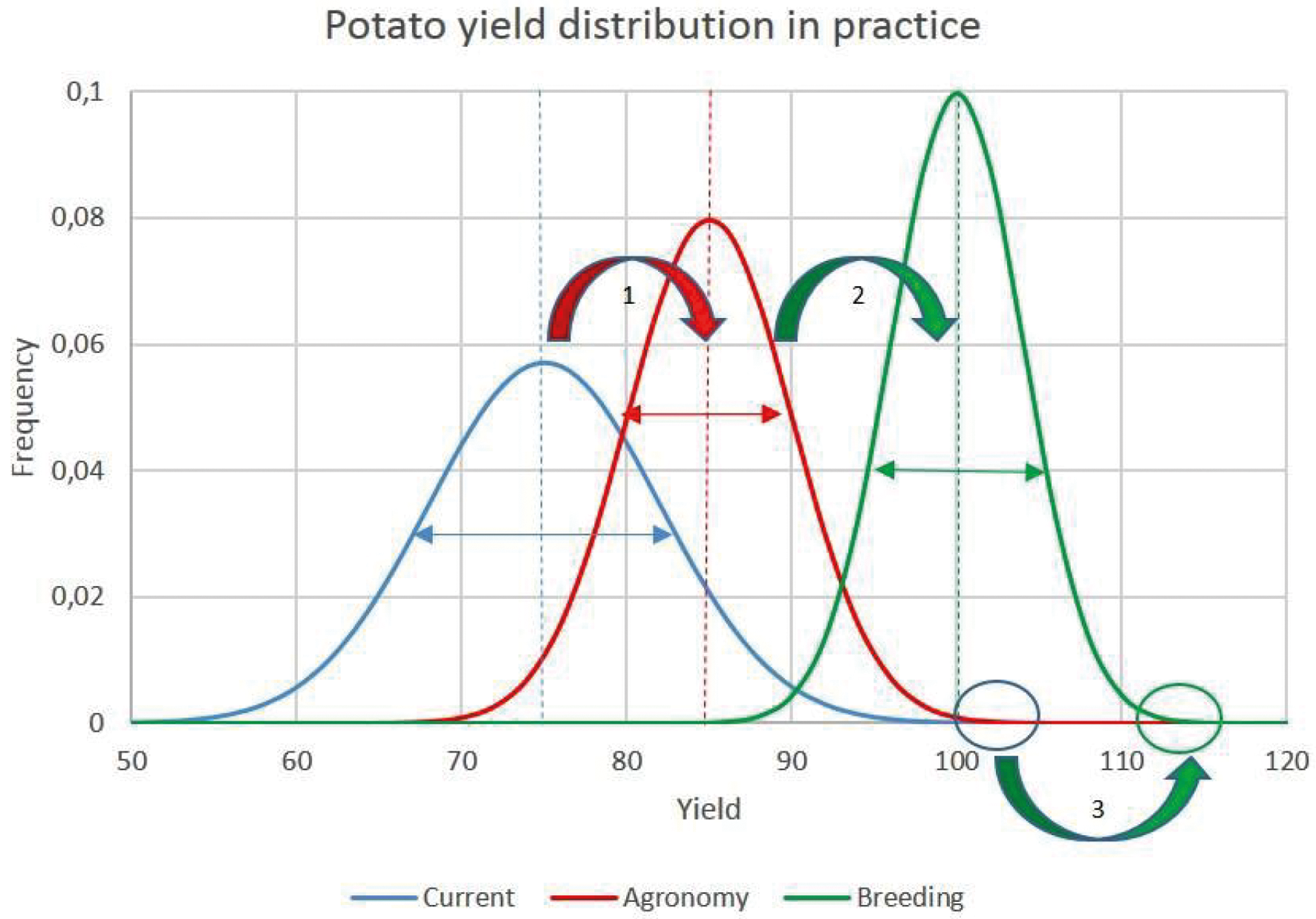
The general ambition of the H.I.P. partners is to obtain a Partnership programme wherein selected projects together cover all objectives, subsequently enforcing and strengthening the complete programme. Projects, in which materials, experiments, trials and data are shared in an integrated approach, are encouraged.
The Netherlands has a strong knowledge infrastructure in relevant potato sciences, both in the public as well as in the private sector. H.I.P. aims at fully exploit the strong positions of all partners involved.
Large field trials as a consequence of the project activities can be organized under the responsibility of H.I.P. partners, whereby materials from the public as well as from the private partners are used. Of note, large field trials cannot be an integral part of a partnership project application.
Though pest management is an integrated aspect of crop handling, research on phytopathology is excluded from this partnership programme.
Agronomy: monitoring crop parameters and development of a crop management tool.
Stability (less variance) of economic yield (higher average) of marketable end-product is a major challenge in potato. Yield varies at different levels of integration: within a tuber, plant, field and region. This variation can be explained by:
• interactions between the genetic background
• crop management
• environmental factors
• post-harvest handling
To develop optimal management decisions the agronomy research area is focused on the management of the environmental factors (in interaction with the gene background and crop management) in order to maximize the yield and to avoid yield losses. It is envisaged to carry out multi-location tests over three years with potato materials, that are proposed by H.I.P. partners. Traditional phenotyping will be combined with, for example, modern precision automatic instruments like drone analyses by using different light spectra, in-soil spectral analysis and data-sciences approaches for analysis. New ways to phenotype mineral yield in the field will be tested by micro-scale measurement of key environmental factors, above and below ground. The data are linked to the final yield in terms of weight, economic value and nutrient value, all per unit area (ha). These data are instrumental to develop and adapt crop management models. Therefore, the agronomy research will lead to optimized cultivation techniques that are used to improve decision support systems, and to quantify environmental interactions. As a result potato germplasm and dedicated segregating populations can be evaluated more efficiently.
The engine behind yield realization is the ability of the crop to produce. In other words, the dry matter production per day per hectare. This is influenced by both genetic and environmental factors, commonly referred to as GxE.
The three phases of the agronomy research are:
• Field monitoring and testing of (new) measurement tools.
Goal(s): identifying the top five agronomic variables that have a negative impact on yield (higher average, less variance) and assess how these agronomic variables best can be measured in practice.
• Fundamental study on the relevant components of the potato growth model.
Goal(s): gain fundamental knowledge on the effects of 1) root growth and activity,2) photosynthetic activity, 3) necrosis and 4) tuber activity on the potato growth model in order to validate/complete this model.
• Translate growth model in a practical tool.
Goal(s): development of a practical and user friendly measurement and monitoring tool that is based on the gained insights from step a (field monitoring) and b (study on relevant component) and that helps farmers to realize higher average yields (and less variance)
Potato has a high level of components that contribute to nutrient value. Given the large genetic variation in general, it is expected that there is also a large variation for these components, though there is little literature on this issue. Therefore, evaluation of the genetic variation for the major nutrition components is an important deliverable of this research area.
Based on the available genetic variation and the economic and social value preferred components are defined to be elaborated upon in further studies. To this end targeted segregating populations are generated, based on crosses between contrasting parents. Thorough knowledge of the GxE is needed as described in the agronomy research area. Therefore, within segregating populations, QTLs for stability across environments will be identified for the yield of preferred components. Development of phenotyping methods for these components will be prioritized in the agronomy studies. The new QTLs identified in the genetics research will be evaluated at different conditions to study the gene x environment interaction. In this way, the robustness of QTLs is assessed.
|
Field traits |
Nutrition traits |
|||
|---|---|---|---|---|
|
Major components |
Example |
Nutrition |
other |
|
|
Plant development Yield |
Macro-nutrients |
|||
|
Proteins |
Lowering blood pressure |
Industrial protein |
||
|
Fibres, Carbohydrates |
Starch |
Glycemic index |
Industrial starch |
|
|
Quality traits |
||||
|
Frying quality Tuber visual quality |
Micro-nutrients |
|||
|
Vitamins |
C, B3, B6, |
Healthy aging folate |
||
|
Minerals |
K, Fe, Mg, Cu, Zn, P |
Bio-fortification |
||
This partnership programme has two main components, genetics and agronomy, that are strongly interrelated: The realization of the full genetic potential of a potato cultivar is dependent on the crop handling and the optimal crop handling is dependent on the genetic make-up of the specific cultivar. Therefore, strong interactions within or between research projects within this partnership programme are greatly encouraged.
Scientists employed by Dutch (Technical) Universities and institutes eligible for funding by NWO Domain TTW (see ‘Guide for applicants’) can submit a proposal to this Partnership call. Of note, employees of Wageningen Research cannot submit a proposal to this call nor act as (co-)applicant. However, Wageningen Research employees may participate in projects by means of an in-kind contribution for manhours (fixed tariffs). This contribution is covered by the Ministry of Economic Affairs.
The proposals must meet the following criteria:
• Project idea’s must be discussed with the representative of the H.I.P. consortium (see ‘Contact information’) before submission in order to determine whether the proposal fits within the scope of the Partnership Programme and aligns with its objectives.
Of note, Potato cultivars, germplasm and varieties are selected and made available for proposed experiments in interaction with H.I.P. partners.
• Proposals that fit within the programme should address one of the described research areas.
• Projects, that describe an integrated approach are encouraged.
• Research proposals concern the development of pre-competitive knowledge on potato comprising any application in the potato value chain.
• Envisaged project results should be applicable in the potato value chain on the middle long term (i.e. 5-10 years). It is therefore recommended that research proposals build upon running projects and/or initiatives thereby creating added value.
• The project proposal must include research activities of Wageningen Research employees as in-kind contribution (see ‘co-funding criteria’ and ‘partnership project and budget’ below)
• The research has to fit within the roadmaps of the Top Sector Agriculture and Food (NL: Agri&Food, http://www.tki-agrifood.nl).
NOT eligible to this Partnership programme are project proposals covering research topics which create a conflict of interest with one of the participants as a result of affiliations with competitors of the H.I.P. companies. Large field trials and research on phytopathology is not eligible for funding in this Partnership programme.
The Partnership programme as a whole is funded by NWO Domain TTW, H.I.P and Ministry of Economic Affairs. Additional co-funding on project level, financial and/or in-kind contributions, is therefore not required for proposals submitted within this call.
The Ministry of Economic Affairs has generously released an in-kind contribution of 1.5 million euros to be allocated specifically towards research activities executed by Wageningen Research employees. Therefore the project proposal should contain a description of research activities by Wageningen Research employees. The research capacity for these activities should be equal to one third of the requested TTW/HIP budget.
In case partners other than H.I.P. members and/or Wageningen Research show interest in the research proposal and are willing to participate in the project and/or to provide co-funding to your project, please discuss the possible consequences for any intellectual property arrangements with these interested partners, programme coordinator of H.I.P. and the TTW office before submission. Potential additional partners will certainly not be direct competitors with respect to interests and activities of H.I.P. partners.
Proposals should address the research areas described in the ‘Objectives of the programme’. Only those research proposals that fit into the described scope of the programme may be submitted. Whether a potential project proposal fits into the programme is determined by H.I.P. It is therefore mandatory to contact the Programme coordinator of H.I.P. to discuss the project idea before submission and, if applicable, mention other partners that have expressed their intention to support the project (see ‘Contact information’). Proposals not relevant to H.I.P. activities will not be eligible for funding.
Although not required, preferably two (2) researchers who are employed by at least two (2) different universities or public research institutes, that are eligible for NWO funding, submit a joint research proposal. The TTW office considers the main applicant to be the project leader, the contact person throughout the assessment procedure and the penholder of the consortium after award of funding.
Together NWO Domain TTW and H.I.P. have made available a budget of 2,85 million euro (inclusive of Dutch VAT) for this Partnership programme. This budget includes a reservation for programme activities within this Partnership with a maximum of 50.000 euro (inclusive of Dutch VAT).
In addition, as an in-kind contribution, the Ministry of Economic Affairs released 1,5 million euro research capacity at Wageningen Research to be embedded in projects within the Partnership.
The programme has a maximum duration of five (5) years, starting from the award date of the first project grant within the Partnership programme. The final date for programme and project activities within this Partnership programme is April 30th, 2023.
The maximum funding that can be requested from TTW/H.I.P. for a Partnership project is 775.000 euro (inclusive of Dutch VAT) and 375.000 euro for research capacity at Wageningen Research. The maximum requested project budget is 1.150.000 euro (including Dutch VAT).
The budget for research capacity at Wageningen Research is covered by the Ministry of Economic Affairs as in-kind contribution must be one third of the requested project budget, excluding co-funding from private parties.
The typical Partnership project duration ranges from 2 to 4 years starting from the award date of the project grant within the Partnership programme.
The Partnership programme is a cooperation between NWO Domain TTW and H.I.P. and a Partnership agreement has been signed between these partners. For any issues that might arise during the course of the project, the project leader can consult NWO Domain TTW for advice.
After award, the applicant obtains a Partnership project agreement in which the legal and financial conditions are stated (available on the website). The institutes and H.I.P. member(s) involved in the project, as well as other project partners such as Wageningen Research, will sign this Partnership project agreement. The grant is available only after this agreement has been signed by all parties and returned to the TTW office.
This Partnership call is published by NWO Domain TTW. This call for proposals and the NWO Grant Rules 2.017 are applicable to this Partnership programme (www.ttw.nwo.nl). Management and administration of project (proposals) will take place according to procedures of NWO Domain TTW.
The partner within this Partnership programme, H.I.P., obtains non-exclusive rights to use and commercialize the results (all inventions, know-how, materials, methods, processes, products, programmes, software, findings and discoveries and any IP rights pertaining thereto), with the option to obtain exclusive rights against a market price to be agreed upon. These conditions will be part of the Partnership project agreement.
A Programme committee of at least six (6) members will be formed after the assessment and granting procedure consisting of representatives from H.I.P. and selected experts from the field that may or may not be involved in the Partnership programme as (co-) project leader or user. These experts will be selected by H.I.P. in close collaboration with the NWO Domain TTW programme coordinator and the committee will choose a chair from their midst.
The programme committee is responsible for the overall directions and management of the programme and stimulates the collaboration between the granted projects, as well as the connection to ongoing applied research projects within H.I.P. Researchers are urged to adhere to the advice and direction of the programme committee with respect to adjustments in the projects towards the benefits of the Programme objectives.
All members of the programme committee are subject to confidentiality restrictions to protect any results of ideas laid down in the project proposals and discussed during meetings. Programme committee meetings will be organised at least once a year unless the programme committee decides differently based on particular needs.
Within this programme, a researcher may associate his/her name to more than one (1) research proposals as an applicant or co-applicant.
Research proposals that were rejected in a previous STW or NWO Domain TTW evaluation procedure cannot be resubmitted automatically. When a research proposal is resubmitted, the scientific description (Section 4 of the application form) and/or the utilisation plan (Section 5 of the application form) must have been significantly revised. NWO Domain TTW will be the judge of this. The earlier referees’ comments may be used as a guideline in revising the proposal. When submitting the research proposal, the applicant is obligated to attach a statement in English explaining the revisions. If the research proposal has not been revised sufficiently, it will not be eligible for funding.
If identical or very similar research proposals are or will be submitted to NWO or other funding bodies, this must be stated in the proposal. For the duration of the assessment procedure of this Partnership programme call, the submission of identical or very similar proposals (this judgement of NWO Domain TTW) to more than one of the following calls is not permitted: Open Technology Programme and ‘Perspectief’ Programme.
All scientific publications resulting from research that is funded by grants derived from this call for proposals and approved by the user committee are to be immediately (at the time of publication) freely accessible worldwide (Open Access) taking into account the terms and conditions of the Partnership agreement and the respective Partnership project agreement. There are several ways for researchers to publish Open Access. A detailed explanation regarding Open Access can be found on http://www.nwo.nl/openscience-en.
Responsible data management is part of good research. NWO wants research data that emerge from publicly funded research to become freely and sustainably available, as much as possible, for reuse by other researchers taking into account the terms and conditions of the Partnership agreement and the respective Partnerhsip project agreement. Furthermore NWO wants to raise awareness among researchers about the importance of responsible data management. Proposals should therefore satisfy the data management protocol of NWO. This protocol consists of two steps:
1. Data management section
The data management section is part of the research proposal. Researchers should answer four questions about data management within their intended research project. Therefore before the research starts the researcher will be asked to think about how the data collected must be ordered and categorised so that it can be made freely available. Measures will often need to be taken during the production and analysis of the data to make their later storage and dissemination possible. Researchers can state which research data they consider to be relevant for storage and reuse.
2. Data management plan
After a proposal has been awarded funding the researcher should elaborate the data management section into a data management plan. The plan should be submitted to NWO via ISAAC within a maximum of 4 months after the proposal has been awarded funding. NWO Domain TTW will approve the plan as quickly as possible. Approval of the data management plan by NWO Domain TTW is a condition for disbursement of the funding. The plan can be adjusted during the research.
Datamanagement is requested on project level. The Partnership programme committee will decide on later date if and how to organize datamanagement on the programme level. Further information about the data management protocol of NWO can be found http://www.nwo.nl/datamanagement.
The Nagoya Protocol became effective on 12 October 2014 and ensures an honest and reasonable distribution of benefits emerging from the use of genetic resources (Access and Benefit Sharing; ABS). Researchers who make use of genetic sources from the Netherlands or abroad for their research should familiarise themselves with the Nagoya Protocol (www.absfocalpoint.nl). NWO assumes that researchers will take all necessary actions with respect to the Nagoya Protocol.
Please be aware that it is mandatory to contact the Partnership Programme coordinator at H.I.P. (see ‘contact information’), before submission to discuss your project idea and to determine whether the project fits within the scope of the Partnership programme (see ‘Assessment of fit to the Partnership programme’ below) preferably no later than four (4) weeks before the deadline.
The submission deadline for complete research proposals to the Partnership NWO Domain TTW – H.I.P. programme is Thursday January 11th, 2018 at 14:00 hours CE(S)T (Central European (Summer) Time).
Before submitting your application electronically via ISAAC, NWO Domain TTW recommends that you visit its website (http://www.ttw.nwo.nl) to verify that you have the latest version of this brochure, and that you read the guidelines carefully.
NWO Domain TTW adheres the NWO policy for deadlines ‘Handhaving deadlines’. Your submission receives time and date of registration. Please be aware that submissions registrations of 14.01 CE(S)T on the day of deadline or later will not be considered. For this reason we recommend to familiarize oneself with ISAAC (http://www.isaac.nwo.nl) in advance of the deadline and before you start the submission of your proposal.
|
CALL OPEN |
September 2017 |
|
Discussion of proposal idea with H.I.P. (see ‘contact info’ p. 33) |
Before submission |
|
DEADLINE FULL PROPOSALS |
January 11th, 2018; 14:00 hr CE(S)T |
|
Assessment formal requirements by TTW |
Mid-January 2018 |
|
Applicants: Revision of proposal to fit formal requirements |
2nd half January 2018 (1 week) |
|
Assessment by international referees |
February – March 2018 |
|
Applicants: Rebuttal |
1st half April 2018 (1 week) |
|
Advice Assessment committee to NWO Domain TTW board |
2nd half April – May 2018 |
|
Decision by the NWO Domain TTW board |
June, 2018 |
|
Notification to applicants on board decision |
Last week of June 2018 |
NWO Domain TTW confirms receipt of the research proposal submitted to ISAAC. It then verifies the formal requirements to determine whether the research proposal is eligible for consideration. If the relevant conditions (see section on ‘Guidelines for applicants’) are not fulfilled or the information requested is incomplete, the research proposal will not be considered. In that case, NWO Domain TTW returns the research proposal to the main applicant within five to ten working days with a request for adjustments or additional information. The main applicant is given 5 workdays (1 week) – calculated from the date of NWO Domain TTW’s notification – to submit a revised version (ISAAC). If the information required is not provided, or is incomplete by the deadline, the research proposal is recorded as withdrawn.
If at least four (4) times more proposals are submitted than can be funded, NWO Domain TTW retains the right to perform a preselection based on (one (1) of) the evaluation criteria (see ‘Assessment Committee’).
NWO Domain TTW submits the research proposal to a number of international experts in the relevant specialist area (peer review). These referees are drawn from the scientific world, large research institutes, and industry. Referees remain anonymous. They assess the proposal on the basis of specific questions about scientific quality and utilisation. The questions submitted to referees (see Appendix 4) are available on the website (http://www.ttw.nwo.nl). NWO Domain TTW recommends that applicants anticipate these questions in the research proposal. The number of referees consulted by NWO Domain TTW depends on the nature of the research proposal and the size of the budget contained in the research proposal. For the purposes of this Partnership programme, NWO Domain TTW aims to have the research proposal assessed by three to five referees.
NWO Domain TTW gives applicants the opportunity to provide suggestions for referees. For this, when submitting via ISAAC, please add a list of the names and contact information for a maximum of five independent (according to NWO code of conduct on conflicts of interest, see below) (inter-)national referees with relevant expertise.
NWO Domain TTW does not use a non-referee list, which allows certain referees to be excluded in advance. However, the applicant(s) may ask NWO Domain TTW to exclude up to two people or organisations from acting as referees. NWO Domain TTW will grant this request only if the provision of information from the research proposal to that referee might obstruct the utilisation.
In ISAAC the individual referees’ comments are anonymised, if necessary paraphrased, and grouped together per question. NWO Domain TTW then requests the main applicant by e-mail to respond in English to the referees’ comments provided in ISAAC. The available text fields in ISAAC for the response to the comments are not restricted by word limits. The main applicant should respond to each question or each comment raised by the referees individually. The combined referees’ comments including the responses from the applicant(s) will be used by the assessment committee in arriving at their assessment.
To guarantee objectivity of the assessment as far as possible NWO Domain TTW puts together an multidisciplinary assessment committee consisting of eight (8) members. The members are highly educated and/or experienced people with an affinity for the research field.
The assessment committee will consist of four (4) representatives from H.I.P. and four (4) independent national and/or international experts from the field; universities, large research institutes or industry and other societal sectors. By using this approach, every assessment can take into account the societal needs that science and technology can address.
Each committee member assigns two ratings of equal weight to each proposal, one for scientific quality and one for utilisation (prospects). After this individual written round of assessment, the preliminary ranking based on the sum of the calculated averages for both criteria is determined. During the Assessment meeting the priority ranking for the research proposals is determined and an advice to NWO Domain TTW Board is formulated.
Of note, proposals can only be considered for funding if both the scientific quality criterion and the utilisation quality criterion together score no more than 7.0 and the individual criterions score no more than 4.0.
Appendix 5 contains an explanation of the meaning of the quality scores.
The data management section in the application is not evaluated and hence not included in the decision about whether or not to award funding. However, both the referees and the committee can issue advice with respect to the data management section.
The TTW Board bases its decision on the prioritisation of the research proposals. The priority ranking established by the assessment committee is the primary starting point, however the available budget for the Partnership programme and any additional policy considerations may result in deviation from the advice of the Assessment committee. The TTW Board does not assess the scientific content of the research proposals. In practice, unfortunately, the available budget will not be sufficient to fund every proposal of good quality.
The TTW Board may attach additional conditions to the award of funding. These conditions may relate to matters imposed by this call for proposals or the NWO Grant Rules 2017, such as intellectual property, co-funding by (potential) users, major investments and/or special infrastructure facilities.
NWO Domain TTW asks active researchers from research institutes and specialists from other knowledge-intensive organisations to participate in assessment procedures. These people are themselves involved in ongoing or new research and often belong to large organisational associations and research networks.
Therefore, any conflict of interests, or anything that remotely resembles this, must be avoided in the assessment of research proposals.
To ensure a fair assessment and transparency for applicants, NWO Domain TTW uses the NWO Code of Conduct on Conflicts of Interest. This code identifies possible forms of conflicts of interest and indicates the steps to be taken to avoid conflicts of interest. Parties subject to the code of conduct are: referees, jury members, committee members, members of decision-making bodies and TTW officers.
The full text of the code of conduct on conflicts of interest used by NWO Domain TTW is available at: http:/www.nwo.nl/en/about-nwo/governance .
(see also the ‘General Conditions’ at http://www.ttw.nwo.nl; choose applicant / user)
The main applicant becomes the project leader and penholder of the project consortium. In the case of large projects, it is necessary to appoint separate sub-project leaders. If the proposal is successful, the research institute of the project leader involved receives an award letter with appendices. If applicable, a copy of this award letter is sent to all other research institutes involved. This sets out the legal and financial conditions of funding and should be signed individually for approval by each research institute.
After a proposal has been awarded funding the applicant should elaborate the data management section into a data management plan. Applicants can make use of the advice from the referees and committee when they write the data management plan. The project can start as soon as the data management plan has been approved by NWO Domain TTW.
The project starts is no later than twelve (12) months after award. Project budget do not become available until after the necessary documents have been signed and received by NWO Domain TTW and all relevant award conditions have been fulfilled. If the latter is not yet the case, for example due to continuing negotiations about intellectual property, written permission to start the project can be requested from NWO Domain TTW. Without such written permission, potential financial risks are borne by the applicant(s). The starting date of the project is the date on which an initial expenditure of allocated funds is undertaken. This is generally not the date of award. It usually relates to the appointment of the first staff member at the project’s expense.
NWO Domain TTW ensures that the knowledge generated by the research is practically and effectively transferred to users by consulting with the project leader of each research project to set up a user committee on the basis of the users proposed in the project plan.
User committee meetings are attended by the applicants/co-applicants, project/subproject leaders, the researchers temporarily appointed to the project, involved employees of Wageningen Research and the user(s). In this particular Partnership programme, the representative from the H.I.P. partner will act s as chairman of the user committee and NWO Domain TTW runs the secretariat.
During the course of a research project, NWO Domain TTW and H.I.P. may change the composition of the user committee if there are grounds for doing so; such changes will always be made with the approval of the project leader and the Partnership partner. In doing so, NWO Domain TTW will make due allowance for the advice of the sitting users and the level of their pledged co-funding, if applicable. The guiding principle will be to ensure that the composition of the user committee maximises the likelihood of the results being applied and that the interchange of ideas, including confidential information, remains possible.
The user committee can advise the project leader on the direction the research should take in order to promote the application of the results. The project leader always holds ultimate responsibility for the realisation of the research in accordance with the approved project plan. The instructions for participants in a user committee are included in the ‘NWO Grant Rules 2017’ (see: www.ttw.nwo.nl; choose user). The members of the user committee are formally invited by NWO Domain TTW to join the user committee. Those participating in the user committee commit themselves to the conditions included in the ‘NWO Grant Rules 2017’ as published with this Partnership call.
A programme committee consisting of representatives from H.I.P, previously involved in the assessment and ranking of the proposals, and selected experts from the field that may or may not be involved in the Partnership programme as (co-)project leader or user. These experts will be selected by H.I.P. in close collaboration with NWO Domain TTW programme coordinator.
After granting the research projects, the programme committee is responsible for the overall directions and management of the programme. All members of the programme committee are subject to confidentiality restrictions to protect any ideas laid down in the university project proposals. Programme committee meetings will be organised at least once a year unless programme committee decides differently based on particular needs.
The project leader reports to the user committee on the progress of the project twice a year, in writing (progress report and/or results overview), and the user committee meets at least once a year to discuss the progress made. As an exception – to be decided by NWO Domain TTW – the user committee may meet in a different frequency.
Utilisation of the research results is always on the meeting agenda. It covers collaboration with (potential) users and the protection and commercialisation of the knowledge generated. The results of the project are confidential until the user committee agreed to publication and NWO Domain TTW has given permission for publication.
Arrangements made between the project partners in terms of IP and publication (for further information, see below under Notes on Intellectual Property & publication arrangements and the Partnership project agreement) will be upheld provided that they have been approved by NWO Domain TTW.
A publication is the disclosure of results by any means, such as a text (including publications, abstracts, announcements on a website), illustration or an image or sound carrier, with the exception of disclosure resulting from a patent or patent application.
An extension after the end of a project is possible only in very limited cases. The prospects in terms of utilisation are crucial in this respect. From the utilisation perspective, funds remaining on the project can be used to extend one staff position (1 fte) for a period of up to three months. In this particular Partnership this concerns the requested project personnel, not the research capacity of Wageningen Research.
If the extension requires an increase in the budget, co-funding by (one of the) users is a prerequisite. This co-funding is subject to the same criteria as co-funding on submission of a research proposal. The NWO Domain TTW contribution is inclusive of the funds remaining on the project and is subject to an upper limit of 50% of the total costs for the extension of the project.
The termination date of a project is the date on which the last temporary appointment is terminated and after which the final report on project results and outcome has been provided to H.I.P. and the TTW office. The project leader then receives two final forms from NWO Domain TTW to round off the project in terms of both content and funding. Unallocated credits cease to be valid after the end of the project. The summaries requested in the final form are used for the purpose of publication in NWO Domain TTW’s utilisation report. NWO Domain TTW publishes an annual utilisation report giving progress updates 5 and 10 years after the start of a project.
NWO Domain TTW may discontinue a project before the official termination date if the obligations based on Partnership agreement and respective Partnership Project agreement and/or NWO Grant Rules 2.017 are not or are no longer fulfilled, or if the scientific quality of the research and/or utilisation of the results of the research are inadequate.
Please contact Programme coordinator at H.I.P.to discuss your project idea before submission to verify the mandatory fit within the programme preferably no later than 4 weeks before the deadline (see ‘Contact Information’).
An application can only be submitted to NWO Domain TTW via the online application system ISAAC.
Applications not submitted via ISAAC will not be considered.
A principal applicant must submit his/her application via his/her own ISAAC account. If the principal applicant does not have an ISAAC account yet, then this should be created at least one (1) day before the application is submitted to ensure that any registration problems can be resolved on time. If the principal applicant already has an NWO-account, then he/she does not need to create a new account to submit an application.
Submitting an application consists of two steps:
• Entering several additional details online in ISAAC. Make sure you allow enough time for this!
• Submitting the application form
Download the application form from the electronic application system ISAAC or from NWO Domain TTW’s website (on the grant page for this programme).
Save the completed application form as a PDF file and upload it in ISAAC.
Appendices:
Accompanying appendices should be submitted separately in PDF format (without protection). The required appendices (see below) together with the application form is regarded as the full research proposal.
Appendices other than the required appendices will not be shared with reviewers and assessment committee.
Required appendices:
• Form ‘Financial planning’
• Form ‘Declaration and signing by the applicant’
• Form ‘Data management section’
• Letters of support (as 1 combined pdf), if applicable
• Written confirmation of tenure track position, if applicable
For technical questions about the use of ISAAC please contact the ISAAC helpdesk. Contact details can be found in section ‘Contact Information’.
Suggestions for reviewers can be submitted in ISAAC. Valuable suggestions are (inter-)national independent experts that comply with the NWO Code of Conduct on Conflicts of Interest (e.g. no co-publication or collaborations within the last 5 years) (http:/www.nwo.nl/en/about-nwo/governance).
The proposal (sections 1 to 8, both included) should not exceed twelve (12) pages in A4 format (minimum Verdana 8.5 or similar font), excluding references and required appendices. Applications submitted by two (2) or more institutes should not exceed fifteen (15) pages. Additional supplementary information is not allowed. The application should be in English. In Section 4.1 of the application form, additional sub-chapters may be added.
The information entered in the application should be complete and correct. Incomplete forms or forms that exceed the maximum permitted length may lead to your application not being considered.
On approval of the project, the main applicant becomes the project leader and bears ultimate responsibility for the realisation of the research including the utilisation plan. All co-applicants must play an active role (associate supervisor and/or daily supervision of researchers appointed to the project) in the realisation of the project and may be designated as sub-project leaders in the event of several participating research institutes.
• Assistant, associate and full professors with a tenured position at:
Dutch universities (or with comparable positions at the university medical centres).
KNAW and NWO-institutes.
the Netherlands Cancer Institute (NKI) or Princes Maxima Medical Centre (PMC)
the Max Planck Institute for Psycholinguistics in Nijmegen.
Dubble beamline at the ESFR in Grenoble.
NCB Naturalis.
Advanced Research Centre for NanoLithography (ARCNL).
• Researchers with a tenure track appointment. NWO Domain TTW defines a tenure track appointment as an appointment for experienced scientific researchers with prospects of permanent employment and a professorship in due course. The tenure track appointment must be confirmed in writing by an official letter from the university and funded from structural resources. NWO Domain TTW will verify that the appointment meets these conditions and that it is guaranteed for the term of the project.
• Main applicants and co-applicants employed on a part-time basis should in any case have access to sufficient university facilities and budget to carry out the project properly.
• Main applicants and co-applicants should carry out NWO Domain TTW research while they are working for the research institute. If this is not the case, the other employer should sign a waiver so as to guarantee knowledge ownership by NWO and the research institute(s).
Main applicants and co-applicants with one of the following positions are not eligible to apply:
• Personnel with a zero-hour appointment,
• Personnel with a temporary employment contract (e.g. postdocs, research fellows).
• Emeritus professors.
• Personnel of institutes with an applied or technological objective, such as TNO, the Large Technological Institutes (GTIs) and the non-university part of the WUR (former DLO),
• Personnel of a research institute funded by a public-private targeted grant.
• Personnel of foreign research institutes.
• Personnel working for industry or private organisations.
NWO Domain TTW funds project-specific costs of:
1. personnel temporarily appointed to the project at the research institute.
2. materials (consumables, small instruments and aids, and domestic travel expenses).
3. foreign travel.
4. equipment (durable scientific equipment in respect of which economic value is depreciated).
The research institute is responsible for co-funding from direct government funding by Ministry of Education Culture and Science (NL: Minister van Onderwijs Cultuur en Wetenschap; eerste geldstroom) and hence for the necessary infrastructure and the supervision of project workers.
If an (co-)applicant cooperates with other institutes not eligible for NWO Domain TTW funding, such as TNO, Wageningen Research or a foreign university, the non-eligible institutes are responsible for their own costs.
Temporary personnel positions can be requested for:
• PhD student.
• postdoc (PD).
• PDEng trainee.
• other SP (scientific personnel, including additional researcher, holders of a master degree (MSc), medical graduates).
• NSP (non-scientific personnel, including technical assistant).
• Casimir candidate.
Temporary personnel positions can be requested for up to four (4) years in the case of a full-time appointment. State the job group, the length of the appointment, the part-time percentage and the associated amount. For each position, NWO Domain TTW uses a predetermined fixed maximum rate per year of appointment For this particular Partnership, please use the personnel tariffs applicable from July 1st, 2017 (see www.ttw.nwo.nl; choose applicant).
In determining these rates, NWO Domain TTW adopts the rates laid down in the most recent ‘akkoord overlaten werkgeverschap NWO/VSNU’, with no supplement for the risk of unemployment. Under this agreement, the personnel rates for the positions are determined annually after agreement on the long-range forecast for personnel rates. The rates which apply at the time of award are maintained for the duration of the TTW project.
In case the personnel rates are changed during the evaluation procedure, NWO Domain TTW will apply the new rates at the time of award. If applicable, this does not affect the level of the compulsory contribution from users. Personnel appointed to additional personnel positions during the course of the project (e.g. in the event extension) are subject to the rates which apply the time of award.
For postdoc, scientific personnel and non-scientific personnel positions, NWO Domain TTW does not accept liability under the Dutch Unemployment Insurance Act if the term of appointment is less than 12 months and/or the candidate has more than 1 year’s relevant work experience in a previous, similar appointment. The research institute appoints the personnel and bears the customary responsibilities of an employer.
The salary or allowance paid to the applicant/co-applicant and the salary or allowance paid to others person with a permanent appointment or other permanent association with the institute where the research is to take place are not eligible for reimbursement. Exceptions to this are the temporary appointment to a project of 1) a technical assistant (NSP) or 2) a scientist with an ‘appointment on a project basis’. An NSP with an existing employment contract at the research institute can temporarily be appointed against the standard NSP rates at the expense of a TTW project, if this NSP has a specific special expertise that is necessary for realising the research proposed. A scientist with an ‘appointment on a project basis’ at the research institute can temporarily be appointed against the standard scientific personnel rates at the expense of a TTW project. The scientist concerned may not be registered as an applicant or co-applicant at TTW/NWO. NWO Domain TTW accepts no liability under the Dutch Unemployment Insurance Act in this case.
Wageningen Research is not eligible for NWO funding and therefore employees cannot act as (co-)applicants of project proposals. Personnel of Wageningen Research can participate in the partnership project (manhours) according the fixed tariffs that have been agreed with the Ministry of Economic Affairs applicable project award date. Of note, this participation should be integral part of the proposal and feature as in-kind contribution (not secondment) in the project. Please include Wageningen Research employees as members of the project team (section 3 (not 5.2) of the proposal). Support letters are not required for the research capacity at Wageningen Research that contributes to the project.
Temporary researchers are appointed to the research institute where the research is to be realised. Because NWO Domain TTW imposes the condition that the majority of knowledge development must take place at the research institute, the secondment of university researchers to a company or other research institute is permitted only for a limited period, i.e. up to 50% of the extent of the appointment. This requires written permission from NWO Domain TTW in advance. A secondment agreement shall be concluded.
Where the need arises, an applicant can submit a reasoned request to the TTW office to grant leniency with regard to the 50% limit. Criteria for this are 1) there must be a need to use the infrastructure of the external party, 2) there must be a sufficient academic environment present at the external party for interaction with and supervision of the researcher and 3) the project leader and/or supervisor of the researcher must also be present at the external location concerned for some of their time.
A temporary personnel position can be requested for a PDEng trainee (certified training Professional Doctorate in Engineering). This position should be applied for within a larger research context (1 or more other scientific personnel positions). The PDEng trainee is employed by the institute submitting the application and for a fixed period of time can perform certain tasks within the research project at an industrial partner (on a secondment basis).
The PDEng position is subject to the following conditions:
• In the research plan and the utilisation section the embedding of the PDEng position should be described and/or the underlying Technological Designer Programme.
• Assuming a full-time appointment, a maximum duration of 2 years applies.
• The personnel rate for a PhD (first 24 months) applies to a PDEng position. The personnel costs are included in the personnel credit.
• For the PDEng position, material and/or travel credit can be applied for as part of the standard credit.
• The contribution of the industrial partner(s) involved to the PDEng position can be entered as co-financing; to be settled in cash with NWO Domain TTW or in-kind if the amount is settled via the institution.
• If the project is funded then a secondment agreement must be signed with the industrial partner concerned.
One SP position can be filled by an academically trained R&D worker from a Dutch company or a company with a Dutch branch where R&D activities are carried out (100% private sector). The following conditions apply:
• In addition to the Casimir position, at least 1 other SP position must be requested with at least the same extent of appointment.
• Based on a full-time secondment, a 2-year time limit applies. The limit for PhD students is 3 years. Part-time secondment (at least 50%) is possible.
• The proposed candidate should have been working for the above-mentioned private sector employer for at least 1 year (tenured or temporary appointment).
• The application should contain a brief description of the proposed candidate’s work experience and expertise. On the basis of the necessary work experience of the relevant candidate, PhD work should be able to be completed within 3 man-years.
• The Casimir candidate should have access to the university infrastructure and the Casimir position should be an integral and necessary part of the proposed university research and serves the realisation of the project aims and utilisation. This should be described in the research plan.
• In relation to personnel costs for the Casimir position, the university can declare to NWO Domain TTW the secondment costs actually paid to the company, up to the personnel rate for a postdoc position which applies for the relevant extent of appointment. These costs should be charged to the material credit for the project. NWO Domain TTW accepts no liability under the Dutch Unemployment Insurance Act for the Casimir candidate.
• Material and/or travel credit can be requested for the Casimir candidate as part of the regular credit to be requested.
• If the project is funded then a secondment agreement must be signed with the company concerned.
NWO Domain TTW funds project-specific costs for consumables, small instruments and aids, and domestic travel expenses.
The amounts entered in the budget are inclusive of Dutch VAT.
Costs which CAN be charged to material credit:
• Materials which no longer have an economic value after use. This concerns consumables, small instruments and aids.
• Specified compound items. Fixed instalments or rates in particular (e.g. bench fees and fees for standard analyses) must be substantiated. Within the rates accepted by NWO Domain TTW, only the consumables costs can be charged to NWO Domain TTW.
• Personnel costs for Casimir position (see ‘notes on temporary personnel’).
• Costs of domestic travel.
• Costs of project-specific courses for NWO Domain TTW researchers which are necessary for the conduct of the research.
• Posters for disseminating knowledge at conferences and symposia.
• Pre-clinical trials. A condition in this respect is that the project workers themselves are responsible for the majority of the work (e.g. sampling, analyses).
• Costs for the use of cleanrooms insofar as these fall under the cleanroom regulation (see www.ttw.nwo.nl).
• Costs for research activities executed by dedicated specialists employed at research institutions not eligible for NWO funding can be limitedly reimbursed. Please contact the TTW office.
Costs which CANNOT be charged to material credit:
• ‘Miscellaneous’ or ‘unforeseen’ items, unspecified bench fees.
• Patent costs. Where appropriate, NWO Domain TTW will consider the extent to which it will bear such costs.
• Costs of publications or costs of purchasing books and/or journals.
• Costs of printing a thesis. A separate reimbursement scheme exists for this (see www.ttw.nwo.nl).
• Costs of general courses which form part of researchers’ generic education and the generic education of a PhD student (e.g. English, presentation skills, literature searching, laboratory animal science, use of isotopes).
• Costs of desktop computer, laptops, notebooks or similar for administrative purposes (text and data processing) and costs for computer use.
• Generic software. NWO Domain TTW assumes that generic software is available via campus licences,
• Costs associated with the use of computing facilities at SURFsara. If necessary, these costs can be requested from the Netherlands eScience Center (NLeSC) in Amsterdam.
• Costs of using existing infrastructure (depreciation charges), salary costs of permanent personnel, accommodation costs, overheads and administrative and technical support, where these are part of the research institute’s customary package of facilities.
• Costs (excluding material costs and cleanroom regulation) of university facilities (e.g. glasshouse space, laboratory animal facilities, specialist research facilities).
• Clinical trials.
The foreign travel credit is intended to cover costs associated with participation in conferences and symposia in other countries. Extended visits may also be applied for.
For temporary project workers (requested personnel in the application), NWO Domain TTW applies a maximum standard amount (2.000 euro/year/fte) which can be claimed as short travel abroad. Foreign travel costs (economy class) of applicants and co-applicants can also be claimed up to a joint maximum of 6.000 euro per project, provided these costs are directly related to the conduct of the proposed research. In principle, travel costs cannot be claimed for non-scientific personnel (NSP).
If the sum claimed exceeds the maximum standard amount per year it cannot be accepted unless clear arguments are put forward on which NWO Domain TTW and the referees can base their verdict.
Temporarily appointed project workers may carry out research at a foreign research institute for a limited period (up to six months) in the context of a TTW project. A foreign researcher may also be temporarily appointed to a TTW project; he or she visits the research institute and participates actively in the conduct of the project.
Conditions relating to foreign travel of up to six months’ duration:
• NWO Domain TTW must be aware of this type of foreign travel when considering the application, and it must form part of the research planning so that referees can include it in their review.
• A condition for an exchange is that the knowledge acquired as a result of the visit is not present, or is not sufficiently available, at the research institute where the research is being conducted. In the event of acceptance, NWO Domain TTW verifies whether this actually results in a strengthening of the knowledge base for the project.
• NWO Domain TTW reimburses the travel expenses, research costs and a standard amount for accommodation expenses. No (additional) salary costs are reimbursed. For the list of standard amounts for accommodation costs, see www.ttw.nwo.nl.
• Any intellectual property matters are covered by a separate agreement (waiver/confidentiality) before travel takes place
Investments are defined as the use of durable scientific equipment in respect of which economic value is depreciated. Investment costs are entered in the budget inclusive of Dutch VAT.
• NWO Domain TTW assumes that the research institute applies a tendering procedure for the purchase of durable equipment and takes account of government procurement guidelines.
• If second-hand equipment is purchased, the original bill must be submitted.
• NWO Domain TTW may be asked to co-fund an item of equipment in proportion to its use. This should be put down in writing after the award.
• The research institute is responsible for the connection, operating costs and maintenance of the equipment purchased (service charges and repairs).
• NWO Domain TTW distinguishes between operation of existing facilities within the research institute and investment in new facilities specifically for the purposes of a TTW project. In the case of operating costs and small-scale investments, NWO Domain TTW pays only the costs of consumables. These costs can be claimed as material credit. NWO Domain TTW will however pay the full cost of capital goods supplied by internal services in those cases where a disproportionate burden is placed on the service in question, provided that a convincing argument is put forward in this respect. NWO Domain TTW will be the judge of this.
• Computers belonging to scientific equipment and specific software used exclusively for the project may be claimed as investment.
• Computing capacity which demonstrably exceeds the normal capacity required for the research in question can be claimed as investment.
• If, in the course of time, it emerges that the costs of the investments described in the proposal are lower than estimated, the remaining funds will revert to NWO Domain TTW.
• NWO Domain TTW may refuse expenditure not estimated in advance.
Users of research are defined as natural or legal persons (at national or international level) who are able to apply the results of the research. A distinction is sometimes drawn between direct users of the knowledge generated, usually companies, and end users, who buy the products from those companies. Both have a role to play in the innovation chain and must be referred to in the utilisation plan.
Research proposals from a medical faculty or university medical centre should have potential users, just like other proposals. At least one of the users should be a company. It is not sufficient in this case to state merely ‘the patient’ or ‘a clinic’. The final composition of the user committee is subject to the same conditions as other TTW projects.
See ‘specific requirements of the programme’; co-funding by private partners for this Partnership programme is not required on project level.
The required research capacity of Wageningen Research employees (manhours – fixed tariffs) is covered by the Ministry of Economic Affairs as in-kind contribution to the project for which no support letters are required.
• Total requested project budget: requested budget from TTW/H.I.P. plus requested in-kind contribution for research capacity of Wageningen Research (one third of total requested budget).
• Total project costs: necessary financial resources plus in-kind contributions.
• Financial contribution: Financial contributions are used to cover part of the project costs and so, together with the contribution from NWO Domain TTW, constitute the necessary financial resources.
• In-kind contributions: In-kind contributions means capitalised personnel and/or material contributions from users.
• NWO Domain TTW uses the financial co-funding to cover part of the project costs. After a project is approved, NWO Domain TTW sends an invoice to users who have pledged a financial contribution. Once the funds have been received, they are allocated to the project.
• NWO Domain TTW accepts personnel input and material contributions as co-funding on the condition that these are capitalised and that they form an integral part of the project. This should be made clear in the description and planning/phasing of the research.
• NWO Domain TTW is the main funder of the projects. Project applications where the co-funding from users exceeds the amount to be borne by NWO Domain TTW will not be considered.
• NWO Domain TTW assumes that providers of co-funding have an interest as users and therefore as appliers of the research results outside science. Co-funders always participate in the user committee.
• Government agencies can play various roles in TTW projects, namely: (1) as a research partner (without entitlement to TTW funding), (2) as a subcontractor of a specific assignment (at market rate) or (3) as a user. Government agencies may act as users under the same conditions as private users.
• The co-funding to be provided by users must be confirmed in a letter of support. These letters must explicitly state: 1) the importance of the research proposal for the organisation, 2) the importance of the utilisation plan for the organisation’s operations, 3) the pledged financial and/or the specified capitalised material and/or personnel contribution(s), 4) whether the user agrees to the Intellectual Property & Publications laid out in the Partnership project agreement.
See for Partnership programme specific requirements the sections ‘Letters of support’ and the 'Notes on Intellectual Property & Publication arrangements' later in this brochure.
Part of the research may be conducted by third parties. A condition is that the expertise provided in the form of man- hours is not already available at the research institute(s) and is used specifically for the TTW project. For personnel support by third parties, NWO Domain TTW applies fixed rates in order to capitalise the number of man-hours used (up to 1400 direct hours/year/fte) for a senior or junior researcher. For the current rates, see www.ttw.nwo.nl.
• For pledges of material resources, charge the cost price. Commercial rates are not accepted. For pledges of equipment, take previous depreciation and intensity of use into account.
• Pledges in the form of supplies of services are possible only if the service can be itemised as an identifiable new endeavour. The service should not already be available at the research institute(s) realising the research. Applicants may wish to claim services already supplied (such as a database or software) as in-kind co-funding. Acceptance is not automatic in such cases. Contact NWO Domain TTW about this. Further consultations will take place to decide whether a specific value can be determined for this supply of services.
NWO Domain TTW guards against the improper mixing of funding sources: co-funding can never come from direct or indirect (NWO, KNAW) government funding. As a result, co-funding can also never come from the research institute of the (co-) applicant(s) or from institutes which are themselves eligible to apply to NWO Domain TTW.
• Discounts on (commercial) rates for materials, equipment and/or services, for example.
• Costs relating to overheads, supervision, consultancy and/or participation in the user committee.
• Costs of services that are conditional. No conditions may be imposed on the provision of co-funding. Nor may the provision of co-funding be contingent upon reaching a certain stage in the research plan (e.g. go/no-go moment).
• Costs which are not paid by NWO Domain TTW (e.g. clinical trials, costs relating to the exploitation of the research results, service costs equipment).
• Costs of equipment if one of the (main) aims of the research proposal is to improve this equipment or to create added value for it.
A letter of support is obligatory if co-funding is provided by the users. NWO Domain TTW advises applicants to ensure that the users pay particular attention to endorsing the importance of the utilisation plan for their operations. The letter of support should satisfy the following requirements:
• Letters of support must be printed on the letter paper of the co-funder.
• Letters of support are addressed to the project leader.
• Letters of support must be written in English.
• The address on the letter is complete and correct.
• Letters of support must be signed by an authorised signatory.
• The cash contribution stated in the letter is exclusive of Dutch VAT and paid to NWO Domain TTW plus Dutch VAT (21%).
• Brief description of the company and the core business (type of company, size, which service, products).
• A statement that the company is interested in and will commit itself to the research.
• An explanation as to why the answering of the research question is important to the company. How does this solution fit in their strategy?
• A brief explanation as to why this particular research group and research proposal are receiving support.
• What the company will contribute in concrete terms (incl. capitalisation) and why this fits in the research proposal/planning.
• Further specification of the in-kind support, both hours (number and/or tariff applied) and materials (numbers; cost price; tariff; percentage that can be attributed to the project, etc.).
• The company provides the contribution described without additional conditions.
In the final paragraph of the support letter should include the following statements from the company and the representative signs for this:
• The company states that it has read the proposal.
• The company states that it will actively participate in the User Committee (UC).
• The company states that it agrees to the NWO Grant Rules 2017 and IP arrangements as proposed in the Partnership project agreement.
If so desired the company can satisfy the requirements by submitting together with the letter of support a checked off and signed list of the conditions stated under A, B and C.
Letters of support are unconditional and do not contain any opt-out clauses!
The amounts stated in the letters of support must correspond with the amounts stated in the budget presented in the application. A copy or scan of the letter will suffice for the submission of a research proposal. NWO Domain TTW will not approach persons or organisations who have signed letters of support to act as referees (code of conduct on conflicts of interest).
After the research proposal has been awarded funding NWO Domain TTW will request a confirmation of the co-funding (“confirmation obligation third parties”) and in relevant cases will record any further arrangements in an agreement.
NWO Domain TTW facilitates the transfer of knowledge between the technical sciences and users. In this process it is important that a responsible approach is taken with regard to research results in general, and patentable inventions and discoveries in particular. NWO Domain TTW's aim is firstly to exploit and publish the results of research as widely as possible, whilst retaining the possibility to establish IP rights and to subsequently transfer these rights to user(s) or grant a licence to user(s) for these and, secondly, to stimulate collaboration between researchers and various external companies taking into account the terms and conditions of the Partnership agreement and the respective Partnership project agreement.
NWO Domain TTW adheres to a set of rules concerning Intellectual Property (IP) that support NWO Domain TTW's mission. NWO Domain TTW’s policy is in line with the IP policy adopted by the Netherlands Organisation for Scientific Research [NL: Nederlandse Organisatie voor Wetenschappelijk Onderzoek, NWO] and with the ‘Rules of Play for public-private collaboration’ as presented to the Lower House of the Dutch Parliament on 25 June 2013.
Within this Partnership programme H.I.P. obtains non-exclusive rights to use and commercialize the results (all inventions, know-how, materials, methods, processes, products, programmes, software, findings and discoveries and any IP rights pertaining thereto), with the option to obtain exclusive rights against a market price. These conditions will be part of the Partnership project agreement.
The name and address of the main applicant in both Dutch and English. State the additional information, including English name of the organisation/division of the organisation, percentage of full-time appointment and confirmation of permanent employment.
Summaries should be clear to potential reviewers and non-specialists, such as committee members whom generally have a broader expertise. Committee members will base their judgement primarily on the opinion of the experts as laid down in the reviewers comments and rebuttal, summaries and utilisation section. It is therefore vital that these sections are worded clearly and concisely, so as to be convincing to committee members. In addition, section 2.3 may be used by NWO Domain TTW for publication purposes; the confidentiality of the data will be taken into account at all times.
On a half page of A4, describe the research question, the research and the anticipated results.
State the composition of the team which will realise the research and the distribution of tasks and responsibilities. Of note, the employees of Wageningen Research participating in the project should also be included in this section.
• If more than one research institute is participating in a project, indicate the intended sub-project leaders in addition to the project leader.
• If more than one research institute and/or research group is involved in the project then also indicate which of the co-applicants per research institute and/or research group is the research leader and who is responsible for supervising the researchers.
• If PhD students are among requested personnel please indicate (co-)promotors.
• In the case of a part-time appointment of a (co-)applicant which is less than 0.4 fte, the proposal should indicate which of the permanent staff is responsible for the day- to-day supervision of the project workers and demonstrate that there is sufficient access to facilities and infrastructure for requested personnel
• The project leader is responsible in all cases for coordination and communication between the participating institutes/research groups/ researchers.
This section should contain sufficient information to enable an expert reviewer to assess the quality of the research proposal. Research activities that are conducted at Wageningen Reseach should be described here as integral part of the project plan.
Describe the underlying scientific basis and the content of the project. Indicate the methods and techniques to be used to tackle the problem, the knowledge already available, the state of the art, what has still to be developed and the instruments or models to be used to that end. It is not sufficient to state only the scientific question.
Specify the research institute(s)/department(s)/ research group(s) where the research will physically take place. This information is used to determine whether the research can be realised at the research institute(s) mentioned.
The available infrastructure includes furnished laboratory space and necessary equipment.
Describe the proposed research planning over the years. For each line of research (including the research by Wageningen research employees), indicate the phasing and give a clear description of the step-by-step plan (subsidiary aims and/or ultimate aims) and the intended results. If different lines of research are dependent on each other, indicate this. A schematic representation of the research planning is compulsory. The overall duration of the research plan may not exceed six years.
The utilisation plan must be clear to people without specific prior knowledge. Give sufficient details to enable referees and Assessment committee members to assess at what point any potential application outside science may be possible.
• Describe the problem that you propose to solve and indicate for whom it is a problem. Indicate the social and economic consequences while the problem remains unresolved.
• Describe how the intended research results contribute towards solving the problem.
• Indicate whether the research results can be incorporated into standards or norms. If so, describe.
• Indicate how long after the start of the research it will be before the intended research results lead to an entirely new method or new product, process or service. Describe the market for this. This relates to non-scientific applications.
• Describe if and how the research contributes to the societal challenges described in Horizon2020, the research and innovation programme of the EU https://ec.europa.eu/programmes/horizon2020/en/h2020-section/societal-challenges.
• Describe if and how the research devotes attention to societal embedding and acceptation.
• NWO Domain TTW regards the development of open- source software code as publication. It may benefit utilisation in certain cases. The utilisation plan should indicate how the promotion of utilisation can be achieved.
State the contact details (name of organisation/company and person to contact, address, telephone number, e-mail address) of companies and institutes wishing to participate in the user committee, including Wageningen Research and the involved member(s) of the H.I.P. consortium. Indicate the step-by-step plan you intend to use to ensure that the results of the research are effectively applied by users. If third parties are necessary in the course of the project, it is important that they have pledged their cooperation.
Also state whether users have already undertaken to accept an invitation to join the user committee or to cooperate in another way. If users have pledged a contribution to the project, give a brief description here. The co-funding with respect to the budget is substantiated below in point 8.5.
Indicate whether the research team has achieved successful utilisation in the past. Indicate whether scientific results have been commercially utilised. Indicate whether the applications were achieved in a NWO Domain TTW context or otherwise. Design and construction disciplines can also include the strength of their design portfolio, prizes, awards, prize questions won and relevant advisory positions.
Of note, please include any involvement of (co-)applicants with the indicated users or in parties to which paid or unpaid work is to be tendered (e.g. appointment, advisor, member of (governing) board etc.).
State all information relevant to the research proposal in relation to NWO Domain TTW policy and NWO IP&E policy. Providing the requested information is compulsory.
State whether there are any existing contracts (including material transfer agreements, licences, cooperation agreements) with third parties in relation to the subject of the research.
1) Give a summary of patents held and/or patent applications made by intended parties to the project in the field of the research proposal. Indicate whether the patents and/or patent applications are in the name of the research institute(s) involved or in the name of third parties. If the research institutes involved have relevant patents, indicate whether agreements have been reached in this respect with third parties.
2) Indicate whether there are any patents and/or patent applications which obstruct the utilisation of the intended research results. If such an obstacle exists, explain whether there is still sufficient likelihood of protecting the intended research results by means of a patent.
3) If the patenting of research results is not expedient, explain why not.
Describe the extent to which the research proposal differs from ongoing research initiatives. Consider both the national and the international context. Also state the relevant collaborations with other national or international research groups.
Indicate what it is that makes the research proposal original and innovative.
Provide further information on the embedding of the research plan described here within ongoing initiatives of the research group and/or section.
Indicate whether the research proposal is part of or related to a research programme in which the applicant or applicants’ research institute is participating. If so, indicate the research programme in question.
Justify the need for both the personnel credits requested and the necessary materials and investments in equipment. This section should contain sufficient information to enable an expert reviewer to form an opinion on the requested budget.
State the necessary temporary project specific personnel positions, excluding those at Wageningen Research Temporary personnel positions can be requested for:
• PhD student.
• postdoc (PD).
• PDEng trainee.
• other SP (scientific personnel, including additional researcher, holders of a masters degree, medical graduates).
• NSP (non-scientific personnel, including technical assistant)
• Casimir candidate.
Please use the personnel tariffs valid from July 1st, 2017, see www.ttw.nwo.nl
In accordance with the standards that apply within your research institute, specify the project-specific costs of consumables, small instruments and aids, and domestic travel expenses. The amounts entered in the budget are inclusive of Dutch VAT.
State the costs of foreign travel (economy class). The foreign travel credit is intended to cover costs associated with participation in conferences and symposia in other countries. Extended visits may also be applied for.
Specify the investment costs and give a detailed summary of the equipment required. Investments are defined as the use of durable scientific equipment in respect of which economic value is depreciated.
Investment costs are entered in the budget inclusive of Dutch VAT.
State the financial, personnel and/or material co-funding made available by users for the purposes of the project, if applicable. For the current rates for in-kind personnel contribution, see www.ttw.nwo.nl.
State the personnel contribution from Wageningen Research employees. The rates for Wageningen Research personnel are according the tariffs as agreed by the Ministry of Economic Affairs
Complete the Partnership specific Financial Planning (FP) form available at http://www.stw.nl/nl/content/partnership-nwo-domain-ttw-holland-innovative-potato, stating any financial contribution(s) and/or capitalised contribution(s) from users.
• Make sure that the capitalised contributions in the budget and the letters of support agree. The research activities at Wageningen Reseach should be mentioned as in-kind contributions to the project
• Notes for the completion of the form can be found in Appendix 1. The form should be submitted together with the factsheet, as a separate appendix in PDF format.
• The main applicant’s research institute concludes a funding agreement with NWO.
• A research proposal with a budget which does not comply with the necessary co-funding will not be considered.
State the key publications of the research group(s) in relation to the proposal. Also state any relevant published patents. Design and construction disciplines can, if so wished, provide an overview of designs realised (selected works).
State the publications cited (preferably without et al). Identify those in which members of the research group(s) submitting the application are involved, by the use of a bold font. Design and construction disciplines can, if so wished, include a list of publications from other people about their designs (Avery Index to Architectural Periodicals, Columbia University, New York).
It is important that both experts and committee members are able to read the proposal easily. Abbreviations and acronyms should therefore be explained at least once. This can be done in the text itself or in a separate list. Keep the use of abbreviations in summaries to a minimum.
After completing the information requested (see Appendix 2) on the Partnership specific form ‘Declaration and signing by the applicant’, available at http://www.stw.nl/nl/content/partnership-nwo-domain-ttw- holland-innovative-potato,please sign the application as truthfully completed, on your own behalf and on that of the co-applicant(s). This form is a compulsory element of the application and should be submitted with the application form as a separate appendix in PDF format.
|
NWO Domain Applied Engineering Sciences |
Holland Innovative Potato |
|
Dr. ir. H.C.M.P. (Henry) van der Valk |
Prof. Dr. Pim Lindhout |
|
Senior Programme Officer |
Solynta |
|
Programme coordinator |
Programme coordinator |
|
Henry.vandervalk@nwo.nl |
pim.lindhout@solynta.com |
|
+31 (0)30 600 12 84 |
+31 (0)6 12 15 10 55 |
|
Dr. ir. G.J. (Gerdine) Stout Programme Officer g.stout@nwo.nl |
|
|
+31 (0)30 600 13 25 |
|
|
Mrs. Q. (Quirine) Ruis Management assistant q.ruis@nwo.nlt |
|
|
+31 (0)30 600 13 13 |
|
|
Mr. B. (Behnam) Sobhani Legal advisor a.i. b.sobhani@nwo.nl |
|
|
+31 (0)30 600 12 82 |
|
|
visiting address |
|
|
Van Vollenhovenlaan 661 |
|
|
3527 JP Utrecht The Netherlands |
|
|
postal address |
|
|
Postbus 3021 |
|
|
3502 GA Utrecht The Netherlands |
|
For technical questions about the use of ISAAC please contact the ISAAC helpdesk. Please read the manual (tab ‘Help’) first before consulting the helpdesk. The ISAAC helpdesk can be contacted from Monday to Friday between 10:00 and 17:00 hours CE(S)T on +31 (0)20-3467179. You can also submit your question by e-mail to isaac.helpdesk@nwo.nl. You will then receive an answer within two working days.
• Netherlands Organisation for Scientific Research (NWO):
• Nederlands Aardappel Organisatie
• Topsector Agriculture and Food
• ISAAC:
https://www.isaac.nwo.nl; An ISAAC manual can be found in ISAAC (tab ‘Help’)
• ISAAC helpdesk:
isaac.helpdesk@nwo.nl
• Open calls NWO Domain TTW:
• Applications for the Partnership call NWO Domain TTW – H.I.P.
http://www.stw.nl/nl/content/partnership-nwo-domain-ttw-holland-innovative-potato
• General Funding Conditions / NWO Grant Rules 2017
• Code of Conduct on Conflicts of Interest:
http://www.nwo.nl/en/documents/nwo/legal/nwo-code-of-conduct-on-conflicts-of-interest
• Cleanroom regulation:
• Fixed rates in salary tables personnel:
• Fixed rated for capitalisation of co-funding of personnel costs:
• Standard amounts for foreign accommodation expenses:
• Payment of thesis printing costs:
• Nagoya Protocol:
The FP form (Financial Planning; Excel file) should be submitted with the application form, as a separate appendix in PDF format.
• Personnel credits are entered per establishment post. For each person, enter a training place number, a personnel category, the extent of the appointment, the number of months and the accompanying rate (page 3). Check that you have the most recent personnel rates. The rates are set as from 1 July each year but may be adjusted in the interim.
When calculating the amount, take into account the extent of the appointment (the personnel rates are based on 1 fte) and the year of appointment (start in month 13 is rate from month 13).
NB: In view of their salary structure, PhD students are always appointed at the rate from month 1.
• Material credit and investment credit are entered inclusive of Dutch VAT.
• Material credit, foreign travel credit and investment credit are entered as a total.
• The personnel credit, material credit, foreign travel credit and investment credit combined, constitute the total necessary financial resources.
• In the case of co-finding in-kind, enter the official name of the co-funder, a brief description of the material and/or personnel contribution and the capitalised amount (hours * tarrfi). This co-funding is not included in the four credits mentioned above, but does count towards the total project costs. Mention in this section of the form the research capacity at Wageningen Research (man hours * tariff).
• In the case of co-funding in cash, enter the official name of the co-funder and the amount pledged by the co-funder. This amount should be entered as a negative amount.
These financial contributions are used by NWO Domain TTW to cover part of the project costs. NWO Domain TTW collects the financial contribution and then allocates it to the project.
• All co-funding requires a letter of support in English from the co-funder, stating the amount pledged.
• Research proposals with budgets that do not meet the compulsory co-funding requirement (graduated scale) are not considered.
• Unallocated credits cease to apply at the end of the project.
Please contact the TTW office in case of uncertainties.
This form should be submitted with the application form as a separate appendix in PDF format.
Declaration and signing by the applicant (yes/no):
• All applicants and co-applicants satisfy the criteria relating to ‘Who can act as main or co-applicant?’
• All compulsory letters of support are attached (separate appendices in PDF format).
• The ‘Financial Planning’ form is attached (separate appendix in PDF format).
• By submitting this document I declare that I satisfy the nationally and internationally accepted standards for scientific conduct as stated in the Netherlands Code of Conduct for Scientific Practice 2012 (Association of Universities in the Netherlands).
• Where applicable: Funding has been requested for (parts of) this research proposal from another funding provider (other than indicated potential users).
• Where applicable: I agree to comply with the Code on Openness in Animal Testing1
• Where applicable: I agree to comply with the Nagoya Protocol (see Links).
I hereby declare that I have truthfully and completed and signed the application, including the answers to the following questions, and that I have also done this on behalf of the co-applicants.
Surname and initials:
Place:
Date:
Signature:
In relation to NWO Domain TTW’s Intellectual Property Policy, please answer the following questions. Please provide a brief explanation where necessary.
1. Are there any applicants or co-applicants who are involved in one of the indicated users or in parties to which paid or unpaid work is to be tendered? yes/no If so, state the nature of the involvement (appointment, advisor, member of (governing) board, etc.).
2. Are there any users who indirectly (e.g. via material or investment credit) receive NWO Domain TTW finances? yes/no If so, this should be stated in the research proposal (8.5).
3. NWO Domain TTW takes the lead in making Intellectual Property & Publication arrangements as described in the Partnership project agreement.
|
I have read the Partnership project agreement |
(yes / no) |
|
Other parties than partners of Holland Innovative Potato consortium will participate in the project |
(yes / no) |
|
If yes, please include the name of the users: |
|
If parties other than H.I.P. will participate in the project, please answer questions 4 through 11.
4. The knowledge generated in the project will be jointly owned by the research institute(s) and NWO. Are the intended user committee members who shall provide co-funding aware of this? (yes/no)
5. Are the users aware of the final version of the research proposal, of each other’s involvement and any positions with regard to intellectual property? (yes/no)
6. Are there already any verbal or contractual agreements between (one of the) users and the research institute(s) submitting the application? (yes/no)
7. Are there any users who wish to enter into contractual agreements at the time when the project is awarded? For example, a joint expression of the wish to use the right to an option. (yes/no)
8. Are any materials or methods/technologies/ software of third parties (including users) used which are subject to restrictions or commercial secrecy? (yes/no)
9. Are any materials or methods/technologies/ software of third parties (including users) used which were obtained through the signing of a material transfer agreement? (yes/no). If so, which conditions are imposed on their use?
10. Are there any relevant patents/patent applications on the part of the research groups involved and/or potential users? (yes/no)
11. Are there any relevant patents on the part of parties not involved in the project application which might obstruct the utilisation? (yes/no)
Surname and initials:
Place:
Date:
Signature:
Other:
• The research described in the proposal falls within the top sector(s) (see selection list). Please note the submission criteria of the Partnership programme.
• The research described in the proposal falls within the scientific disciplines: (see selection list)
Please note: It is obligatory to fill in this main discipline in ISAAC (tab “General Information” section ”Research fields”) before submitting the proposal.
The Partnership project agreement can be found on the call website.
1.1. To what extent is the proposed research original and how would you rate the innovative elements?
1.2. What is your assessment of the design of the project, including the goals, hypotheses, research methods, and scientific feasibility?
1.3. What is your assessment of the coherence and time schedule of the proposed lines of research?
1.4. Is the research group competent enough to carry out the research? Does the group have a relevant position in the international scientific community? Is the available infrastructure adequate?
1.5. Are the number and category of requested personnel, budget for materials, investments, and foreign travel adequate?
1.6. What are the strong and weak points of the scientific part of the proposal?
2.1. What is your assessment of the description of the commercial and/or societal potential impacts of the research given in the proposal?
2.2. What is your assessment of the contribution and commitment of the user(s) and the proposed composition of the user committee?
2.3. Do you expect the application of results to be hampered by commercial propositions, existing patents, eligibility or societal acceptance?
2.4. What are the prospects for collaboration with the industry and knowledge transfer, assuming the project is successful? Please address both aspects.
2.5. What is your assessment of the research group's competence regarding the transfer and application of research results?
2.6. What are the strong and weak points of the utilisation plan?
The data management section is a compulsory part of the application but it will not be an assessment criterion for obtaining funding. It will not be included in the decision of a committee as to whether or not a proposal should be awarded funding. However for the data management section of this proposal, you can make suggestions and give advice that could be helpful for the researcher in drawing up the data management plan to be submitted after funding is awarded.
1. Excellent
• An excellent researcher or outstanding research team.
• A well-chosen problem.
• The method is especially/pre-eminently effective and original.
• Very urgent.
2. Excellent to very good
3. Very good
• A competent researcher or competent research team.
• A significant problem.
• The method is original and effective.
• An urgent approach is important.
4. Very good to good
5. Good
• An average researcher or average research team.
• A routine problem.
• With the method, which has some original details, the project can be addressed, although other possibilities are conceivable.
6. Good to moderate
7. Moderate
• It is far from certain that this work is within the capacity of the researcher and / or the research team: the proposal itself contains no obvious errors.
• The problem is moderately interesting.
• Whether the project can be successfully tackled with this standard method, is questionable.
• The project may well be postponed.
8. Moderate to poor
9. Poor
• The competence of the investigator or research team is inadequate.
• The proposal contains serious errors or mistakes.
• This old method is not good for this project.
• Not to be executed, even if there is money left.
1. Excellent
• This will certainly lead to important new techniques or to very important applications in industry, society and other sciences.
• This research is urgently needed to make an estimate of the consequences of the use of this technology or technique.
• The utilisation is very well thought out and the approach ensures the greatest likelihood of an effective use of the results.
2. Excellent to very good
3. Very good
• This research will likely lead to important new techniques or to important applications in industry, society, or in other sciences.
• This research is highly desirable to make an estimate of the consequences of the use of this technology or technique.
• The utilisation is well thought out and the approach makes it plausible that the results of this work will be used well.
4. Very good to good
5. Good
• This work will possibly lead to new technologies or applications that might be useful for industry, society, or other sciences.
• This research will be needed to make an estimate of the impact of this technology or technique.
• The utilisation is sufficiently thought through, it can probably be improved during the execution of the work. The results of this work will probably be used.
6. Good to moderate
7. Moderate
• Technically this work could possibly be useful at some time or it is conceivable that in due course another science, industry or society or of the results could make use of it.
• The results of this research are not exactly awaited, but they may be useful in the future if an evaluation is made of the consequences of using this technology or technique.
• The utilisation is very unsatisfactory. This should certainly be improved, otherwise it is likely that the results of this work will not be used.
8. Moderate to poor
9. Poor
• Technically the work is bad and redundant, i.e. different, better or similar techniques, which are cheaper are already available.
• This study does not evaluate the consequences of using this technology or technique, moreover, it increases the confusion.
• The utilisation is completely wrong.
NWO wants to contribute to the development of good data management by asking researchers to make all relevant data sustainably available for reuse. Therefore in the data management section, researchers will be asked before their research starts to think about how the data collected should be ordered and categorised such that it can be made freely available. Researchers will often need to take measures to this effect during the production and analysis of the data.
NWO understands ‘data’ to include collected, unprocessed data as well as analysed, generated data. This includes all conceivable forms of digital and non-digital data (such as samples, completed questionnaires, sound recordings, etc.).
NWO only requires the storage of data that are relevant for reuse. NWO assumes that within disciplines there are widely held opinions about which data are relevant for storage and reuse. Research Data Netherlands offers a “http://www.researchdata.nl/diensten/datamanagement/onderzoeksgegevens-selecteren/" for the selection of data that can be eligible for archiving.
Research results should be stored in such a way that they can be retrieved and reused in the long term, also by researchers in disciplines and organisations other than those in which the research took place. The operating principle is that all stored data are, in principle, freely accessible and that access is only limited if aspects such as privacy, public security, ethical limitations, property rights and commercial interests require that.
The costs of data management are eligible for funding and should be included in the project budget. Important factors that determine the costs are:
• the type of data;
• the capacity needed for storage and backup;
• the amount of manual work needed to allocate metadata and the compilation of other documentation such as codebooks and the queries used in the statistical package;
• the extent to which the data needs to be protected;
• the hiring in of external data management expertise or other expertise.
With the data management section NWO mainly wants to raise awareness about the importance of responsible data management. The section is therefore not included in a committee's decision about whether a proposal should be awarded funding or not. NOW Domain TTW does, however, submit this section to the committee and referees for advice. After a proposal has been awarded funding the researcher should elaborate the section into a data management plan. For this, applicants can make use of the advice they have received.
|
1. |
Will data be collected or generated that are suitable for reuse? |
Yes / No |
|
|
If Yes: |
Then answer questions 2 to 4 |
||
|
If No: |
Then explain why the research will not result in reusable data or in data that cannot be stored or data that for other reasons are not relevant for reuse |
||
|
Explanation: |
|||
|
2. |
Where will the data be stored during the research? |
||
|
3. |
After the project has been completed, how will the data be stored for the long-term and made available for the use by third parties? To whom will the data be accessible? |
||
|
4. |
Which facilities (ICT, (secure) archive, refrigerators or legal expertise) do you expect will be needed for the storage of data during the research and after the research? Are these available?* |
||
|
* ICT facilities for data storage are considered to be resources such as data storage capacity, bandwidth for data transport and calculating power for data processing. |
|||
The overall timeframe of this Partnership NWO Domain TTW – H.I.P. call is:
|
CALL OPEN |
September 2017 |
|
Discussion of proposal idea with H.I.P. (see ‘contact info’ p. 33) |
Before submission |
|
DEADLINE FULL PROPOSALS |
January 11th, 2018; 14:00 hr CE(S)T |
|
Assessment formal requirements by TTW |
Mid-January 2018 |
|
Applicants: Revision of proposal to fit formal requirements |
2nd half January 2018 (1 week) |
|
Assessment by international referees |
February – March 2018 |
|
Applicants: Rebuttal |
1st half April 2018 (1 week) |
|
Advice Assessment committee to NWO Domain TTW board |
2nd half April – May 2018 |
|
Decision by the NWO Domain TTW board |
June, 2018 |
|
Notification to applicants on board decision |
Last week of June 2018 |
If the project involves animal experimentation, the applicants declare that they agree to comply with the ‘Code on Openness in Animal Testing’, as drawn up by the KNAW, VSNU and NFU (April 2008).
Kopieer de link naar uw clipboard
https://zoek.officielebekendmakingen.nl/stcrt-2017-62594.html
De hier aangeboden pdf-bestanden van het Staatsblad, Staatscourant, Tractatenblad, provinciaal blad, gemeenteblad, waterschapsblad en blad gemeenschappelijke regeling vormen de formele bekendmakingen in de zin van de Bekendmakingswet en de Rijkswet goedkeuring en bekendmaking verdragen voor zover ze na 1 juli 2009 zijn uitgegeven. Voor pdf-publicaties van vóór deze datum geldt dat alleen de in papieren vorm uitgegeven bladen formele status hebben; de hier aangeboden elektronische versies daarvan worden bij wijze van service aangeboden.
 Authentieke versie (PDF)
 Informatie
 Printen
 Delen
Delen