Kamerstuk
| Datum publicatie | Organisatie | Vergaderjaar | Dossier- en ondernummer | Datum vergadering |
|---|---|---|---|---|
| Eerste Kamer der Staten-Generaal | 2009-2010 | 31700-IXB nr. E |

U bent nu hier: Publicaties Officiële publicaties
Zoals vergunningen, bouwplannen en lokale regelgeving.
Adressen en contactpersonen van overheidsorganisaties.

Vastgesteld 14 september 2009
Chair: Prof. dr. Peter Essers, Chairman of the standing committee on Finance of the Dutch Senate.
| 13.00 | Registration - Coffee and tea |
| 13.30 | Official opening of the symposium by the President of the Senate of the Netherlands, Mrs. Yvonne Timmerman-Buck |
| 13.40 | Opening statement by the State Secretary for Finance, Mr. Drs. Jan Kees de Jager |
| 13.55 | Introduction book «Tax Justice – Putting Global Inequality on the Agenda» by the editor, prof.dr. Francine Mestrum Presentation of the book to the State Secretary |
| 14.10 – 14.50 | Session I Tax Havens |
| Speaker I: | Pascal Saint-Amans |
| (Head of the International Co-operation and Tax Competition Division at the OECD) | |
| Speaker II: | Albert Hollander |
| (President of Tax Justice NL) | |
| 14.50 – 15.30 | Session II Bank Secrecy and Bank Privacy, including Tax Information Exchange Agreements and Tax Cooperation |
| Speaker I: | prof. dr. Peter Kavelaars |
| (Professor of Fiscal Economics, Erasmus University Rotterdam; Head of the Scientific Department Deloitte Tax Advisors) | |
| Speaker II: | prof. dr. Martin Wenz |
| (Chair of Tax Management and the Law of International and Liechtenstein Taxation and Head of the Institute for Financial Services, University Liechtenstein, Vaduz) | |
| 15.30 – 15.45 | Floor open for discussion |
| 15.45 – 16.10 | Coffee break |
| 16.10 – 16.50 | Session III Tax Evasion and Avoidance in relation to Developing Cooperation |
| Speaker I: | prof. dr. Francine Mestrum |
| (Lecturer, Free University of Brussels (F) and visiting lecturer, Ghent University) | |
| Speaker II: | prof. mr. Eric Kemmeren |
| (Professor of International tax law, Tilburg University; Advisor Ernst & Young Tax Advisers) | |
| 16.50 – 17.30 | Session IV Tax Planning in relation to Corporate Social Responsibility |
| Speaker I: | drs. Jos Beerepoot |
| (Head of Group Taxation, Unilever) | |
| Speaker II: | prof. mr. Richard Happé |
| (Professor of Tax Law, Tilburg University) | |
| 17.30 – 17.45 | Floor open for discussion |
| 17.45 | Reception |
WELCOMING ADDRESS BY THE PRESIDENT OF THE SENATE MRS YVONNE E.M.A. TIMMERMAN-BUCK
Mrs. Timmerman-Buck: Distinguished Guests. As President of the Dutch Senate it is with great pleasure that I welcome you in the plenary hall of the Senate for the symposium on Tax Justice, initiated by the Senate Standing Committee on Finance. I would like to especially welcome the international and national guest speakers and of course the state secretary for finance of the Netherlands, Mr. de Jager.
The current international financial and economic crisis has -rightly so – stirred up a lot of discussion about fiscal policies, tax policies and banking. Discussions are being held about future policies with regards to international institutions on both European and national levels, such as the IMF and within the framework of the G20. The financial and economic crisis has made crystal clear that the effects of globalisation can no longer be overlooked. Our world, our politics, our economies are completely interdependent. We have to deal with the challenges that come with globalisation forces, but at the same time we are faced with many other international challenges such as food safety, the fight against terrorism and climate change. Within this international chain of development and growth, a great variety of actors must play their parts accordingly.
Besides the many challenges that come with globalisation forces, these forces have especially brought about many positive developments. It has made it much easier to deal with several challenges, for example, the benefits of the introduction of the Euro in the European Union in dealing with the current crisis or simply the fact that we have international institutions and cooperation to discuss and deal with our problems.
In this increasing complexity of different challenges, an important role is reserved for multinational companies. Society is increasingly holding these companies accountable for their corporate social responsibility. Companies are even more being judged by their efforts to comply with, what can only be defined as the triple bottom line: People, Planet, and Profit. It is this bottom line that demands from companies that they redirect their shareholder responsibility to also include important stakeholders. Multinational companies are expected to no longer just focus on what their shareholders want, but to contribute to the development of the world and the international society with so-called post-materialistic policies. Besides their traditional focus on profit, multinationals are expected to pay more attention to People and Planet.
Corporate social responsibility and the triple bottom line of People, Planet and Profit, bring with it a lot of decisions: should a company «go green», should it invest time and energy in development or should a company change its whole strategy and broaden its horizon to include the stakeholders of the future? These decisions are somewhat similar to the complex challenges facing governments and parliaments in their efforts to bring about successful and fair policies. In this way, political institutions are dealing and have always dealt with stakeholders. Every citizen is a stakeholder with his own wishes and needs. To govern successfully, means finding a balance between the needs of so many citizens in the public interest.
It also means that we cannot expect multinationals to implement corporate social responsibility without also taking up our own responsibilities. A society may expect a company to pay attention to People, Planet and Profit, only if that society applies the same guidelines in its own policies. Governments have the obligation to create an economic climate in which corporate social responsibility can flourish. This means the prevention of double taxation. This means the prevention of unfair and improper competition between states to generate economic activities. Within the international society of today, we must be able to rely on each other’s proper behaviour for the globalisation to be a success.
It is of course important to realise that positive developments, such as the inclusion of corporate social responsibility in business plans, take time and require difficult decisions to be made. Governments and companies, together with the many other actors involved, need to find a successful way in working together. Only then they can benefit all the stakeholders, the stakeholders of course actually being the citizens of our world.
Today you are gathered here for a symposium on Tax Justice and will discuss a variety of topics. All these topics relate not only specifically to taxes and fiscal policy, but are also geared towards providing instruments to face the international challenges of globalisation head-on and to make this process successful.
The symposium comes at the right moment. Hopefully today’s deliberations will help in thinking about solutions for the current financial and economic crisis. Globalisation has made all of us shareholders and stakeholders of this crisis. I wish you a very inspiring meeting today!
(Applause)
Mr Chairman: Mrs President. Thank you very much for officially opening this symposium and for your welcoming address.
The Standing Committee on Finance of the Senate is grateful for the opportunity to organise this symposium on a very relevant and topical issue in this beautiful and ancient plenary hall. The question that will be at stake this afternoon is how to adapt national tax systems to the challenges of a globalising world. What should be our attitude towards tax havens, how should we deal with the banking secrecy, what is the impact on developing countries and which place does tax planning in corporate social responsible behaviour of multinational companies have.
Mrs President has informed me that due to other important obligations she will have to leave us rather soon. So Yvonne, thank you very much for being here with us. We will inform you about the outcome of this conference. There will be a verbatim report of this conference and there will be a video recording of the conference that will be available on the website of the Senate and of the national tax review Weekblad Fiscaal Recht.
I would like to welcome you all. We are very pleased that you have shown your interest in this conference. I am very pleased we have visitors from several countries. I am also very happy that His Excellency the Ambassador of Luxembourg is present with us. Feel very welcome! I am very pleased that fellow senators are present with us. This meeting will be a means to get more information about the problems with respect to the topic of Tax Justice. I will give you the floor to ask questions before I go to the other attendants.
I would also very much like to welcome our State Secretary of Finance, Mr Jan Kees de Jager. Recently, he has been very active in introducing measures to combat undeclared income and net wealth. He also plays a key role in the recent debate within the G20, the European Union and the OECD with respect to the fight against money laundering and the attempts to improve global tax transparency. We are very pleased to have him here with us and I would like to give him the floor.
2. Opening statement by the State Secretary for Finance
Mr de Jager: Thank you, Mr Chairman. I usually speak from behind the other table, so I am very pleased to be allowed to speak from this side!
Ladies and gentlemen! Ten days ago I signed a tax information exchange treaty with Bermuda. One week earlier I signed a similar treaty with Luxembourg. These are just the latest additions to what is now a substantial body of treaties for the exchange of information. In fact, the Netherlands have one of the most extensive networks of tax treaties with other countries.
Why is that? The answer is simple: the Netherlands have an open economy and the economy is globalising. More and more individuals and businesses are earning income abroad and money crosses borders very easily.
Tax treaties provide transparency. This serves two purposes. First, tax treaties prevent individuals and businesses being taxed twice on the same income in two countries. The treaty usually gives one of the two countries the right to tax certain types of income while the other country grants tax relief. This provides clarity and benefits tax payers.
Transparency and sharing information are essential in the fight against tax evasion, fraud, money laundering and also terrorist financing. The treaties also prevent that taxes are evaded twice. So, they actually prevent double taxation but also double evasion.
We want the Netherlands to have a fair tax system, one in which everyone contributes to the financing of public spending according to their means. Taxes are necessary; you could even say they are «a necessary evil». We may not like them but we do want to preserve our public services. We want our schools, our roads and our good health services. We also want the government to take responsibility for these tasks and the governments obviously need money to do so.
But taxes must be levied fairly. It is unacceptable for businesses or individuals to illegally evade taxes just as it is unacceptable that you pay double taxes. The key in this is exchange of information, permitting every country to establish its own taxation in a proper fashion. With a complete exchange of information and transparency as well as a sound protection of the foundation of taxes, for instance no excessive deductions of interests – like I introduced in my plans thirty days ago – you can set up a solid system of taxation and source taxation will then become an old fashioned 20th century means of protecting the foundation of taxes. They will not be necessary in a transparent 21st century system of taxation. It is not acceptable for countries to assist to tax evasion. For instance, by refusing to be transparent and by refusing to share information. But such countries do exist. They enable individuals and companies to stash away large sums of money abroad. Banking secrecy makes that possible as do certain types of legal entities, such as the Liechtenstein establishment or the «Anstalt».
A great many other countries are confronted with the same problem. This is why already in 1998 the OECD published a report on tax havens. It reaffirmed the importance of transparency and willingness to share information. The OECD says that every country should have agreements on exchange of information with at least twelve other countries. The OECD also has a number of lists: a black list, a grey list and a white list. The Netherlands have always actively contributed to the process of exchange of information. In 2002, we co-chaired a global forum, a working group that published the model Tax Information Exchange Agreement, the TIEA. This is now the minimum standard that every country must meet. It requires countries to provide one and another with information on request without any reservations, such as banking secrecy. Following the G20 in London, four European countries that practice banking secrecy also endorsed the model agreement: Switzerland, Belgium, Austria and Luxembourg. Belgium even wants to go a step further and exchange information automatically.
So, since the G20 we have really made headway. It is now clear that banking secrecy has no future. Agreements have been made on promoting transparency and exchanging information. It also has been agreed that countries which drag their feet will face sanction. From the beginning, I have taken a firm stand for these agreements within the OECD, the EU as well as the G20 meeting I attended in Washington and the London Finance Ministers meeting. The Netherlands have quickly started approaching countries where they suspect money is being hidden. We are going to sign an agreement with Belgium next week. We are currently negotiating with Switzerland, the Cayman Islands and the British Virgin Islands. We have contacts with many other countries such as Austria and Singapore.
In Europe, most countries already exchange bank information automatically. This should ultimately become standard practice for everyone. Countries that have not yet reached that stage should make agreements and amend their legislation. But above all, they should start exchanging information and the proof of the pudding is in the eating.
The OECD cooperates with the World Bank and the IMF in the global tax network. Here, an international dialogue takes place about best practices and further improvements in national taxation systems. The UN is not yet a member of this network because it is concerned that it will not be able to speak in this clearly enough for developing countries in this forum. The Netherlands would welcome the UN as a member of the global tax network. Of course, we feel that there should be safeguards to ensure that the poorest countries have a voice in the network.
As you can see, we are doing everything we can internationally to end tax evasion. But we know there is still a great deal of capital abroad on which tax is being paid. That is why we introduced a voluntary disclosure scheme in the Netherlands: tax evaders who contact the tax administration on their own and pay what they owe will not face a hefty fine or criminal prosecution. Those who do not come clean run the risk that officials from the tax administration or its criminal investigation service will come knocking on their door one day.
I am now clamping down further. I have proposed to raise the fine for those hiding money abroad from 100% to a minimum of 300%. It just passed the Second Chamber and this is going to be discussed here in the Senate soon. Also, as amended in the Second Chamber, we will only allow tax evaders to make use of the voluntary disclosure scheme for up to two years after the date of the relevant tax return. More and more people are using the voluntary scheme. There was an upsurge in numbers of people after countries such as Switzerland, Luxembourg and Liechtenstein relaxed their banking secrecy laws. This year alone, a sum of EUR 189 million has already been disclosed from more than one thousand people.
Ladies and gentlemen, next Tuesday I will be in Berlin for the second high level OECD meeting on information exchange and transparency. I would eventually like to see a system in which information is exchanged automatically. We know that this is still a step too far for many countries but that is our ultimate goal. This will be the standard in the long term. We need to carefully monitor how the sharing of information is progressing in reality. Peer reviews are an ideal tool for achieving this and I will bring this also up in the Berlin meeting.
I hope we will eventually arrive at the situation where everyone willingly makes a contribution to society. No more and no less. We will then have a much fairer and better tax system. Thank you!
3. Introduction book «Tax Justice – Putting Global Inequality on the Agenda»
Mrs. Mestrum: Mr Chairman, Mr Secretary of State, honourable members of the Senate, ladies and gentlemen!
First of all, I would like to thank the Senate of the Netherlands for giving me the opportunity to present our book and to discuss some of what we think are among the most urgent matters in today’s policies. We – and by «we» I refer to myself and the different authors of this book – think indeed that taxation is one of the most neglected and yet one of the most important issues that should be tackled if we want to defend a fair globalisation, a sustainable development and a more just, equitable world. I think that today’s discussion will show that we all share these objectives, but that we do not share the ways in which we can achieve them. Therefore, an open, democratic debate is all the more useful.
All our Western European states have rather well developed tax systems. They did not come about spontaneously, but are the result of many decades of social and political struggle. Taxes are indeed at the heart of any process of nation building and of democracy. They are very closely linked to issues that, today, we call «good governance», «accountability» and «public goods». At first sight, there is no urgent reason to fundamentally change our tax systems, and yet, they are under extreme pressure or already have undergone severe cutbacks. Yet, as I want to argue, we need strong and stable tax systems if we want to solve the serious problems we are faced with today. There are many reasons for this, and I hope we will have an opportunity to discuss them in detail today. At this moment, let me just mention three major arguments.
First of all, there is globalisation. This means: mobility of capital, goods and services, though not of people. It is easy to see a first major consequence of this mobility: the principle of state sovereignty and territoriality, mobile factors can escape taxation if some states are willing to abandon or significantly lower their tax rates. People, who, in general are far less mobile, cannot avoid them. This means that transnational companies cannot only avoid national social and environmental regulations, but that they can also avoid paying taxes. Let me briefly refer to the many tax havens that exist as well as the many mechanisms that are used to avoid taxes, like mispricing and transfer pricing. The consequences of this whole system are unfair competition, less tax revenue for states and privatisation of benefits, which means that many transnational companies only contribute to the welfare creation in the countries they work in through the employment they create. They hardly contribute to the public finances of these countries.
In fact, these problems are easy to solve: tax havens can be abandoned; poor countries can introduce stricter regulations and tax rules. Even some global taxes can be introduced, as is explained in our book. However, these obvious solutions are hindered by power relations and the lack of policy autonomy of poor countries. Even if tax havens are today on the international political agenda, the recent G20 meeting in London has shown that only «illegal practices» are being considered, whereas most tax avoidance practices have been made perfectly legal though they are not, I want to argue, equitable.
My second argument is linked to the above: democracy and citizenship. Both are delicate and sensitive concepts that refer to the relationship between people and their states. Even if states can be defined in many divergent ways, one of their major tasks remains the responsibility for the external and domestic protection and well-being of their populations. This is even recognised by the World Bank. It means that states have to provide public goods, such as defence and a legal system, but also macro-economic stability, a stable price system, a healthy environment, education, health services and other public services. It does not mean that governments have to produce these goods themselves, but they are responsible for their organisation, their regulation and their provision. It is clear that in order to do this, they need resources, and these resources come from taxes. In any democratic system, citizens, who pay these taxes, can also demand their governments to efficiently provide all these public goods and they can demand accountability. Now, if states, because of an international aid system or because of commodity exports that create royalties, do not need to levy taxes, the accountability chain is broken, the reciprocity between states and people is interrupted, and democracy cannot emerge. This is precisely what is happening today in many poor countries and it is even worsened by the deterritorialisation and the transnationalisation of capital. Demanding «good governance» and «accountability» in Africa is incoherent with a simultaneous demand for the reduction of public services, the free movement of capital, free trade and what is called an «enabling environment» for business.
The contradiction between the current system of development aid and democracy and citizenship is something we will talk about later, but I wanted to mention it from the outset because it is crucial for the democratic, economic and social development of poor countries.
My third argument is again a consequence of what has already been said. It concerns social citizenship and the redistribution of incomes. Social citizenship is at the heart of the European social model. It implies that civil and political rights cannot meaningfully be respected if the economic inequality between citizens is too important. People who cannot read or write cannot use their right to vote. People who are hungry cannot defend their right to life. This is why, in the 20th century, all our European countries have developed systems of social protection and social citizenship based on the legal equality and the equal value of individuals, protection against markets and the decommodification of certain goods, such as those mentioned in my former point. What I want to stress therefore is the importance of reducing inequality and of redistributing incomes.
Let me briefly mention the main reasons for this. The first reason is the importance of economic growth and poverty reduction. Whatever opinion one may have on the importance or the inadequacy of the growth model, poor countries do need to develop their economic and productive capacities. Yet, World Bank research has shown that growth and poverty reduction are seriously hampered if not made impossible if income inequalities are too important.
The second reason is moral indignation, not only because of the magnitude of income inequalities in today’s world, but also because of the profound feeling of injustice many people in the third world have. Jean Ziegler, the former UN representative on the right to food speaks of an emerging «hatred of the Western world». Shall I remind you that half of the population in developing countries lives under the poverty line of 2 dollars a day?
My third reason, then, is linked to political and social stability. Terrorism is not linked to extreme poverty, since extremely poor people are too busy trying to survive. But it may be linked to inequality, to middle classes threatened by impoverishment, to young graduates with no employment perspectives, to professionals faced with the unkept promises of development and modernity, all faced with the daily Western good-news-shows on globalisation. These people may have good reasons to resist and revolt. The war on inequality, then, is more urgent than the war on poverty.
The fourth reason is the fact that economic differences imply asymmetric power relations, at the level of individuals as well as at the level of countries. Poor people are powerless and can easily be «purchased» for any reasonable amount, in the same way as the votes of poor countries in international organisations can easily be exchanged for a promise of more aid. Inequality then erodes the democratic functioning of states and of the international state system.
The fifth reason is also linked to globalisation and the paradoxical need of borders. If one believes in the desirability of one world community in which not only goods and capital but also people can move freely, inequality is clearly a major problem. Today’s migration is not a matter of free choice but of survival strategies. The emergence of extremist right-wing political parties all over Europe is a clear signal that inequality reduction is as important for safeguarding democratic systems in rich countries as it is in poor countries.
Finally, rich countries do have a debt towards poor countries. Colonialism and slavery are probably the most controversial aspects of this debt. The structural adjustment policies of the more recent history have also favoured rich countries and impoverished the poor, mainly through financial deregulation and trade liberalisation. Rich countries also have an enormous ecological debt, as Dr. Keune shows in our book. Again, this is about the survival of rich as well as poor countries. We do live in an interdependent world. If we want to survive, we should reduce the gap that divides us.
Two brief points remain to be mentioned and will certainly be discussed this afternoon. The first is of course, how to reduce inequality? By and large, there are two possibilities. One can reduce the incomes of the wealthy or improve the incomes of the poor. Unfortunately, we know that there are limits to this latter solution, since we are already faced with an ecological crisis. We know that the possibility of generalising our own standard of living is absolutely impossible. The ecological crisis then, is also a social crisis. It means that we mainly have to look at the side of wealthy countries, transnational companies and individuals to contribute to a global redistributive system in order to reduce income inequalities.
The second question is whether is taxation is the only possible mechanism to do this. I want to argue that it is not the only mechanism but that it is the best and most efficient mechanism. Tax systems need to be improved in poor countries and need to be restored in rich countries. New global taxes can help to solve some of the more difficult problems of globalisation.
So, these are the main messages of the book that I want to present to you. It has chapters on debt, on global public goods, on global taxes, on the missed revenues of poor countries, on trade liberalisation and on the third world. We should know that poverty reduction can help people to survive, but that it does not lead to a fair globalisation and a more just world. We need to tackle the huge income inequalities. Development aid and cooperation are useless as long as poor countries have no policy autonomy to develop their own domestic development programs and as long as they have no resources. Tax justice at the national and at the global level can help to provide public goods, equally, at the domestic and at the global level.
I do hope we will be able to discuss these different points this afternoon. I am not a tax expert, but it is my conviction, as a scholar engaged in the pursuit of a better world, that we urgently need to tackle the injustice that threatens our democracies, our citizenship and our ecological survival. We live in a world of greed and we should not allow the current civilisational crisis to be solved with mere palliatives. Let us try to build a world in which we all can survive. Thank you.
(Applause)
Mr Chairman: Thank you, Francine. We are very eager to read the book. Ladies and gentlemen, due to a very busy agenda – he is always busy with crime fighting and tax evasion – our State Secretary Mr Jan Kees de Jager cannot stay with us. We have promised to send him the conclusion of this conference. We will send him the report and the video. For this moment we say goodbye but we will not let him go without presenting him a token of our appreciation for his willingness to come speech and to accept a copy of the book Tax Justice. We hope to see him in the Senate soon. Thank you!
The time is there for our first session, which will be on the topic of Tax Havens. Some talk about tax heavens, but I can assure you not all Tax Havens are tax heavens.
PANEL: Mr. Albert Hollander, Tax Justice Nederland
Prof. Dr. Martin Wenz, University of Liechtenstein, Vaduz
Mr. Pascal Saint-Amans, OECD
Prof. Dr. Peter Kavelaars, Erasmus University/Deloitte Tax Advisors
Session I Tax Havens
Speaker I: Pascal Saint-Amans, Head of the International Co-operation and Tax Competition Division at the OECD
Speaker II: Albert Hollander, President of Tax Justice NL
Mr Chairman: Our first speaker is Mr Pascal Saint-Amans. We are very pleased to have him here with us. He is the head of the International Co-operation and Tax Competition at the OECD. Pascal, the floor is yours!

Mr Saint-Amans: Thank you very much, Mr President, ladies and gentlemen! I am very happy to be with you today to share some enthusiasm in tax matters. It is not always the case but there is a lot of good news for both OECD countries and developing countries and for the sake of transparency in the coming weeks and months. I am happy to share the progress that was made recently. I think I can say that in four weeks’ time more progress has been made than in forty years! These four weeks were from 10th February till 13th March. In that month we have had announcements from Singapore, which was the most reluctant jurisdiction to exchange information. They endorsed the OECD standard on transparency and exchange of information on 10th February. On 25th February Hong Kong, which was not a model in terms of transparency and exchange of information, announced that it would endorse the OECD model and would have domestic legislation by mid-year in order to be able to implement this standard. On 12th March Liechtenstein and Andorra, which were well known for being blacklisted by the OECD as «uncooperative tax havens» decided to change policies and commit to exchange information based on the OECD model? Finally, on 13th March -one day before the G20 Finance Ministers’ meeting – four OECD countries that used to have a reservation to Article 26 decided to withdraw these reservations so that all OECD countries would share the same model. This allowed the leaders of the G20 to say in their communiqué on 2nd April that the era of bank secrecy for tax purposes was over. Gordon Brown added that it was the beginning of the end of bank secrecy.
A lot remains to be done. The weeks and months to come will be more than busy to ensure effective implementation of these principles and to be inclusive, that is to say to make sure that developing countries benefit from these movements.
The OECD has been working on the exchange of information and transparency for years. In 1998 we produced a report on tax havens, harmful tax competitions. We also listed what you call Tax Havens, which at the time were called tax haven countries. In 2002 we started a new list of uncooperative tax havens. But I must confess that between 2002 and 2008 not much progress was made, because probably there was a lack of political support, in particular from one of the big OECD countries. I will not mention the name but you will have recognised the country which changed presidents not long ago. So, we have been working on that but it was like a sleeping beauty: a lot of commitments to the standard were made by the tax havens, which were identified, except Liechtenstein and Monaco, which did not commit and were therefore as «uncooperative» tax havens. What was the distinction between Andorra and Panama? Panama committed in 2002 but has not done anything to implement the standard.

So, early 2008 we were at the stage where we had to say that not a lot of progress was made. Then we had what we call the «Liechtenstein scandal», which occurred in February 2008. You know the story of an employee dealing with the trust of a Liechtenstein Bank selling some listings to the German secret services for a lot of money, who woke up the chair of Die Deutsche Post at six o’clock in the morning, which is not a nice way to wake up and blame him for hiding millions of Euros in Lichtenstein. This has triggered political attention.
At the same time, the US tax administration pursued their enquiries on UBS. We call it the UBS case with the John Doe summons, which were issued. Some bankers were put in jail in the US. Again, a lot of media and political attention was paid to this project.
Finally, the financial crisis helped something that was there. Of course, we would have done without it. The financial crisis highlighted the importance of transparency for tax and regulatory purposes. You will remember the DOHA UN conference at the end of 2008, which focused on tax. It was said that maybe tax would be as important as the other three-letter word AID. Tax is an important way to make progress to help developing countries addressing the issues of development. There was consensus about how strict secrecy jurisdictions deprived developing countries of the financial resources that they need for development. These brought a new political environment with the threshold of tolerance decreasing and dropping to equal to zero.

What happened? A lot of decisions or announcements were made by leaders and Finance ministers. It started with the G7 communiqué of heads of state and governments in Hokkaido in July 2007, urging all countries to implement the OECD standard on transparency and exchange of information. They asked the OECD to report on the progress made to them in two years’ time. Mr de Jager recalled us on that point. At the initiative of Mr. Steinbrück, finance minister of Germany and Mr. Woerth, the French minister for budget there was a meeting with 17 countries in Paris on 21st October, where all budget and finance ministers of all OECD countries decided it was time to take defensive measures against non-cooperative jurisdictions and against all countries including partners from the EU or the OECD which would not change their policy in terms of exchanging information. For the first time, the threat of defensive measures was put on the table by the leaders and not by technicians.
Finally, on 15th November we had the G20 summit in Washington which had Action Plan 38 on the need to draw on the OECD standard to improve tax cooperation. The breakthrough was made at the London on 2nd April, when all G20 leaders agreed to take action against non-cooperative jurisdictions and announced they would stand ready to deploy sanctions. That is where you have the sentence «the era of bank secrecy is over». It is a bit of a statement because it is not the era of bank secrecy as such but bank secrecy for tax purposes. Hopefully, bank secrecy is necessary; it would not want my bank account to be disclosed in front of my bank agencies. I would ashamed of what is not on this bank account!
They also noted that we, the OECD, published a list on that day, a list of countries assessed by the Global Forum. Mr de Jager recalled that we have a Global Forum where all participating parties, the tax havens which were identified in 2000, all OECD countries and other countries such as China, participated in order to assess the progress made in that direction.

Is this a political push away? You will find that it is not the case. Look at what happened last week in Lecce, Italy. The G7/8 finance ministers met and again urged further progress in the implementation of the OECD standard. They called for «an effective mechanism» to assess compliance with the same standard. They also called for an expanded global forum, which includes the fact that developing countries should be included in that global forum that will monitor the progress made in exchanging information. They also asked for an updated progress at the OECD ministerial meeting, which will take place next week.

What happened on 2nd April that made the difference? It is what we call the Progress Report at the OECD and what the G20 call a list that is made up of three categories. The first category is the jurisdictions, which never committed to the internationally agreed tax standard. I am talking about «internationally agreed» because it now is a UN model as well as an OECD model, as the UN tax committee of experts endorsed it in October 2008. The G20 did so as well as the G8.

When we issued that progress report on 2nd April four jurisdictions were there. In the following days they decided to commit to the OECD standard.
There is a second broad category, which is made of the countries that have committed to the standard, many of them being tax havens which committed early 2000 but also some maybe more important financial centres that used to have a policy of strict bank secrecy and decided in their run-up to the G20 to change their policies. All these jurisdictions are considered to have committed to the standard but have not yet implemented this standard. The criterion here is the fact that they have not concluded a sufficient number of agreements to be considered as having substantially implemented the standard. Secretary de Jager told us that this threshold contains twelve agreements to the OECD standard.
We drew that list based on that assessment and on objective criteria, which is a number of agreements. It may be arbitrary and of course, this will need further refinement and dynamism in the assessment of the jurisdictions. But for sure, it had a major impact on the way the jurisdictions have started implementing the standard.
Let us move to the next slide and see what the standard is.

The standard is included in Article 26 of the OECD Model Tax Convention. You know that we have a Model Tax Convention. It is a model of convention in order to eliminate double taxation. We also have an OECD Model Agreement on Exchange of Information on Tax Matters, because tax havens which do not have taxation cannot be offered double tax agreements, as they do not tax by definition. So, this instrument is an agreement on exchanging information which is limited to the exchange of information.
The standard is exchange on request and not automatically. We expect countries to exchange information on request in both criminal and civil tax matters. The information can be requested when it is foreseeably relevant to the assessment or the administration of the taxes of the requesting party. So, the principle here is that information must be foreseeably relevant. There is no need for the demonstration that there is a suspicion against the tax payer. There is just the need to say that you need this information on a case. This does not allow fishing expeditions where you would ask for random information to a partner. Actually, in practice I do not see tax administration asking randomly for information as conducting an audit is something quite burdensome. It requires specific fine tuning of information.
Of course, that standard is about exchanging information, even though that information would be held by a bank, a financial institution or a trust, a fiduciary. There should not be any hurdles such as a domestic tax interest requirement. That is something you can find in Hong Kong or Singapore. Offshore income is not taxed and therefore, according to the domestic legislation, in these jurisdictions tax administration cannot access the information because it is not needed to assess domestic taxes and it is a nice way not to cooperate. The OECD model says you need to put an end to that.
But there are some safeguards as well. We need to protect confidentiality of tax payers and there is no requirement to exchange information with countries that cannot guarantee strict confidentiality.
What does it mean to adopt this standard or to have this standard universally adopted? It means that there is no more safe place to hide your income or to hide your assets. It changes the dynamic completely. There might be a debate on the advantages or drawback on request versus automatic, but what has been done for sure is a step which changes the world. There is no more safe place to hide. Yesterday, you could safely hide money in a jurisdiction because your tax man could not have access to the information. In today world, it has changed and I think this is a breakthrough change.

We will get back to the progress made since the G7 July summit last year. As I said, Andorra, Liechtenstein and Monaco, which were uncooperative jurisdictions, have committed to the standard. Liechtenstein even concluded an agreement with the United States and is actively negotiating. Andorra is about to pass legislation to put an end to its secrecy legislations.
Malta and Cyprus, significant EU member countries, are now implementing the standard. They changed their domestic legislation so that we can use their bilateral treaty networks to exchange information to the OECD standard. Singapore announced its change. Singapore was one of the countries referred to when tax havens we cannot move before there is a level playing field. They mention Singapore very often. Singapore announced that they will propose a legislative change very shortly, that is to say by the end of the month. The same goes for Hong Kong.
The four OECD countries which used to have a reservation to Article 26 are now involved, engaged in active negotiations on agreement to the standard. Belgium, Luxembourg, Switzerland have removed their reservation on Article 26 and all except Austria are very active in negotiating. Luxembourg has signed six agreements to the OECD standard in a couple of months, which is very significant and something we cannot but applaude. Switzerland has initialled five agreements. When I say the world is changing I think these changes illustrate that statement.
Other countries like Brunei, Costa Rica, Malaysia, the Philippines and Uruguay all endorsed the standard and will make changes by the end of the year, because in this new environment we need to make sure that there is no free rider and that there is an actual level playing field. This is one of the key issues to make sure that we make further progress.
More than 40 Tax Information Exchange Agreements – TIEAs – have been signed. 25 are being negotiated. Yesterday, I had dinner with the representative of the Cayman Islands, which are desperately seeking partners to conclude TIEAs with. Six months ago, the Cayman Islands did not respond to a new request and they just asked for double tax treaties, which did not make sense given het fact that they do not have direct taxation. Now, they are begging for getting TIEAs and according to the model standard TIEA of the OECD, with no mutual benefits but being removed from what they call the grey list, the second category.
But still, progress has been made and more progress has to be made. Only 7 tax havens are actively negotiating Tax Information Exchange Agreements, even though every day we have more requests. Just before the meeting San Marino was on the phone asking with whom they have to negotiate to make progress.
We can see that the world is changing. Why is it changing so fast?
It is because of the threat of defensive measures and it is because of an emerging consensus on the need to assess taxes and to put an end to tax fraud. The threshold of tolerance for tax fraud has been dropped.

The following sanctions were identified by the G20, the G7 and by the Franco-German participants of the initiative and by the OECD countries. Domestic tax measures, such as denying deductibility of expenses which is a killer from an economy point of view. Tax treaty review – no more tax treaties with jurisdictions which do not exchange information – for instance Hong Kong, which is seeking to develop a tax treaty network or Singapore, which is threatened to see some of its 58 tax treaties to be terminated because Singapore would not exchange information. Singapore received letters from ambassadors and ministers telling them it is either exchanging information or no more tax treaty. Another sanction are non tax measures, such as encouraging International Financial Institutions not to invest in con-cooperative jurisdictions, such as imposing on the tax or financial intermediaries reporting obligations. The OECD is working on improving the effectiveness on such defensive measures.

What is on the plate? The first is to speed up the process, make sure that we have more TIEAs, that we amend existing Double Tax Agreements and that we put in place legal instruments. I want to tell you that the Netherlands are leader in the pilot test of multilateral negotiations of bilateral agreements with some Caribbean islands. That is speeding up the process.
The second – the two last bullets on the slide – is that we need to make sure that we have an improved peer review mechanism and that we refine the threshold. We have to make progress in actual effective implementation of the standard. To do so, we will have to put in place an expanded global forum to which the UN is wholeheartedly invited to participate to be present in the interest of developing countries.
Thank you!
(Applause)
Mr Chairman: Pascal, thank you very much for this interesting introduction about the progress made.
Our second speaker on this topic is Albert Hollander, president of Tax Justice in the Netherlands and responsible for the Tax and Legal Department of Triodos Bank.

Mr Hollander: Good afternoon! Where professor Mestrum and Pascal Saint-Amans have described the tax haven issues – tax heaven is a new word to me – from a global perspective I would like to take you on a tour that describes the Dutch situation at this time, a snapshot as to how can the Netherlands be perceived. Is it a tax haven, a tax heaven or maybe a tax hell? Let us see.
If you look at the aspects of a tax haven we feel that bank secrecy is one of the major aspects of a country that makes it very interesting to be hiding money. No regulations: it is a reason to choose a country that is very badly regulated or has a low tax rate. It might even given the opportunity to evade taxes elsewhere in the world.
Those are the general aspects of a country that makes it interesting for people or companies to go there, but if you look at the weighing of the aspects, the Dutch way of looking at it, we can say there are no secrecy and no bank secrecy in the Netherlands. We are a highly regulated country, so we are in the green there.
Do we have a low tax rate? Well, by looking at it: 25.5% is not too bad. It is pretty high to international standards but sometimes, as I will show you later, we do have a low tax rate. Do the Netherlands give opportunity for tax evasion and give opportunity to companies to evade taxes elsewhere in the world? I think we do. Yes, the Netherlands do so.

If you look at the slide that has been printed you see a triangle that gives the weighing of the tax haven aspects of the Netherlands. The font I used in the PowerPoint is green. If you look at the screen you see green on the top side. It is greyish in the print but it is meant to be green going to yellow at the bottom. So, the opportunity-giving aspect has the most tax haven aspects for the Netherlands. It is yellow; it is not red and it will be depending on the way the Dutch government will direct their tax policies if this yellow will evolve to red or green. It might stay yellow for some time, because we are dependant of international developments as well.

If we focus on the low tax rates of the Netherlands and not on the 25.5% it is most interesting to multinational corporations and not as much to individuals who are hiding their money. So, the bank secrecy aspect in the Netherlands is not really an issue. That is for other countries that have just given up their bank secrecy. But low tax rates are interesting for multinational corporations. For instance, we have the participation exemption that exempts the profits made on participations in other companies or dividends. We have an interest box that will be renewed, if we listen carefully to the plans of the State Secretary. That means that interest income will be tax low in the Netherlands. We have no or sometimes low withholding taxes. In combination with a good treaty network that makes it very interesting for multinational corporations to be here in the Netherlands. I think that is a fair policy.
It is a fair policy to attract business to the country, to the Netherlands. We are doing this very well. But is especially fair when it is public. It should be open in the international community and known what our tax legislation is. I think it is. It should also be directed to attract real local activity. So, brick and mortar, and provide jobs here in the Netherlands. And of course, the abuse provisions should be there but I do not think that our tax legislation should be helpful for abuse to other companies, and information should be shared with other tax authorities where it is needed for other countries to determine their tax base. As we have heard from the State Secretary, we are very active in that. We would like to do that and we expect other countries to do the same thing to us, so we are in the clear there.

Why do we from the Tax Justice Network feel that the Netherlands is giving opportunity for tax avoidance? Again, it is tax avoidance for multinational corporations. This has to do with the tax rate: the tax rate in the Netherlands is low, so where you can make use of participation exemptions or the interest box in combination with the treaty network. The Netherlands have an elaborate practice of giving advanced tax rulings, which is good because it gives multinational corporations certainty as to the tax aspects of being in the Netherlands. We also have an elaborate financial industry and infrastructure and a lot of trust companies that help that infrastructure.
Again, that is fair where we meet primary treaty partners in the Netherlands who make their contribution here by coming here as a company and having real, local activities i.e. providing jobs. On the other hand, it can be unfair when companies use the Netherlands as a financial detour and do not address it anymore as a primary treaty partner. Let me give you an example. If the tax rate on dividend is lowered between the Netherlands and a treaty country it is a good thing but if that same country has another tax treaty with a third country with a high dividend it is something between the two partners there. If the Netherlands are being used as a go-between en the dividend is reduced it is the other country that pays. Especially when that is the case with letter-boxes, where there is no real company. If it is just a piece of paper that is present here in an office of a trust company we feel this is an unfair use of the Dutch tax system.
There is also a development within the fiscal administration in the Netherlands that recognises that. In new tax treaties we see there is a special clause taken in, the limitation of benefits clause. If I am well informed it is the last clause that has been made in the US tax treaty. It says that the treaty only benefits those companies that really should have access to it and should be limited to those companies only. This includes that there can be situations in which companies in the Netherlands should not have access to the tax advantages of the treaty. That will be seen as unfair. Sharing information there is not enough. Of course, it is a good thing that we share information with other tax authorities but just stepping up and say that the Netherlands are helping multinational corporations to avoid taxes in your country would not help very much in the international community. It will be seen as unfair. There is a price to pay for unfairness.

It gives a sense of untruthfulness. I have found it very difficult to find the right English words for that. In Dutch it is «onwaarachtigheid»; it gives a sense of untruthfulness if just a piece of paper in the cabinet of a trust company provides tax relief for a multinational company without actually having local economic activities in the country. Again, you could say we should learn to live with that feeling of untruthfulness but in the Netherlands it can have a negative effect. We could have loss of public trust. The more people see that there is an element of untruthfulness in the way the financial community or multinational corporations behave the more they ask why other people living in the Netherlands should comply with the Dutch tax legislation as such. It would erode the tax moral.
Also, it damages the international reputation. What I am telling you now is not new. It is recognised by the international community and once in a while you see a country opposing to that. Only one month ago it was Barack Obama himself who put the Netherlands on the spot. There are also reasons not to see the Netherlands as a tax haven and because of that it was removed from the list very rapidly, but on the other hand I feel that Obama has a point there, especially there where the Netherlands are being used as a flow-through for companies to evade taxes elsewhere in the world. Also I understand that in some tax negotiations with tax treaty partners this practice in the Netherlands is hindering the positive outcome of such treaty negotiations. Measures can be taken by other countries. A couple of years ago we were on a black list, from which we were removed very quickly, but we could be put back on it very quickly as well, as we have just seen one month ago. It also gives an increasing complexity as to how companies organise their legal structures. There is a lack of level playing field for small businesses. This is often quite expensive to have these kinds of tax structures in place and local businesses suffer from it. They will have to pay the exact tax amount in the Netherlands.

Is it big, this practice in the Netherlands? If we go to the next slide we see that one of the partners of Tax Justice has given it quite some research. Based on figures that come from the Dutch National Bank and from UNCTAD we have made this impression as to how big the issues in the Netherlands are. You are looking at the foreign direct investments, based on the year 2005, foreign directed outwards investments in the Netherlands. So, these investments have been done outwards from the Netherlands. We see that we are in a wide range of other countries. We are not doing pretty well there; we are doing well. The question is why is that? With regard to the letter-box companies and the flow-through companies and the moneys attached to that we see that the large part of the foreign direct investments come from letter-box companies in the Netherlands. This gives reason to believe that lots of the investments that have done through the Netherlands do not benefit the Netherlands directly but are only done to evade taxes elsewhere in the world.

What kind of volumes are we talking about? They are pretty well reported in the national figures of the Dutch National Bank. Last year we learned that the money flow-through of the Netherlands through these companies was about EUR 4700 billion, which is seven to eight times the Dutch Gross National Product.
The tax revenues attached to that are about EUR 1.5 billion, which is quite a lot. There are a few thousand jobs attached to that. The Tax Justice network comes from striving through to alleviate, to lineate the poverty in the world from developing countries, so we especially try to get a grip on the aspects of how much does this cost to developing countries. We came up with an estimate from EUR 100 million to EUR 700 million in the year 2005 by the Dutch aspects alone. The international aspects of tax havens are of course a much larger number. As professor Mestrum has showed, it hinders development and the democratic development in these countries.

As we are in a phase in the 21st century when social responsibility more and more becomes an aspect that is being taken seriously in companies and society as a whole, we see that these kinds of aspects should be taken into the picture as well. There are a number of players that should address these issues and we are addressing them right now. It is a very good sign that the First Chamber in the Netherlands has come up with this seminar.
Some main players that I see are the academic world, also the business world, which you can break up in the banking sector and the trust sector – they are very well connected to these activities – and also the big four. The Tax Justice Network in the Netherlands is trying to create a table of discussion and debate around these issues to see how we can better the tax aspects in the Netherlands and get a more social responsible oriented tax policy. I feel very pleased with the fact that the banking sector as well the trust sector and the big four auditing companies, as well as the academic world are open to this discussion. So, we have held several seminars on these issues, where these players within their own responsibility try and contribute to this discussion.

Of course, the government is one of the players there as well. There are open discussions with the ministry of Finance on these issues, but today we are in parliament so I would like to give some suggestions to the politicians as to what actions they could take to get these issues to a next phase. Of course, they could encourage transparency. Especially the reporting of special financing institutions of the letter-box companies that are used throughout the world should be reported on a global scale. We are doing that in the Netherlands already and that is a good thing, because it gives some grip as to whether there is abuse with these kinds of companies or no abuse. We can use these figures to have a more business-like and more solid debate on these issues, but of course it would help if other countries would do the same. The Netherlands are a frontrunner there. I am happy with that, but other countries should follow because it could be a disadvantage in the end in the way we do business in the world.
Country-by-country reporting is one of the aspects that politicians could encourage. It is not to them to say what the bookkeeping requirements should be. The international auditing firms contribute to that discussion but country-by-country reporting, asking multinational corporations to show where they make their profits, in what countries they are present and where they pay their taxes could help to make the discussion on the ethics of tax levying and tax practice more open.
The trust sector in the Netherlands is regulated and it helps of course to do that in the world as well. They are checked with another item there, because I feel that the political players in the Netherlands already contribute to the discussion on country-by-country reporting and regulating trust companies in a positive way.
Many TIEAs, Tax Information Exchange Agreements, have been made by the Netherlands during the last couple of years. Politicians could ask the ministry of Finance to check on the concrete results of the TIEAs. I understand there are only several situations – 10 to 15 times – in which actual information has been asked by other tax authorities. In my view this should be done on a more elaborate scale. Does the information actually get here to get a grip on what is happening with money flows? Does it actually happen? Also checked should be the limitation clause. Tax treaties should be open to companies that deserve it. It should not be opened to letter-box companies that just use the Netherlands as a flow-through.
There should be new tax laws. A major tax law proposal has just been launched by the State Secretary two days ago. As we have a check on the environmental impact of legislation once infrastructure is concerned it would also be a good idea to check new tax laws on a possible unfair impact on the international community. That could be a suggestion for future tax legislation to have it checked by politicians as well.
Thank you!
(Applause)
Mr Chairman: Albert, thank you very much! The discussion is there. You have made perfectly clear that the more the Western countries try to attack tax havens the more their own tax systems will be the centre of the discussion. So, if you want to get rid of tax havens the accusation could be that you give more leeway, more room to your own tax system to be used. There of course the definition of what we think is a tax haven is very important: what are the characteristics and what does the OECD think is a tax haven and what do other countries think is a tax haven? I am sure this will come back in the discussion. Thank you very much!
Session II Bank Secrecy and Bank Privacy, including Tax Information
Exchange Agreements and Tax Cooperation
Speaker I: Prof. Dr. Peter Kavelaars, Professor of Fiscal Economics, Erasmus University Rotterdam; Head of the Scientific Department Deloitte Tax Advisors
Speaker II: Prof. Dr. Martin Wenz, Chair of Tax Management and the Law of International and Liechtenstein Taxation and Head of the Institute for Financial Services, University Liechtenstein, Vaduz
Mr Chairman: Our first speaker in this session is Prof. Peter Kavelaars. The floor is yours.
Mr Kavelaars: Ladies and gentlemen! It is with great pleasure that I have accepted the invitation to speak at this symposium on the subject of bank secrecy. I truly appreciate your House organising a symposium on a number of interesting tax topics. I sincerely hope that you will undertake this sort initiative more often. It would be even better if the Lower House were to pick up on this initiative as well.
Bank secrecy: a topic that has been increasingly spotlighted over the last months, not in the least thanks to the efforts of the Netherlands and in particular our State Secretary for Finance, Mr de Jager. He is a strong advocate of uncovering income or the battle against undeclared income and net wealth, and not just in the Netherlands. In Europe and on a global level, too, he is fully committed to revealing undeclared funds and taxing them. On a European level the Savings Directive, introduced in 2005, is of particular interest: it contains two methodologies that lead to interest income received by private individuals being effectively included in the taxation. It regards mutual exchange of information on interest and the taxation at source on net wealth, specifically on interest income. Although for years the European Commission has endeavoured to achieve a single method – the mutual exchange of information on interest – this preference for univocality was prematurely torpedoed due to the bank secrecy which a number of member states, such as Belgium, Luxembourg and Austria, held sacred.
At the time, the European Commission was unable to breach this and both systems were accepted so as to make the directive to become more effective. The member states that currently find themselves in the firing line are the same as those that apply the system of taxation at source under the Savings Directive. There was another reason, for that matter, to accept both systems under the Savings Directive, i.e. the so-called third country issue. After all, the Savings Directive can only be effective when a large number of other countries within and outside the European Union participates, something which was successfully implemented; it would only be attainable by incorporating both systems in the Savings Directive and by also letting the third party countries choose between them, as those third party countries, too, have sectors that apply bank secrecy. As far as I am concerned a system of mutually exchanging information on interest is preferable over taxation at source. Even though in terms of technical implementation a system of taxation at source is simpler, the drawback remains in that the owner of the net wealth can technically stay invisible, unless – of course – he still reports himself based on the taxation at source. If he fails to do so and the net wealth thus continues to be invisible for the tax authorities, it may be relatively easy to include it in an inheritance and not declare it. That is undesirable.
Under a system of taxation at source a taxpayer will technically only report himself when the taxation at source is sufficiently high. In terms of the Savings Directive this may eventually be the case given the fact that the rate of the taxation at source over the course of the transitional period ultimately increases to 35%. Clearly, the Netherlands is a strong champion of mutually exchanging information. As stated earlier, I endorse this. Another argument against a system of taxation at source is that within the EU taxation at source quickly seems to lead to impediments and discriminations and that there is a clear tendency to abolish taxations at source. I refer to the case law of the Court of Justice – particularly in respect of inbound and outbound dividends – to the Parent/Subsidiary directive and the Interest and Royalty directive. Does the Savings Directive really function well? Unfortunately, the answer to that question is negative, something which many had already anticipated upon its realisation. Firstly, the shortcomings regard the circumstance that it only encompasses certain interest proceeds but excludes other income from net wealth. Secondly, income from interposed entities – such as trusts – is excluded. An amendment to the Savings Directive has now been proposed that intends to solve these shortcomings. It is of the utmost importance that these amendments are effected as soon as possible.
The foregoing shows that – as with the Savings Directive – the same three member states that are unwilling to surrender their bank secrecy are the member states that currently refuse to follow EU policy; they will not follow OECD policy either. This conclusion will be brought forward in a slightly more balanced manner later on. Apart from that, various unwilling countries exist outside the EU, Switzerland and Liechtenstein being among the most prominent. But do note that the Netherlands Antilles, for example, apply taxation at source and thus effectively foster bank secrecy as well; Aruba does exchange information, although I have some doubts as to whether this is done adequately. Anyhow, even within the Kingdom we use different approaches.
Regarding the three member states referred to earlier: to my knowledge things are now such that Luxembourg and Austria technically have no intention to surrender their bank secrecy right now in the sense that they will automatically and spontaneously start to provide information. So, they stick to their policy. This means the pressure on those countries will have to increase. Luxembourg’s refusing to waver is witnessed by the revised tax convention that has been concluded between the Netherlands and Luxembourg recently: the Netherlands failed to include a general clause on mutual exchange of information. The sole situation in which Luxembourg is prepared to give up information regards concrete cases of fraud committed by a specified taxpayer; the Netherlands is in the process of realising comparable convention clauses with Belgium, Austria and Switzerland and, of course, some other countries as said by Secretary de Jager. Remarkably enough, Austria has remained almost completely silent throughout the entire discussion. Almost no messages and no responses are sent out from that country, as far as I have seen. This country is likely to follow Luxembourg’s line. For Belgium this is different by now, at least to some extent. Through protocols appended to its bilateral tax conventions, Belgium is prepared to accelerate the inclusion of a clause that provides for information exchange. This may seem forthcoming but it actually does not amount to much: it does not concern a general obligation to mutually exchange information but an exchange of data requested in concrete cases. In effect, this can be compared to the regulation as I referred to before in respect of the new convention between the Netherlands and Luxembourg. As far as application of the Savings Directive is concerned Belgium did however, indicate that the system of taxation at source is to be replaced by the system of mutually exchanging information as from 2010. Belgium will thus be in step with the international and European regulations and it will – at least to this extent – have to surrender its bank secrecy.
Obviously, results are not going to be any better if the pressure on countries like Switzerland and Liechtenstein is not increased: they cling to bank secrecy at least as hard as Luxembourg and Austria do and, in effect, so does Belgium – as we have seen above. So, the conclusion is that the pressure on these countries will have to increase. Pressure that, in my opinion, should be political and economical. The tried and tested method of black lists – and by now grey, too – is an adequate tool.
It is a known fact that it really annoys countries like Belgium and Luxembourg to be on the grey list. Belgium, for instance, tried the approach described before to get on the white list but clearly failed to do so. And Luxembourg, too, is known to be truly irritated about being placed on the grey list. It should be clear that I wholly endorse this OECD approach with various lists.
How to proceed? Through political and economical pressure, as stated before. This attaches great importance to the European Commission’s proposal for a revised Information Directive, also known as the Mutual Assistance Directive. An Information Directive has existed ever since 1977. Under the Directive member states essentially have the obligation to mutually exchange information, if requested. A member state that receives such a request has the obligation to comply with it, of course within the limits of its competence and legislation. In many judgments of the European Court of Justice this Directive has played a major part and it still does; I refer to the judgments such as Bachmann, Safir, Skandia and Persche, but there are many more. In very brief terms this case law holds that in respect of an impediment within the meaning of the EU Treaty, in its legislation a member state cannot invoke such an impediment being justified because that member state does not have sufficient information from another country, rendering impossible the verifiability. The European Court rules that in all those cases the member state can request the related information in that other country by invoking the Information Directive. Hence, is not justified to distinguish between a tax treatment in domestic and in cross-border situations by arguing that it is impossible to verify foreign data. Obviously, this Directive has no effect towards third party countries. In respect of today’s topic, for that matter, the scope of the Directive is limited: it solely regards specific data requested by a member state, on top of which the member state that is requested to provide the information is not even under the obligation to provide it, if it is prohibited from obtaining that information under its national legislation. What’s more, in terms of bank secrecy the Directive contains a specific, restrictive clause; Article 8 provides for respecting bank secrecy applied by a member state; only if tax fraud occurs can such bank secrecy be breached. This is the reason that this Directive cannot currently breach bank secrecy. At the time, various member states clearly only agreed to this Directive under this condition. I do note there is a Recovery Directive as well, which has been significantly extended some years ago. Where the Information Directive regards the levy of taxes, the Recovery Directive focuses on mutual assistance upon recovery. The scope of both Directives is wide but obviously the Recovery Directive has no meaning in terms of bank secrecy.
As regards the issue of bank secrecy, on 2nd February of this year the European Commission filed a proposal for an entirely revised Information Directive, with a much wider scope than the current one. This is very important. The intended effective date is 1st January 2010, which is the desired planning, although it may be somewhat optimistic. In terms of the scope of general information to be exchanged the proposal for the Directive contains four interesting extensions.
1. Other than is the case now, the information requested need no longer be limited to a specific case or situation. However, the scope of this extension is not entirely clear (Article 5).
2. Automatic clause of information can take place in respect of income and net wealth regarding special categories. It is not clear what is meant by special categories and how wide this criterion is interpreted. The European Commission determines these categories through comitology (Article 8). This measure will be effective two years after entering into force of his Directive. In my opinion this means the end of bank secrecy.
3. Breaching bank secrecy regarding all kinds of income, so not limited to bank accounts. Given the text the question remains whether that information must be provided spontaneously, which in its turn is linked to what I have stated before, under point 2. The extension particularly regards the lapse of the current condition for breaching bank secrecy, which is fraud (Article 17).
4. As regards third party countries it has been determined that member states will agree clauses comparable to those included in the Directive and that on top of that it should be possible to pass on information from third party countries to other member states. Conversely, information that a member state receives from other member states can be passed on to third party countries (Article 23).
Obviously, the main question is now how Belgium, Luxembourg and Austria will handle this draft Directive. It is very important for the other member states to increase the pressure on those countries for the proposal for the Directive to be approved, as the Directive can only become effective on the basis of unanimity. As far as I am concerned, in respect of said countries an approach would be desirable that is similar to the one we applied at the time with the Code of conduct to eliminate – or at least strongly reduce – harmful tax competition. The Netherlands should specifically aim its policy at accepting this Directive at short notice.
In addition to this development in terms of European legislation, the Netherlands applies two more methodologies in its fight against undeclared income that other countries apply as well. It is, however, certainly desirable that more countries take a more active stance. This initially regards strengthening the application and the scope of the information article in the model tax convention of the OECD, Article 26. In itself this article has a wide scope: it provides for all manner of providing information that may be important to the taxation and regards all kinds of taxes and thus shows a lot of similarity with Article 47 of the General Taxes Act. Nevertheless, at first instance Article 26 does not breach bank secrecy because paragraph 3 states that no information needs to be provided if this is prohibited under national legislation. Next, however, Article 26 was supplemented with a fifth paragraph in 2005, stating explicitly that bank secrecy cannot limit the information exchange. So, we see the OECD explicitly rejecting bank secrecy in its model tax convention. It will not come as a surprise that Belgium, Luxembourg, Austria and Switzerland made a reservation when this fifth paragraph was realised in 2005: they do not wish to apply this fifth paragraph or only to a limited extent. Very recently – March 2009 – however, it became clear that they have partially abandoned this reservation made in 2005. The above has already shown Belgium to have taken a number of steps. Luxembourg, Austria and Switzerland, too, have surrendered their reservation in respect of bank secrecy to a certain extent -irrespective of whether it concerns fraud – but they do limit it to information that is requested. They have no intention to spontaneously provide the information and have also indicated that it must concern specific cases. So the question is: which cases? Besides, this is done as part of renegotiating conventions those countries have concluded, so it may take some time before this is sufficiently effective. Therefore, urging these countries to fully surrender their reservation with this clause and giving up their bank secrecy continue to be important from the viewpoint of the Netherlands, the other EU member states and the OECD.
Finally, I refer to the supplementary OECD Agreement on Exchange of Information on Tax Matters, which has been initiated by the Netherlands and a number of other countries and which agreement effectively is an extension of Article 26 OECD, while at the same being perfectly suited for the relationship with countries with which no model tax convention is concluded, usually because those countries do not provide for a regular tax system. This effectively regards countries that have the hallmarks of a tax paradise. We see the Netherlands currently being very busy concluding such agreements. Examples are the information agreements that the Netherlands have concluded with some of the Channel Islands, the Isle of Man and Bermuda. These agreements may be more limited than Article 26 OECD because they only regard information exchange upon request; on the other hand it prohibits the states concluding the agreements to invoke any bank secrecy.
In concluding, it is my firm conviction that bank secrecy will perish, both within the EU and within the OECD. This does not need and must not take a lot of time, provided that the countries that do qualify exert substantial economic, political and legal pressure on the countries that entirely or partially hold on to bank secrecy. The same applies, of course, to the European Commission. The implementation of the new Information Directive has a major role to play in this respect and the Netherlands and the other countries must set their targets high.
My final remarks on the issue of bank secrecy are of a general nature. First, it concerns the voluntary information scheme and the penalty issue. In my opinion, a voluntary information system must be maintained. It is very important that this continues to apply to all undeclared income. In principle, there is no reason to differentiate between types of income. Voluntary information could, however, be coupled with a minor penalty – for instance 10% – because in terms of criminal law there is no reason to distinguish between a tax offence for which a person voluntarily reports and a non-tax offence for which a person does the same. In the latter case, if a person reports voluntarily he is punished as well. Moreover, I note that under the Money Laundering and Terrorist Financing (Prevention) Act the advisor of the person voluntarily providing information is under the obligation to report undeclared funds.
Secondly, given the foregoing it will be clear that I fully endorse the Dutch policy of rejecting an amnesty regulation for persons who do not declare funds. In terms of legal equality such an accommodation is entirely reprehensible, both towards those persons who have always fulfilled their tax liabilities and towards others who have different types of undeclared income to which the amnesty does not apply. Countries that do have such an amnesty include Germany, Italy, Belgium and Portugal.
My third point regards the proposal recently brought forward for raising the penalty to 300% in the event of so-called box-3 net wealth. That proposal is entirely reprehensible because it makes an unjustifiable distinction between box 3 and other income or profits: surely it should not make a difference whether a taxpayer has undeclared funds as an entrepreneur or as a private person? And also because the legislator effectively imposes a penalty because supposedly the taxation in box 3 is too low. In other words: in a roundabout way additional tax is levied in those cases where income has been left undeclared. That is unacceptable.
Thank you for your attention and I wish you success with your further discussions on this interesting issue. I hope my contribution to this will be seen as useful.
(Applause)
Mr Chairman: Peter, thank you very much. I am sure we will come back to your issues somewhat later, because you have given us some advice with respect to the increase of the penalty to 300% for undeclared box 3 income.
Ladies and gentlemen, let us now give the floor to Professor Martin Wenz. He is holder of the chair of Tax Management and the Law of International and Liechtenstein Taxation and also Head of the Institute for Financial Services at the University of Liechtenstein in Vaduz. Feel very welcome! We are pleased to have you here with us. We are very keen to hear what you are going to say to us. The floor is yours!

Mr Wenz: Thank you very much, members of the Senate, Mr Chairman, ladies and gentlemen! It is a great honour for me to attend this symposium on Tax Justice at the Dutch Senate. I am very pleased to have the opportunity to say a few words on banking secrecy, tax information exchange, Tax Information Exchange Agreements, tax cooperation and maybe also tax havens. At least I may say that at the end of the month I do not have the feeling I live in a tax haven. In any case, I do also not have the feeling I live in a tax heaven.
However, just to mention it, my remarks are purely personal. They are based on academic and practical analysis and they are no official or unofficial statement on behalf of the government of the Principality of Liechtenstein.

You see the agenda and I would like to start with a short introduction. Then, I will make some remarks on the status quo, on the international measures and on possible strategic options to combat tax evasion and tax fraud. I will also have a look at the Liechtenstein declaration from 12th March that was already mentioned. I must say I very much agree with all that was said by my former colleagues. I think we are quite close in how we see the situation and maybe we are even closer as to how we see solutions. This is the most important thing to see what kind of solutions are possible.
The G20 decided on 2nd April, 2009 that «The era of banking secrecy is over» and this, at least from a fiscal point of view and whether we like this decision or not. I do not think that we have to discuss that decision extensively. We should rather think about the outcome of that statement. Thus, I do not especially want to discuss that statement but rather the outcome.

It is clear and it has already been mentioned that there are huge amounts of fiscally undeclared money worldwide. We have different analyses of how much these amounts of undeclared money are. In this slide we see the problem. However, the G20 left open the ways for solving those problems and – as we call it – the ways of transformation.

With regard to the status quo the G20 also declared that we live in a global economy and that we have a global economic and financial crisis and they agreed that we still have liberalisation of economic and financial decisions and that we have and should have a free movement of capital and currencies. Maybe the most important question within that crisis and after that crisis will be whether we are on the way towards a regulatory crisis. What are the regulations we need? Of course, we need regulations but what kind of regulations? What is the «right» level of regulation?

On this slide we see the involved parties to what we call «tax havens». We see the residence states on the one side and the investment states – very often the same – on the other side. We see the financial centres – of course these can also be residence states – and the financial services’ industry. It is most important that all jurisdictions, all persons and institutions involved are very important for solving the problem of fiscally undeclared money. Just to criminalise investors and the financial services industry is not a solution, as two parts of the whole picture are left out and thus they are probably not «a» part of the solution anymore.

The current problems are neither the exodus or the drain of capital nor tax competition between jurisdictions or jurisdictions and financial centres. The problems are the lack in tax compliance of investors in residence states, because of their lack of documentation or – as it is sometimes called – tax optimisation instead of legal tax planning.

With regard to the international measures we have already seen – and we will see in the future – the European Union and especially the OECD have introduced or proposed a variety of international measures to solve the problem of fiscally undeclared money. You see here a list of such measures and it may be quite interesting to see that it is not only the EU where we see the directive and agreements with regard to the taxation of savings income as there are 42 jurisdictions that are within that process of safeguarding the taxation of savings income. So, it is the EU 27 and many other states, including Liechtenstein and other states.

This has led to a kind of level playing field of taxation, as you see here, with different numbers of Double Taxation Conventions, Tax Information Exchange Agreements and of course the question of being a member of the EU Savings Directive or the EU Savings Agreements, if the states are not part of the EU.

The EU then – and this was already mentioned – proposed further amendments with regard to the Directive and later on probably also with regard to the Agreements on the taxation of savings for the next four topics, the first being the look-through approach. It is quite interesting to see here that the European Commission and the European Parliament also include states like Hong Kong, Singapore and US Delaware, Nevada and others. The other concepts are paying agent upon receipt, definition of interest payments -of course to enlarge that – and amendments with regard to the transitional period. These are all measures to broaden the scope of the Directive and the following Agreements.
The G20 work together with the OECD on a process with listing: grey listing, white listing and black listing. Of course, it is not that funny to be blacklisted and in so far we are happy to be grey listed but the aim of Liechtenstein is obviously to be white listed. In this case, the Liechtenstein declaration is mentioned to be white listed.

What are the strategic options? First, one has to introduce a comprehensive transmission management process. This is a process where we know the end of the result, i.e. that there is tax compliance with regard to investors in their state of residence. This is the aim, this is the objective and this is quite clear, at least after the G20 meeting in London. Maybe it was clear years ago but now it is definitely clear.
Second, how to solve the past? That is to give a kind of immunity to tax payers – amnesty and other things that have already been mentioned – and the other involved persons and institutions. Again, if we want to have these two groups of persons within the solution we cannot keep them out of the solution. The more we bring them into the solution and also treat them as a part of the solution, the more we will have a solution and the faster we will see the results such a solution.
Third, there is a need to regularise avoidance of double taxation. There might also be a kind of double taxation with regard to tax havens. If we see dividends flowing between active companies – I am not talking about non-active companies or the financial sector – they are not taxed according to the participation exemption as long as these dividends are on the company level. In so far, of course, there is also a need for double taxation conventions with regard to tax havens. Just to mention it, Liechtenstein has a complete tax system with wealth tax, income tax, corporation tax and so on.
We need to regularise the automatic exchange of information. However, this is only one possibility of a possible solution -we are still talking about strategic options – and/or a so-called final withholding tax. This alternative solution was mentioned not only by Liechtenstein but also by other countries, for instance Luxembourg and others in order to achieve tax compliance of investors without sanctions to prove innocence.
The topic of sanctions is the one thing but the topic of sanctions to prove innocence is another thing. If we have a look at the current German legislation that says more or less that you have to prove that you do not have any offshore bank accounts worldwide this is not an easy issue. How do you do that? Do you really want to introduce such legislation?

Coming to the Liechtenstein Declaration of 12th March, Liechtenstein first made some general remarks. These are not only general remarks – as one generally does in such a declaration – but they are also quite important, because Liechtenstein is part of the European Economic Area and insofar also a part of the integrated economic and financial world within Europe. So, e.g. all funds you see from Liechtenstein as long as they are UCITS have the same regulatory background as they have in Luxembourg, Germany, France or in the Netherlands.
Second, with regard to the general remarks we see at the bottom line that Liechtenstein commits to global OECD-standards of transparency and exchange of information and on the prevention of double taxation. This means that Liechtenstein is prepared to conclude Double Taxation Conventions and/or Tax Information Exchange Agreements without reservations, without conditions. I think that is quite important.

The second part of the Liechtenstein Declaration stresses the details with regard to the fiscal problem of undeclared money. Liechtenstein’s objective is to protect legitimate tax claims of other jurisdictions. I think this is the most important thing: to protect the legitimate tax claims of other jurisdictions, one may say to accept the tax claims of other jurisdictions. Not to discuss them, because they are introduced by the parliaments of the other states but to accept them as well as the legitimate needs of investors and its financial centre.
Liechtenstein is prepared to continue the negotiations with the EU – they were already underway – on a comprehensive anti-fraud agreement, including indirect taxation and direct taxation.
Liechtenstein is willing to help its investors, if necessary, to recognise any former, ongoing and future tax compliance obligations in their countries of residence.
The voluntary disclosure part: of course, there is an interest to see many voluntary disclosure procedures in other states, in other jurisdictions, because this could be a way open for the solution we are all looking for.
In the end, Liechtenstein thinks that all these parts will help Liechtenstein to strengthen its role in the future as a tax-compliant international financial centre.

So, the way forward for Liechtenstein and maybe also for other countries is to have a kind of level playing field of taxation with regard to the involved parties, the investors, the jurisdictions, the financial services and the service providers. For the national or international tax policy this means to have national tax sovereignty and to accept international tax competition with a clear commitment for tax compliance of investors.
Second – and this was mentioned also with regard to the Netherlands tax system by Mr Chairman – with regard to the different national tax laws this means for each state the need to have a national and international law of taxation on the basis of international and European accepted principles. This means no ring-fencing and no state aid. Thus, there are no problems with regard to the European State aid rules.
Third, there is a need for international tax cooperation on the basis of the OECD and the EU standards and beyond – and that is what Liechtenstein is looking for – to help regularise any past, present and future needs of jurisdictions, investors and financial centres by introducing such a comprehensive transmission process. This cannot be done by Liechtenstein itself; this should be done by all countries, jurisdictions, financial centres, service providers and tax payers and investors that are involved.
So, these were my remarks with regard to bank secrecy and bank privacy. Peter said twenty minutes is the limit. I think I have reached the limit. Thank you very much for your attention!
(Applause)
Mr Chairman: Martin, thank you very much for this very interesting introduction and also for being in time!
DISCUSSION
Mr Chairman: We now have maximum ten minutes for some questions. I will take the microphone and I will come to you. First, I will address my fellow Senators whether they have been sufficiently informed or whether they have some questions.
Mr Kox (Senator SP): Thank you very much for all your information. When I was young we had the great train robbery. Many movies were made and I even remember the name of one of the important guys, Mr Biggs. How come we have had so few movies on the great tax robbery? We now have a book but I would like to ask that question to Mr Saint-Amans. He said that until 2008 we were well aware of the problem but nothing happened. How was that possible? Why was this great tax robbery not dealt with for such a long time?
Mr Chairman: We will get back to you but first I will collect some other questions.
Mr Tijnagel: I have a question to the Senators themselves. If you put money in the bank in the Netherlands you are obliged to pay 1.2% of the capital sum on a yearly basis to the Dutch tax authorities. In case you die another 20% has to be paid to the Dutch tax authorities. The tax return will be set on the basis of an automatic exchange of information by the bank concerned. In case the money is deposited in Luxembourg or a Swiss bank, part of the interest received will be paid on an anonymous basis to the fiscal authorities. However, in practice this levy can easily be avoided. Hence, there is no level playing field between banks in Europe, which is against the basic principle of the freedom of the European Community Treaty of 1957, and particularly the freedom of establishment and the free movement of capital. My point is that recently the Netherlands and Luxembourg have concluded the protocol for the exchange of information upon request. On the basis of the level playing field there should be an automatic exchange of information and not upon request.
Mr Chairman: I do not think this is a question; it is a statement! We will come back to it.
Mr Weyzig (SOMO): I have a question also for Mr. Saint-Amans. Recently, we have seen a lot of progress in tax information exchange but what is in it for developing countries or non-OECD countries? You mentioned them at the end of the next step, but what are the next steps to make sure that developing countries will also benefit?
Mr Neve (Neve Belastingadviseurs): Many questions can be asked but one question is on the tip of my tongue. Professor Wenz is in favour of the amnesty. If we want to regulate the situation we need to give amnesty to those who have stashed away their money in offshore jurisdictions. You can say you are against amnesty but that does not bring the money back. A period of eighteen months is considered for the people to come clean but then also give them an exemption from being taxed on that money, otherwise we will never be able to regularise the situation.
Mr Hochscheit (Ambassador of Luxembourg): I do not have a question but I would like to make a comment. I will try to be very brief. I have been sitting here very quietly and calmly but I felt challenged. The jury is still out on which system is more efficient in terms of effectively ensuring that income is really taxed. A substantial part of this debate can be lead on that. My government is convinced that there is a legitimate role for bank secrecy, provided obviously that a number of conditions are respected. We believe that information upon request can be combined with other measures like a withholding tax, as we have it now. It clearly shows that Luxembourg is not a tax paradise because we have an adequate level of taxation and an adequate prudential and fiscal legislation on these issues.
Mr Chairman: Let’s turn to Pascal Saint-Amans. The first question was about the great tax robbery. What is the reason that we see this movie now and not some years ago? This topic has played for a long time already.
Mr Saint-Amans (Panel): That is a very good question. We had two main steps. The first was in the mid-nineties. You remember that in the late eighties we had the Acte Unique, which put in place the free market within the EU and in the mid-nineties there is tax competition in which many OECD and EU countries were involved, the Netherlands being one of them. But also Ireland, Luxembourg, usually the small open economies and for obvious reasons, where the bigger economies thought they were suffering from that. So, in the mid-nineties this was on top of the agenda. There was a G7 communiqué in Lyon, France in 1996 pushed by the US, Germany and France and all the machineries were put in place to push this agenda. That is what I refer to as the 98 Report of the OECD, which had two pillars. One was dealing with harmful tax competition within the OECD with special derogatory tax regimes for corporations and the second was the tax haven issue with bank secrecy. That faded early 2000 and the main reason for that in my view was the political change in the US. Because of less support from the US at that time the political pressure faded. At the OECD we tried to keep the project of harmful tax competition alive. It was solved by the dismantling of all the regimes which were identified through peer reviews as being harmful. But the second pillar – tax havens – was more difficult to handle. There was no level playing field. The big or the non-OECD countries, such as Singapore and Hong Kong refused to cooperate and the tax havens decided not to cooperate that much. Then, political attention faded. There was a lack of trust in the fact that progress could be made.
Why is it back? My personal view is that early 2000 all OECD countries have lowered the level of taxes on high net worth individuals. Most of them have put an end to wealth taxes and they have decreased death duties and therefore, there was a lack of political perception for fraud from the high net worth individuals, though it is over simplistic to oppose such categories of tax payers.
Secondly, NGOs such as Tax Justice Networks and others played a role for instance in France. When you talk about tax fraud there is always a smile: it is not that serious, he is a tax cheater; he is smart! This perception has dramatically changed, in part because of the work done by the NGOs. Tax fraud is serious; it is an offense and not something you should laugh at, because it deprives the states from infrastructure, from hospitals, etc. Again, it may be over simplistic when you say that the Christian report states that tax fraud results in an x-number of children dying every year but at the end of the day the tax, if efficiently used by the government, is there to supply public goods. So, also because of that change of mindset of the public the political reaction has strengthened.
Finally, you have the scandals. One is the Liechtenstein scandal, which was very well instrumented by Germany to raise the political attention.
With the financial crisis on top of that, where leaders say that we need to make choices – when you face such a financial crisis the choice is easier to make – you may spoil your relationship with a big European partner but you chose to do it. As a civil servant I was struck by the fact that is a top/down project. It comes from the top; the higher you go in the hierarchy the higher the pressure is. Usually you have civil servants trying to grab the attention of the minister, who will try to grab the attention of his premier or the president. Here it is the contrary: when you go to the G7 leaders the language is stronger than the language from the finance ministers. On 14th March the G20 finance ministers did not say one single word on tax, because the leaders decided it was for them. They wanted to deal with this issue. We have a unique opportunity.
Maybe I can answer the question what is next for developing countries in one sentence.
Mr Chairman: That will be discussed after the coffee break. I suggest we come back to that question.
A statement was made towards the Senators. We will come back to that in our debate on the crisis regulations, where you have an increase of the tax penalty of 300%. Then we will also address the question whether this is in line with the EC freedoms.
There was a very concrete question about amnesty. What do you think about tax amnesty? Peter Kavelaars and Martin Wenz were addressed with this question. Peter, are you in favour of tax amnesty or not?
Mr Kavelaars (panel) I think it is not an equality system. If people have not given up their income there is no reason to come with an amnesty later on. Everyone has to pay and in my view there is too much discussion about this topic.
Mr Saint-Amans (panel): The background is in the slides. We have done some work on that. On the one hand you have no more places to hide but on the other hand tax administrations, governments want to secure their revenue as easily as possible. In that context I tend to think that it makes sense probably not to do tax amnesties. I guess the public would not understand that the cheaters get it for free. I am a bureaucrat; I will not give you a political sense. But having voluntary compliance initiatives, facilitating the disclosure of hidden assets by telling the tax payers that they will not be prosecuted if they come to light rather than wait for the light to come to them that makes sense. Also telling them that they will not be hijacked by too high penalties when they want to disclose, but that they would face very high penalties if they continue to hide, that makes sense too. We have recently published a report on high net worth individuals and the relationship between this category of tax payers and the tax administration, where there is a whole part on voluntary compliance initiatives you can find everywhere in the world, in the US, the Netherlands, in France, Germany, the UK, etc. There is a trend and I invite you to look at our website where you can find the report on high net worth individuals. I was in Lecce last week at the finance ministers’ meeting and we made a presentation on the paper recommending the G7 finance ministers to pursue reflection in that direction.
Mr Chairman: The last question was to Martin Wenz: do you agree with the Ambassador of Luxembourg that we should look in a nuanced, a different shaded way to the banking secrecy? I have listened carefully to your presentation and my impression was that Liechtenstein is giving away the bank secrecy and is fully committed to comply with the OECD standard. I saw a little hesitation in Luxembourg. What is your opinion?
Mr Wenz (panel): I think the Liechtenstein commitment is unconditional towards the OECD standards. This is what is mentioned in the Liechtenstein Declaration. Nevertheless, I more or less agree with what was said by the Ambassador of Luxembourg about the European solution with regard to the savings directive, the proposed amendments and so on. We have to see which solution we have in Europe and what does it mean for the competition of financial centres within Europe but also beyond Europe. Is it is a solution where we have quite an interesting competitive position. Or does this solution go too far or into the wrong direction. This was the way I understood him. We should not forget that even if we talk on an EU or even a European topic with regard to the Savings Directive that this is more than only a European topic, because it has something to do with our competitive position within Europe and within the whole global financial world.
However, I would like to say one sentence with regard to tax amnesty. I am not in favour of tax amnesties. Please do not misunderstand me. The question of immunity, the question of amnesties is just a part of a possible solution. You may say that you do not want to have tax amnesties but then you keep this part out of the solution. You may also say you have a 100% amnesty every three years, but then you may have other problems. My point was to put that into the discussion to identify the involved parties. It is not only the financial centres; of course, they play a big role. Nevertheless, there are other parts and players that might be also a part of the solution to solve the problem. Because at the end of the day, we want to solve the problem.
Mr Hochscheit (Ambassador of Luxembourg): I would hate to be misunderstood. There was no information exchange on request and that is clearly covered by Article 26 but within certain parameters.
Mr Chairman: That is for the record. Thank you very much!
Coffee break.
PANEL: Drs. Jos Beerepoot, Head of Group Taxation Unilever
Prof. Mr. Richard Happé, Tilburg University
Prof. Dr. Francine Mestrum, Free University of Brussels
Prof. Mr. Eric Kemmeren, Tilburg University
Session III Tax Evasion and Avoidance in relation to Developing Cooperation
Speaker I: Prof. Dr. Francine Mestrum, Lecturer, Free University of Brussels (F) and visiting lecturer, Ghent University)
Speaker II: Prof. Mr. Eric Kemmeren, Professor of International tax law, Tilburg University; Advisor Ernst&Young Tax Advisors
Mrs. Mestrum: Good afternoon! In this contribution, I would like to focus on two questions. First, what do tax evasion and avoidance mean for developing countries and second, what does development cooperation mean in that context?
Allow me, first al all, to refer once again to the interdependence in our global world. We are faced today with a global crisis. It is «global», not because it emerged at a global scale, but because it started in the United States and has severe consequences all over the world, in Latin America, in Europe, in Asia and in Africa. Needless to say, I guess that the majority of poor African people have no responsibility for this crisis, many of them hardly live in a market economy but are extremely busy with trying to survive. Nevertheless, they are victims of this crisis, in several ways. There will be less foreign investments in Africa, less remittance received from their migrated family members and there is a risk of less ODA, Official Development Aid.
Again, the main problem is one of resources. We should never forget that economic and social development requires financial resources. Current discourses about so-called multidimensional poverty tend to neglect this basic requirement.
Now, if foreign resources from investments, exports, remittances and ODA are lacking, revenues from domestic and global taxation might be a solution. Saying this, I do not pretend that investments and exports can be neglected, though I have serious doubts about the value of purely export-led development and growth models.
I do think that all resources that can offer stable and more autonomous revenue have to be preferred and therefore, domestic markets are also very important. There is nothing wrong with globalisation if it is a level playing field. We all know that it is not. We should realize that poor countries realize more than ever that only more political and economic independence can help if they really want to achieve a certain degree of development.
This means in the very first instance that domestic tax systems need to be developed. This is easier said than done since a major part of the GDP of poor countries is realized in the informal sector. Moreover, neoliberal policies of the past decades have promoted a shift to indirect taxes, mostly VAT, though we know that this hurts the poor majority of the population more than it does the middle classes and the wealthy. VAT is a regressive tax, even if the scale of this regressivity remains controversial.
Before developing my ideas about foreign resources for development, I would like to try to answer the first question. Taxation systems are useless if they cannot be implemented, if they allow for tax evasion and avoidance. And this probably is the main problem of poor countries. Tax evasion and avoidance not only make tax systems redundant, they also make our development cooperation efforts look like mere fiddling.
The authors that have contributed to our book have considered several leakages that amount to USD 1350 billion a year in lost revenue for poor countries. The main one, of course, is debt servicing. Public and private external debt of developing countries in 2007 stood at USD 3 360 billion. Between brackets: compare this amount to the barely USD 100 billion promised by the HIPC and the MDRI initiatives; it is hardly 30 % of the total external debt.
In 2007, the net transfer from poor to rich countries, that is the difference between what they received in gifts and new loans on the one hand, and their debt servicing on the other hand, was USD 18,9 billion. For the period 1985 to 2007, this net transfer of wealth from poor to rich countries amounted to USD 759 billion.
This has nothing to do with tax avoidance, but it is a major element of what is called «reverse development», the financing of rich countries by poor countries, even if we still pretend we are giving so-called development aid. Let me add that many countries have foreign reserves, invested in the US treasury bonds, of many times the amount of their public debt. The interests paid on their debt is often much higher than the interests received for their investments. Moreover, the deposits of wealthy individuals of poor countries in banks of the North are also a multiple of the amount of their country’s public foreign debt. For Sub-Saharan Africa, the amount of public external debt is USD 130 billion. Its wealthy individuals have USD 230 billion deposited in banks in the North.
A second leakage concerns the national tax base. As was already mentioned, poor countries suffer from asymmetrical power relations in which they have to concede tax holidays to transnational companies. In addition, they suffer from a huge informal sector that is difficult to tax. Exporting processing zones erode the domestic tax base, not only because of the favourable treatment in terms of tax holidays and missed income taxes, but also because of the abandonment of import and export duties. The strange thing is that there is very few cost-benefit analysis of export processing zones, though estimates point to a very negative result for poor countries. It is clear that poor countries are drawn into a negative spiral of tax competition and are being threatened to lose foreign investments if they do not lower their tax rates.
Lack of serious research into this system does not allow us to give a reasonable estimate of the missed revenue, but it clearly amounts to several hundreds of billions Dollars per year. Finally, the liberalisation of trade, as proposed for instance in the EPAs of the European Union lead to a substantial loss of import duties that are often responsible for 15% to 30% of budget revenues of poor countries.
A third leakage is linked to the dirty money flows, due to mispricing, abusive transfer pricing and mere capital flight. Some good examples are given in the book, e.g. the bananas that zigzag to and fro across the Atlantic, virtually stopping at half a dozen offshore financial centres en route. There is nothing illegal about it, but the result is that for every Euro of bananas sold in Europe merely one cent is a taxable profit in the consumer country and one cent is a taxable profit in the production country. The same goes for cereals, sugar, coffee and cocoa. The same goes for diamonds, coltan, and oil that are sold to offshore companies and provide excellent revenue for a small elite in Europe and in Africa but keep the African countries and their people in misery.
Finally, let me also mention the missing global tax base. It arises from the unregulated and untaxed nature of global trade flows and investments that are not contained within the jurisdiction of any single national state. The best-known examples concern financial transactions without any link to the real economy, but also maritime fuel or kerosene. In order to solve this problem, many very reasonable proposals are made in our book, and I can only recommend you to carefully read it. According to Jacques Cossart, more than USD 1000 billion could easily be raised through different measures for global taxation. At a recent meeting of the leading group for innovative financing in Paris, the old idea of the Tobin tax has again been mentioned and was said to be recommended.
What these brief examples teach us is that the nature itself of these practices, be they informal sector or transactions with tax havens, make it difficult or even impossible to give reasonable estimates of missed revenue. Some of the authors in the book tried to do it, though I think one has to be very careful with these estimates. They give an idea of the order of the amounts involved, but they should be taken for what they are: estimates. I think we have to thank the researchers and the civil society organisations that try to map and measure what poor people are losing and what they are entitled to. Many of the mentioned practices are totally legal, so it is not only a matter of introducing some «ethics» in business, it is also about changing the rules of the game.
Now let us look at the second question: what does development aid mean in this context? It is easy to answer this question: nothing. What do USD 119.8 billion in official development aid in 2008 mean compared to the more than USD 1000 billion of missed revenue? Nothing. In the best of hypotheses, it is a signal of our good intentions, it is a means to avoid that too many people are dying of hunger and preventable diseases. In the worst of hypotheses, it is one more instrument for undermining democracy and accountability, undermining good governance and turning Africans into beggars.
In fact, there are two reasons for questioning the aid system. The first and major reason is the structural problem that is the cause of non-development, inequality and poverty. The failing tax and redistributive systems I described are one major element of this.
Another major element that I cannot explain here is the «Kicking away the ladder» system, as the biased free-trade thinking is called by the Korean researcher Ha-Joon Chang. If we do not seriously tackle these structural elements, poor countries will never develop. As they can never develop if we do not reduce our ecological footprint or if we do not stop the brain drain. We can be very sure about that.
The second reason is the aid system itself. It is donor-driven, it is very fragmented and its effectiveness cannot be measured. In spite of the new discourse of the international organisations, from ownership and participation to MDGs and the Paris Declaration, aid, in most of the cases, is inefficient. A major part of all projects is not sustainable. Poor countries have no policy autonomy. They cannot decide on the type of development they want.
To me, both reasons are equally valid and should make us reflect on other mechanisms. I have already made clear that our current unequal world is not sustainable. This means that one way or another we must find mechanisms to reduce this inequality and to redistribute incomes. It is a matter of social and ecological survival.
Globalisation could be the first historical process that gives a real and meaningful content to the concept of global community and of one universal humankind. In order to achieve this, we need redistributive justice, we need global taxes and global social protection, beyond poverty reduction. In our global world, we cannot consider finances from the exclusive vantage point of national states. The economy has deterritorialised, the sovereignty of national states is slowly eroded by increasing transborder activities not covered by democratic rules at the international level.
If that is true, the responsibility of protecting people also has to be partially deterritorialised. Global actors, be they international organisations, transnational companies and states themselves, cannot escape their global responsibility. Article 2 of the International Covenant for economic, social and cultural rights obliges states to internationally cooperate in order to achieve the progressive realisation of the mentioned rights. It is, then, also a matter of human rights.
Global income redistribution based on global taxes is perfectly possible. The concept of World Public Finances has a very high potential to reorient the development debate. It allows for thinking on the provision of global public goods such as the global environment, public services and social protection. It avoids the pitfalls of too narrow a vision on development that, at any rate, should always be the prerogative of poor countries to define. Current discussions on market versus aid solutions are totally flawed since they miss the most important point: what is development and who can define it? How do we solve the structural problems that cause non-development and poverty? To me, multilateral aid and markets are part of the answer, as are domestic and global taxes, domestic and foreign investments, domestic and global redistribution.
We should stop doing and talking as if we were helping poor countries. We are not. However, I also want to stress that the main problem is not one between North and South, it is one between rich and poor, the greedy rich all over the world and the dispossessed poor all over the world. This world is unsustainable, for political, social and ecological reasons. We have all the material and intellectual resources to change it. Greed and power hinder it. How we can change that is another question that cannot be answered here. But change it should. Globalisation, if it wants to survive, should be made politically, socially and ecologically sustainable. Thank you.
(Applause)
Mr Chairman: Francine, thank you very much for this clear inventory of the problems developing countries are facing in a globalising economy. You said it is not only about ethics; we should also change the rules of the game. That also reflects to the rules of international taxation.
This topic will be addressed by our next speaker, Professor Eric Kemmeren. He is Professor of International tax law at Tilburg University and technical advisor to Ernst & Young Tax Advisors. Eric, the floor is yours!
Mr Kemmeren: First of all I would like to thank the Standing Committee on Finance for the invitation to be part of this symposium. I must say, as an academic I feel really at home! Why, you may wonder, because this is a political arena. Let me refer to your congress kit. The brand of this Senate is – as it said itself in the Senate’s description – a «Chambre de reflection». This shows that it is an institution that pays a little heat to ideas that happen to be fashionable at any given time. As an academic I say «Yes, that is what we want». So, I really feel at home.
What are we going to do? Let us think about our system. In that respect it is indeed a continuation of Francine’s presentation. Do you know what the similarity is between the Mexican flu and taxation of interest payments? Both are worldwide concerns but in respect of the Mexican flu there seems to be an appropriate medicine available, whilst in respect of taxation of interest payments states all over the world have been struggling for decades to find an appropriate medicine. They rely on rules to limit interest deductions and very recently, last Sunday night, our State Secretary of Finance again produces a set of rules on limiting interest deduction. It has not worked for decades. So why should it work now? I do not think it will. Why? Because our tax system is sick and we forget to put proper diagnose. If we do not have it properly diagnosed, we will not find the proper medicine. That is what I want to discuss with you: the origin-based taxation on interest payments could be a proper medicine for the future. On the one hand it would reduce tax avoidance and on the other hand it would contribute to filling the gap between developing and developed states, because the income is actually taxed where it is earned. It should be taxed over there. I could stop here because this is my conclusion. But I would like to show you why.

Let me first deal with the general setting: the position of economies policies in globalising economies. What is an origin-based allocation of tax jurisdiction? I will give you an example of how we see that taxes are avoided by a simple but often applied interest conduit tax avoidance structure. Subsequently, I will give you the idea why such an origin-based taxation should prevail. Tax evasion will disappear as well, I can assure you. At least, it will be reduced, mitigated. We do not need Savings Directives. Information exchange will be of interest but predominantly for getting rid of residence taxation. How should this operate? That will be the origin-based taxation on interest payments. Finally, I come to my concluding remarks. I will try to do it all in twenty minutes. This also implies that I cannot go in-depth into all issues, but I will pinpoint some of them.
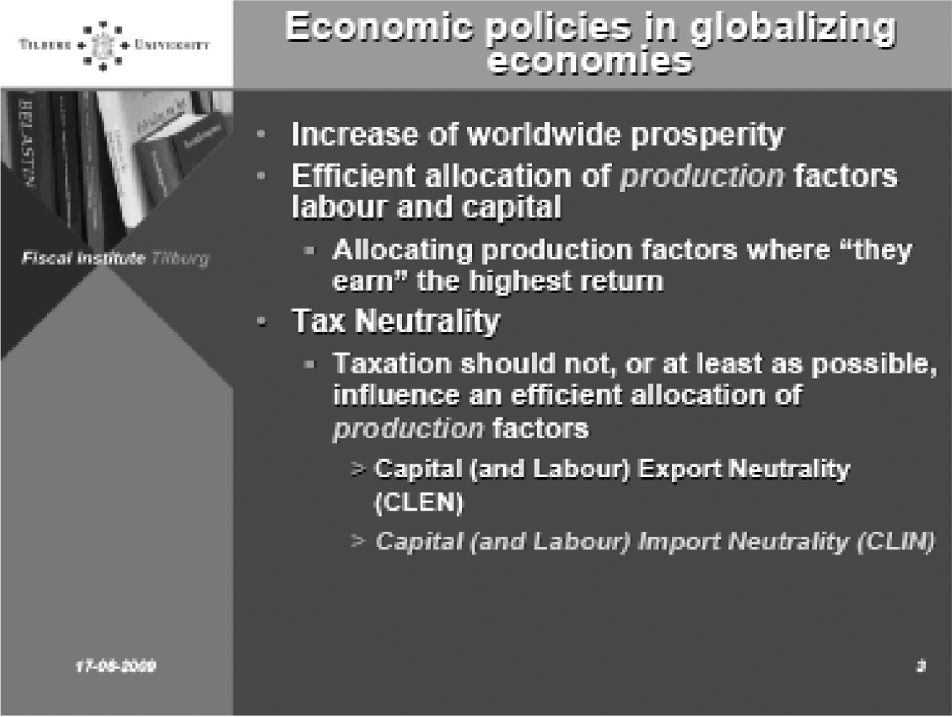
The general concept for economists is to increase worldwide prosperity as such and in a wide sense. That is obvious; that is what we all want. So, well-being and climate are also part of that. In this respect, I will focus on income taxes and profit taxes. There are environmental taxes, consumption taxes, etc. but these go beyond the scope of my contribution. However, they should be taken into account. We also have to take into account consumption taxes in the international arena, with which one predominantly taxes residents with.
An economic starting point is that production factors labour and capital should be allocated where they earn the highest return. This results in an efficient allocation of the production factors. That also implies that we need tax-neutrality. In this way taxation should not or at least as possible influence an efficient allocation of those production factors. Basically, we have two economic policies in that respect. I refer to capital and labour export neutrality (CLEN) and capital and labour import neutrality (CLIN) instead of capital export neutrality and capital import neutrality, because in these two terms the factor labour is forgotten and capital as such does not produce income. Only people produce income. That is why I include labour in it.
What is export neutrality? You could say that there is equality in the street: for a resident it should not matter whether he invests his funds at home or abroad. At the end of the day, the tax burden should be the same. That is export neutrality, equality in the street between residents. What is import neutrality? Labour and capital funds should be taxed on an equal basis where they actually operate. The market in which the entrepreneur is actually working does matter and whether he is a resident or not, should not matter. The same tax burden should apply. The same goes for employees.
At the end of the day in globalising economies only import neutrality can really play an important role and will achieve tax neutrality.

The production of income in globalising economies implies that business competes with business and not owners with owners. The same is true for employees: employees compete with employees, whether they are hired yes or no.
Residents do not compete with residents. Although they may compete with each other in the context of consumption taxes, they do not in respect of the production of income. In globalising economies, the world is the production market and not one’s home country.
That is the distinction we should make: the trade-off is not whether you invest domestically or abroad. This is still more or less the position of the Obama-administration, which it upholds in its green paper on international tax issues that was recently published. I would say it is out of date. What really matters is import neutrality because the real trade-off is whether the activity will be carried out by a foreign-based business or a domestic-based business. If you have your operations in for instance information technology, the question is not whether it will be done in Silicon Valley or in Ireland by a US firm but whether it will be done in Ireland by a US firm, a German firm or a Dutch firm. The tax rate of 12.5% may play a role here. The perspective should not be as if the US investor thinks of himself as «being the world». No, the world is the world. So, other parties will then start this business and if you have to apply a rate of 30% where competitors can apply 12.5% you will not even enter that market as an entrepreneur because your price has to make up for 17.5%. You can never do that. So, at the end of the day import neutrality is the only solution. It will increase an efficient allocation of the production factors.
From that economic perspective, we come to the next point on the slide that import neutrality supports an origin-based interpretation of the term «source».

In the discussion on allocation of tax jurisdiction you often find the terms «residence-based» and «source-based». But «source» has many, many meanings. One of them is where payment is coming from. But that does not automatically imply that there the income has been earned. For instance, a company pays dividends from the Netherlands to non-resident shareholders, but those dividends have been received from Germany or South Africa. Nevertheless, this payment is sourced to the Netherlands. But the origin of the income is not in the Netherlands. Should the Netherlands then be entitled to tax it? I would say no. That is more or less the basic idea of the principal of origin, that you allocate tax jurisdiction on income to the state where the income has been created, through substantial income producing activities, where the work is actually done. Sweat and tears of the entrepreneurs, sweat and tears of the employee! There is where the income should be taxed, within that territory.
Of course, it should be a substantial income activity and not only an occasional one. Then, it should be taxed over there. There is no reason to tax the latter, because then you do not use substantially and on a structural basis the economic infrastructure of that state and neither will it be practical. So, let’s forget about that and stick to only substantial income producing activities. When is that the case? If the activity forms an essential and significant part of the activity as a whole. Basically, that is also the idea we have included in the Double Tax Conventions as a basic principle. But the rules are not really based on them and that is the problem.

How do we see arising the avoidance of taxes? On this slide, you see a rather basic structure, also in practise. What you see is an entrepreneur is working sweat and tears. He has taken up a loan and the loan receivable is in state R. The debtor is in state O. The state of the origin is where the entrepreneur carries on his business. Often we see, also in developing states, that initially a withholding tax can be levied on the interest payment of, for instance, 30%. A number of other countries do have that as well, also within Europe. We have taken that out through EU directives which are wrong, I would say. In the example on the left hand we see that the creditor receives 70% of interest at the end of the day; a 30% withholding tax is levied in state O on the gross payment of 100.
In practice this is often called a non-tax efficient structure. That usually implies we should improve efficiency, at least tax-wise. What should we do?
In the example on the right hand, you see a structure developed in practice. You basically include a finance company in a state with which state O has concluded a Double Tax Convention, in this case state C and that this finance company can rely on the Double Tax Convention. The initial loan receivable between the creditor and the entrepreneur is transferred to the finance company, but the finance company is a poor company. It cannot pay for it, so it will be transferred against a note. The finance company itself has to pay interest to be able to buy the loan receivable from the creditor. That implies that the new creditor of the entrepreneur now is the finance company and not the original creditor, who is now the creditor of the finance company. What do we see in respect of the payment of 100 from the entrepreneur to the finance company? Based on a lot of Double Tax Conventions the withholding tax is reduced to nil. So, state O will not be entitled to any taxation anymore. In particular for developing states this implies that the tax base will be reduced tremendously. You may wonder whether that is in favour of them. I would say no.
The finance company will be taxed. It can be taxed in a high taxed country even, because the tax base will only be 100 received interest less 99 paid interest. So, the taxable base will be only 1. Even if the tax rate is 30% – like the US for instance – it is only 30% of 1, which is 0.3 and 0.3 seems to be less than 30. In this way it becomes a rather tax efficient structure, especially if the finance company pays the interest to the creditor who is taxed in the state of residence and who can benefit from a low taxation. Then, the interest will hardly be taxed in that state as well. If we look at the right hand example, the Netherlands can not only be State O, but also State C and State R. Not at the same time, of course, but it can have the three positions. When we look at the proposals of last Sunday about the interest deduction: the Secretary does not want this interest deduction, so he will take the interest deduction away from the entrepreneur. Then we are State O. But in the Tax Treaty Network, the Netherlands is often used as an intermediate holding company country and an intermediate finance company country. Then we are state C. But we are even worse if the proposal were adopted as it has been presented: the group interest box, which is a low taxation of 5% of the received interest. Normally, if you have no limitation on interest deduction it implies that interest will be deductible in other countries and it will be received in the Netherlands against a rate of 5%. Is that justified? I would say no. Is that state aid? Yes, I would say yes. I have argued this also in academic writing. We are still waiting for an answers from Brussels in that respect, but Brussels has to change its policy if it wants to accept this group interest box. In my view, it is specific state aid. In my view, as far as the policy has been developed up till now. Should we want to have such a system? Is that part of a logical tax system in the Netherlands? You might guess my answer.

As I showed you, the intermediate finance company structure was a residence-based structure in order to avoid taxes. Why should an origin-based taxation prevail? First of all – and such a taxation fits within the general topic, I think – it enhances the principle of justice. That is an overall conclusion if you assess all other elements why an origin-based taxation should prevail. Why should it prevail? Because it is in line with the ability to pay: you create wealth within a state and there it should be taxed as well. That is also closely connected to the direct benefit principle, which, in my view, is part of that ability to pay principle. If you benefit from the infrastructure of a state to increase your ability to pay, you also have to contribute to the expenses of that state. It also contributes to enhancing inter-nation equity because you tax where the income is really earned in that state. Then you can also improve the economic infrastructure over there and further economic activity. That is in the benefit for all of us. For developing states it is really rewarded to have economic activity but also for all other countries. It enhances tax neutrality. Taxes play less a role for decision making whether you invest or have activities in a country, yes or no. It also enhances also the territoriality principle, because you stick to the territory where you exercise your activities. It enhances the efficient allocation of production factors.
There are more favours. If properly implemented, it will reduce the international juridical and economic double taxation, because the income should be taxed only once and not twice. Because of double taxation a cross-border activity will not arise or will be hampered. There will also be a reduction of treaty shopping. You do not need treaty shopping devices anymore because they will not work anymore. They are unproductive. Whether they are called «abusive» or not is irrelevant then. The same is true for rule shopping, converting dividends into interest because interest is taxed at a lower effective tax rate than dividends and profits. That is not necessary anymore, because under an origin-based system you tax them in a similar way, so the tax burden will be similar. It also reduces tax fraud because the information will be directly available with the entrepreneur. In this way, the entrepreneur may deduct but he has to disclose who is his creditor. You only need one information point, so in that respect it is much easier than the Savings Directives where income flows from one country to a tax haven not disclosed, into Panama, to Bermuda, etc. At the end, there is someone in the Netherlands who has a bank account somewhere. Do we know it? We do not need it anymore under this system.

The point is of course who is the originator of the income. There you need quite a change in thinking compared to the current system. Especially in the Senate, a chambre de réflection, that should be possible.
The originator of the income is not the creditor but is the debtor, the entrepreneur working sweat and tears. Before he even makes a profit, he has to pay interest and repay the loan. What is left is for him. The same goes more or less for employees.
Where is the creditor? He can be on a sunny beach, picking up his phone «did they pay today? Yes? Ok then, give me another bottle of wine.» Is that the work? Should he be rewarded? I would say no.
There is always a close connection between the interest payments on the one side and the debt claims on the other side. The system in respect of debt claims should be similar to that of interest.
Under the origin-based system, both interest and debt claims should be allocated to the state in which the debtor actually produces the income. As a result, it will also reduce the tension between equity-financing and debt-financing. If you look at the present economic crises, you see that overloaded debt financing by hedge funds, private equity funds but also in acquisitions and group restructuring is an advantage. Often the focus is on private equity and hedge funds as if they only deploy such a system, but that is not the case. The consequence will be «more flesh on the bones» of companies and a better economic system.

The left hand side is just a copy of the sheet on the residence-based conduit but on the right hand side you see the consequences under the origin-based system. There is a shift of allocation of tax jurisdiction from state R to state O. Of the 100 interest, 99 of that income should be taxed in the state where it is actually produced by the entrepreneur. The finance company country may tax on 1, because it brings the two parties together. The financial service was just provided for that amount. What should the State of residence of the creditor do? Under the import neutrality system, the income should be exempt or at least the tax levied by state O should be taken into account. In this way, international juridical double taxation is avoided, international economic double taxation is avoided and the income is actually taxed where the income is earned. That is a sound approach, not only for developing states, but also for developed states.

In globalising economies import neutrality increases an efficient allocation of production factors. That should be the economic policy we should adhere to. Import neutrality also supports the origin-based taxation. Putting that into practice in respect of interest payments and capital gains on debt claims is, in my view, justified. It is feasible and we can make it operational without much red tape. It improves efficiency of globalising economies, it reduces tax avoidance schemes, it also improves the functioning of the internal market of the EC and it enables the developing states to reduce the gap in economic development with developed states. It will contribute to an improvement of the world-wide prosperity. What you need is co-ordination within the European Union. Tax systems should be attuned to each other and the Double Tax Conventions should be reconsidered and changed. Thank you!
(Applause)
Mr Chairman: Thank you very much! This could be a system that would help the developing countries. On the other hand we need to help these countries to apply this system. Mostly it is also a question of lack of knowledge and experienced tax administrations and tax accounting. I think this is a very good approach to determine the essence of tax planning.
Session IV Tax Planning in relation to corporate social responsibility
Speaker I: Drs. Jos Beerepoot, Head of Group Taxation, Unilever
Speaker II: Prof. Mr. Richard Happé, Professor of Tax Law, Tilburg University
Mr Beerepoot: Ladies and gentlemen. Let me first thank Professor Essers for inviting me to address you in this respectable environment regarding such a relevant topic as corporate social responsibility and taxation. As Head of Group Taxation of Unilever, one of the 100 largest multinationals on this globe, this topic indeed appeared on my radar screen frequently during the last couple of years.
My personal dealings with corporate social responsibility go back to as far as 1981, when a research fellow of the institute I worked for as a student wrote his thesis on corporate social responsibility and reporting. Together with a peer student I read the book cover to cover, chapter by chapter, heading by heading, page by page, and indeed line by line. We looked at every comma, every space, and every dot. And when we congratulated the new doctor at the reception after the defence of his thesis, he looked at us rather seriously, and he said: «Gentlemen, when I read the book myself another time to prepare for today, I still found four typing errors. Is that what I paid you for», before his face turned in a smile and he thanked us for the work done. The thesis recognised corporate social responsibility as a relevant issue and looked at the reporting consequences thereof. Today, 28 years later, both corporate social responsibility and reporting are substantial parts of the annual reports or can be found in separate reports.
The relevant question for me today is what role corporate social responsibility plays in the area of taxation. corporate social responsibility focuses really on the triangle of People, Planet and Profit. In all three areas, one can argue that taxation is relevant. It is relevant when people are paid, that is: do companies pay the tax on the income their employees earn; it is relevant when we look at the environmental consequences of the activities of companies, for example when we look at the tax effects of emission rights of CO2 – carbon dioxide – and it is relevant when we look at the tax companies pay on the profits they realise and distribute to their shareholders.
When we talk about corporate social responsibility and taxation, most participants in the discussion will focus on the third area, regarding the question whether companies pay the right amount of tax on their profits. In the United States the discussion is already somewhat older and focussed on the question whether companies pay their fair share of taxes. In the United Kingdom a discussion emerged around the issue of the so-called tax gap: do companies pay the tax they have to pay or are they successful in escaping this obligation? In the Netherlands the issue emerged last year as a consequence of articles in newspapers in which it was suggested that not all large internationally active companies pay their fair share of tax. This issue was also discussed in a hearing in parliament last year. Finally, especially from the side of NGOs, it has been suggested that multinational enterprises, which I will further refer to as MNEs, escape taxation in developing economies by using shell companies in tax havens.
I would like to note however that in information available in the United States, the United Kingdom and the Netherlands no really strong evidence or support can be found for the allegation or suggestion that large MNEs systematically do not pay their fair share of tax. Information from the United Kingdom reveals that not all MNE’s pay corporate income tax, while others do, but at the same time explains that this may be caused by the fact that they paid large sums to their underfunded pension funds, by the fact that they used old losses to offset profits for the year or by the simple fact that they realised all or a large part of their income outside the UK. A study performed in the Netherlands shows that Dutch large enterprises pay on average 26.1% tax on their profits.
To test the outcome of these studies, I would like to share some information with you that we have collected from our peer group. This information can be found in the financial statements these companies have published. I have not included the names of the individual companies, because the general trend is the most relevant information from these sheets.

On this diagram you see what may seem to you as coloured spaghetti. It really is the development of the effective tax rates of our peer group of companies. What is clear from the diagram is that there is a tendency of reducing effective tax rates during the last six years, with increased differences between the different companies. This is in line with the tendency that statutory or nominal corporate income tax rates are getting lower. This has several reasons. Not only have countries reduced their tax rates to improve the business climate, they also have made their tax systems more efficient by broadening the tax base in parallel with reducing the rates, improving compliance and with that increasing the overall level of tax collected. I also note the volatility in the rates of some companies. For example, I suspect that the tax director of the company of the light green line – which looks blue on the printed version – has had some interesting discussions with his CFO and the audit committee. It seems to suggest there is an inverted relationship between a low effective tax rate and risk.

On Sheet 2 you find the actual numbers on which the diagram is based. The numbers show that the effective tax rates are all within certain bandwidths. There is no indication to support any statement that these companies do not pay their fair share of tax or are heavily engaged in tax avoidance.
I would like to point your attention to two matters though. The first is that accounting for tax is an extremely complex area. There may therefore be differences between the effective tax rates and the tax actually paid, the cash tax. We have analysed those differences and have come to the conclusion that these differences do not change our conclusion, since there is a correlation between the effective tax rates and the cash tax, be it that for US based multinationals the cash tax may be somewhat lower due to the specifics of the US tax system, while for some companies for example the use of tax losses from old years or large contributions to pension funds – a very topical issue indeed – may distort the picture.
Secondly, I would like to point you to for example the tax rate of the company on the second line in 2008. The low rate compared to other years is caused by the fact that that company sold a substantial business in that year, and the capital gain realised – as you will find in many countries – is tax exempt.
The question is what this means for the answer on the question regarding the relationship between taxation and corporate social responsibility, now there is no clear evidence that MNEs do not take their responsibility in this area. Before I am going to address that, I wonder how Dutch based MNEs deal with the issue and whether information from these MNEs would be in line with the information I collected from our peer group. For this I reviewed the Annual Accounts of ten Dutch based MNEs listed in the AEX. I excluded real estate companies and covered the largest, but also included some of the smaller companies in the index. I looked at the effective tax rates of these companies, the cash tax paid, whether they have published a corporate social responsibility report and if so in what form and whether these include any reference to taxation. I also included a column on the impact of tax inefficiencies on the effective tax rate. These inefficiencies include the effect of the facts that not all costs are tax deductible and that some countries levy withholding taxes that cannot be reclaimed in other countries and so form an extra tax cost to companies in addition to the regular profit tax. I will come back to this matter later. I do note that my review is rather high level, and therefore indicative only.

As you can see in the first column, most companies have relatively normal effective tax rates, but I need to alert you to some issues. Company 2 has a high tax rate and high cash tax rate, since it faced a rather high non deductible charge, so reducing the reported income but not its tax burden. Company 6 faced a loss. A positive tax rate means that this company expects that it can use the loss to offset against profits from other years, but it still paid an amount of tax, hence the negative cash tax rate. Company 7 realised a loss as well, but it does not expect to be able to offset the losses against profits from other years or the loss results from non deductible charges. Companies 4 and 8 used losses from old years to reduce the tax paid, therefore their relatively low cash tax rate, while company 10 used some losses from other years not accounted for, but still paid a significant amount of tax that was outstanding. This table shows that company taxation is a complex issue, and that it is not easy to draw conclusions from just the numbers.
The third and fourth column show how these companies deal with reporting around corporate social responsibility and the role of tax therein. As you can see there are various ways companies deal with the reporting side. Some have their Sustainability Report included in the Annual Accounts, while others publish separate Sustainability or corporate social responsibility reports. Except for two cases I have not found references to Taxation in the reports. One company only includes an explanation of the tax charge, while the other refers in the report to its tax policy.
That company mentions: «In order to create and preserve value, we will seek to minimise our tax liabilities while complying with all applicable laws.» The company also mentions that it will respect international standards set by the OECD when applying transfer pricing.
I assume that most companies will have similar policy statements. Most companies will organise their business in such a way that the tax they have to pay will be minimised within the boundaries set by laws. And most companies make in their reports reference to general policy statements that they will respect the laws applicable in the countries where they are active. They usually have a Code of Business Principles to endorse this. This is all not surprising. Looking at the three Ps, Profit, Planet and People and the stakeholders, shareholders will expect companies to pay the tax they are due, but not more than that while respecting all applicable laws. When I talk to my peer tax directors about tax planning, many of them will say to me that tax planning is not their key activity, but that their key activity is to reduce tax inefficiencies. This indicates that companies will take tax as an important but not necessarily decisive factor when organising themselves, while the tax department will be focussed on reducing the tax inefficiencies accepting the way the business is organised.
I have seen three inefficiencies regularly appearing in my review: tax losses, non-deductible costs and non-creditable withholding taxes. How to deal with losses? A company expects to pay tax on the profits it realises as they are realised over the years and by the business as a whole, irrespective of where and when the profits and losses are realised. Unfortunately, the dimensions of time and place are cut into years and jurisdictions between which profits and losses cannot always be offset. As a consequence losses may go expired or unused, increasing the tax burden for companies. Companies expect that all costs they make are deductible. In reality, these deductions are often denied. Finally, withholding taxes are taxes levied from the recipient of a payment like interest or dividend but withheld on payment by the payer. One would expect that the tax authorities in the country of the recipient would give a credit for the tax withheld. That often is not the case, increasing the tax burden for companies. So, despite the efforts of companies to deal with these inefficiencies, many of them cause effective tax rates to increase. The effect can be seen in the last column. This column only shows the effect of the non deductible costs and the non creditable withholding taxes. As you can see, only in one case the inefficiencies were dealt with sufficiently; in all other cases they increase the effective tax rates, in some cases significantly.
All in all, my review confirms that there is no evidence to justify a statement that MNEs do not pay their tax; as a matter of fact it shows the opposite. It also shows that there are not many tax related indicators in the sustainability reports or sections I reviewed.

Despite this, some companies have engaged with service providers to complete so called total tax reports. These reports provide for overviews of all tax paid by companies, including taxes paid on profits and labour, VAT, custom duties etc. The question is how useful these reports really are. MNEs are active in many countries. They pay corporate income tax on the profits realised in those countries, according to the applicable laws. They pay their employees and expect these employees to pay their tax, if so required they will take action to ensure compliance. They will charge VAT or other indirect taxes to their customers and will pay the taxes collected to the authorities. They will pay interest to their creditors and dividend to their shareholders and will deduct applicable taxes from these payments. And this is all reflected in some of the sustainability or corporate social responsibility reports by providing for information on the allocation of the value created by the company over the employees, governments, creditors and shareholders. These overviews give very clear information about these allocations and enable the reader to judge their fairness, be it at a rather high level. Here I would like to refer you to a study done by Unilever and Oxfam regarding our activities in Indonesia. The study revealed that our business, which employs 5000 FTEs in Indonesia, indirectly creates more than 300 000 FTEs. This is only partly related to the tax we pay in Indonesia, the bigger picture is more important than just the tax we pay.
Whether the allocation of the value added to all the countries in which MNEs operate is appropriate is primarily a matter of efficient design and execution of tax laws in those countries. These countries all want to have a share of the pie. Companies however, do not want to pay tax on the same profits twice. Some countries are concerned that MNEs will divert profits to lower taxed countries. Although that may be a reasonable concern, it should also be noted that some countries are actively promoting their low tax rates, and then I am definitely not referring to so called tax havens, while companies should be able to apply the laws in countries to their benefit. In doing so, they will have some flexibility in reporting profits in lower taxed countries. I say some, because due to many international agreements as well as local laws, there clearly are restrictions to this flexibility.
To monitor these kinds of tax planning, the tax authorities of 35 countries are working together in the Forum of Tax Administrations. These are tax administrations from both OECD member and non OECD member countries. This forum has published a report, the so called Cape Town Declaration to fight aggressive tax planning and to improve compliance with tax laws. Aggressive tax planning according to this Forum includes planning involving a tax position that is tenable but has unintended and unexpected tax revenue consequences and taking a tax position that is favourable to the taxpayer without openly disclosing that there is uncertainty whether significant matters in the tax return accord with the law.
The compliance bit is sought to be improved by increasing transparency. This means that companies should be more transparent about their tax affairs. Moreover, there have been attempts to increase the level of engagement of boards of companies with the tax matters of the companies. We support those initiatives. The Audit Committee of the Unilever Board has reviewed the tax policy and strategy, while the Financial Director has signed a compliance agreement with the Dutch tax authorities. The company will actively inform the Dutch tax authorities about its tax risks, while the tax authorities will support the company in identifying those risks by actively giving views on fact patterns the company plans to implement, reducing uncertainty. It is this kind of co-operation that we fully support. I do note however, that this will not keep us from taking positions we believe are supported by the laws of the countries in which we operate, but we will not conceal these positions. We advocate transparency. We expect to be treated fair.
As I have explained there is no foundation for allegations or suggestions that MNEs systematically avoid taxation. From publications I have read over the last years it appears to me that not everybody agrees. On one matter I believe however everybody does agree. Many issues would be resolved if there would be a global tax system, because many of the issues that either reduce or increase effective tax rates are connected to cross border dealings. Unfortunately, there is not such a system. The EU is as a matter of fact struggling to get a consolidated base taxation introduced just in Europe, so it is a dream to have a global tax system introduced ever. We should however not stop dreaming or imagining. Like John Lennon sang: «Imagine there’s no countries, it isn’t hard to do» ... and «you may say that I am a dreamer, but I am not the only one, I hope someday you’ll join us and the world will be as one.»
Ladies and gentlemen, please allow me to say that Unilever is proud to be the no. 1 in the Dow Jones Sustainability index for the Food sector for ten straight years. Our former Chairman and CEO Mr Antony Burgmans advised the Dutch government that reporting on corporate social responsibility should be extended to all companies employing over 50 personnel, on the basis of the comply or explain rule. In this context we have been advocating for a consolidated tax base in Europe since the early nineties of the last century, and we will continue to do so. We also would be in favour of a global tax system if that would be an efficient and fair system. We are in favour of transparency towards tax authorities and of including information on the tax position in the sustainability report, as long as that is on an aggregate level. Our mantra is «doing well by doing good». We show willingness to act as agent for social and environmental improvement.
As you know this is called a symposium. According to the Oxford Dictionary one explanation of the word is that a symposium is a drinking party with intellectual debate and music. I have tried to contribute to the intellectual debate and I have referred to the music, and conclude that with this we are also closer to the drinking part. Thank you very much for your attention.
(Applause)
Mr Chairman: Jos, thank you very much! You have shown that reality has many colours. We have national tax systems, national tax administrations. You are the representative of a multinational firm. What could be considered by an individual national tax inspector as tax avoidance could be seen by a multinational enterprise as avoiding double taxation. There you see the problem we face.
The question where is the equilibrium. This topic will be addressed by Professor Richard Happé of the University of Tilburg. Richard, the floor is yours!

Mr Happé: Thank you, Mr Chairman and thank you for the invitation to speak here on the subject of corporate social responsibility.
Tax planning and corporate social responsibility are examples of an ongoing debate nowadays. The credit crunch has made the tension between personal interest on the one hand and the common good on the other hand very evident. What are the limits of the market? What is the impact of our ethical responsibility? Let us try to explore this with respect to international tax planning.

Multinationals are by definition global players. Also by definition, multinationals have to deal with many different tax systems. It is almost impossible to imagine an activity which is not, directly or indirectly, related to tax. The complexity of the world of an average multinational with its hundreds of subsidiaries all over the world is reflected in the complexity of its tax planning.
The function of tax planning is to pay no more tax than necessary, to avoid double taxation, to get tax advantages that the different countries offer, and so on. Tax planning is both an indispensable and a very complicated instrument. It is crucial for a multinational to function well.
Tax planning practice has undergone an explosive development since the 1970s. More and more the predominant goal is keeping the tax burden to a minimum. In some areas of the tax market this practice has also led to an aggressive form of tax planning. As a result, to a certain extent tax planning is gradually becoming a form of engineering. And complexity and lack of transparency are the main characteristics of the schemes used. For tax inspectors extremely difficult to unravel, for the public completely incomprehensible.
I will mention some of the techniques to reduce tax burdens.
First of all there are the fraus legis-type schemes that push the limits of legislation. Anything is allowed as long as a taxpayer complies with the letter of the law. The spirit of the law is less important.
Secondly, the use of tax havens. The art is to shift deductions to countries with relatively high tax rates and drop profits in countries with low tax rates.
Finally, the phenomenon of cross-border tax arbitrage: the search for so-called mismatches between the various tax systems. A well-known example is the «double dip» schemes. Summarized in the words of David Rosenbloom: «One airplane, two owners, and two sets of deductions».
The implicit idea underlying such practices is that tax law amounts to nothing more than a «bunch of rules» used for «gaming the system». As I said before, to get the effective tax burden as low as possible. Already in 2001, subsidiaries in the top 11 tax havens accounted for 46% of foreign profits of US companies. John Braithwaite has pointed out that for years some of the largest enterprises in the United States paid little or no corporation tax. As you see, aggressive tax planning is big business and has to be taken very seriously. It costs the countries huge amounts of tax money.

But now the countervailing power: corporate social responsibility. Nowadays – Jos Beerepoot made that very clear – no enterprise can afford to pay no attention to matters as human rights and sustainability. A current example is the compensation of USD 15.5 million Shell paid to the relatives of the victims of oil-pollution in Nigeria, the so-called Ken Wiwa-case. In general, every multinational has to pay attention to sustainability.
Corporate social responsibility is not something additional, something extra for companies. It belongs to the core strategy of every company. You can compare it with a car; it is not only the engine, its power and maximum speed that matter, also the way somebody drives his car matters. Does he take a lot of risks; does he inflict damage to others by his way of driving? So for a company it is not only maximizing its profit which matters. Doing business is no longer a one-dimensional but a multi-dimensional activity. In this context corporate social responsibility speaks of the «triple bottom line»: how does business take account of its social, environmental and economic impacts on society?
Let me focus on the third aspect, the economic bottom line. What is at stake here, is the tension between the short term interest and the long term interest of the company and its stakeholders: fair trade, where to locate the company’s activities and so on. There is more than maximizing its profit.
Until now I did not mention «tax». We have seen that in the one-dimension view it is the one and only goal of the company to pay as little tax as possible. What has social responsibility to say about this aggressive tax planning practice? Is there a bottom line in the amount of tax to be paid?
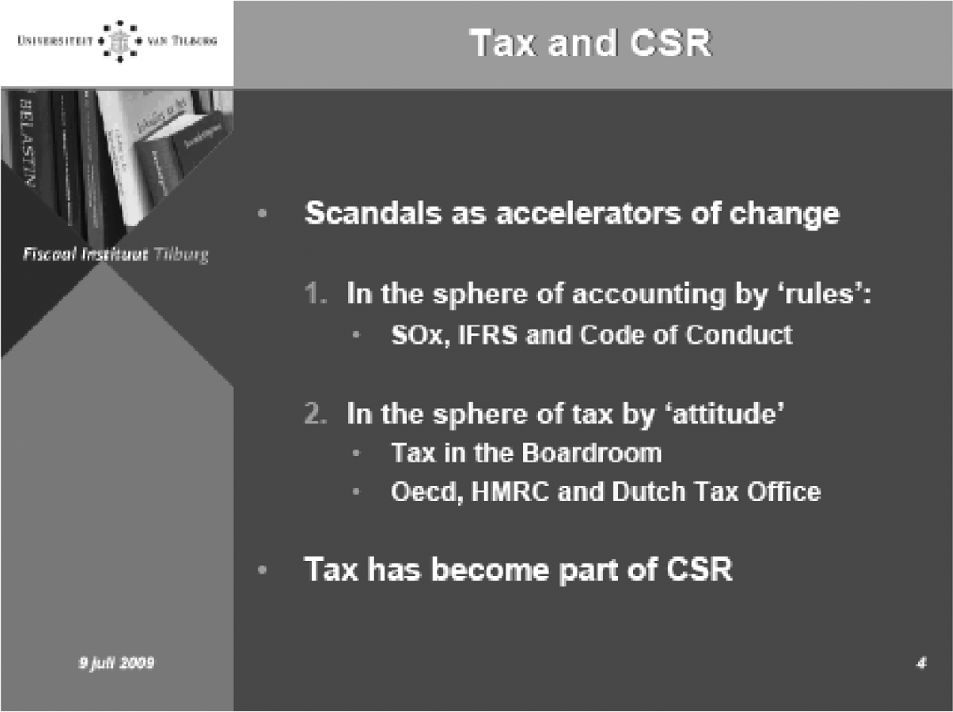
At the beginning of this century scandals caused a mayor change in thinking about accounting and tax planning. First, there were the accounting scandals. In 2002 the Enron bankruptcy happened, leading also to the fall of Arthur Andersen, the then world’s biggest accounting firm. WorldCom and Parmalat, to mention only a few, have gone similar paths.
In order to restore trust, the Sarbanes-Oxley Act and IFRS were introduced. Corporate governance became the focal issue: how should large corporations be managed well, both efficiently and responsibly? And how should companies manage their social responsibility? Restoring trust chiefly by means of rules.

How is it with the world of aggressive tax planning? Also the tax consultancy world has been in the firing line. KPMG-US, for instance, narrowly escaped the same fate as Arthur Andersen. These scandals also resulted in a process of heightened awareness and reflection. In 2004 KPMG published a very influential paper «Tax in the Boardroom». The message was tax risk management. A company has to recognise its tax risks in time and to control them adequately. It has to do that effectively and, where possible, pro-actively. The measure of tax planning is the responsibility of the board. And, remarkably, the issue of «fair share» of taxes was mentioned. In a following discussion paper, The Governance of Tax (2006) the topic returns more explicit in terms of the «fairness of tax planning». Different research reports, for example by Henderson and PWC, show that many companies are becoming, on the one hand, more conservative in matters of tax planning and, on the other hand, more open to the authorities and the public.
Also the OECD and tax administrations have gone along with that development and have put good tax governance on the agenda. I mention The Cape Town Conference of 2008, where the topic of the so-called «enhanced relationship» was the central issue. The papers of this conference underline that tax planning is more than a technical issue. It has an intrinsic connection with reputation and responsibility of the taxpayers. As a result, countries put the large companies under pressure to take good tax governance more seriously than before.

Evidently, tax has become a part of corporate social responsibility.
The time is past that tax planning can be done in a one-dimensional way. The social and ethical aspects of tax strategy have to be taken into account. Multinationals must realise that ignoring these aspects is also an ethical position and a vulnerable one.
What does corporate social responsibility in taxation mean? It means both compliance with the law and paying your fair share, just as is expected from others. In a society each member has to contribute his fair share; that is what people expect from each other, also from large companies.

We will discuss this in relation to two stakeholders: society – the other taxpayers – and the Tax Administration. And we will discriminate between two levels: the effective tax burden and the concrete tax schemes.
First, society, the other taxpayer. There is an increasing interest of the media and the public for large enterprises concerning tax. People want to know how much tax they pay and how smart they are in avoiding tax. There is a growing feeling, right or wrong, that the large companies do not pay their fair share. And a fair share is what the public expects. That is the point large companies have to realise. In this context the role of the media is extremely important. They are the eyes of the public. Currently, the Guardian has started publications under the title «Tax Gap». To say it in a neutral way, the series is a success. I will give some highlights.
First about the effective tax burden. «Almost a third of the UK’s 700 largest firms paid no corporation tax in 2006.» «From the 100 largest companies only two offered a response how much corporation tax they paid in the UK and only one gave an answer about its attitude to tax planning.» The Guardian concluded that they hide themselves behind a veil of secrecy and complexity.
And in terms of fair share: «2.4 million households – a tenth of all those in Britain – are paying over their entire annual income tax just to plug the gap left by the legal manoeuvres of big corporations.»
Now about tax schemes. The Guardian discovered, with the help of a whistleblower, an avoiding scheme, applied by Barclays. The tax interest is hundreds of millions of pounds. The scheme has made use of Cayman Islands companies, US partnerships and Luxembourg subsidiaries. Instead of being transparent the Bank chose to sue the Guardian to prevent the publication of the documents that were already published elsewhere on the internet. But the negative publicity for Barclays is enormous.
What the Guardian discloses is a world of complexity and lack of transparency, a reluctance of companies to give information and to discuss matters.
Of course, it is difficult to defend yourself against such publications, but I think the worst thing you can do, is saying to the media and the public: «We do not want to comment on the article. I do not see what we would gain by doing that», as did the spokesman of another company to The Guardian.
I believe that in the Netherlands, in general, more and more large companies have a different attitude. Many large companies are working at an explicit tax strategy and are more restrained in their tax planning than before. It suffices to refer to the Dutch enforcement agreements. In general, it is very important that these companies take a proactive attitude to inform the public. Let me now turn to the other stakeholder, the tax authority.

I think it is self-evident that taxpayers have to be compliant. There is no discussion about that. So let us focus on fair share. What does «fair share» mean in this legal context, so in the relationship with the tax inspector?
First of all, in the context of tax planning – the dealing between the tax inspector and the tax payer – we have to substitute the spirit of the law for fair share. In other words, the legal concept must be substituted by the social and ethical one. The taxpayer must fulfil the obligation that his tax schemes must not only meet the letter of the law, but also the spirit of the law. Within the rule of law, fair share is not a relevant term in the relationship with the tax inspector. In principal, «fair share» is translated by the legislator in legal terms.
Furthermore, the second interest in the relationship with the tax inspector is: what is the aggregate impact of the tax planning activities on the effective tax burden? If a profitable company doesn’t pay corporation tax at all, this is a sign the company doesn’t take its fair share seriously. Situations in which the public would be indignant, if they knew. In the Netherlands we have to think about situations like PCM, Hema and Stork. Now preparations are being made to plug that gap in the tax legislation.
What must be the reaction of the tax inspector? A reaction in terms of the rule of law, one in terms of proportionality. This means supervision activities by the tax inspector. A company with a lot of aggressive tax planning asks for a lot of corresponding supervision. On the other hand, a company with a cooperative attitude is the ideal partner to conclude an enforcement agreement with the tax office. In the vocabulary of corporate social responsibility, which is not the language of the tax inspector but of the public and politics, the concept of fair share must be recognisable.
It is also clear in this framework that the large company has to determine its attitude to tax planning; whether it wants to choose for a restrained or a «creative» attitude to legislation, for a cooperative or an aggressive attitude to the tax inspector.
I return to my example of participating with your car in traffic. How do you drive? As fast as possible or do you also take into account the interests of the other participants? So it is with tax planning. For the answer on the underlying ethical problem Aristotle, the famous Greek philosopher, gave a wise advice:
«A temperate human being (large company) holds a position between these things.» And I add: and pays his fair share. Thank you!
(Applause)
Mr Chairman: Richard, thank you very much for this introduction in tax philosophy!
DISCUSSION
Mr Chairman: We still have some times for questions and discussion. First, I would like to give the floor to the Senators.
Mrs Vedder (Senator CDA): Systems are useless if they cannot be implemented. That was one of the remarks. When the government of a developing country is not strong, how can it implement a good tax system? When they can and will do it is this tax money used to develop the country or the people or is it used to favour a small group? Should we not help them not only to implement a tax system or a rule of law but also help them to develop their government?
Mr Elzinga (Senator SP): I have a few very short questions. Professor Mestrum addressed the consequences of tax avoidance for the developing world. As a Dutch Senator I am interested in the Dutch role that is played there. Before the break, Mr Hollander showed us the huge role SFIs play in our outgoing foreign direct investments. I would like to know from Mr Hollander how our tax system relates to the subject of tax avoidance. How could corporate social responsibility solve this specific problem according to Professor Happé? Would anti-abuse legislation solve the problem? Finally, what do we have to refer to origin-based taxation, as was mentioned this afternoon? What does Unilever think about this suggestion as an alternative to world tax?
Mr Reuten (Senator SP): I have three questions. I would like ask the addressants if they can answer these questions in one sentence. First Professor Kemmeren: what do you consider yourself as the main perhaps political hurdle for your proposal? My question to Mr Beerepoot is whether he believes or has evidence that multinational companies pay relatively more taxes than local companies on an average relevant sample. I would like to ask Professor Happé whether his idea of tax payments in the spirit of the law – which I think is very interesting, but I am an economist – is an ethical statement or whether he believes this could be implemented juridically.
Mr Chairman: Let us answer these questions first, otherwise I might forget them.
Mrs Mestrum (panel): To answer the first question by Mrs Vedder I must say there sure are problems at many different levels in developing countries. On the other hand I would not underestimate the capacities that are there. It is not that they are absolutely unable to do whatever is right for their countries; they do have capacities. Yes, we may help them though I think that it is less a matter of help than a matter of democracy. It is their own population that have to pressure their governments, their administrations for having right and decent systems. That is the only sustainable way to solve these problems in a sustainable way. So yes, we may help them with some capacity but the main point is that these countries need good and democratic systems, so that their governments are accountable. There is a need for pressure on these governments and these administrations.
Mr Chairman: We had a few questions by Tuur Elzinga. One of them was addressed to Albert Hollander about the relationship between the tax system and tax avoidance. How do you see that?
Mr Hollander (panel): I am convinced that the Dutch tax system provides the possibility for tax avoidance and the Netherlands should take responsibility for that aspect of their own tax system. The way I understand the official standpoint of the State Secretary is that he wants to take responsibility for that aspect. He can do that by explaining that he does not want out tax system to be abused, but of course the difficulty is to determine what abuse is and what not. The only way to find that out is to encourage companies to implement legislation that makes it necessary for companies to be transparent about that. I am very happy to hear that Mr. Beerepoot supports that as a multinational company. Only based on the information that we can get out of companies as to how they react to the tax system of countries we can have a global discussion on these issues.
Mr Chairman: Another interesting question was what is the opinion of a company like Unilever towards an origin-based taxation system in which for instance you do not tax the interest in the country where the creditor is but in the creditor where the debtor is. I use general terms but that is one of the aspects.
Mr Beerepoot (panel): I would not be overenthusiastic about it because you would face a lot of other complexities. The operation is not always in one place; you can have sourcing units and marketing and sales organisations in different countries, as in our case. This would not solve some of the problems like transfer prices issues, etc. A second disadvantage is that it looks like a development into a global tax system based on factor, which I believe would not be in balance. These are two disadvantages that jump to my mind. I would rather see the solution in an improved international cooperation. That would help more. There is one remark I would like to make about the presentation of Professor Kemmeren and that is that instead of having less treaties we should have more treaties. That will really lead us into the way of solving problems.
Mr Chairman: Then we had questions by Geert Reuten who is asking for one-line answers. One of the questions relates to the answer given by Jos Beerepoot and was asked to Eric Kemmeren: what might be obstacles to achieve this origin-based taxation system?
Mr Kemmeren (panel): I would say there are two main issues. There is a lack of political sense of urgency and a lack of consistency in tax policy. We can see that in the Dutch proposal that was handed out Sunday night: on the one hand you see the Netherlands should be attractive: a group interest box with a 5% tax rate on received interest overall and on the other hand the limitation of the reduction of interest. On the one hand, the Netherlands wants to be pretty and beautiful for the rest of the world, whereas on the other hand, in respect of the interest paid, the Netherlands puts its foot on the brake and says: «no deduction». That is a problem. But it may change and that depends on the political environment and maybe also on the economic crises. Pascal has showed us how things can change quickly if the sense of urgency is there. We have seen that in the context of bank secrecy issues. Within four to five weeks, the world has really changed. If the idea is, there is much to gain, also from a budget perspective, there may be a change. Such a change needs political cooperation. In this context, Europe is on the table and should be on the table. That is one of the good things of the brochure of the Senate, because it explicitly refers to Europe.
Mr Chairman: Another question was addressed to Professor Happé. How does your appeal towards paying a fair share relate to legislation?
Mr Happé (panel): It was a short question and I was asked for a short answer. Of course, it deserves an extensive answer, but for that there is no time. In the context of my speech I was talking about «the spirit of the law» as the goal of the legislation. We have to find this goal in the preliminary deliberations of the legislator. It is absolutely necessary for the legislator to pay more attention to the goal of the provisions. That will be an enormous help for the tax judge. If the goal of the law is unclear or vague, the tax judge has often no other choice than to stick to the letter of the law. And that is very often advantageous for the tax planners and their schemes.
Mr Chairman: So it is in our hands to specify the spirit of the law.
Mr van Hees (Oxfam Novib): I have two points. The first is a call upon the Senate to sit together with their colleagues in the Second Chamber to look at the text from the Dutch co-drafter of the UN Senate on the financial crisis of 24th-26th June and in their capacity of member of the G20. I would like them to use both capacities to look into the draft the Netherlands are responsible for. This draft will be presented at the next summit. This draft hardly contains any of the reasonable proposals by the commission on taxes. I cannot go into detail now but I hope it will be discussed by the Second Chamber before the summit. So, there might be an opportunity to address that.
Secondly, as a student I was a researcher in Mexico in the 1970s. I was studying Dutch investments there. We look into the intracompany trade transfer of technology with Philips and other Dutch companies. The major response we had from Philips and other transnational company representatives when we addressed the problem of transfer pricing and mispricing was that they complied with the applicable law in the respective countries. Since the 1970s that is the answer that has been given on this problem. So, I have some distrust when I hear that argument in a debate.
Mr Chairman: I think we are running out of time. We only have time for the one million dollar question. If you have it you will get the floor!
Mr Neve (Neve Belastingadviseurs): We spoke about capital export neutrality but the Dutch tax system promotes tax avoidance by the participation exemption for active income realised outside the Netherlands. We have deleted the subject of tax requirement. Now, all companies who do business in tax havens have a tax exemption because they only need to do active business to qualify for participation exemption. In the finance world all major banks have their finance companies and aircraft leasing companies outside of the Netherlands in these famous tax havens. This has the consequence that those profits are not subject to tax in the Netherlands. The same applies to the United States. Since the United States introduced Sub-part F also for finance activities the tax havens took off enormously. Bermuda is no. 1 in insurance because US companies are now allowed to set up shop in Bermuda. If the United States and Senate allow to do business in tax havens what are we talking about today?
Mr Chairman: So, should we not change the exemption system into a credit system? Should we not change capital import neutrality into capital export neutrality?
Mr Neve (Neve Belastingadviseurs): No, export neutrality into import neutrality!
Mr Chairman: We have capital import neutrality and that is leading to the exemption method. If you have capital export neutrality your own tax system is the basis for taxation. You can only get a credit for foreign tax.
Mr Neve (Neve Belastingadviseurs): The UK have changed from the credit system to an exemption system because it was disadvantageous for them in an environment where everybody has an exemption system.
Mr Kemmeren: You will not be surprised that I fully disagree with your proposal to change to an export neutrality system. Then you are taxing a resident similar to a resident. You should tax the activity where the activity is really carried out. If that happens at a low tax rate, this is not a problem if that rate is generally applied. A state may design its own tax system. If it wants to put less emphasis on corporate income tax, income tax or labour tax and more on green taxes it should be free to do so. But there should not be a special regime that is ringfenced and that is, like in a number of tax havens, only available for tax haven companies that are not really active over there, that have no bricks and mortar. If that is the case then we have a problem. But if it is a generally applied 12.5%, as in Ireland for instance, it is a choice for Ireland to make. If you are active in Ireland in IT or in actual finance services these should be taxed in Ireland and not, for instance, in the US at a rate of 30%. The activity is not carried out in the US, so you do not benefit from the infrastructure to produce your income in the US. You benefit from the infrastructure in Ireland, so there you should contribute to the budget and not to that of the US. That is not unfair competition; that is fair competition.
Mr Chairman: I am sure you would like to reply but there is a possibility to continue the discussion while we have our drinks.
I would like to conclude this symposium. I would like to thank you very much for your attendance. I would like to thank the audience and the students. They were not in a position to ask questions but I am sure they will come in the near future. They have the future to develop a new system.
Of course, there would not be a symposium without speakers. I would like to thank them very cordially. As a symbol of our appreciation we would like to give them a small present.
(Applause)
Also on behalf of Tuur Elzinga I would like to thank the supporting staff of the Senate very much, because they have done a tremendous job. For the records that will be there for centuries to go I will mention their names: Paul Breitbarth, Marjolein Rijs, Hester Menninga, Kees Oudshoorn, Ton van Bokhoven, Fieke Kal, Peter Kranendonk, Sunita Jainandunsing and Jurjen Bügel. Thank you very much!
Kopieer de link naar uw clipboard
https://zoek.officielebekendmakingen.nl/kst-20092010-31700-IXB-E.html
De hier aangeboden pdf-bestanden van het Staatsblad, Staatscourant, Tractatenblad, provinciaal blad, gemeenteblad, waterschapsblad en blad gemeenschappelijke regeling vormen de formele bekendmakingen in de zin van de Bekendmakingswet en de Rijkswet goedkeuring en bekendmaking verdragen voor zover ze na 1 juli 2009 zijn uitgegeven. Voor pdf-publicaties van vóór deze datum geldt dat alleen de in papieren vorm uitgegeven bladen formele status hebben; de hier aangeboden elektronische versies daarvan worden bij wijze van service aangeboden.
 Authentieke versie (PDF)
 Informatie
 Gerelateerd
 Printen
 Delen
Delen